anaheim-gazette 1951-05-07
Scanned page
Searchable text
Land on Which Anaheim Stands Sold for $2 per Acre in 1850's a group of most interested in promotion of Anaheim, "home on the Sar
Land on Which Anaheim Stands Sold for $2 per Acre in 1850
In the early 1850's a group of Germans met in San Francisco for the purpose of establishing a center of agriculture some place in California. They had noticed that much of the state's produce was imported from great distances; wheat from Chile, ice from Alaska, lumber from the Orient, and manufactured goods from the eastern states.
They were particularly interested that most of California's wines were imported from great distances to be consumed in the mining camps and the boom towns. They proposed to begin the production of native wines on a commercial scale.
George Hansen, one of the men most interested in promotion of this project, was appointed to investigate suitable sites for the proposed colony.
Believing Southern California offered the greatest chance for success in this enterprise, Hansen visited the ranch of Juan Pacifico Ontiveras on the San Juan Cajon de Santa Ana tract.
He was impressed by the success of the vineyards on the Ontiveras holdings. He returned to San Francisco, recommending the colonists to purchase 1165 acres on the Santa Ana at a price of $2.00 per acre.
Before leaving San Francisco, the owners met to decide on a name for the colony. The name, Anaheim, "home on the San Ana" was chosen, winning by single vote over the name Angela.
Although incorporated in 1858, actual settlement by the colonis began in 1858, as family groups Property owners of the vineyard tracts in 1860 included the families of Wenzel, Rust, Sholl, Brememan, Hoelscher, Himmelman, Hammes, Kuchel, Muse, Rehbach, Schenk, Mosseman, Hittell, Kelle-Schmidt, Rooch, Cramer, Kroegel-Zeyn, Luedke, Matz, Newhauser-Fischer, Podderatz, Sturenben von Guelpen, Jaszynsky, Hurboldt, Poppe, Andres, Reside-Kuelp, Beythlen, Hansen, Bachman, Bach, Boege and Werder.
E. A. SILZLE CORPORATION
PIONEER
E. A. SILZLE CORPORATION
PIONEER
PACKERS
of
• CITRUS JUICES
• CONCENTRATES
—and—
• ESSENTIAL OILS
212 S. Atchinson St.
Anaheim
Phone 2268
With Pleasure . . .
We congratulate the Anzette on the celebration of year of publishing and p vice in Anaheim . . . and Anniversary as a daily.
We thank them for their port of the interests of the dustry . . . which has al a vital backlog to the Anaheim.
per Acre in 1859 — 1,250,000 Gallons of Wine Produced Here in 1884
Super Acre in 1859 — 1,250,000 Gallons of Wine Produced Here in 1884
Tim, "home on the Santa must have been a shock to the new owners, the barren, sandy soil of Anaheim, with its ditches, its inadequate willow fences, acres of tiny vine cuttings only slightly leafed out, and a few wooden shacks.
The nearest center of trade was a day's journey away at Los Angeles. Roads were deep in dust, and of necessity were bordered by irrigation ditches.
One of the most difficult problems at Anaheim was the water supply. There was either too much, or not enough. The high water of 1862 nearly put an end to the whole settlement.
A second, and possibly more serious threat, came from insufficient winter rain, and periods of acute droughts during the summer when surface streams ran dry and ground water sank to low levels in the wells.
Low dams were constructed, and numerous pumped wells, providing an adequate flow of water, were installed.
The grape cuttings thrived in the fertile sandy soils and gravels; the first crops were harvested, and wineries were built.
Anaheim wines were not admired at first by Californians, but the residents of the town were so persistent in improving the quality that eventually, the Anaheim wine became favorably known.
On the whole business prospered. Other towns were built in the vicinity. The Mexican ranchos were divided into small land and sold for farm lands.
Agriculture became more diversified. All signs indicated a manent and prosperous existence for the residents. Production Anahelm wines increased from 000 gallons in 1861 to 1,250 gallons in 1884.
In 1884, on the lower ground the southwestern part of the town a vine disease of mysterious origin began to kill the vineyard. Within three years it spread throughout the entire settlement. By 1891, only 14 acres of the original acres of plantings remained Anaheim.
After some experimentation variety of orange was found readily marketable, the Valencia.
WE ARE EXCLUSIVE
for th
35 FOOT VIKING
Custom Cruiser
Complete with bath,
electric refrigeration and
island bed . . $4,195
Also D
PAN A
TERRA-CRUIS
MANY GOOD BUY
FAIRBAIRN T
1108 S. SPADRA
(Just North of O
in 1884
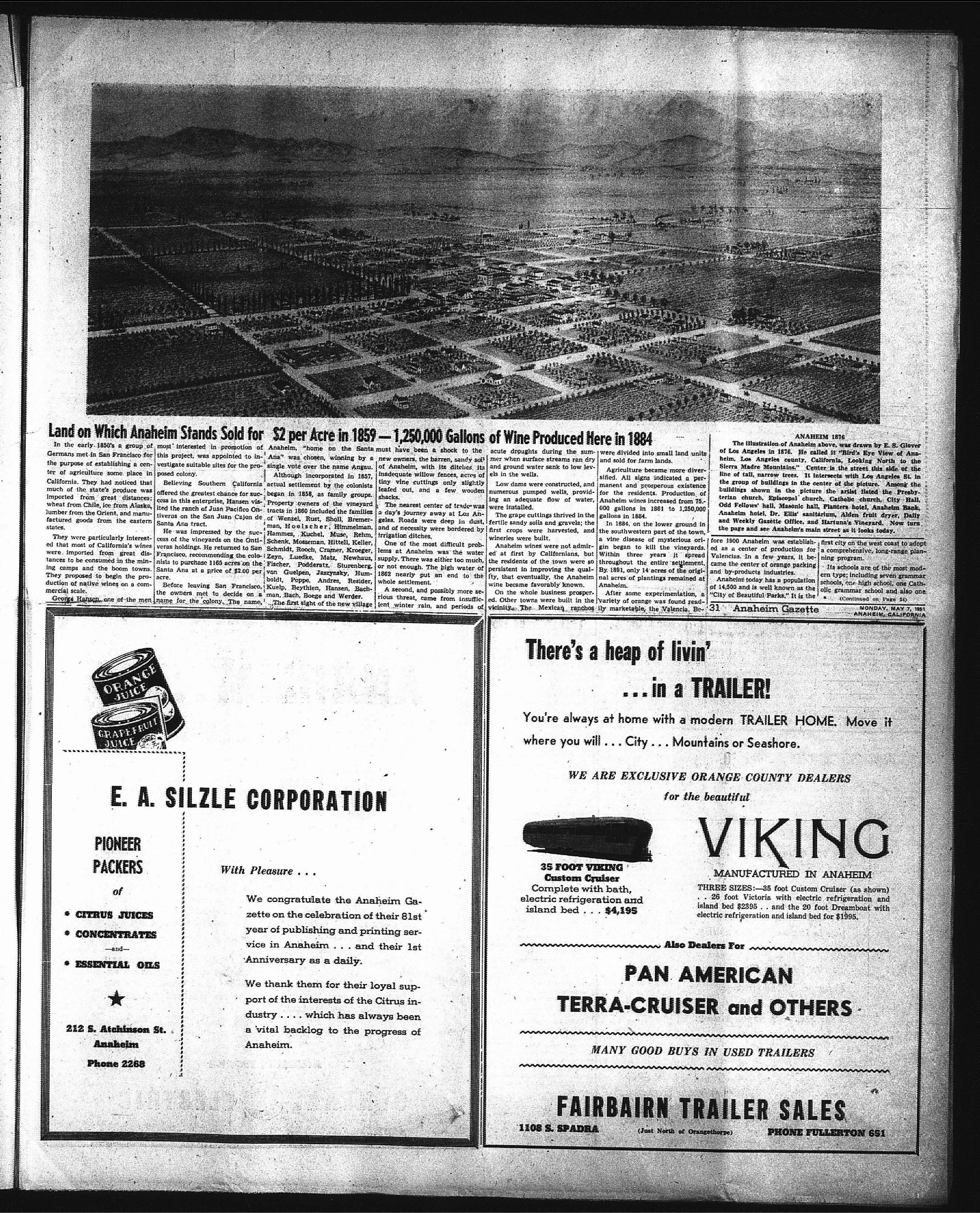
ANAHEIM 1876
The illustration of Anaheim above, was drawn by E. S. Glover
of Los Angeles in 1876. He called it "Bird's Eye View of Ana
in 1884
divided into small land units sold for farm lands.
Agriculture became more diversified. All signs indicated a permanent and prosperous existence for the residents. Production of hemlm wines increased from 75-gallons in 1861 to 1,250,000 gals in 1884.
1884, on the lower ground in southwestern part of the town, the disease of mysterious ori-began to kill the vineyards. In three years it spread throughout the entire settlement, 1891, only 14 acres of the original acres of plantings remained at hemlm.
After some experimentation, a city of orange was found read-marketable, the Valencia.
ANAHEIM 1876
The illustration of Anaheim above, was drawn by E. S. Glover of Los Angeles in 1876. He called it "Bird's Eye View of Ana-helm, Los Angeles county, California, Looking North to the Sierra Madre Mountains." Center is the street this side of the line of tall, narrow trees. It intersects with Los Angeles St. in the group of buildings in the center of the picture. Among the buildings shown in the picture the artist listed the Presbyterian church, Episcopal church, Catholic church, City Hall, Odd Fellows' hall, Masonic hall, Planters hotel, Anaheim Bank, Anaheim hotel, Dr. Ellis' sanitarium, Alden fruit dryer, Daily and Weekly Gazette Office, and Hartuna's Vineyard. Now turn the page and see Anaheim's main street as it looks today.
fore 1900 Anaheim was established as a center of production for Valencias. In a few years, it became the center of orange packing and by-product industries.
Anaheim today has a population of 14,500 and is well known as the "City of Beautiful Parks." It is the first city on the west coast to adopt a comprehensive, long-range planning program.
Its schools are of the most modern type; including seven grammar schools, one high school, one Catholic grammar school and also one (Continued on Page 34)
31 Anaheim Gazette
MONDAY, MAY 7, 1951
ANAHEIM, CALIFORNIA
eap of livin'
...in a TRAILER!
home with a modern TRAILER HOME. Move it
. City ... Mountains or Seashore.
EXCLUSIVE ORANGE COUNTY DEALERS
for the beautiful
VIKING
EXCLUSIVE ORANGE COUNTY DEALERS
for the beautiful
VIKING
MANUFACTURED IN ANAHEIM
THREE SIZES:—35 foot Custom Cruiser (as shown)
... 26 foot Victoria with electric refrigeration and island bed $2395 ... and the 20 foot Dreamboat with electric refrigeration and island bed for $1995.
Also Dealers For
PAN AMERICAN
A-CRUISER and OTHERS
NY GOOD BUYS IN USED TRAILERS
BAIRN TRAILER SALES
(Just North of Orangethorpe)
PHONE FULLERTON 651