anaheim-gazette 1950-11-29
Scanned page
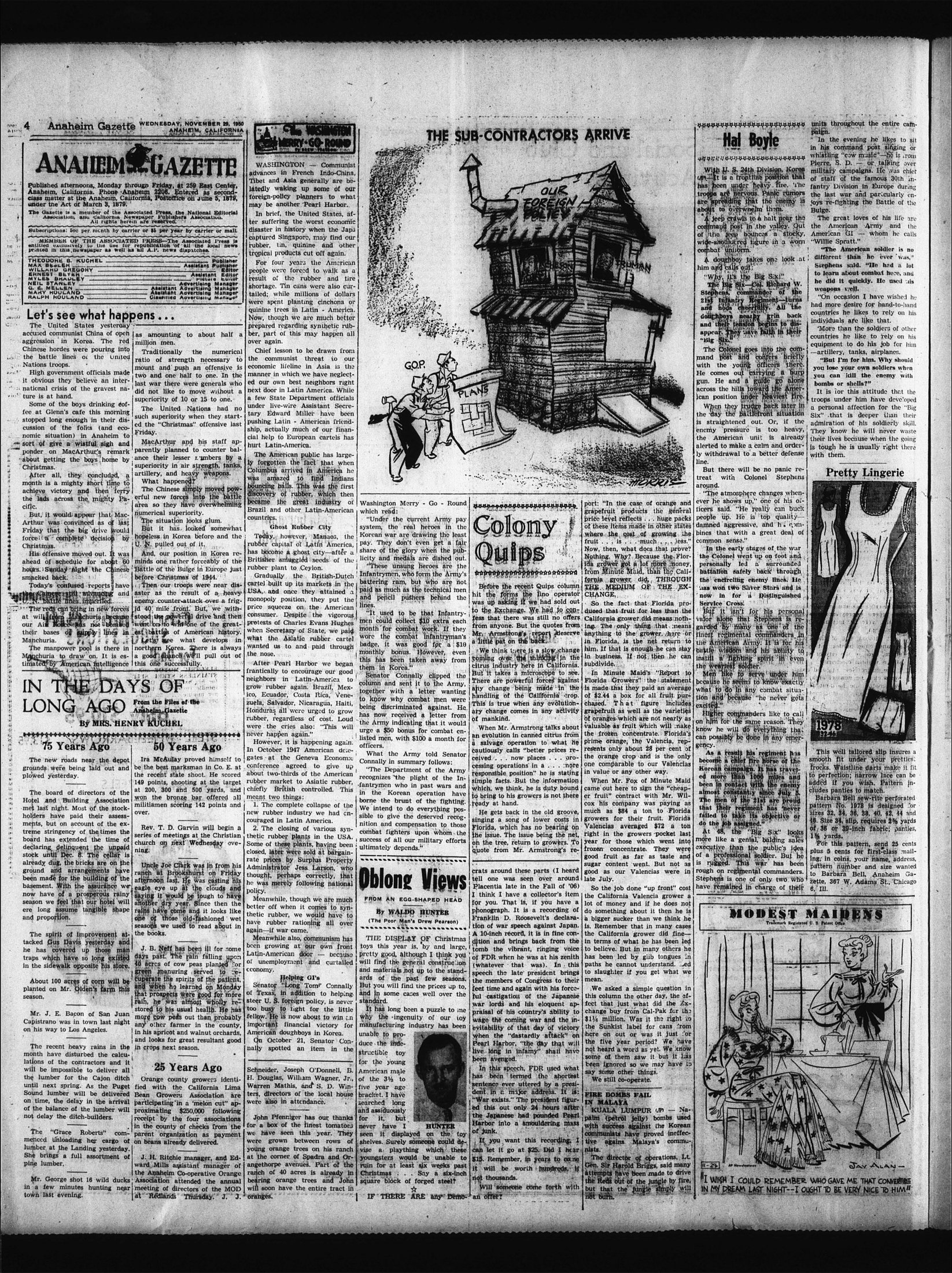
Searchable text
4 Anaheim Gazette WEDNESDAY, NOVEMBER 29, 1950
ANAHEIM, CALIFORNIA
ANAIIEM GAZETTE
Published afternoons, Monday through Friday, at 259 East Center,
Anaheim, California. Phone: Anaheim 2206. Entered as second-class matter at the Anaheim, California, Postoffice on June 5, 1879,
under the Act of March 3, 1879.
The Gazette is a member of the Associated Press, the National Editorial Association, and California Newspaper Publishers Association. All rights herein are reserved.
Subscriptions: $0 per month by carrier or $5 per year by carrier or mail.
MEMBER OF THE ASSOCIATED PRESS—The Associated Press is entitled exclusively to the use for republication of all the local news printed in this newspaper as well as all A.P. news dispatches.
THEODORE B. KUCHEL Publisher
MAX BESLEH Assistant Publisher
WILLAND GREGORY Editor
ERNEST BEYER Assistant Editor
MYLES BRADLEY Mistle Editor
NEIL STANLEY Advertising Manager
G. E. MELLEN Assistant Advertising Manager
MARY HOULAND Assistant Advertising Manager
RALPH HOULAND Classified Advertising Manager
Let's see what happens...
The United States yesterday accused communist China of open aggression in Korea. The red Chinese hordes were pouring into the battle lines of the United Nations troops.
High government officials made it obvious they believe an international crisis of the gravest nature is at hand.
Some of the boys drinking coffee at Glenn's cafe this morning stopped long enough in their discussion of the folks (and economic situation) in Anaheim to sort of give a wistful sigh and ponder on MacArthur's remark about getting the boys home by Christmas.
as amounting to about half a million men.
Traditionally the numerical ratio of strength necessary to mount and push an offensive is two and one half to one. In the last war there were generals who did not like to move without a superiority of 10 or 15 to one.
The United Nations had no such superiority when they started the "Christmas" offensive last Friday.
MacArthur and his staff apparently planned to counter balance their lesser numbers by a superiority in air strength, tanks, artillery, and heavy weapons.
WASHINGTON — Communist advances in French Indo-China, Tibet and Asia generally are belatedly waking up some of our foreign-policy planners to what may be another Pearl Harbor.
In brief, the United States, after suffering the worst economic disaster in history when the Japa captured Singapore, may find our rubber, tin, quinine and other tropical products cut off again.
For four years the American people were forced to walk as a result of the rubber and tire shortage. Tin cans were also curtailed; while millions of dollars were spent planting cinchona or quinine trees in Latin - America. Now, though we are much better prepared regarding synthetic rubber, part of this may happen all over again.
Chief lesson to be drawn from the communist threat to our economic lifeline in Asia is the manner in which we have neglected our own best neighbors right next door in Latin America. While a few State Department officials under live-wire Assistant Secretary Edward Miller have been pushing Latin - American friendship, actually much of our financial help to European cartels has hurt Latin-America.
The American public has largely forgotten the fact that when Columbus arrived in America he
High government officials made it obvious they believe an international crisis of the gravest nature is at hand.
Some of the boys drinking coffee at Glenn's cafe this morning stopped long enough in their discussion of the folks (and economic situation) in Anaheim to sort of give a wistful sigh and ponder on MacArthur's remark about getting the boys home by Christmas.
After all, they concluded, a month is a mighty short time to achieve victory and then ferry the lads across the mighty Pacific.
But, it would appear that MacArthur was convinced as of last Friday that the big drive would force a complete decision by Christmas.
His offensive moved out. It was ahead of schedule for about 60 hours. Sunday night the Chinese smacked back.
Today's confused reports have the Chinese still advancing and U.N. battle lines imperiled.
The reds can bring in new forces at will from Manchuria because our Air Force has not bombed their bases or supply lines in Manchuria.
The manpower pool is there in Manchuria to draw on. It is estimated by American intelligence
IN THE DAYS OF LONG AGO From the Files of the Anaheim Gazette By MRS. HENRY KUCHEL
75 Years Ago
The new roads near the depot grounds were being laid out and plowed yesterday.
The board of directors of the Hotel and Building Association met last night. Most of the stockholders have paid their assessments, but on account of the extreme stringency of the times the board has extended the time of declaring delinquent the unpaid stock until Dec. 8. The cellar is already dug, the bricks are on the ground and arrangements have been made for the building of the basement. With the assurance we now have of a prosperous rainy two and one half to one. In the last war there were generals who did not like to move without a superiority of 10 or 15 to one.
The United Nations had no such superiority when they started the "Christmas" offensive last Friday.
MacArthur and his staff apparently planned to counter balance their lesser numbers by a superiority in air strength, tanks, artillery, and heavy weapons.
What happened?
The Chinese simply moved powerful new forces into the battle area so they have overwhelming numerical superiority.
The situation looks glum.
But it has looked somewhat hopeless in Korea before and the U.N. pulled out of it.
And, our position in Korea reminds one rather forceably of the Battle of the Bulge in Europe just before Christmas of 1944.
Then our troops were near disaster as the result of a heavy enemy counter-attack over a frigid 40 mile front. But, we withstood the powerful drive and then went on to win one of the greatest battles of American history.
Let's see what develops in northern Korea. There is always a good chance well pull out of this one successfully.
Ghost Rubber City
Today, however, Manaos, the rubber capital of Latin America, has become a ghost city—after a Britisher smuggled seeds of the rubber plant to Ceylon.
Gradually the British-Dutch cartel built up its markets in the USA, and once they attained a monopoly position, they put the price squeeze on the American consumer. Despite the vigorous protests of Charles Evans Hughes when Secretary of State, we paid what the Asiatic rubber cartel wanted us to and paid through the nose.
After Pearl Harbor we began frantically to encourage our good neighbors in Latin-America to grow rubber again. Brazil, Mexico, Ecuador, Costa Rica, Venezuela, Salvador, Nicaragua, Haiti, Honduras all were urged to grow rubber, regardless of cost. Loud were the cries also: "This will never happen again."
However, it is happening again. In October 1947 American delegates at the Geneva Economic conference agreed to give up about two-thirds of the American rubber market to Asiatic rubber, chiefly British controlled. This meant two things:
1. The complete collapse of the new rubber industry we had encouraged in Latin America.
2. The closing of various synthetic rubber plants in the USA. Some of these plants, having been closed, later were sold at bargain-rate prices by Surplus Property Administrator Jess Larson, who thought, perhaps correctly, that he was merely following national policy.
Meanwhile though we are much
Hotel and Building Association met last night. Most of the stockholders have paid their assessments, but on account of the extreme stringency of the times the board has extended the time of declaring delinquent the unpaid stock until Dec. 8. The cellar is already dug, the bricks are on the ground and arrangements have been made for the building of the basement. With the assurance we now have of a prosperous rainy season we feel that our hotel will ere long assume tangible shape and proportion.
The spirit of improvement attacked Gus Davis yesterday and he has covered up those man traps which have so long existed in the sidewalk opposite his store.
About 100 acres of corn will be planted on Mr. Olden's farm this season.
Mr. J. E. Baçon of San Juan Capistrano was in town last night on his way to Los Angeles.
The recent heavy rains in the month have disturbed the calculations of the contractors and it will be impossible to deliver all the lumber for the Cajon ditch until next spring. As the Puget Sound lumber will be delivered on time, the delay in the arrival of the balance of the lumber will not delay the ditch-builders.
The "Grace Roberts" commenced unloading her cargo of lumber at the Landing yesterday. She brings a full assortment of pine lumber.
Mr. George shot 16 wild ducks in a few minutes hunting near town last evening.
Rev. T. D. Garvin will begin a series of meetings at the Christian church on next Wednesday evening.
Uncle Joe Clark was in from his ranch at Brookshurst on Friday afternoon last. He was casting his eagle eye up at the clouds and saying it would be tough to have another dry year. Since then the rains have come and it looks like one of those old-fashioned wet seasons we used to read about in the books.
J. B. Neff has been ill for some days past. The rain falling upon 40 acres of cow peas planted or green manuring served to recuperate the spirits of the patient, and when he learned on Monday that prospects were good for more rain, he was almost wholly restored to his usual health. He has more cow peas out than probably any other farmer in the county, in his apricot and walnut orchards, and looks for great resultant good in crops next season.
25 Years Ago
Orange county growers identified with the California Lima Bean Growers Association are participating in a 'melon cut' approximating $250,000 following receipt by the four associations in the county of checks from the parent organization as payment on beans already delivered.
J. H. Ritchie manager, and Edward Mills assistant manager of the Anaheim Co-operative Orange Association attended the annual meeting of directors of the MOD at Redlands Thursday. J. J.
1. The complete collapse of the new rubber industry we had encouraged in Latin America.
2. The closing of various synthetic rubber plants in the USA. Some of these plants, having been closed, later were sold at bargain-rate prices by Surplus Property Administrator Jess Larson, who thought, perhaps correctly, that he was merely following national policy.
Meanwhile, though we are much better off when it comes to synthetic rubber, we would have to have rubber rationing all over again—if war came.
Meanwhile also, communism has been growing at our own front Latin-American door — because of unemployment and curtailed economy.
Helping GI's
Senator "Long Tom" Connally of Texas, in addition to helping steer U. S. foreign policy, is never too busy to fight for the little fellow. He is now about to win an important financial victory for American doughboys in Korea.
On October 21, Senator Connally spotted an item in the Schneider, Joseph O'Donnell, B. H. Douglas, William Wagner, Jr., Warren Mathis, and S. D. Winters, directors of the local house were also in attendance.
John Pfenniger has our thanks for a box of the finest tomatoes we have seen this year. They were grown between rows of young orange trees on his ranch at the corner of Spadra and Orangethorpe avenues. Part of the ranch of 40 acres is already in bearing orange trees and John will soon have the entire tract in oranges.
THE SUB-CONTRACTORS ARRIVE
OUR FOREIGN POLICE
GOP.
PLANS
Washington Merry - Go - Round which read:
"Under the current Army pay system, the real heroes in the Korean war are drawing the least pay. They don't even get a fair share of the glory when the publicity and medals are dished out.
These unsung heroes are the Infantrymen, who form the Army's battering ram, but who are not paid as much as the technical men and pencil pushers behind the lines.
"It used to be that Infantrymen could collect $10 extra each month for combat work. If they wore the combat infantryman's badge, it was good for a $10 monthly bonus. However, even this has been taken away from them in Korea."
Senator Connally clipped the column and sent it to the Army, together with a letter wanting to know why combat men were being discriminated against. He has now received a letter from the Army indicating that it would urge a $50 bonus for combat enlisted men, with $100 a month for officers.
What the Army told Senator Connally in summary follows:
"The Department of the Army recognizes the plight of the Infantrymen who in past wars and in the Korean operation have borne the brunt of the fighting. We intend to do everything possible to give the deserved recognition and compensation to those combat fighters upon whom the success of all our military efforts ultimately depends."
Colony Quips
Before the recent Quips column hit the forms the lino operator was up asking if we had sold out to the Exchange. We had to confess that there was still no offers from anyone. But the quotes from Mr. Armstrong's report deserve a little pat on the back.
We think there is a slow change coming over the thinking in the citrus industry here in California. But it takes a microscope to see. There are powerful forces against any change being made in the handling of the California crop. This is true when any evolutionary change comes in any activity of mankind.
When Mr. Armstrong talks about an evolution in canned citrus from a salvage operation to what he cautiously calls "better prices received...now places...processing operations in a...more responsible position" he is stating simple facts. But the information which, we think, he is duty bound to bring to his growers is not there ready at hand.
He gets back in the old groove, singing a song of lower costs in Florida, which has no bearing on the issue. The issue being the net, on the tree, return to growers. To quote from Mr. Armstrong's re-prints around these parts (I heard tell one was seen over around Placentia late in the Fall of '06) I think I have a collector's item port: "In the case of orange grapefruit products the price level reflects...huge of these items made in other where the cost of growing fruit...is...much...Now, then, what does that mean? Nothing. Why? Because theida grower got a lot more from Minute Maid, than the forma grower did, THRO THE MEDIUM OF THE CHANGE.
So the fact that Floridauced that fruit for less than California grower did means ing. The only thing that is anything to the grower, he in Florida, is the net return him. If that is enough he can in business. If not then he subdivide.
In Minute Maid's "Report Florida Growers" the state is made that they paid an aval of $2.44 a box for all fruit chased. That figure includes grapefruit as well as the value of oranges which are not near valuable as fruit which will be frozen concentrate. Flo prime orange, the Valencia, resents only about 28 per cent of the orange crop and is the one comparable to our Valencia in value or any other way.
When Mr. Fox of Minute came out here to sign the "cater fruit" contract with Mr. cox his company was paying much as $84 a ton to F growers for their fruit. F Valencias averaged $72 a right in the growers pocket year for those which went frozen concentrate. They good fruit as far as taste sugar content went. But not good as our Valencias we late July.
So the job done "up front the California Valencia grow
Oblong Views
FROM AN EGG-SHAPED HEAD
By WALDO HUNTER
(The Poor Man's Drew Pearson)
THE DISPLAY OF Christmas toys this year is, by and large, pretty good, although I think you will find the general construction and materials not up to the standards of the past few seasons. But you will find the prices up to, and in some cases well over the standard.
It has long been a puzzle to me why the ingenuity of our toy manufacturing industry has been unable to produce the indestructible toy for the young American male of the 3½ to five year age bracket. I have searched long and assiduously for it, but never have I seen it displayed on the toy shelves. Surely someone could devise a plaything which these youngsters would be unable to ruin for at least six weeks past Christmas... Say a six-inch square block of forged steel?
IF THERE ARE ANY DEMONS around these parts (I heard tell one was seen over around Placentia late in the Fall of '06)
I think I have a collector's item for you. That is, if you have a phonograph. It is a recording of Franklin D. Roosevelt's declaration of war speech against Japan. A 10-inch record, it is in fine condition and brings back from the tomb the vibrant, ringing voice of FDR when he was at his zenith (whatever that was). In this speech the late president brings the members of Congress to their feet time and again with his forceful castigation of the Japanese war lords and his eloquent appraisal of his country's ability to wage the coming war and the inevitability of that day of victory when the "dastardly attack" on Pearl Harbor, "the day that will live long in infamy" shall have been avenged.
In this speech, FDR used what has been termed the shortest sentence ever uttered by a president in a major address. It is: "War exists." The president figured this out only 24 hours after the Japanese had pounded Pearl Harbor into a smouldering mass of junk.
If you want this recording, I can let it go at $25. Did I hear $15. Remember, in years to come it will be worth hundreds, if not thousands.
Will someone come forth with an offer?
Hal Boyle
With U. S. 24th Division, Korea (P).—It is a frontline position that has been under heavy fire. The troops are nervous. Panic rumors are spreading that the enemy is about to overwhelm them.
A jeep crawls to a halt near the command post in the valley. Out of the jeep bounces a stocky, wide-shouldered figure in a worn combat uniform.
A doughboy takes one look at him and calls out:
"Why, it's the Big Six."
The Big Six—Col. Richard W. Stephens, commander of the 21st Infantry Regiment—turns and nods cheerfully. All the doughboys nearby grin back and their tension begins to disappear. They have fallen in their "Big Six."
The Colonel goes into the command post and confers briefly with the young officers there. He comes out carrying a burp gun. He and a guide go alone across the hills toward the American position under heaviest fire.
When they trudge back later in the day the battlefront situation is straightened out. Or, if the enemy pressure is too heavy, the American unit is already alerted to make a calm and orderly withdrawal to a better defense line.
But there will be no panic units throughout the entire campaign.
In the evening he likes to sit in his command post singing or whistling "cow music"—he is from Pierre, S. D. — or talking over military campaigns. He was chief of staff of the famous 30th infantry Division in Europe during the last war and particularly enjoys re-fighting the Battle of the Bulge.
The great loves of his life are the American Army and the American GI — whom he calls "Willie Spratt."
"The American soldier is no different than he ever was," Stephens said. "He had a lot to learn about combat here, and he did it quickly. He used his weapons well."
"On occasion I have wished he had more desire for hand-to-hand countries he likes to rely on his individuals are like that.
More than the soldiers of other countries he like to rely on his equipment to do his job for him—artillery, tanks, airplanes.
"But I'm for him. Why should you lose your own soldiers when you can kill the enemy with bombs or shells?"
It is for this attitude that the troops under him have developed a personal affection for the "Big Six" that is deeper than their admiration of his soldierly skill. They know he will never waste their lives because when the going is tough he is usually right there with them.
Pretty Lingerie
"In the case of orange and peefruit products the general level reflects... huge packs these items made in other states are the cost of growing the fruit... is... much... less."
Then, what does that prove? Nothing. Why? Because the Florid grower got a lot more money, on Minute Maid, than the California grower did, THROUGH THE MEDIUM OF THE EXCHANGE.
So the fact that Florida provided that fruit for less than the California grower did means nothings. The only thing that means nothing to the grower, here or Florida, is the net return to him. If that is enough he can stay business. If not then he can divide.
Minute Maid's "Report to Growers" the statement made that they paid an average $2.44 a box for all fruit purposed. That figure includes peefruit as well as the varieties which are not nearly as valuable as fruit which will make a frozen concentrate. Florida's one orange, the Valencia, repents only about 28 per cent of the orange crop and is the only comparable to our Valencias value or any other way.
When Mr. Fox of Minute Maid out here to sign the "cheap-fruit" contract with Mr. Wilkinson his company was paying as much as $84 a ton to Florida growers for their fruit. Florida valencias averaged $72 a ton in the growers pocket last year for those which went into concentrate. They were still fruit as far as taste and content went. But not as well as our Valencias were in July.
So the job done "up front" cost California Valencia grower a gun. He and a guide go alone across the hills toward the American position under heaviest fire.
When they trudge back later in the day the battlefront situation is straightened out. Or, if the enemy pressure is too heavy, the American unit is already alerted to make a calm and orderly withdrawal to a better defense line.
But there will be no panic retreat with Colonel Stephens around.
"The atmosphere changes whenever he shows up," one of his officers said. "He really can buck people up. He is top quality—damned aggressive, and combines that with a great deal of common sense."
In the early stages of the war the Colonel went up on foot and personally led a surrounded battalion safely back through the encircling enemy lines. He has won two Silver Stars and is now in for a Distinguished Service Cross.
But it isn't for his personal valor alone that Stephens is regarded by many as one of the finest regimental commanders in the American Army. It is for his battle wisdom and his ability to instill a fighting spirit in even the weariest soldier.
Men like to serve under him because he seems to know exactly what to do in any combat situation and because "he never gets excited."
Higher commanders like to call on him for the same reason. They know he will do everything that can possibly be done in any emergency.
As a result his regiment has become a chief fire horse of the Korean campaign. It has traveled more than 1000 miles and been in contact with the enemy almost constantly since July 5.
The men of the 21st are proud that their regiment has never failed to take its objective or do the job assigned.
At 48, the "Big Six" looks more like a genial, balding sales executive than the public's idea of a professional soldier. But he is rugged. This war has been rough on regimental commanders. Stephens is one of only two who have remained in charge of their you can idlll the enemy with bombs or shells?"
It is for this attitude that the troops under him have developed a personal affection for the "Big Six" that is deeper than their admiration of his soldierly skill. They know he will never waste their lives because when the going is tough he is usually right there with them.
Pretty Lingerie
This well tailored slip insures a smooth fit under your pretties frocks. Waistline darts make it fit to perfection; narrow lace can be added if you wish. Pattern includes panties to match.
Barbara Bell sew-rite perforated pattern No. 1978 is designed or sizes 32, 34, 36, 38, 40, 42, 44 and 48. Size 34, slip, requires 2% yards of 36 or 39-inch fabric; panties, 1% yards.
For this pattern, send 25 cents plus 5 cents for first-class mailing, in coins, your name, address, pattern number and size wanted to Barbara Bell, Anaheim Gazette, 367 W. Adams St., Chicago 6, Ill.
MODEST MAIDENS
Trademark Registered U.S. Patent Office
"I WISH I COULD REMEMBER WHO GAVE ME THAT CONVERTIBLE IN MY DREAM LAST NIGHT--I OUGHT TO BE VERY NICE TO HIM"