anaheim-gazette 1950-11-21
Scanned page
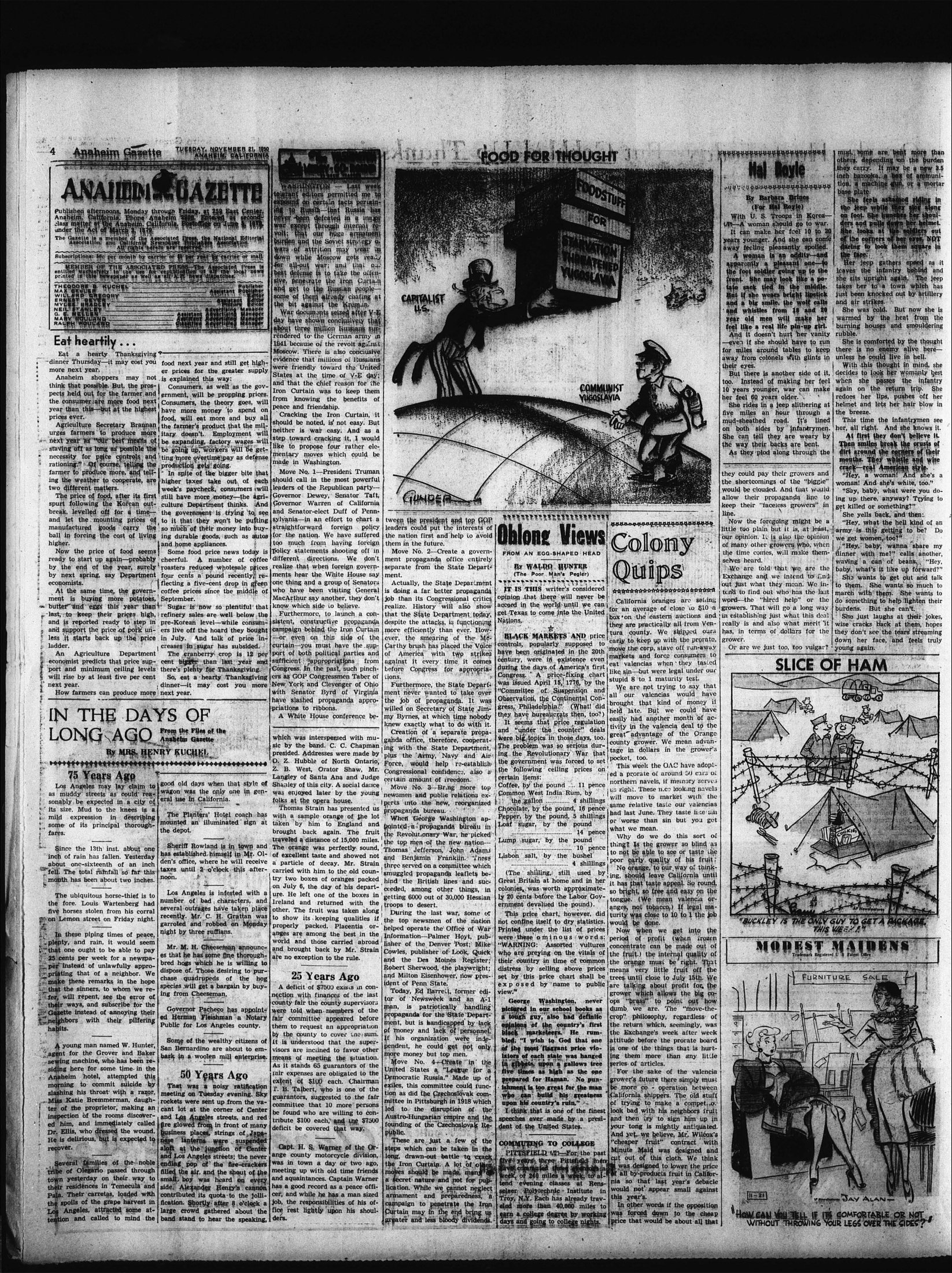
Searchable text
Anaheim Gazette
TUESDAY, NOVEMBER 21, 1950
ANAHEIM, CALIFORNIA
Published afternoons, Monday through Friday, at 258 East Center,
Anaheim, California. Phone Anaheim 2808. Entered as secondclass matter at the Anaheim, California, Postoffice on June 5, 1879,
under the Act of March 2, 1879.
The Gazette is a member of the Associated Press, the National Editorial
Association, and California Newspaper Publishers Association.
All rights herein are reserved.
Subscriptions: $5c per month by carrier or mail.
MEMBER OF THE ASSOCIATED PRESS—The Associated Press is
entitled exclusively to the use for republication of all the local news
printed in this newspaper as well as all A.P. news dispatches.
THEODORE B. KUCHEL
Publisher
MAX GELLER
Assistant Publisher
WILLARD GREGORY
Editor
ERNEST GEVER
Assistant Editor
MYLES BRADLEY
Picture Editor
NEIL STANLEY
Advertising Manager
G. E. MELLER
Assistant Advertising Manager
MARY ROULAND
Assistant Advertising Manager
RALPH ROULAND
Classified Advertising Manager
Eat heartily...
Eat a hearty Thanksgiving dinner Thursday—it may cost you more next year.
Anaheim shoppers may not think that possible. But, the prospects held out for the farmer and the consumer are more food next year than this—but at the highest prices ever.
Agriculture Secretary Brannan urges farmers to produce more next year as "our best means of staving off as long as possible the necessity for price controls and rationing." Of course, telling the farmer to produce more, and tell-food next year and still get higher prices for the greater supply is explained this way:
Consumers, as well as the government, will be propping prices. Consumers, the theory goes, will have more money to spend on food, will eat more and buy all the farmer's product that the military doesn't. Employment will be expanding, factory wages will be going up, workers will be getting more overtime pay as defense production gets going.
In spite of the bigger bite that
Anaheim shoppers may not think that possible. But, the prospects held out for the farmer and the consumer are more food next year than this—but at the highest prices ever.
Agriculture Secretary Brannan urges farmers to produce more next year as "our best means of staving off as long as possible the necessity for price controls and rationing." Of course, telling the farmer to produce more, and telling the weather to cooperate, are two different matters.
The price of food, after its first spurt following the Korean outbreak, levelled off for a time—and let the mounting prices of manufactured goods carry the ball in forcing the cost of living higher.
Now the price of food seems ready to start up again—probably by the end of the year, surely by next spring, say Department economists.
At the same time, the government is buying more potatoes, butter and eggs this year than last, to keep their prices high, and is reported ready to step in and support the price of pork unless it starts back up the price ladder.
An Agriculture Department economist predicts that price support and minimum ceiling levels will rise by at least five per cent next year.
How farmers can produce more
Consumers, as well as the government, will be propping prices. Consumers, the theory goes, will have more money to spend on food, will eat more and buy all the farmer's product that the military doesn't. Employment will be expanding, factory wages will be going up, workers will be getting more overtime pay as defense production gets going.
In spite of the bigger bite that higher taxes take out of each week's paycheck, consumers will still have more money—the agriculture Department thinks. And the government is trying to see to it that they won't be puffing so much of their money into buying durable goods, such as autos and home appliances.
Some food price news today is cheerful. A number of coffee roasters reduced wholesale prices four cents a pound recently, reflecting a five-cent drop in green coffee prices since the middle of September.
Sugar is now so plentiful that refinery sales are well below the pre-Korean level—while consumers live off the hoard they bought in July. And talk of price increases in sugar has subsided.
The cranberry crop is 12 per cent bigger than last year and there's plenty for Thanksgiving.
So, eat a hearty Thanksgiving dinner—it may cost you more next year.
IN THE DAYS OF LONG AGO From the Files of the Anaheim Gazette By MRS. HENRY KUCHEL
75 Years Ago
Los Angeles may lay claim to as muddy streets as could reasonably be expected in a city of its size. Mud to the knees is a mild expression in describing some of its principal thoroughfares.
Since the 13th inst. about one inch of rain has fallen. Yesterday about one-sixteenth of an inch fell. The total rainfall so far this month has been about two inches.
The ubiquitous horse-thief is to good old days when that style of wagon was the only one in general use in California.
The Planters' Hotel coach has mounted an illuminated sign at the depot.
Sheriff Rowland is in town and has established himself in Mr. Olden's office, where he will receive taxes until 2 o'clock this afternoon.
Los Angeles is infested with a number of rodents and insects.
Since the 13th inst. about one inch of rain has fallen. Yesterday about one-sixteenth of an inch fell. The total rainfall so far this month has been about two inches.
The ubiquitous horse-thief is to the fore. Louis Wartenberg had five horses stolen from his corral on Lemon street on Friday night.
In these piping times of peace, plenty, and rain, it would seem that one ought to be able to pay 25 cents per week for a newspaper instead of unlawfully appropriating that of a neighbor. We make these remarks in the hope that the sinners, to whom we refer, will repent, see the error of their ways, and subscribe for the Gazette instead of annoying their neighbors with their pilfering habits.
A young man named W. Hunter, agent for the Grover and Baker sewing machine, who has been residing here for some time in the Anaheim hotel, attempted this morning to commit suicide by slashing his throat with a razor. Miss Katie Bremmerman, daughter of the proprietor, making an inspection of the rooms discovered him, and immediately called Dr. Ellis, who dressed the wound. He is delirious, but is expected to recover.
Several families of the noble tribe of Olegario passed through town yesterday on their way to their residences in Temecula and Pala. Their carretas, loaded with the spoils of the grape harvest in Los Angeles, attracted some attention and called to mind the
The Planters' Hotel coach has mounted an illuminated sign at the depot.
Sheriff Rowland is in town and has established himself in Mr. Olden's office, where he will receive taxes until 2 o'clock this afternoon.
Los Angeles is infested with a number of bad characters, and several outrages have taken place recently. Mr. C. H. Grattan was garroted and robbed on Monday night by three ruffians.
Mr. M. H. Cheeseman announces that he has some fine thoroughbred hogs which he is willing to dispose of. Those desiring to purchase quadrupeds of the hog species will get a bargain by buying from Cheeseman.
Governor Pacheco has appointed Herman Fleishman a Notary Public for Los Angeles county.
Some of the wealthy citizens of San Bernardino are about to embark in a woolen mill enterprise.
50 Years Ago
That was a noisy ratification meeting on Tuesday evening. Sky rockets were sent up from the vacant lot at the corner of Center and Los Angeles streets, and red fire glowed from in front of many business places, strings of Japanese lanterns were suspended aloft at the junction of Center and Los Angeles streets; the never ending pop of the fire-crackers filled the air, and the shout of the small boy was heard on every side. Alexander Henry's cannon contributed its quota to the jollification. Shortly after 8 o'clock a large crowd gathered about the band stand to hear the speaking,
Thomas Strain has presented with a sample orange of taken by him to England brought back again. The traveled a distance of 15,000 The orange was perfectly of excellent taste and show a particle of decay. Mr. carried with him to the old try two boxes of oranges on July 6, the day of his return. He left one of the bells Ireland and returned with other. The fruit was taken to show its keeping quality properly packed. Placements are among the best world and those carried and brought back by Mr. are no exception to the rule.
25 Years Ago
A deficit of $7500 exists connection with finances of the county fair the county superintendent told when members of fair committee appeared them to request an appropriation by the county to cover it It is understood that the visors are inclined to favor means of meeting the sunday As it stands 65 guarantors' fair expenses are obligated extent of $100 each. Chr. T. B. Talbert, who is one guarantor, suggested to committee that 10 more be found who are willing toribute $100 each, and the deficit be covered that w
Capt. H. S. Warner of range county motorcycle club was in town a day or two meeting up with old time aquaintances. Captain has a good record as a peace officer, and while he has a major job, the responsibilities of fice rest lightly upon hisders.
WASHINGTON — Last week
relevant editors permitted me to
pound on certain facts pertaining
to Russia—that Russia has
never been defeated in a major
war except through internal revolt; that our huge armament
burden and the Soviet strategy of
arms of attrition may wear us
down while Moscow gets ready
for all-out war; and that our
best defense is to take the offenve, penetrate the Iron Curtain
and get to the Russian people—
some of them already chafing at
the bit against the Kremlin.
War documents seized after V-E
may have shown conclusively that
about three million Russians surendered to the German army in
1941 because of the revolt against
moscow. There is also conclusive
evidence that millions of Russians
were friendly toward the United
States at the time of V-E day;
and that the chief reason for the
Iron Curtain was to keep them
from knowing the benefits of
peace and friendship.
Cracking the Iron Curtain, it
could be noted, is not easy. But
either is war easy. And as a
keep toward cracking it, I would
like to propose four rather elementary moves which could be
made in Washington.
Move No. 1—President Truman
FOODSTUFF
FOR
STARVATION
THREATENED
YUGOSLAVIA
CAPITALIST
U.S.
COMMUNIST
YUGOSLAVIA
Cracking the Iron Curtain, it would be noted, is not easy. But either is war easy. And as a step toward cracking it, I would like to propose four rather elementary moves which could be made in Washington.
Move No. 1—President Truman should call in the most powerful leaders of the Republican party—Governor Dewey, Senator Taft, Governor Warren of California and Senator-elect Duff of Pennsylvania—in an effort to chart a straightforward foreign policy for the nation. We have suffered so much from having foreign policy statements shooting off in different directions. We don't realize that when foreign governments hear the White House say one thing and a group of Senators who have been visiting General MacArthur say another, they don't know which side to believe.
Furthermore, to launch a content, constructive propaganda campaign behind the Iron Curtain or even on this side of the curtain—you must have the support of both political parties and efficient appropriations from Congress. In the past, such pinch as GOP Congressmen Taber of New York and Clevenger of Ohio with Senator Byrd of Virginia have slashed propaganda appropriations to ribbons.
A White House conference between the president and top GOP leaders could put the interests of the nation first and help to avoid them in the future.
Move No. 2—Create a government propaganda office entirely separate from the State Department.
Actually, the State Department is doing a far better propaganda job than its Congressional critics realize. History will also show that the State Department today, despite the attacks, is functioning more efficiently than ever. However, the smearing of the McCarthy brush has placed the Voice of America with two strikes against it every time it comes before Congress for appropriations.
Furthermore, the State Department never wanted to take over the job of propaganda. It was willed on Secretary of State Jimmy Byrnes, at which time nobody knew exactly what to do with it.
Creation of a separate propaganda office, therefore, cooperating with the State Department, plus the Army, Navy and Air Force, would help re-establish Congressional confidence, also a certain amount of freedom.
Move No. 3—Bring more top newsmen and public relations experts into the new, reorganized propaganda bureau.
When George Washington appointed a propaganda bureau in the Revolutionary War, he picked the top men of the new nation—Thomas Jefferson, John Adams and Benjamin Franklin. These three served on a committee which smuggled propaganda leaflets behind the British lines and succeeded, among other things, in getting 6000 out of 30,000 Hessian
Oblong Views
FROM AN EGG-SHAPED HEAD
BY WALDO HUNTER
(The Poor Man's Pegler)
IT IS THIS writer's considered opinion that there will never be accord in the world until we can get Texas to come into the United Nations.
BLACK MARKETS AND price controls, popularly supposed to have been originated in the 20th century, were in existence even during the days of America's first Congress. A price-fixing chart was issued April 15, 1776, by the "Committee of Suspension and Observation, the Continental Congress, Philadelphia." (What! did they have bureaucrats then, too?)
It seems that price regulation and "under the counter" deals were big topics in those days, too. The problem was so serious during the Revolutionary War that the government was forced to set the following ceiling prices on certain items:
Coffee, by the pound ... 11 pence Common West India Rum, by the gallon ... 4 shillings Chocolate, by the pound, 16 pence Pepper, by the pound, 5 shillings Loaf sugar, by the pound ... 14 pence Lump sugar, by the pound ... 10 pence Lisbon salt, by the bushel ... 4 shillings
(The shilling, still used by Great Britain at home and in her colonies, was worth approximately 20 cents before the Labor Gov't)
California orange for an average of cocoa on the eastern county. We early to keep up with move the corp, stave markets and force eat valencias when like sin—but were less stupid 8 to 1 mature.
We are not trying all our valencias brought that kind held late. But we easily had another activity in the valencia great advantage of county grower. We tage in dollars in pocket, too.
This week theOAed a prorate of around northern navels, if r us right. These n.e.c will move to mar same relative taste had last June. They or worse than sin what we mean.
Why do we do thing? Is the growth not able to se poor early quality?
No orange, to our ing, should leave C it has that taste app so bright, so free an tongue. (We mean)
Thomas Strain has presented us with a sample orange of the lot taken by him to England and brought back again. The fruit traveled a distance of 15,000 miles. The orange was perfectly sound, an excellent taste and showed not a particle of decay. Mr. Strain carried with him to the old county two boxes of oranges packed in July 6, the day of his departure. He left one of the boxes in Ireland and returned with the other. The fruit was taken along to show its keeping qualities if properly packed. Placentia oranges are among the best in the world and those carried abroad had brought back by Mr. Strain no exception to the rule.
25 Years Ago
A deficit of $7500 exists in connection with finances of the last county fair the county supervisors are told when members of the committee appeared before them to request an appropriation for the county to cover the sum. It is understood that the supervisors are incited to favor other means of meeting the situation. It stands 65 guarantors of the air expenses are obligated to the extent of $100 each. Chairman B. Talbert, who is one of the guarantors, suggested to the fair committee that 10 more persons found who are willing to contribute $100 each, and the $7500 deficit be covered that way.
Capt. H. S. Warner of the Orange county motorcycle division, was in town a day or two ago, meeting up with old time friends and acquaintances. Captain Warner is a good record as a peace officer, and while he has a man sized job, the responsibilities of his office rest lightly upon his shoulders.
When George Washington appointed a propaganda bureau in the Revolutionary War, he picked the top men of the new nation—Thomas Jefferson, John Adams and Benjamin Franklin. These three served on a committee which smuggled propaganda leaflets behind the British lines and succeeded, among other things, in getting 6000 out of 30,000 Hessian troops to desert.
During the last war, some of the top newsmen of the nation helped operate the Office of War Information—Palmer Hoyt, publisher of the Denver Post; Mike Cowles, publisher of Look, Quick and the Des Moines Register; Robert Sherwood, the playwright; and Milton Eisenhower, now president of Penn State.
Today, Ed Barrell, former editor of Newsweek and an A-1 man, is patriotically handling propaganda for the State Department, but is handicapped by lack of money and lack of personnel. If his organization were independent, he could get not only more money but top men.
Move No. 4—Create in the United States a "League for a Democratic Russia." Made up of exiles, this committee could function as did the Czechoslovak committee in Pittsburgh in 1918 which led to the disruption of the Austro-Hungarian empire and the founding of the Czechoslovak Republic.
These are just a few of the steps which can be taken in the long, drawn-out battle to crack the Iron Curtain. A lot of other moves should be made, many of a secret nature and not for publication. While we cannot neglect armament and preparedness, a campaign to penetrate the Iron Curtain may in the end bring us greater and less bloody dividends.
the gallon ... 4 shillings Chocolate, by the pound, 16 pence Pepper, by the pound, 5 shillings Loaf sugar, by the pound ... 14 pence Lump sugar, by the pound ... 10 pence Lisbon salt, by the bushel ... 4 shillings (The shilling, still used by Great Britain at home and in her colonies, was worth approximately 20 cents before the Labor Government devalued the pound).
This price chart, however, did not confine itself to dry statistics. Printed under the list of prices were these ominous words: "WARNING: Assorted vultures who are preying on the vitals of their country in time of common distress by selling above prices set by this price chart shall be exposed by name to public view."
George Washington, never pictured in our school books as a tough guy, also had definite opinions of the country's first black marketers. He rumbled; "I wish to God that one of the most flagrant price violators of each state was hanged in gibbets, upon a gallows tree five times as high as the one prepared for Haman. No punishment is too great for the man who can build his greatness upon his country's ruin."
I think that is one of the finest speeches ever made by a president of the United States.
COMMUTING TO COLLEGE
PITTSFIELD (F)—For the past five years three Pittsfield men have commuted three months a week, of 240 miles a week, to attend evening classes at Rensselaer Polytechnic Institute in Troy, N.Y. Each has already traveled more than 40,000 miles to earn a college degree by working days and going to college nights.
will move to make same relative taste had last June. They or worse than sin what we mean.
Why do we do thing? Is the grower to not be able to sell poor early quality?
No orange, to our ing, should leave C it has that taste app so bright, so free and tongue. (We mean angles, not tobacco.) turity was close to I would be done.
Now when we period of profit concentrate can be the fruit.) the interim the orange must be means very little trees until close to are talking about grower which allows ops "brass" to po dumb we are. The crop" philosophy, he return which, since the Exchange's week attitude before the year is one of the things ing them more than series of articles.
For the sake of grower's future there be more co - opera California shippers. Of trying to make look bad with his m and then try to sit your tong is might And yet, we believe "cheaper fruit" or Minute Maid was cut out of this clo it was designed to l l all by-products fr nia so that last y would not appear this year's.
In other words if was forced down price that would be
Hal Boyle
By Barbara Brines
(For Hal Boyle)
With U. S. Troops in Korea—(AF)—A woman should go to war.
It can make her feel 10 to 20 years younger. And she can come away feeling pleasantly spoiled.
A woman is an oddity—and apparently a pleasant one—to the foot soldier going up to the front. She may look like a potato sack tied in the middle. But if she wears bright lipstick and a big smile, the wolf calls and whistles from 18 and 20 year old men will make her feel like a real life pin-up girl.
And it doesn’t hurt her vanity—even if she should have to run for miles around tables to keep away from colonels with glints in their eyes.
But there is another side of it, too. Instead of making her feel 10 years younger, war can make her feel 60 years older.
She rides in a jeep slithering at five miles an hour through a mud-sheathed road. It’s lined on both sides by infantrymen. She can tell they are weary by the way their backs are bent.
As they plod along through the mud, some are bent more than others, depending on the burden they carry. It may be a new 3.5 inch bazooka, a box of ammunition, a machine gun, or a mortar base plate.
She feels ashamed riding in the jeep while they slide along on foot. She hunches her shoulders and pulls down her helmet. She looks at the soldiers out of the corners of her eyes, NOT daring to look them square in the face.
Her jeep gathers speed as it leaves the infantry behind and she sits upright again. The jeep takes her to a town which has just been knocked out by artillery and air strikes.
She was cold. But now she is warmed by the heat from the burning houses and smouldering rubble.
She is comforted by the thought there is no enemy alive here—unless he could live in hell.
With this thought in mind, she decides to look her womanly best when she passes the infantry again on the return trip. She redoes her lips, pushes off her helmet and lets her hair blow in the breeze.
This time the infantrymen see her, all right. And she knows it.
At first they don’t believe it. Then smiles break the crusts of dirt around the corners of their mouths. They whistle and wise crack—real American style.
Colony Quips
California oranges are selling for an average of close to $10 a box on the eastern auctions and they are practically all from Ventura county. We shipped ours early to keep up with the pratec, move the corp, stave off run-away markets and force consumers to eat valencias when they tasted like sin—but were legal under our stupid 8 to 1 maturity test.
We are not trying to say that all our valencias would have brought that kind of money if held late. But we could have easily had another month of activity in the valencia deal to the great advantage of the Orange county grower. We mean advantage in dollars in the grower's pocket, too.
This week the OAC have adopted a pratec of around 50 cars of northern navels, if memory serves us right. These nice looking navels will move to market with the same relative taste our valencias had last June. They taste like sin or worse than sin but you get what we mean.
Why do we do this sort of thing? Is the grower so blind as to not be able to see or taste the poor early quality of his fruit?
No orange, to our way of thinking, should leave California until it has that taste appeal. So round, so bright, so free and easy on the tongue. (We mean valencia or...)
they could pay their growers and the shortcomings of the "biggie" would be clouded. And that would allow their propaganda line to keep their "faceless growers" in line.
Now the foregoing might be a little too plain but it is, at least, our opinion. It is also the opinion of many other growers who, when the time comes, will make themselves heard.
We are told that we are the Exchange and we intend to find out just what they mean. We intend to find out who has the last word—the "hired help" or the growers. That will go a long way in establishing just what this deal really is and also what merit it has, in terms of dollars for the grower.
Or are we just too, too vulgar?
At first they don't believe it. Then smiles break the crusts of dirt around the corners of their months. They whistle and wise crack—real American style.
"Hey, a woman! And she's a woman! And she's white, too."
"Say, baby, what were you doing up there, anyway? Trying to get killed or something?"
She yells back, and then:
"Hey, what the hell kind of an army is this getting to be? Do we get women, too?"
"Hey, baby, wanna share my dinner with me?" calls another, waving a can of beans. "Hey, baby, what's it like up forward?"
She wants to get out and talk to them. She wants so much to march with them. She wants to do something to help lighten their burdens. But she can't.
She just laughs at their jokes, wise cracks back at them, hopes they don't see the tears streaming down her face, and feels truly young again.
Why do we do this sort of thing? Is the grower so blind as to not be able to see or taste the poor early quality of his fruit?
No orange, to our way of thinking, should leave California until it has that taste appeal. So round, so bright, so free and easy on the tongue. (We mean valencia oranges, not tobacco.) If legal maturity was close to 10 to 1 the job would be done.
Now when we get into the period of profit (when frozen concentrate can be made out of the fruit.) the internal quality of the orange must be right. That means very little fruit off the trees until close to July 15th. We are talking about profit for the grower which allows the big coops "brass" to point out how dumb we are. The "move-the-crop" philosophy, regardless of the return which, seemingly, was the Exchange's week after week attitude before the prorate board is one of the things that is hurting them more than any little series of articles.
For the sake of the valencia grower's future there simply must be more cooperation between California shippers. The old stuff of trying to make a competition look bad with his neighbors fruit and then try to sign him up in your tong is mightly antiquated. And yet, we believe, Mr. Wilcox's "cheaper fruit" contract with Minute Maid was designed and cut out of this cloth. We think it was designed to lower the price of all by-products fruit in California so that last year's debacle would not appear small against this year's.
In other words if the opposition was forced down to the cheap price that would be about all that