anaheim-gazette 1950-09-28
Scanned page
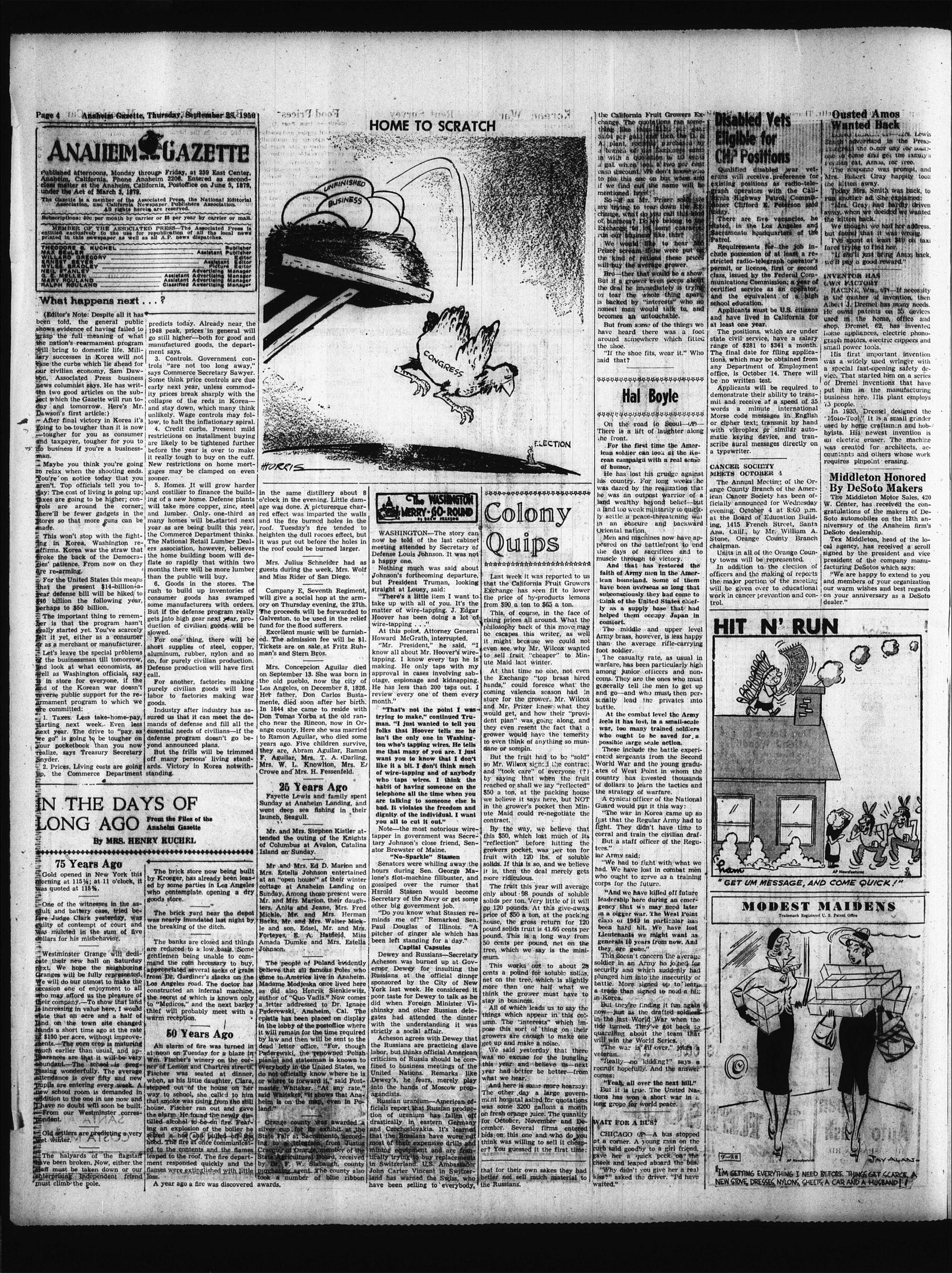
Searchable text
ANAIIEM GAZETTE
Published afternoons, Monday through Friday, at 259 East Center,
Anaheim, California. Phone Anaheim 2206. Entered as secondclass matter at the Anaheim, California, Postoffice on June 5, 1879,
under the Act of March 3, 1879.
The Gazette is a member of the Associated Press, the National Editorial
Association, and California Newspaper Publishers Association.
All rights hereins are reserved.
Subscriptions: 60c per month by carrier or $5 per year by carrier or mail.
MEMBER OF THE ASSOCIATED PRESS—The Associated Press is
entitled exclusively to the use for republication of all the local news
printed in this newspaper as well as all A.P. news dispatches.
THEODORE S. KUCHEL Publisher
MAX BEULER Assistant Publisher
WILLARD GREGORY Editor
ERNEST SEYER Assistant Editor
MYLES BRADLEY Picture Editor
NEIL STANLEY Advertising Manager
G. E. MELLEN Assistant Advertising Manager
MARY ROULAND Assistant Advertising Manager
RALPH ROULAND Classified Advertising Manager
What happens next . . .
(Editor's Note: Despite all it has been told, the general public shows evidence of having failed to grasp the full meaning of what the nation's rearmament program will bring to domestic life. Military successes in Korea will not ease the curbs which lie ahead for our civilian economy, Sam Dawson, Associated Press business news columnist says. He has written two good articles on the subject which the Gazette will run today and tomorrow. Here's Mr. Dawson's first article:)
After final victory in Korea it's going to be tougher than it is now—tougher for you as consumer and taxpayer, tougher for you to do business if you're a businessman.
Maybe you think you're going to relax when the shooting ends.
predicts today. Already near the 1948 peak, prices in general will go still higher—both for good and manufactured goods, the department says.
3. Controls. Government controls "are not too long away," says Commerce Secretary Sawyer. Some think price controls are due early next year, unless commodity prices break sharply with the collapse of the reds in Korea—and stay down, which many think unlikely. Wage controls may follow, to halt the inflationary spiral.
4. Credit curbs. Present mild restrictions on installment buying are likely to be tightened further before the year is over to make it really tough to buy on the cuff. New restrictions on home mortgages may be clamped on even
SON, Associated Press business news columnist says. He has written two good articles on the subject which the Gazette will run today and tomorrow. Here's Mr. Dawson's first article:)
After final victory in Korea it's going to be tougher than it is now—tougher for you as consumer and taxpayer, tougher for you to do business if you're a businessman.
Maybe you think you're going to relax when the shooting ends. You're on notice today that you aren't. Top officials tell you today: The cost of living is going up; taxes are going to be higher; controls are around the corner; there'll be fewer gadgets in the stores so that more guns can be made.
This won't stop with the fighting in Korea, Washington reaffirms. Korea was the straw that broke the back of the Democracies' patience. From now on they are re-arming.
For the United States this means that the present $14-billion-a-year defense bill will be hiked to $40 billion the following year, perhaps to $50 billion.
The important thing to remember is that the program hasn't really started yet. You've scarcely felt it yet, either as a consumer or as a merchant or manufacturer.
Let's leave the special problems of the businessman till tomorrow, and look at what economists, as well as Washington officials, say is in store for everyone, if the end of the Korean war doesn't reverse public support for the re-equipment program to which we are committed:
1. Taxes. Less take-home-pay, starting next week. Even less next year. The drive to "pay as we go" is going to be tougher on your pocketbook than you now realize, says Treasury Secretary Snyder.
2. Prices. Living costs are going up, the Commerce Department
IN THE DAYS OF LONG AGO From the Files of the Anaheim Gazette By MRS. HENRY KUCHEL
75 Years Ago
Gold opened in New York this morning at 115½; at 11 o'clock, it was quoted at 115%.
The brick store now being built by Kroeger, has already been leased by some parties in Los Angeles who contemplate opening a dry goods store.
Some think price controls are due early next year, unless commodity prices break sharply with the collapse of the reds in Korea—and stay down, which many think unlikely. Wage controls may follow, to halt the inflationary spiral.
4. Credit curbs. Present mild restrictions on installment buying are likely to be tightened further before the year is over to make it really tough to buy on the cuff. New restrictions on home mortgages may be clamped on even sooner.
5. Homes. It will grow harder and costlier to finance the building of a new home. Defense plants will take more copper, zinc, steel and lumber. Only one-third as many homes will be started next year as are being built this year, the Commerce Department thinks. The National Retail Lumber Dealers association, however, believes the home building boom will deflate so rapidly that within two months there will be more lumber than the public will buy.
6. Goods in the stores. The rush to build up inventories of consumer goods has swamped some manufacturers with orders. But if the defense program really gets into high gear next year, production of civilian goods will be slowed.
For one thing, there will be short supplies of steel, copper, aluminum, rubber, nylon and so on, for purely civilian production. Defense production will have first call.
For another, factories making purely civilian goods will lose labor to factories making war goods.
Industry after industry has assured us that it can meet the demands of defense and fill all the essential needs of civilians—if the defense program doesn't go beyond announced plans.
But the frills will be trimmed off many persons' living standards. Victory in Korea notwithstanding.
Mrs. Concepcion Aguilar on September 13. She was born the old pueblo, now the city Los Angeles, on December 8, 1911. Her father, Don Carlos Buenger, died soon after her birth in 1844 she came to reside with Don Tomas Yorba at the old rio near the Rincon, now in range county. Here she was married to Ramon Aguilar, who died so years ago. Five children survive they are, Abram Aguilar, Raul F. Aguilar, Mrs. T. A. Darl Mrs. W. L. Knowlton, Mrs. Crowe and Mrs. H. Fessenfeld.
25 Years Ago
Fayette Lewis and family spent Sunday at Anaheim Landing, went deep sea fishing in the launch, Seagull.
Mr. and Mrs. Stephen Kistler tended the outing of the Knight of Columbus at Avalon, Catalan Island on Sunday.
Mr. and Mrs. Ed D. Marion Mrs. Estella Johnson entertained at an "open house" at their wint cottage at Anaheim Landing Sunday. Among those present were
IN THE DAYS OF
LONG AGO
From the Files of the
Anaheim Gazette
By MRS. HENRY KUCHEL
75 Years Ago
Gold opened in New York this morning at 11 o'clock, it was quoted at 115%.
One of the witnesses in the assault and battery case, tried before Judge Clark yesterday, was guilty of contempt of court and was mulcted in the sum of five dollars for his misbehavior.
Westminster Grange will dedicate their new hall on Saturday next. We hope the neighboring Granges will be fully represented. We will do our utmost to make the occasion one of enjoyment to all who may afford us the pleasure of their company.—To show that land is increasing in value here, I would state that an acre and a half of land on the town site changed hands a short time ago at the rate of $150 per acre, without improvements.—The corn crop is maturing much earlier than usual, and appearances are that it will be very abundant.—The school is progressing wonderfully. The average attendance is over fifty and new pupils are entering every week. A new school room is demanded in addition to the one in use now and I have no doubt will soon be built.—From our Westminster correspondent.
Old settlers are predicting a very wet winter.
The halyards of the flagstaff have been broken. Now, either the staff must be taken down or our enterprising Independent friend must climb the pole.
The brick store now being built by Kroeger, has already been leased by some parties in Los Angeles who contemplate opening a dry goods store.
The brick yard near the depot was nearly inundated last night by the breaking of the ditch.
The banks are closed and things are reduced to a low basis. Some gentlemen being unable to command the coin necessary to buy, appropriated several sacks of grain from Dr. Gardiner's slacks on the Los Angeles road. The doctor has constructed an infernal machine, the secret of which is known only to "Medicos," and the next barley thief will probably meet with a warm reception.
50 Years Ago
An alarm of fire was turned in at noon on Tuesday for a blaze in Wm. Fischer's winery on the corner of Lemon and Chartres streets. Fischer was seated at dinner, when, as his little daughter, Clara, stepped out of the house on her way to school, she called to him that smoke was rising from the still house. Fischer ran out and gave the alarm. He found the newly distilled alcohol to be on fire. Fearing an explosion of the boiler he selzed a hoe and pulled off the hood. The fire at once communicated to the contents and the flames leaped to the roof. The fire department responded quickly and the flames were extinguished with little loss.
A year ago a fire was discovered Mr. and Mrs. Stephen Kistler tended the outing of the Knight of Columbus at Avalon, Catalonia Island on Sunday.
Mr. and Mrs. Ed D. Marion Mrs. Estella Johnson entertained at an "open house" at their winters cottage at Anaheim Landing Sunday. Among those present were Mr. and Mrs. Marlon, their daughters, Anita and Jeane, Mrs. Fickle, Mr. and Mrs. Herrick Backs, Mr. and Mrs. Walter Minle and son, Edsel, Mr. and M Forteyes, E. A. Hatfield, M Amada Dumke and Mrs. Este Johnson.
The people of Poland evident believe that all famous Poles come to America live in Anaheim Madame Modjeska once lived here as did also Henrik Sienkiewicz author of "Quo Vadis." Now congratulate a letter addressed to Dr. Ignace Paderewski, Anaheim, Cal.
The epistle has been placed on display in the lobby of the postoffice where it will remain for the time required by law and then will be sent to dead letter office. "For those Paderewski, the renowned pianist and statesman is known everybody in the United States; do not officially know where he or where to forward it," said Pam master Whitaker. "At any rate said Whitaker, 'It shows that Anaheim is on the map, even inland.'"
Orange county was awarded silver cup for its exhibit at State Fair at Sacramento, according to a telegram from Justin Craemer of Orange, member of State Agricultural Board, received by Dr. F. W. Slabaugh, county purchasing agent. The county took a number of blue ribbons awards.
HOME TO SCRATCH
UNFINISHED BUSINESS
CONGRESS
ELECTION
the California Fruit Gro
change. The quotations
thing like this: $120
$104 per gallon and then
A plant, received par
a branch of the Exchange
in with a quotation on
a gal which took a two
cash discount. We don't
to pin this one on but
if we find out the name
mentioned here.
So—if as Mr. Prizer
are trying to tear down
change, what do you call
of business? Do we belo
Exchange to let some
run our business like th
We would like to
Prizer scream if he wе
the kind of rations thе
will buy the average gro
Bro—ther that would b
But if a grower even po
the deal he immediately
to tear the whole thi
is backed by "interests
nonsest man would tall
becomes an untouchab
But from some of the
have heard there wa
around somewhere whi
the shoe.
"If the shoe fits, wear
said that?
Hal Boyle
On the road to Sc
There is a lift of laugh
the front.
For the first time thе
ican soldier can look at
rean campaign with a r
of humor,
He has lost his crud
The same distillery about 8 miles in the evening. Little dam was done. A picturesque charm was imparted the walls of the fire burned holes in the Tuesday's fire tended to ennail the dull rocoes effect, but put out before the holes in of could be burned larger.
Julius Schneider had as during the week, Mrs. Wolf Miss Rider of San Diego.
Company E, Seventh Regiment, gave a social hop at the armory Thursday evening, the 27th. Proceeds will be forwarded to Boston, to be used in the relief for the flood sufferers. Elent music will be furnish-the admission fee will be $1.5s are on sale at Fritz Ruhland Stern Bros.
Concepcion Aguilar died October 13. She was born in old pueblo, now the city of Angeles, on December 8, 1826. Five children survive; are Abram Aguilar, Ramon Aguilar, Mrs. T. A. Darling, W. L. Knowlton, Mrs. E./and Mrs. H. Fessenfeld.
25 Years Ago
Cette Lewis and family spent my at Anaheim Landing, and deep sea fishing in their Seagull.
And Mrs. Stephen Kistler at the outing of the Knights Cumbus at Avalon, Catalina on Sunday.
And Mrs. Ed D. Marion and Estella Johnson entertained "open house" at their winter at Anaheim Landing on May. Among those present were
WASHINGTON—The story can now be told of the last cabinet meeting attended by Secretary of Defense Louis Johnson. It was not a happy one.
Nothing much was said about Johnson's forthcoming departure, but President Truman, looking straight at Louey, said:
"There's a little item I want to take up with all of you. It's the matter of wire-tapping. J. Edgar Hoover has been doing a lot of wire-tapping . . ."
At this point, Attorney General Howard McGrath interrupted.
"Mr. President," he said, "I know all about Mr. Hoover's wire-tapping. I know every tap he is making. He only taps with my approval in cases involving sabotage, espionage and kidnapping. He has less than 200 taps out. I review every one of them every month."
"That's not the point I was trying to make," continued Truman. "I just wanted to tell you folks that Hoover tells me he isn't the only one in Washington who's tapping wires. He tells me that many of you are. I just want you to know that I don't like it a bit. I don't think much of wire-tapping and of anybody who taps wires. I think the habit of having someone on the telephone all the time when you are talking to someone else is bad. It violates the freedom and dignity of the individual. I want you all to cut it out."
Note—the most notorious wire-tapper in government was Secretary Johnson's close friend, Senator Brewster of Maine.
"No-Sparkle" Stassen
Senators were whiling away the hours during Sen. George Malone's slot-machine fillbuster, and gossiped over the rumor that Harold Stassen would become Secretary of the Navy or get some
Colony Quips
Last week it was reported to us that the California Fruit Growers Exchange has seen fit to lower the price of by-products lemons from $90 a ton to $65 a ton.
This, of course, in the face of rising prices all around. What the philosophy back of this move may be escapes this writer, as well it might because we could not even see why Mr. Wilcox wanted to sell fruit "cheaper" to Minute Maid last winter.
At that time no one, not even the Exchange "top brass hired hands," could foresee what the coming valencia season had in store for the grower. Mr. Wilcox and Mr. Prizer knew what they would get, and how their "provident plan" was going along, and they even resent the fact that a grower would have the temerity to even think of anything so mundane or sompin.
But the fruit had to be "sold" so Mr. Wilcox signed the contract and "took care" of everyone (?) by saying that when the fruit reached or shall we say "reflected" $50 a ton, at the packing house we believe it says here, but NOT in the grower's pocket then Minute Maid could re-negotiate the contract.
By the way, we believe that this $50, which lost much of its "reflection" before hitting the growers pocket, was per ton for fruit with 120 lbs. of soluble solids. If this is so, and we believe it is, then the deal merely gets more ridiculous.
The fruit this year will average only about 98 pounds of soluble solids.
Hal Boyle
On the road to Seven There is a lift of laughter the front.
For the first time the lean soldier can look at rean campaign with a rall of humor,
He has lost his grudge his country. For long he was dazed by the realization he was an outpost war land wealthy beyond bury a land too weak militarily settle a peace-threatened in an obscure and Oriental nation.
Men and machines now peared on the battlefront the days of sacrifices muscle through to victory.
And that has restored faith of Army men in theican homeland. Some have been overseas so long subconsciously they had think of the United States as a supply base helped them occupy J comfort.
The middle and upper Army brass, however, is far than the average rifle foot soldier.
The casualty rate, as warfare, has been particul among junior officers cooms. They are the ones generally tell the men and go—and who must, sonally lead the private battle.
At the combat level they feels it has lost, in a small war, too many trained who ought to be saved possible large scale action.
These include the battles enced sergeants from World War and the yourates of West Point in w country has invested w dollars to learn ta the strategy of warfare.
A cynical officer of the Guard would put it this way: "The war in Korea can fast that the Regular Army fight. They didn't have corral and train the civil But a staff officer of tees."
lar Army said:
"We had to fight with had. We have lost in com who ought to serve as a corps for the future."
and Mrs. Stephen Kistler at the outing of the Knights Crumbus at Avalon, Catalina on Sunday.
and Mrs. Ed D. Marion and Estella Johnson entertained "open house" at Anaheim Landing on day among those present were Mrs. Marlon, their daugh- Anita and Jeane, Mrs. Fred Mr. and Mrs. Herman Mr. and Mrs. Walter Mickelson, Edsel, Mr. and Mrs. Jes, E. A. Hatfield, Miss Dumke and Mrs. Estella
people of Poland evidently know that all famous Poles who live in America live in Anaheim. The Modjeska once lived here also Henrik Sienkiewitz, of "Quo Vadis." Now comes her addressed to Dr. Ignace Winski, Anaheim, Cal. The county was awarded a cup for its exhibit at the Fair at Sacramento, according to telegram from Justus Bar of Orange, member of the Agricultural Board, received F. W. Slabaugh, county using agent. The county also has number of blue ribbon are talking to someone else is bad. It violates the freedom and dignity of the individual. I want you all to cut it out."
Note—the most notorious wire-tapper in government was Secretary Johnson's close friend, Senator Brewster of Maine.
"No-Sparkle" Stassen
Senators were whiling away the hours during Sen. George Malone's slot-machine filibuster, and gossiped over the rumor that Harold Stassen would become Secretary of the Navy or get some other big government job.
"Do you know what Stassen reminds me of?" Remarked Sen. Paul Douglas of Illinois. "A pitcher of ginger ale which has been left standing for a day."
Capital Capsules
Dewey and Russians—Secretary Acheson was burned up at Governor Dewey for insulting the Russians at the official dinner sponsored by the City of New York last week. He considered it poor taste for Dewey to talk as he did when Foreign Minister Vishinsky and other Russian delegates had attended the dinner with the understanding it was strictly a social affair.
Acheson agrees with Dewey that the Russians are practicing slave labor, but thinks official American criticism of Russia should be confined to business meetings of the United Nations. Remarks like Dewey's, he fears, merely play into the hands of Moscow propagandists.
Russian uranium—American officials report that Russian production of uranium has fallen off drastically in eastern Germany and Czechoslovakia. It's learned that the Russians have worn out most of their expensive drills and mining equipment and are frantically trying to buy replacements in Switzerland. U.S. Ambassador John Carter Vincent in Switzerland has warned the Swiss, who have been selling to everybody,
we believe it says here, but NOT in the grower's pocket then Minute Maid could re-negotiate the contract.
By the way, we believe that this $50, which lost much of its "reflection" before hitting the growers pocket, was per ton for fruit with 120 lbs. of soluble solids. If this is so, and we believe it is, then the deal merely gets more ridiculous.
The fruit this year will average only about 98 pounds of soluble solids per ton. Very little of it will go 120 pounds. At this give-away price of $50 a ton, at the packing house, the gross return for 120 pound solids fruit is 41.65 cents per pound. This is a long way from 50 cents per pound, net on the tree, which we say is the minimum.
This works out to about 28 cents a pound for soluble solids, net on the tree, which is slightly more than one half what we think the grower must have to stay in business.
All of which leads us to say the things which appear in this column. The "interests" which impose this sort of thing on their growers are enough to make one get up and make a noise.
We said yesterday that there was no excuse for the bungling this year and believe us—next year had better be better—from what we hear.
And here is some more hearsay: The other day a large government hospital asked for quotations was some 3200 gallons a month on fresh orange juice. The quantity for October, November and December. Several firms entered bids on this one and who do you think was willing to sell it cheaper? You guessed it the first time:
that for their own sakes they had better not sell much material to the Russians.
A cynical officer of the Guard would put it this way: "The war in Korea can fast that the Regular Army fight. They didn't have corral and train the civil But a staff officer of the tees."
lar Army said:
"We had to fight with him had. We have lost in com who ought to serve as a corps for the future.
"And we have killed our leadership here during agency that we may need in a bigger war. The We class or 1949 in particular been hard hit. We have Lientenants we might w generals 10 years from now they are gone."
This doesn't concern the soldier in an Army ho jockey security and which sudden plunged him into the insect battle. More signed up a trade than signed to new in Korea.
But they're finding it far now—just as the drafted in the last World War v tide turned. They've got quarrelling about the tea will win the World Series.
"The war is all over," veteran.
"Really—no kidding?" recruit hopefully. And the comes:
"Yeah, all over the next But it is true. The Unions has won a short long grope for world peace."
WAIT FOR A BUS?
CHICAGO (F)—A bus at a corner. A young man curb said goodbye to a girl gave her a quick peck cheek and leaped aboard.
"Why didn't you give her kiss?" asked the driver." waited."
the California Fruit Growers Exchange. The quotations ran something like this (S.L.) per gall: $0.04 per gal; and then the D. & A. plant, recently purchased by a branch of the Exchange came in with a quotation to 50 cents a gal. when took a two per cent cash discount. We don't know who to pin this one on but whom and if we find out the name will be mentioned here.
So—if as Mr. Prizer said we are trying to tear down the Exchange, what do you call this kind of business? Do we belong to the Exchange to let some characters run our business like this?
We would like to hear Mr. Prizer scream if he were put on the kind of rations these prices will buy the average grower.
Bro—ther that would be a show. But if a grower even peeps about the deal he immediately is trying to tear the whole thing apart, is backed by "interests" who no honest man would talk to, and becomes an untouchable.
But from some of the things we have heard there was a foot around somewhere which fitted the shoe.
"If the shoe fits, wear it." Who said that?
Hal Boyle
On the road to Seoul—(AP)—There is a lift of laughter along the front.
For the first time the American soldier can look at the Korean campaign with a real sense of humor,
He has lost his crudge against
Disabled Vets Eligible for CHP Positions
Qualified disabled war veterans will receive preference for existing positions as radio-telegraph operators with the California Highway Patrol. Commissioner Clifford E. Peterson said today.
There are five vacancies, he stated, in the Los Angeles and Sacramento headquarters of the Patrol.
Requirements for the job include possession of at least a restricted radio-telegraph operator's permit, or license, first or second class, issued by the Federal Communications Commission; a year of certified service as an operator, and the equivalent of a high school education.
Applicants must be U.S. citizens and have lived in California for at least one year.
The positions, which are under state civil service, have a salary range of $281 to $341 a month. The final date for filing applications, which may be obtained from any Department of Employment office, is October 14. There will be no written test.
Applicants will be required to demonstrate their ability to transmit and receive at a speed of 35 words a minute international Morse code messages in English or cipher text; transmit by hand with vibroplex or similar automatic keying device, and transcribe aural messages directly on a typewriter.
CANCER SOCIETY MONTH OCTOBER 4
Ousted Amos Wanted Back
Lewis Smith advertised in the PressTelegram the other day for someone to come and get the family's Persian eat, Amos, for free.
The response was prompt, and Mrs. Robert Gray happily took the kitten away.
Today Mrs. Smith was back, to run another ad. She explained:
"Mrs. Gray had hardly driven away, when we decided we wanted the kitten back.
We thought we had her address, but found that it was wrong.
I've spent at least $10 on taxi fares trying to find her.
"It she'll just bring Amos back, we'll pay a good reward."
INVENTOR HAS OWN FACTORY
RACINE, Wis., (D)—If necessity is the mother of invention, then Albert J. Dremel has many needs. He owns patents on 55 devices used in the home, office and shop. Dremel, 62, has invented home appliances, electric phonograph motors, electric clippers and small power tools.
His first important invention was a widely used wringer with a special fast-opening safety device. That started him on a series of Dremel inventions that have put him in the manufacturing business here. His plant employs 75 people.
In 1935, Dremel designed the "Moto-Tool." It is a small grinder used by home craftsmen and hobbyists. His newest invention is an electric eraser. The machine was created for architects, accountants and others whose work requires pinpoint erasing.
Hal Boyle
On the road to Seoul—(AP)—There is a lift of laughter along the front.
For the first time the American soldier can look at the Korean campaign with a real sense of humor.
He has lost his grudge against his country. For long weeks he was dazed by the realization that he was an outpost warrior of a land wealthy beyond belief—but a land too weak militarily to quickly settle a peace-threatening war in an obscure and backward Oriental nation.
Men and machines now have appeared on the battlefront to end the days of sacrifices and to muscle through to victory.
And that has restored the faith of Army men in the American homeland. Some of them have been overseas so long that subconsciously they had come to think of the United States chiefly as a supply base that had helped them occupy Japan in comfort.
The middle and upper level Army brass, however, is less happy than the average rifle-carrying foot soldier.
The casualty rate, as usual in warfare, has been particularly high among junior officers and non-coms. They are the ones who must generally tell the men to get up and go—and who must then personally lead the privates into battle.
At the combat level the Army feels it has lost, in a small-scale war, too many trained soldiers who ought to be saved for a possible large scale action.
These include the battle experienced sergeants from the Second World War and the young graduates of West Point in whom the country has invested thousands of dollars to learn the tactics and the strategy of warfare.
A cynical officer of the National Guard would put it this way:
"The war in Korea came up so fast that the Regular Army had to fight. They didn't have time to corral and train the civilian draft. But a staff officer of the Reguess."
Army said:
"We had to fight with what we had. We have lost in combat men who ought to serve as a training corps for the future.
"And we have killed off future leadership here during an emergency office, is October 14. There will be no written test.
Applicants will be required to demonstrate their ability to transmit and receive at a speed of 35 words a minute international Morse code messages in English or cipher text; transmit by hand with vibroplex or similar automatic keying device, and transcribe aural messages directly on a typewriter.
CANCER SOCIETY MEETS OCTOBER 4
The Annual Meeting of the Orange County Branch of the American Cancer Society has been officially announced for Wednesday evening, October 4 at 8:00 p.m. at the Board of Education Building, 1415 French Street, Santa Ana, Calif., by Mr. William A. Stone, Orange County Branch chairman.
Units in all of the Orange County towns will be represented.
In addition to the election of officers and the making of reports the major portion of the meeting will be given over to educational work in cancer prevention and control.
Middleton Honored By DeSoto Makers
The Middleton Motor Sales, 420 W. Center, has received the congratulations of the makers of DeSoto automobiles on the 12th anniversary of the Anaheim firm's DeSoto dealership.
Tex Middleton, head of the local agency, has received a scroll signed by the president and vice president of the company manufacturing DeSotos which says:
"We are happy to extend to you and members of your organization our warm wishes and best regards on your anniversary as a DeSoto dealer."
HIT N' RUN
GET UM MESSAGE, AND COME QUICK!"
A cynical officer of the National Guard would put it this way:
"The war in Korea came up so fast that the Regular Army had to fight. They didn't have time to corral and train the civilian draft.
But a staff officer of the Regutees."
Army said:
"We had to fight with what we had. We have lost in combat men who ought to serve as a training corps for the future.
"And we have killed off future leadership here during an emergency that we may need later in a longer war. The West Point class or 1940 in particular has been hard hit. We have lost Lieutenants we might want as generals 10 years from now. And they are gone."
This doesn't concern the average soldier in an Army ho joined for security and which suddenly had volunteered him into the insecurity of battle. More signed up to learn a trade than signed to noid a hit in Korea.
But they're finding it fun again now—just as the drafted soldiers on the last World War when the side turned. They've got back to squarrelling about the team that will win the World Series.
"The war is all over," jokes a veteran.
"Really—no kidding?" says a recruit hopefully. And the answer comes:
"Yeah, all over the next hill."
But it is true. The United Nations has won a short war in a long grope for world peace.
WAIT FOR A BUS?
CHICAGO (P)—A bus stopped at a corner. A young man on theurb said goodbye to a girl friend, gave her a quick peck on the cheek and leaped aboard the bus.
"Why didn't you give her a real kiss?" asked the driver. "I'd have waited."