anaheim-gazette 1950-09-20
Scanned page
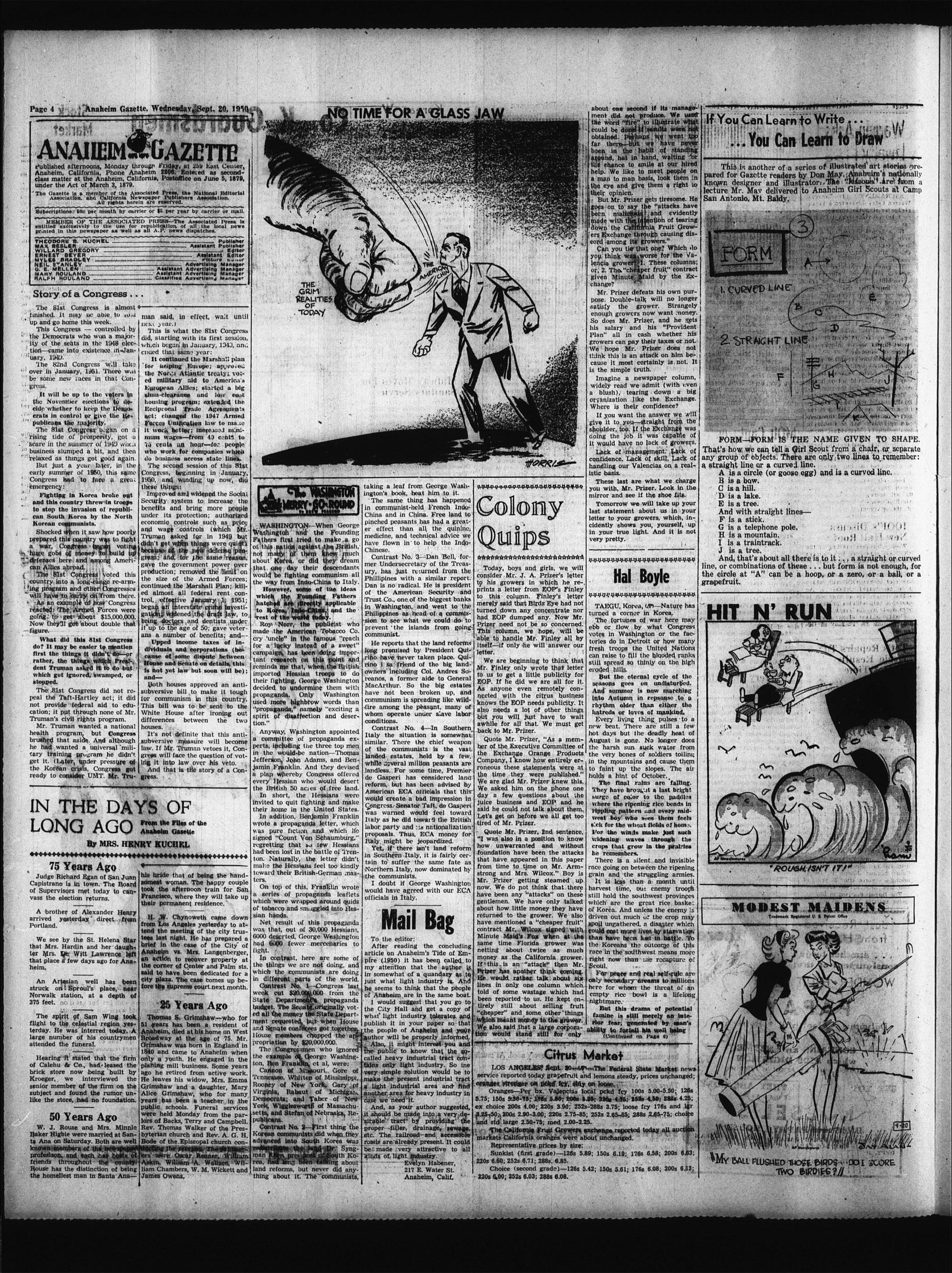
Searchable text
ANAIIEM GAZETTE
Published afternoons, Monday through Friday, at 259 East Center, Anaheim, California, Phone Anaheim 2206. Entered as second-class matter at the Anaheim, California, Postoffice on June 5, 1879, under the Act of March 3, 1879.
The Gazette is a member of the Associated Press, the National Editorial Association, and California Newspaper Publishers Association. All rights herein are reserved.
Subscriptions: $0 per month by carrier or $5 per year by carrier or mail.
MEMBER OF THE ASSOCIATED PRESS—The Associated Press is entitled exclusively to the use for republication of all the local news printed in this newspaper as well as all A.P. news dispatches.
THEODORE B. KUCHEL Publisher
MAX BESLER Assistant Publisher
WILLARD GREGORY Editor
ERNEST BEYER Assistant Editor
MYLES BRADLEY Picture Editor
NEIL STANLEY Advertising Manager
G. E. MELLEN Assistant Advertising Manager
MARY ROULAND Assistant Advertising Manager
RALPH ROULAND Classified Advertising Manager
Story of a Congress ...
The 81st Congress is almost finished. It may be able to end up and go home this week.
This Congress — controlled by the Democrats who won a majority of the seats in the 1948 election — came into existence in January, 1949.
The 82nd Congress will take over in January, 1951. There will be some new races in that Congress.
It will be up to the voters in the November elections to decide whether to keep the Democrats in control or give the Republicans the majority.
The 81st Congress began on a rising tide of prosperity, got a scarce in the summer of 1949 when business slumped a bit, and then relaxed as things got good again.
But just a year later, in the early summer of 1950, this same man said, in effect, wait until next year.
This is what the 81st Congress did, starting with its first session, which began in January, 1949, and ended that same year:
It continued the Marshall plan for helping Europe; approved the North Atlantic treaty; voted military aid to America's European Allies; started a big alum-clearance and low cost housing program; extended the Recliprocal Trade Agreements act; changed the 1947 Armed Forces Unification law to make it work better; increased minimum wages—from 40 cents to 75 cents an hour—for people who work for companies which do business across state lines.
The second session of this 81st Congress, beginning in January.
It will be up to the voters in the November elections to decide whether to keep the Democrats in control or give the Republicans the majority.
The 81st Congress began on a rising tide of prosperity, got a scare in the summer of 1940 when business slumped a bit, and then relaxed as things got good again.
But just a year later, in the early summer of 1950, this same Congress had to face a great emergency:
Fighting in Korea broke out and this country threw in troops to stop the invasion of republican South Korea by the North Korean communists.
Shocked when it saw how poorly prepared this country was to fight a war, Congress began voting huge gobs of money to build up defenses here and among American Allies abroad.
The 81st Congress voted this country into a long-range re-arming program and other Congresses will have to carry on from there.
As an example of how Congress reacted: The Armed Forces were going to get about $15,000,000. Now they'll get about double that figure.
What did this 81st Congress do? It may be easier to mention first the things it didn't do—or rather, the things which President Truman asked it to do but which got ignored, swamped, or stopped.
The 81st Congress did not repeal the Taft-Hartley act; it did not provide federal aid to education; it put through none of Mr. Truman's civil rights program.
Mr. Truman wanted a national health program, but Congress brushed that aside. And although he had wanted a universal military training program he didn't get it. (Later, under pressure of the Korean crisis, Congress got ready to consider UMT. Mr. Tru-
Improved and widened the Soolai Security system to increase the benefits and bring more people under its protection; authorized economic controls such as price and wage controls (which Mr. Truman asked for in 1949 but didn't get when things were quiet) because of the new defense program; and, for the same reason, gave the government power over production; removed the limit on the size of the Armed Forces; continued the Marshall Plan; killed almost all federal rent control, effective January 1, 1951; began an interstate crime investigation; widened the draft law, to bring doctors and dentists under it up to the age of 50; gave veterans a number of benefits; and—
Upped income taxes of individuals and corporations (because of some dispute between House and Senate on details, this is not yet law but soon will be); and—
Both houses approved an anti-subversive bill to make it tough for communism in this country. This bill was to be sent to the White House after ironing out differences between the two houses.
It's not definite that this anti-subversive measure will become law. If Mr. Truman vetoes it, Congress will face the question of voting it into law over his veto.
And that is the story of a Congress.
IN THE DAYS OF LONG AGO From the Files of the Anaheim Gazette By MRS. HENRY KUCHEL
75 Years Ago
Judge Richard Egan of San Juan Capistrano is in town. The Board of Supervisors met today to canvass the election returns.
his bride that of being the handsomest woman. The happy couple took the afternoon train for San Francisco, where they will take up military aid to America's European Allies; started a big alum-clearance and low cost housing program; extended the Reciprocal Trade Agreements act; changed the 1947 Armed Forces Unification law to make it work better; increased minimum wages—from 40 cents to 75 cents an hour—for people who work for companies which do business across state lines.
The second session of this 81st Congress, beginning in January, 1950, and winding up now, did these things:
WASHINGTON—When George Washington and the Founding Fathers first tried to make a gov't of this nation against the British not many of them knew much about Korea. or did they dream that one day their descendant would be fighting communism at the way from Indo-China to Italy.
However, some of the ideas which the Founding Fathers hatched are directly applicable to Korea, India-China, and the rest of the world today.
Roy Norr, the publicist who made the American Tobacco Co.'s 'uncle' in the famous "reaction for a lucky instead of a sweet campaign, has been doing important research on this point and reminds me that, when the British imported Hessian troops to do their fighting, George Washington decided to undermine them with propaganda. Only Washington used more highbrow words than "propaganda," namely "exciting spirit of disaffection and desertion."
Anyway, Washington appointed a committee of propaganda experts, including the three top men in the would-be nation—Thomas Jefferson, John Adams, and Benjamin Franklin. And they devise a plan whereby Congress offers every Hessian who would deserter the British 50 acres of free land.
In short, the Hessians were invited to quit fighting and make their home in the United States.
In addition, Benjamin Franklin wrote a propaganda letter, which was pure fiction and which if signed "Count Von Schaumburg, regretting that so few Hessians had been lost in the battle of Trenton. Naturally, the letter didn’t make the Hessians feel too kind toward their British-German masters.
On top of this, Franklin wrote a series of propaganda leaflets.
IN THE DAYS OF
LONG AGO
From the Files of the
Anaheim Gazette
By MRS. HENRY KUCHEL
75 Years Ago
Judge Richard Egan of San Juan Capistrano is in town. The Board of Supervisors met today to canvass the election returns.
A brother of Alexander Henry arrived yesterday direct from Portland.
We see by the St. Helena Star that Mrs. Hardin and her daughter Mrs. De Witt Lawrence left that place a few days ago for Anaheim.
An Artesian well has been struck on Sproul's place, near Norwalk station, at a depth of 375 feet.
The spirit of Sam Wing took flight to the celestial region yesterday. He was interred today. A large number of his countrymen attended the funeral.
Hearing it stated that the firm of Calehu & Co., had leased the brick store now being built by Kroeger, we interviewed the senior member of the firm on the subject and found the rumor unlike the store, had no foundation.
50 Years Ago
W. J. Rouse and Mrs. Minnie Baker Higbie were married at Santa Ana on Saturday. Both are well known members of the newspaper profession, and each has hosts of friends throughout the county. Rouse has the distinction of being the homellest man in Santa Ana—his bride that of being the handsomest woman. The happy couple took the afternoon train for San Francisco, where they will take up their permanent residence.
H. W. Chynoweth came down from Los Angeles yesterday to attend the meeting of the city trustees last night. He has prepared a brief in the case of the City of Anaheim vs. Mrs. Langenberger, an action to recover property at the corner of Center and Palm sts. said to have been dedicated for a city plaza. The case comes up before the supreme court next month.
25 Years Ago
Thomas S. Grimshaw—who for 51 years has been a resident of Anaheim, died at his home on West Broadway at the age of 75. Mr. Grimshaw was born in England in 1840 and came to Anaheim when only a youth. He engaged in the plating mill business. Some years ago he retired from active work. He leaves his widow, Mrs. Emma Grimshaw and a daughter, Mary Alice Grimshaw, who for many years has been a teacher in the public schools. Funeral services were held Monday from the parlor of Backs, Terry and Campbell. Rev. Thomas Walker of the Presbyterian church and Rev. A. G. H. Bode of the Episcopal church conducting the services. The pallbearers were Oscar Renner, William Askin, William A. Wallace, William Chambers, W. M. Wickett and James Owens.
In addition, Benjamin Franklin wrote a propaganda letter, which was pure fiction and which if signed "Count Von Schaumburg," regretting that so few Hessians had been lost in the battle of Trenton. Naturally, the letter didn't make the Hessians feel too kindly toward their British-German masters.
On top of this, Franklin wrote a series of propaganda leaflets which were wrapped around quick of tobacco and smuggled into Hessian hands.
Net result of this propaganda was that, out of 30,000 Hessians 6000 deserted, George Washington had 6000 fewer mercenaries to fight.
In contrast, here are some of the things we are not doing, and which the communists are doing in different parts of the world.
Contrast No. 1—Congress last week cut $20,000,000 from the State Department's propaganda budget. The Senate originally voted all the money the State Department requested, but when House and Senate conferences got together House members chopped the appropriation by $20,000,000.
The Congressmen who ignore the example of George Washington, Ben Franklin, et al, were:
Cannon of Missouri., Gore of Tennessee., Whitten of Mississippi., Rooney of New York., Gary of Virginia., Rahaut of Michigan Democrats; and Taber of New York., Wigglesworth of Massachusetts, and Stefan of Nebraska., Republicans.
Contrast No. 2—First thing the Korean communists did when they advanced into South Korea was redistribute the land Dr. Syngman Rhee president of South Korea, had long been talking about land reforms, but never did anything about it. The communists
NO TIME FOR A GLASS JAW
THE GRIM REALITIES OF TODAY
THE AMERICAN CHIN
Mr. Prizer gets tires goes on to say the "attack been malicious and made with the intention of down the California Fruiters Exchange through cause cord among its growers."
Can you tie that one? When you think was worse for lencia grower 1. These or, 2. The "cheaper fruit" given Minute Maid by change?
Mr. Prizer defeats his own pose. Double-talk will not satisfy the grower. So enough growers now want So does Mr. Prizer, and his salary and his "Pr Plan" all in cash whether growers can pay their taxes. We hope Mr. Prizer do think this is an attack on cause it most certainly is the simple truth.
Imagine a newspaper widely read we admit (with a blush), tearing down organization like the Exchanger where is their confidence.
If you want the answer give it to you—straight from shoulder, too. If the Exchanger doing the job it was capable it would have no lack of skill.
Lack of management. Lack of skill, handling our Valencias onistic basis.
WHINGTON—When George Washington and the Founding first tried to make a go-ahead against the British, many of them knew much more about it than they dreamed. Day their descendants were fighting communism all over some of the ideas the Founding Fathers are directly applicable to India-China and the world today.
Norr, the publicist who wrote the American Tobacco Co. article in the famous "reachucky instead of a sweet" has been doing important research on this point and came that when the British Hessian troops to do fighting, George Washington undermine them with India. Only Washington are highbrow words thananda," namely "exciting a disaffection and deser-tion."
Washington appointed quitter of propaganda excluding the three top men would-be nation—Thomas Jefferson, John Adams, and Benjamin Franklin. And they devised whereby Congress offered Hessian who would desert 50 acres of free land, port, the Hessians were no quit fighting and make time in the United States. Edition, Benjamin Franklin propaganda letter, which he fiction and which life Count Von Schaumburg," said that so few Hessians lost in the battle of Trenturally, the letter didn't see Hessians feel too kindly their British-German mas-ter of this, Franklin wrote of propaganda leaflets taking a leaf from George Washington's book, beat him to it.
The same thing has happened in communist-held French Indo-China and in China. Free land to pinched peasants has had a greater effect than all the quinine, medicine, and technical advice we have flown in to help the Indo-Chinese.
Contrast No. 3—Dan Bell, former Undersecretary of the Treasury, has just returned from the Phillipines with a similar report. Dan is no radical. He is president of the American Security and Trust Co., one of the biggest banks in Washington, and went to the Philippines as head of a commission to see what we could do to prevent the islands from going communist.
He reports that the land reforms long promised by President Quirino have never taken place. Quirino is a friend of the big landowners including Col. Andres Soreanos, a former aide to General MacArthur. So the big estates have not been broken up, and communism is spreading like wildfire among the peasant, many of whom operate under slave labor conditions.
Contrast No. 4—In Southern Italy the situation is somewhat similar. There the chief weapon of the communists is the vast landed estates, held by a few, while several million peasants are landless. For some time, Premier de Gasperi has considered land reform, but has been advised by American ECA officials that this would create a bad impression in Congress: Senator Taft, de Gasperi was warned would feel toward Italy as he did toward the British labor party and its nationalization proposals. Thus, ECA money for Italy might be jeopardized.
Yet, if there isn't land reform in Southern Italy, it is fairly certain to suffer the same fate as Northern Italy, now dominated by the communists.
I doubt if George Washington would have agreed with our ECA officials in Italy.
Colony Quips
Today, boys and girls, we will consider Mr. J. A. Prizer's letter to his growers in which he reprints a letter from EOP's Finley to this column. Finley's letter merely said that Birds Eye had not turned down any concentrate nor had EOP dumped any. Now Mr. Prizer need not be so concerned. This column, we hope, will be able to handle Mr. Finley all by itself—if only he will answer our letter.
We are beginning to think that Mr. Finley only wrote that letter to us to get a little publicity for EOP. If he did we are all for it. As anyone even remotely connected with the citrus business knows the EOP needs publicity. It also needs a lot of other things but you will just have to wait awhile for all that. We must get back to Mr. Prizer.
Quote Mr. Prizer, "As a member of the Executive Committee of the Exchange Orange Products Company, I know how entirely erroneous these statements were at the time they were published." We are glad Mr. Prizer knew this. We asked him on the phone one day a few questions about the juice business and EOP and he said he could not talk about them. Let's get on before we all get too tired of Mr. Prizer.
Quote Mr. Prizer, 2nd sentence, "I was also in a position to know how unwarranted and without foundation have been the attacks that have appeared in this paper from time to time on Mr. Armstrong and Mrs. Wilcox." Boy is Mr. Prizer getting steamed up now. We do pot think that there have been any "attacks" on these Imagine a newspaper or widely read we admit (with a blush), tearing down an organization like the Exxon Where is their confidence?
If you want the answer give it to you—straight from shoulder, too. If the Exxon doing the job it was capable it would have no lack of skill.
Lack of management: Lack of skill, handling our Valencias on istic basis.
These last are what we wish you with, Mr. Prizer. Look mirror and see if the shoe Tomorrow we will take last statement about us letter to your growers, which cidently shows you, yours in your true light. And it very pretty.
Hal Boyle
TAEGU, Korea, (P)—Natural turnered a corner in Korea.
The fortunes of war here ebb or flow by what C votes in Washington or those do in Detroit or how fresh troops the United can raise to fill the blooded still spread so thinly on theroded hills.
But the eternal cycle of seasons goes on undisturbed And summer is now marked into Autumn in repsonse rhythm older than either latrids or loves of mankind Every living thing pulses new beat. There are still hot days but the deadly August is gone. No longer the harsh sun suck water in the mountains and cause west boy who sees them sick for the wheat fields of For the winds make just widening waves through crops that grow in the prairies.
There is a silent and in race going on between the r grain and the struggling It is less than a month harvest time, but enemy still hold the southwest pro-
Mail Bag
To the editor:
After reading the concluding article on Anaheim's Tide of Empire (1950) it has been called to my attention that the author is in somewhat of a quandary as to just what light industry is. And he seems to think that the people of Anaheim are in the same boat.
I would suggest that you go to the City Hall and get a copy of what light industry tolerates and publish it in your paper so that the people of Anaheim and your author will be properly informed.
Also, it might interest you and the public to know that the so-called heavy industrial tract contains only light industry. So in very simple solution would be to make the present industrial tract a light industrial area and find another area for heavy industry in case we need it.
And, as your author suggested, it should be made into a very desirable tract by providing the proper filler, drainage, sewage, etc. The railroad and accessible roads are already present. It could be made very attractive to all kinds of light industry.
Evelyn Habener,
217 E. Water St.
Anaheim, Calif.
If You Can Learn to Write ...
You Can Learn to Draw
This is another of a series of illustrated art stories prepared for Gazette readers by Don May, Anaheim's nationally known designer and illustrator. The lessons are from a lecture Mr. May delivered to Anaheim Girl Scouts at Camp San Antonio, Mt. Baldy.
1. CURVED LINE
2. STRAIGHT LINE
FORM—FORM IS THE NAME GIVEN TO SHAPE.
That's how we can tell a Girl Scout from a chair, or separate any group of objects. There are only two lines to remember: a straight line or a curved line.
A is a circle (or goose egg) and is a curved line.
Imagine a newspaper column, widely read we admit (with even blush), tearing down a big organization like the Exchange. Here is their confidence?
If you want the answer we will be it to you—straight from the shoulder, too. If the Exchange was doing the job it was capable of would have no lack of growers.
Lack of management: Lack of confidence. Lack of skill. Lack of handling our Valencias on a realistic basis.
These last are what we charge you with, Mr. Prizer. Look in the mirror and see if the shoe fits.
Tomorrow we will take up your hot statement about us in your letter to your growers, which incidentally shows you, yourself, up your true light. And it is not very pretty.
Hal Boyle
TAEGU, Korea, (AP)—Nature has turned a corner in Korea.
The fortunes of war here may be or flow by what Congress writes in Washington or the facies do in Detroit or how many Irish troops the United Nations can raise to fill the blooded ranks will spread so thinly on the high-odged hills.
But the eternal cycle of the seasons goes on undisturbed. And summer is now marching into Autumn in reponse to a rhythm older than either the natreds or loves of mankind.
Every living thing pulses to a new beat. There are still a few days but the deadly heat of August is gone. No longer does the harsh sun suck water from the very bones of soldiers toiling at the mountains and cause them frost up the slopes. The air holds a hint of October.
The final rains are falling. They have brought a last bright surge of color to the paddles where the ripening rice bends in suppling pattern and over midwest boy who sees them feels sick for the wheat fields of home. For the winds make just such widening waves through the crops that grow in the prairies we remember.
There is a silent and invisible force going on between the ripening rain and the struggling armies. It is less than a month until harvest time, but enemy troops will hold the southwest provinces.
FORM—FORM IS THE NAME GIVEN TO SHAPE.
That’s how we can tell a Girl Scout from a chair, or separate any group of objects. There are only two lines to remember: a straight line or a curved line.
A is a circle (or goose egg) and is a curved line.
B is a bow.
C is a hill.
D is a lake.
E is a tree.
And with straight lines—
F is a stick.
G is a telephone pole.
H is a mountain.
I is a traintrack.
J is a tree.
And, that’s about all there is to it...a straight or curved line, or combinations of these...but form is not enough, for the circle at “A” can be a hoop, or a zero, or a ball, or a grapefruit.
HIT N’ RUN
"ROUGH ISN'T IT!"
There is a silent and invisible force going on between the ripening grain and the struggling armies. It is less than a month until harvest time, but enemy troops will hold the southwest provinces which are the great rice basket in Korea. And unless the enemy is given out much of the crop may ungathered, a disaster which would cost more lives by starvation can have been lost in battle. To Koreans the outcome of this race in the southwest means more light now than the recapture of soul.
For peace and real self-rule are only secondary dreams to millions who whom the threat of an empty rice bowl is a lifelong nightmare.
But this drama of potential famine is still merely an interior fear, generated by man's inability to fortall his well being (Continued on Page 6)
The Federal State Market news remons steady, prices unchanged; loose.
pckd fcy 100s 5.00-5.50; 126s
290s 4.75; 252s 4.50; 288s 4.25;
8s 3.75; loose fcy 176s and lgr
22s 2.65-85; 288s 2.65-75; choice
ange reported today all auction unchanged.
150s 6.19; 176s 6.58; 200s 6.63;
150s 5.61; 176s 6.08; 200s 6.13;
MY BALL FLUSHED THOSE BIRDS...DO I SCORE TWO BIRDIES?//