anaheim-gazette 1950-08-08
Scanned page
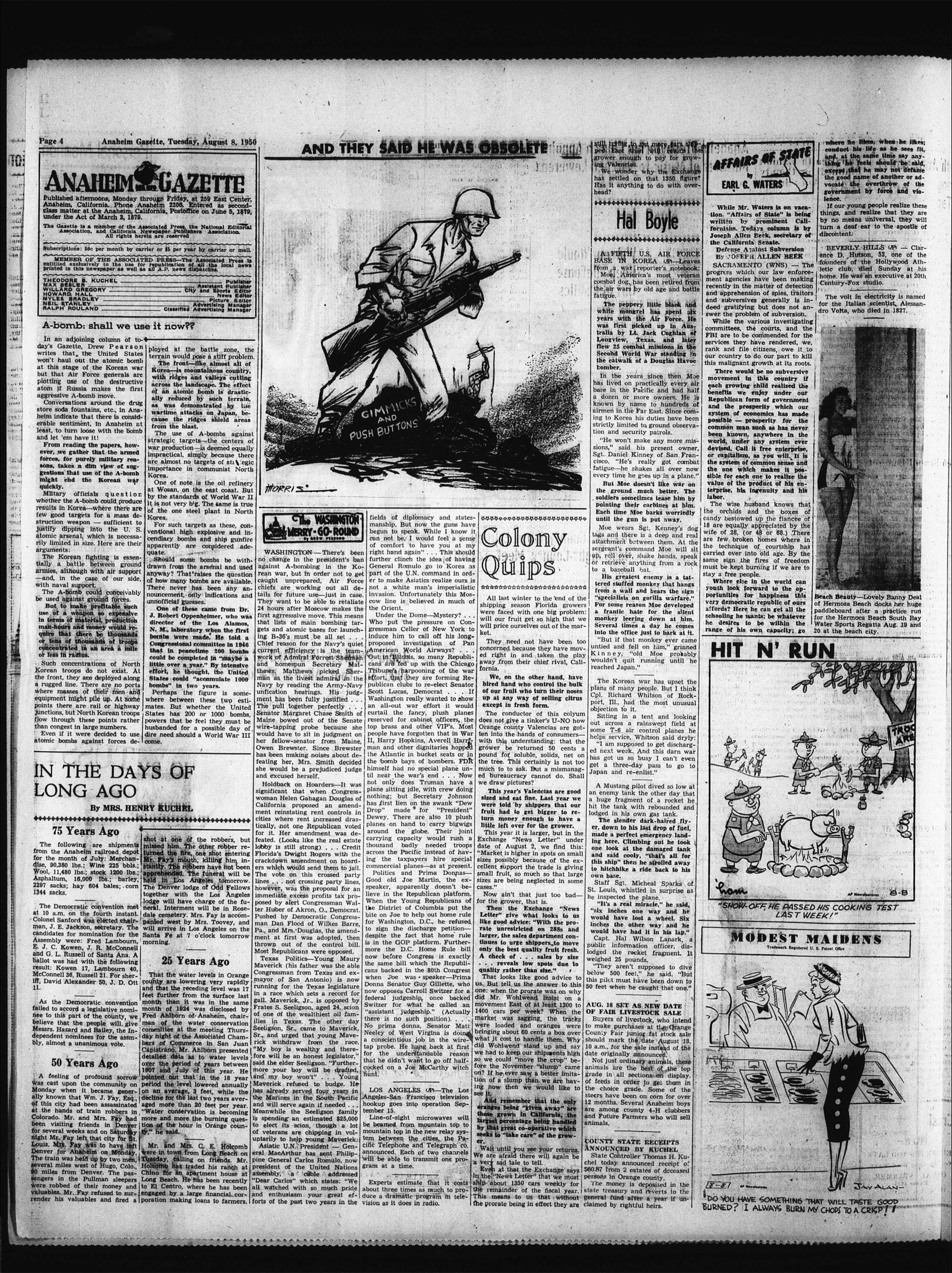
Searchable text
ANAHEM GAZETTE
Published afternoons, Monday through Friday, at 259 East Center,
Anaheim, California. Phone Anaheim 2206. Entered as second-class matter at the Anaheim, California, Postoffice on June 5, 1879,
under the Act of March 3, 1879.
The Gazette is a member of the Associated Press, the National Editorial Association, and California Newspaper Publishers Association. All rights herein are reserved.
Subscriptions: 50c per month by carrier or $5 per year by carrier or mall.
MEMBER OF THE ASSOCIATED PRESS—The Associated Press is entitled exclusively to the use for republication of all the local news printed in this newspaper as well as all A.P. news dispatches.
THEODORE B. KUCHEL ... Publisher
MAX BESLER ... Assistant Publisher
WILLARD GREGORY ... City and Sports Editor
HOWARD HALL ... News Editor
MYLES BRADLEY ... Picture Editor
NEIL STANLEY ... Advertising Manager
RALPH ROULAND ... Classified Advertising Manager
A-bomb: shall we use it now??
In an adjoining column of today's Gazette, Drew Pearson writes that the United States won't haul out the atomic bomb at this stage of the Korean war but that Air Force generals are plotting use of the destructive atom if Russia makes the first aggressive A-bomb move.
Conversations around the drug store soda fountains, etc., in Anaheim indicate that there is considerable sentiment, in Anaheim at least, to turn loose with the bomb and let 'em have it!
From reading the papers, however, we gather that the armed forces, for purely military reasons, takes a dim view of suggestions that use of the A-bombployed at the battle zone, the terrain would pose a stiff problem.
The front—like almost all of Korea—is mountainous country, with ridges and valleys cutting across the landscape. The effect of an atomic bomb is drastically reduced by such terrain, as was demonstrated by the wartime attacks on Japan, because the ridges shield areas from the blast.
The use of A-bombs against strategic targets—the centers of war production—is deemed equally impractical, simply because there are almost no targets of strategic importance in communist North Korea.
but that Air Force generals are plotting use of the destructive atom if Russia makes the first aggressive A-bomb move.
Conversations around the drug store soda fountains, etc., in Anaheim indicate that there is considerable sentiment, in Anaheim at least, to turn loose with the bomb and let 'em have it!
From reading the papers, however, we gather that the armed forces, for purely military reasons, takes a dim view of suggestions that use of the A-bomb might end the Korean war quickly.
Military officials question whether the A-bomb could produce results in Korea—where there are few good targets for a mass destruction weapon — sufficient to justify dipping into the U. S. atomic arsenal, which is necessarily limited in size. Here are their arguments:
The Korean fighting is essentially a battle between ground armies, although with air support—and, in the case of our side, with naval support.
The A-bomb could conceivably be used against ground forces.
But to make profitable such use of a weapon so expensive in terms of material, production man-hours and money would require that there be thousands or tens of thousands of troops concentrated in an area a mile or less in radius.
Such concentrations of North Korean troops do not exist. At the front, they are deployed along a rugged line. There are no ports where masses of their men and equipment might pile up. At some points there are rail or highway junctions, but North Korean troops flow through these points rather than congest in large numbers.
Even if it were decided to use atomic bombs against forces de-
with ridges and valleys cutting across the landscape. The effect of an atomic bomb is drastically reduced by such terrain, as was demonstrated by the wartime attacks on Japan, because the ridges shield areas from the blast.
The use of A-bombs against strategic targets—the centers of war production—is deemed equally impractical, simply because there are almost no targets of strategic importance in communist North Korea.
One of note is the oil refinery at Wosan, on the east coast. But by the standards of World War II it is not very big. The same is true of the one steel plant in North Korea.
For such targets as these, conventional high explosive and incendiary bombs and ship gunfire apparently are considered adequate.
Should some bombs be withdrawn from the arsenal and used anyway? That raises the question of how many bombs are available. There never has been any announcement, only indications and unofficial guesses.
One of these came from Dr. J. Robert Oppenheimer, who was director of the Los Alamos, N. M., laboratory when the first bombs were made. He told a Congressional committee in 1946 that in peacetime 200 bombs could be completed in "maybe a little over a year." By intensive effort, he thought, the United States could "accumulate 1000 bombs" in two years.
Perhaps the figure is somewhere between these two estimates. But whether the United States has 200 or 1000 bombs, powers that be feel they must be husbanded for a possible day of dire need should a World War III come.
IN THE DAYS OF LONG AGO
By MRS. HENRY KUCHEL
75 Years Ago
The following are shipments from the Anaheim railroad depot for the month of July: Merchandise, 90,380 lbs.; Wine 225 bbls.; Wool, 11,480 lbs.; stock 1200 lbs.; Asphaltum, 16,000 lbs.; barley, 2297 sacks; hay 604 bales; corn 1344 sacks.
shot at one of the robbers, but missed him. The other robber returned the fire, one shot entering Mr. Fay's mouth, killing him instantly. The robbers have not been apprehended. The funeral will be held in Los Angeles tomorrow. The Denver lodge of Odd Fellows together with the Los Angeles
WASHINGTON — There's been no change in the president's behavior against A-bombing in the Korean war, but in order not to caught unprepared, Air Force chiefs are working out all options for future use—just in case they want to be able to retaliate 24 hours after Moscow makes the first agressive move. This means that lists of main bombing targets and atomic bases for launching B-36's must be all set.
Chief reason for the Navy's current efficiency is the team work of Admiral Forrest Sheermann and homespun Secretary Maithws. Matthews picked Shawman as the livest admiral in the Navy by reading the Army-Navy unification hearings. His judgment has been fully justified.
The pull together perfectly. Senator Margaret Chase Smith Maine bowed out of the Senate wire-tapping probe because she would have to sit in judgment of her fellow-senator from Main Owen Brewster. Since Brewster has been making noises about feating her, Mrs. Smith decide she would be a prejudiced judge and excused herself.
Holdback on Hoarders—It was significant that when Congresswoman Helen Gahagan Douglas California proposed an amendment reinstating rent controls cities where rent increased dramatically, not one Republican vote for it. Her amendment was defeated. (Looks like the real estate lobby is still strong) . . . Credits Florida's Dwight Rogers with this crackdown amendment on hoarders which would send them to jail. The vote on this crossed party lines . . . not crossing party lines however, was the proposal for an immediate excess profits tax pro-
By MRS. HENRY KUCHEL
75 Years Ago
The following are shipments from the Anaheim railroad depot for the month of July: Merchandise, 90,380 lbs.; Wine 225 bbls.; Wool, 11,480 lbs.; stock 1200 lbs.; Asphaltum, 16,000 lbs.; barley, 2297 sacks; hay 604 bales; corn 1344 sacks.
The Democratic convention met at 10 a.m. on the fourth instant. Colonel Sanford was elected chairman, J. E. Jackson, secretary. The candidates for nomination for the Assembly were: Fred Lambourn, E. J. C. Kowen, J. R. McConnell and G. L. Russell of Santa Ana. A ballot was had with the following result: Kowen 17, Lambourn 40, McConnell 36, Russell 21. For sheriff, David Alexander 50, J. D. Ott 11.
As the Democratic convention failed to accord a legislative nominee to this part of the county, we believe that the people will give Messrs. Hazard and Bailey, the Independent nominees for the assembly, almost a unanimous vote.
50 Years Ago
A feeling of profound sorrow was cast upon the community on Monday when it became generally known that Wm. J. Fay, Esq., of this city had been assassinated at the hands of train robbers in Colorado. Mr. and Mrs. Fay had been visiting friends in Denver for several weeks and on Saturday night Mr. Fay left that city for St. Louis. Mrs. Fay was to have left Denver for Anaheim on Monday. The train was held up by two men, several miles west of Hugo, Colo., 90 miles from Denver. The passengers in the Pullman sleepers were robbed of their money and valuables. Mr. Fay refused to surrender his valuables and fired a shot at one of the robbers, but missed him. The other robber returned the fire, one shot entering Mr. Fay's mouth, killing him instantly. The robbers have not been apprehended. The funeral will be held in Los Angeles tomorrow.
The Denver lodge of Odd Fellows together with the Los Angeles lodge will have charge of the funeral. Interment will be in Rosedale cemetery. Mrs. Fay is accompanied west by Mrs. Toovey, and will arrive in Los Angeles on the Santa Fe at 7 o'clock tomorrow morning.
25 Years Ago
That the water levels in Orange county are lowering very rapidly and that the receding level was 17 feet further from the surface last month than it was in the same month of 1924 was disclosed by Fred Ahlborn of Anaheim, chairman of the water conservation committee at the meeting Thursday night of the Associated Chambers of Commerce in San Juan Capistrano. Mr. Ahlborn presented detailed data as to water levels over the period of years between 1907 and July of this year. He pointed out that in the 18 year period the level lowered annually on an average, 3 feet, while the decline for the last two years averaged more than 20 feet per year. "Water conservation is becoming more and more the burning question of the hour in Orange county," he said.
Mr. and Mrs. C. E. Holcomb were in town from Long Beach on Tuesday, calling on friends. Mr. Holcomb has traded his ranch at Chino for an apartment house at Long Beach. He has been recently to El Centro, where he has been engaged by a large financial corporation making loans to farmers.
Texas Politics—Young Maverick (his father was the abbot Congressman from Texas and ex mayor of San Antonio) is now running for the Texas legislature in a race which sets a record for gall. Maverick, Jr., is opposed by Frates S. Seeligson, aged 24, scoliosis of one of the wealthiest oil families in Texas. The other day Seeligson, Sr., came to Maverick Sr., and urged that young Maverick withdraw from the race "My boy is wealthy and there fore will be an honest legislator," said the elder Seeligson. "Furthermore your boy will be drafted and my boy won't" . . . Young Maverick refused to budge. He has already served four years in the Marines in the South Pacific and will serve again if needed . . . Meanwhile the Seeligson family is spending an estimated $25,000 to elect its scion, though a lot of veterans are chipping in voluntarily to help young Maverick.
Asiatic U.N. President — General MacArthur has sent Philippe General Carlos Romulo, now president of the United Nations assembly, a cable addressed "Dear Carlos" which states: "We all watched with so much pride and enthusiasm your great efforts of the past two years in th
AND THEY SAID HE WAS OBSOLETE
GIMMICKS
AND
PUSH BUTTONS
A FIETH U.S. AIR
BASE IN KOREA (AP)
from a war reporter's remorse America's most
combat dog, has been retithe air wars by old age and
fatigue.
The peppery little blawhite mongrel has sped
years with the Air Forwas first picked up in
tralla by Lt. Jack CogLongview, Texas, and
flew 25 combat missions.
Second World War stand
the catwalk of a Douglas
bomber.
In the years since th
has lived on practically e
base in the Pacific and h
a dozen or more owner
known by name to hunairmen in the Far East. Si
ing to Korea his duties ha
strictly limited to ground
tion and security patrols.
"He won't make any m
sions," said his present
Sgt. Daniel Kinney of Sa
cisco. "He's really got
fatigue—he shakes all o
WASHINGTON — There's been change in the president's ban on A-bombing in the Koerar, but in order not to get unprepared, Air Force are working out all dear future use—just in case. Want to be able to retaliate wars after Moscow makes the arrowsive move. This means tests of main bombing targets at atomic bases for launch-36's must be all set. Season for the Navy's quiet efficiency is the team of Admiral Forrest Sherman Homespun Secretary Matthews picked Sherman the livest admiral in the day reading the Army-Navy on hearings. His judgments been fully justified. All together perfectly. Margaret Chase Smith of Bowed out of the Senateapping probe because she have to sit in judgment on low-senator from Maine, Brewster. Since Brewster is making noises about her, Mrs. Smith decided would be a prejudiced judge used herself.
back on Hoarders—It was meant that when Congress-Helen Gahagan Douglas ofonia proposed an amendinstating rent controls in there rent increased drasstnot one Republican voted Her amendment was de(Looks like the real estate is still strong).. Credit is Dwight Rogers with the own amendment on hoarder would send them to jail. De on this crossed party not crossing party lines, was the proposal for an ante excess profits tax pro
fields of diplomacy and statesmanship. But now the guns have begun to speak. While I know it can not be, I would feel a sense of comfort to have you at my right hand again". . . This should further clinch the idea of having General Romulo go to Korea as part of the U.N. command in order to make Asiatics realize ours is not a white man's imperialistic invasion. Unfortunately this Moscow line is believed in much of the Orient.
Under the Dome—Mystery? . . Who put the pressure on Congressman Celler of New York to induce him to call off his long-proposed investigation of Pan American World Airways? . . Out in Illinois, so many Republicans are fed up with the Chicago Tribune's harpooning of the war effort, that they are forming Republican clubs to re-elect Senator Scott Lucas, Democrat . . . If Washington really wanted to show an all-out war effort it would curtail the fancy, plush planes reserved for cabinet officers, the top brass and other VIP's. Most people have forgotten that in War II, Harry Hopkins, Averell Harriman and other dignitaries hopped the Atlantic in bucket seats or in the bomb bays of bombers. FDR himself had no special plane until near the war's end . . . Now not only does Truman have a plane sitting idle, with crew doing nothing; but Secretary Johnson has first lien on the swank "Dew Drop" made for "President" Dewey. There are also 10 plush planes on hand to carry bigwigs around the globe. Their joint carrying capacity would rush a thousand badly needed troops across the Pacific instead of having the taxpayers hire special commercial planes—as at present.
Politics and Prima Donnas—Good old Joe Martin, the exspeaker, apparently doesn't believe in the Republican platform.
Colony Quips
All last winter to the 'end of the shipping season Florida growers were faced with one big problem: will our fruit get so high that we will price ourselves out of the market.
They need not have been too concerned because they have moved right in and taken the play away from their chief rival, California.
We, on the other hand, have hired hand who control the bulk of our fruit who turn their noses up at any way of selling citrus except in fresh form.
The conductor of this colyum does not give a tinker's U-NO how Orange county Valencias are gotten into the hands of consumers—with this understanding: that the grower be returned 50 cents a pound for soluble, solids, net on the tree. This certainly is not too much to to ask. But a mismanaged bureaucracy cannot do. Shall we draw pictures?
This year's Valencias are good sized and eat fine. Last year we were told by shippers that our fruit had to get bigger to return money enough to have a little left over for the grower.
This year it is larger, but in the Exchange "News Letter" under date of August 2, we find this: "Market is higher in spots on small sizes possibly because of the excellent support the trade is giving small fruit, so much so that large sizes are being neglected in some cases."
Now ain't that just too bad—
In the years since tha has lived on practically every base in the Pacific and has a dozen or more owners known by name to hunt airmen in the Far East. Sitting to Korea his duties have strictly limited to ground station and security patrols.
"He won't make any mansions," said his present Sgt. Daniel Kinney of San Francisco. "He's really got fatigue—he shakes all over every time he goes up in a
But Moe doesn't like that the ground much better soldiers sometimes tease pointing their carbines Each time Moe barks wo until the gun is put aw aw
Moe wears Sgt. Kenneth tags and there is a deep attachment between them sergeant's command Moe up, roll over, shake hands or retrieve anything from to a baseball bat.
His greatest enemy is tered stuffed monkey that from a wall and bears thie "specialists on gorilla war For some reason Moe devil a frantic hate for the monkey leering down at Several times a day he into the office just to bar
"But if that monkey ever untied and fell on him," Kinney, "old Moe po wouldn't quit running u reached Japan."
The Korean war has up plans of many people. But Cpl. Richard Whitson of port, Ill., had the most objection to it.
Sitting in a tent and out across a rainswept some T-6 air control plan helps service, Whitson said.
"I am supposed to get died next week. And this day has got us so busy I can get a three-day pass to Japan and re-enlist."
A Mustang pilot dived so an enemy tank the other day a huge fragment of a rook hit the tank with rebound lodged in his own gas tank.
The slender dark-haired er, down to his last drop o made a perfect emergency ing here. Climbing out he one look at the damaged and said cooly, "that's a this ship" then he strolled to hitchhike a ride back o own base.
Staff Sgt. Micheal Spat St. Louis, whistled in surprise he inspected the plane.
HELEN GANAGAN DOUGLAS OF MEDIA proposed an amendment reinstating rent controls in
here rent increased drasnot one Republican voted
Her amendment was de-
(Looks like the real estate
is still strong) . . .
Credit
US Dwight Rogers with the
own amendment on hoardth would send them to jail.
State on this crossed party
not crossing party lines,
was the proposal for an
state excess profits tax proly alert Congressman Walter of Akron, O., Democrat.
By Democratic Congresson Flood of Wilkes Barre,
of Mrs. Douglas, the amendment first was adopted, then
out of the control bill.
Republicans were opposed.
Politics—Young Maury
Bick (his father was the able
man from Texas and exof San Antonio) is now
for the Texas legislature
which sets a record for
Severick, Jr., is opposed by
Seeligson, aged 24, scion
of the wealthiest oil famTexas. The other day
Sr., came to Maverick,
urged that young Mavewithdraw from the race.
He is wealthy and therebe an honest legislator,"
Seeligson. "Furtherboy will be drafted,
boy won't" . . .
Young
Bick refused to budge. He
had served four years in
lines in the South Pacific
serve again if needed . . .
while the Seeligson family
ing an estimated $25,000
its scion, though a lot
ans are chipping in volto help young Maverick:
U.N. President — GenArthur has sent PhilippeGeneral Carlos Romulo, now
of the United Nations
a cable addressed
Carlos" which states: "We
need with so much pride
musiasm your great efthe past two years in the
LOS ANGELES (AP)—The Los
Angeles-San Francisco television hookup goes into operation September 15.
Line-of-sight microwaves will be beamed from mountain top to mountain top in the new relay system between the cities, the Pacific Telephone and Telegraph co. announced. Each of two channels will be able to transmit one program at a time.
Experts estimate that it costs about three times as much to produce a dramatic program in television as it does in radio.
Then the Exchange "News Letter" under date of August 2, we find this:
"Market is higher in spots on small sizes possibly because of the excellent support the trade is giving small fruit, so much so that large sizes are being neglected in some cases."
Now ain't that just too bad—for the grower, that is.
Then the Exchange "News Letter" give what looks to us like good advice: "With the prorate unrestricted on 288s and larger, the sales department continues to urge shippers to move only the best quality fruit fresh. A check of . . . sales by size . . . reveals low spots due to quality rather than size."
That looks like good advice to us. But tell us the answer to this one: when the prorate was on why did Mr. Wohlwend insist on a movement East of at least 1300 to 1400 cars per week? When the market was sagging, the tracks were loaded and oranges were bringing about 60 cents a box over what it cost to handle them. Why did Wohlwend stand up and say we had to keep our shipments high so we could "move the crop" before the November "slump" came on? If he ever saw a better imitation of a slump than we are having now then we would like to see it.
And remember that the only oranges being "given away" are those grown in California, the largest percentage being handled by that great co-operative which seeks to "take care" of the grower.
Wait until you see your returns. We are afraid there will again be a very sad tale to tell.
Even at that the Exchange says in the "News Letter" that we must ship about 1350 cars weekly for the remainder of the fiscal year. This means to us that without the prorate being in effect they are sized and eat line. Last year we were told by shippers that our fruit had to get bigger to return money enough to have a little left over for the grower.
This year it is larger, but in the Exchange "News Letter" under date of August 2, we find this:
"Market is higher in spots on small sizes possibly because of the excellent support the trade is giving small fruit, so much so that large sizes are being neglected in some cases."
Now ain't that just too bad—for the grower, that is.
Then the Exchange "News Letter" give what looks to us like good advice: "With the prorate unrestricted on 288s and larger, the sales department continues to urge shippers to move only the best quality fruit fresh. A check of . . . sales by size . . . reveals low spots due to quality rather than size."
That looks like good advice to us. But tell us the answer to this one: when the prorate was on why did Mr. Wohlwend insist on a movement East of at least 1300 to 1400 cars per week? When the market was sagging, the tracks were loaded and oranges were bringing about 60 cents a box over what it cost to handle them. Why did Wohlwend stand up and say we had to keep our shipments high so we could "move the crop" before the November "slump" came on? If he ever saw a better imitation of a slump than we are having now then we would like to see it.
And remember that the only oranges being "given away" are those grown in California, the largest percentage being handled by that great co-operative which seeks to "take care" of the grower.
Wait until you see your returns. We are afraid there will again be a very sad tale to tell.
Even at that the Exchange says in the "News Letter" that we must ship about 1350 cars weekly for the remainder of the fiscal year. This means to us that without the prorate being in effect they are sized and eat line. Last year we were told by shippers that our fruit had to get bigger to return money enough to have a little left over for the grower.
This year it is larger, but in the Exchange "News Letter" under date of August 2, we find this:
"Market is higher in spots on small sizes possibly because of the excellent support the trade is giving small fruit, so much so that large sizes are being neglected in some cases."
Now ain't that just too bad—for the grower, that is.
Then the Exchange "News Letter" give what looks to us like good advice: "With the prorate unrestricted on 288s and larger, the sales department continues to urge shippers to move only the best quality fruit fresh. A check of . . . sales by size . . . reveals low spots due to quality rather than size."
That looks like good advice to us. But tell us the answer to this one: when the prorate was on why did Mr. Wohlwend insist on a movement East of at least 1300 to 1400 cars per week? When the market was sagging, the tracks were loaded and oranges were bringing about 60 cents a box over what it cost to handle them. Why did Wohlwend stand up and say we had to keep our shipments high so we could "move the crop" before the November "slump" came on? If he ever saw a better imitation of a slump than we are having now then we would like to see it.
And remember that the only oranges being "given away" are those grown in California, the largest percentage being handled by that great co-operative which seeks to "take care" of the grower.
Wait until you see your returns. We are afraid there will again be a very sad tale to tell.
Even at that the Exchange says in the "News Letter" that we must ship about 1350 cars weekly for the remainder of the fiscal year. This means to us that without the prorate being in effect they are sized and eat line. Last year we were told by shippers that our fruit had to get bigger to return money enough to have a little left over for the grower.
This year it is larger, but in the Exchange "News Letter" under date of August 2, we find this:
"Market is higher in spots on small sizes possibly because of the excellent support the trade is giving small fruit, so much so that large sizes are being neglected in some cases."
Now ain't that just too bad—for the grower, that is.
Then the Exchange "News Letter" give what looks to us like good advice: "With the prorate unrestricted on 288s and larger, the sales department continues to urge shippers to move only the best quality fruit fresh. A check of . . . sales by size . . . reveals low spots due to quality rather than size."
That looks like good advice to us. But tell us the answer to this one: when the prorate was on why did Mr. Wohlwend insist on a movement East of at least 1300 to 1400 cars per week? When the market was sagging, the tracks were loaded and oranges were bringing about 60 cents a box over what it cost to handle them. Why did Wohlwend stand up and say we had to keep our shipments high so we could "move the crop" before the November "slump" came on? If he ever saw a better imitation of a slump than we are having now then we would like to see it.
And remember that the only oranges being "given away" are those grown in California, the largest percentage being handled by that great co-operative which seeks to "take care" of the grower.
Wait until you see your returns. We are afraid there will again be a very sad tale to tell.
Even at that the Exchange says in the "News Letter" that we must ship about 1350 cars weekly for the remainder of the fiscal year. This means to us that without the prorate being in effect they are sized and eat line. Last year we were told by shippers that our fruit had to get bigger to return money enough to have a little left over for the grower.
This year it is larger, but in the Exchange "News Letter" under date of August 2, we find this:
"Market is higher in spots on small sizes possibly because of the excellent support the trade is giving small fruit, so much so that large sizes are being neglected in some cases."
Now ain't that just too bad—for the grower, that is.
Then the Exchange "News Letter" give what looks to us like good advice: "With the prorate unrestricted on 288s and larger, the sales department continues to urge shippers to move only the best quality fruit fresh. A check of . . . sales by size . . . reveals low spots due to quality rather than size."
That looks like good advice to us. But tell us the answer to this one: when the prorate was on why did Mr. Wohlwend insist on a movement East of at least 1300 to 1400 cars per week? When the market was sagging, the tracks were loaded and oranges were bringing about 60 cents a box over what it cost to handle them. Why did Wohlwend stand up and say we had to keep our shipments high so we could "move the crop" before the November "slump" came on? If he ever saw a better imitation of a slump than we are having now then we would like to see it.
And remember that the only oranges being "given away" are those grown in California, the largest percentage being handled by that great co-operative which seeks to "take care" of the grower.
Wait until you see your returns. We are afraid there will again be a very sad tale to tell.
Even at that the Exchange says in the "News Letter" that we must ship about 1350 cars weekly for the remainder of the fiscal year. This means to us that without the prorate being in effect they are sized and eat line. Last year we were told by shippers that our fruit had to get bigger to return money enough to have a little left over for the grower.
This year it is larger, but in the Exchange "News Letter" under date of August 2, we find this:
"Market is higher in spots on small sizes possibly because of the excellent support the trade is giving small fruit, so much so that large sizes are being neglected in some cases."
Still trying to get more ears shopped East than will return the grower enough to pay for growing Valencias.
We wonder why the Exchange has settled on that 1350 figure? Has it anything to do with overhead?
Hal Boyle
A FIFTH U.S. AIR FORCE BASE IN KOREA (AP)—Leaves from a war reporter's notebook: Moe America's most veteran combat dog, has been retired from the air wars by old age and battle fatigue.
The peppery little black and white mongrel has spent six years with the Air Force. He was first picked up in Australia by Lt. Jack Coghlan of Longview, Texas, and later flew 25 combat missions in the Second World War standing in the catwalk of a Douglas Havoc bomber.
In the years since then Moe has lived on practically every air base in the Pacific and had half dozen or more owners. He is known by name to hundreds of irmen in the Far East. Since coming to Korea his duties have been strictly limited to ground observation and security patrols.
"He won't make any more missions," said his present owner,gt. Daniel Kinney of San Francisco. "He's really got combat fatigue—he shakes all over now every time he goes up a place."
While Mr. Waters is on vacation. "Affairs of State" is being written by prominent Californians. Todays column is by Joseph Allen Beck, secretary of the California Senate.
Defense Against Subversion By JOSEPH ALLEN BEEK
SACRAMENTO (WNS) — The progress which our law enforcement agencies have been making recently in the matter of detection and apprehension of spies, traitors and subversives generally is indeed gratifying but does not answer the problem of subversion.
While the various investigating committees, the courts, and the FBI are to be commended for the services they have rendered, we rank and file citizens, owe it to our country to do our part to kill this malignant growth at its roots.
There would be no subversive movement in this country if each growing child realized the benefits we enjoy under our Republican form of government and the prosperity which our system of economics has made possible — prosperity for the common man such as has never been known, anywhere in the world, under any system ever devised. Call it free enterprise, or capitalism, as you will. It is the system of common sense and the one which makes it possible...
In the years since then Moe was lived on practically every air base in the Pacific and had half a dozen or more owners. He is known by name to hundreds of airmen in the Far East. Since coming to Korea his duties have been strictly limited to ground observation and security patrols.
"He won't make any more missions," said his present owner, Sgt. Daniel Kinney of San Francisco. "He's really got combat fatigue—he shakes all over now every time he goes up in a plane."
But Moe doesn't like war on the ground much better. The soldiers sometimes tease him by pointing their carbines at him. Each time Moe barks worriedly until the gun is put away.
Moe wears Sgt. Kenney's dog tags and there is a deep and real attachment between them. At theergeant's command Moe will sit up, roll over, shake hands, speak or retrieve anything from a rock to a baseball bat.
His greatest enemy is a tattered stuffed monkey that hangs from a wall and bears the sign "specialists on gorilla warfare." For some reason Moe developed a frantic hate for the silent monkey leering down at him. Several times a day he comes into the office just to bark at it.
"But if that monkey ever came enticed and fell on him," grinned Kinney, "old Moe probably couldn't quit running until he reached Japan."
The Korean war has upset the lives of many people. But I think so. Richard Whitson of Rockport, Ill., had the most unusual objection to it.
Sitting in a tent and looking out across a rainswept field at time T-6 air control planes he helps service, Whitson said dryly: "I am supposed to get discharge next week. And this darn war is got us so busy I can't even get a three-day pass to go to Japan and re-enlist."
A Mustang pilot dived so low at the enemy tank the other day that huge fragment of a rocket he held the tank with rebounded and lodged in his own gas tank.
The slender dark-haired flyer, down to his last drop of fuel, made a perfect emergency landing here. Climbing out he took one look at the damaged tank and said cooly, "that's all for this ship" then he strolled away hitchhike a ride back to his own base.
Staff Sgt. Micheal Sparks of Louis, whistled in surprise as inspected the plane.
movement in this country if each growing child realized the benefits we enjoy under our Republican form of government and the prosperity which our system of economics has made possible — prosperity for the common man such as has never been known, anywhere in the world, under any system ever devised. Call it free enterprise, or capitalism, as you will. It is the system of common sense and the one which makes it possible for each one to realize the value of the product of his enterprise, his ingenuity and his labor.
The wise husband knows that the orchids and the boxes of candy bestowed up the flamecee of 18 are equally appreciated by the wife of 28, (or 48 or 68.) There are few broken homes where in the technique of courtship has carried over into old age. By the same sign the fires of freedom must be kept burning if we are to stay a free people.
Where else in the world can youth look forward to the opportunities for happiness this very democratic republic of ours affords? Here he can get all the schooling he wants; be whatever he desires to be within the range of his own capacity; go
Beach Beauty—Lovely Banny Deal of Hermosa Beach docks her huge paddleboard after a practice run for the Hermoca Beach South Bay Water Sports Regatta Aug. 19 and 20 at the beach city.
HIT N' RUN
huge fragment of a rocket he
the tank with rebounded and
ugged in his own gas tank.
The slender dark-haired flyer, down to his last drop of fuel,
made a perfect emergency landing here. Climbing out he took
one look at the damaged tank
and said cooly, "that's all for
his ship" then he strolled away
a hitchhike a ride back to his
own base.
Staff Sgt. Micheal Sparks of
Louis, whistled in surprise as
inspected the plane.
"It's a real miracle," he said,
six inches one way and he
would have lost a wheel. Six
miles the other way and he
would have had it in his lap."
Capt. Hal Wilson Lanark, a
public information officer, disgued the rocket fragment. It
ighed 25 pounds.
They aren't supposed to dive
low 500 feet," he said. "But
a pilot must have been down to
feet when he caught that one."
G. 18 SET AS NEW DATE
FAIR LIVESTOCK SALE
Buyers of livestock, who intend
to make purchases at the Orange
County Fair junior fat stock sale,
should mark the date August 18,
a.m., for the sale instead of the
originally announced.
Not just ordinary animals, these
animals are the best of the top
side in all sections on display.
Feeds in order to get them in
choice grade. Some of the
ears have been on corn for over
months. Several Anaheim boys
among county 4-H clubbers
Future Farmers who will sell
animals.
COUNTY STATE RECEIPTS
NOUNCED BY KUCHEL
State Controller Thomas H. Kutoday announced receipt of
87 from 2 estates of deceased
ons in Orange county.
The money is deposited in the
treasury and reverts to the
general fund after a year if unneded by rightful heirs.
SHOW-OFF, HE PASSED HIS COOKING TEST
LAST WEEK!
MODEST MAIDENS
Trademark Registered U. S. Patent Office
JAY ALAN
DO YOU HAVE SOMETHING THAT WILL TASTE GOOD
BURNED? I ALWAYS BURN MY CHOPS TO A CRISP!!