anaheim-gazette 1950-04-27
Scanned page
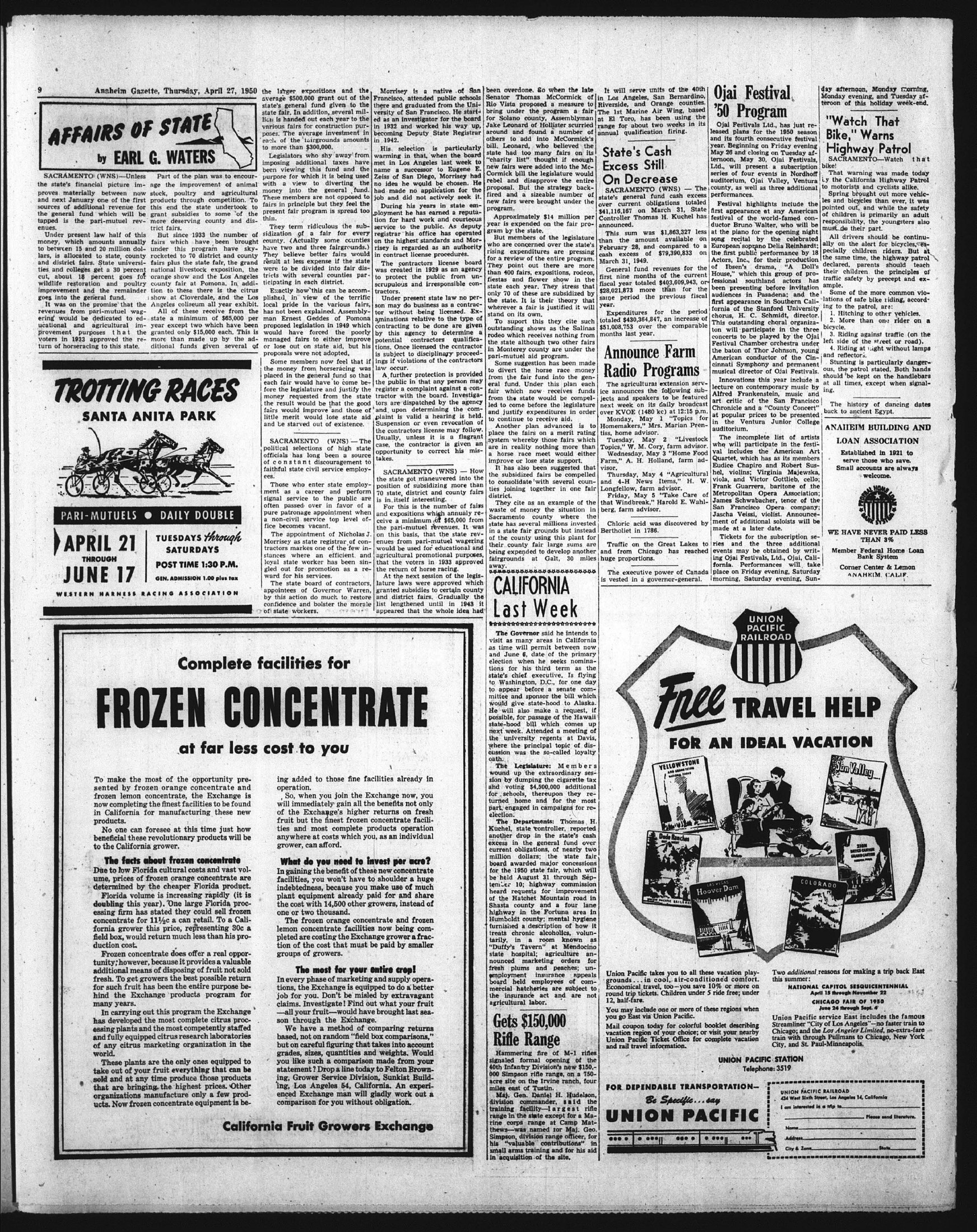
Searchable text
AFFAIRS OF STATE
by EARL G. WATERS
SACRAMENTO (WNS)—Unless the state's financial picture improves materially between now and next January one of the first sources of additional revenue for the general fund which will be tapped is the pari-mutuel revenues.
Under present law half of this money, which amounts annually to between 15 and 20 million dollars, is allocated to state, county and district fairs. State universities and colleges get a 30 percent cut, about 18 percent goes for wildlife restoration and poultry improvement and the remainder goes into the general fund.
It was on the promise that the revenues from pari-mutuel wagering would be dedicated to educational and agricultural improvement purposes that the voters in 1933 approved the return of horseracing to this state.
Part of the plan was to encourage the improvement of animal stock, poultry and agricultural products through competition. To this end the state undertook to grant subsidies to some of the more deserving county and district fairs.
But since 1933 the number of fairs which have been brought under this program have skyrocketed to 70 district and county fairs plus the state fair, the grand national livestock exposition, the orange show and the Los Angeles county fair at Pomona. In addition to these there is the citrus show at Cloverdale, and the Los Angeles coliseum all year exhibit.
All of these receive from the state a minimum of $65,000 per year except two which have been granted only $15,000 each. This is more than made up by the additional funds given several of the larger expositions and the average $500,000 grant out of the state's general fund given to the state fair. In addition, several million is handed out each year to the various fairs for construction purposes. The average investment in each of the fairgrounds amount to more than $300,000.
Legislators who shy away from imposing additional taxes have been viewing this fund and the purpose for which it is being used with a view to diverting the money into the general fund. These members are not opposed to fairs in principle but they feel that present fair program is spread too thin.
They term ridiculous the subsidization of a fair for every county. (Actually some counties have two and three fairgrounds.) They believe better fairs would result at less expense if the state were to be divided into fair districts with several counties participating in each district.
Exactly how this can be accomplished, in view of the terrific local pride in the various fairs has not been explained. Assemblyman Ernest Geddes of Pomona proposed legislation in 1949 which would have forced the poor managed fairs to either improve or lose out on state aid, but his proposals were not adopted.
Some members now feel that the money from horseracing was placed in the general fund so that each fair would have to come before the legislature and justify the money requested from the state; the result would be that the good fairs would improve and those little merit would lose state aid and be starved out of existence.
SACRAMENTO (WNS) — The political selections of high state officials has long been a source...
TROTTING RACES
SANTA ANITA PARK
PARI-MUTUELS DAILY DOUBLE
APRIL 21
THROUGH
JUNE 17
TUESDAYS through
SATURDAYS
POST TIME 1:30 P.M.
GEN. ADMISSION 1.00 plus tax
WESTERN HARNESS RACING ASSOCIATION
Complete facilities for
FROZEN CONCENTRATE
at far less cost to you
To make the most of the opportunity presented by frozen orange concentrate and frozen lemon concentrate, the Exchange is now completing the finest facilities to be found in California for manufacturing these new products.
No one can foresee at this time just how beneficial these revolutionary products will be to the California grower.
The facts about frozen concentrate
Due to low Florida cultural costs and vast vol-
ing added to those fine operation.
So, when you join the will immediately gain all of the Exchange’s higher fruit but the finest frozen ties and most complete anywhere at costs which grower, can afford.
What do you need to
To make the most of the opportunity presented by frozen orange concentrate and frozen lemon concentrate, the Exchange is now completing the finest facilities to be found in California for manufacturing these new products.
No one can foresee at this time just how beneficial these revolutionary products will be to the California grower.
The facts about frozen concentrate
Due to low Florida cultural costs and vast volume, prices of frozen orange concentrate are determined by the cheaper Florida product.
Florida volume is increasing rapidly (it is doubling this year). One large Florida processing firm has stated they could sell frozen concentrate for 11½c a can retail. To a California grower this price, representing 30c a field box, would return much less than his production cost.
Frozen concentrate does offer a real opportunity; however, because it provides a valuable additional means of disposing of fruit not sold fresh. To get growers the best possible return for such fruit has been the entire purpose behind the Exchange products program for many years.
In carrying out this program the Exchange has developed the most complete citrus processing plants and the most competently staffed and fully equipped citrus research laboratories of any citrus marketing organization in the world.
These plants are the only ones equipped to take out of your fruit everything that can be sold and at any time produce those products that are bringing the highest prices. Other organizations manufacture only a few products. Now frozen concentrate equipment is being added to those fine operations.
So, when you join the Exchange's higher fruit but the finest frozen ties and most complete anywhere at costs which your grower, can afford.
What do you need to do?
In gaining the benefit of the facilities, you won't have indebtedness, because your plant equipment already fits the cost with 14,500 other one or two thousand.
The frozen orange concentrate柠檬 concentrate facility pleted are costing the Exchange of the cost that must groups of growers.
The most for you
In every phase of marketing, the Exchange is equivalent job for you. Don't be misleading claims. Investigate! Find all your fruit—would have son through the Exchange.
We have a method of based, not on random "field" but on careful figuring that grades, sizes, quantities say you like such a comparison statement? Drop a line too ing, Grower Service Dividing, Los Angeles 54, Cal enced Exchange man will comparison for you without
tiger expositions and the $500,000 grant out of the general fund given to the city. In addition, several milled out each year to the fares for construction purposes. The average investment in the fairgrounds amounts more than $300,000.
Members who shy away from additional taxes have viewed this fund and the for which it is being used view to diverting the money into the general fund. Members are not opposed to principle but they feel the fair program is spread too broadly.
The term ridiculous the subjection of a fair for every county (Actually some counties two and three fairgrounds.) believe better fairs would not less expense if the state be divided into fair disaffected with several counties paring in each district.
How this can be accomplished in view of the terrific pride in the various fairs, been explained. Assembly-earned Geddes of Pomona and legislation in 1949 which have forced the poorly paid fairs to either improve or out on state aid, but his rules were not adopted.
Members now feel that if money from horseracing was taken from the general fund so that fair would have to come before legislature and justify the request from the state unit would be that the good would improve and those of merit would lose state aid starved out of existence.
Morrissey is a native of San Francisco, attended public schools there and graduated from the University of San Francisco. He started as an investigator for the board in 1932 and worked his way up, becoming Deputy State Registrar in 1942.
His selection is particularly warming in that, when the board met in Los Angeles last week to name a successor to Eugene E. Zeiss of San Diego, Morrissey had no idea he would be chosen. He had made no application for the job and did not actively seek it.
During his years in state employment he has earned a reputation for hard work and courteous service to the public. As deputy registrar his office has operated on the highest standards and Morrissey is regarded as an authority in contract license procedures.
The contractors license board was created in 1929 as an agency to protect the public from unscrupulous and irresponsible contractors.
Under present state law no person may do business as a contractor without being licensed. Examinations relative to the type of contracting to be done are given by this agency to determine a potential contractors qualifications. Once licensed the contractor is subject to disciplinary proceedings if violations of the contractors law occur.
A further protection is provided the public in that any person may register a complaint against a contractor with the board. Investigators are dispatched by the agency and upon determining the complaint is valid a hearing is held. Suspension or even revocation of the contractors license may follow. Usually, unless it is a flagrant case, the contractor is given an opportunity to correct his mistakes.
been overdone. So when the late Senator Thomas McCormick of Rio Vista proposed a measure to bring under the program a fair for Solano county, Assemblyman Jake Leonard of Hollister scurried around and found a number of others to add into McCormick's bill. Leonard, who believed the state had too many fairs on its "charity list" thought if enough new fairs were added into the McCormick bill the legislature would rebel and disapprove the entire proposal. But the strategy backfired and a sizeable number of new fairs were brought under the program.
Approximately $14 million per year is expended on the fair program by the state.
But members of the legislature who are concerned over the state's rising expenditures are pressing for a review of the entire program. They point out there are more than 400 fairs, expositions, rodeos, fiestas and flower show in the state each year. They stress that only 70 of these are subsidized by the state. It is their theory that wherever a fair is justified it will stand on its own.
To support this they cite such outstanding shows as the Salinas rodeo which receives nothing from the state although two other fairs in Monterey county are under the pari-mutuel aid program.
Some suggestion has been made to divert the horse race money from the fair fund into the general fund. Under this plan each fair which now receives funds from the state would be compelled to come before the legislature and justify expenditures in order to continue to receive aid.
Another plan advanced is to place the fairs on a merit rating system whereby those fairs which are in reality nothing more than a horse race meet would either improve or lose state support.
It will serve units of the city in Los Angeles, San Bernardino Riverside, and Orange county. The 1st Marine Air Wing, based at El Toro, has been using a range for about two weeks in annual qualification firing.
State's Cash Excess Still On Decrease
SACRAMENTO (WNS) — state's general fund cash eased over current obligations to $41,116,167 on March 31, Controller Thomas H. Kuche announced.
This sum was $1,863,327 than the amount available February 28, and compared with cash excess of $79,390,833 March 31, 1949.
General fund revenues for first nine months of the fiscal year totaled $403,609,949 $28,021,873 more than for same period the previous year.
Expenditures for the totaled $430,364,847, an increase $51,008,753 over the comparable months last year.
Announce Farm Radio Program
The agricultural extension ice announces the following projects and speakers to be feared next week on its daily broadcast KVOE (1480 kc) at 12:15 Monday, May 1 "Topics Homemakers," Mrs. Marian Tiss, home advisor.
Tuesday, May 2 "Live Topics," W. M. Cory, farm ad Wednesday, May 3 "Home Farm." A H. Holland farm.
A further protection is provided the public in that any person may register a complaint against a contractor with the board. Investigators are dispatched by the agency and upon determining the complaint is valid a hearing is held. Suspension or even revocation of the contractors license may follow. Usually, unless it is a flagrant case, the contractor is given an opportunity to correct his mistakes.
SACRAMENTO (WNS) — How the state got maneuvered into the position of subsidizing more than 70 state, district and county fairs is in itself interesting.
For this is the number of fairs and expositions which annually receive a minimum of $65,000 from the pari-mutuel revenues. It was on this basis, that the state revenues from pari-mutuel wagering would be used for educational and agricultural promotional purposes, that the voters in 1933 approved the return of horse racing.
At the next session of the legislature laws were approved which granted subsidies to certain county and district fairs. Gradually the list lengthened until in 1943 it appeared that the whole idea had
CALIFORNIA Last Week
The Governor said he intends to visit as many areas in California as time will permit between now and June 6, date of the primary election when he seeks nominations for his third term as the state's chief executive. Is flying to Washington, D.C., for one day to appear before a senate committee and sponsor the bill which would give state-hood to Alaska. He will also make a request, if possible, for passage of the Hawaii state-hood bill which comes up next week. Attended a meeting of the university regents at Davis, where the principal topic of discussion was the so-called loyalty oath.
The Legislature: Members wound up the extraordinary session by dumping the cigarette tax and voting $4,500,000 additional for schools, thereupon they returned home and for the most part, engaged in campaigns for re-election.
The Departments: Thomas H. Kuchel, state controller, reported another drop in the state's cash excess in the general fund over current obligations, of nearly two million dollars; the state fair board awarded major concessions for the 1950 state fair which will
What do you need to invest per acre?
Gaining the benefit of these new concentrate facilities, you won't have to shoulder a huge debtedness, because you make use of much equipment already paid for and share the cost with 14,500 other growers, instead of one or two thousand.
The frozen orange concentrate and frozen lemon concentrate facilities now being constructed are costing the Exchange grower a fraction of the cost that must be paid by smaller groups of growers.
The most for your entire crop!
Every phase of marketing and supply operations, the Exchange is equipped to do a better job for you. Don't be misled by extravagant claims. Investigate! Find out what your fruit will your fruit—would have brought last season through the Exchange.
We have a method of comparing returns based, not on random "field box comparisons," but on careful figuring that takes into account trades, sizes, quantities and weights. Would you like such a comparison made from your statement? Drop a line today to Felton Brown, Grower Service Division, Sunkist Buildings, Los Angeles 54, California. An experienced Exchange man will gladly work out a comparison for you without obligation.
Fruit Growers Exchange
Gets $150,000
Rifle Range
Hammering fire of M-1 rifles signaled formal opening of the 40th Infantry Division's new $150,-000 Simpson rifle range, on a 750-acre site on the Irvine ranch, four miles east of Tustin.
Maj. Gen. Daniel H. Hudelson, division commander, said the training facility—largest rifle range in the state except for a Marine corps range at Camp Matthews—was named for Maj. Geo. Simpson, division range officer, for his "valuable contributions" in small arms training and for his aid in acquisition of the site.
Ojai Festival '50 Program
Ojai Festivals Ltd., has just released plans for the 1950 season and its fourth consecutive festival year. Beginning on Friday evening May 26 and closing on Tuesday afternoon, May 30, Ojai Festivals, Ltd., will present a subscription series of four events in Nordhoff auditorium, Ojai Valley, Ventura county, as well as three additional performances.
Festival highlights include the first appearance at any American festival of the world-famed conductor Bruno Walter, who will be at the piano for the opening night song recital by the celebrated European soprano Delia Reinhardt; the first public performance by 18 Actors, Inc., for their production of Ibsen's drama, "A Doll's House," which this group of professional southland actors has been presenting before invitation audiences in Pasadena; and the first appearance in Southern California of the Stanford University chorus, H. C. Schmidt, director. This outstanding choral organization will participate in the three concerts to be played by the Ojai Festival Chamber orchestra under the baton of Thor Johnson, young American conductor of the Cincinnati Symphony and permanent musical director of Ojai Festivals.
Innovations this year include a lecture on contemporary music by Alfred Frankenstein, music and art critic of the San Francisco Chronicle and a "County Concert" at popular prices to be presented in the Ventura Junior College auditorium.
The incomplete list of artists who will participate in the festival includes the American Art Quartet, which has as its members day afternoon, Monday morning, Monday evening, and Tuesday afternoon of this holiday week-end.
"Watch That Bike," Warns Highway Patrol
SACRAMENTO—Watch that bike!
That warning was made today by the California Highway Patrol to motorists and cyclists alike.
Spring brought out more vehicles and bicycles than ever, it was pointed out, and while the safety of children is primarily an adult responsibility, the youngsters also must do their part.
All drivers should be continually on the alert for bicycles, especially children riders. But at the same time, the highway patrol declared, parents should teach their children the principles of traffic safety by precept and example.
Some of the more common violations of safe bike riding, according to the patrol, are:
1. Hitching to other vehicles.
2. More than one rider on a bicycle.
3. Riding against traffic (on the left side of the street or road).
4. Riding at night without lamps and reflectors.
Stunting is particularly dangerous, the patrol stated. Both hands should be kept on the handlebars at all times, except when signaling.
The history of dancing dates back to ancient Egypt.
The agricultural extension service announces the following subscriptions and speakers to be featured at week on its daily broadcast on KVOE (1480 kc) at 12:15 p.m. Monday, May 1 "Topics for Farmers," Mrs. Marian Prenn- home advisor.
Tuesday, May 2 "Livestock News," W. M. Cory, farm advisor.
Wednesday, May 3 "Home Food News," A. H. Holland, farm advisor.
Thursday, May 4 "Agricultural News Items," H. W. Giffellow, farm advisor.
Friday, May 5 "Take Care of Windbreak," Harold E. Wahlg, farm advisor.
Chloric acid was discovered by tholiet in 1786.
Traffic on the Great Lakes to from Chicago has reached proportions.
The executive power of Canada rested in a governor-general.
Innovations this year include a lecture on contemporary music by Alfred Frankenstein, music and art critic of the San Francisco Chronicle and a "County Concert" at popular prices to be presented in the Ventura Junior College auditorium.
The incomplete list of artists who will participate in the festival includes the American Art Quartet, which has as its members Eudice Chapiro and Robert Sushel, violins; Virginia Majewska, viola, and Victor Gottlieb, cello; Frank Guarrera, baritone of the Metropolitan Opera Association; James Schwabacher, tenor of the San Francisco Opera company; Jascha Veissi, violist. Announcement of additional soloists will be made at a later date.
Tickets for the subscription series and the three additional events may be obtained by writing Ojai Festivals, Ltd., Ojai, California. Performances will take place on Friday evening, Saturday morning, Saturday evening, Sun-
ANAHEIM BUILDING AND LOAN ASSOCIATION
Established in 1921 to serve those who save.
Small accounts are always welcome.
WE HAVE NEVER PAID LESS THAN 3%
Member Federal Home Loan Bank System
Corner Center & Lemon ANAHEIM. CALIF.
UNION PACIFIC RAILROAD
Free TRAVEL HELP FOR AN IDEAL VACATION
Union Pacific takes you to all these vacation playgrounds...in cool, air-conditioned comfort. Economical travel, too—you save 10% or more on round trip tickets. Children under 5 ride free; under 7, half-fare.
You may include one or more of these regions when you go East via Union Pacific.
A rail coupon today for colorful booklet describing vacation region of your choice; or visit your nearby Union Pacific Ticket Office for complete vacation and rail travel information.
Two additional reasons for making a trip back East this summer:
NATIONAL CAPITOL SESQUICENTENNIAL
April 15 through November 22
CHICAGO FAIR OF 1950
June 24 through Sept. 4
Union Pacific service East includes the famous Streamliner "City of Los Angeles"—no faster train to Chicago; and the Los Angeles Limited, no extra-fare train with through Pullmans to Chicago, New York City, and St. Paul-Minneapolis.
UNION PACIFIC STATION
Telephone: 3519
FOR DEPENDABLE TRANSPORTATION—Be Specific...say UNION PACIFIC
UNION PACIFIC RAILROAD
434 West Sixth Street, Los Angeles 14, California
I am interested in a trip to___Please send literature.
Name___
Address___
City & Zone___State___