anaheim-gazette 1948-06-10
Scanned page
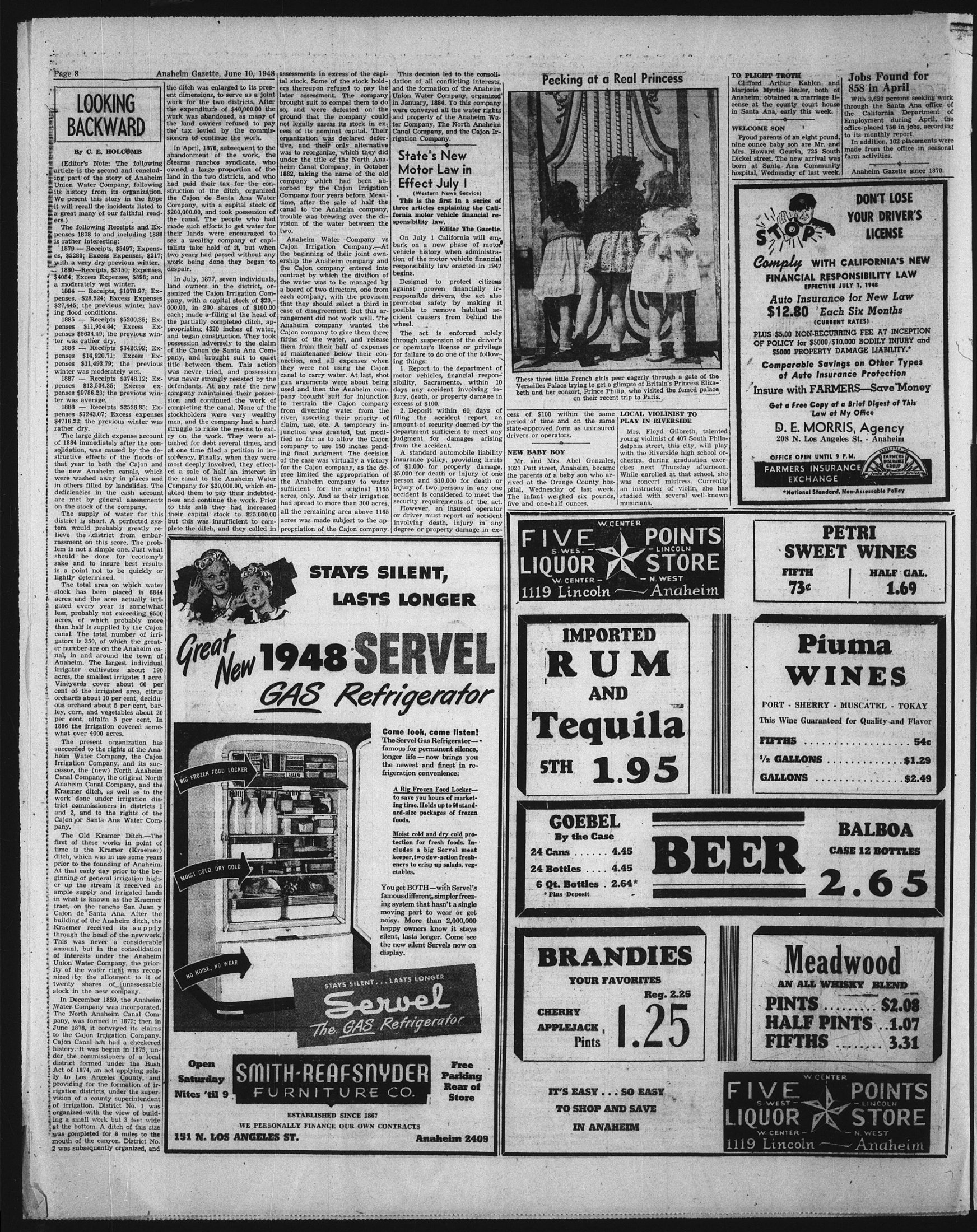
Searchable text
LOOKING BACKWARD
By C. E. HOLCOMB
(Editor's Note: The following article is the second and concluding part of the story of Anaheim Union Water Company, following its history from its organization. We present this story in the hope it will recall the incidents listed to a great many of our faithful readers.)
The following Receipts and Expenses 1878 to and including 1888 is rather interesting:
1879 — Receipts, $5497; Expenses, $5280; Excess Expenses, $217; with a very dry previous winter.
1880—Receipts, $3150; Expenses, $4084; Excess Expenses, $898; and a moderately wet winter.
1884 — Receipts, $1078.97; Expenses, $28,524; Excess Expenses $27,445; the previous winter having flood conditions.
1885 — Receipts $5200.35; Expenses $11,924.84; Excess Expenses $6634.49; the previous winter was rather dry.
1886 — Receipts $3426.92; Expenses $14,920.71; Excess Expenses $11,493.79; the previous winter was moderately wet.
1887 — Receipts $3748.12; Expenses $13,534.35; Excess expenses $9786.23; the previous winter was average.
1888 — Receipts $2526.85; Expenses $7243.07; Excess expenses $4716.22; the previous winter was rather dry.
The large ditch expense account of 1884 immediately after the consolidation, was caused by the destructive effects of the floods of the ditch was enlarged to its present dimensions, to serve as a joint work for the two districts. After the expenditure of $40,000.00 the work was abandoned, as many of the land owners refused to pay the tax levied by the commissioners to continue the work.
In April, 1876, subsequent to the abandonment of the work, the Stearns ranchos syndicate, who owned a large proportion of the land in the two districts, and who had paid their tax for the construction of the ditch, organized the Cajon de Santa Ana Water Company, with a capital stock of $200,000.00, and took possession of the canal. The people who had made such efforts to get water for their lands were encouraged to see a wealthy company of capitalists take hold of it, but when two years had passed without any work being done they began to despair.
In July, 1877, seven individuals, land owners in the district, organized the Cajon Irrigation Company, with a capital stock of $20,-000.00, in 200 shares of $100.00 each; made a filing at the head of the partially completed ditch, appropriating 4320 inches of water, and began construction. They took possession adversely to the claim of the Canon de Santa Ana Company, and brought suit to quiet title between them. This action was never tried, and possession was never strongly resisted by the defendants. At any rate the new company maintained their possession and continued the work of completing the canal. None of the stockholders were very wealthy men, and the company had a hard struggle to raise the means to carry on the work. They were attached for debt several times, and at one time filed a petition in insolvency. Finally, when they were assessments in excess of their total stock. Some of the stockers thereupon refused to participate in later assessment. The company brought suit to compel them so, and were defeated in ground that the company not legally assess its stock or access its nominal capital organization was declared active, and their only alteration was to reorganize, which under the title of the Northheim Canal Company, in 1882, taking the name of the company which had been sorbed by the Cajon Irrigation Company four years before time, after the sale of his canal to the Anaheim company trouble was brewing over vision of the water between two.
Anaheim Water Company Cajon Irrigation Company—the beginning of their jointorship the Anaheim company—the Cajon company entered contract by which the divider water was to be managed a board of two directors on each company, with the promise that they should select a case of disagreement. But arrangement did not work with Anaheim company wanting Cajon company to give their fifths of the water, and them from their half of every maintenance below the connection, and all expenses they were not using their canal to carry water. At last gun arguments were about used and then the Anaheim company brought suit for injunction was granted, but fled so far as to allow the company to use 150 inches final judgment. The cost of the case was virtually zero.
The large ditch expense account of 1884 immediately after the consolidation, was caused by the destructive effects of the floods of that year to both the Cajon and the new Anaheim canals, which were washed away in places and in others filled by landslides. The deficiencies in the cash account are met by general assessments on the stock of the company.
The supply of water for this district is short. A perfected system would probably greatly relieve the district from embarrassment on this score. The problem is not a simple one. Just what should be done for economy's sake and to insure best results is a point not to be quickly or lightly determined.
The total area on which water stock has been placed is 6844 acres and the area actually irrigated every year is somewhat less, probably not exceeding 6500 acres, of which probably more than half is supplied by the Cajon canal. The total number of irrigators is 350, of which the greater number are on the Anaheim canal, in and around the town of Anaheim. The largest individual irrigator cultivates about 190 acres, the smallest irrigates 1 acre. Vineyards cover about 60 per cent of the irrigated area, citrus orchards about 10 per cent, deciduous orchard about 5 per cent, barley, corn, and vegetables about 20 per cent, alfalfa 5 per cent. In 1886 the irrigation covered somewhat over 4000 acres.
The present organization has succeeded to the rights of the Anaheim Water Company, the Cajon Irrigation Company, and its successor, the (new) North Anaheim Canal Company, the original North Anaheim Canal Company, and the Kraemer ditch, as well as to the work done under irrigation district commissioners in districts 1 and 2, and to the rights of the Cajon or Santa Ana Water Company.
The Old Kramer Ditch.—The first of these works in point of time is the Kramer (Kraemer) ditch, which was in use some years prior to the founding of Anaheim. At that early day prior to the title between them. This action was never tried, and possession was never strongly resisted by the defendants. At any rate the new company maintained their possession and continued the work of completing the canal. None of the stockholders were very wealthy men, and the company had a hard struggle to raise the means to carry on the work. They were attached for debt several times, and at one time filed a petition in solvency. Finally, when they were most deeply involved, they effected a sale of half an interest in the canal to the Anaheim Water Company for $20,000.00, which enabled them to pay their indebtedness and continue the work. Prior to this sale they had increased their capital stock to $25,000.00 but this was insufficient to complete the ditch, and they called in...
The Old Kramer Ditch.—The first of these works in point of time is the Kramer (Kraemer) ditch, which was in use some years prior to the founding of Anaheim. At that early day prior to the beginning of general irrigation higher up the stream it received an ample supply and irrigated lands in what is known as the Kraemer tract, on the rancho San Juan y Cajon de Santa Ana. After the building of the Anaheim ditch, the Kraemer received its supply through the head of the newwork. This was never a considerable amount, but in the consolidation of interests under the Anaheim Union Water Company, the priority of the water right was recognized by the allotment to it of twenty shares of unassessable stock in the new company.
In December 1859, the Anaheim Water Company was incorporated. The North Anaheim Canal Company, was formed in 1872; then in June 1878, it conveyed its claims to the Cajon Irrigation Company. Cajon Canal has had a checkered history. It was begun in 1875, under the commissioners of a local district formed under the Bush Act of 1874, an act applying solely to Los Angeles County, and providing for the formation of irrigation districts, under the supervision of a county superintendent of irrigation. District No. 1 was organized with the view of building a small work but 3 feet wide at the bottom. A ditch of this size was completed for 8 miles to the mouth of the canyon. District No. 2 was subsequently organized, and
Assessments in excess of the capital stock. Some of the stock holdings thereupon refused to pay the water assessment. The company brought suit to compel them to do so, and were defeated on the ground that the company could not legally assess its stock in excess of its nominal capital. Their organization was declared defective, and their only alternative was to reorganize, which they did under the title of the North Anaheim Canal Company, in October 1882, taking the name of the old company which had been aborted by the Cajon Irrigation Company four years before. Meanwhile, after the sale of half the final to the Anaheim company, double was brewing over the division of the water between the two.
Anaheim Water Company vs. Cajon Irrigation Company.—At the beginning of their joint ownership the Anaheim company and the Cajon company entered into contract by which the division of the water was to be managed by board of two directors, one from each company, with the provision that they should select a third in case of disagreement. But this arrangement did not work well. The Anaheim company wanted the Cajon company to give them three months of the water, and release them from their half of expenses in maintenance below their collection, and all expenses when they were not using the Cajon canal to carry water. At last, shot gun arguments were about being used and then the Anaheim company brought suit for injunction against restrain the Cajon company from diverting water from the river, asserting their priority of claim, use, etc. A temporary injunction was granted, but modified so far as to allow the Cajon company to use 150 inches pending final judgment. The decision
This decision led to the consolidation of all conflicting interests, and the formation of the Anaheim Union Water Company, organized in January, 1884. To this company were conveyed all the water rights and property of the Anaheim Water Company, The North Anaheim Canal Company, and the Cajon Irrigation Company.
State's New Motor Law in Effect July 1
(Western News Service)
This is the first in a series of three articles explaining the California motor vehicle financial responsibility law.
Editor The Gazette.
On July 1 California will embark on a new phase of motor vehicle history when administration of the motor vehicle financial responsibility law enacted in 1947 begins.
Designed to protect citizens against proven financially irresponsible drivers, the act also promotes safety by making it possible to remove habitual accident causes from behind the wheel.
The act is enforced solely through suspension of the driver's or operator's license or privilege for failure to do one of the following things:
1. Report to the department of motor vehicles, financial responsibility, Sacramento, within 10 days any accident involving injury, death, or property damage in excess of $100.
2. Deposit within 60 days of filing the accident report an amount of security deemed by the department sufficient to meet any judgment for damages arising from the accident.
A standard automobile liability insurance policy providing limits
These three little French girls peer eagerly through a gate Versailles Palace trying to get a glimpse of Britain's Prince beth and her consort, Prince Philip, who visited the famine on their recent trip to Paris.
LOCAL VIOLINIST THE PLAY IN RIVERSIDE
Mrs. Floyd Gilbret young violinist of 407 S delphia street, this city with the Riverside high school during graduation
they were not using the Cajon
nal to carry water. At last, shot
an arguments were about being
used and then the Anaheim company brought suit for injunction
restrain the Cajon company
from diverting water from the
river, asserting their priority of
aim, use, etc. A temporary inction was granted, but modiced so far as to allow the Cajon
company to use 150 inches pending final judgment. The decision
the case was virtually a victory
for the Cajon company, as the deree limited the appropriation of
the Anaheim company to water
efficient for the original 1165
acres, only. And as their irrigation
and spread to more than 300 acres,
all the remaining area above 1165
acres was made subject to the appropriation of the Cajon company.
1. Report to the department of motor vehicles, financial responsibility, Sacramento, within 10 days any accident involving injury, death, or property damage in excess of $100.
2. Deposit within 60 days of filing the accident report an amount of security deemed by the department sufficient to meet any judgment for damages arising from the accident.
A standard automobile liability insurance policy, providing limits of $1,000 for property damage, $5,000 for death or injury of one person and $10,000 for death or injury of two persons in any one accident is considered to meet the security requirements of the act.
However, an insured operator or driver must report an accident involving death, injury in any degree or property damage in ex-
STAYS SILENT,
LASTS LONGER
1948 SERVEL
GAS Refrigerator
Come look, come listen!
The Servel Gas Refrigerator—famous for permanent silence;
longer life—now brings you the newest and finest in refrigeration convenience:
A Big Frozen Food Locker—to save you hours of marketing time. Holds up to 60 standard-size packages of frozen foods.
Moist cold and dry cold protection for fresh foods. Includes a big Servel meat keeper, two dew-action fresheners to crisp up salads, veg-
These three little French girls peer eagerly through a gaVersailles Palace trying to get a glimpse of Britain's Prince
beth and her consort, Prince Philip, who visited the famon their recent trip to Paris.
cess of $100 within the same period of time and on the same state-approved form as uninsured drivers or operators.
NEW BABY BOY
Mr. and Mrs. Abel Gonzales,
1027 Patt street, Anaheim, became the parents of a baby son who arrived at the Orange County hospital, Wednesday of last week.
The infant weighed six pounds, five and one-half ounces.
W.CENTER
FIVE
S.WES.
LIQUOR
W.CENTER
N.WEST
1119 Lincoln
Anah
IMPORTED
RUM AND
Tequila
5TH 1.95
GOEBEL
By the Case
24 Cans . . . 4.45
24 Bottles . . . 4.45
A Big Frozen Food Locker—to save you hours of marketing time. Holds up to 60 standard-size packages of frozen foods.
Moist cold and dry cold protection for fresh foods. Includes a big Servel meat keeper, two dew-action fresheners to crisp up salads, vegetables.
You get BOTH—with Servel's famous different, simpler freezing system that hasn't a single moving part to wear or get noisy. More than 2,000,000 happy owners know it stays silent, lasts longer. Come see the new silent Servels now on display.
STAYS SILENT...LASTS LONGER
Servel
The GAS Refrigerator
H-REAFSNYDER
FURNITURE CO.
ESTABLISHED SINCE 1867
LLY FINANCE OUR OWN CONTRACTS
ST.
Anaheim 2409
GOEBEL
By the Case
24 Cans . . . . 4.45
24 Bottles . . . 4.45
6 Qt. Bottles . 2.64*
* Plus Deposit
BRANDIES
YOUR FAVORITES
Reg. 2.25
CHERRY
APPLEJACK,
Pints 1.25
IT'S EASY...SO EASY
TO SHOP AND SAVE
IN ANAHEIM
TO PLIGHT TROTH
Clifford Arthur Kahlen and Marjorie Myrtle Resler, both of Anaheim, obtained a marriage license at the county court house in Santa Ana, early this week.
WELCOME SON
Proud parents of an eight pound, nine ounce baby son are Mr. and Mrs. Howard Geurin, 725 South Dickel street. The new arrival was born at Santa Ana Community hospital, Wednesday of last week.
Jobs Found for 858 in April
With 3,630 persons seeking work through the Santa Ana office of the California Department of Employment during April, the office placed 756 in jobs, according to its monthly report.
In addition, 102 placements were made from the office in seasonal farm activities.
Anaheim Gazette since 1870.
DON'T LOSE YOUR DRIVER'S LICENSE
Comply WITH CALIFORNIA'S NEW FINANCIAL RESPONSIBILITY LAW
EFFECTIVE JULY 1, 1948
Auto Insurance for New Law
$12.80 Each Six Months
(CURRENT RATES)
PLUS $5.00 NON-RECURRING FEE AT INCEPTION OF POLICY for $5000/$10,000 BODILY INJURY and $5000 PROPERTY DAMAGE LIABILITY.*
Comparable Savings on Other Types of Auto Insurance Protection
Insure with FARMERS—Save Money
Get a Free Copy of a Brief Digest of This Law at My Office
D. E. MORRIS, Agency
208 N. Los Angeles St. - Anaheim
OFFICE OPEN UNTIL 9 P.M.
LOCAL VIOLINIST TO PLAY IN RIVERSIDE
Mrs. Floyd Gilbreth, talented young violinist of 407 South Philadelphia street, this city, will play with the Riverside high school orchestra, during graduation exercises next Thursday afternoon. While enrolled at that school, she was concert mistress. Currently an instructor of violin, she has studied with several well-known musicians.
Comparable Savings on Other Types of Auto Insurance Protection
Insure with FARMERS—Save Money
Get a Free Copy of a Brief Digest of This Law at My Office
D. E. MORRIS, Agency
208 N. Los Angeles St. - Anaheim
OFFICE OPEN UNTIL 9 P.M.
FARMERS INSURANCE EXCHANGE
*National Standard, Non-Assessable Policy
POINTS LINCOLN STORE
N.WEST Anaheim
PETRI SWEET WINES
FIFTH 73¢ HALF GAL. 1.69
Piuma WINES
PORT - SHERRY - MUSCATEL - TOKAY
This Wine Guaranteed for Quality and Flavor
FIFTHS . . . . . . . . . . . . . . . . . . . . . . . . . . . . 54¢
½ GALLONS . . . . . . . $1.29
GALLONS . . . . . . . . . $2.49
BEER
BALBOA
CASE 12 BOTTLES
GALLONS $2.49
BEER BALBOA CASE 12 BOTTLES 2.65
NDIES
AVORITES
Reg. 2.25
1.25
Meadwood
AN ALL WHISKY BLEND
PINTS $2.08
HALF PINTS 1.07
FIFTHS 3.31
SO EASY
ND SAVE
HEIM
W.CENTER
FIVE
S.WEST
LIQUOR
W.CENTER
1119 Lincoln
POINTS
LINCOLN
STORE
N.WEST
Anaheim