anaheim-gazette 1948-01-01
Scanned page
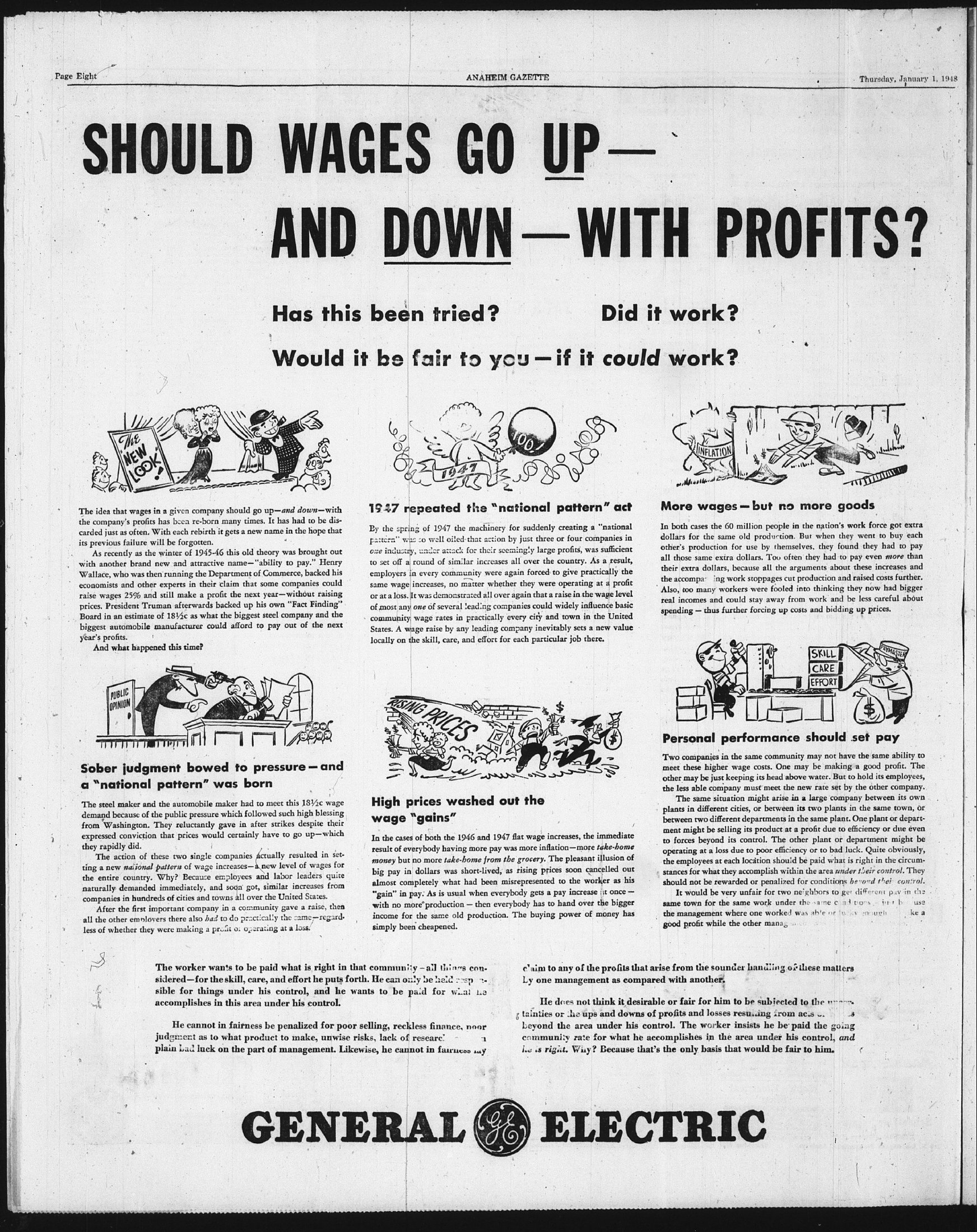
Searchable text
SHOULD WAG
AND
Has this
Would it
The idea that wages in a given company should go up—and down—with the company's profits has been re-born many times. It has had to be discarded just as often. With each rebirth it gets a new name in the hope that its previous failure will be forgotten.
As recently as the winter of 1945-46 this old theory was brought out with another brand new and attractive name—"ability to pay." Henry Wallace, who was then running the Department of Commerce, backed his economists and other experts in their claim that some companies could raise wages 25% and still make a profit the next year—without raising prices. President Truman afterwards backed up his own "Fact Finding" Board in an estimate of 18½c as what the biggest steel company and the biggest automobile manufacturer could afford to pay out of the next year's profits.
And what happened this time?
Sober judgment bowed to pressure—and a "national pattern" was born
The steel maker and the automobile maker had to meet this 18½c wage demand because of the public pressure which followed such high blessing from Washington. They reluctantly gave in after strikes despite their expressed conviction that prices would certainly have to go up—which they rapidly did.
The action of these two single companies actually resulted in setting a new national pattern of wage increases—a new level of wages for
a "national pattern" was born
The steel maker and the automobile maker had to meet this 18½c wage demand because of the public pressure which followed such high blessing from Washington. They reluctantly gave in after strikes despite their expressed conviction that prices would certainly have to go up—which they rapidly did.
The action of these two single companies actually resulted in setting a new national pattern of wage increases—a new level of wages for the entire country. Why? Because employees and labor leaders quite naturally demanded immediately, and soon got, similar increases from companies in hundreds of cities and towns all over the United States.
After the first important company in a community gave a raise, then all the other employers there also had to do practically the same—regardless of whether they were making a profit or operating at a loss.
The worker wants to be paid what is right in that sidered—for the skill, care, and effort he puts forth sible for things under his control, and he want accomplishes in this area under his control.
He cannot in fairness be penalized for poor so judgment as to what product to make, unwise risk plain bad luck on the part of management. Likew
ANAHEIM GAZETTE
WAGES GO UP —
AND DOWN — WITH
Has this been tried?
Did it we
Would it be fair to you—if it could we
1947 repeated the "national pattern" act
By the spring of 1947 the machinery for suddenly creating a "national pattern" was so well oiled that action by just three or four companies in one industry, under attack for their seemingly large profits, was sufficient to set off a round of similar increases all over the country. As a result, employers in every community were again forced to give practically the same wage increases, no matter whether they were operating at a profit or at a loss. It was demonstrated all over again that a raise in the wage level of most any one of several leading companies could widely influence basic community wage rates in practically every city and town in the United States. A wage raise by any leading company inevitably sets a new value locally on the skill, care, and effort for each particular job there.
High prices washed out the wage "gains"
In the cases of both the 1946 and 1947 flat wage increases, the immediate result of everybody having more pay was more inflation—more take-home money but no more take-home from the grocery. The pleasant illusion of high pay in dollars was short-lived, as rising prices soon cancelled out
High prices washed out the wage "gains"
In the cases of both the 1946 and 1947 flat wage increases, the immediate result of everybody having more pay was more inflation—more take-home money but no more take-home from the grocery. The pleasant illusion of big pay in dollars was short-lived, as rising prices soon cancelled out almost completely what had been misrepresented to the worker as his "gain" in pay. As is usual when everybody gets a pay increase once with no more production — then everybody has to hand over the bigger income for the same old production. The buying power of money has simply been cheapened.
What is right in that community—all things confort he puts forth. He can only be held respintrol, and he wants to be paid for what he
for his control.
Generalized for poor selling, reckless finance, poor
to make, unwise risks, lack of researcmanagement. Likewise, he cannot in fairness say
claim to any of the profits that arise from
by one management as compared with a
He does not think it desirable or failtainies or the ups and downs of profits a
beyond the area under his control. Th
community rate for what he accomplishe
he is right. Why? Because that's the on-
Thursday, January 1, 1948
WITH PROFITS?
Did it work?
Could work?
More wages—but no more goods
In both cases the 60 million people in the nation's work force got extra dollars for the same old production. But when they went to buy each other's production for use by themselves, they found they had to pay all those same extra dollars. Too often they had to pay even more than their extra dollars, because all the arguments about these increases and the accompanying work stoppages cut production and raised costs further. Also, too many workers were fooled into thinking they now had bigger real incomes and could stay away from work and be less careful about spending—thus further forcing up costs and bidding up prices.
Personal performance should set pay
Two companies in the same community may not have the same ability to meet these higher wage costs. One may be making a good profit. The other may be just keeping its head above water. But to hold its employees, the less able company must meet the new rate set by the other company.
The same situation might arise in a large company between its own plants in different cities, or between its two plants in the same town, or between two different departments in the same plant. One plant or department might be selling its product at a profit due to efficiency or due even to forces beyond its control. The other plant or department might be operating at a loss due to poor efficiency or to bad luck. Quite obviously, the employees at each location should be paid what is right in the circum-
other may be just keeping its head above water. But to hold its employees,
the less able company must meet the new rate set by the other company.
The same situation might arise in a large company between its own plants in different cities, or between its two plants in the same town, or between two different departments in the same plant. One plant or department might be selling its product at a profit due to efficiency or due even to forces beyond its control. The other plant or department might be operating at a loss due to poor efficiency or to bad luck. Quite obviously, the employees at each location should be paid what is right in the circumstances for what they accomplish within the area under their control. They should not be rewarded or penalized for conditions beyond their control.
It would be very unfair for two neighbors to get different pay in the same town for the same work under the same conditions, just because the management where one worked was able or lucky enough to make a good profit while the other managed.
Profit that arise from the sounder handling of these matters was compared with another.
It is desirable or fair for him to be subjected to the unpleasant downs of profits and losses resulting from acts under his control. The worker insists he be paid the going what he accomplishes in the area under his control, and because that's the only basis that would be fair to him.