anaheim-gazette 1947-12-25
Scanned page
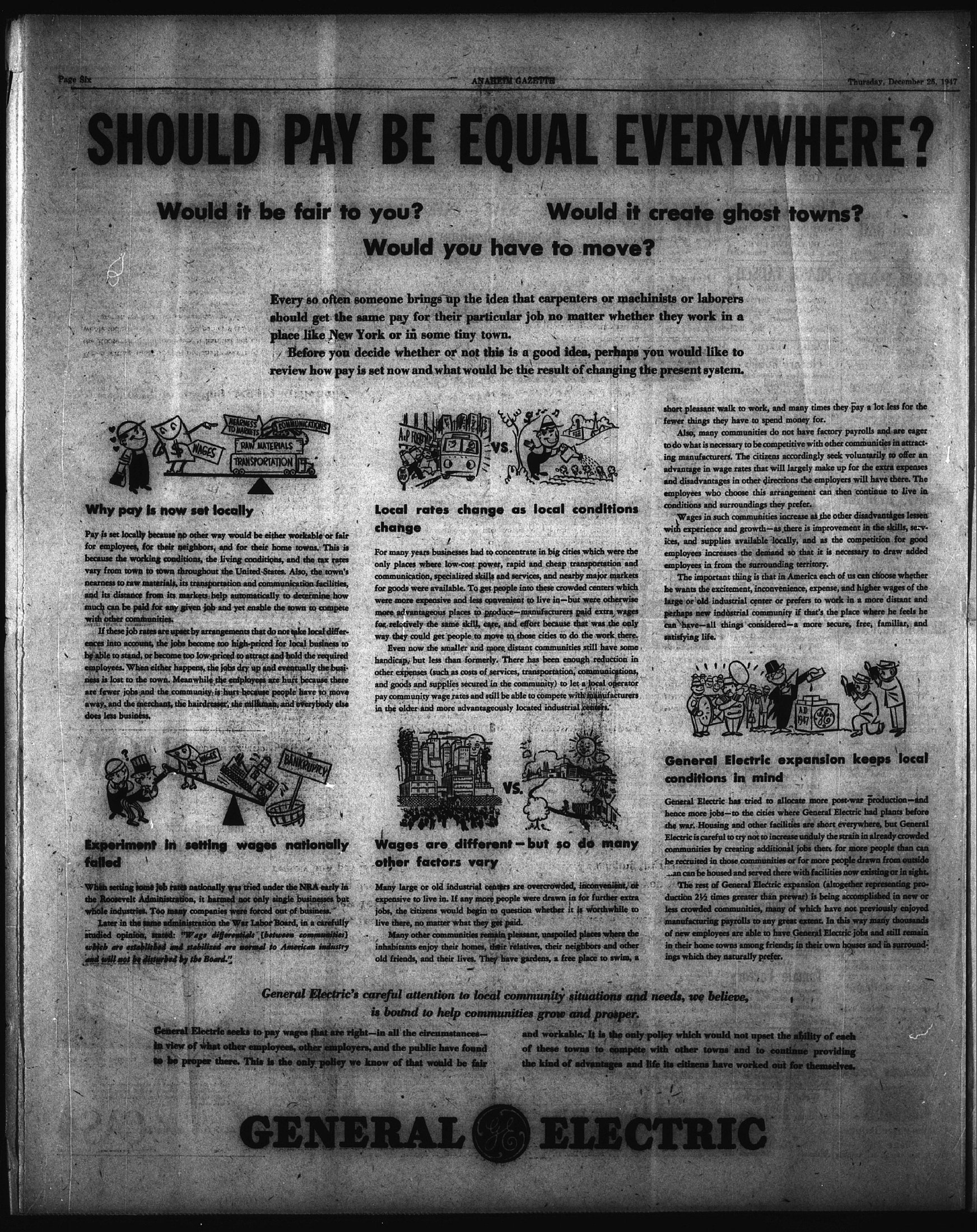
Searchable text
SHOULD PAY
Would it be fair to
Every so often so should get the same place like New York Before you do review how pay is
NEARNESS TO MARKETS COMMUNICATIONS WAGES RAW MATERIALS
Why pay is now set locally
Pay is set locally because no other way would be either workable or fair for employees, for their neighbors, and for their home towns. This is because the working conditions, the living conditions, and the tax rates vary from town to town throughout the United States. Also, the town's nearness to raw materials, its transportation and communication facilities, and its distance from its markets help automatically to determine how much can be paid for any given job and yet enable the town to compete with other communities.
If these job rates are upset by arrangements that do not take local differences into account, the jobs become too high-priced for local business to be able to stand, or become too low-priced to attract and hold the required employees. When either happens, the jobs dry up and eventually the business is lost to the town. Meanwhile the employees are hurt because there are fewer jobs and the community is hurt because people have to move away, and the merchant, the hairdresser, the milkman, and everybody else does less business.
Experiment in setting wages nationally failed
Experiment in setting wages nationally failed
When setting some job rates nationally was tried under the NRA early in the Roosevelt Administration, it harmed not only single businesses but whole industries. Too many companies were forced out of business.
Later in the same administration the War Labor Board, in a carefully studied opinion, stated: "Wage differentials [between communities] which are established and stabilized are normal to American industry and will not be disturbed by the Board."
General Electric seeks to pay wages that are right in view of what other employees, other employers to be proper there. This is the only policy we
PAY BE EQUAL EVEN
fair to you? Would it crea
Would you have to move?
ery so often someone brings up the idea that carpenters or machinists or
would get the same pay for their particular job no matter whether they w
ce like New York or in some tiny town.
Before you decide whether or not this is a good idea, perhaps you wou
iew how pay is set now and what would be the result of changing the prese
Local rates change as local conditions change
For many years businesses had to concentrate in big cities which were the only places where low-cost power, rapid and cheap transportation and communication, specialized skills and services, and nearby major markets for goods were available. To get people into these crowded centers which were more expensive and less convenient to live in—but were otherwise more advantageous places to produce—manufacturers paid extra wages for relatively the same skill, care, and effort because that was the only way they could get people to move to those cities to do the work there.
Even now the smaller and more distant communities still have some handicap, but less than formerly. There has been enough reduction in other expenses (such as costs of services, transportation, communications, and goods and supplies secured in the community) to let a local operator pay community wage rates and still be able to compete with manufacturers in the older and more advantageously located industrial centers.
Wages are different—but so do many other factors vary
nationally
the NRA early in
le businesses but
of business.
ard, in a carefully
en communities]
american industry
VS.
Wages are different—but so do many other factors vary
Many large or old industrial centers are overcrowded, inconvenient, or expensive to live in. If any more people were drawn in for further extra jobs, the citizens would begin to question whether it is worthwhile to live there, no matter what they get paid.
Many other communities remain pleasant, unspoiled places where the inhabitants enjoy their homes, their relatives, their neighbors and other old friends, and their lives. They have gardens, a free place to swim, a
General Electric’s careful attention to local community situations and needs, which is bound to help communities grow and prosper.
wages that are right—in all the circumstances—es, other employers, and the public have found the only policy we know of that would be fair
and workable. It is the only policy whi of these towns to compete with othe the kind of advantages and life its citi
Thursday, December 25, 1947
EVERYWHERE?
If it create ghost towns?
ove?
machinists or laborers
whether they work in a
haps you would like to
going the present system.
short pleasant walk to work, and many times they pay a lot less for the fewer things they have to spend money for.
Also, many communities do not have factory payrolls and are eager to do what is necessary to be competitive with other communities in attracting manufacturers. The citizens accordingly seek voluntarily to offer an
short pleasant walk to work, and many times they pay a lot less for the fewer things they have to spend money for.
Also, many communities do not have factory payrolls and are eager to do what is necessary to be competitive with other communities in attracting manufacturers. The citizens accordingly seek voluntarily to offer an advantage in wage rates that will largely make up for the extra expenses and disadvantages in other directions the employers will have there. The employees who choose this arrangement can then continue to live in conditions and surroundings they prefer.
Wages in such communities increase as the other disadvantages lessen with experience and growth—as there is improvement in the skills, services, and supplies available locally, and as the competition for good employees increases the demand so that it is necessary to draw added employees in from the surrounding territory.
The important thing is that in America each of us can choose whether he wants the excitement, inconvenience, expense, and higher wages of the large or old industrial center or prefers to work in a more distant and perhaps new industrial community if that's the place where he feels he can have—all things considered—a more secure, free, familiar, and satisfying life.
General Electric expansion keeps local conditions in mind
General Electric has tried to allocate more post-war production—and hence more jobs—to the cities where General Electric had plants before the war. Housing and other facilities are short everywhere, but General Electric is careful to try not to increase unduly the strain in already crowded communities by creating additional jobs there for more people than can be recruited in those communities or for more people drawn from outside
General Electric has tried to allocate more post-war production—and hence more jobs—to the cities where General Electric had plants before the war. Housing and other facilities are short everywhere, but General Electric is careful to try not to increase unduly the strain in already crowded communities by creating additional jobs there for more people than can be recruited in those communities or for more people drawn from outside...an can be housed and served there with facilities now existing or in sight.
The rest of General Electric expansion (altogether representing production 2½ times greater than prewar) is being accomplished in new or less crowded communities, many of which have not previously enjoyed manufacturing payrolls to any great extent. In this way many thousands of new employees are able to have General Electric jobs and still remain in their home towns among friends; in their own houses and in surroundings which they naturally prefer.
The only policy which would not upset the ability of each compete with other towns and to continue providing lives and life its citizens have worked out for themselves.