anaheim-gazette 1947-12-18
Scanned page
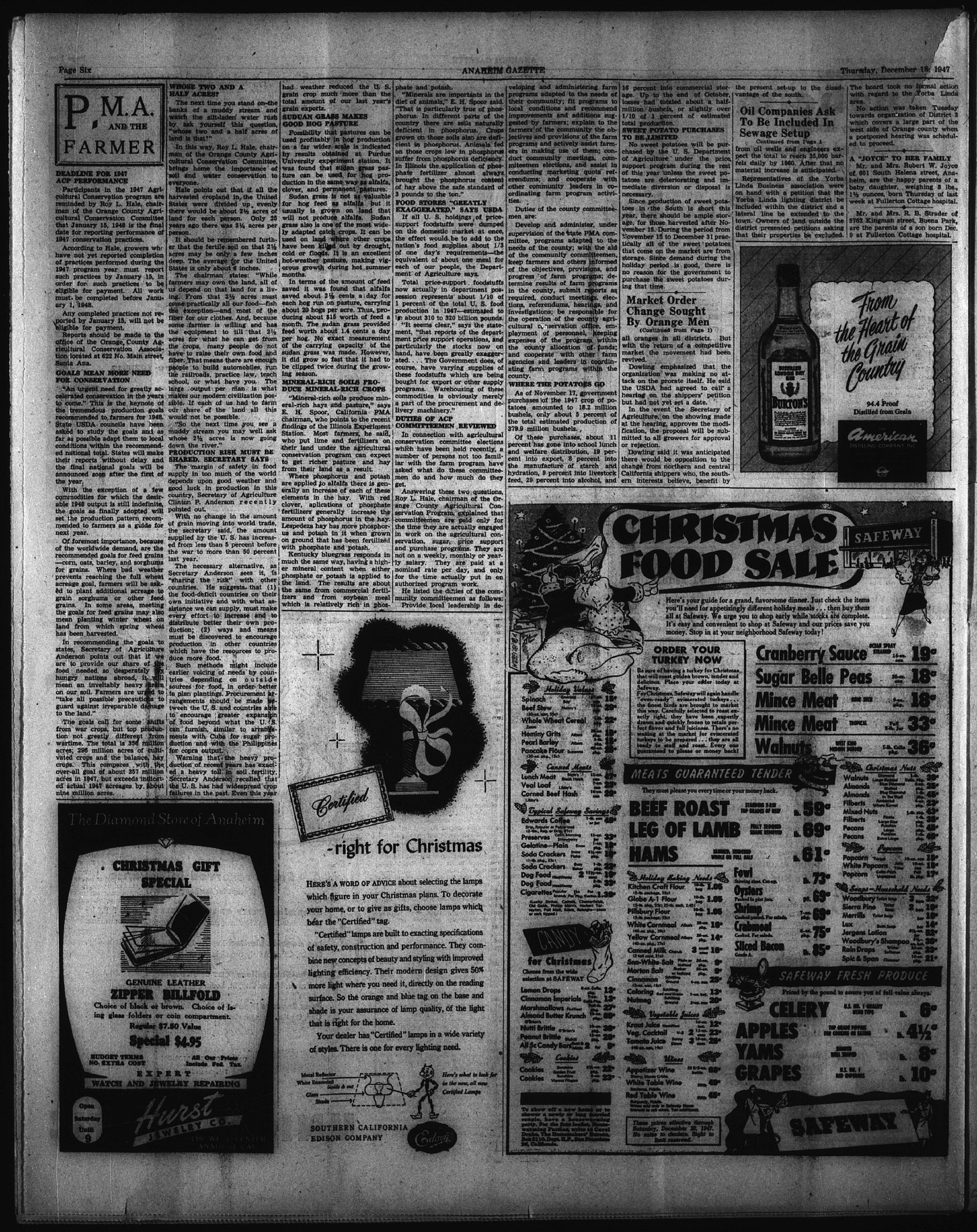
Searchable text
P.M.A. AND THE FARMER
DEADLINE FOR 1947 ACP PERFORMANCE
Participants in the 1947 Agricultural Conservation program are reminded by Roy L. Hale, chairman of the Orange County Agricultural Conservation Committee that January 15, 1948 is the final date for reporting performance of 1947 conservation practices.
According to Hale, growers who have not yet reported completion of practices performed during the 1947 program year must report such practices by January 15, in order for such practices to be eligible for payment. All work must be completed before January 1, 1948.
Any completed practices not reported by January 15, will not be eligible for payment.
Reports should be made to the office of the Orange County Agricultural Conservation Association located at 622 No. Main street, Santa Ana.
GOALS MEAN MORE NEED FOR CONSERVATION
"An urgent need for greatly accelerated conservation in the years to come." This is the keynote of the tremendous production goals recommended to farmers for 1948. State USDA councils have been asked to study the goals and as far as possible adapt them to local conditions within the recommended national total. States will make their reports without delay and WHOSE TWO AND A HALF ACRES?
The next time you stand on-the banks of a muddy stream and watch the silt-laden water rush by ask yourself this question, "whose two and a half acres of land is that?"
In this way, Roy L. Hale, chairman of the Orange County Agricultural Conservation Committee, brings home the importance of soil and water conservation to everyone.
Hale points out that if all the harvested cropland in the United States were divided up evenly there would be about 2½ acres of land for each person. Only 25 years ago there was 3¼ acres per person.
It should be remembered further that the fertile soil on that 2½ acres may be only a few inches deep. The average for the United States is only about 6 inches.
The chairman states: "While farmers may own the land, all of us depend on that land for a living. From that 2½ acres must come practically all our food—fish the exception—and most of the fiber for our clothes. And, because some farmer is willing and has the equipment to till that 2½ acres for what he can get from the crops, many people do not have to raise their own food and fiber. That means there are enough people to build automobiles, run the railroads, practice law, teach school, or what have you. The large output per man is what makes our modern civilization possible. If each of us had to farm our share of the land all this would not be possible."
"So the next time you see a muddy stream you may well ask whose 2½ acres is now going down the river."
PRODUCTION RISK MUST BE SHARED SECRETARY SAYS
Possibility that pastures used profitably in hog-production on a far wider scale is by results obtained at University experiment station was found that Sudan grain can be used for production in the same way as clover, and permanent grass.
Sudan grass is not as for hog feed as alfalfa usually is grown on land will not produce alfalfa grass also is one of the mostly adapted catch crops. It used on land where other have been killed out by cold or floods. It is an excellent hot-weather pasture, makingorous growth during hot months.
In terms of the amount saved it was found that saved about 2½ cents a each hog run on pasture, about 20 hogs per acre. The ducing about $15 worth of month. The Sudan grass feed worth about 1.4 cent per hog. No exact measure of the carrying capacity sudan grass was made. It did grow so fast that it be clipped twice during the ing season.
MINERAL-RICH SOILS DUCE MINERAL-RICH CHOICE
"Mineral-rich soils produce rich hays and pasture." E. H. Spoor, California chairman, who points to the findings of the Illinois Experiment Station. Most farmers who put lime and fertilize their land under the agrivisional conservation program can had weather reduced than grain crop much more than total amount of our last grain exports.
SUDUAN GRASS MAKES GOOD HOG PASTURE
GOALS MEAN MORE NEED FOR CONSERVATION
"An urgent need for greatly accelerated conservation in the years to come." This is the keynote of the tremendous production goals recommended to farmers for 1948. State USDA councils have been asked to study the goals and as far as possible adapt them to local conditions within the recommended national total. States will make their reports without delay and the final national goals will be announced soon after the first of the year.
With the exception of a few commodities for which the desirable 1948 output is still indefinite, the goals as finally adopted will set the production pattern recommended to farmers as a guide for next year.
Of foremost importance, because of the worldwide demand, are the recommended goals for feed grains—corn, oats, barley, and sorghums for grains. Where bad weather prevents reaching the full wheat acreage goal, farmers will be asked to plant additional acreage to grain sorghums or other feed grains. In some areas, meeting the goals for feed grains may also mean planting winter wheat on land from which spring wheat has been harvested.
In recommending the goals to states, Secretary of Agriculture Anderson points out that if we are to provide our share of the food needed so desperately by hungry nations abroad, it will mean an inveltably heavy drain on our soil. Farmers are urged to "take all possible precautions to guard against irreparable damage to the land."
The goals call for some shifts from war crops, but top production not greatly different from wartime. The total is 356 million acres; 296 million acres of cultivated crops and the balance, hay crops. This compares with the over-all goal of about 357 million acres in 1947, but exceeds indicated actual 1947 acreages by about nine million acres.
The margin of safety in food supply in too much of the world depends upon good weather and good luck in production in this country, Secretary of Agriculture Clinton P. Anderson recently pointed out.
With no change in the amount of grain moving into world trade, the secretary said, the amount supplied by the U.S. has increased from less than 5 percent before the war to more than 50 percent last year.
The necessary alternative, as Secretary Anderson sees it, is "sharing the risk" with other countries. He suggests that (1) the food-deficit countries on their own initiative and with what assistance we can supply, must make every effort to increase and to distribute better their own production; (2) ways and means must be discovered to encourage production in other countries which have the resources to produce more food.
Such methods might include earlier voicing of needs by countries depending on outside sources for food, in order better to plan plantings. Procurement arrangements should be made between the U.S. and countries able to encourage greater expansion of food beyond what the U.S. can furnish, similar to arrangements with Cuba for sugar production and with the Philippines for copra output.
Warning that the heavy production of recent years has exacted a heavy toll in soil fertility, Secretary Anderson recalled that the U.S. has had widespread crop failures in the past. Even this year
The Diamond Store of Anaheim
CHRISTMAS GIFT SPECIAL
GENUINE LEATHER
ZIPPER BILLFOLD
Choice of black or brown. Choice of laing glass folders or coin compartment.
Regular $7.50 Value
Special $4.95
BUDGET TERMS
NO EXTRA COST
All Our Prices
Include Fed. Tax.
EXPERT
WATCH AND JEWELRY REPAIRING
Open
Saturday
Until
9
Hurst
JEWELRY CO.
119 W. 1 CENTER
ANAHEIM, CA
head weather reduced the U. S. grain crop much more than the total amount of our last year's grain exports.
SUDUAN GRASS MAKES GOOD HOG PASTURE
Possibility that pastures can be used profitably in hog production on a far wider scale is indicated by results obtained at Purdue University experiment station. It was found that sudan grass pasture can be used for hog production in the same way as alfalfa, lover, and permanent pastures.
Sudan grass is not as valuable for hog feed as alfalfa but it usually is grown on land that will not produce alfalfa. Sudan grass also is one of the most widely adapted catch crops. It can be used on land where other crops have been killed out by drought, cold or floods. It is an excellent hot-weather pasture, making vigorous growth during hot summer months.
In terms of the amount of feed saved it was found that alfalfa saved about 2½ cents a day for each hog run on pasture, carrying about 20 hogs per acre. Thus, producing about $15 worth of feed a month. The sudan grass provided feed worth about 1.4 cents a day per hog. No exact measurement of the carrying capacity of the sudan grass was made. However, it did grow so fast that it had to be clipped twice during the growing season.
MINERAL-RICH SOILS PRODUCE MINERAL-RICH CROPS
"Mineral-rich soils produce mineral-rich hays and pasture," says H. Spoor, California PMA chairman, who points to the recent findings of the Illinois Experiment Station. Most farmers, he said, who put lime and fertilizers on their land under the agricultural conservation program can expect phosphate and potash.
"Minerals are important in the diet of animals," E. H. Spoor said. "That is particularly true of phosphorus. In different parts of the country there are soils naturally deficient in phosphorus. Crops grown on those soils also are deficient in phosphorus. Animals fed on those crops low in phosphorus suffer from phosphorus deficiency. In Illinois the application of phosphate fertilizer almost always brought the phosphorus content of hay above the safe standard of 3 pounds to the ton."
FOOD STORES "GREATLY EXAGGERATED," SAYS USDA
If all U. S. holdings of price-support foodstuffs were dumped on the domestic market at once, the effect would be to add to the nation's food supplies about 1/3 of one day's requirements—the equivalent of about one meal for each of our people, the Department of Agriculture says.
Total price-support foodstuffs now actually in department possession represents about 1/10 of 1 percent of the total U. S. food production in 1947—estimated to about 310 to 320 billion pounds. "It seems clear," says the statement, "that reports of the department price support operations, and particularly the stocks now on hand, have been greatly exaggerated... The Government does, of course, have varying supplies of these foodstuffs which are being bought for export or other supply programs. Warehousing of these commodities is obviously merely a part of the procurement and delivery machinery."
DUTIES OF ACP COMMITTEEMEN REVIEWED
In connection with agricultural conservation committee elections which have been held recently, a number of persons not too familiar and administering farm programs adapted to the needs of their community; fit programs to local conditions and recommend improvements and additions suggested by farmers; explain to the farmers of the community the objectives and provisions of the farm programs and actively assist farmers in making use of them; conduct community meetings, committeemen elections, and assist in conducting marketing quota referendums; and cooperate with other community leaders in coordinating farm program activities.
Duties of the county committee are:
Develop and administer, under supervision of the state PMA committee, programs adapted to the needs of the county; with the aid of the community committeemen, keep farmers and others informed of the objectives, provisions, and progress of farm programs; determine results of farm programs in the county, submit reports as required, conduct meetings, elections, referendums, hearings, and investigations; be responsible for the operation of the county agricultural conservation office, employment of personnel, keeping expenses of the program within the county allocation of funds; and cooperate with other farm agencies and leaders in coordinating farm programs within the county.
WHERE THE POTATOES GO
As of November 17, government purchases of the 1947 crop of potatoes amounted to 18.2 million bushels, only about 5 percent of the total estimated production of 379.9 million bushels.
Of these purchases, about 11 percent has gone into school lunch and welfare distribution, 19 percent into export, 8 percent into 16 percent into commerce age. Up to the end of losses had totaled all million bushels, or so 1/10 of 1 percent of total production.
SWEET POTATO PURCHASE TO BE LIMITED
No sweet potatoes chased by the U. S. of Agriculture under support program during this year unless the potatoes are deteriorating mediate diversion or necessary.
Since production of toes in the South in year, there should be age, for those harvested vember 15. During the November 15 to December tically all of the swat that come on the market storage. Since demand holiday period is good no reason for the go purchase the sweet purging that time.
Market Order Change Soup By Orange Milk (Continued from all oranges in all diets with the return of a market the movement revived.
Dowling emphasizes organization was main tack on the prorate itthe USDA had agreed hearing on the shipping but had not yet set a date.
In the event the Agriculture, on the shift at the hearing, approvification, the proposalmitted to all growers or rejection.
Dowling said it was there would be oppose
MINERAL-RICH SOILS PRODUCE MINERAL-RICH CROPS
"Mineral-rich soils produce mineral-rich hays and pasture," says H. Spoor, California PMA chairman, who points to the recent findings of the Illinois Experiment Station. Most farmers, he said, who put lime and fertilizers on their land under the agricultural conservation program can expect to get richer pasture and hay from their land as a result.
Where phosphorus and potash are applied to alfalfa there is generally an increase of each of these elements in the hay. With red cover, applications of phosphate fertilizers generally increase the amount of phosphorus in the hay. Respedeza hay has more phosphorus and potash in it when grown in ground that has been fertilized with phosphate and potash.
Kentucky bluegrass responds in much the same way, having a higher mineral content when either phosphate or potash is applied to the land. The results are about the same from commercial fertilizers and from soybean meal which is relatively rich in phosphate.
DUTIES OF ACP COMMITTEEMEN REVIEWED
In connection with agricultural conservation committee elections which have been held recently, a number of persons not too familiar with the farm program have asked what do these committeemen do and how much do they get.
Answering these two questions, Roy L. Hale, chairman of the Orange County Agricultural Conservation Program, explained that committeemen are paid only for the time they are actually engaged in work on the agricultural conservation, sugar, price support and purchase programs. They are not on a weekly, monthly or yearly salary. They are paid at a nominal rate per day, and only for the time actually put in on authorized program work.
He listed the duties of the community committee as follows:
Provide local leadership in de-
CHR
FOO
Here's you you'll need all at Sa It's easy money.
ORDER TURKEY
Holiday Values
Spinach 15¢
Beef Stew 20¢
Whole Wheat Cereal 22¢
Hominy Grits 18¢
Pearl Barley 18¢
Pancake Flour 20¢
Canned Meats
Lunch Meat 17¢
Veal Loaf 23¢
Corned Beef Hash 20¢
Typical Safeway Savings
Edwards Coffee 49¢
Drink, Regular or Powdered (2-3 oz., Reg. or Dish 1972)
Preserves 33¢
Coffe-Mering Strawberry 18¢
Gelatine—Plain 18¢
Soda Crackers 19¢
Soda Crackers 22¢
MEATS GUY
They must please y BEEF RO LEG OF HAMS
- right for Christmas
HERE'S A WORD OF ADVICE about selecting the lamps which figure in your Christmas plans. To decorate your home, or to give as gifts, choose lamps which bear the "Certified" tag.
"Certified" lamps are built to exacting specifications of safety, construction and performance. They combine new concepts of beauty and styling with improved lighting efficiency. Their modern design gives 50% more light where you need it, directly on the reading surface. So the orange and blue tag on the base and shade is your assurance of lamp quality, of the light that is right for the home.
Your dealer has "Certified" lamps in a wide variety of styles. There is one for every lighting need.
Metal Reflector
White Enamelled inside & out
Glass Shade
Here's what to look for in the new, all new Certified Lamps
SOUTHERN CALIFORNIA
EDISON COMPANY
16 percent into commercial storage. Up to the end of October, losses had totaled about a half-million bushels, or slightly over 1/10 of 1 percent of estimated total production.
SWEET POTATO PURCHASES TO BE LIMITED
No sweet potatoes will be purchased by the U. S. Department of Agriculture under the price support program during the rest of this year unless the sweet potatoes are deteriorating and immediate diversion or disposal is necessary.
Since production of sweet potatoes in the South is short this year, there should be ample storage, for those harvested after November 15. During the period from November 15 to December 31 practically all of the sweet potatoes that come on the market are from storage. Since demand during the holiday period is good, there is no reason for the government to purchase the sweet potatoes during that time.
Market Order Change Sought By Orange Men
(Continued from Page 1)
all oranges in all districts. But with the return of a competitive market the movement had been revived.
Dowling emphasized that the organization was making no attack on the prorate itself. He said the USDA had agreed to call a hearing on the shippers' petition but had not yet set a date.
In the event the Secretary of Agriculture, on the showing made at the hearing, approves the modification, the proposal will be submitted to all growers for approval or rejection.
Dowling said it was anticipated there would be opposition to the present set-up to the disadvantage of the south.
Oil Companies Ask To Be Included In Sewage Setup
Continued from Page 1
from oil wells and engineers expect the total to reach 35,000 barrels daily by 1960. After that no material increase is anticipated.
Representatives of the Yorba Linda Business association were on hand with a petition that the Yorba Linda lighting district be included within the district and a lateral line be extended to the town. Owners of land outside the district presented petitions asking that their properties be excluded.
The board took no formal action with regard to the Yorba Linda area.
No action was taken Tuesday towards organization of District 3 which covers a large part of the west side of Orange county when a postponed hearing was scheduled to proceed.
A "JOYCE" TO HER FAMILY
Mr. and Mrs. Robert W. Joyce of 601 South Helena street, Anaheim, are the happy parents of a baby daughter, weighing 8 lbs., 1½ ounces, born Thursday of last week at Fullerton Cottage hospital.
Mr. and Mrs. R. B. Strader of 5762 Kingman street, Buena Park, are the parents of a son born Dec. 9 at Fullerton Cottage hospital.
Dowling emphasized that the organization was making no attack on the prorate itself. He said the USDA had agreed to call a hearing on the shippers' petition but had not yet set a date.
In the event the Secretary of Agriculture, on the showing made at the hearing, approves the modification, the proposal will be submitted to all growers for approval or rejection.
Dowling said it was anticipated there would be opposition to the change from northern and central California shippers who, the southern interests believe, benefit by
CHRISTMAS FOOD SALE
Here's your guide for a grand, flavorsome dinner. Just check the items you'll need for appetizingly different holiday meals... then buy them all at Safeway. We urge you to shop early while stocks are complete. It's easy and convenient to shop at Safeway and our prices save you money. Stop in at your neighborhood Safeway today!
ORDER YOUR TURKEY NOW
Be sure of having a turkey for Christmas that will roast golden brown, tender and delicious. Place your order today at Safeway.
For Christmas, Safeway will again handle "oven-ready" eviscerated turkeys... the finest birds are brought to market this way. Carefully selected to roast exactly right, they have been expertly drawn and quickly frozen to retain perfect flavor and full juiciness. There's no waiting at the market for eviscerated turkeys to be prepared... they are all tendy to stuff and roast. Every one guaranteed to please or money back!
Cranberry Sauce 16 oz. can 19¢
Sugar Belle Peas 20 oz. can 18¢
Mince Meat None such 9 oz. pkg. 18¢
Mince Meat Tropical Full 2-lb. Juice 33¢
Walnuts West King Medium Budded 1-lb. Cello pkg. 36¢
MEATS GUARANTEED TENDER
They must please you every time or your money back.
BEEF ROAST STANDING 5-RIB TOP GRADES OF BEEF 59¢
LEG OF LAMB FULLY TRIMONED SHANK REMOVED 69¢
HAMS SKINNED, TENDERED WHOLE OR FULL HALF 61¢
Christmas Nuts
Walnuts Diamond Large Budded Blue Diamond Shattied Almonds Blue Diamond in the Shell Filberts Ambered Whole Kernel Mixed Nuts Plate Pecans Pecans Extra Large Popcorn Target White Popcorn Jelly Time
MEATS GUARANTEED TENDER
They must please you every time or your money back.
BEEF ROAST
STANDING 5-RD
TOP GRADES OF BEEF
59¢
LEG OF LAMB
FULLY TRIPPED
SHARK REMOVED
69¢
HAMS
SLIMMED, TENDERED
WHILE OR FULL HALF
61¢
Holiday Baking Needs
Kitchen Craft Flour
10-lb. bag 1.05
(5-lb. package, 55c)
Globe A-1 Flour
10-lb. bag 1.05
(5-lb. pkg, 55c; 25-lb. each, 2.40)
Pillsbury Flour
10-lb. bag 1.05
(5-lb. package, 55c)
White Cornmeal
Alberts
38-cm. pkg 16¢
(40-oz. pkg, 29c)
Yellow Cornmeal
Alberts
38-cm. pkg 14¢
(40-oz. pkg, 27c)
Canned Milk
Charub
12-tail can, 21c)
Sna-White Salt
Plain or lighted
9¢
Morton Salt
Starter or toasted
9¢
Cinnamon
Schilling Ground
4-oz. ea. 25¢
Coloring
Red and Green
1-oz. bot. 13¢
Nutmeg
Schilling Ground
2-oz. ea. 20¢
Vegetable Juices
Kraut Juice Hamilton
16-oz. butt 12¢
Veg. Cocktail v-a 2 12-oz. 23¢
Tomato Juice Sunny Dawn 3 18-oz. 25¢
Wines
Appetizer Wine 23 B/5-oz. bottle 68¢
Sherry Monte Cristo
White Table Wine pine 49¢
Sanford, Pidillo
Red Table Wine pine 45¢
Walmuts Diamond 1-lb.
Large Budded Cola Plug 39¢
Almonds Blue Diamond 6-plug 35¢
Almonds Blue Diamond 1-plug 45¢
Filberts Ambered White Kernel 4-plug 23£
Mixed Nuts Pirate 1-plug 49£
Filberts Large Size Funston 1-plug 35£
Pecans Large Funston 1-plug 45£
Pecans Extra Large 1-plug 40£
Popcorn Target Jelly Time 10-oz. ea. 15£
White Popcorn Cello-Pack Unpopped Fulll plug 17£
Soaps—Household Needs
Woodbury Toilet Soap 3 basn 32£
Sierra Pine Toilet Soap 2 basn 10£
Merrills Toilet Soap basn 10£
Lux Both Soap basn 14£
Jergens Lotion basn 52£
Woodbury's Shampoo basn 30£
Rain Drops Water Softener basn 23£
Spic & Span Cleaner basn 21£
SAFEWAY FRESH PRODUCE
Priced by the pound to assure you of full value always.
CELERY U.S. NO. I QUALITY STAIN TYPE 6¢
APPLES TOP GRADE POPPINS FOR COOKING OR EATING 4½¢
YAMS SMOOTH WILL SHAPE 8¢
GRAPES U.S. NO. I RED DIFFERENCES 10¢
These prices effective through Saturday, December 20, 1947.
No sales to dealers. Right to limit reserved.
SAFEWAY