anaheim-gazette 1947-01-30
Scanned page
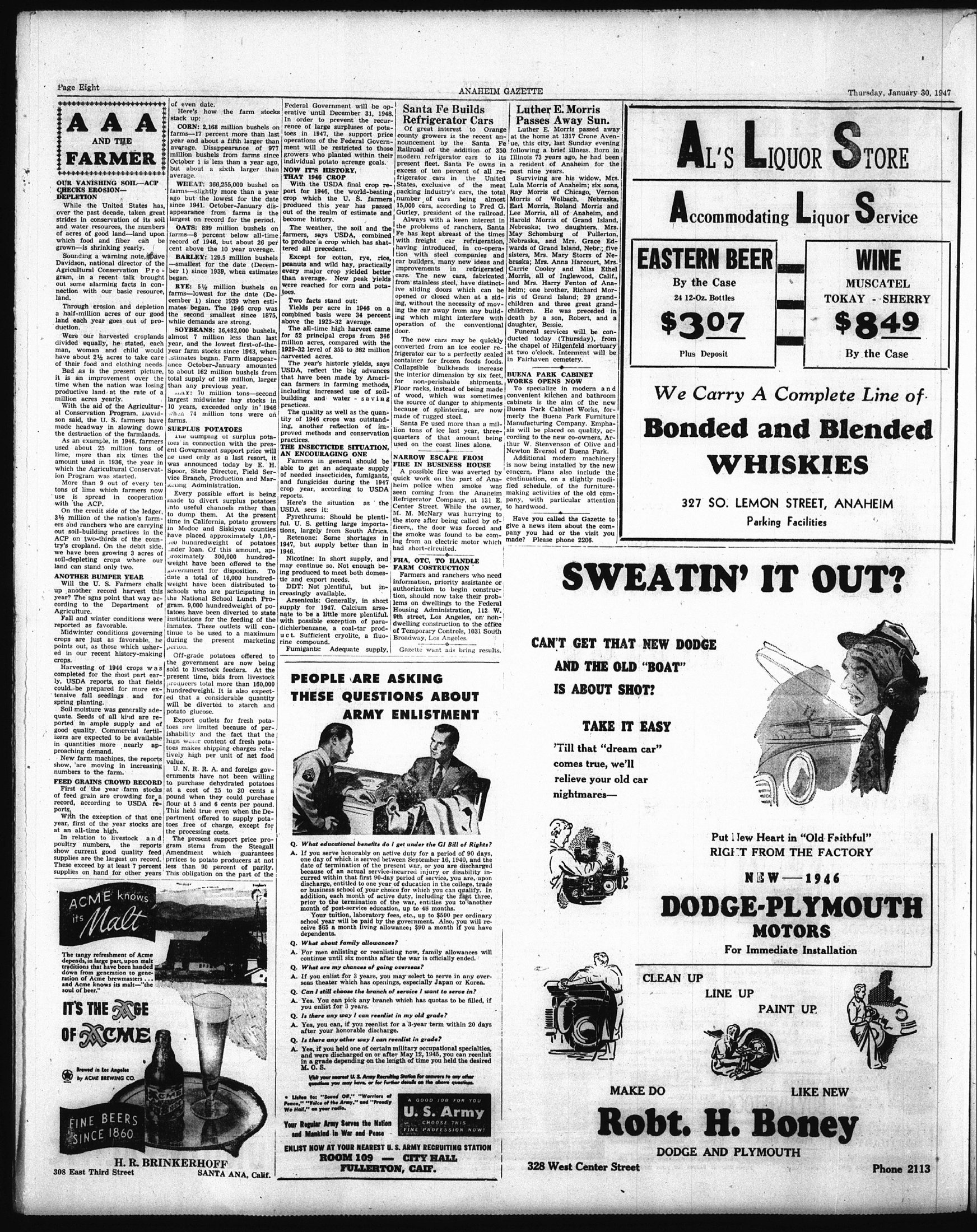
Searchable text
A A A
AND THE
FARMER
OUR VANISHING SOIL—ACP CHECKS EROSION—DEPLETION
While the United States has, over the past decade, taken great strides in conservation of its soil and water resources, the numbers of acres of good land—land upon which food and fiber can be grown—is shrinking yearly.
Sounding a warning note, Dave Davidson, national director of the Agricultural Conservation Program, in a recent talk brought out some alarming facts in connection with our basic resource, land.
Through erosion and depletion a half-million acres of our good land each year goes out of production.
Were our harvested croplands divided equally, he stated, each man, woman and child would have about 2½ acres to take care of their food and clothing needs.
Bad as is the present picture, it is an improvement over the time when the nation was losing productive land at the rate of a million acres yearly.
With the aid of the Agricultural Conservation Program, Davidson said, the U. S. farmers have made headway in slowing down the destruction of the farmlands.
As an example, in 1946, farmers used about 25 million tons of lime, more than six times the of even date.
Here's how the farm stocks stack up:
CORN: 2,168 million bushels on farms—17 percent more than last year and about a fifth larger than average. Disappearance of 977 million bushels from farms since October 1 is less than a year ago, but about a sixth larger than average.
WHEAT: 366,255,000 bushels on farms—slightly more than a year ago but the lowest for the date since 1941. October-January disappearance from farms is the largest on record for the period.
OATS: 899 million bushels on farms—8 percent below all-time record of 1946, but about 26 per cent above the 10 year average.
BARLEY: 129.5 million bushels—smallest for the date (December 1) since 1939, when estimates began.
RYE: 5½ million bushels on farms—lowest for the date (December 1) since 1939 when estimates began. The 1946 crop was the second smallest since 1875, while demands are strong.
SOYBEANS: 36,482,000 bushels, almost 7 million less than last year, and the lowest first-of-the-year farm stocks since 1943, when estimates began. Farm disappearance October-January amounted to about 162 million bushels from total supply of 199 million, larger than any previous year.
MAX: 70 million tons—second largest midwinter hay stocks in 10 years, exceeded only in' 1946 when 74 million tons were on farms.
SURPLUS POTATOES
The dumping of surplus potatoes in connection with the present Government support price will be used only as a last resort.
of their food and clothing needs.
Bad as is the present picture,
it is an improvement over the time when the nation was losing productive land at the rate of a million acres yearly.
With the aid of the Agricultural Conservation Program, Davidson said, the U. S. farmers have made headway in slowing down the destruction of the farmlands.
As an example, in 1946, farmers used about 25 million tons of lime, more than six times the amount used in 1936, the year in which the Agricultural Conservation Program was started.
More than 9 out of every ten tons of lime which farmers now use is spread in cooperation with the ACP.
On the credit side of the ledger, 3½ million of the nation's farmers and ranchers who are carrying out soil-building practices in the ACP on two-thirds of the country's cropland. On the debit side, we have been growing 3 acres of soil-depleting crops where our land can stand only two.
ANOTHER BUMPER YEAR
Will the U. S. Farmers chalk up another record harvest this year? The signs point that way according to the Department of Agriculture.
Fall and winter conditions were reported as favorable.
Midwinter conditions governing crops are just as favorable, he points out, as those which ushered in our recent history-making crops.
Harvesting of 1946 crops was completed for the most part early, USDA reports, so that fields could be prepared for more extensive fall seedings and for spring planting.
Soil moisture was generally adequate. Seeds of all kind are reported in ample supply and of good quality. Commercial fertilizers are expected to be available in quantities more nearly approaching demand.
New farm machines, the reports show, are moving in increasing numbers to the farm.
FEED GRAINS CROWD RECORD
First of the year farm stocks of feed grain are crowding for a record, according to USDA reports.
With the exception of that one year, first of the year stocks are at an all-time high.
In relation to livestock and poultry numbers, the reports show current good quality feed supplies are the largest on record. These exceed by at least 7 percentance October-January amounted to about 162 million bushels from total supply of 199 million, larger than any previous year.
MAY: 70 million tons—second largest midwinter hay stocks in 10 years, exceeded only in' 1946 when 74 million tons were on farms.
SURPLUS POTATOES
The dumping of surplus potatoes in connection with the present Government support price will be used only as a last resort, it was announced today by E. H. Spoor, State Director, Field Service Branch, Production and Marketing Administration.
Every possible effort is being made to divert surplus potatoes into useful channels rather than to dump them. At the present time in California, potato growers in Modoc and Siskiyou counties have placed approximately 1,000 hundredweight of potatoes under loan. Of this amount, approximately 300,000 hundredweight have been offered to the government for disposition. To date a total of 16,000 hundredweight have been distributed to schools who are participating in the National School Lunch Program. 9,000 hundredweight of potatoes have been diverted to state institutions for the feeding of the inmates. These outlets will continue to be used to a maximum during the present marketing period.
Off-grade potatoes offered to the government are now being sold to livestock feeders. At the present time, bids from livestock producers total more than 160,000 hundredweight. It is also expected that a considerable quantity will be diverted to starch and potato glucose.
Export outlets for fresh potatoes are limited because of perishability and the fact that the high water content of fresh potatoes makes shipping charges relatively high per unit of net food value.
U. N. R. R. A. and foreign governments have not been willing to purchase dehydrated potatoes at a cost of 25 to 30 cents a pound when they could purchase flour at 5 and 6 cents per pound. This held true even when the Department offered to supply potatoes free of charge, except for the processing costs.
The present support price program stems from the Steagall Amendment which guarantees prices to potato producers at not less than 90 percent of parity.
FEED GRAINS CROWD RECORD
First of the year farm stocks of feed grain are crowding for a record, according to USDA reports.
With the exception of that one year, first of the year stocks are at an all-time high.
In relation to livestock and poultry numbers, the reports show current good quality feed supplies are the largest on record. These exceed by at least 7 percent supplies on hand for other years.
ACME knows its Malt
The tangy refreshment of Acme depends, in large part, upon malt traditions that have been handed down from generation to generation of Acme brewmasters... and Acme knows its malt—"the soul of beer."
IT'S THE AGE OF ACME
Brewed in Los Angeles by ACME BREWING CO.
FINE BEERS SINCE 1860
H. R. BRINKERHOFF
308 East Third Street
SANTA ANA, Calif.
Federal Government will be operative until December 31, 1948. In order to prevent the recurrence of large surpluses of potatoes in 1947, the support price operations of the Federal Government will be restricted to those growers who planted within their individual potato acreage goals.
NOW IT'S HISTORY,
THAT 1946 CROP
With the USDA final crop report for 1946, the world-beating crop which the U.S. farmers produced this year has passed out of the realm of estimate and become history.
The weather, the soil and the farmers, says USDA, combined to produce a crop which has shattered all precedent.
Except for cotton, rye, rice, peanuts and wild hay, practically every major crop yielded better than average. New peak yields were reached for corn and potatoes.
Two facts stand out:
Yields per acre in 1946 on a combined basis were 34 percent above the 1923-32 average.
The all-time high harvest came for 52 principal crops from 346 million acres, compared with the 1929-32 level of 355 to 362 million harvested acres.
The year's historic yields, says USDA, reflect the big advances that have been made by American farmers in farming methods, including increased use of soil-building and water-saving practices.
The quality as well as the quantity of 1946 crops was outstanding, another reflection of improved methods and conservation practices.
THE INSECTICIDE SITUATION,
IN ENCOURAGING ONE
Santa Fe Builds Refrigerator Cars
Of great interest to Orange county growers is the recent announcement by the Santa Fe Railroad of the addition of 350 modern refrigerator cars to its present fleet. Santa Fe owns in excess of ten percent of all refrigerator cars in the United States, exclusive of the meat packing industry's cars, the total number of cars being almost 15,000 cars, according to Fred G. Gurley, president of the railroad.
Always with a keen interest in the problems of ranchers, Santa Fe has kept abreast of the times with freight car refrigeration, having introduced, in co-operation with steel companies and car builders, many new ideas and improvements in refrigerated cars. The new cars, fabricated from stainless steel, have distinctive sliding doors which can be opened or closed when at a siding, without the necessity of moving the car away from any building which might interfere with operation of the conventional door.
The new cars may be quickly converted from an ice cooler refrigerator car to a perfectly sealed container for frozen foods foods. Collapsible bulkheads increase the interior dimension by six feet, for non-perishable shipments. Floor racks, instead of being made of wood, which was sometimes the source of danger to shipments because of splintering, are now made of rugged steel.
Santa Fe used more than a million tons of ice last year, three quarters of that amount being used on the coast lines alone.
Luther E. Morris Passes Away Sun.
Luther E. Morris passed away at the home at 1317 Crone Avenue, this city, last Sunday evening following a brief illness. Born in Illinois 73 years ago, he had been a resident of Anaheim for the past nine years.
Surviving are his widow, Mrs. Lula Morris of Anaheim; six sons, Ray Morris of Chicago, Vernon Morris of Wolbach, Nebraska, Earl Morris, Roland Morris and Lee Morris, all of Anaheim, and Harold Morris of Grand Island, Nebraska; two daughters, Mrs. May Schomburg of Fullerton, Nebraska, and Mrs. Grace Edwards of Grand Island, Nebr.; five sisters, Mrs. Mary Storrs of Nebraska; Mrs. Anna Harcourt, Mrs. Carrie Cooley and Miss Ethel Morris, all of Inglewood, Calif., and Mrs. Harry Fenton of Anaheim; one brother, Richard Morris of Grand Island; 29 grandchildren and three great grandchildren. He was preceded in death by a son, Robert, and a daughter, Bessie.
Funeral services will be conducted today (Thursday), from the chapel of Hilgenfeld mortuary at two o'clock. Interment will be in Fairhaven cemetery.
BUENA PARK CABINET WORKS OPENS NOW
To specialize in modern and convenient kitchen and bathroom cabinets is the aim of the new Buena Park Cabinet Works, formerly the Buena Park Furniture Manufacturing Company. Emphasis will be placed on quality, according to the new co-owners, Arthur W. Stenvenson of Olive and Newton Eversol of Buena Park.
Additional modern machinery
The year’s historic yields, says SDA, reflect the big advances that have been made by American farmers in farming methods, including increased use of soil-building and water-saving practices.
The quality as well as the quantity of 1946 crops was outstanding, another reflection of improved methods and conservation practices.
THE INSECTICIDE SITUATION, IN ENCOURAGING ONE
Farmers in general should be able to get an adequate supply of needed insecticides, fumigants, and fungicides during the 1947 crop year, according to USDA reports.
Here’s the situation as the SDA sees it:
Pyrethrums: Should be plentiful. U. S. getting large importations, largely from South Africa.
Retenone: Some shortages in 1947, but supply better than in 1946.
Nicotine: In short supply, and may continue so. Not enough being produced to meet both domestic and export needs.
DDT: Not plentiful, but increasingly available.
Arsenicals: Generally, in short supply for 1947. Calcium arsenate to be a little more plentiful with possible exception of parachlorbenzane, a coal-tar product. Sufficient cryolite, a fluorine compound.
Fumigants: Adequate supply,
NARROW ESCAPE FROM FIRE IN BUSINESS HOUSE
A possible fire was averted by quick work on the part of Anaheim police when smoke was seen coming from the Ananeim Refrigerator Company, at 131 E. Center Street. While the owner, M. M. McNary was hurrying to the store after being called by officers,, the door was forced and the smoke was found to be coming from an electric motor which had short-circuited.
FHA, OTC, TO HANDLE FARM COSTRUCTION
Farmers and ranchers who need information, priority assistance or authorization to begin construction, should now take their problems on dwellings to the Federal Housing Administration, 112 W. 9th street, Los Angeles, on non-dwelling construction to the office of Temporary Controls, 1031 South Broadway, Los Angeles.
Gazette want ads bring results.
PEOPLE ARE ASKING THESE QUESTIONS ABOUT ARMY ENLISTMENT
Q. What educational benefits do I get under the GI Bill of Rights?
A. If you serve honorably on active duty for a period of 90 days, one day of which is served between September 16, 1940, and the date of termination of the present war, or you are discharged for service in the armed forces.
BUENA PARK CABINET WORKS OPENS NOW
To specialize in modern and convenient kitchen and bathroom cabinets is the aim of the new Buena Park Cabinet Works, formerly the Buena Park Furniture Manufacturing Company. Emphasis will be placed on quality, according to the new co-owners, Arthur W. Stenvenson of Olive and Newton Eversol of Buena Park.
Additional modern machinery is now being installed by the new concern. Plans also include the continuation, on a slightly modified schedule, of the furniture-making activities of the old company, with particular attention to hardwood.
Have you called the Gazette to give a news item about the company you had or the visit you made? Please phone 2206.
SWEAT
CAN’T GET THAT NEW DOOR AND THE OLD “BOAT” IS ABOUT SHOT?
TAKE IT EASY
’Till that “dream car” comes true, we’ll relieve your old car nightmares—
Q. What educational benefits do I get under the G1 Bill of Rights?
A. If you serve honorably on active duty for a period of 90 days, one day of which is served between September 16, 1940, and the date of termination of the present war, or you are discharged because of an actual service-incurred injury or disability incurred within that first 90-day period of service, you are, upon discharge, entitled to one year of education in the college, trade or business school of your choice for which you can qualify. In addition, each month of active duty, including the first three, prior to the termination of the war, entitles you to another month of post-service education, up to 48 months.
Your tuition, laboratory fees, etc., up to $500 per ordinary school year will be paid by the government. Also, you will receive $65 a month living allowance; $90 a month if you have dependents.
Q. What about family allowances?
A. For men enlisting or reenlisting now, family allowances will continue until six months after the war is officially ended.
Q. What are my chances of going overseas?
A. If you enlist for 3 years, you may select to serve in any overseas theater which has openings, especially Japan or Korea.
Q. Can I still choose the branch of service I want to serve in?
A. Yes. You can pick any branch which has quotas to be filled, if you enlist for 3 years.
Q. Is there any way I can reenlist in my old grade?
A. Yes, you can, if you reenlist for a 3-year term within 20 days after your honorable discharge.
Q. Is there any other way I can reenlist in grade?
A. Yes, if you held one of certain military occupational specialties, and were discharged on or after May 12, 1945, you can reenlist in a grade depending on the length of time you held the desired M. O. S.
Visit your nearest U.S. Army Recruiting Station for answers to any other questions you may have, or for further details on the above questions.
O Listen to: "Sound Off," "Warriors of Peace," "Voice of the Army," and "Proudly We Hail," on your radio.
Your Regular Army Serves the Nation and Mankind in War and Peace
ENLIST NOW AT YOUR NEAREST U.S. ARMY RECRUITING STATION
ROOM 109 — CITY HALL
FULLERTON, CAIF.
relieve your old car nightmares—
MAKE DO
Robt.
DODG
328 West Center Street
Thursday, January 30, 1947
AL'S LIQUOR STORE
Accommodating Liquor Service
EASTERN BEER
By the Case
24 12-Oz. Bottles
$307
Plus Deposit
WINE
MUSCATEL
TOKAY - SHERRY
$849
By the Case
We Carry A Complete Line of
Bonded and Blended
We Carry A Complete Line of
Bonded and Blended
WHISKIES
327 SO. LEMON STREET, ANAHEIM
Parking Facilities
WEATIN' IT OUT?
HAT NEW DODGE
OLD "BOAT"
SHOT?
E IT EASY
ream car"
we'll
old car
Put New Heart in "Old Faithful"
RIGHT FROM THE FACTORY
Put New Heart in "Old Faithful"
RIGHT FROM THE FACTORY
NEW — 1946
DODGE-PLYMOUTH
MOTORS
For Immediate Installation
CLEAN UP
LINE UP
PAINT UP
MAKE DO LIKE NEW
Robt. H. Boney
DODGE AND PLYMOUTH
Street Phone 2113