anaheim-gazette 1946-02-14
Scanned page
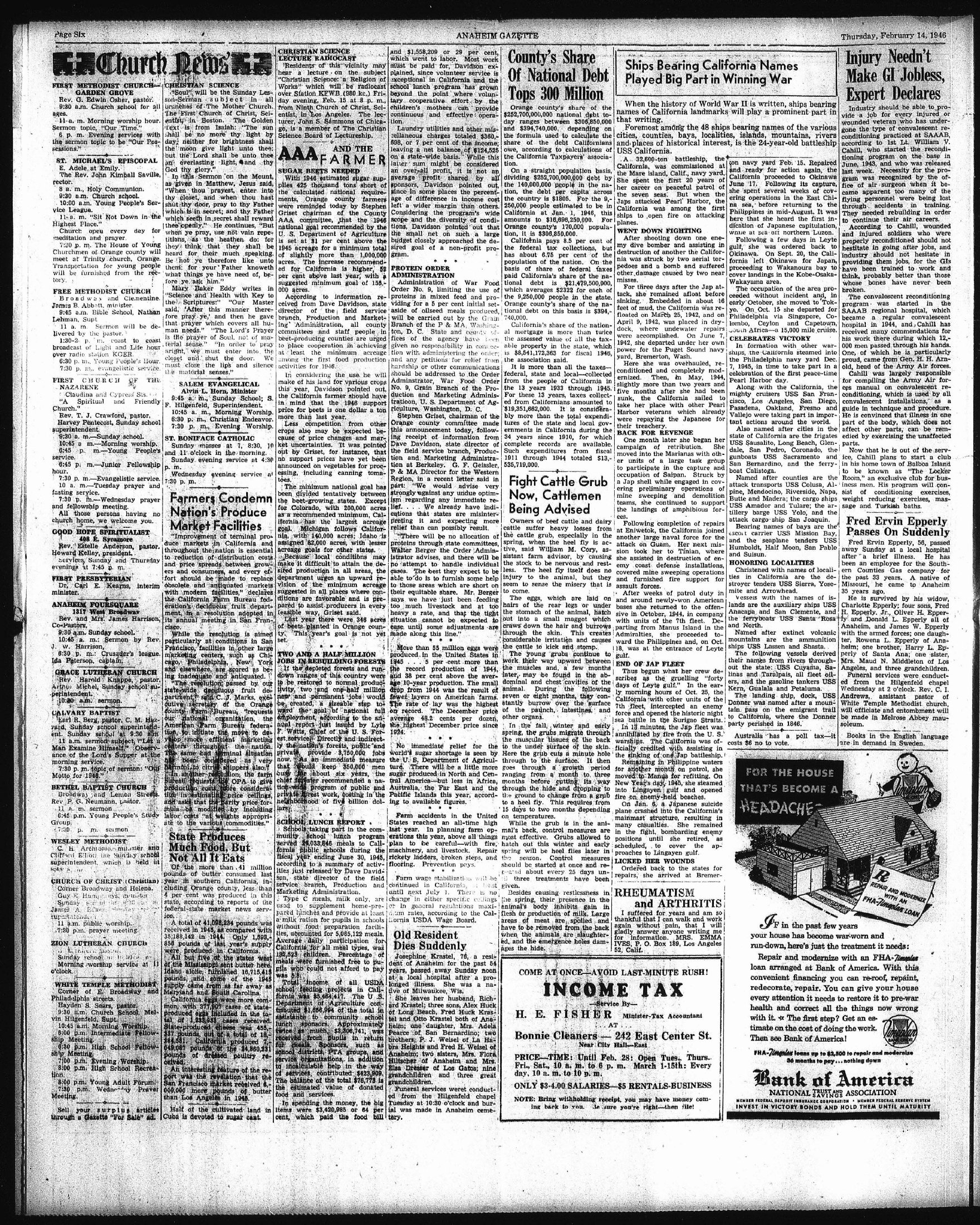
Searchable text
FIRST METHODIST CHURCH—GARDEN GROVE
Rev. G. Edwin Osher, pastor.
9:30 a.m. Church school for all ages.
11 a.m. Morning worship hour.
Sermon topic, "Our Time."
6 p.m. Evening services with the sermon topic to be "Our Possessions."
ST. MICHAEL'S EPISCOPAL
E. Adele at Emily.
The Rev. John Kimball Saville, rector.
8 a.m., Holy Communion.
9:30 a.m. Church school.
10:00 a.m. Young People's Service League.
11 a.m. "Sit Not Down in the Highest Place."
Church opeu every day for meditation and prayer.
7:20 p.m. The House of Young Churchmen of Orange county will meet at Trinity church, Orange. Transportation for young people will be furnished from the rectory.
FREE METHODIST CHURCH
Broadway and Clementine.
James B. Abbott, minister.
9:45 a.m. Bible School, Nathan Lehman, Supt.
11 a.m. Sermon will be delivered by the pastor.
1:30-2 p.m. coast to coast broadcast of Light and Life hour over radio station KGER.
6:30 p.m., Young People's Hour.
7:30 p.m., evangelistic service.
FIRST CHURCH OF THE NAZARENE
Claudina and Cypress Sts.
"A Spiritual and Friendly Church."
Rev. T. J. Crawford, pastor.
Harvey Pentecost, Sunday school superintendent.
9:30 a.m.—Sunday school.
10:45 a.m.—Morning worship.
6:45 p.m.—Young People's service
CHRISTIAN SCIENCE
"Soul" will be the Sunday Lesson-Serman subject in all branches of The Mother Church. The First Church of Christ, Scientist, in Boston. The Golden Text is from Isaiah: "The sun shall be no more thy light by day; neither for brightness shall the moon give light unto thee; but the Lord shall be unto thee an everlasting light, and thy God thy glory."
In this Sermon on the Mount, as given in Matthew, Jesus said, "When thou prayest, enter into thy closet, and when thou hast shut thy door, pray to thy Father which is in secret; and thy Father which seeth in secret shall reward thee openly." He continues, "But when ye pray, use not vain repetitions, as the heathen do: for they think that they shall be heard for their much speaking. Be not ye therefore like unto them; for your Father knoweth what things ye have need of, before ye ask him."
Mary Baker Eddy writes in "Science and Health with Key to the Scriptures:" "Our Master said, 'After this manner therefore pray ye,' and then he gave that prayer which covers all human needs." "The Lord's Prayer is the prayer of Soul, not of material sense." "In order to pray aright, we must enter into the closet and shut the door. We must close the lips and silence the material senses."
SALEM EVANGELICAL
Alvin L. Horn, Minister
9:45 a.m., Sunday School; S. F. Hilgenfeld, Superintendent.
10:45 a.m., Morning Worship.
6:30 p.m., Christian Endeavor.
7:30 p.m., Evening Worship.
ST. BONIFACE CATHOLIC
Sunday masses at 7, 8:30, 10 and 11 o'clock in the morning.
CHRISTIAN SCIENCE LECTURE RADIOCAST
Residents of this vicinity hear a lecture on the subject "Christian Science: a Religious Work" which will be read over Station KFWB (980 kc) day evening, Feb. 15 at 8:30 from Ninth Church of Christmas Institute, in Los Angeles. Theurer, John S. Sammons of Goa, is a member of The Church Science Board of Lectureship.
AAA AND THE FARM
SUGAR BEETS NEEDED
With 1946 estimated sugar supplies 425 thousand tons she calculated national requirements, Orange county was reminded today by Griset chairman of the AAA committee, that the national goal recommended by U.S. Department of Agriculture is set at 81 per cent above 1945 acreage for a minimum of slightly more than 1,000 acres. The increase recommended for California is high per cent above last year, suggested minimum goal of 2000 acres.
According to information received from Dave Davidson director of the field branch, Production and Marketing Administration, all committees and staff people beet-producing counties are to place cooperation in aching at least the minimum amount among the first food production activities for 1946.
In considering the use of his land for various this year, Davidson pointed that California farmer should in mind that the 1946 price for beets is one dollar more than last year.
Less competition from crops also may be expected cause of price changes and key uncertainties. It was put out by Griset, for instance.
FIRST CHURCH OF THE NAZARENE
Claudina and Cypress Sts.
"A Spiritual and Friendly Church."
Rev. T. J. Crawford, pastor.
Harvey Pentecost, Sunday school superintendent.
9:30 a.m.-Sunday school.
10:45 a.m.-Morning worship.
6:45 p.m.-Young People's service.
6:45 p.m.-Junior Fellowship hour.
7:30 p.m.-Evangelistic service.
10 a.m.-Tuesday prayer and fasting service.
7:30 p.m.-Wednesday prayer and fellowship meeting.
All those persons having no church home, we welcome you.
GOOD HOPE SPIRITUALIST
408 E. Sycamore
Rev. Estelle Anderson, pastor.
Howard Kelley, president.
Services, Sunday and Thursday evenings at 7:45 p.m.
FIRST PRESBYTERIAN
Dr. Carl E. Kearns, interim minister.
ANAHEIM FOURSQUARE
1817 West Broadway
Rev. and Mrs. James Harrison, Co-Pastors.
9:30 a.m. Sunday school.
10:45 a.m.: Sermon by Rev. J. W. Harrison.
6:30 p.m.: Crusader's league. Ida Peterson, captain.
GRACE LUTHERAN CHURCH
Rev. Harold Knappe, pastor.
Arthur Michel, Sunday school superintendent.
10:30 a.m. sermon.
CALVARY BAPTIST
Earl R. Berg, pastor. C. M. Hazard, Sunday school superintendent. Sunday school at 9:30 am.
11 a.m. sermon subject, "Let a Man Examine Himself." Observance of the Lord's Supper at the morning service.
7:30 p.m. topic of sermon: "Our Motto for 1946."
BETHEL BAFTIST CHURCH
Broadway and Lemon Streets.
Rev. P. G. Neumann, pastor.
11 a.m. sermon.
6:45 p.m. Young People's Study Group.
7:30 p.m. sermon
WESLEY METHODIST
C. H. Archbishop, minister and Clifford Elliott the Sunday school superintendent, which is held at
SALEM EVANGELICAL
Alvin L. Horn, Minister
9:45 a.m., Sunday School; S. F. Hilgenfeld, Superintendent.
10:45 a.m., Morning Worship.
6:30 p.m., Christian Endeavor.
7:30 p.m., Evening Worship.
ST. BONIFACE CATHOLIC
Sunday masses at 7, 8:30, 10 and 11 o'clock in the morning.
Sunday evening service at 4:30 p.m.
Wednesday evening service at 7:30 p.m.
Farmers Condemn Nation's Produce Market Facilities
"Improvement of terminal produce markets in California and throughout the nation is essential to reduction of distribution costs and price spreads between growers and consumers, and every effort should be made to replace obsolete and antiquated markets with modern facilities," declares the California Farm Bureau federation's deciduous fruit department, in a resolution adopted in its annual meeting in San Francisco.
While the resolution is aimed particularly at conditions in San Francisco, facilities in other large marketing centers, such as Chicago, Philadelphia, New York and elsewhere, are scored as being inadequate and antiquated.
"The resolution passed by our state-wide deciduous fruit department," said C. J. Marks, executive secretary of the Orange county Farm Bureau, "requests our national organization, the American Farm Bureau Federation, to initiate the move to develop more efficient marketing centers throughout the nation. The same bad terminal situation has been considered as very harmful to citrus shippers also."
In another resolution, the farm bureau requests UPA to give production costs more consideration in estimating price ceilings, and asks that the parity price formula be modified by including labor costs "at weights appropriate to the various commodities."
State Produces Much Food, But Not All It Eats
In considering the use of his land for various this year, Davidson pointed the California farmer should in mind that the 1946 price for beets is one dollar more than last year.
Less competition from crops also may be expected cause of price changes and market uncertainties. It was put out by Griset, for instance no support prices have yet announced on vegetables for essing, including canning toes.
The minimum national goal been divided tentatively be the beet-growing states. For Colorado, with 200,000 acres as a recommended minimum california has the largest goal. Michigan follows Georgia with 140,000 acres; Idaho assigned 82,000 acres with acreage goals for other states.
Because local conditions make it difficult to attain sized production in all areas department urges an upward vision of the minimum area suggested in all places where ditions are favorable and is paired to assist producers in feasible way, Griset said.
Last year there were 346 of beets planted in Orange city. This year's goal is not set.
TWO AND A HALF MILLION JOBS IN REBUILDING FOR
If the depleted forests and down ranges of this country be restored to normal productivity, two and one-half r new and permanent jobs be created, a sizeable step toward the goal of national employment according to the final report just issued by F. Watts, Chief of the U.S.est services Directly and indirectly the nation's forests, public private provide 8,750,000 now. As an immediate measure should keep 850,000 busy for about six years chief register recommended nationwide program of public private forest work, costing neighborhood of five billion lars.
SCHOOL LUNCH REPORT
Schools taking part in the munity school lunch preserved 24,033,846 meals to formia public schools during fiscal year ending June 30, according to a summary of
BETHEL BAPTIST CHURCH
Broadway and Lemon Streets.
Rev P. G. Neumann, pastor.
11 a.m. sermon.
6:45 p.m. Young People's Study Group.
7:30 p.m. sermon
WESLEY METHODIST
C. H. Archibald minister and Clifford Elliott the Sunday school superintendent, which is held at 8:45 a.m.
CHURCH OF CHRIST (Christian)
Corner Broadway and Helena.
Guy E. Humphrey, minister
Sunday school at 9:30 a.m.
James A. Eckert, Sunday school superintendent
11 a.m. public worship.
7:30 p.m. prayer meeting.
ZION LUTHERAN CHURCH
Sunday school at 10:00 a.m.
Morning worship service at 11 o'clock.
WHITE TEMPLE METHODIST
Corner of E. Broadway and Philadelphia streets.
Hayden S. Sears, pastor.
9:30 a.m. Church School, Melvin Hilgenfeld, Supt.
10:45 a.m. Morning Worship.
6:00 p.m. Intermediate Fellowship Meeting.
6:30 p.m. High School Fellowship Meeting.
7:00 p.m. Evening Worship.
8:00 p.m. High School Recreation.
8:00 p.m. Young Adult Forum.
7:30 p.m. Wednesday Pravar Meeting.
Sell your surplus articles through a Gazette "For Sale" ad.
State Produces Much Food, But Not All It Eats
Of the more than 41 million pounds of butter consumed last year in southern California, including Orange county, less than 4 per cent was produced in this state, according to reports of the federal-state market news service.
A total of 41,098,234 pounds was received in 1945, as compared with 35,188,142 in 1944. Only 1,593,858 pounds of last year's supply were produced in California.
All but five of the states west of the Mississippi sent butter here. Idaho alone, furnished 16,715,415 pounds, and some of the 1945 supply came from as far away as Maryland and South Carolina.
California eggs were more common, with 377,907 cases of state-produced eggs included in the total of 1,238,938 cases received. State-produced cheese was 455,-$37 pounds, out of a total of 18,-$244,581. California produced 7-049,087 pounds of the $4,860,231 pounds of dressed poultry received.
An interesting feature of the report was the revelation that the San Francisco market received 6,000,000 more pounds of butter than Los Angeles in 1945.
Half of the cultivated land in Cuba is devoted to sugar cane.
School taking part in the munity school lunch program served 24,033,846 meals to formla public schools during fiscal year ending June 30, according to a summary of titles just released by Dave Dixon, state director of the service branch. Production Marketing Administration.
Type C meals, milk only used to supplement home-pared lunches and provide a milk ration for pupils in without food preparation tiles, accounted for 5,065,122 mAverage daily participation California for all meal types 132,523 children. Percentage meals were furnished free to pils who could not afford them was 5.8.
Total income of all the school feeding projects in formla was $5,464,417. The Department of Agriculture distributed $1,656,994 of the total assistance to community lunch sponsors. Approximately as much, $3,306,741, received from pupils in for meals. Sponsors such school districts, PTA groups, service organizations, in add to calculable help in the services contributed $42 The balance of the total $76,the estimated value of do food and services.
In spending the money, the items were $3,420,985 or 6-cent which paid the food
CHRISTIAN SCIENCE
LECTURE RADIOCAST
Residents of this vicinity may hear a lecture on the subject Christian Science: a Religion of Works" which will be radiocast at Station KFWB (980 kc.) Friday evening, Feb. 15 at 8 p.m., from Ninth Church of Christ, Scientist, in Los Angeles. The lecturer, John S. Sammons of Chicago, is a member of The Christian Science Board of Lectureship.
AAA FARMER
SUGAR BEETS NEEDED
With 1946 estimated sugar supplies 425 thousand tons short of calculated national requirements, Orange county farmers are reminded today by Stephen Griset chairman of the County A committee, that the 1946 national goal recommended by the U.S. Department of Agriculture set at $1 per cent above the 45 acreage for a minimum total slightly more than 1,000,000 acres. The increase recommendation for California is higher, 52 per cent above last year, with a suggested minimum goal of 155,-to acres.
According to information received from Dave Davidson, state sector of the field service branch, Production and Market Administration, all county committees and staff people in pest-producing counties are urged place cooperation in achieving least the minimum acreage along the first food production activities for 1946.
In considering the use he will take of his land for various crops this year, Davidson pointed out, that California farmer should have mind that the 1946 support price for beets is one dollar a ton more than last year.
Less competition from other crops also may be expected because of price changes and uncertainties. It was pointed by Griset, for instance, that and $1,558,209 or 29 per cent, which went to labor. Most work must be paid for, Davidson explained, since volunteer service is exceptional in California and the school lunch program has grown beyond the point where voluntary cooperative effort by the children's mothers can provide continuous and effective operation.
Laundry utilities and other miscellaneous charges totaled $380,-698, or 7 per cent of the income; leaving a net balance of $124,525 on a state-wide basis. While this latter sum might be considered an over-all profit, it is not an average profit shared by all sponsors, Davidson pointed out, since in some places the percentage of difference in income cost left a wider margin than others. Considering the program's wide scope and the diversity of conditions, Davidson pointed out that the small net on such a large budget closely approached the desired goal of a non-profit program.
PROTEIN ORDER ADMINISTRATION
Administration of War Food Order No. 9, limiting the use of proteins in mixed feed and providing for a 5 per cent initial set-aside of oilseed meals produced, will be carried out by the Grain Branch of the P & MA, Washington, D.C. State and county offices of the agency have been given no responsibility in connection with administering the order; and any petitions for relief from hardship or other communications should be addressed to the Order Administrator, War Food Order No. 9, Grain Branch of the Production and Marketing Administration, U.S. Department of Agriculture, Washington, D.C.
Stephen Griset, chairman of the Orange county committee made this announcement today, following receipt of information from Dave Davidson, state director of the field service branch, Production and Marketing Administration.
County’s Share Of National Debt Tops 300 Million
Orange county's share of the $252,700,000,000 national debt today ranges between $306,850,000 and $394,740,000. depending on the formula used to calculate the share of the debt Californians owe, according to calculations of the California Taxpayers' association.
On a straight population basis, dividing $252,700,000,000 debt by the 140,000,000 people in the nation, the debt per capita across the country is $1805. For the 9,-250,000 people estimated to be in California at Jan. 1, 1946, this amounts to $16,696,250,000. For Orange county's 170,000 population, it is $306,850,000.
California pays 8.5 per cent of the federal tax collections, but has about 6.75 per cent of the population of the nation. On the basis of share of federal taxes paid California's share of the national debt is $21,479,500,000, which averages $2322 for each of the 9,250,000 people in the state. Orange county's share of the national debt on this basis is $394,-740,000.
California's share of the national mortgage is more than twice the assessed value of all the taxable property in the state, which is $8,541,172,363 for fiscal 1946, the association said.
It is more than all the taxes—federal, state and local—collected from the people of California in the 13 years 1933 through 1945. For these 13 years, taxes collected from Californians amounted to $19,351,662,000. It is considerably more than the total expenditures of the state and local governments in California during the 34 years since 1910, for which complete records are available. Such expenditures from fiscal 1911 through 1944 totaled $183 million.
Ships Bearing Played Big
When the history of names of California lies that writing.
Foremost among cities, counties, bays and places of historic USS California.
A 32,600-ton battlefield California was commissioned by Mare island, Calif., near She spent the first 20 years her career on peaceful seas. But Japs attacked Pearl Harbor California was among ships to open fire on planes.
WENT DOWN FIGHTING
After shooting down my dive bomber and attacking another thief was struck by two pedoes and a bomb and other damage caused by misses.
For three days after the tack she remained afloat in feet of mud, the California floated on March 25, 1944 April 9, 1942 was placed dock where undewater were accomplished. On April 1942 she departed under power for the Puget Sound yard, Bremerton, Wash.
Here she was overhailed conditioned and complex erized. Then in May slightly more than two five months after she sunk, the California took her place with off Harbor veterans which were repaying the Japan their treachery.
BACK FOR REVENGE
One month later she campaign of retributive moved into the Marianas.
considering the use he will take of his land for various crops this year, Davidson pointed out, California farmer should have mind that the 1946 support price for beets is one dollar a ton more than last year.
Less competition from other crops also may be expected because of price changes and market uncertainties. It was pointed by Griset, for instance, that support prices have yet been announced on vegetables for processing, including canning tomato.
The minimum national goal has been divided tentatively between beet-growing states. Except Colorado, with 200,000 acres recommended minimum, California has the largest acreage. Michigan follows California, with 140,000 acres; Idaho is signed 82,000 acres, with lesser usage goals for other states.
Because local conditions may make it difficult to attain the desired production in all areas, the department urges an upward reason of the minimum acreage requested in all places where consoles are favorable and is predeed to assist producers in everysible way, Griset said.
Last year there were 346 acres beets planted in Orange county. This year's goal is not yet
NO AND A HALF MILLION BESS IN REBUILDING FORESTS
of the depleted forests and runoff ranges of this country were be restored to normal productivity, two and one-half million and permanent jobs would creatd, a sizeable step toward the goal of national full employment, according to the annual report just issued by Lyle Watts, Chief of the U.S. Forest Service.
Directly and indirectly the nation's forests, public and private, provide 3,750,000 jobs. As an immediate measure I would keep 350,000 men for about six years, the forestier recommended a nationwide program of public and private forest work, costing in the neighborhood of five billion dollars.
HOOL LUNCH REPORT
schools taking part in the community school lunch program fed 24,033,846 meals to Califia public schools during the final year ending June 30, 1945, ordering to a summary of activities for 1946.
In considering the use he will take of his land for various crops this year, Davidson pointed out, California farmer should have mind that the 1946 support price for beets is one dollar a ton more than last year.
Less competition from other crops also may be expected because of price changes and marriag uncertainties. It was pointed by Griset, for instance, that support prices have yet been announced on vegetables for procuring, including canning tomato.
The minimum national goal has been divided tentatively between beet-growing states. Except Colorado, with 200,000 acres recommended minimum, California has the largest acreage. Michigan follows California, with 140,000 acres; Idaho is signed 82,000 acres, with lesser usage goals for other states.
Because local conditions may make it difficult to attain the desired production in all areas, the department urges an upward reason of the minimum acreage requested in all places where consoles are favorable and is predeed to assist producers in everysible way, Griset said.
Last year there were 346 acres beets planted in Orange county. This year's goal is not yet
More than 55 million eggs were produced in the United States in 1945...5 per cent more than the record production of 1944,...and 38 per cent above the average 10-year production. The small drop from 1944 was the result of fewer layers on American farms. The rate of lay was the highest on record. The December price average 48.2 cents per dozen, the highest December price since 1924.
No immediate relief for the world's sugar shortage is seen by the U.S. Department of Agriculture. There will be a little more sugar produced in North and Central America—but less in Africa, Australia, the Far East and the Pacific Islands this year, according to available figures.
Farm accidents in the United States reached an all-time high last year. In planning farm operations this year, above all things plan to be careful—with fire, machinery, and livestock. Repair rickety ladders, broken steps, and flooring. Prevention pays.
It is more than all the taxes—federal, state and local—collected from the people of California in the 13 years 1933 through 1945. For these 13 years, taxes collected from Californians amounted to $19,351,662,000. It is considerably more than the total expenditures of the state and local governments in California during the 34 years since 1910, for which complete records are available. Such expenditures from fiscal 1911 through 1944 totaled $13,-535,719,000.
Fight Cattle Grub Now, Cattlemen Being Advised
Owners of beef cattle and dairy cattle suffer heavy losses from the cattle grub, especially in the spring, when the heel fly is active, said William M. Cory, assistant farm advisor, by causing the stock to be nervous and restless. The heel fly itself does no injury to the animal, but they seem to sense the misery that is to come.
The eggs, which are laid on hairs of the rear legs or under the stomach of the animal, hatch out into a small maggot which crawls down the hair and burrows through the skin. This creates considerable irritation and causes the cattle to kick and stomp.
The young grubs continue to work their way upward between the muscles and a few months later, may be found in the abdominal and chest cavities of the animal. During the following seven or eight months, they constantly burrow over the surface of the paunch, intestines, and other organs.
In the fall, winter and early spring, the grubs migrate through the muscular tissues of the back to the under surface of the skin. Here the grub cuts a minute hole through to the surface. It then goes through a growth period ranging from a month to three months before cutting its way through the hide and dropping to the ground to change from a grub to a heel fly. This requires from 15 days to two months depending on temperatures.
While the grub is in the animal's back, control measures are most effective. Grubs allowed to hatch out this winter and early spring will be heel flies later in the season. Control measures should be started at once and re-
Here she was overhailed conditioned and completelyernized. Then, in May slightly more than two or five months after she sunk, the California man take her place with other Harbor veterans which were repaying the Japan their treachery.
BACK FOR REVENGE
One month later she campaign of retributive moved into the Marianaser units of a large tractor participate in the car occupation of Saipan.
A Jap shell while engaging preliminary open mine sweeping and team she continued tothe landings of amphibians.
Following completion at Eniwetok, the California another large naval force attack on Guam. Her sion took her to Tinian she assisted in destructi emy coast defense inspected mine sweeping o covered mine sweeping o furnished fire suic assault forces.
After weeks of patrol and around newly-won bases she returned to tive in October, 1944, int with units of the 7th flel parting from Manus Isla Admiralties, she proceed ward the Philippines anl8 was at the entrance gulf.
END OF JAP FLEET
Thus begun what her scribes as the gruellin days of Leyte guelf. In ly morning hours of Occ California with other unl7 fleet, intercepted a force and opened the hist sea battle in the Surigua.
In 13 minutes,the Jap annihilated by fire from warships.The California officially credited with ashe sinking of one Jap b
Remaining in Philippine for another month on p moved to Manus for refi New Year's day, 1945,she into Lingayan guelf and fire on enemy-held beach.
On Jan. 6,a Japanese plane crashed into the Ca mainmast structure,res many casualties.She n in the fight,bombarding positions until she re scheduled,to cover proaches to Lingayan guelf
LICKED HER WOUNDS
HOOD LUNCH REPORT
schools taking part in the community school lunch program
24,033,846 meals to California public schools during the final year ending June 30, 1945, ordering to a summary of activities just released by Dave Davidson, state director of the field service branch, Production and Marketing Administration.
Type C meals, milk only, are to supplement home-prepared lunches and provide at least milk ration for pupils in schools about food preparation facilities accounted for 5,065,122 meals. Daily participation for California for all meal types was 523 children. Percentage of meals were furnished free to pupils who could not afford to pay 5.8%.
Total income of all USDA food feeding projects in California was $5,484,417. The U.S. Department of Agriculture conducted $1,656,994 of the total in balance to community school sponsors. Approximately twice as much, $3,306,741, was received from pupils in return for meals. Sponsors, such as school districts, PTA groups, and like organizations, in addition to calculable help in the way services contributed $423,909. Balance of the total $76,778 is estimated value of donated aid and services.
Spending the money, the big bills were $3,420,985 or 64 per cent, which paid the food bill.
Farm accidents in the United States reached an all-time high last year. In planning farm operations this year, above all things plan to be careful—with fire, machinery, and livestock. Repair rickety ladders, broken steps, and flooring. Prevention pays.
Farm wage stabilization will be continued in California until next July 1. There is no change in either specific ceiling or in general regulations maximum rates, according to the California USDA Wage Board.
Old Resident Dies Suddenly
Josephine Krastel, 76, a resident of Anaheim for the past 54 years, passed away Sunday noon at a local hospital after a prolonged illness. She was a native of Milwaukee, Wis.
She leaves her husband, Richard Krastel; three sons, Alex Huck of Long Beach, Fred Huck Krastel and Otto Krastel both of Anaheim; one daughter, Mrs. Adela Pearce of San Bernardino; two brothers; P. J. Weisel of La Habra Heights and Fred H. Weisel of Anaheim; two sisters, Mrs. Flora Hiltscher of Anaheim and Mrs. Elsa Dresser of Los Gatos; nine grandchildren and three great grandchildren.
Funeral services were conducted from the Hilgenfeld chapel Tuesday at 10:30 o'clock and burial was made in Anaheim cemetery.
COME AT ONCE—AVOID LAST-MINUTE RUIT INCOME TAX
Service By—
H. E. FISHER Minister-Tax Accountant
AT
Bonnie Cleaners — 242 East Center Near City Hall—East
PRICE—TIME: Until Feb. 28: Open Tues., Thurs., Sat., 10 a.m. to 6 p.m. March 1-15th: Day, 10 a.m. to 10 p.m.
ONLY $3-4.00 SALARIES—$5 RENTALS-BUSINESS
NOTE: Bring withholding receipt, you may have money ing back to you. Be sure you're right—then file!
Ships Bearing California Names Played Big Part in Winning War
When the history of World War II is written, ships bearing names of California landmarks will play a prominent part in that writing.
Foremost among the 48 ships bearing names of the various cities, counties, bays, localities, islands, mountains, rivers and places of historical interest, is the 24-year-old battleship USS California.
A 32,600-ton battleship, the California, was commissioned at the Mare island, Calif., navy yard. She spent the first 20 years of her career on peaceful patrol of the seven seas. But when the Japs attacked Pearl Harbor, the California was among the first ships to open fire on attacking planes.
WENT DOWN FIGHTING
After shooting down one enemy dive bomber and assisting in destruction of another the California was struck by two aerial torpedoes and a bomb and suffered other damage caused by two near misses.
For three days after the Jap attack, she remained afloat before sinking. Embedded in about 16 feet of mud, the California was refloated on March 25, 1942, and on April 9, 1942, was placed in dry-dock, where undewater repairs were accomplished. On June 7, 1942, she departed under her own power for the Puget Sound navy yard, Bremerton, Wash.
Here she was overhauled, reconditioned and completely modernized. Then, in May, 1944, slightly more than two years and five months after she had been sunk, the California sailed to take her place with other Pearl Harbor veterans which already were repaying the Japanese for their treachery.
BACK FOR REVENGE
One month later she began her campaign of retribution. She moved into the Marianas with other navy yard Feb. 15. Repaired and ready for action again, the California proceeded to Okinawa June 17. Following its capture, she spent several weeks of covering operations in the East China sea, before returning to the Philippines in mid-August. It was here that she heard the first indication of Japanese capitulation, wnue at sea or northern Luzon.
Following a few days in Leyte gulf, she was ordered back to Okinawa. On Sept. 20, the California left Okinawa for Japan, proceeding to Wakanoura bay to cover landings in the Kobe-Osaka-Wakayama area.
The occupation of the area proceeded without incident and, in early October, she moved to Tokyo. On Oct. 15 she departed for Philadelphia via Singapore, Colombo, Ceylon and Capetown, South Africa—a 15,000 mile cruise.
CELEBRATES VICTORY
In formation with other warships, the California steamed into the Philadelphia navy yard Dec. 7, 1945, in time to take part in a celebration of the first peace-time Pearl Harbor day.
Along with the California, the mighty cruisers USS San Francisco, Los Angeles, San Diego, Pasadena, Oakland, Fresno and Vallejo were taking part in important actions around the world.
Also named after cities in the state of California are the frigates USS Sausalito, Long Beach, Glendale, San Pedro, Coronado, the gunboats USS Sacramento and Injury Needn't Make GI Jobless, Expert Declares
Industry should be able to provide a job for every injured or wounded veteran who has undergone the type of convalescent reconditioning practiced at SAAAB, according to 1st Lt. William V. Cahill, who started the reconditioning program on the base in June, 1943, and who was released last week. Necessity for the program was recognized by the office of air surgeon when it became apparent too many of the flying personnel were being lost through accidents in training. They needed rebuilding in order to continue their air careers.
According to Cahill, wounded and injured soldiers who were properly reconditioned should not hesitate in going after jobs, and industry should not hesitate in providing them jobs, for the GIs have been trained to work and think, probably better than those whose bones have never been broken.
The convalescent reconditioning program was started in the SAAAB regional hospital, which became a regular convalescent hospital in 1944, and Cahill has received many commendations for his work there during which 12,000 men passed through his hands. One, of which he is particularly proud, came from Gen. H. H. Arnold, head of the Army Air forces.
Cahill was largely responsible for compiling the Army Air forces manual on convalescent reconditioning, which is used by all convalescent installations, as a guide in technique and procedure. He is convinced that illness in one part of the body, which does not affect other parts, can be remedied by exercising the unaffected parts.
Now that he is out of the service Cahill plans to start a club
Here she was overhauled, reconditioned and completely modernized. Then, in May, 1944, slightly more than two years and five months after she had been sunk, the California sailed to take her place with other Pearl Harbor veterans which already were repaying the Japanese for their treachery.
BACK FOR REVENGE
One month later she began her campaign of retribution. She moved into the Marianas with other units of a large task group to participate in the capture and occupation of Saipan. Struck by a Jap shell while engaged in covering preliminary operations of mine sweeping and demolition teams, she continued to support the landings of amphibious forces.
Following completion of repairs at Eniwetok, the California joined another large naval force for the attack on Guam. Her next mission took her to Tinian, where she assisted in destruction of enemy coast defense installations, covered mine sweeping operations and furnished fire support for assault forces.
After weeks of patrol duty in and around newly-won American bases she returned to the offensive in October, 1944, in company with units of the 7th fleet. Departing from Manus Island in the Admiralties, she proceeded toward the Philippines and, on Oct. 18, was at the entrance of Leyte gulf.
END OF JAP FLEET
Thus begun what her crew describes as the gruelling "forty days of Leyte gulf." In the early morning hours of Oct. 25, the California with other units of the 7th fleet, intercepted an enemy force and opened the historic night sea battle in the Surigao Straits.
In 13 minutes, the Jap fleet was annihilated by fire from the U.S. warships. The California was officially credited with assisting in the sinking of one Jap battleship.
Remaining in Philippine waters for another month on patrol, she moved to Manus for refitting. On New Year's day, 1945, she steamed into Lingayen gulf and opened fire on enemy-held beaches.
On Jan. 6, a Japanese suicide plane crashed into the California's mainmast structure, resulting in many casualties. She remained in the fight, bombarding enemy positions until she retired, as scheduled, to cover the approaches to Lingayen gulf.
LICKED HER WOUNDS
FOR THE HOUSE
THAT'S BECOME A
HEADACHE
IF in the past few years your house has become war-worn and run-down, here's just the treatment it needs:
Repair and modernize with an FHA-Timeplan loan arranged at Bank of America. With this convenient financing you can re-roof, repaint, redecorate, repair. You can give your house every attention it needs to restore it to pre-war health and correct all the things now wrong with it. The first step? Get an estimate on the cost of doing the work. Then see Bank of America!
FHA-Timeplan loans up to $2,500 to repair and modernize 36 months to pay... nothing down
Bank of America
NATIONAL TRUST AND SAVINGS ASSOCIATION
MEMBER FEDERAL DEPOSIT INSURANCE CORPORATION • MEMBER FEDERAL REBERYE SYSTEM
INVEST IN VICTORY BONDS AND HOLD THEM UNTIL MATURITY