anaheim-gazette 1945-12-06
Scanned page
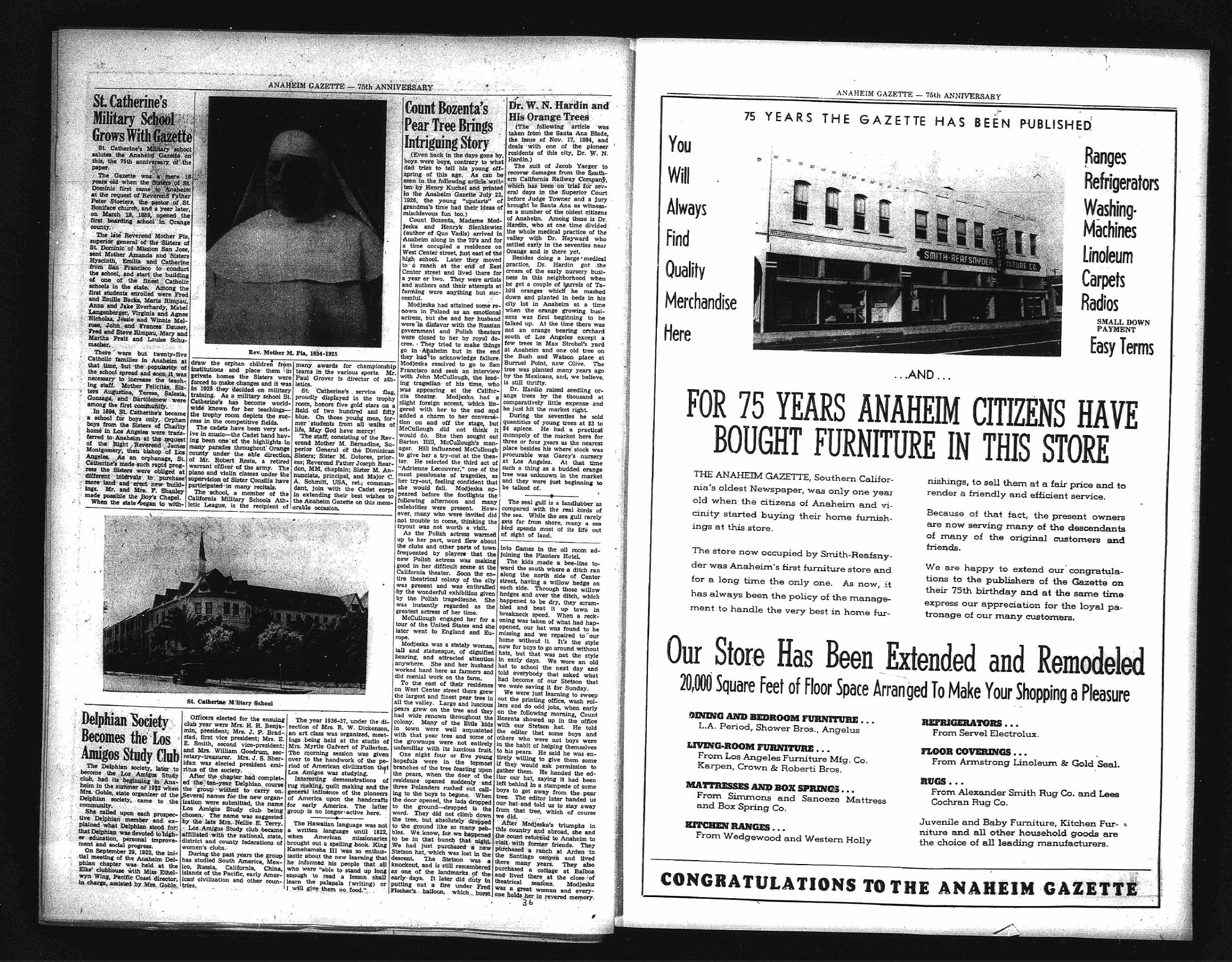
Searchable text
St. Catherine’s Military School Grows With Gazette
St. Catherine’s Military school salutes the Anaheim Gazette on this, the 75th anniversary of the paper.
The Gazette was a mere 18 years old when the Sisters of St. Dominic first came to Anaheim at the request of Reverend Father Peter Stoeters, the pastor of St. Boniface church, and a year later, on March 19, 1889, opened the first boarding school in Orange county.
The late Reverend Mother Pia, superior general of the Sisters of St. Dominic of Mission San Jose, sent Mother Amanda and Sisters Hyacinth, Emilia and Catherine from San Francisco to conduct the school, and start the building of one of the finest Catholic schools in the state. Among the first students enrolled were Fred and Emilie Backs, Maria Rimpau, Anna and Jake Everhardy, Mabel Langenberger, Virginia and Agnes Nicholas, Jessie and Winnie Melrose, John and Frances Dauser, Fred and Steve Rimpau, Mary and Martha Pratt and Louise Schumacher.
There were but twenty-five Catholic families in Anaheim.
There were but twenty-five Catholic families in Anaheim at that time, but the popularity of the school spread and soon it was necessary to increase the teaching staff. Mother Felicitas, Sisters Augustina, Teressa, Salesia, Gonzaga, and Bartolomew were among the first community.
In 1894, St. Catherine's became a school for boys only. Orphan boys from the Sisters of Charity home in Los Angeles were transferred to Anaheim at the request of the Right Reverend James Montgomery, then bishop of Los Angeles. As an orphanage, St. Catherine's made such rapid progress the Sisters were obliged at different intervals to purchase more land and erect new buildings. Mr. and Mrs. F. Shanley made possible the Boy's Chapel.
When the state began to with-draw the orphan children from institutions and place them in private homes the Sisters were forced to make changes and it was in 1925 they decided on military training. As a military school St. Catherine's has become worldwide known for her teachings—the trophy room depicts the success in the competitive fields.
The cadets have been very active in music—the Cadet band having been one of the highlights in many parades throughout Orange county under the able direction of Mr. Robert Resta, a retired warrant officer of the army. The piano and violin classes under the supervision of Sister Consilia have participated in many recitals.
The school, a member of the California Military Schools Athletic League, is the recipient of many awards for championship teams in the various sports. Mr. Paul Grover is director of athletics.
St. Catherine's service flag, proudly displayed in the trophy room, honors five gold stars on a field of two hundred and fifty blue. On those young men, former students from all walks of life, May God have mercy!
The staff, consisting of the Reverend Mother M. Bernadine, Superior General of the Diminican Sisters; Sister M. Dolores, prioress; Reverend Father Joseph Reardon, MM, chaplain; Sister M. Annunciata, principal, and Major C. A. Schmitt, USA, ret.; commandant, join with the Cadet corps in extending their best wishes to the Anaheim Gazette on this memorable occasion.
The staff, consisting of the Reverend Mother M. Bernadine, Superior General of the Diminican Sisters; Sister M. Dolores, prioress; Reverend Father Joseph Reardon, MM, chaplain; Sister M. Annunciata, principal, and Major C. A. Schmitt, USA, ret.; commandant, join with the Cadet corps in extending their best wishes to the Anaheim Gazette on this memorable occasion.
As the Polish act up to her part, words the clubs and other parties frequented by players new Polish actress was present and waded by the wonderful exhibit by the Polish tragedy was instantly regarded greatest actress of her.
McCullough engaged tour of the United States later went to England rope.
Modjeska was a stat tall and statuesque, o bear ing, and attracted anywhere. She and he worked hard here as did menial work on th-
Delphian Society Becomes the Los Amigos Study Club
The Delphian society, later to become the Los Amigos Study club, had its beginning in Anaheim in the summer of 1922 when Mrs. Goble, state organizer of the Delphian society, came to the community.
She called upon each prospective Delphian member and explained what Delphian stood for; that Delphian was devoted to higher education, personal improvement and social progress.
On September 29, 1922, the initial meeting of the Anaheim Delphian chapter was held at the Elks' clubhouse with Miss Ethelwyn Wing, Pacific Coast director, in charge, assisted by Mrs. Goble.
Officers elected for the ensuing club year were Mrs. H. H. Benjamin, president; Mrs. J. P. Bradstad, first vice president; Mrs. E. E. Smith, second vice-president; and Mrs. William Goodrum, secretary-treasurer. Mrs. J. S. Sheridan was elected president emiritus of the society.
After the chapter had completed the ten-year Delphian course the group wished to carry on. Several names for the new organization were submitted, the name Los Amigos Study club being chosen. The name was suggested by the late Mrs. Nellie E. Terry.
Los Amigos Study club became affiliated with the national, state, district and county federations of women's clubs.
During the past years the group has studied South America, Mexico, Russia, California, China, islands of the Pacific, early American civilization and other countries.
The year 1936-37, under the direction of Mrs. R. W. Dickenson, an art class was organized, meetings being held at the studio of Mrs. Myrtle Gafvert of Fullerton. The morning session was given over to the handwork of the period of American civilization that Los Amigos was studying.
Interesting demonstrations of rug making, quilt making and the general influence of the pioneers of America upon the handicrafts for early America. The latter group is no longer active here.
The Hawaiian language was not a written language until 1822, when American missionaries brought out a spelling book. King Kamehameha III was so enthusiastic about the new learning that he informed his people that all who were "able to stand up long enough to read a lesson shall learn the palapala (writing) or I will give them no food."
Count Bozenta’s Pear Tree Brings Intriguing Story
(Even back in the days gone by, boys were boys, contrary to what dad tries to tell his young offspring of this age. As can be seen in the following article written by Henry Kuchel and printed in the Anaheim Gazette July 22, 1926, the young “upstarts” of grandma’s time had their ideas of mischievous fun too.)
Count Bozenta, Madame Modjeska and Henryk Sienkiewlez (author of Quo Vadis) arrived in Anaheim along in the 70's and for a time occupied a residence on West Center street, just east of the high school. Later they moved to a ranch at the end of East Center street and lived there for a year or two. They were artists and authors and their attempts at farming were anything but successful.
Modjeska had attained some renown in Poland as an emotional actress, but she and her husband were in disfavor with the Russian government and Polish theaters were closed to her by royal decree. They tried to make things go in Anaheim but in the end they had to acknowledge failure.
Dr. W. N. Hardin and His Orange Trees
(The following article was taken from the Santa Ana Blade, the issue of Nov. 17, 1894, and deals with one of the pioneer residents of this city, Dr. W. N. Hardin.)
The suit of Jacob Yaeger to recover damages from the Southern California Railway Company, which has been on trial for several days in the Superior Court before Judge Towner and a jury brought to Santa Ana as witnesses a number of the oldest citizens of Anaheim. Among these is Dr. Hardin, who at one time divided the whole medical practice of the valley with Dr. Hayward who settled early in the seventies near Orange and is there yet.
Besides doing a large medical practice, Dr. Hardin got the cream of the early nursery business in this neighborhood when he got a couple of barrels of Tahiti oranges which he mashed down and planted in beds in his city lot in Anaheim at a time when the orange growing business was first beginning to be talked up. At the time there was not an orange bearing orchard south of Los Angeles except a few trees in Max Strobel's yard at Anaheim and one old tree on the Bush and Watson place at
and authors and their attempts at farming were anything but successful.
Modjeska had attained some renown in Poland as an emotional actress, but she and her husband were in disfavor with the Russian government and Polish theaters were closed to her by royal decree. They tried to make things go in Anaheim but in the end they had to acknowledge failure. Modjeska resolved to go to San Francisco and seek an interview with John McCullough, the leading tragedian of his time, who was appearing at the California theater. Modjeska had a slight foreign accent, which lingered with her to the end and added a charm to her conversation on and off the stage, but McCullough did not think it would do. She then sought out Barton Hill, McCullough's manager. Hill influenced McCullough to give her a try-out at the theater. He selected the third act of "Adrienne Lecouvrer," one of the most passionate of tragedies, as her try-out, feeling confident that she would fail. Modjeska appeared before the footlights the following afternoon and many celebrities were present. However, many who were invited did not trouble to come, thinking the tryout was not worth a visit.
As the Polish actress warmed up to her part, word flew about the clubs and other parts of town frequented by players that the new Polish actress was making good in her difficult scene at the California theater. Soon the entire theatrical colony of the city was present and was enthralled by the wonderful exhibition given by the Polish tragedienne. She was instantly regarded as the greatest actress of her time.
McCullough engaged her for a tour of the United States and she later went to England and Europe.
Modjeska was a stately woman, tall and statuesque, of dignified bearing, and attracted attention anywhere. She and her husband worked hard here as farmers and did menial work on the farm.
he got a couple of barrels of Tahiti oranges which he mashed down and planted in beds in his city lot in Anaheim at a time when the orange growing business was first beginning to be talked up. At the time there was not an orange bearing orchard south of Los Angeles except a few trees in Max Strobel's yard at Anaheim and one old tree on the Bush and Watson place at Burruel Point, now Olive. The tree was planted many years ago by the Mexicans, and, we believe, is still thrifty.
Dr. Hardin raised seedling orange trees by the thousand at comparatively little expense and he just hit the market right.
During the seventies he sold quantities of young trees at $3 to $4 apiece. He had a practical monopoly of the market here for three or four years as the nearest place besides his where stock was procurable was Garey's nursery at Los Angeles. At that time such a thing as a budded orange tree was unknown in the market and they were just beginning to be talked of.
The seal gull is a landlubber as compared with the real birds of the sea. While the sea gull rarely gets far from shore, many a sea bird spends most of its life out of sight of land.
into flames in the oil room adjoining the Planters Hotel.
The kids made a bee-line toward the south where a ditch ran along the north side of Center street, having a willow hedge on each side. Through those willow hedges and over the ditch, which happened to be dry, they scrambled and beat it up town in breakneck speed. When a reckoning was taken of what had happened, our hat was found to be missing and we repaired to our home without it. It's the style now for boys to go around without hats, but that was not the style in early days. We wore an old hat to school the next day and told everybody that asked what had become so beautiful.
Merchandise Here
FOR 75 YEARS ABOUT BOUGHT FURNITURE
THE ANAHEIM GAZETTE, Southern California’s oldest Newspaper, was only one old when the citizens of Anaheim and cinity started buying their home furnishings at this store.
The store now occupied by Smith-Rea der was Anaheim’s first furniture store for a long time the only one. As now has always been the policy of the man ment to handle the very best in home Our Store Has Been
Our Store Has Been
20,000 Square Feet of Floor Space
OINING AND BEDROOM FURNITURE...
L.A. Period, Shower Bros., Angelus
LIVING-ROOM FURNITURE...
From Los Angeles Furniture Mfg. Co.
Karpen, Crown & Roberti Bros.
MATTRESSES AND BOX SPRINGS...
From Simmons and Sanoeze Matttr
and Box Spring Co.
KITCHEN RANGES...
From Wedgewood and Western Holly
CONGRATULATIONS T
ANAHEIM GAZETTE — 75th ANNIVERSARY
EARS THE GAZETTE HAS BEEN PUBLISHED
Ranges
Refrigerators
Washing-Machines
Linoleum
Carpets
Radios
SMALL DOWN
PAYMENT
Easy Terms
YEARS ANAHEIM CITIZENS HAVE
HT FURNITURE IN THIS STORE
AZETTE, Southern Califorspaper, was only one year
izens of Anaheim and viying their home furnishoccupied by Smith-Reafsny-
's first furniture store and
the only one. As now, it
the policy of the managene very best in home fur-
nishings, to sell them at a fair price and to
render a friendly and efficient service.
Because of that fact, the present owners
are now serving many of the descendants
of many of the original customers and
friends.
We are happy to extend our congratulations to the publishers of the Gazette on
their 75th birthday and at the same time
express our appreciation for the loyal patronage of our many customers.
Has Been Extended and Remodeled
Has Been Extended and Remodeled
set of Floor Space Arranged To Make Your Shopping a Pleasure
ROOM FURNITURE ...
Power Bros., Angelus
FURNITURE ...
es Furniture Mfg. Co.
& Roberti Bros.
BOX SPRINGS ...
and Sanoeze Mattress
Co.
Food and Western Holly
REFRIGERATORS ...
From Servel Electrolux.
FLOOR COVERINGS ...
From Armstrong Linoleum & Gold Seal.
RUGS ...
From Alexander Smith Rug Co. and Lees
Cochran Rug Co.
Juvenile and Baby Furniture, Kitchen Furniture and all other household goods are
the choice of all leading manufacturers.
RELATIONS TO THE ANAHEIM GAZETTE