anaheim-gazette 1944-08-03
Scanned page
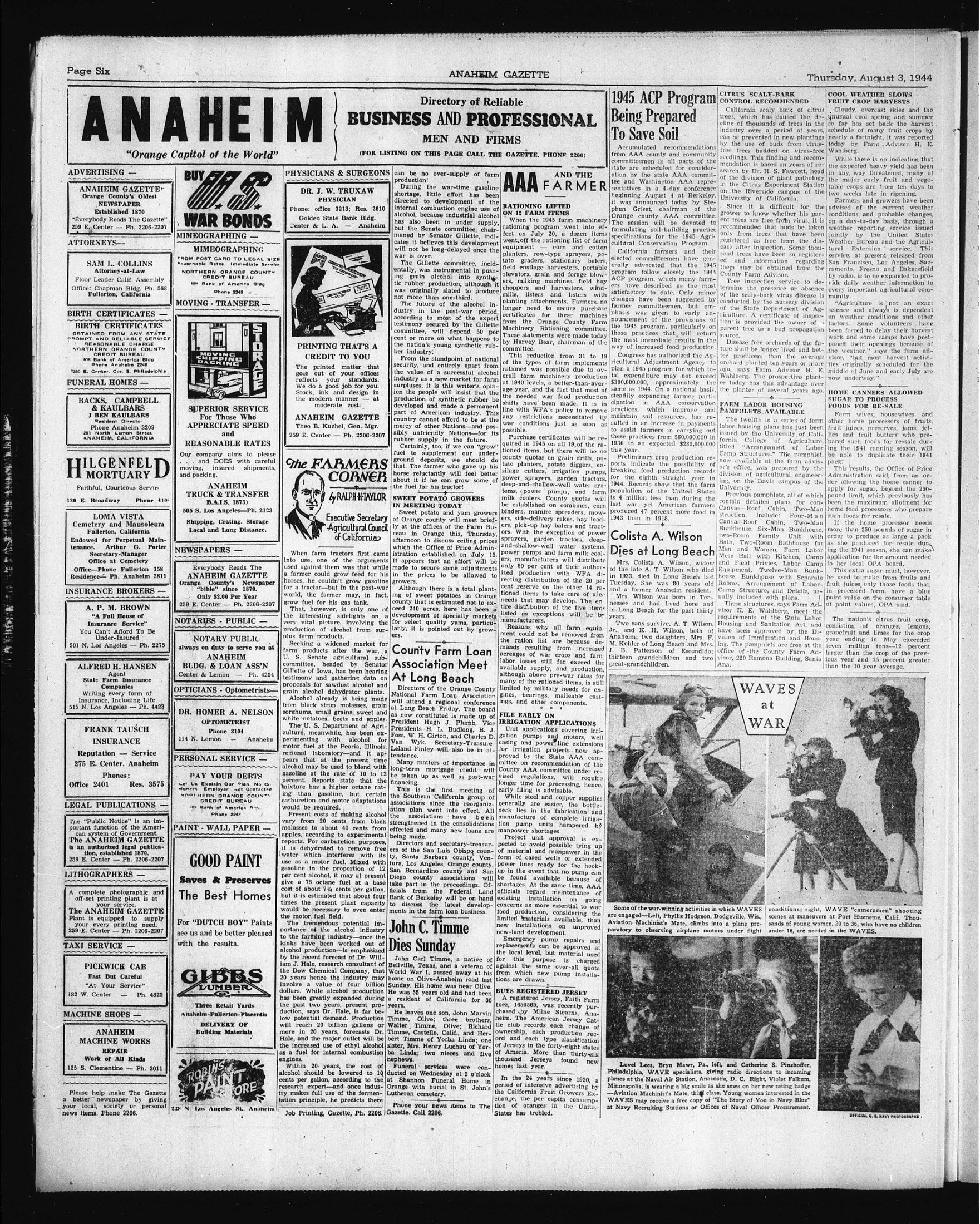
Searchable text
Page Six
ANAHEIM
"Orange Capitol of the World"
ADVERTISING —
ANAHEIM GAZETTE
Orange County's Oldest
NEWSPAPER
Established 1870
"Everybody Reads The Gazette"
259 E. Center — Ph. 2206-2207
ATTORNEYS—
SAM L. COLLINS
Attorney-at-Law
Floor Leader Calif. Assembly
Office: Chapman Bldg. Ph. 568
Fullerton, California
BIRTH CERTIFICATES —
BIRTH CERTIFICATES
OBTAINED FROM ANY STATE
PROMPT AND RELIABLE SERVICE
REASONABLE CHARGE
NORTHERN ORANGE COUNTY
CREDIT BUREAU
408 Bank of America Bldg
Phone Anaheim 2248
250 E. Center. Cor. S. Philadelphia
FUNERAL HOMES —
BACKS, CAMPBELL & KAULBARS
J BEN KAULBARS
Resident Director
Phone Anaheim 3209
251 North Lemon Street
ANAHEIM, CALIFORNIA
BUY U.S. WAR BONDS
MIMEOGRAPHING —
FROM POST CARD TO LEGAL SIZE
Reasonable Rates Immediate Service
NORTHERN ORANGE COUNTY CREDIT BUREAU
109 Bank of America Bldg
Phone 2248
MOVING - TRANSFER —
STORAGE
SUPERIOR SERVICE
For Those Who APPRECIATE SPEED and REASONABLE RATES
Our company aims to please
FUNERAL HOMES —
BACKS, CAMPBELL & KAULBARS
J BEN KAULBARS
Resident Director
Phone Anaheim 3209
251 North Lemon Street
ANAHEIM, CALIFORNIA
HILGENFELD MORTUARY
Faithful, Courteous Service
120 E. Broadway Phone 410
LOMA VISTA
Cemetery and Mausoleum
Fullerton, California
Endowed for Perpetual Maintenance. Arthur G. Porter
Secretary-Manager
Office at Cemetery
Office—Phone Fullerton 158
Residence—Ph. Anaheim 2811
INSURANCE BROKERS —
A. P. M. BROWN
"A Full House of Insurance Service"
You Can't Afford To Be Under-Insured
501 N. Los Angeles — Ph. 2275
ALFRED H. HANSEN
Agent
State Farm Insurance Companies
Writing every form of Insurance, Including Life
515 N. Los Angeles — Ph. 4423
FRANK TAUSCH
INSURANCE
Reputation — Service
275 E. Center, Anaheim
Phones:
Office 2401 Res. 3575
LEGAL PUBLICATIONS —
The "Public Notice" is an important function of the American system of Government.
The ANAHEIM GAZETTE is an authorized legal publication, established 1870.
259 E. Center — Ph. 2206-2207
SUPERIOR SERVICE For Those Who APPRECIATE SPEED and REASONABLE RATES
Our company aims to please and DOES with careful moving, insured shipments, and packing.
ANAHEIM TRUCK & TRANSFER
B.A.I.S. 1873)
505 S. Los Angeles—Ph. 2123
Shipping, Crating. Storage Local and Long Distance.
NEWSPAPERS —
Everybody Reads The ANAHEIM GAZETTE Orange County's Newspaper "bible" since 1870.
Only $2.00 Per Year
259 E. Center — Ph. 2206-2207
NOTARIES - PUBLIC —
NOTARY PUBLIC always on duty to serve you at ANAHEIM BLDG. & LOAN ASS'N Center & Lemon — Ph. 4204
OPTICIANS - Optometrists —
DR. HOMER A. NELSON OPTOMETRIST Phone 3104
114 N. Lemon — Anaheim
PERSONAL SERVICE —
PAY YOUR DERTS Let Us Explain Our Plan. No Co-signers Employer not Contacted NORTHERN ORANGE COUNTY CREDIT BUREAU Bank of America Rim Phone 224P
PAINT - WALL PAPER —
GOOD PAINT
Phones:
Office 2401 Res. 3575
LEGAL PUBLICATIONS —
The "Public Notice" is an important function of the American system of Government. The ANAHEIM GAZETTE is an authorized legal publication, established 1870.
259 E. Center — Ph. 2206-2207
LITHOGRAPHERS —
A complete photographic and off-set printing plant is at your service. The ANAHEIM GAZETTE Plant is equipped to supply your every printing need.
259 E. Center — Ph. 2206-2207
TAXI SERVICE —
PICKWICK CAB
Fast But Careful
"At Your Service"
182 W. Center — Ph. 4822
MACHINE SHOPS —
ANAHEIM MACHINE WORKS
REPAIR
Work of All Kinds
125 S. Clementine — Ph. 2011
Please help make The Gazette a better newspaper by giving your local, society or personal news items. Phone 2206.
PAINT - WALL PAPER —
GOOD PAINT
Saves & Preserves
The Best Homes
For "DUTCH BOY" Paints see us and be better pleased with the results.
GIBBS LUMBER
Three Retail Yards
Anaheim-Fullerton-Placentia
DELIVERY OF Building Materials
ROBINS PAINT MORE
Within 20 years, the alcohol should be lowered per gallon, according to research expert—and once it makes full use of the fermentation principle, he predicts
ANAHEIM GAZETTE
Directory of Reliable BUSINESS AND PROFESSIONAL MEN AND FIRMS
(FOR LISTING ON THIS PAGE CALL THE GAZETTE, PHONE 2206)
PHYSICIANS & SURGEONS
DR. J. W. TRUXAW
PHYSICIAN
Phone: office 3213; Res. 2610
Golden State Bank Bldg.
Center & L. A. — Anaheim
PRINTING THAT'S A CREDIT TO YOU
The printed matter that goes out of your offices reflects your standards. We do a good job for you. Stock, ink and design in the modern manner — at moderate cost.
ANAHEIM GAZETTE
Theo B. Kuchel, Gen. Mgr.
259 E. Center — Ph. 2206-2207
can be no over-supply of farm production!
During the war-time gasoline shortage, little effort has been directed to development of the internal combustion engine use of alcohol, because industrial alcohol has also been in under supply, but the Senate committee, chairmaned by Senator Gillette, indicates it believes this development will not be long-delayed once the war is over.
The Gillette committee, incidentally, was instrumental in pushing grain alcohol into synthetic rubber production, although it was originally slated to produce not more than one-third.
The future of the alcohol industry in the post-war period, according to most of the expert testimony secured by the Gillette committee, will depend 50 per cent or more on what happens to the nation's young synthetic rubber industry.
From the standpoint of national security, and entirely apart from the value of a successful alcohol industry as a new market for farm surpluses, it is this writer's opinion the people will insist that the production of synthetic rubber be developed and made a permanent part of American industry. This country cannot afford to be at the mercy of other Nations—and possibly unfriendly Nations—for its rubber supply in the future.
Certainly, too, if we can "grow" fuel to supplement our under-
AAA AND THE FARMER
RATIONING LIFTED ON 12 FARM ITEMS
When the 1945 farm machinery rationing program went into effect on July 20, a dozen items went off the rationing list of farm equipment — corn and cotton planters, row-type sprayers, potato graders, stationary balers, field ensilage harvesters, portable elevators, grain and forage blowers, milking machines, field hay choppers and harvesters, windmills, listers and listers with planting attachments. Farmers no longer need to secure purchase certificates for these machines from the Orange County Farm Machinery Rationing committee. These statements were made today by Harvey Bear, chairman of the committee.
This reduction from 31 to 19 of the types of farm implements rationed was possible due to overall farm machinery production at 1940 levels, a better-than-average year, and the fact that most of the needed war food production shifts have been made. It is in line with WFA's policy to remove any restrictions necessitated by war conditions just as soon as possible.
Purchase certificates will be required in 1945 on all 19 of the rationed items, but there will be no county quotes on grain.
1945 ACP Program Being Prepared To Save Soil
Accumulated recommendations from AAA county and committeemen in all parts state are scheduled for collection by the state AAAtee and Washington AAA sentatives in a 4-day course beginning August 4 at Burlington. It was announced today that Stephen Griset, chairman of Orange county AAA consortium. The session will be developing soil-building specifications for the 1945 cultural Conservation Project.
California farmers and elected committeemen have erally advocated that the program follow closely the ACP program, which many farmers have described as the satisfactory to date. Only changes have been suggested farmer committeemen, but phasis was given to encourageancement of the provisional 1945 program, particularly those practices that will result in the most immediate result way of increased food production.
Congress has authorized agricultural Adjustment Agent plan a 1945 program for total expenditure may not $300,000,000, approximate same as 1944. On a nationwide steadily expanding farmer cipation in AAA consortia practices, which improve maintain soil resources, resulted in an increase in pay to assist farmers in carry these practices from $60,000,1936 to an expected $285,this year.
The printed matter that goes out of your offices reflects your standards. We do a good job for you. Stock, ink and design in the modern manner — at moderate cost.
ANAHEIM GAZETTE
Theo B. Kuchel, Gen. Mgr.
259 E. Center — Ph. 2206-2207
The FARMERS CORNER
by RALPH-H-TAYLOR
Executive Secretary Agricultural Council of California
When farm tractors first came into use, one of the arguments used against them was that while a farmer could grow feed for his horses, he couldn't grow gasoline or a tractor—but in the post-war world, the farmer may, in fact, grow fuel for his gas tank.
That, however, is only one of the interesting sidelights on a very vital picture, involving the production of alcohol from surplus farm products.
Seeking a widened market for farm products after the war, a U.S. Senate agricultural subcommittee, headed by Senator Ellette of Iowa, has been hearing testimony and gathering data on proposals for sawdust alcohol and grain alcohol dehydrator plants.
Alcohol already is being made from black strop molasses, grain sorghums, small grains, sweet and white potatoes, beets and apples. The U.S. Department of Agriculture, meanwhile, has been experimenting with alcohol for motor fuel at the Peoria, Illinois regional laboratory—and it appears that at the present time alcohol may be used to blend with gasoline at the rate of 10 to 12 percent. Reports state that the mixture has a higher octane rating than gasoline, but certain carburetion and motor adaptations should be required.
Present costs of making alcohol vary from 20 cents from black molasses to about 40 cents from apples, according to experimental reports. For carburetion purposes, it is dehydrated to remove free water which interferes with its use as a motor fuel. Mixed with security, and entirely apart from the value of a successful alcohol industry as a new market for farm surpluses, it is this writer's opinion the people will insist that the production of synthetic rubber be developed and made a permanent part of American industry. This country cannot afford to be at the mercy of other Nations—and possibly unfriendly Nations—for its rubber supply in the future.
Certainly, too, if we can "grow" fuel to supplement our underground deposits, we should do that. The farmer who gave up his horse reluctantly will feel better about it if he can grow some of the fuel for his tractor!
SWEET POTATO GROWERS IN MEETING TODAY
Sweet potato and yam growers of Orange county will meet briefly at the offices of the Farm Bureau in Orange this Thursday, afternoon to discuss ceiling prices which the Office of Price Administration established on July 15. It appears that an effort will be made to secure some adjustments in the prices to be allowed to growers.
Although there is a total planting of sweet potatoes in Orange county that is estimated not to exceed 240 acres, here has been a development of specialty markets for select quality yams, particularly, it is pointed out by growers.
County Farm Loan Association Meet At Long Beach
Directors of the Orange County National Farm Loan Association will attend a regional conference at Long Beach Friday. The board as now constituted is made up of President Hugh J. Plumb, Vice Presidents H. L. Budlong, B. J. Foss, W. H. Girton, and Charles D. Van Wyk. Secretary-Treasurer Leland Finley will also be in attendance.
Many matters of importance in long-term mortgage credit will be taken up as well as post-war financing.
This is the first meeting of the Southern California group of associations since the reorganization plan went into effect. All the associations have been strengthened in the consolidations effected and many new loans are being made.
Directors and secretary-treasurers of the San Luis Obispo county, Santa Barbara county, Ventura, Los Angeles, Orange county of the types of farm implements rationed was possible due to overall farm machinery production at 1940 levels, a better-than-average year, and the fact that most of the needed war food production shifts have been made. It is in line with WFA's policy to remove any restrictions necessitated by war conditions just as soon as possible.
Purchase certificates will be required in 1945 on all 19 of the rationed items, but there will be no county quotas on grain drills, potato planters, potato diggers, ensilage cutters, irrigation pumps, power sprayers, garden tractors, deep-and-shallow-well water systems, power pumps, and farm milk coolers. County quotas will be established on combines, corn binders, manure spreaders, mowers, side-delivery rakes, hay loaders, pick-up hay balers and tractors. With the exception of power sprayers, garden tractors, deep-and-shallow-well water systems, power pumps and farm milk coolers, manufacturers will distribute only 80 per cent of their authorized production with WFA directing distribution of the 20 per cent reserve on the other 14 rationed items to take care of areas that may develop. The entire distribution of the five items listed as exceptions will be by manufacturers.
Reasons why all farm equipment could not be removed from the ration list are because demands resulting from increased acreages of war crops and farm labor losses still far exceed the available supply, and production, although above pre-war rates for many of the rationed items, is still limited by military needs for engines, bearings, malleable castings, and other components.
FILE EARLY ON IRRIGATION APPLICATIONS
Unit applications covering irrigation pumps and motors, well casing and power line extensions for irrigation projects now approved by the State AAA committee on recommendation of the County AAA committee under revised regulations, will require longer time for processing, hence, early filing is advisable.
While steel and copper supplies generally are easier, the bottleneck lies in the fabrication and manufacture of complete irrigation pump units hampered by manpower shortages.
Project unit approval is expected to avoid possible tying up of material and manpower in the form of cased wells or extended power lines ready for the back-circulation Adjustment Agenda plan a 1955 program for walt expenditure may not be $300,000,000, approximately same as 1944. On a national steadily expanding farmer cipation in AAA consort practices, which improve maintain soil resources,sulted in an increase in pay to assist farmers in carry these practices from $60,000;1936 to an expected $285;this year.
Preliminary crop production ports indicate the possibility breaking food production for the eighth straight year;1944. Records show that the population of the United States is 4 million less than during last war; yet American produced 47 percent more in 1943 than in 1918.
Colista A. Wilson Dies at Long Bee
Mrs. Colista A. Wilson, of the late A. T. Wilson wint in 1933; died in Long Beach Tuesday. She was 80 years and a former Anaheim resident.
Mrs. Wilson was born in Nessee and had lived her in Long Beach for the past years.
Two sons survive: A. T., Jr., and K. H. Wilson; bonaheim; two daughters; M. M. Kohler of Long Beach and J. B. Patterson of Essex thirteen grandchildren and great-grandchildren.
John C. Timme Dies Sunday
John Carl Timme, a native of Bellville, Texas, and a veteran of World War I, passed away at his home on Olive-Anaheim road last Sunday. His home was near Olive. He was 55 years old and had been a resident of California for 36 years.
He leaves one son, John Marvin Timme, Olive; three brothers, Walter Timme, Olive; Richard Timme, Castello, Calif., and Herbert Timme of Yorba Linda; one sister, Mrs. Henry Luchau of Yorba Linda; two nieces and five nephews.
Funeral services were conducted on Wednesday at 2 o'clock at Shannon Funeral Home in Orange with burial in St. John's Lutheran cemetery.
Phone your news items to The Gazette. Call 2206.
County AAA committee under revised regulations, will require longer time for processing, hence, early filing is advisable.
While steel and copper supplies generally are easier, the bottle-neck lies in the fabrication and manufacture of complete irrigation pump units hampered by manpower shortages.
Project unit approval is expected to avoid possible tying up of material and manpower in the form of cased wells or extended power lines ready for the hook-up in the event that no pump can be found available because of shortages. At the same time, AAA officials regard maintenance of existing installation on going concerns as more essential to war food production, considering the limited materials available, than new installations on unproved new-land development.
Emergency pump repairs and replacements can be approved at the local level, but material used for this purpose is charged against the same over-all quota from which new pump installations are drawn.
BUYS REGISTERED JERSEY
A registered Jersey, Faith Farm Inez, 1450565, was recently purchased by Milne Stearns, Anaheim. The American Jersey Cattle club records each change of ownership, each production record and each type classification of Jerseys in the forty-eight states of America. More than thirty-six thousand Jerseys found new homes last year.
In the 24 years since 1920, a period of intensive advertising by the California Fruit Growers Exchange, the per capita consumption of oranges in the United States has trebled.
1945 ACP Program Being Prepared To Save Soil
Accumulated recommendations from AAA county and community committeemen in all parts of the state are scheduled for consideration by the state AAA committee and Washington AAA representatives in a 4-day conference beginning August 4 at Berkeley, it was announced today by Stephen Griset, chairman of the Orange county AAA committee. The session will be devoted to formulating soil-building practice specifications for the 1945 Agricultural Conservation Program.
California farmers and their elected committeemen have generally advocated that the 1945 program follow closely the 1944 ACP program, which many farmers have described as the most satisfactory to date. Only minor changes have been suggested by farmer committeemen, but emphasis was given to early announcement of the provisions of the 1945 program, particularly on those practices that will return the most immediate results in the way of increased food production.
Congress has authorized the Agricultural Adjustment Agency to plan a 1945 program for which total expenditure may not exceed $300,000,000, approximately the same as 1944. On a national basis, steadily expanding farmer participation in AAA conservation practices, which improve and maintain soil resources, has resulted in an increase in payments to assist farmers in carrying out these practices from $60,000,000 in 1936 to an expected $285,000,000 this year.
CITRUS SCALY-BARK CONTROL RECOMMENDED
California scaly bark of citrus trees, which has caused the decline of thousands of trees in the industry over a period of years, can be prevented in new plantings by the use of buds from virus-free trees budded on virus-free seedlings. This finding and recommendation is based on years of research by Dr. H. S. Fawcett, head of the division of plant pathology in the Citrus Experiment Station on the Riverside campus of the University of California.
Since it is difficult for the grower to know whether his parent trees are free from virus, it is recommended that buds be taken only from trees that have been registered as free from the disease after inspection. Some thousand trees have been so registered and information regarding them may be obtained from the County Farm Advisor.
Tree inspection service to determine the presence or absence of the scaly-bark virus disease is conducted by the nursery division of the State Department of Agriculture. A certificate of inspection is provided the owner of parent tree as a bud propagation source.
Disease free orchards of the future shall be longer lived and better producers than the average orchard planted ten years or more ago, says Farm Advisor H. E. Wahlberg. The prospective plantter today has this advantage over the planter of several years ago.
COOL WEATHER SLOWS FRUIT CROP HARVESTS
Cloudy, overcast skies and the unusual cool spring and summer so far has set back the harvest schedule of many fruit crops by nearly a fortnight, it was reported today by Farm Advisor H. E. Wahlberg.
While there is no indication that the expected heavy yield has been in any way threatened, many of the major early fruit and vegetable crops are from ten days to two weeks late in ripening.
Farmers and growers have been advised of the current weather conditions and probable changes, on a day-to-day basis, through a weather reporting service issued jointly by the United States Weather Bureau and the Agricultural Extension service. This service, at present released from San Francisco, Los Angeles, Sacramento, Fresno and Bakersfield by radio, is to be expanded to provide daily weather information to every important agricultural community.
"Agriculture is not an exact science and always is dependent on weather conditions and other factors. Some volunteers have been forced to delay their harvest work and some camps have postponed their openings because of the weather," says the farm advisor, "but most harvest activities originally scheduled for the middle of June and early July are now underway."
HOME CANNERS ALLOWED SUGAR TO PROCESS FOODS FOR RE-SALE
Farm wives, housewives, and other home processors of fruits, fruit juices, preserves, jams, jellies and fruit butters who prepared such foods for re-sale during the 1941 canning season, will be able to duplicate their 1941
Agricultural Adjustment Agency to plan a 1945 program for which total expenditure may not exceed $300,000,000, approximately the same as 1944. On a national basis, steadily expanding farmer participation in AAA conservation practices, which improve and maintain soil resources, has resulted in an increase in payments to assist farmers in carrying out these practices from $60,000,000 in 1936 to an expected $285,000,000 this year.
Preliminary crop production reports indicate the possibility of breaking food production records for the eighth straight year in 1944. Records show that the farm population of the United States is 4 million less than during the last war, yet American farmers produced 47 percent more food in 1943 than in 1918.
Colista A. Wilson Dies at Long Beach
Mrs. Colista A. Wilson, widow of the late A. T. Wilson who died in 1933, died in Long Beach last Tuesday. She was 80 years old and a former Anaheim resident. Mrs. Wilson was born in Tennessee and had lived here and Long Beach for the past thirty years.
Two sons survive, A. T. Wilson, Jr., and K. H. Wilson, both of Anaheim; two daughters, Mrs. F. L. Kohler of Long Beach and Mrs. B. Patterson of Escondido; fourteen grandchildren and two great-grandchildren.
The twelfth in a series of farm labor housing plans has just been issued by the University of California College of Agriculture, titled "Arrangement of Labor Camp Structures." The pamphlet, now available at the farm advisor's office, was prepared by the division of agricultural engineering on the Davis campus of the University.
Previous pamphlets, all of which contain detailed plans for concrete—Roof Cabin, Two-Man construction, include: Four-Man Canvas-Roof Cabin, Two-Man Bunkhouse, Six-Man Bunkhouse, two-Room Family Unit with Bath, Two-Room Bathhouse for Men and Women, Farm Labor Mess Hall with Kitchen, Camp and Field Privies, Labor Camp Equipment, Twelve-Man Bunkhouse, Bunkhouse with Separate Rooms, Arrangement of Labor-Camp Structure, and Details, usually included with plans.
These structures, says Farm Advisor H. E. Wahlberg, meet the requirements of the State Labor Housing and Sanitation Act, and have been approved by the Division of Immigration and Housing. The pamphlets are free at the office of the County Farm Advisor, 220 Ramona Building, Santa Ana.
HOME CANNERS ALLOWED SUGAR TO PROCESS FOODS FOR RE-SALE
Farm wives, housewives, and other home processors of fruits, fruit juices, preserves, jams, jellies and fruit butters who prepared such foods for re-sale during the 1941 canning season, will be able to duplicate their 1941 pack.
This results, the Office of Price Administration said, from an order allowing the home canner to apply for sugar, beyond the 250-pound limit, which previously has been the maximum allotment for home food processors who prepare such foods for resale.
If the home processor needs more than 250 pounds of sugar in order to produce as large a pack as she produced for resale during the 1941 season, she can make application for the amount needed to her local OPA board.
This extra sugar must, however, be used to make from fruits and fruit juices only those foods that, in processed form, have a blue point value on the consumer table of point values, OPA said.
The nation's citrus fruit crop, consisting of oranges, lemons, grapefruit and limes for the crop year ending in May exceeded seven million tons—12 percent larger than the crop of the previous year and 75 percent greater than the 10 year average.
Some of the war-winning activities in which WAVES were engaged—Left, Phyllis Hodgson, Dodgeville, Wis., Aviation Machinist's Mate, climbs into a plane laboratory to observing airplane motors under flight conditions; right, WAVE "cameramen" shooting scenes at maneuvers at Port Hueneme, Calif. Thousands of young women, 20 to 36, who have no children under 18, are needed in the WAVES.
Lovel Lees, Bryn Mawr, Pa., left, and Catherine S. Pinzhoffer, Philadelphia, WAVE specialists, giving radio directions to incoming planes at the Naval Air Station, Anacostia, D. C. Right, Violet Falkum, Minneapolis, is wearing a big smile as she sews on her new rating badge. Aviation Machinist's Mate, third class. Young women interested in the WAVES may receive a free copy of "The Story of You in Navy Blue" by Navy Recruiting Stations or Offices of Naval Officer Procurement.