anaheim-gazette 1940-12-12
Scanned page
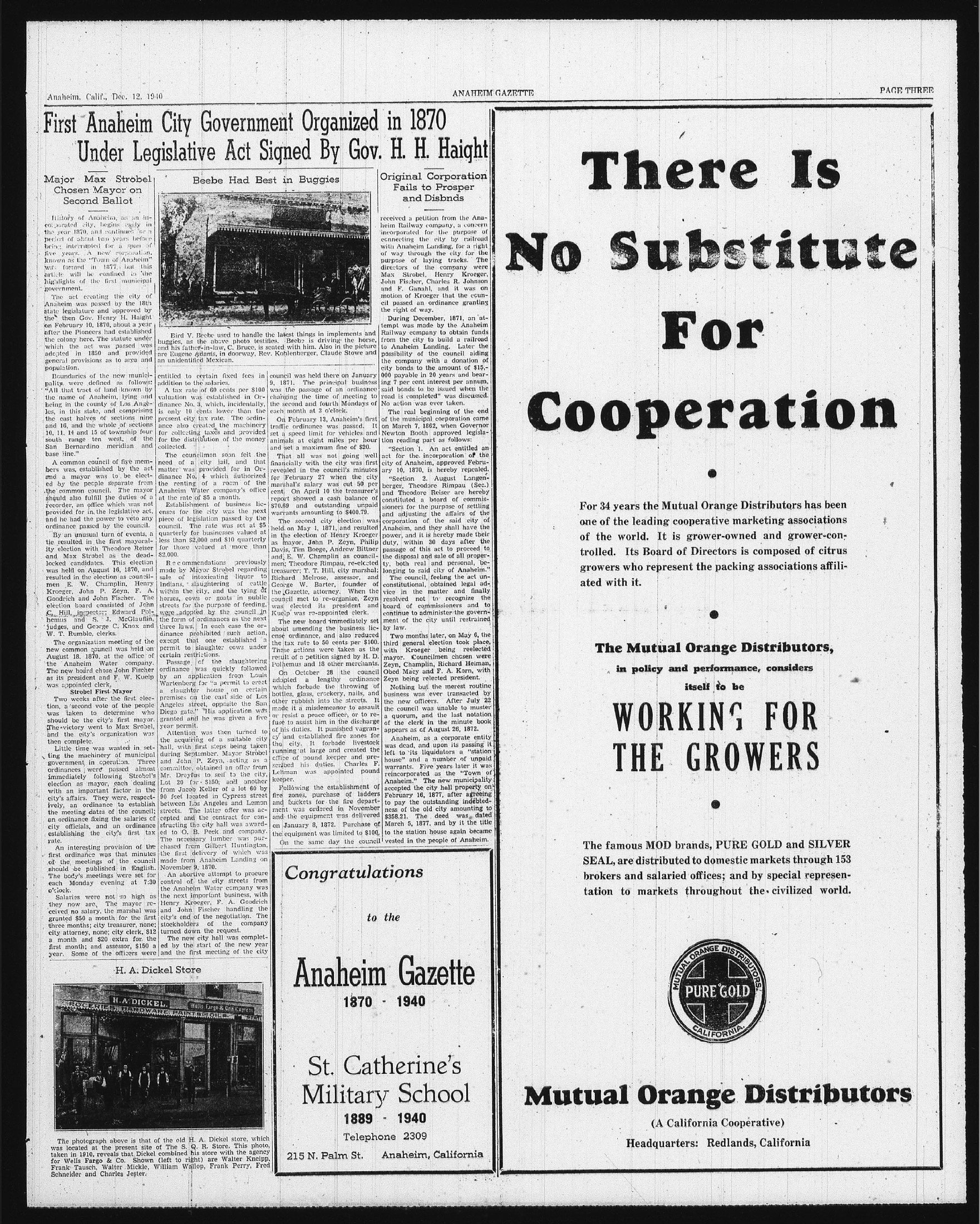
Searchable text
First Anaheim City Government Organized Under Legislative Act Signed By Gov.
Major Max Strobel
Chosen Mayor on Second Ballot
History of Anaheim, as an incorporated city, begins early in the year 1870, and continues for a period of about two years before being interrupted for a span of five years. A new corporation, known as the "Town of Anaheim" was formed in 1877, but this article will be confined to the highlights of the first municipal government.
The act creating the city of Anaheim was passed by the 18th state legislature and approved by then Gov. Henry H. Haight on February 10, 1870, about a year after the Pioneers had established the colony here. The statute under which the act was passed was adopted in 1850 and provided general provisions as to area and population.
Boundaries of the new municipality were defined as follows:
"All that tract of land known by the name of Anaheim, lying and being in the county of Los Angeles, in this state, and comprising the east halves of sections nine and 16, and the whole of sections 10, 11, 14 and 15 of township four south range ten west, of the San Bernardino meridian and base line."
Beebe Had Best in Buggies
Bird V. Beebe used to handle the latest things in implements and buggies, as the above photo testifies. Beebe is driving the horse and his father-in-law, C. Bruce, is seated with him. Also in the picture are Eugene Adams, in doorway, Rev. Kohlenberger, Claude Stowe, an unidentified Mexican.
entitled to certain fixed fees in addition to the salaries.
A tax rate of 60 cents per $100 valuation was established in Ordinance No. 3, which, incidentally, is only 10 cents lower than the present city tax rate. The ordinance also created the machinery for collecting taxes and provided for the distribution of the money collected.
The councilmen soon felt the council was held there on January 9, 1871. The principal business was the passage of an ordinance changing the time of meeting the second and fourth Monday each month at 3 o'clock.
On February 13, Anaheim's traffic ordinance was passed, set a speed limit for vehicles animals at eight miles per hour and set a maximum fine of $200.
Boundaries of the new municipality were defined as follows:
"All that tract of land known by the name of Anaheim, lying and being in the county of Los Angeles, in this state, and comprising the east halves of sections nine and 16, and the whole of sections 10, 11, 14 and 15 of township four south range ten west, of the San Bernardino meridian and base line."
A common council of five members was established by the act and a mayor was to be elected by the people separate from the common council. The mayor should also fulfill the duties of a recorder, an office which was not provided for in the legislative act, and he had the power to veto any ordinance passed by the council.
By an unusual turn of events, a tie resulted in the first mayorality election with Theodore Reiser and Max Strobel as the deadlocked candidates. This election was held on August 16, 1870, and resulted in the election as councilmen E. W. Champlin, Henry Kroeger, John P. Zeyn, F. A. Goodrich and John Fischer. The election board consisted of John C. Hill, inspector; Edward Polhemus and S. J. McGlaustin, judges, and George C. Knox and W. T. Rumble, clerks.
The organization meeting of the new common council was held on August 18, 1870, at the office of the Anaheim Water company. The new board chose John Fischer as its president and F. W. Kuelp was appointed clerk.
Strobel First Mayor
Two weeks after the first election, a second vote of the people was taken to determine who should be the city's first mayor. The victory went to Max Strobel, and the city's organization was then complete.
Little time was wasted in setting the machinery of municipal government in operation. Three ordinances were passed almost immediately following Strobel's election as mayor, each dealing with an important factor in the city's affairs. They were, respectively, an ordinance to establish the meeting dates of the council; an ordinance fixing the salaries of city officials, and an ordinance establishing the city's first tax rate.
An interesting provision of the first ordinance was that minutes of the meetings of the council entitled to certain fixed fees in addition to the salaries.
A tax rate of 60 cents per $100 valuation was established in Ordinance No. 3, which incidentally, is only 10 cents lower than the present city tax rate. The ordinance also created the machinery for collecting taxes and provided for the distribution of the money collected.
The councilmen soon felt the need of a city jail, and that matter was provided for in Ordinance No. 4 which authorized the renting of a room of the Anaheim Water company's office at the rate of $5 a month.
Establishment of business licenses for the city was the next piece of legislation passed by the council. The rate was set at $5 quarterly for businesses valued at less than $2,000 and $10 quarterly for those valued at more than $2,000.
Recommendations previously made by Mayor Strobel regarding sale of intoxicating liquor to Indians, slaughtering of cattle within the city, and the tying of horses, cows or goats in public streets for the purpose of feeding, were adopted by the council in the form of ordinances as the next three laws. In each case the ordinance prohibited such action, except that one established a permit to slaughter cows under certain restrictions.
Passage of the slaughtering ordinance was quickly followed by an application from Louis Wartenberg for "a permit to erect a slaughter house on certain premises on the east side of Los Angeles street, opposite the San Diego gate." His application was granted and he was given a five year permit.
Attention was then turned to the acquiring of a suitable city hall, with first steps being taken during September. Mayor Strobel and John P. Zeyn acting as a committee, obtained an offer from Mr. Dreyfus to sell to the city, Lot 20 for $150, and another from Jacob Keller of a lot 60 by 90 feet located in Cypress street between Los Angeles and Lemon streets. The latter offer was accepted and the contract for constructing the city hall was awarded to O. B. Peck and company. The necessary lumber was purchased from Gilbert Huntington, the first delivery of which was made from Anaheim Landing on
On February 13, Anaheim's traffic ordinance was passed. It set a speed limit for vehicles animals at eight miles per hour and set a maximum fine of $25.
That all was not going financially with the city was revealed in the council's minutes for February 27 when the marshal's salary was cut 50 percent. On April 10 the treasurer report showed a cash balance $70.69 and outstanding unwarrants amounting to $400.79.
The second city election held on May 1, 1871, and resulted in the election of Henry Krower as mayor, John P. Zeyn, Ph.Davis, Tim Boege, Andrew Bitter and E. W. Champlin as councillors; Theodore Rimpau, re-elder treasurer; T. T. Hill, city marshal Richard Melrose, assessor; George W. Barter, founder the Gazette attorney. When council met to re-organize, Zeyn was elected its president Kuelp was re-appointed clerk.
The new board immediately about amending the business sense ordinance, and also redacted the tax rate to 50 cents per dollar. These actions were taken as result of a petition signed by H.Polhemus and 18 other merchants.
On October 28 the council adopted a lengthy ordinance which forbade the throwing bottles, glass, crockery, nails, other rubbish into the streets made it misdemeanor to assist or resist a peace officer, or to fuse to assist him in the dischargement of his duties. It punished vagacy and established fire zones in the city. It forbade lives running at large and created office of pound keeper and described his duties. Charles Lehman was appointed police keeper.
Following the establishment fire zones, purchase of lace buckets for the fire department was ordered in November and the equipment was delivered on January 8, 1872. Purchasing the equipment was limited to one unit each day.
An interesting provision of the first ordinance was that minutes of the meetings of the council should be published in English. The body's meetings were set for each Monday evening at 7:30 o'clock.
Salaries were not so high as they now are. The mayor received no salary, the marshal was granted $50 a month for the first three months; city treasurer, none; city attorney, none; city clerk, $12 a month and $20 extra for the first month; and assessor, $150 a year. Some of the officers were
The photograph above is that of the old H. A. Dickel store, which was located at the present site of The S. Q. R. Store. This photo, taken in 1910, reveals that Dickel combined his store with the agency for Wells Fargo & Co. Shown (left to right) are Walter Kneipp, Frank Tausch, Walter Mickle, William Wallop, Frank Perry, Fred Schneider and Charles Jester.
It Organized in 1870
Named By Gov. H. H. Haight
Original Corporation Fails to Prosper and Disbnds
received a petition from the Anaheim Railway company, a concern incorporated for the purpose of connecting the city by railroad with Anaheim Landing, for a right of way through the city for the purpose of laying tracks. The directors of the company were Max Strobel, Henry Kroeger, John Fischer, Charles R. Johnson and F. Ganahl, and it was on motion of Kroeger that the council passed an ordinance granting the right of way.
During December, 1871, an attempt was made by the Anaheim Railway company to obtain funds from the city to build a railroad to Anaheim Landing. Later the possibility of the council aiding the company with a donation of city bonds to the amount of $15,-000 payable in 20 years and bearing 7 per cent interest per annum, said bonds to be issued when the road is completed" was discussed. No action was ever taken.
The real beginning of the end of the municipal corporation came on March 7, 1862, when Governor Newton Booth approved legislation reading part as follows:
"Section 1. An act entitled an act for the incorporation of the
February 13, Anaheim's first ordinance was passed. It speed limit for vehicles and mails at eight miles per hour set a maximum fine of $20.
On April 10 the treasurer's act showed a cash balance of $50 and outstanding unpaid amounts amounting to $400.79.
The second city election was on May 1, 1871, and resulted in the election of Henry Kroeger mayor, John P. Zeyn, Philip Boege, Andrew Bittner, E. W. Champlin as councilman; Theodore Rimpau, re-elected mayor; T. T. Hill, city marshal; David Melrose, assessor, and George W. Barter, founder of Gazette, attorney. When the council met to re-organize, Zeyn elected its president and was re-appointed clerk.
The new board immediately set out amending the business licensure, and also reduced tax rate to 50 cents per $100.
The actions were taken as the result of a petition signed by H. D. Hemus and 18 other merchants.
October 28 the council voted a lengthy ordinance with forbade the throwing of fires, glass, crockery, nails, and rubbish into the streets. It it a misdemeanor to assault a peace officer, or to re- assist him in the discharge of duties. It punished vagrant and established fire zones for city. It forbade livestock being at large and created the size of sound keeper and pre- served his duties. Charles F. Han was appointed pounder.
Following the establishment of zones, purchase of ladders buckets for the fire depart- istion, the equipment was delivered January 8, 1872. Purchase of equipment was limited to $100, in the same day the council with a donation of city bonds to the amount of $15,-000 payable in 20 years and bearing 7 per cent interest per annum, said bonds to be issued when the road is completed" was discussed. No action was ever taken.
The real beginning of the end of the municipal corporation came on March 7, 1862, when Governor Newton Booth approved legislation reading part as follows:
"Section 1. An act entitled an act for the incorporation of the city of Anaheim, approved February 10, 1870, is hereby repealed.
Section 2. August Langenberger, Theodore Rimpau (Sec.) and Theodore Reiser are hereby constituted a board of commissioners for the purpose of settling and adjusting the affairs of the corporation of the said city of Anaheim, and they shall have the power, and it is hereby made their duty, within 30 days after the passage of this act to proceed to the disposal and sale of all property, both real and personal, belonging to said city of Anaheim."
The council, feeling the act unconstitutional, obtained legal advice in the matter and finally resolved not to recognize the board of commissioners and to continue to administer the government of the city until restrained by law.
Two months later, on May 6, the third general election took place, with Kroeger being reelected mayor. Councilmen chosen were Zeyn, Champlin, Richard Heiman, Obed Macy and F. A. Korn, with Zeyn being reelected president.
Nothing but the merest routine business was ever transacted by the new officers. After July 22 the council was unable to muster a quorum, and the last notation of the clerk in the minute book appears as of August 26, 1872.
Anaheim, as a corporate entity was dead, and upon its passing it left to its liquidators a "station house" and a number of unpaid warrants. Five years later it was reincorporated as the "Town of Anaheim." The new municipality accepted the city hall property on February 16, 1877, after agreeing to pay the outstanding indebtedness of the old city amounting to $358.21. The deed was dated March 5, 1877, and by it the title to the station house again became vested in the people of Anaheim.
Congratulations
to the
Anaheim Gazette
1870 - 1940
St. Catherine's Military School
1889 - 1940
Telephone 2309
215 N. Palm St. Anaheim, California
PAGE THREE
There Is Substitute For Operation
years the Mutual Orange Distributors has been
the leading cooperative marketing associations
world. It is grower-owned and grower-con-
. Its Board of Directors is composed of citrus
s who represent the packing associations affiliith it.
The Mutual Orange Distributors,
in policy and performance, considers
itself to be
WORKING FOR
THE GROWERS
famous MOD brands, PURE GOLD and SILVER
are distributed to domestic markets through 153
famous MOD brands, PURE GOLD and SILVER
are distributed to domestic markets through 153
s and salaried offices; and by special represento markets throughout the civilized world.
MUTUAL ORANGE DISTRIBUTORS
PURE GOLD
CALIFORNIA
Real Orange Distributors
(A California Cooperative)
Headquarters: Redlands, California