anaheim-gazette 1940-01-04
Scanned page
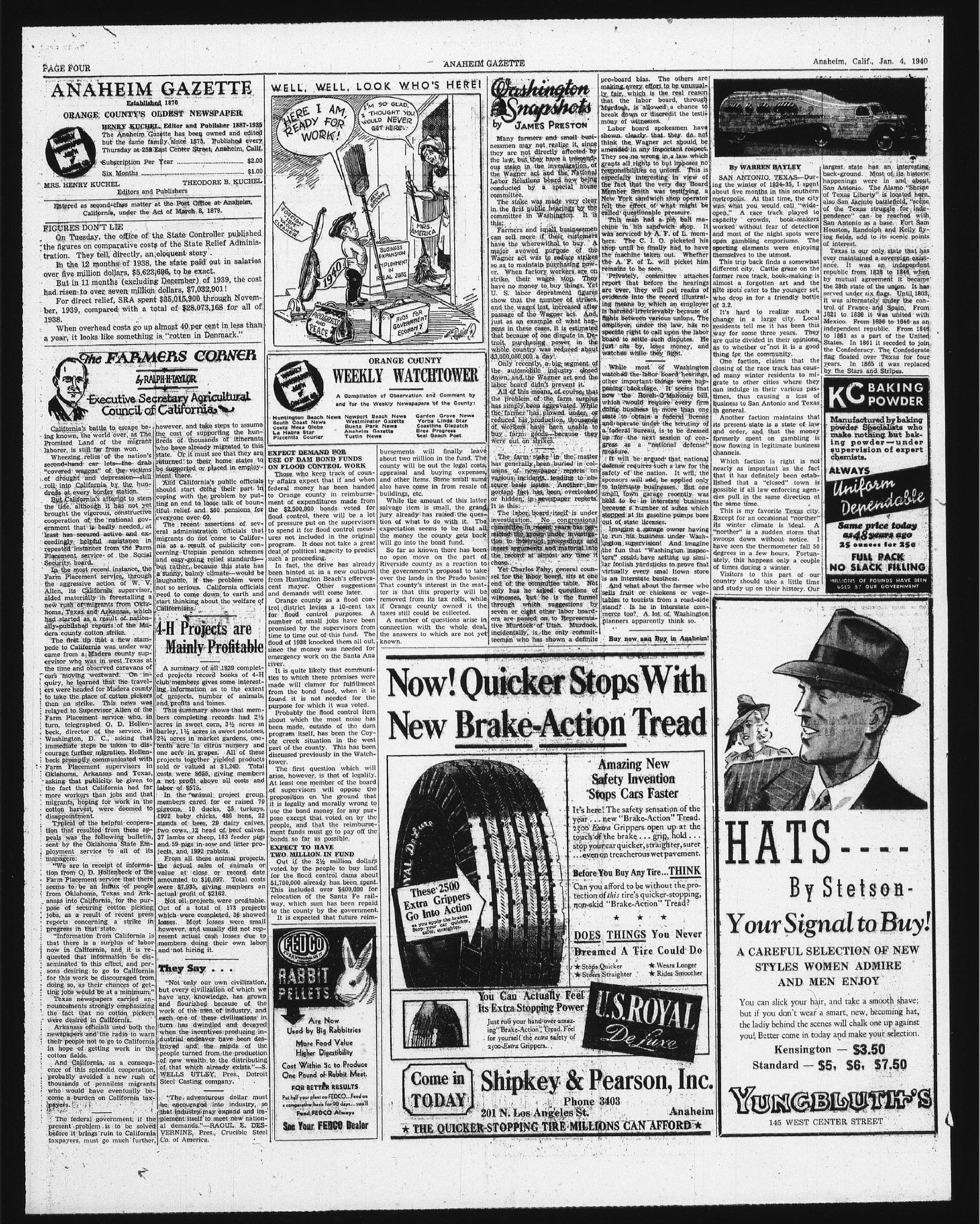
Searchable text
ANAHEIM GAZETTE
Established 1870
ORANGE COUNTY'S OLDEST NEWSPAPER
HENRY KUCHEL, Editor and Publisher 1887-1935
The Anaheim Gazette has been owned and edited but the same family since 1875. Published every Thursday at 259 East Center Street, Anaheim, Calif.
Subscription Per Year ... $2.00
Six Months ... $1.00
MRS. HENRY KUCHEL
THEODORE B. KUCHEL
Editors and Publishers
Entered as second-class matter at the Post Office at Anaheim,
California, under the Act of March 8, 1879.
FIGURES DON'T LIE
On Tuesday, the office of the State Controller published the figures on comparative costs of the State Relief Administration. They tell, directly, an eloquent story.
In the 12 months of 1938, the state paid out in salaries over five million dollars, $5,623,696, to be exact.
But in 11 months (excluding December) of 1939, the cost had risen to over seven million dollars, $7,032,901!
For direct relief, SRA spent $35,015,900 through November, 1939, compared with a total of $28,073,168 for all of 1938.
When overhead costs go up almost 40 per cent in less than a year, it looks like something is "rotten in Denmark."
The FARMERS CORNER
by RALPH-H-TAYLOR
Executive Secretary Agricultural Council of California
California's battle to escape being known, the world over, as The Promised Land of the migrant laborer, is still far from won.
However, and take steps to assume the cost of supporting the hundreds of thousands of itinerants who have already migrated to this state. Or it must see that they are...
California's battle to escape being known, the world over, as The Promised Land of the migrant laborer, is still far from won.
Wheezing relics of the nation's second-hand car lots—the drab "covered wagons" of the victims of drought and depression—still roll into California by the hundreds at every border station.
But California's attempt to stem the tide, although it has not yet brought the vigorous, constructive cooperation of the national government that is badly needed, at least has secured active and exceedingly helpful assistance in repeated instances from the Farm Placement service of the Social Security board.
In the most recent instance, the Farm Placement service, through the aggressive action of W. V. Allen, its California supervisor, aided materially in forestalling a new rush of migrants from Oklahoma, Texas and Arkansas, which had started as a result of nationally-published reports of the Madera county cotton strike.
The first tip that a new stampede to California was under way came from a Madera county supervisor who was in west Texas at the time and observed caravans of cars moving westward. On inquiry, he learned that the travelers were headed for Madera county to take the place of cotton pickers then on strike. This news was relayed to Supervisor Allen of the Farm Placement service who, in turn, telegraphed O. D. Hollenbeck, director of the service, in Washington, D. C., asking that immediate steps be taken to discourage further migration. Hollenbeck promptly communicated with Farm Placement supervisors in Oklahoma, Arkansas and Texas, asking that publicity be given to the fact that California had far more workers than jobs and that migrants, hoping for work in the cotton harvest, were doomed to disappointment.
Typical of the helpful cooperation that resulted from these appeals was the following bulletin sent by the Oklahoma State Employment service to all of its managers:
However, and take steps to assume the cost of supporting the hundreds of thousands of itinerants who have already migrated to this state. Or it must see that they are returned to their home states to be supported or placed in employment there.
And California's public officials should start doing their part in coping with the problem by putting an end to loose talk of bountiful relief and $60 pensions for everyone over 60.
The recent assertions of several administration officials that migrants do not come to California as a result of publicity concerning Utopian pension schemes and easy-going relief standards—but rather, because this state has a sunny, balmy climate—would be laughable, if the problem were not so serious. California officials need to come down to earth and start thinking about the welfare of Californians.
4-H Projects are Mainly Profitable
A summary of all 1939 completed projects record books of 4-H club members gives some interesting information as to the extent of projects, number of animals, and profits and losses.
This summary shows that members completing records had 2½ acres in sweet corn, 3½ acres in barley, 1½ acres in sweet potatoes, 2¾ acres in market gardens, one-tenth acre in citrus nursery and one acre in grapes. All of these projects together yielded products sold or valued at $1,240. Total costs were $855, giving members a net profit above all costs and labor of $575.
In the animal project group, members cared for or raised 70 pigeons, 10 ducks, 35 turkeys, 1922 baby chicks, 486 hens, 22 stands of bees, 29 dairy calves, two cows, 12 head of beef calves, 37 lambs or sheep, 183 feeder pigs and 59 pigs in sow and litter projects, and 1992 rabbits.
From all these animal projects, the actual sales of animals or...
Farm Placement supervised Oklahoma, Arkansas and Texas, asking that publicity be given to the fact that California had far more workers than jobs and that migrants, hoping for work in the cotton harvest, were doomed to disappointment.
Typical of the helpful cooperation that resulted from these appeals was the following bulletin, sent by the Oklahoma State Employment service to all of its managers:
"We are in receipt of information from O. D. Hollenbeck of the Farm Placement service that there seems to be an influx of people from Oklahoma, Texas and Arkansas into California, for the purpose of securing cotton picking jobs, as a result of recent press reports concerning a strike in progress in that state.
"Information from California is that there is a surplus of labor now in California, and it is requested that information be disseminated to this effect, and persons desiring to go to California for this work be discouraged from doing so, as their chances of getting jobs would be at a minimum."
Texas newspapers carried announcements strongly emphasizing the fact that no cotton pickers were desired in California.
Arkansas officials used both the newspapers and the radio to warn their people not to go to California in hope of getting work in the cotton fields.
And California, as a consequence of this splendid cooperation, probably avoided a new rush of thousands of penniless migrants who would have eventually become a burden on California taxpayers.
The federal government, if the present problem is to be solved before it brings ruin to California taxpayers, must go much further,
In the animal project group, members cared for or raised 70 pigeons, 10 ducks, 35 turkeys, 1922 baby chicks, 486 hens, 22 stands of bees, 29 dairy calves, two cows, 12 head of beef calves, 37 lambs or sheep, 183 feeder pigs and 59 pigs in-sow and litter projects, and 1992 rabbits.
From all these animal projects, the actual sales of animals or value at close or record date amounted to $10,097. Total costs were $7,935, giving members an actual profit of $2162.
Not all projects were profitable. Out of a total of 173 projects which were completed, 36 showed losses. Most losses were small however, and usually did not represent actual cash losses due to members doing their own labor and not hiring it.
They Say ...
"Not only our own civilization, but every civilization of which we have any knowledge, has grown and flourished because of the work of the men of industry, and each one of these civilizations in turn has dwindled and decayed when the incentives producing industrial endeavor have been destroyed and the minds of the people turned from the production of new wealth to the distributing of that which already exists."—S. WELLS UTLEY, Pres., Detroit Steel Casting company.
"The adventurous dollar must be encouraged into industry, so that industry may expand and implement itself to meet new national demands."—RAOUL E. DESVERNINE, Pres., Crucible Steel Co. of America.
WELL, WELL, LOOK WHO'S HERE!
HERE I AM. READY FOR WORK!
I'M SO GLAD. I THOUGHT YOU WOULD NEVER GET HERE:
Washington Snapshots by James Preston
Many farmers and small businessmen may not realize it, since they are not directly affected by the law, but they have a tremendous stake in the investigation of the Wagner act and the National Labor Relations board now being conducted by a special house committee.
The stake was made very clear in the first public hearings by the committee in Washington. It is this:
Farmers and small businessmen can sell more if their customers have the wherewithal to buy. A major avowed purpose of the Wagner act was to reduce strikes so as to maintain purchasing power. When factory workers are on strike, their wages stop. They have no money to buy things. Yet U. S. labor depratment figures show that the number of strikes, and the wages lost, increased after passage of the Wagner act. And, just as an example of what happens in these cases, it is estimated that because of one dispute in Detroit, purchasing power in the whole country was reduced about $3,000,000,000 a day!
Only recently, a big segment of the automobile industry closed down, and the Wagner act and the labor board didn't prevent it.
All of this means, of course, that the problem of the farm surplus has simply been aggravated. While the farmer has plowed under, or reduced his production, thousands of workers have been unable to buy farm goods—because they were out on strikes.
The farm stake in the matter pro-board bias. The others making every effort to be unfairly fair, which is the real reason that the labor board, through Murdock, is allowed a chance break down or discredit the mony of witnesses.
Labor board spokesmen shown clearly that they do think the Wagner act should amended in any important reed. They see no wrong in a law granting all rights to but imposing responsibilities on unions. The especially interesting in view the fact that the very day Member Smith was testifying New York sandwich shop opened felt the effect of what might called questionable pressure.
This man had a pin ball chine in his sandwich shop was serviced by A. F. of L. nbers. The C. I. O. picketeer shop until he finally had to the machine taken out. When the A. F. of L. will picketeer remains to be seen.
Privately, committee attest report that before the head are over, they will put rear evidence into the record illus ing means by which an emp is harmed irretrievably because fights between various unions employer, under the law, has specific right to call upon the board to settle such disputes just sits by, loses money, watches while they fight.
While most of Washi watched the labor board hear other important things were opening backstage. It seems now the Borah-O'Mahoney which would require every doing business in more than state to obtain a federal lia and operate under the scrutiny a federal bureau, is to be dr up for the next session of gress as a "national def measure."
ORANGE COUNTY
WEEKLY WATCHTOWER
A Compilation of Observation and Comment by
and for the Weekly Newspapers of the County:
INGTON BEACH NEWS
NEWPORT BEACH NEWS
GARDEN GROVE NEWS
WESTMINSTER GAZETTE
BUENA PARK NEWS
COASTLINE DISpatch
ANAHELM GAZETTE
BREA PROGRESS
TUATIN NEWS
SEAL BEACH POST
ECT DEMAND FOR
OF DAM BOND FUNDS
BOOD CONTROL WORK
Those who keep track of councils expect that if and when
money has been handed
range county in reimburseof expenditures made from
2,500,000 bonds voted for
the county, there will be a lot
pressure put on the supervisors
and it for flood control meanot included in the original
am. It does not take a great
of political sagacity to predict
proceeding.
Fact, the drive has already
intended at in a new outburst
Huntington Beach's effervesmayor. Other suggestions
remands will come later.
Range county as a flood condistrict levies a 10-cent tax
food control purposes. A
er of small jobs have been
used by the supervisors from
no time out of this fund. The
of 1938 knocked them all out,
the money was needed for
ency work on the Santa Ana
quite likely that communiwhich these promises were
will clamor for fulfillment
the bond fund, when it is
it is not needed for the
use for which it was voted.
Probably the flood control item
which the most noise has
made, outside of the dam
itself, has been the Coyreek situation in the west
of the county. This has been
used previously in the Watch-
first question which will however, is that of legality.
Just one member of the board
supervisors will oppose the position on the ground that legally and morally wrong to the bond money for any purexcept that voted on by the use, and that the reimburse-funds must go to pay off the so far as possible.
RECT TO HAVE
MILLION IN FUND
if the 2½ million dollars
bursements will finally leave about two million in the fund. The county will be out the legal costs, appraisal and buying expenses, and other items. Some small sums also have come in from resale of buildings, etc.
While the amount of this latter salvage item is small, the grand jury already has raised the question of what to do with it. The expectation seems to be that all the money the county gets back will go into the bond fund.
So far as known there has been no open move on the part of Riverside county as a reaction to the government's proposal to take over the lands in the Prado basin. That county's interest in the matter is that this property will be removed from its tax rolls, while if Orange county owned it the taxes still could be collected.
A number of questions arise in connection with the whole deal, the answers to which are not yet known.
Only recently, a big segment of the automobile industry closed down, and the Wagner act and the labor board didn't prevent it.
All of this means, of course, that the problem of the farm surplus has simply been aggravated. While the farmer has plowed under or reduced his production, thousands of workers have been unable to buy farm goods—because they were out on strikes.
The farm stake in the matter has generally been buried in columns of newspaper reports on various incidents, tending to obscure basic issues. Another important fact has been overlooked or hidden in newspaper reports. It is this:
The labor board itself is under investigation. No congressional committee in recent years has permitted the group under investigation to interrupt proceedings and insert arguments and material into the record at almost any time it chose.
Yet Charles Fahy, general counsel for the labor board, sits at one end of the committee table. Not only has he asked questions of witnesses, but he is the funnel through which suggestions by seven or eight other labor boarders are passed on to Representative Murdock of Utah. Murdock, incidentally, is the only committeeman who has shown a definite
Now! Quicker Stops With New Brake-Action Treat
Amazing New Safety Invention Stops Cars Faster
It's here! The safety sensation of thе year ...new "Brake-Action" Treat 2500 Extra Grippers open up at thе touch of the brake...grip, hold...stop your car quicker, straighter,sun...even on treacherous wet pavement...
These 2500 Extra Grippers Go Into Action
as you apply the brakes.
Stop your car quicker,
safer, straighter.
Safety Invention Stops Cars Faster
It's here! The safety sensation of the year...new "Brake-Action" Treads 2500 Extra Grippers open up at touch of the brake...grip, hold...stop your car quicker, straighter, sun...even on treacherous wet pavement.
Before You Buy Any Tire...THIN
Can you afford to be without the protection of this tire's quicker-stopping non-skid "Brake-Action" Tread?
DOES THINGS You New Dreamed A Tire Could I
Stops Quicker
Stders Straighter
Rides Smooth
You Can Actually Feel Its Extra Stopping Power
Just rub your hand over amazing "Brake-Action" Tread. Feel for yourself the extra safety of 2500 Extra Grippers.
Come in TODAY
Shipkey & Pearson, Inc
Phone 3403
201 N. Los Angeles St.
Analyze THE QUICKER-STOPPING TIRE MILLIONS CAN AFFORD
By WARREN BAYLEY
SAN ANTONIO, TEXAS—During the winter of 1934-35, I spent about five months in this southern metropolis. At that time, the city was what you would call "wide-open." A race track played to capacity crowds, book-makers worked without fear of detection and most of the night spots were open gambling emporiums. The sporting elements were enjoying themselves to the utmost.
This trip back finds a somewhat different city. Cattle graze on the former race track, book-making is almost a forgotten art and the nine spots cater to the younger set, who drop in for a friendly bottle of 3.2.
It's hard to realize such a change in a large city. Local residents tell me it has been this way for some three years. They are quite divided in their opinions, as to whether or not it is a good thing for the community.
One faction, claims that the closing of the race track has caused many winter residents to migrate to other cities where they can indulge in their various pastimes, thus causing a loss of business to San Antonio and Texas in general.
Another faction maintains that its present state is a state of law and order, and that the money formerly spent on gambling is now flowing in legitimate business channels.
largest state has an interesting back-ground. Most of its historic happenings were in and about San Antonio. The Alamo "Shrine of Texas Liberty" is located here, also San Jacinto battlefield, "scene of the Texas struggle for independence" can be reached with San Antonio as a base. Fort Sam Houston, Randolph and Kelly flying fields, add to its scenic points of interest.
Texas is our only state that has ever maintained a sovereign existence. It was an independent republic from 1836 to 1846 when by mutual agreement it became the 28th state of the union. It has served under six flags. Until 1803, it was alternately under the control of France and Spain. From 1821 to 1830 it was united with Mexico. From 1836 to 1846 as an independent republic. From 1846 to 1861 as a part of the United States. In 1861 it seceded to join the Confederacy. The Confederate flag floated over Texas for four years. In 1865 it was replaced by the Stars and Stripes.
While most of Washington reached the labor board hearings, other important things were happening backstage. It seems that by the Borah-O'Mahoney bill, which would require every firm to operate under the scrutiny of federal bureau, is to be dressed for the next session of conventions as a "national defense" issue.
It will be argued that national defense requires such a law for the city of the nation. It will, the sensors will add, be applied only interstate businesses. But one full town garage recently was told to be in interstate business because a number of autos which operated at its gasoline pumps bore state licenses.
Imagine a garage owner having run his business under Washon supervision! And imagine fun that "Washington inspectors" could have setting up similar foolish yardsticks to prove that usually every small ltown store on interstate business.
And what about the farmer who is fruit or chickens or vegetables to tourists from a road-side road? Is he in interstate commerce too? A lot of Washington farmers apparently think so.
One faction, claims that the closing of the race track has caused many winter residents to migrate to other cities where they can indulge in their various pastimes, thus causing a loss of business to San Antonio and Texas in general.
Another faction maintains that its present state is a state of law and order, and that the money formerly spent on gambling is now flowing in legitimate business channels.
Which faction is right is not nearly as important as the fact that it has definitely been established that a "closed" town is possible if all law enforcing agencies pull in the same direction at the same time.
This is my favorite Texas city. Except for an occasional "norther" its winter climate is ideal. A "norther" is a sudden storm that swoops down without notice. I have seen the thermometer fall 50 degrees in a few hours. Fortunately, this happens only a couple of times during a winter.
Visitors to this part of our country should take a little time and study up on their history. Our
KC BAKING POWDER
Manufactured by baking powder Specialists who make nothing but baking powder—under supervision of expert chemists.
ALWAYS
Uniform Dependable
Same price today as 48 years ago
25 ounces for 25¢
FULL PACK
NO SLACK FILLING
MILLIONS OF POUNDS HAVE BEEN USED BY OUR GOVERNMENT
HATS ...
HATS ----
By StetsonYour Signal to Buy!
A CAREFUL SELECTION OF NEW
STYLES WOMEN ADMIRE
AND MEN ENJOY
You can slick your hair, and take a smooth shave;
but if you don't wear a smart, new, becoming hat,
the ladiy behind the scenes will chalk one up against
you! Better come in today and make your selection.
Kensington — $3.50
Standard — $5, $6, $7.50
YUNGBLUTH'S
145 WEST CENTER STREET