anaheim-gazette 1939-09-07
Scanned page
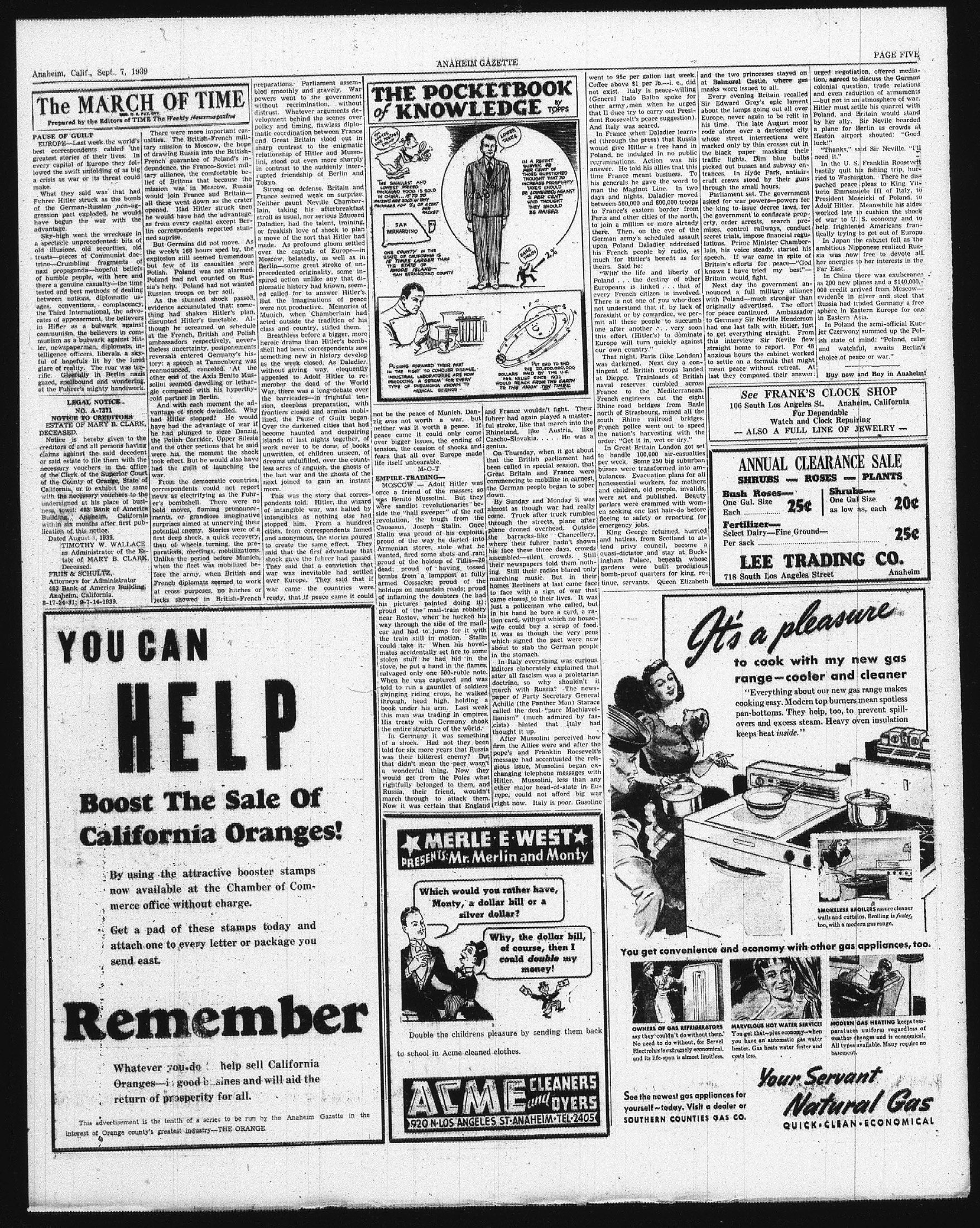
Searchable text
The MARCH OF TIME
Prepared by the Editors of TIME The Weekly Newsmagazine
PAUSE OF GUILT
EUROPE—Last week the world's best correspondents cabled the greatest stories of their lives. In every capital of Europe they followed the swift unfolding of as big a crisis as war or its threat could make.
What they said was that had Fuhrer Hitler struck as the bomb of the German-Russian non-aggression pact exploded, he would have begun the war with the advantage.
Sky-high went the wreckage in a spectacle unprecedented: bits of old illusions, old securities, old trusts—pieces of Communist doctrine—Crumbling fragments of nazi propaganda—hopeful beliefs of humble people, with here and there a genuine casualty—the time tested and best methods of dealing between nations, diplomatic usages, conventions, complacency, the Third International, the advocates of appeasement, the believers in Hitler as a bulwark against communism, the believers in communism as a bulwark against Hitler, newspapermen, diplomats, intelligence officers, liberals, a skyful of hopefuls lit by the lurid glare of reality. The roar was terrific. Gleefully in Berlin nazis gazed, spellbound and wondering at the Fuhrer's mighty handiwork.
LEGAL NOTICE
NO. A-7371
NOTICE TO CREDITORS
ESTATE OF MARY B. CLARK,
DECEASED.
Notice is hereby given to the creditors of and all persons having claims against the said decendent.
There were more important casualties. The British-French military mission to Moscow, the hope of drawing Russia into the British-French guarantee of Poland's independence, the Franco-Soviet military alliance, the comfortable belief of Britons that because the mission was in Moscow, Russia would join France and Britain—all these went down as the crater opened. Had Hitler struck then he would have had the advantage, as from every capital except Berlin correspondents reported stunned surprise.
But Germans did not move. As the week's 168 hours sped by, the explosion still seemed tremendous but few of its casualties were Polish. Poland was not alarmed. Poland had not counted on Russia's help. Poland had not wanted Russian troops on her soil.
As the stunned shock passed, evidence accumulated that something had shaken Hitler's plan, disrupted Hitler's timetable. Although he screamed on schedule at the French, British and Polish ambassadors respectively, nevertheless uncertainty, postponements reversals entered Germany's history: a speech at Tannenberg was reannounced, canceled. At the other end of the Axis Benito Musolini seemed dawdling or lethargic compared with his hyperthyroid partner in Berlin.
And with each moment the advantage of shock dwindled. Why had Hitler stopped? He would have had the advantage of war if he had plunged to siege Danzig, the Polish Corridor, Upper Silesia and the other sections that he said were his, the moment the shock preparations: Parliament assembled smoothly and gravely. War powers went to the government without recrimination, without distrust. Whatever arguments development behind the scenes over policy and timing, flawless diplomatic coordination between France and Great Britain stood out in sharp contrast to the enigmatic relationship of Hitler and Mussolini, stood out even more sharply in contrast to the suddenly interrupted friendship of Berlin and Tokyo.
Strong on defense, Britain and France seemed weak on surprise. Neither gaunt Neville Chamberlain, taking his afterbreakfast stroll as usual, nor serious Eduard Daladier, had the talent, training, or freakish love of shock to plan a move of the sort that Hitler had made. As profound gloom settled over the capitals of Europe—in Moscow, belatedly, as well as in Berlin—some great stroke of unprecedented originality, some inspired action unlike any that diplomatic history had known, seemed called for to answer Hitler's. But the imaginations of peace were not productive. Memories of Munich, when Chamberlain had acted outside the tradition of his class and country, stifled them.
Breathless before a bigger, more heroic drama than Hitler's bomb shell had been, correspondents saw something new in history develop as the week closed. As Daladier without giving way, eloquently appealed to Adolf Hitler to re-member the dead of the World War; there was a long-debate over the barricades—in frightful tension, sleepless preparation, with frontiers closed and armies mobilized, the Pause of Guilt began Over the darkened cities that had become haunted and despairing islands of last nights together, o work never to be done, of book unwritten, of children unseen, o
LEGAL NOTICE
NO. A-7371
NOTICE TO CREDITORS
ESTATE OF MARY B. CLARK,
DECEASED.
Notice is hereby given to the creditors of and all persons having claims against the said decedent or said estate to file them with the necessary vouchers in the office of the Clerk of the Superior Court of the County of Orange, State of California, or to exhibit the same with the necessary vouchers to the undersigned at his place of business, towit: 403 Bank of America Building, Anaheim, California within six months after first publication of this notice.
Dated August 3, 1939.
TIMOTHY W. WALLACE
as Administrator of the Estate of MARY B. CLARK,
Deceased.
FRIIS & SCHULTZ.
Attorneys for Administrator
403 Bank of America Building, Anaheim, California.
8-17-24-31; 9-7-14-1939.
LEGAL NOTICE:
a speech at Tannenberg was reannounced, canceled. At the other end of the Axis Benito Musolini seemed dawdling or lethargic compared with his hyperthyroid partner in Berlin.
And with each moment the advantage of shock dwindled. Why had Hitler stopped? He would have had the advantage of war if he had plunged to siege Danzig, the Polish Corridor, Upper Silesia and the other sections that he said were his, the moment the shock took effect. But he would also have had the guilt of launching the war.
From the democratic countries, correspondents could not report news as electrifying as the Fuhrer's bombshell. There were no bold moves, flaming pronouncements, or grandiose imaginative surprises aimed at unnerving their potential enemy. Stories were of a first deep shock, a quick recovery, then of wheels turning, the preparations, meetings, mobilizations. Unlike the period before Munich, when the fleet was mobilized before the army, when British and French diplomats seemed to work at cross purposes, no hitches or jerks showed in British-French tory:
as the week closed. As Daladier without giving way, eloquently appealed to Adolf Hitler to re-member the dead of the World War, there was a long debate over the barricades—in frightful tension, sleepless preparation, with frontiers closed and armies mobilized, the Pause of Guilt began. Over the darkened cities that had become haunted and despairing islands of last nights together, our work never to be done, of book unwritten, of children unseen, of dreams unfulfilled, over the countless acres of anguish, the ghosts of the last war and the ghosts of the next joined to gain an instant more.
This was the story that correspondents told. Hitler, the wizard of intangible war, was halted by intangibles as nothing else had stopped him. From a hundred cities, from correspondents famous and anonymous, the stories poured to create the same effect. The said that the first advantage the shock gave the fuhrer had passed. They said that a conviction that war was inevitable had settled over Europe. They said that war came the countries we ready, that if peace came it cou
Boost The Sale Of California Oranges!
By using the attractive booster stamps now available at the Chamber of Commerce office without charge.
Get a pad of these stamps today and attach one to every letter or package you send east.
Remember
Whatever you do help sell California Oranges—in good business and will aid the return of prosperity for all.
This advertisement is the tenth of a series to be run by the Anaheim Gazette in the interest of Orange county's greatest industry—the Orange.
ANAHEIM GAZETTE
THE POCKETBOOK OF KNOWLEDGE BY TOPPS
THE SMALLEST AND LOWEST PRICE OF PACKAGED FOOD IS GOLD IN CHINA... AT 70 PER CENT OF THOSE QUESTIONED THought that 30 INCREASED PROSPERITY TAXES SHOULD BE LOWERED AGAINST 2 PER CENT WHO THOUGHT THEY SHOULD BE RAISED.
PUSHING FORWARD THE PART IN THE FIGHT TO CONQUER DISEASE, INDUSTRIAL LABORATORIES ARE NOW PRODUCING A SERUM FOR EVERY TYPE OF PNEUMONIA KNOWN TO MEDICAL SCIENCE.
not be the peace of Munich. Danzig was not worth a war, but neither was it worth a peace. If peace came it could only come over bigger issues, the ending of tension, the cession of shocks and fears that all over Europe made and France wouldn't fight. Their fuhrer had again played a masterful stroke, like that march into the Rhineland, like Austria, like Czecho-Slovakia. He was a genius.
On Thursday, when it got about went to 95¢ per gallon last week. Coffee above $1 per lb.—i.e., did not exist. Italy is peace-willing (General Italo Balbo spoke for other army, men when he urged that Il duce try to carry out President Roosevelt's peace suggestion). And Italy was scared.
In France when Daladier learned (through the press) that Russia would give Hitler a free hand in Poland, he indulged in no public recriminations. Action was his answer. He told his allies that the time France meant business. His generals he gave the word to man the Maginot Line. In two days and nights, Daladier moved between 500,000 and 600,000 troops to France's eastern border from Paris and other cities of the north to join a million or more already there. Then, on the eve of the German army's scheduled assault upon Poland Daladier addressed his French people by radio, much for Hitler's benefit as for theirs. Said he:
"With' the life and liberty of Poland ... the destiny of other Europeans is linked ... that every French citizen is involved. There is not one of you who do not understand that if, by lack of foresight or by cowardice, we permit all these people to succumbe after another ... very soon this effort (Hitler's) to dominate Europe will turn quickly against our own country."
That night, Paris (like London) was darkened. Next day a contingent of British troops landed at Dieppe. Trainloads of British naval reserves rumbled across France to the Mediterranean French engineers cut the Rhine road bridges from Bavaria north of Strasbourg, mined all south Rhine railroad bridge French police went out to spar the nation's harvesting with order: "Get it in, wet or dry." In Great Britain London got to handle 100,000 air-casa
not be the peace of Munich. Danzig was not worth a war, but neither was it worth a peace. If peace came it could only come over bigger issues, the ending of tension, the cession of shocks and fears that all over Europe made life itself unbearable.
M-O-T
EMPIRE-TRADING—
MOSCOW — Adolf Hitler was once a friend of the masses; so was Benito Mussolini. But they were sandlot revolutionaries beside the "hall sweeper" of the red revolution, the tough from the Caucasus, Joseph Stalin. Once Stalin was proud of his exploits, proud of the way he darted into Armenian stores, stole what he wanted, fired some shots and ran; proud of the holdup of Tiflis—20 dead; proud of having tossed bombs from a lamppost at fully armed Cossacks; proud of the holdups on mountain roads; proud of inflaming the doubters (he had his pictures painted doing it); proud of the mail-train robbery near Rostov, when he hacked his way through the side of the mailcar and had to jump for it with the train still in motion. Stalin could take it. When his hovel-mates accidentally set fire to some stolen stuff he had hid in the stove, he put a hand in the flames, salvaged only one 500-ruble note. When he was captured and was told to run a gauntlet of soldiers swinging riding crops, he walked through, head high, holding a book under his arm. Last week this man was trading in empires. His treaty with Germany shook the entire structure of the world.
In Germany it was something of a shock. Had not they been told for six more years that Russia was their bitterest enemy? But that didn't mean the pact wasn't a wonderful thing. Now they would get from the Poles what rightfully belonged to them, and Russia, their friend, wouldn't march through to attack them. Now it was certain that England and France wouldn't fight. Their fuhrer had again played a masterful stroke, like that march into the Rhineland, like Austria, like Czecho-Slovakia. He was a genius.
On Thursday, when it got about that the British parliament had been called in special session, that Great Britain and France were commencing to mobilize in earnest, the German people began to sober down.
By Sunday and Monday it was almost as though war had really come. Truck after truck rumbled through the streets, plane after plane droned overhead. Outside the barracks-like Chancellery, where their fuhrer hadn't shown his face these three days, crowds assembled—silent crowds. Still their newspapers told them nothing. Still their radios blared only marching music. But in their homes Berliners at last came face to face with a sign of war that came closest to their lives. It was just a policeman who called, but in his hand he bore a card, a ration card, without which no housewife could buy a scrap of food. It was as though the very pens which signed the pact were now about to stab the German people in the stomach.
In Italy everything was curious. Editors elaborately explained that after all fascism was a proletarian doctrine, so why shouldn't it march with Russia? The newspaper of Party Secretary General Achille (the Panther Man) Starace called the deal "pure Machiavelianism" (much admired by fascists) hinted that Italy had thought it up.
After Mussolini perceived how firm the Allies were and after the pope's and Franklin Rocsevelt's message had accentuated the religious issue, Mussolini began exchanging telephone messages with Hitler. Mussolini, less than any other major head-of-state in Europe, could not afford big war right now. Italy is poor. Gasoline
MERLE·E·WEST
PRESENTS: Mr. Merlin and Monty
Which would you rather have,
Monty, a dollar bill or a silver dollar?
Why, the dollar bill,
of course, then I could double my money!
Double the childrens pleasure by sending them back to school in Acme cleaned clothes.
ACME CLEANERS
and DYERS
920 N·LOS ANGELES ST·ANAHEIM·TEL·2405
In the 95c per gallon last week. Above $1 per lb.—i. e., did not. Italy is peace-willing. All Italo Balbo spoke for army, men when he urged France try to carry out Presi-rosevelt's peace suggestion). Only was scared.
A chance when Daladier learn-ough the press) that Russia invade Hitler—a free hand in which he indulged in no public negotiations. Action was his. He told his allies that thisrance meant business. To derals he gave the word to the Maginot Line. In two and nights, Daladier moved from 500,000 and 600,000 troops since's eastern border from and other cities of the north, to a million or more already Then, on the eve of the then army's scheduled assault Poland Daladier addressed French people by radio, as for Hitler's benefit as for Said he:
"Oh' the life and liberty of . . . the destiny of other peoples is linked . . . that of French citizen is involved. It is not one of you who does understand that if, by lack of light or by cowardice, we permit these people to succumb after another . . . very soon effort (Hitler's) to dominate we will turn quickly against own country."
At night, Paris (like London) darkened. Next day a con- tent of British troops landed Europe. Trainloads of British reserves rumbled across the Mediterranean. Irish engineers cut the eight road bridges from Basle of Strasbourg, mined all the Rhine railroad bridges. Irish police went out to speed nation's harvesting with the: "Get it in, wet or dry." Great Britain London got set handle 100,000 air-casualties and the two princesses stayed on at Balmoral Castle, where gas masks were issued to all.
Every evening Britain recalled Sir Edward Grey's epic lament about the lamps going out all over Europe, never again to be relit in his time. The late August moor rode alone over a darkened city whose street intersections were marked only by thin crosses cut in the black paper masking their traffic lights. Dim blue bulbs picked out busses and subway entrances. In Hyde Park, antiaircraft crews stood by their guns through the small hours.
Parliament sat. The government asked for war powers—powers for the king to issue decree laws, for the government to confiscate property, order arrests, search premises, control railways, conduct secret trials, impose financial regulations. Prime Minister Chamberlain, his voice steady, started his speech. If war came in spite of Britain's efforts for peace—"God knows I have tried my best"—Britain would fight.
Next day the government announced a full military alliance with Poland—much stronger than originally advertised. The effort for peace continued. Ambassador to Germany Sir Neville Henderson had one last talk with Hitler, just to get everything straight. From this interview Sir Neville flew straight home to report. For 48 anxious hours the cabinet worked to settle on a formula that might mean peace without retreat. At last they composed their answer:
urged negotiation, offered mediation, agreed to discuss the German colonial question, trade relations and even reduction of armaments—but not in an atmosphere of war. Hitler must settle his quarrel with Poland, and Britain would stand by her ally. Sir Nevile boarded a plane for Berlin as crowds at Heston airport shouted: "Good luck!"
"Thanks," said Sir Neville. "I'll need it."
In the U.S. Franklin Roosevelt hastily quit his fishing trip, hurried to Washington. There he dispached Peace pleas to King Victorio Emmanuele III of Italy, to President Moscicki of Poland, to Adolf Hitler. Meanwhile his aides worked late to cushion the shock of war to U.S. economy and to help frightened Americans frantically trying to get out of Europe.
In Japan the cabinet fell as the ambitious Nipponese realized Russia was now free to devote all her energies to her interests in the Far East.
In China there was exuberance as 200 new planes and a $140,000-000 credit arrived from Moscow—evidence in silver and steel that Russia had traded Germany a free sphere in Eastern Europe for one in Eastern Asia.
In Poland the semi-official Kurjer Czerwony summed up the Polish state of mind: "Poland, calm and watchful, awaits Berlin's choice of peace or war."
Buy now and Buy in Anaheim!
See FRANK'S CLOCK SHOP
106 South Los Angeles St. Anaheim, California
For Dependable
Watch and Clock Repairing
— ALSO A FULL LINE OF JEWELRY —
See FRANK'S CLOCK SHOP
106 South Los Angeles St. Anaheim, California
For Dependable
Watch and Clock Repairing
— ALSO A FULL LINE OF JEWELRY —
ANNUAL CLEARANCE SALE
SHRUBS — ROSES — PLANTS
Bush Roses—
One Gal. Size
Each 25¢
Shrubs—
One Gal. Size
as low as, each 20¢
Fertilizer—
Select Dairy—Fine Ground—
Per sack 25¢
LEE TRADING CO.
718 South Los Angeles Street Anaheim
It's a pleasure
to cook with my new gas range—cooler and cleaner
"Everything about our new gas range makes cooking easy. Modern top burners mean spotless pan-bottoms. They help, too, to prevent spill-overs and excess steam. Heavy oven insulation keeps heat inside."
SMOKELESS BROILERS assure cleaner walls and curtains. Broiling is faster too, with a modern gas range.
You get convenience and economy with other gas appliances, too.
OWNERS OF GAS REFRIGERATORS say they couldn't do without them. No need to do without, for Servel Electrolux is extremely economical, and its life-span is almost limitless.
MARVELOUS HOT WATER SERVICE! You get that-plus economy—when you have an automatic gas water heater. Gas heats water faster and costs less.
MODERN GAS HEATING keeps temperatures uniform regardless of weather changes and is economical. All types available. Many require no basement.
See the newest gas appliances for yourself—today. Visit a dealer or SOUTHERN COUNTIES GAS CO.
Your Servant
Natural Gas
QUICK • CLEAN • ECONOMICAL