anaheim-gazette 1939-08-10
Scanned page
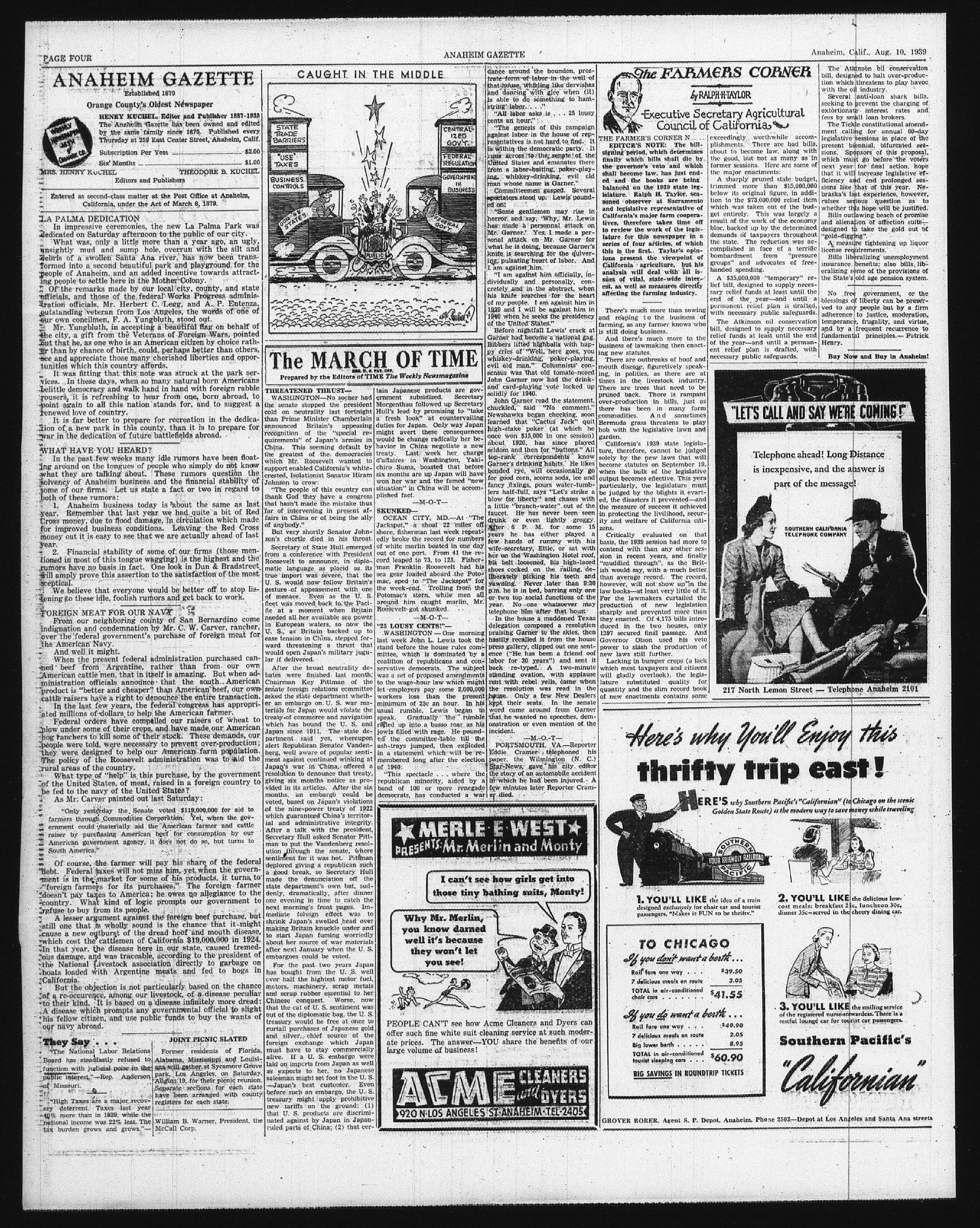
Searchable text
ANAHEIM GAZETTE
Established 1870
Orange County's Oldest Newspaper
HENRY KUCHEL, Editor and Publisher 1887-1935
The Anaheim Gazette has been owned and edited by the same family since 1875. Published every Thursday at 259 East Center Street, Anaheim, Calif.
Subscription Per Year ..... $2.00
Six' Months ..... $1.00
MRS. HENRY KUCHEL
THEODORE B. KUCHEL
Editors and Publishers
Entered as second-class matter at the Post Office at Anaheim,
California, under the Act of March 8, 1879.
LA PALMA DEDICATION
In impressive ceremonies, the new La Palma Park was dedicated on Saturday afternoon to the public of our city.
What was, only a little more than a year ago, an ugly, unsightly mud and sump hole, overrun with the silt and debris of a swollen Santa Ana river, has now been transformed into a second beautiful park and playground for the people of Anaheim, and an added incentive towards attracting people to settle here in the Mother Colony.
Of the remarks made by our local city, county, and state officials, and those of the federal Works Progress administration officials, Mr. Herbert C. Legg, and A. P. Entenza, outstanding veteran from Los Angeles, the words of one of our own concilmen, F. A. Yungbluth, stood out.
Mr. Yungbluth, in accepting a beautiful flag on behalf of the city, a gift from the Veterans of Foreign Wars, pointed out that he, as one who is an American citizen by choice rather than by chance of birth, could, perhaps better than others, see and appreciate those many cherished liberties and opportunities which this country affords.
It was fitting that this note was struck at the park services. In these days, when so many natural born Americans belittle democracy and walk hand in hand with foreign rabble rousers, it is refreshing to hear from one, born abroad, to point again to all this nation stands for, and to suggest a renewed love of country.
It is far better to prepare for recreation in the dedication of a new park in this county, than it is to prepare for war in the dedication of future battlefields abroad.
WHAT HAVE YOU HEARD?
It was fitting that this note was struck at the park services. In these days, when so many natural born Americans belittle democracy and walk hand in hand with foreign rabble rousers, it is refreshing to hear from one, born abroad, to point again to all this nation stands for, and to suggest a renewed love of country.
It is far better to prepare for recreation in the dedication of a new park in this county, than it is to prepare for war in the dedication of future battlefields abroad.
WHAT HAVE YOU HEARD?
In the past few weeks many idle rumors have been floating around on the tongues of people who simply do not know what they are talking about. These rumors question the solvency of Anaheim business and the financial stability of some of our firms. Let us state a fact or two in regard to both of these rumors:
1. Anaheim business today is about the same as last year. Remember that last year we had quite a bit of Red Cross money, due to flood damage, in circulation which made for improved business conditions. Leaving the Red Cross money out it is easy to see that we are actually ahead of last year.
2. Financial stability of some of our firms (those mentioned in most of this tongue wagging) is the highest and the rumors have no basis in fact. One look in Dun & Bradstreet will amply prove this assertion to the satisfaction of the most skeptical.
We believe that everyone would be better off to stop listening to these idle, foolish rumors and get back to work.
FOREIGN MEAT FOR OUR NAVY
From our neighboring county of San Bernardino come indignation and condemnation by Mr. C. W. Carver, rancher, over the federal government's purchase of foreign meat for the American Navy.
And well it might.
When the present federal administration purchased canned beef from Argentine, rather than from our own American cattle men, that in itself is amazing. But when administration officials announce that the south...American product is "better and cheaper" than American beef, our own cattle raisers have a right to denounce the entire transaction.
In the last few years, the federal congress has appropriated millions of dollars to help the American farmer.
Federal orders have compelled our raisers of wheat to plow under some of their crops, and have made our American hog ranchers to kill some of their stock. These demands, our people were told, were necessary to prevent over-production; they were designed to help our American farm population.
The policy of the Roosevelt administration was to aid the rural areas of the country.
What type of "help" is this purchase, by the government of the United States, of meat, raised in a foreign country to be fed to the navy of the United States?
As Mr. Carver painted out last Saturday:
"Only yesterday the Senate voted $119,000,000 for aid to farmers through Commodities Corporation. Yet, when the government could materially aid the American farmer and cattle raiser by purchasing American beef for consumption by our American government agency, it does not do so, but turns to South America."
Of course, the farmer will pay his share of the federal
THREATENED THRUST—
WASHINGTON—No sooner had the senate stopped the president cold on neutrality last fortnight than Prime Minister Chamberlain announced Britain's appeasing recognition of the "special requirements" of Japan's armies in China. This seeming default by the greatest of the democracies which Mr. Roosevelt wanted to support enabled California's white crested, Isolationist Senator Hirai Johnson to crow:
"The people of this country can thank God they have a congratulation that hasn't made the mistake that far of intervening in present affairs in China or of being the ally of anybody."
But very shortly Senator Johnson's chortle died in his throat.
Secretary of State Hull emerged from a conference with President Roosevelt to announce, in diplomatic language as placid as true import was severe, that U.S. would now follow Britain's gesture of appeasement with our menace. Even as the U.S. fleet was moved back to the Pacific at a moment when Britain needed all her available sea power in European waters, so now that U.S., as Britain backed up its ease tension in China, stepped forward threatening a thrust that would open Japan's military juglar if delivered.
After the broad neutrality debates were finished last month Chairman Key Pittman of the senate foreign relations committee asked the state department wheeler an embargo on U.S. war materials for Japan would violate treaty-of-commerce-and-navigation which has bound the U.S. and Japan since 1911. The state department said yes, whereupon alert Republican Senator Vanderberg, well aware of popular sentiment against continued winking Japan's war in China, offered resolution to denounce that treaty giving six months notice as provided in its articles. After the six months, an embargo could be voted, based on Japan's violation of the nine-power treaty of 1918 which guaranteed China's territorial and administrative integrity. After a talk with the presiding Secretary Hull asked Senator Pittman to put the Vandenberg resolution through the senate, whose sentiment for it was hot. Pittman deplored giving a republican su
What type of "help" is this purchase, by the government of the United States, of meat, raised in a foreign country to be fed to the navy of the United States?
As Mr. Carver painted out last Saturday:
"Only yesterday the Senate voted $119,000,000 for aid to farmers through Commodities Corporation. Yet, when the government could materially aid the American farmer and cattle raiser by purchasing American beef for consumption by our American government agency, it does not do so, but turns to South America."
Of course, the farmer will pay his share of the federal debt. Federal taxes will not miss him, yet when the government is in the market for some of his products, it turns to "foreign farmers for its purchases." The foreign farmer doesn't pay taxes to America; he owes no allegiance to the country. What kind of logic prompts our government to refuse to buy from its people.
A lesser argument against the foreign beef purchase, but still one that is wholly sound is the chance that it might cause a new outburst of the dread hoof and mouth disease, which cost the cattlemen of California $19,000,000 in 1924. In that year, the disease here in our state, caused tremendous damage, and was traceable, according to the president of the National Livestock association directly to garbage on boats loaded with Argentine meats and fed to hogs in California.
But the objection is not particularly based on the chance of a re-occurence, among our livestock, of a disease peculiar to their kind. It is based on a disease infinitely more dread: A disease which prompts any governmental official to slight his fellow citizen, and use public funds to buy the wants of our navy abroad.
They Say
"The National Labor Relations Board has steadfastly refused to function with judicial poise in the public interest."—Rep. Anderson of Missouri.
"High Taxes are a major recovery deterrent. Taxes last year 40% more than in 1929, while the national income was 22% less. The tax burden grows and grows."
JOINT PICNIC SLATED
Former residents of Florida, Alabama, Mississippi and Louisiana will gather at Sycamore Grove park, Los Angeles, on Saturday, August 19, for their picnic reunion. Separate sections for each state have been arranged with county registers for each state.
William B. Warner, President, the McCall Corp.
resolution to denounce that treaty giving six months notice as provided in its articles. After the six months, an embargo could be voted, based on Japan's violation of the nine-power treaty of 1937 which guaranteed China's territorial and administrative integrity. After a talk with the president Secretary Hull asked Senator Pitman to put the Vandenberg resolution through the senate, whose sentiment for it was hot. Pitman deplored giving a republican support a good break, so Secretary Hull made the denunciation off the state department's own bat, suddenly, dramatically, after dinner one evening in time to catch the next morning's front pages. In mediate foreign effect was to shrink Japan's swelled head over making Britain knuckle under able to start Japan fuming worried about her source of war materiel after next January when the U.S. embargoes could be voted.
For the past two years Japan has bought from the U.S. ever half the highest motor fuel motors, machinery, scrap metal and scrap rubber essential to his Chinese conquest. Worse, now that the cat of U.S. sentiment went out of the diplomatic bag, the U.S. treasury would be free at once curtail purchases of Japanese goods and silver, chief source of the foreign exchange which Japan must have to stay commercial alive. If a U.S. embargo were laid on imports from Japan as well as exports to her, no Japanese salesman might set foot in the U.S.-Japan's best customer. Even before such an embargo, the U.S. treasury might apply prohibitive tariffs on the ground: (1) that U.S. products are discriminated against by Japan in Japan ruled parts of China; (2) that co-
CAUGHT IN THE MIDDLE
THE MARCH OF TIME
Prepared by the Editors of TIME The Weekly Newsmagazine
ATTENED THRUST—
HINGTON—No sooner had state stopped the president in neutrality last fortnight Prime Minister Chamberlain faced Britain's appeasing action of the "special re-ments" of Japan's armies in this seeming default by greatest of the democracies.
Japanese products are government subsidized. Secretary Morgenthau followed up Secretary Hull's lead by promising to "take a fresh look" at countervailing duties for Japan. Only way Japan might avert these consequences would be change radically her behavior in China negotiate a new treaty. Last week her charge dance around the bounden, prostrate form of labor in the well of that house, whirling like dervishes and dancing with glee when (it) is able to do something to hamstring labor..."
"All labor asks is . . . 25 lousy cents an hour."
"The genesis of this campaign against labor in the house of representatives is not hard to find. It is within the democratic party. It runs across to the senate of the United States and emanates there from a labor-baiting, poker-playing, whiskey-drinking, evil old man whose name is Garner."
Committeemen gasped. Several spectators stood up. Lewis pounded on:
"Some gentlemen may rise in horror and say, 'Why, Mr. Lewis has made a personal attack on Mr. Garner.' Yes, I made a personal attack on Mr. Garner for what he is doing, because Garner's knife is searching for the quivering, pulsating heart of labor. And I am against him.
"I am against him officially, individually and personally, concretely and in the abstract, when his knife searches for the heart of my people. I am against him in 1939 and I will be against him in 1940 when he seeks the presidency of the United States."
Before nightfall Lewis' crack at Garner had become a national gag. Bibbers lifted highballs with happy cries of "Well, here goes, you whiskey-drinking, poker-playing, evil old man." Columnists' consensus was that old tomato-nosed John Garner now had the drink-and card-playing vote locked up solidly for 1940.
John Garner read the statement, chuckled, said "No comment." Newshawks began checking, soon learned that "Cactus Jack" quit high-stake poker (at which he once won $15,000 in one session) about 1920, has since played seldom and then for "buttons." All top-rank correspondents know
THE FARMER'S CORNER N.
EDITOR'S NOTE: The best signing period, which determines finally which bills shall die, the governor's veto and which shall become law, has just ended and the books are being balanced on the 1939 state legislature. Ralph H. Taylor, son of observer at Sacramento and legislative representative California's major farm cooperatives, therefore takes time to review the work of the legislation for this newspaper in series of four articles, of which this is the first. Taylor's opinions present the viewpoint California agriculture, but analysis will deal with all issues of vital, state-wide interest, as well as measures direct affecting the farming industry.
There's much more than so and reaping to the business farming, as any farmer knows it is still doing business.
And there's much more to business of lawmaking then ening new statutes.
There are outbreaks of hoof mouth disease, figuretively spiking, in politics, as there are times in the livestock industry. There are trees that need to pruned back. There is ram over-production in bills, just there has been in many commodities. And sometimes Bermuda grass threatens to hob with the legislative lawn garden.
California's 1939 state legislature, therefore, cannot be juxtaposed by the new laws that
HISTENED THRUST—
WHINGTON—No sooner had state stopped the president in neutrality last fortnight Prime Minister Chamberlain ceased Britain's appeasing motion of the "special re-ments" of Japan's armies in China. This seeming default by people of this country can God they have a congress isn't made the mistake thus intervening in present affair China or of being the ally body.
Every shortly Senator John-shortle died in his throat. Stary of State Hull emerged conference with President Belt to announce, in diplo-language as placid as its import was severe, that the would now follow Britain's effort to appeasement with one peace. Even as the U. S. is moved back to the Pacifia moment when Britain all her available sea power popean waters, so now the U. S. backed up to invasion in China, stepped forth threatening a thrust that open Japan's military juguelyivered.
The broad neutrality dewere finished last month; Ian Key Pittman of the foreign relations committee the state department whethumbargo on U. S. war mator Japan would violate the of commerce and navigation has bound the U. S. and since 1911. The state denied said yes, whereupon republican Senator Vanden-bell aware of popular senti-gainst continued winking at war in China, offered a con to denounce that treaty, six months notice as pro-n its articles. After the six an embargo could be based on Japan's violations nine-power treaty of 1922 guaranteed China's territorial administrative integrity. A talk with the president, Sir Hull asked Senator Pittput the Vandenberg resol-through the senate, whereent for it was hot. Pittman and giving a republican suchtain Japanese products are government subsidized. Secretary Morgenthau followed up Secretary Hull's lead by promising to "take a fresh look" at countervailing duties for Japan. Only way Japan might avert these consequences would be change radically her behavior in China negotiate a new treaty. Last week her charge d'affaires in Washington, Yakichiro Suma, boasted that before six months are up Japan will have won her war and the famed "new situation" in China will be accomplished fact.
M-O-T—
SKUNKED—
OCEAN CITY, MD.—At "The Jackspot," a shoal 22 miles off shore, fisherman last week repeatedly broke the record for numbers of white marlin boated in one day out of one port. From 41 the record leaped to 73, to 123. Fisherman Franklin Roosevelt had his sea gear loaded aboard the Potomac, sped to "The Jackspot" for the week-end. Trolling from the Potomac's stern, while men all around him caught marlin, Mr. Roosevelt got skunked.
M-O-T—
"25 LOUSY CENTS!"—WASHINGTON — One morning last week John L. Lewis took the stand before the house rules committee, which is dominated by a coalition of republicans and conservative democrats. The subject was a set of proposed amendments to the wage-hour law which might let employers pay some 2,000,000 workers loss than the present minimum of 25c an hour. In his usual rumble, Lewis began to speak. Gradually the rumble rolled up into a basso roar as his jowls filled with rage. He pounded the committee-table till the ash-trays jumped, then exploded in a statement which will be remembered long after the election of 1940:
"This spectacle . . . where the republican minority, aided by a band of 100 or more renegade democrats, has conducted a war evil old man." Columnists' consensus was that old tomato-nosed John Garner now had the drink-and card-playing vote locked up solidly for 1940.
John Garner read the statement, chuckled, said "No comment." Newshawks began checking, soon learned that "Cactus Jack" quit high-stake poker (at which he once won $15,000 in one session) about 1920, has since played seldom and then for "buttons." All top-rank correspondents know Garner's drinking habits. He likes bonded rye, will occasionally go for good corn, scorns soda, ice and fancy fixings, pours water-tumblers half-full, says "Let's strike a blow for liberty" and chases with a little "branch-water" out of the faucet. He has never been seen drunk or even lightly groggy. After 6 P. M. for some 15 years he has either played a few hands of rummy with his wife-secretary, Ettie, or sat with her on the Washington Hotel roof, his belt loosened, his high-laced shoes cocked on the railing, deliberately picking his teeth and yawning. Never later than 9:30 p.m. he is in bed, barring only one or two top social functions of the year. No one whatsoever may telephone him after that hour.
In the house a maddened Texas delegation composed a resolution praising Garner to the skies, then hastily recalled it from the house press gallery, clipped out one sentence ("He has been a friend oof labor for 30 years") and sent it back re-typed. A two-minute standing ovation, with applause rent with rebel yells, came when the resolution was read in the house. Only a few New Dealers kept their seats. In the senate word came around from Garner that he wanted no speeches, demonstration or even mention of the incident.
M.-O.-T—
PORTSMOUTH, VA—Reporter Eddie Cramer telephoned his paper, the Wilmington (N. C.) Star-News, gave his city editor the story of an automobile accident in which he had been injured. A few minutes later Reporter Cramer died.
There are outcures of mouth disease, figuratively speaking, in politics, as there are times in the livestock industry. There are trees that need to pruned back. There is ram over-production in bills, just there has been in many commodities. And sometimes Bermuda grass threatens to hob with the legislative lawn garden.
California's 1939 state legislature, therefore, cannot be solely by the new laws that become statutes on September when the bulk of the legislation output becomes effective. This particularly, the legislature be judged by the blights it evoked, the disasters it prevented—the measure of success it achieved in protecting the livelihood, security and welfare of California zens.
Critically evaluated on basis, the 1939 session had most contend with than any other session in recent years, and fit "muddled through," as the ish would say, with a much better average record. The reason however, will not show up in law books—at least very little. For the lawmakers curtailed production of new legislative sharply and prevented more they enacted. Of 4,175 bills introduced in the two houses, 1397 secured final passage. Governor Olson used his power to slash the production new laws still further.
Lacking in bumper crops (a which most taxpayers and citizens will gladly overlook), the lature substituted quality quantity and the slim record of new enactments contains...
MERLE E WEST
PRESENTS: Mr. Merlin and Monty
I can’t see how girls get into those tiny bathing suits, Monty!
Why Mr. Merlin, you know darned well it’s because they won’t let you see!
PEOPLE CAN’T see how Acme Cleaners and Dyers can offer such fine white suit cleaning service at such moderate prices. The answer—YOU share the benefits of our large volume of business!
ACME CLEANERS AND DYERS
920 N·LOS ANGELES ST·ANAHEIM·TEL·2405
The FARMERS CORNER
by RALPH H. TAYLOR
Executive Secretary Agricultural Council of California
FARMER'S CORNER N... exceedingly worthwhile accomplishments. There are bad bills, about to become law, along with the good, but not as many as in former sessions. Here are some of the major enactments:
A sharply pruned state budget, trimmed more than $15,000,000 below its original figure, in addition to the $73,000,000 relief item which was taken out of the budget entirely. This was largely a result of the work of the economy bloc, backed up by the determined demands of taxpayers throughout the state. The reduction was accomplished in face of a terrific bombardment from "pressure groups" and advocates of free-handed spending.
A $35,000,000 "temporary" relief bill, designed to supply necessary relief funds at least until the end of the year—and until a permanent relief plan is drafted, with necessary public safeguards.
The Atkinson oil conservation bill, designed to supply necessary relief funds at least until the end of the year—and until a permanent relief plan is drafted, with necessary public safeguards.
The Atkinson oil conservation bill, designed to halt over-production which threatens to play havoc with the oil industry.
Several anti-loan shark bills, seeking to prevent the charging of extortionate interest rates and fees by small loan brokers.
The Tickle constitutional amendment calling for annual 60-day legislative sessions in place of the present biennial, bifurcated sessions. Sponsors of this proposal, which must go before the voters next year for final action, hope that it will increase legislative efficiency and end prolonged sessions like that of this year. Nebraska's last experience, however, raises serious question as to whether this hope will be justified.
Bills outlawing beach of promise and alienation of affection suits—designed to take the gold out of "gold-digging".
A measure tightening up liquor license requirements.
Bills liberalizing unemployment insurance benefits; also bills liberalizing some of the provisions of the State's old age pension system.
No free government, or the blessings of liberty can be preserved to any people but by a firm adherence to justice, moderation, temperance, frugality, and virtue, and by a frequent recurrence to fundamental principles. — Patrick Henry.
Buy Now and Buy in Anaheim!
"LET'S CALL AND SAY WERE COMING!
Telephone ahead! Long Distance is inexpensive, and the answer is part of the message!
SOUTHERN CALIFORNIA TELEPHONE COMPANY
217 North Lemon Street — Telephone Anaheim 2101
Here's why You'll Enjoy this thrifty trip east!
HERE'S why Southern Pacific's "Californian" (to Chicago on the scenic Golden State Route) is the modern way to save money while traveling
HERE'S why Southern Pacific's "Californian" (to Chicago on the scenic Golden State Route) is the modern way to save money while traveling
1. YOU'LL LIKE the idea of a train designed exclusively for chair car and tourist passengers. "Makes it FUN to be thrifty."
2. YOU'LL LIKE the delicious low-cost meals: breakfast 25c, luncheon 30c, dinner 35c—served in the cheery dining car.
TO CHICAGO
If you don't want a berth...
Rail fare one way $39.50
7 delicious meals en route 2.05
TOTAL in air-conditioned chair cars $41.55
If you do want a berth...
Rail fare one way $49.90
7 delicious meals en route 2.05
Big lower berth 8.95
TOTAL in air-conditioned tourist sleeping cars $60.90
BIG SAVINGS IN ROUNDTRIP TICKETS
3. YOU'LL LIKE the smiling service of the registered nurse-stewardess. There is a restful lounge car for tourist car passengers.
Southern Pacific's "Californian"
OVER RORER, Agent S. P. Depot, Anaheim, Phone 2503—Depot at Los Angeles and Santa Ana streets