anaheim-gazette 1938-04-14
Scanned page
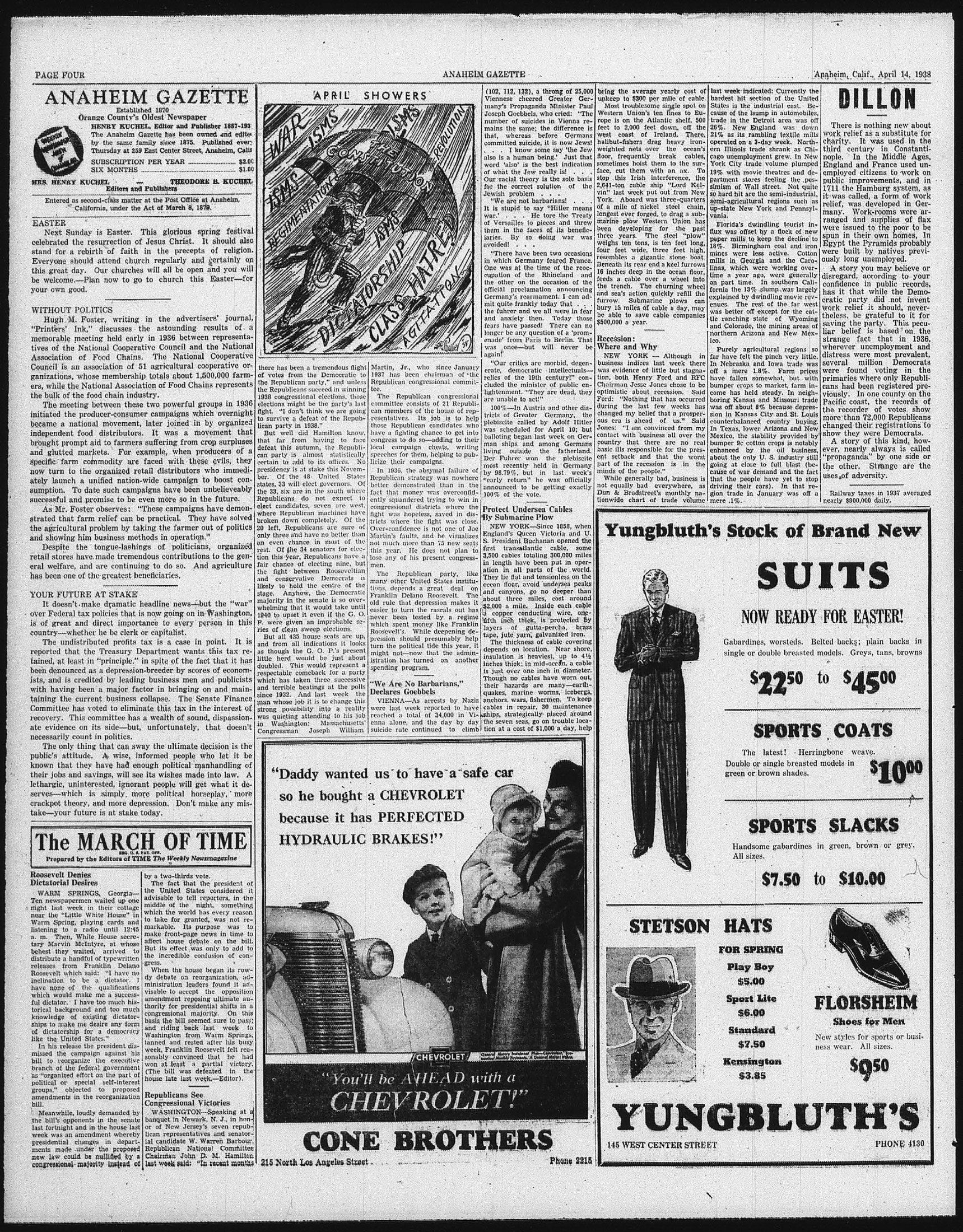
Searchable text
ANAHEIM GAZETTE
Established 1870
Orange County's Oldest Newspaper
HENRY KUCHEL, Editor and Publisher 1887-193
The Anaheim Gazette has been owned and edited by the same family since 1875. Published every Thursday at 259 East Center Street, Anaheim, Calif.
SUBSCRIPTION PER YEAR $2.00
SIX MONTHS $1.00
MRS. HENRY KUCHEL THEODORE B. KUCHEL Editors and Publishers
Entered as second-class matter at the Post Office at Anaheim, California, under the Act of March 8, 1879.
EASTER
Next Sunday is Easter. This glorious spring festival celebrated the resurrection of Jesus Christ. It should also stand for a rebirth of faith in the precepts of religion. Everyone should attend church regularly and certainly on this great day. Our churches will all be open and you will be welcome. Plan now to go to church this Easter—for your own good.
WITHOUT POLITICS
Hugh M. Foster, writing in the advertisers' journal, "Printers' Ink," discusses the astounding results of a memorable meeting held early in 1936 between representatives of the National Cooperative Council and the National Association of Food Chains. The National Cooperative Council is an association of 51 agricultural cooperative organizations, whose membership totals about 1,500,000 farmers, while the National Association of Food Chains represents the bulk of the food chain industry.
The meeting between these two powerful groups in 1936 initiated the producer-consumer campaigns which overnight became a national movement, later joined in by organized independent food distributors. It was a movement that brought prompt aid to farmers suffering from crop surpluses and glutted markets. For example, when producers of a
Council is an association of 51 agricultural cooperative organizations, whose membership totals about 1,500,000 farmers, while the National Association of Food Chains represents the bulk of the food chain industry.
The meeting between these two powerful groups in 1936 initiated the producer-consumer campaigns which overnight became a national movement, later joined in by organized independent food distributors. It was a movement that brought prompt aid to farmers suffering from crop surpluses and glutted markets. For example, when producers of a specific farm commodity are faced with these evils, they now turn to the organized retail distributors who immediately launch a unified nation-wide campaign to boost consumption. To date such campaigns have been unbelievably successful and promise to be even more so in the future.
As Mr. Foster observes: "These campaigns have demonstrated that farm relief can be practical. They have solved the agricultural problem by taking the farmer out of politics and showing him business methods in operation."
Despite the tongue-lashings of politicians, organized retail stores have made tremendous contributions to the general welfare, and are continuing to do so. And agriculture has been one of the greatest beneficiaries.
YOUR FUTURE AT STAKE
It doesn't make dramatic headline news—but the "war" over Federal tax policies that is now going on in Washington, is of great and direct importance to every person in this country—whether he be clerk or capitalist.
The undistributed profits tax is a case in point. It is reported that the Treasury Department wants this tax retained, at least in "principle," in spite of the fact that it has been denounced as a depression-breeder by scores of economists, and is credited by leading business men and publicists with having been a major factor in bringing on and maintaining the current business collapse. The Senate Finance Committee has voted to eliminate this tax in the interest of recovery. This committee has a wealth of sound, dispassionate evidence on its side—but, unfortunately, that doesn't necessarily count in politics.
The only thing that can sway the ultimate decision is the public's attitude. A wise, informed people who let it be known that they have had enough political manhandling of their jobs and savings, will see its wishes made into law. A lethargic, uninterested, ignorant people will get what it deserves—which is simply more political horseplay, more crackpot theory, and more depression. Don't make any mistake—your future is at stake today.
The MARCH OF TIME
Prepared by the Editors of TIME The Weekly Newsmagazine
The MARCH OF TIME
Prepared by the Editors of TIME The Weekly Newsmagazine
Roosevelt Denies Dictatorial Desires
WARM SPRINGS, Georgia—Ten newspapermen waited up one right last week in their cottage near the "Little White House" in Warm Spring, playing cards and listening to a radio until 12:45 a.m. Then, White House secretary Marvin McIntyre, at whose behest they waited, arrived to distribute a handful of typewritten releases from Franklin Delano Roosevelt which said: "I have no inclination to be a dictator. I have none of the qualifications which would make me a successful dictator. I have too much historical background and too much knowledge of existing dictatorships to make me desire any form of dictatorship for a democracy like the United States."
In his release the president dismissed the campaign against his bill to reorganize the executive branch of the federal government as "organized effort on the part of political or special self-interest groups," objected to proposed amendments in the reorganization bill.
Meanwhile, loudly demanded by the bill's opponents in the senate last fortnight and in the house last week was an amendment whereby presidential changes in departments made under the proposed new law could be nullified by a congressional majority instead of by a two-thirds vote.
The fact that the president of the United States considered it advisable to tell reporters, in the middle of the night, something which the world has every reason to take for granted, was not remarkable. Its purpose was to make front-page news in time to affect house debate on the bill. But its effect was only to add to the incredible confusion of congress.
When the house began its rowdy debate on reorganization, administration leaders found it advisable to accept the opposition amendment reposing ultimate authority for presidential shifts in a congressional majority. On this basis the bill seemed sure to pass; and riding back last week to Washington from Warm Springs, tanned and rested after his busy week, Franklin Roosevelt felt reasonably convinced that he had won at least a partial victory. (The bill was defeated in the house late last week.) Editor.
Republicans See Congressional Victories
WASHINGTON—Speaking at a banquet in Newark, N. J., in honor of New Jersey's seven republican representatives and senatorial candidate W. Warren Barbour, Republican National Committee Chairman John D. M. Hamilton last week said: "In recent months
APRIL SHOWERS
has been a tremendous flight from the Democratic to Republican party," and unless publicans succeed in winning congressional elections, those might be the party's last I don't think we are going to have a defeat of the Republiarty in 1938."
well did Hamilton know, or from having to face this autumn, the Republiarity is almost statistically Martin, Jr., who since January 1937 has been chairman of the Republican congressional committee.
The Republican congressional committee consists of 21 Republican members of the house of representatives. Its job is to help those Republican candidates who have a fighting chance to get into congress to do so—adding to their local campaign chests, writing speeches for them, helping to publ(102, 112, 132), a throng of 25,000 Viennese cheered Greater Germany's Propaganda Minister Paul Joseph Goebbels, who cried: "The number of suicides in Vienna remains the same; the difference is that, whereas before Germans committed suicide, it is now Jews! . . . I know some say 'the Jew also is a human being.' Just that word 'also' is the best indication of what the Jew really is! . . . Our racial theory is the sole basis for the correct solution of the Jewish problem . . .
"We are not barbarians! . . It is stupid to say 'Hitler means war.' He tore the Treaty of Versailles to pieces and threw them in the faces of its beneficiaries. By so doing war was avoided! . . .
"There have been two occasions in which Germany feared France. One was at the time of the reoccupation of the Rhineland and the other on the occasion of the official proclamation announcing Germany's rearmament. I can admit quite frankly today that . . ; the fuhrer and we all were in fear and anxiety then. Today those fears have passed! There can no longer be any question of a 'promenade' from Paris to Berlin. That was once—but will never be again!
"Our critics are morbid, degenerate, democratic intellectuals—relies of the 19th century!" concluded the minister of public enlightenment. "They are dead, they are unable to act!"
100%—In Austria and other districts of Greater Germany, the plebiscite called by Adolf Hitler was scheduled for April 10; but balloting began last week on German ships and among Germans living outside the fatherland. Der Fuhrer won the plebiscite bring the average yearly upkeep to $300 per mile or most troublesome single Western Union's ten lines rope is on the Atlantic shore feet to 2,000 feet down, west coast of Ireland. halibut-fishers drag heavy weighted nets over the floor, frequently break sometimes hoist them to the face, cut them with an stop this Irish interference, 2,641-ton cable ship "Lorvin" last week put out from York. Aboard was three-eleven of a mile of nickel steel longest ever forged, to draw marine plow Western Union been developing for three years. The steel weighs ten tons, is ten feet four feet wide, three feet resembles a gigantic storm. Beneath its rear end a keel 16 inches deep in the ocean feeds a cable over a whirlpool. The churning and sea's action quickly furrow. Submarine plow bury 15 miles of cable a day be able to save cable cost $500,000 a year.
Recession:
Where and Why
NEW YORK — Although business indices last week was evidence of little buttion, both Henry Ford and Chairman Jesse Jones chose optimistic about recession Ford: "Nothing that has occurred during the last few weeks changed my belief that a pious era is ahead of us." Jones: "I am convinced if contact with business all over country that there are basic illresponsible for the entire setback and that the
has been a tremendous flight from the Democratic to Republican party," and unless publicans succeed in winning congressional elections, those might be the party's last I don't think we are going have a defeat of the Republarty in 1938."
Martin, Jr., who since January 1937 has been chairman of the Republican congressional committee.
The Republican congressional committee consists of 21 Republican members of the house of representatives. Its job is to help those Republican candidates who have a fighting chance to get into congress to do so—adding to their local campaign chests, writing speeches for them, helping to publicize their campaigns.
In 1936, the absymal failure of Republican strategy was nowhere better demonstrated than in the fact that money was overconfidently squandered trying to win in congressional districts where the fight was hopeless, saved in districts where the fight was close. Over-confidence is not one of Joe Martin's faults, and he visualizes not much more than 75 new seats this year. He does not plan to lose any of his present congressmen.
The Republican party, like many other United States institutions, depends a great deal on Franklin Delano Roosevelt. The old rule that depression makes it easier to turn the rascals out has never been tested by a regime which spent money like Franklin Roosevelt's. While deepening depression should presumably help turn the political tide this year, it might not—now that the administration has turned on another spending program.
"We Are No Barbarians," Declares Goebbels
VIENNA—As arrests by Nazis were last week reported to have reached a total of 34,000 in Vienna alone, and the day by day suicide rate continued to climb.
"Our critics are morbid, degenerate, democratic intellectuals—relies of the 19th century!" concluded the minister of public enlightenment. "They are dead, they are unable to act!"
100%—In Austria and other districts of Greater Germany, the plebiscite called by Adolf Hitler was scheduled for April 10; but balloting began last week on German ships and among Germans living outside the fatherland. Der Fuhrer won the plebiscite most recently held in Germany by 98.79%, but in last week's "early return" he was officially announced to be getting exactly 100% of the vote.
Protect Undersea Cables By Submarine Plow
NEW YORK—Since 1858, when England's Queen Victoria and U.S. President Buchanan opened the first transatlantic cable, some 3,500 cables totaling 300,000 miles in length have been put in operation in all parts of the world. They lie flat and tensionless on the ocean floor, avoid undersea peaks and canyons, go no deeper than about three miles, cost around $2,000 a mile. Inside each cable a copper conducting wire, one-fifth thick, is protected by layers of gutta-percha, brass tape, jute yarn, galvanized iron.
The thickness of cable covering depends on location. Near shore, insulation is heaviest, up to 4½ inches thick; in mid-ocean, a cable is just over one inch in diameter. Though no cables have worn out, their hazards are many—earthquakes, marine worms, icebergs, anchors, wars, fishermen. To keep cables in repair, 30 maintenance ships, strategically placed around the seven seas, go on trouble location at a cost of $1,000 a day, help...
so he bought a CHEVROLET because it has PERFECTED HYDRAULIC BRAKES!"
CHEVROLET
"You'll be AHEAD with a CHEVROLET!"
CONE BROTHERS
North Los Angeles Street
Phone 2215
During the average yearly cost of keep up to $300 per mile of cable. Most troublesome single spot on Western Union's ten lines to Europe is on the Atlantic shelf, 500 feet to 2,000 feet down, off the west coast of Ireland. There, allbut-fishers drag heavy iron-weighted nets over the ocean's water, frequently break cables, sometimes hoist them to the surface, cut them with an ax. To tap this Irish interference, the 1941-ton cable ship "Lord Kelton" last week put out from New York. Aboard was three-quarters a mile of nickel steel chain, longest ever forged, to drag a submarine plow Western Union has been developing for the past three years. The steel "plow" weighs ten tons, is ten feet long, four feet wide, three feet high, assembles a gigantic stone boat. beneath its rear end a keel furrows inches deep in the ocean floor, feeds a cable over a wheel into the trench. The churning wheel and sea's action quickly refill the arrow. Submarine plows can carry 15 miles of cable a day, may be able to save cable companies 100,000 a year.
Recession: Here and Why
NEW YORK — Although in business indices last week there was evidence of little but stagnation, both Henry Ford and RFC chairman Jesse Jones chose to be optimistic about recession. Said Lord: "Nothing that has occurred during the last few weeks has changed my belief that a prosperous era is ahead of us." Said Jones: "I am convinced from my contact with business all over the country that there are no real basicills responsible for the present setback and that the worst last week indicated: Currently the hardest hit section of the United States is the industrial east. Because of the lsump in automobiles, trade in the Detroit area was off 26%. New England was down 21% as its rambling textile mills operated on a 3-day week. Northern Illinois trade shrank as Chicago unemployment grew. In New York City trade volume plumped 19% with movie theatres and department stores feeling the pessimism of Wall street. Not quite so hard hit are the semi-industrial, semi-agricultural regions such as up-state New York and Pennsylvania.
Florida's dwindling tourist influx was offset by a flock of new paper mills to keep the decline to 18%. Birmingham coal and iron mines were less active. Cotton mills in Georgia and the Carolinas, which were working overtime a year ago, were generally on part time. In southern California the 13% slump was largely explained by dwindling movie revenues. The rest of the far west was better off except for the cattle ranching state of Wyoming and Colorado, the mining areas of northern Arizona and New Mexico.
Purely agricultural regions so far have felt the pinch very little. In Nebraska and Iowa trade was off a mere 1.8%. Farm prices have fallen somewhat, but with bumper crops to market, farm income has held steady. In neighboring Kansas and Missouri trade was off about 8% because depression in Kansas City and St. Louis counterbalanced country buying. In Texas, lower Arizona and New Mexico, the stability provided by bumper 9c cotton crops is notably enhanced by the oil business, about the only U.S. industry still
DILLON
There is nothing new about work relief as a substitute for charity. It was used in the third century in Constantinople. In the Middle Ages, England and France used unemployed citizens to work on public improvements, and in 1711 the Hamburg system, as it was called, a form of work relief, was developed in Germany. Work-rooms were arranged and supplies of flax were issued to the poor to be spun in their own homes. In Egypt the Pyramids probably were built by natives previously long unemployed.
A story you may believe or disregard, according to your confidence in public records, has it that while the Democratic party did not invent work relief it should, nevertheless, be grateful to it for saving the party. This peculiar belief is based on the strange fact that in 1936, wherever unemployment and distress were most prevalent, several million Democrats were found voting in the primaries where only Republicans had been registered previously. In one county on the Pacific coast, the records of the recorder of votes show more than 72,000 Republicans changed their registrations to show they were Democrats.
A story of this kind, however, nearly always is called "propaganda" by one side or
business indices last week there was evidence of little but stagnation, both Henry Ford and RFC chairman Jesse Jones chose to be optimistic about recession. Said Ford: "Nothing that has occurred during the last few weeks has changed my belief that a prosperous era is ahead of us." Said Jones: "I am convinced from my contact with business all over the country that there are no real basicills responsible for the present setback and that the worst part of the recession is in the hands of the people."
While generally bad, business is not equally bad everywhere, as Sun & Bradstreet's monthly nationwide chart of trade volume
In Nebraska and Iowa trade was off a mere 1.8%. Farm prices have fallen somewhat, but with bumper crops to market, farm income has held steady. In neighboring Kansas and Missouri trade was off about 8% because depression in Kansas City and St. Louis counterbalanced country buying. In Texas, lower Arizona and New Mexico, the stability provided by bumper 9c cotton crops is notably enhanced by the oil business, about the only U.S. industry still going at close to full blast (because of war demand and the fact that the people have yet to stop driving their cars). In that region trade in January was off a mere .1%.
Railway taxes in 1937 averaged nearly $900,000 daily.
Yungbluth's Stock of Brand New
SUITS
NOW READY FOR EASTER!
Gabardines, worsteds. Belted backs; plain backs in single or double breasted models. Greys, tans, browns
$2250 to $4500
SPORTS COATS
The latest! Herringbone weave.
Double or single breasted models in green or brown shades.
$1000
SPORTS SLACKS
Handsome gabardines in green, brown or grey.
All sizes.
SPORTS SLACKS
Handsome gabardines in green, brown or grey.
All sizes.
$7.50 to $10.00
STETSON HATS
FOR SPRING
Play Boy
$5.00
Sport Lite
$6.00
Standard
$7.50
Kensington
$3.85
FLORSHEIM
Shoes for Men
New styles for sports or business wear. All sizes.
$9.50
YUNGBLUTH'S
145 WEST CENTER STREET
PHONE 4130