anaheim-gazette 1936-12-10
Scanned page
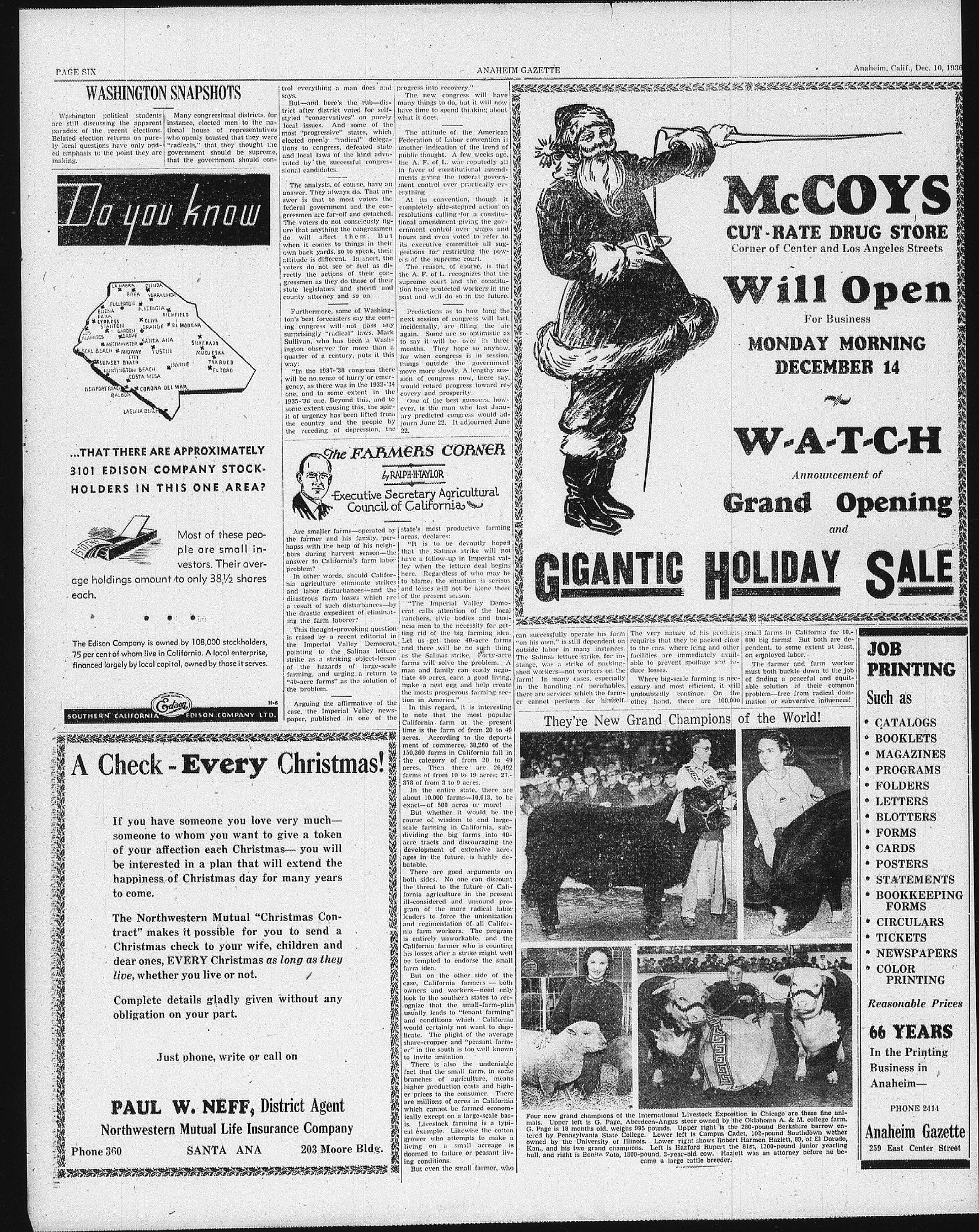
Searchable text
WASHINGTON SNAPSHOTS
Washington political students are still discussing the apparent paradox of the recent elections. Belated election returns on purely local questions have only added emphasis to the point they are making.
Many congressional districts, for instance, elected men to the national house of representatives who openly boasted that they were "radicals," that they thought the government should be supreme, that the government should control everything a man does says.
But—and here's the trick after district voted by styled "conservatives" on local issues. And some most "progressive" states elected openly "radical" tions to congress, defeat and local laws of the kind cited by the successful national candidates.
Do you know
...THAT THERE ARE APPROXIMATELY
...THAT THERE ARE APPROXIMATELY 3101 EDISON COMPANY STOCKHOLDERS IN THIS ONE AREA?
Most of these people are small investors. Their average holdings amount to only 38½ shares each.
The Edison Company is owned by 108,000 stockholders, 75 per cent of whom live in California. A local enterprise, financed largely by local capital, owned by those it serves.
A Check - Every Christmas
If you have someone you love very much—someone to whom you want to give a token of your affection each Christmas—you will be interested in a plan that will extend the
If you have someone you love very much—someone to whom you want to give a token of your affection each Christmas—you will be interested in a plan that will extend the happiness of Christmas day for many years to come.
The Northwestern Mutual "Christmas Contract" makes it possible for you to send a Christmas check to your wife, children and dear ones, EVERY Christmas as long as they live, whether you live or not.
Complete details gladly given without any obligation on your part.
Just phone, write or call on
PAUL W. NEFF, District Agent
Northwestern Mutual Life Insurance Company
Phone 360 SANTA ANA 203 Moore Bl
local everything a man does and says.
But—and here's the rub—district after district voted for self-styled "conservatives" on purely local issues. And some of the most "progressive" states, which elected openly "radical" delegations to congress, defeated state and local laws of the kind advocated by the successful congressional candidates.
The analysts, of course, have an answer. They always do. That answer is that to most voters the federal government and the congressmen are far-off and detached. The voters do not consciously figure that anything the congressmen do will affect them. But when it comes to things in their own back yards, so to speak, their attitude is different. In short, the voters do not see or feel as directly the actions of their congressmen as they do those of their state legislators and sheriff and county attorney and so on.
Furthermore, some of Washington's best forecasters say the coming congress will not pass any surprisingly "radical" laws. Mark Bullivan, who has been a Washington observer for more than a quarter of a century, puts it this way:
"In the 1937-'38 congress there will be no sense of hurry or emergency, as there was in the 1933-'34 one, and to some extent in the 1935-'36 one. Beyond this, and to some extent causing this, the spirit of urgency has been lifted from the country and the people by the receding of depression, the progress into recovery."
The new congress will have many things to do, but it will now have time to spend thinking about what it does.
The attitude of the American Federation of Labor convention is another indication of the trend of public thought. A few weeks ago, the A. F. of L. was reputedly all in favor of constitutional amendments giving the federal government control over practically everything.
At its convention, though it completely side-stepped action on resolutions calling for a constitutional amendment giving the government control over wages and hours and even voted to refer to its executive committee all suggestions for restricting the powers of the supreme court.
The reason, of course, is that the A. F. of L. recognizes that the supreme court and the constitution have protected workers in the past and will do so in the future.
Predictions as to how long the next session of congress will last, incidentally, are filling the air again. Some are so optimistic as to say it will be over in three months. They hope so anyhow, for when congress is in session, things outside the government move more slowly. A lengthy session of congress now, these say, would retard progress toward recovery and prosperity.
One of the best guessers, however, is the man who last January predicted congress would adjourn June 22. It adjourned June 22.
In the 1937-'38 congress there will be no sense of hurry or emergency, as there was in the 1933-'34 one, and to some extent in the 1935-'36 one. Beyond this, and to some extent causing this, the spirit of urgency has been lifted from the country and the people by the receding of depression, the state's most productive farming areas, declares:
"It is to be devoutly hoped that the Salinas strike will not have a follow-up in Imperial valley when the lettuce deal begins here. Regardless of who may be to blame, the situation is serious and losses will not be alone those of the present season.
"The Imperial Valley Democrat calls attention of the local ranchers, civic bodies and business men to the necessity for getting rid of the big farming idea. Let us get those 40-acre farms and there will be no such thing as the Salinas strike. Forty-acre farms will solve the problem. A man and family can easily negotiate 40 acres, earn a good living, make a nest egg and help create the most prosperous farming section in America."
In this regard, it is interesting to note that the most popular California farm at the present time is the farm of from 20 to 49 acres. According to the department of commerce, 38,260 of the 150,360 farms in California fall in the category of from 20 to 49 acres. Then there are 26,492 farms of from 10 to 19 acres; 27,-378 of from 3 to 9 acres.
In the entire state, there are about 10,000 farms—10,618, to be exact—of 500 acres or more!
But whether it would be the course of wisdom to end large-scale farming in California, subdividing the big farms into 40-acre tracts and discouraging the development of extensive acreages in the future, is highly debatable.
The Farmers Corner
by RALPH H. TAYLOR
Executive Secretary Agricultural Council of California
Are smaller farms—operated by the farmer and his family, perhaps with the help of his neighbors during harvest season—the answer to California's farm labor problem?
In other words, should California agriculture eliminate strikes and labor disturbances—and the disastrous farm losses which are a result of such disturbances—by the drastic expedient of eliminating the farm laborer?
This thought-provoking question is raised by a recent editorial in The Imperial Valley Democrat, pointing to the Salinas lettuce strike as a striking object-lession of the hazards of large-scale farming, and urging a return to "40-acre farms" as the solution of the problem.
Arguing the affirmative of the case, the Imperial Valley newspaper, published in one of the state's most productive farming areas, declares:
"It is to be devoutly hoped that the Salinas strike will not have a follow-up in Imperial valley when the lettuce deal begins here. Regardless of who may be to blame, the situation is serious and losses will not be alone those of the present season.
"The Imperial Valley Democrat calls attention of the local ranchers, civic bodies and business men to the necessity for getting rid of the big farming idea. Let us get those 40-acre farms and there will be no such thing as the Salinas strike. Forty-acre farms will solve the problem. A man and family can easily negotiate 40 acres, earn a good living, make a nest egg and help create the most prosperous farming section in America."
In this regard, it is interesting to note that the most popular California farm at the present time is the farm of from 20 to 49 acres. According to the department of commerce, 38,260 of the 150,360 farms in California fall in the category of from 20 to 49 acres. Then there are 26,492 farms of from 10 to 19 acres; 27,-378 of from 3 to 9 acres.
In the entire state, there are about 10,000 farms—10,618, to be exact—of 500 acres or more!
But whether it would be the course of wisdom to end large-scale farming in California, subdividing the big farms into 40-acre tracts and discouraging the development of extensive acreages in the future, is highly debatable.
They're New Grand Charm
can successfully operate his farm "on his own," is still dependent on outside labor in many instances. The Salinas lettuce strike, for instance, was a strike of packingshed workers—not workers on the farm! In many cases, especially in the handling of perishables, there are services which the farmer cannot perform for himself.
The very nature of requires that they be able to cars, where facilities are immobile to prevent spruce losses.
Where big-scale essential and most important other hand, there
In the entire state, there are about 10,000 farms—10,613, to be exact—of 500 acres or more!
But whether it would be the course of wisdom to end large-scale farming in California, subdividing the big farms into 40-acre tracts and discouraging the development of extensive acreages in the future, is highly debatable.
There are good arguments on both sides. No one can discount the threat to the future of California agriculture in the present ill-considered and unsound program of the more radical labor leaders to force the unionization and regimentation of all California farm workers. The program is entirely unworkable, and the California farmer who is counting his losses after a strike might well be tempted to endorse the small farm idea.
But on the other side of the case, California farmers — both owners and workers—need only look to the southern states to recognize that the small-farm-plan usually leads to "tenant farming" and conditions which. California would certainly not want to duplicate. The plight of the average share-cropper and "peasant farmer" in the south is too well known to invite imitation.
There is also the undeniable fact that the small farm, in some branches of agriculture, means higher production costs and higher prices to the consumer. There are millions of acres in California which cannot be farmed economically except on a large-scale basis. Livestock farming is a typical example. Likewise the cotton grower who attempts to make a living on a small acreage is doomed to failure or peasant living conditions.
But even the small farmer, who
McCOYS
CUT-RATE DRUG STORE
Corner of Center and Los Angeles Streets
Will Open
For Business
MONDAY MORNING
DECEMBER 14
W-A-T-C-H
DECEMBER 14
W-A-T-C-H
Announcement of
Grand Opening
and
ANTIC HOLIDAY SALE
The very nature of his products requires that they be packed close to the cars, where iceing and other facilities are immediately available to prevent spoilage and reduce losses.
Where big-scale farming is necessary and most efficient, it will undoubtedly continue. On the other hand, there are 100,000 small farms in California for 10,000 big farms! But both are dependent, to some extent at least, on employed labor.
The farmer and farm worker must both buckle down to the job of finding a peaceful and equitable solution of their common problem—free from radical domination or subversive influences!
JOB PRINTING
Such as
• CATALOGS
• BOOKLETS
• MAGAZINES
• PROGRAMS
• FOLDERS
• LETTERS
• BLOTTERS
• FORMS
• CARDS
• POSTERS
of the International Livestock Exposition in Chicago are these fine anilage, Aberdeen-Angus steer owned by the Oklahoma A. & M. college farm.
weighs 995 pounds. Upper right is the 280-pound Berkshire barrow encage College. Lower left is Campus Cadet, 102-pound Southdown wether
of Illinois. Lower right shows Robert Harmon Hazlett, 89, of El Dorado,
champions. Left is Hazford Rupert the 81st, 1300-pound junior yearling
to, 1800-pound, 2-year-old cow. Hazlett was an attorney before he became a large cattle breeder.
PROGRAMS
• FOLDERS
• LETTERS
• BLOTTERS
• FORMS
• CARDS
• POSTERS
• STATEMENTS
• BOOKKEEPING FORMS
• CIRCULARS
• TICKETS
• NEWSPAPERS
• COLOR PRINTING
Reasonable Prices
66 YEARS
In the Printing Business in Anaheim—
PHONE 2414
Anaheim Gazette
259 East Center Street