anaheim-gazette 1936-07-23
Scanned page
Searchable text
ANAHEIM GAZETTE
Established 1870
Orange County's Oldest Newspaper
HENRY KUCHEL, Editor and Publisher 1887-1935
The Anaheim Gazette has been owned and edited by the same family since 1875. Published every Thursday at 259 East Center Street, Anaheim, Calif.
MRS. HENRY KUCHEL — THEODORE B. KUCHEL
Editors and Publishers
"THE SOBER SECOND THOUGHT"
Orange county, reputedly the richest per capita county of any in the entire land, is credited by the leaders of the state with being high above the average in intelligence when dealing with governmental problems confronting California and the nation.
For that reason, the issues appearing—both as to candidates and initiative or referendum measures—in the August and November elections should receive a more thorough search and enlightened decision here than elsewhere.
Lincoln, in his first campaign for the Presidency, appealed to "the sober second thought." So must we. Citizens of all shades of political faith, Democrats, Republicans, and all the rest, should not base their political conclusions upon hackneyed arguments which are brought forth, recurrently, at every election time.
Take, for example, the much-discussed Agricultural Act, and its brother, the federal Soil Conservation program. Naturally, it would seem, every one is interested in a good agricultural policy for the federal government, whatever it may be; and no one could find any fault with a policy of soil conservation.
The business man, the citrus grower, the laborer, and the housewife living here in this county, must determine his or her political principles upon hearsay—that which is brought through periodicals, through radio, and through casual conversation. In much of this information there is much which is not so, much that is based upon misinterpretation., sometimes unintentional, and sometimes not.
To fulfill his duty as a citizen, the voter must determine
Naturally, it would seem, every one is interested in a good agricultural policy for the federal government, whatever it may be; and no one could find any fault with a policy of soil conservation.
The business man, the citrus grower, the laborer, and the housewife living here in this county, must determine his or her political principles upon hearsay—that which is brought through periodicals, through radio, and through casual conversation. In much of this information there is much which is not so, much that is based upon misinterpretation, sometimes unintentional, and sometimes not.
To fulfill his duty as a citizen, the voter must determine, as best he may, exactly what he believes to be the facts, and then upon them, decide how he should vote. This is difficult, and doubly so in regard to any such overwhelming and far-reaching legislation as the AAA. That it was declared unconstitutional, as far as its set-up for the payment of bounties to farmers is concerned, should not be wholly decisive.
Where did the government intend to go under the AAA?
First, it may be conceded, the present soil conservation program attempts to do what the AAA tried to do. The theory is apparently, to limit production, so that surplus—or, in other words, over-supply—would not cause a reduction in price.
Federal statistics on importation of farm products into the country serve to blast the theory. Farmers serves the sea, aided by their governments in increasing productivity, were able to import their own surplus crops into the United States, and not only to compete with, but actually to undersell, the American farmer.
That opens up the discussion of the relationship of nations, and the part it plays in respect to our own prosperity. Even with a policy of nationalism, there are some facts which we cannot blink. A part of our own success must depend as was pointed out by Senator Arthur Vandenburg, of Michigan, upon as exportable surplus—in all lines—selling at the world price in the world market.
Yes, there's much to be discussed, debated, and decided by the voter in the forthcoming elections. But that is his price, and a reasonable one, too, for enjoying the liberties of the republic. His mind should not work upon snap judgment. The 'sober second thought' is vital this year.
A SYSTEM THAT WILL WORK
In these days of strikes and labor troubles that seem to be engulfing the nation the average citizen reaches out for every beacon light opportunity throws in his way. In a democracy as we 'count opinions but do not weigh them' every voter must think clearly and honestly whether he is at the top of the economic heap or at the bottom. The following is from the pen of Corb Sarchet of the Brea Progress. It tells the workings of one of our industrial concerns. It gives a new slant on conditions between employer and employee:
A System That Is Working —
An employee is always an employer also.
That is the system evolved by W. D. Shaffer, president of the Shaffer Tool Works of Brea, and it works.
democracy as we 'count opinions but do not weigh them' every voter must think clearly and honestly whether he is at the top of the economic heap or at the bottom. The following is from the pen of Corb Sarchet of the Brea Progress. It tells the workings of one of our industrial concerns. It gives a new slant on conditions between employer and employee:
A System That Is Working —
An employee is always an employer also.
That is the system evolved by W. D. Shaffer, president of the Shaffer Tool Works of Brea, and it works. gives a new slant on conditions between employer and produce until the company provides him a set-up, making it possible for him to function; he employs the company to provide that set-up to the same extent that the company employs him to produce. This Mr. Shaffer holds, and puts into execution, is true of every employee.
The company as an employee of the employer (producer) provides the place, material and opportunity for the producer to function. If the company did not do this, then the producer, generally known as an employee, would have no opportunity to produce. He would be just as badly off as the company would be without the men who produce for it.
To that extent, and really clear down the line in their association together, the company and the employee are co-operating. Each needs the other and one is just as much an employee as the other. It's a fifty-fifty proposition, Mr. Shaffer holds, and he uses the system all the time.
The profit the company makes is the amount paid to or allowed the company by the employee for providing the setup so he can be an employer-producer.
The producer (employee) in thus being made an employer, also is, has every right to be and should be on just as high a plane as any other employer or any professional man. His shoulders should be just as erect, his head should be just as straight up, and his dignity just as deserved and important.
It is the opinion of Mr. Shaffer that should this system be adopted by companies, corporations and individuals who employ, there would be no doubt of the outcome, there would be no labor trouble, security propositions would take care of themselves, and both employer and employee would be happier and more contented.
A survey or study of the Shaffer plant in Brea will convince any employer of the wisdom of the system.
And California taxpayer gardless of the fact that the bills are often excessive and densome, must subject pro "eure-alls" to the most scrutiny—recognizing that cure may be worse than the case" and that no magic banish tax disorders which developed over a long period years.
The two-in-one Sales Peal—"Single Tax" Act, whence on the November bank doubtsly takes front rank most dangerous panacea submitted to California vote year — particularly from standpoint of the farm home-owner, or any property taxpayer.
Stripped of its camouflage proposal is the old and divided "Single Tax" Act—severely defeated in California by whelming majorities—destroys the private owner land and common property easily by the simple expectancy tax confiscation.
Masquerading as a sales peal act in an attempt to unwary voter, this act abolishes outright all forms of tax, liquor taxes and probation truck and gas tax—TRANING THE ENTIRE BURD LAND. In addition, it willduce personal property taxes on improvements on each year until entirely alien—AGAIN PLACING THE DEN ON LAND.
During the first year, it timated by the state's fiscal thorities that the "Single proposal would add a minimum $305,234,574 to taxes levle California lands—with an tax rate in the State of $1
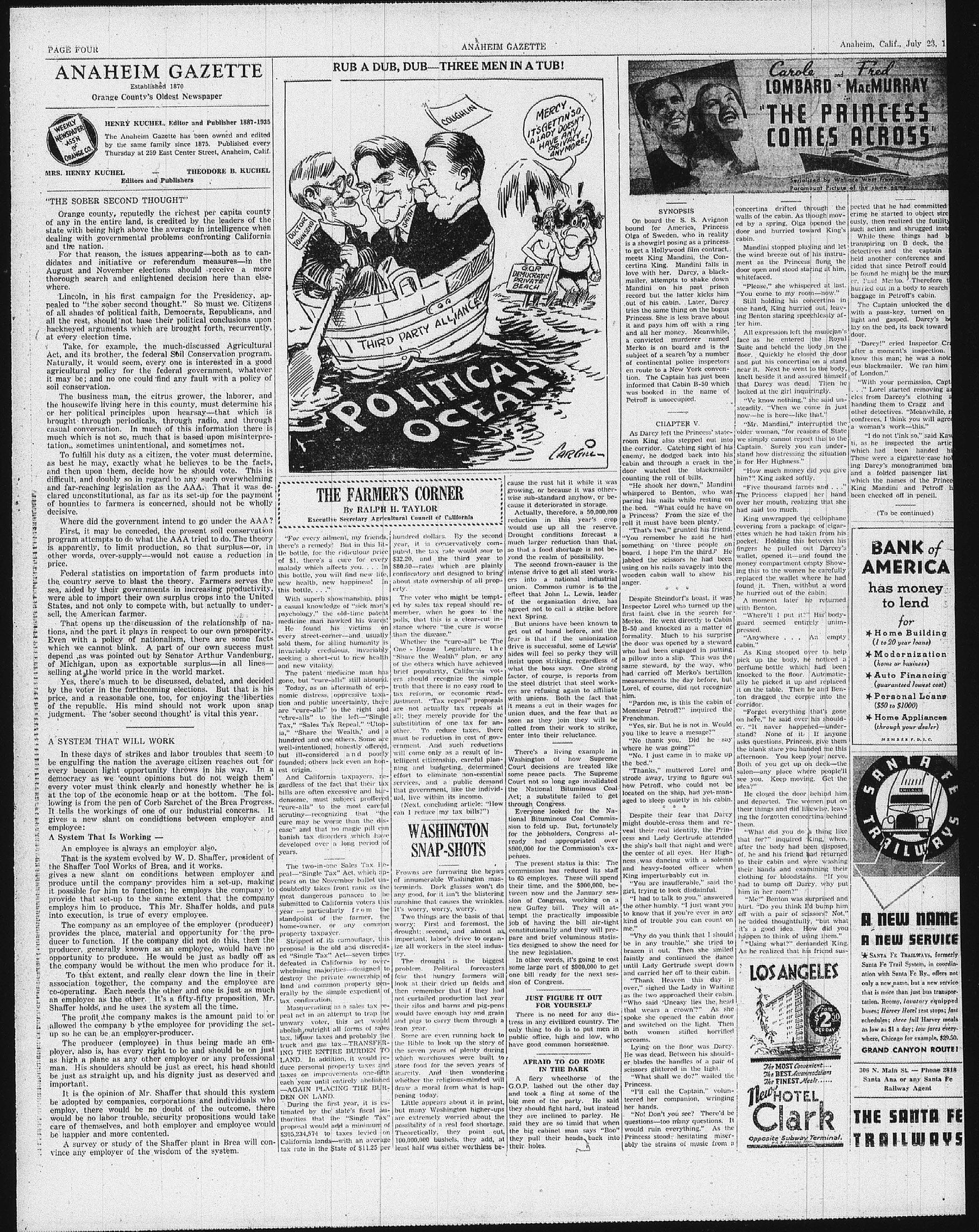
RUB A DUB, DUB—THREE MEN IN A TUB!
MERCY,
IT'S GETTIN' SO
A LADY DOESN'T
HAVE ANY
PRIVACY
ANYMORE!
DUTOR
TOWNSEND
G.O.R.
DEMURRATIC
PRIVATE
BEACH
THIRD PARTY ALLIANCE
POLITICAL
OCEAN
ANAHEIM GAZETTE
SYNOPSIS
On board the S. S.
bound for America,
Olga of Sweden, who
is a showgirl posing a
to get a Hollywood fi
meets King Mandini
certina King. Mandi
love with her. Darc
mailer, attempts to s
Mandini on his p
record but the latter
out of his cabin. L.
tries the same thing o
Princess. She is less b
it and pays him off
and all her money.
a convicted murder.
Merko is on board
subject of a search b
of continental police
en route to a New Y
tion. The Captain h
informed that Cabin
was booked in the
Petroff is unoccupied.
CHAPTER
As Darcy left the Pr
room King also steps
the corridor. Catchin
enemy, he dodged b
THE FARMER'S CORNER
By RALPH H. TAYLOR
Executive Secretary Agricultural Council of California
For every ailment, my friends, there's a remedy! But in this lit-bottle, for the ridiculous price of $1, there's a cure for every lady which affects you... In its bottle, you will find new life, new health, new happiness! In its bottle,...
With superb showmanship, plus casual knowledge of "sick man's rychology," the old-time patent medicine man hawked his wares! He found his victims on very street-corner—and usually them, for dilling humanity is variably creedious, invariably taking a short-cut to new health and new vitality.
The patent medicine man has one, but "cure-alls" still abound. Today, as an aftermath of economic distress, oppressive taxation and public uncertainty, there are "cure-alls" to the right and "cure-alls" to the left—"Single tax," "Sales Tax Repeal," "Utopia," "Share the Wealth," and a hundred and one others. Some are ill-intentioned, honestly offered, at ill-considered and poorly audited; others lack even an honororigin.
And California taxpayers, regardless of the fact that their taxes are often excessive and burdensome, must subject proffered "cure-alls" to the most careful routine—recognizing that "the cure may be worse than the disease" and that no magic pill can finish tax disorders which have developed over a long period of years.
The two-in-one Sales Tax He hundred dollars. By the second year, it is conservatively computed, the tax rate would soar to $32.20, and the third year to $80.50—rates which are plainly confiscatory and designed to bring about state ownership of all property.
The voter who might be tempted by sales tax repeal should remember, when he goes to the polls, that this is a clear-cut instance where "the cure is worse than the disease."
Whether the "cure-all" be The One - House Legislature, the "Share the Wealth" plan, or any of the others which have achieved brief popularity, California voters should recognize the simple truth that there is no easy road to tax reform, or economic readjustment. "Tax repeal" proposals are not actually tax repeals at all; they merely provide for the substitution of one tax for another. To reduce taxes, there must be reduction in cost of government. And such reductions will come only as a result of intelligent citizenship, careful planning and budgeting, determined effort to eliminate non-essential services, and a public demand that government, like the individual, live within its income.
(Next, concluding article: "How can I reduce my tax bills?")
WASHINGTON SNAP-SHOTS
cause the rust hit it while it was growing, or because it was otherwise sub-standard anyhow, or because it deteriorated in storage.
Actually, therefore, a 50,000,000 reduction in this year's crop would use up all the reserve. Drought conditions forecast a much larger reduction than that; so that a food shortage is not beyond the realm of possibility.
The second frown-causer is the intense drive to get all steel workers into a national industrial union. Common rumor is to the effect that John L. Lewis, leader of the organization drive, has agreed not to call a strike before next Spring.
But unions have been known to get out of hand before, and the fear is that if the unionization drive is successful, some Lewis' aides will feel so perky they will insist upon striking, regardless of what the boss says. One strong factor, of course, is reports from the steel district that steel workers are refusing again to affiliate with unions. Both the fact that it means a cut in their wages for union dues, and the fear that as soon as they join they will be called from their work to strike, enter into their reluctance.
There's a living example in Washington of how Supreme Court decisions are treated like some peace pacts. The Supreme Court not so long ago invalidated the National Bituminous Coal Act; a substitute failed to get through Congress.
Everyone looked for the National Bituminous Coal Commission to fold up. But, fortunately for the jobholders, Congress already had appropriated over $900,000 for the Commission's expenses.
The present status is this: The commission has reduced its staff.
CHAPTER
As Darcy left the Prairie King also stepped the corridor. Catching enemy, he dodged back cabin and through a door watched the roll of bob. "He shook her down whispered to Benton paring his nails while the bed. 'What could a Princess?' From this roll it must have been 'That's two,' grunted. "You remember he has something on 'three' board. I hope I'm the jabbed the scissors he using on his nails savaged wooden cabin wall to anger.
Despite Steindorf's Inspector Lorel who took first faint clue in the Merko. He went direct B-50 and knocked as formally. Much to do the door was opened by who had been engaged a pillow into a slip. "Same steward, by the had carried off Merk measurements the day Lorel, of course, did not him.
"Pardon me, is this Monsieur Petroff?" in Frenchman.
"Yes,sir. But he is ready you like to leave a mug." No thank you. D where he was going?
No. I just came in the bed."
Thanks," muttered strode away, trying to how Petroff, who co-located on the ship, hagged to sleep quietly.
Despite their fear might double-cross their real identity and Lady Gertrude the ship's ball that night the center of all eyesness was dancing wild and heavy-footed o
And California taxpayers, regardless of the fact that their tax bills are often excessive and burdensome, must subject proffered cure-alls" to the most careful routine—recognizing that "the one may be worse than the disease" and that no magic pill can unbend tax disorders which have developed over a long period of years.
The two-in-one Sales Tax Act—"Single Tax" Act, which appears on the November ballot unobtutely takes front rank as the most dangerous panacea to be submitted to California voters this year—particularly from the endpoint of the farmer, the time-owner, or any common property taxpayer.
Stripped of its camouflage, this proposal is the old and discredited "Single Tax" Act—seven times featured in California by overwhelming majorities—designed to destroy the private ownership of land and common property generally by the simple expedient of tax confiscation.
Masquerading as a sales tax real act in an attempt to trap the wary voter, this act would polish outright all forms of sales tax, liquor taxes and probably the back gas tax—TRANSFERING THE ENTIRE BURDEN TO LAND. In addition, it would reece personal property taxes and taxes on improvements one-fifth each year until entirely abolished AGAIN PLACING THE BURDEN ON LAND.
During the first year, it is estimated by the state's fiscal authorities that the "Single Tax"posal would add a minimum of 105,234,574 to taxes levied on California lands—with an average tax rate in the State of $11.25 per effort to eliminate non-essential services, and a public demand that government, like the individual, live within its income.
(Next, concluding article: "How can I reduce my tax bills?")
WASHINGTON SNAP-SHOTS
Frowns are furrowing the brows of innumerable Washington masterminds. Dark glasses won't do any good, for it isn't the blistering sunshine that causes the wrinkles. It's worry, worry, worry.
Two things are the basis of that worry: First and foremost, the drought; second, and almost as important, labor's drive to organize all workers in the steel industry.
The drought is the biggest problem. Political forecasters fear that hungry farmers will look at their dried up fields and then remember that if they had not curtailed production last year their silos and barns and pig-pens would have enough hay and grain and pigs to carry them through a lean year.
Some are even running back to the Bible to look up the story of the seven years of plenty during which warehouses were built to store food for the seven years of scarcity. And then wondering whether the religious-minded will draw a moral from what is happening today.
Little appears about it in print, but many Washington higher-ups are extremely worried about the possibility of a real food shortage. Theoretically, they point out, 100,000,000 bushels, they add, at least half was either worthless be-
The present status is this: The commission has reduced its staff to 65 employees. These will spend their time, and the $900,000, between now and the January session of Congress, working on a new Guffey bill. They will attempt the practically impossible job of having the bill air-tight constitutionally and they will prepare and brief voluminous statistics designed to show the need for the new legislation.
In other words, it's going to cost some large part of $900,000 to get one bill ready for the next session of Congress.
JUST FIGURE IT OUT FOR YOURSELF
There is no need for any distress in any civilized country. The only thing to do is to put men in public office, high and low, who have good common horsesense.
AFRAID TO GO HOME IN THE DARK
A fiery wheelhorse of the G.O.P. lashed out the other day and took a fling at some of the big men of the party. He said they should fight hard, but instead they are inclined to parley. He said they are so timid that when the big cabinet man says "Boo" they pull their heads back into their holes.
Despite their fears might double-cross them veal their real identitycess and Lady Gertrude the ship's ball that nips the center of all eyes.ness was dancing with and heavy-footed o King imperturbably b c You are insufferable girl, trying to look dis- I had to talk to you the other humbly. "I j i know that if you're kind of trouble you o me."
"Why do you think he be in any trouble," brazen it out. There faintly and continue until Lady Gertrude and carried her off to "Thank Heaven over," sighed the Lad as the two approached "Who said 'Uneasy' l that wears a crown spoke she opened th e and switched on th e both women stiff screams.
Lying on the floor He was dead. Between er blades the handlec scissors glittered in t "What shall we do Princess.
"I'll call the Capita teered her companion her hands." "No! Don't you see questions—too many w would ruin everythi Princess stood hesitably the strains of n
SYNOPSIS
On board the S. S. Avignon bound for America, Princess Olga of Sweden, who in reality is a showgirl posing as a princess to get a Hollywood film contract, meets King Mandini, the Concertina King. Mandini falls in love with her. Darcy, a blackmailer, attempts to shake down Mandini on his past prison record but the latter kicks him out of his cabin. Later, Darcy tries the same thing on the bogus Princess. She is less brave about it and pays him off with a ring and all her money. Meanwhile, a convicted murderer named Merko is on board and is the subject of a search by a number of continental police inspectors en route to a New York convention. The Captain has just been informed that Cabin B-50 which was booked in the name of Petroff is unoccupied.
CHAPTER V.
As Darcy left the Princess' state-room King also stepped out into the corridor. Catching sight of his enemy, he dodged back into his concertina drifted through the walls of the cabin. As though moved by a spring, Olga opened the door and hurried toward King's cabin.
Mandini stopped playing and let the wind breeze out of his instrument as the Princess flung the door open and stood staring at him, whitefaced.
"Please," she whispered at last. "You come to my room—now."
Still holding his concertina in one hand, King hurried out, leaving Benton staring speechlessly after him.
All expression left the musician's face as he entered the Royal Suite and beheld the body on the floor. Quickly he closed the door and put his concertina on a stand near it. Next he went to the body, knelt beside it and assured himself that Darcy was dead. Then he looked at the girl inquiringly.
"We know nothing," she said unsteadily. "When we come in just now—he is here—like that."
Mr. Mandini, interrupted the older woman, "for reasons of State we simply cannot report this to the Captain. Surely you can understand how distressing the situation expected that he had committed crime he started to object strongly, then realized the futility such action and shrugged instead.
While these things had been transpiring on B deck, the detectives and the captain held another conference and cided that since Petroff could be found he might be the murderer, Paul Merko. Therefore he hurried out in a body to search baggage in Petroff's cabin.
The Captain unlocked the door with a pass-key, turned on light and gasped. Darcy's be lay on the bed, its back toward door.
"Darcy!" cried Inspector Crafter after a moment's inspection. Know this man; he was a notorious blackmailer. We ran him off London.
"With your permission, Capt... Lorel started removing arcs from Darcey's clothing handling them to Cragg and other detectives. 'Meanwhile, no confreses, I think you will agree a woman's work—this."
"I do not tink so," said Kawti, as he inspected the article which had been handed him. These were a cigarette case ho
CHAPTER V.
As Darcy left the Princess' state-room King also stepped out into the corridor. Catching sight of his enemy, he dodged back into his cabin and through a crack in the door watched the blackmailer counting the roll of bills.
"He shook her down," Mandini whispered to Benton, who was paring his nails while resting on the bed. "What could he have on a Princess? From the size of the roll it must have been plenty."
"That's two," grunted his friend. "You remember he said he had something on \three people on board. I hope I'm the third." He jabbed the scissors he had been using on his nails savagely into the wooden cabin wall to show his anger.
Despite Steindorf's boast, it was Inspector Lorel who turned up the first faint clue in the search for Merko. He went directly to Cabin B-50 and knocked as a matter of formality. Much to his surprise the door was opened by a steward who had been engaged in putting a pillow into a slip. This was the same steward, by the way, who had carried off Merko's bertillon measurements the day before, but Lorel, of course, did not recognize him.
"Pardon me, is this the cabin of Monsieur Petroff?" inquired the Frenchman.
"Yes, sir. But he is not in. Would you like to leave a message?"
"No thank you. Did he say where he was going?"
"No. I just came in to make up the bed."
"Thanks," muttered Lorel and strode away, trying to figure out how Petroff, who could not be located on the ship, had yet-managed to sleep quietly in his cabin.
Despite their fear that Darcy might double-cross them and reveal their real identity, the Princess and Lady Gertrude attended the ship's ball that night and were the center of all eyes. Her Highness was dancing with a solemn and heavy-footed officer when and put his concentration on a stand near it. Next he went to the body, knelt beside it and assured himself that Darcy was dead. Then he looked at the girl inquiringly.
"We know nothing," she said unsteadily. "When we come in just now—he is here—like that."
Mr. Mandini, interrupted the older woman, "for reasons of State we simply cannot report this to the Captain. Surely you can understand how distressing the situation is for Her Highness."
"How much money did you give him?" King asked softly.
"五 thousand farres and . . ."
The Princess clapped her hand over her mouth, realizing that she had said too much.
King unwrapped the cellophane covering from a package of cigarettes which he had taken from his pocket. Holding this between his fingers he pulled out Darcey's wallet, opened it—and found the money compartment empty Showing this to the women he carefully replaced the wallet where he had found it. Then, without a word he hurried out of the cabin.
A moment later he returned with Benton.
"Where'll I put it?" His bodyguard seemed entirely unimpressed.
"Anywhere . . . An empty cabin."
As King stooped over to help pick up the body, he noticed a perfume bottle which had been knocked to the floor. Automatically he picked it up and replaced it on the table. Then he and Benton dragged the corpse into the corridor.
"Forget everything that's gone on here," he said over his shoulder. "It naver happened—understand? None of it. If anyone asks questions, Princess, give them the blank stare you handed me this afternoon. You keep your nerve. Both of you get up on deck—the salon—any place where people'll see you. Keep moving. Get the idea?"
He closed the door behind him and departed. The women put on their things and did likewise, leaving the forgotten concertina behind them.
"What did you do a thing like that for?" inquired King, when after the body had been disposed of, he and his friend had returned to their cabin and were washing their hands and examining their
Despite their fear that Darcy might double-cross them and reveal their real identity, the Princess and Lady Gertrude attended the ship's ball that night and were the center of all eyes. Her highness was dancing with a solemn and heavy-footed officer when King imperturbably cut in.
"You are insufferable," said the girl, trying to look disdainful.
"I had to talk to you," answered the other humbly. "I just want you to know that if you're ever in any kind of trouble you can count on me."
"Vhy do you think that I should be in any trouble," she tried to brazen it out. Then she smiled faintly and continued the dance until Lady Gertrude swept down and carried her off to their cabin.
"Thank Heaven this day is over," sighed the Lady in Waiting as the two approached their cabin. "Who said 'Uneasy lies the head that wears a crown'?" As she spoke she opened the cabin door and switched on the light. Then both women stifled horrified screams.
Lying on the floor was Darcy. He was dead. Between his shoulder blades the handles of a pair of scissors glittered in the light.
"What shall we do?" wailed the Princess.
"I'll call the Captain," volunteered her companion, wringing her hands.
"No! Don't you see? There'd be questions—too many questions. It would ruin everything." As the Princess stood hesitating miserably the strains of music from a