anaheim-gazette 1936-03-26
Scanned page
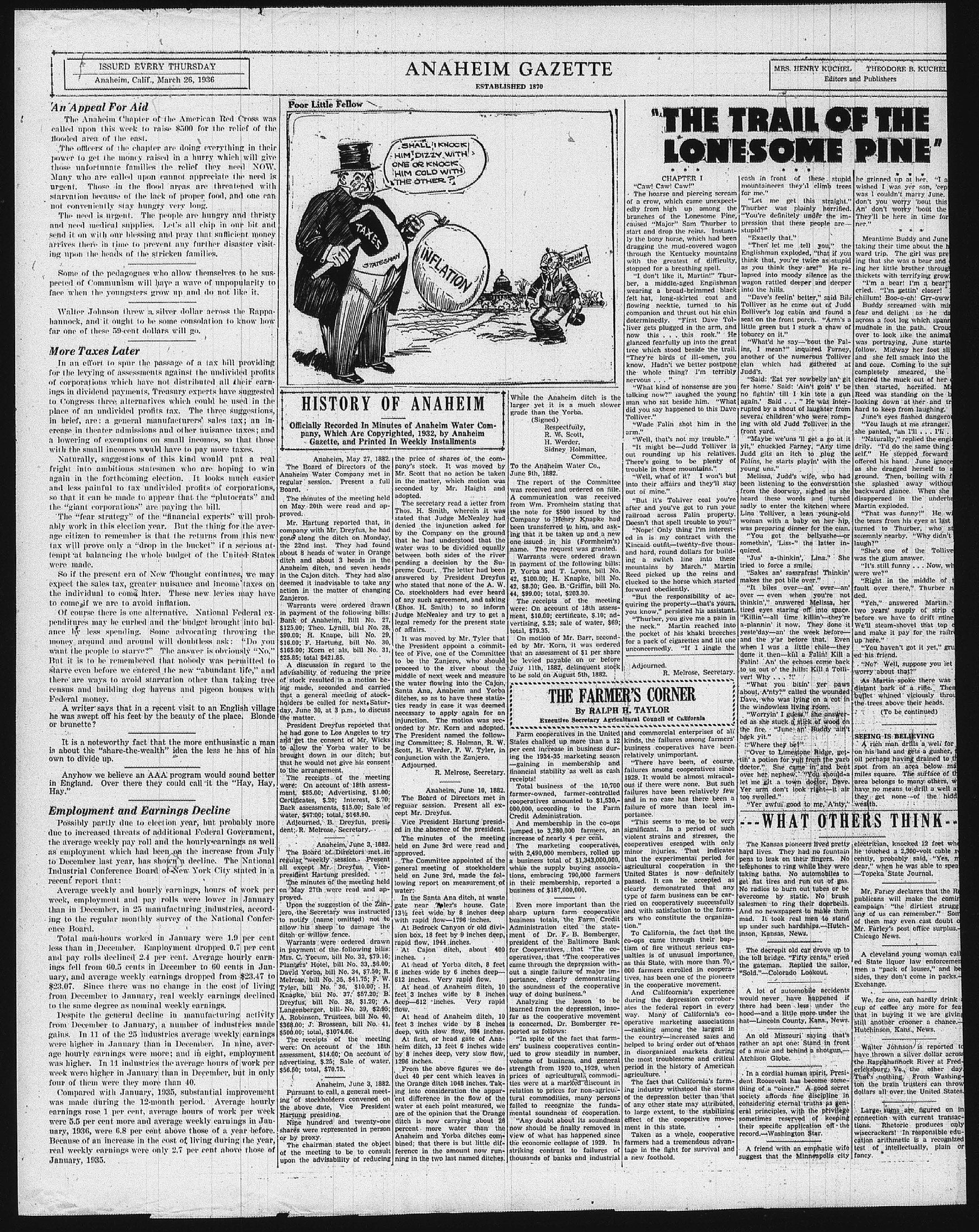
Searchable text
ISSUED EVERY THURSDAY
Anaheim, Calif., March 26, 1936
An Appeal For Aid
The Anaheim Chapter of the American Red Cross was called upon this week to raise $500 for the relief of the flooded area of the east.
The officers of the chapter are doing everything in their power to get the money raised in a hurry which will give those unfortunate families the relief they need NOW. Many who are called upon cannot appreciate the need is urgent. Those in the flood areas are threatened with starvation because of the lack of proper food, and one can not conveniently stay hungry very long.
The need is urgent. The people are hungry and thirsty and need medical supplies. Let’s all chip in our bit and send it on with our blessing and pray that sufficient money arrives there in time to prevent any further disaster visiting upon the heads of the stricken families.
Some of the pedagogues who allow themselves to be suspected of Communism will have a wave of unpopularity to face when the youngsters grow up and do not like it.
Walter Johnson threw a silver dollar across the Rappahannock, and it ought to be some consolation to know how far one of these 59-cent dollars will go.
More Taxes Later
In an effort to spur the passage of a tax bill providing for the levying of assessments against the undivided profits of corporations which have not distributed all their earnings in dividend payments, Treasury experts have suggested to Congress three alternatives which could be used in the place of an undivided profits tax. The three suggestions, in brief, are: a general manufacturers’ sales tax; an increase in theater admissions and other nuisance taxes; and a lowering of exemptions on small incomes, so that those with the small incomes would have to pay more taxes.
Naturally, suggestions of this kind would put a real
In an effort to spur the passage of a tax bill providing for the levying of assessments against the undivided profits of corporations which have not distributed all their earnings in dividend payments, Treasury experts have suggested to Congress three alternatives which could be used in the place of an undivided profits tax. The three suggestions, in brief, are: a general manufacturers' sales tax; an increase in theater admissions and other nuisance taxes; and a lowering of exemptions on small incomes, so that those with the small incomes would have to pay more taxes.
Naturally, suggestions of this kind would put a real fright into ambitious statesmen who are hoping to win again in the forthcoming election. It looks much easier and less painful to tax undivided profits of corporations, so that it can be made to appear that the "plutocrats" and the "giant corporations" are paying the bill.
The "fear strategy" of the "financial experts" will probably work in this election year. But the thing for the average citizen to remember is that the returns from this new tax will prove only a "drop in the bucket" if a serious attempt at balancing the whole budget of the United States were made.
So if the present era of New Thought continues, we may expect the sales tax, greater nuisance and income taxes on the individual to come later. These new levies may have to come if we are to avoid inflation.
Of course there is one alternative. National Federal expenditures may be curbed and the budget brought into balance by less spending. Some advocating throwing the money around and around will doubtless ask: "Do you want the people to starve?" The answer is obviously "No." But it is to be remembered that nobody was permitted to starve even before we entered the new "abundant life," and there are ways to avoid starvation other than taking tree census and building dog havens and pigeon houses with Federal money.
A writer says that in a recent visit to an English village he was swept off his feet by the beauty of the place. Blonde or brunette?
It is a noteworthy fact that the more enthusiastic a man is about the "share-the-wealth" idea the less he has of his own to divide up.
Anyhow we believe an AAA program would sound better in England. Over there they could call it the "Hay, Hay, Hay."
Employment and Earnings Decline
Possibly partly due to election year, but probably more due to increased threats of additional Federal Government, the average weekly pay roll and the hourly earnings as well as employment which had been on the increase from July to December last year, has shown a decline. The National Industrial Conference Board of New York City stated in a
Employment and Earnings Decline
Possibly partly due to election year, but probably more due to increased threats of additional Federal Government, the average weekly pay roll and the hourly earnings as well as employment which had been on the increase from July to December last year, has shown a decline. The National Industrial Conference Board of New York City stated in a recent report that:
Average weekly and hourly earnings, hours of work per week, employment and pay rolls were lower in January than in December, in 25 manufacturing industries, according to the regular monthly survey of the National Conference Board.
Total man-hours worked in January were 1.9 per cent less than in December. Employment dropped 0.7 per cent and pay rolls declined 2.4 per cent. Average hourly earnings fell from 60.5 cents in December to 60 cents in January, and average weekly earnings dropped from $23.47 to $23.07. Since there was no change in the cost of living from December to January, real weekly earnings declined to the same degree as nominal weekly earnings.
Despite the general decline in manufacturing activity from December to January, a number of industries made gains. In 11 of the 25 industries average weekly earnings were higher in January than in December. In nine, average hourly earnings were more; and in eight, employment was higher. In 11 industries the average hours of work per week were higher in January than in December, but in only four of them were they more than 40.
Compared with January, 1935, substantial improvement was made during the 12-month period. Average hourly earnings rose 1 per cent, average hours of work per week were 5.5 per cent more and average weekly earnings in January, 1936, were 6.8 per cent above those of a year before. Because of an increase in the cost of living during the year, real weekly earnings were only 2.7 per cent above those of January, 1935.
ANAHEIM GAZETTE
ESTABLISHED 1870
Poor Little Fellow
SHALL I KNOCK HIM DIZZY WITH ONE OR KNOCK HIM COLD WITH THE OTHER?
TAXES STATESMAN
INFLATION
HISTORY OF ANAHEIM
Officially Recorded In Minutes of Anaheim Water Company, Which Are Copyrighted, 1932, by Anaheim Gazette, and Printed In Weekly Installments
While the Anaheim ditch is the larger yet it is a much slower grade than the Yorba.
(Signed)
Respectfully,
R. W. Scott,
H. Werder,
Sidney Holman,
Committee.
CHAPTER
"Caw! Caw! Caw!"
The hoarse and pity of a crow, which caused "Major" Sarah start and drop the reilly the bony horse, wielding the mud-crown through the Kentuck with the greatest stopped for a breath.
"I don't like it, Mr. Ber, a middle-aged wearing a broad-brimmed felt hat, long-skirted flowing necktie, tuft companion and thus determinedly. "Fir liver gets plugged in now this... this glanced fearfully up tree which stood beoward. "They're birds of know. Hadn't we be the whole thing? nervous..."
"What kind of non-talking now?" laughs man who sat beside did you say happened Tolliver."
"Wade Falin shot arm."
Well, that's not m
"It might be—Juice out rounding up
HISTORY OF ANAHEIM
Officially Recorded In Minutes of Anaheim Water Company, Which Are Copyrighted, 1932, by Anaheim Gazette, and Printed In Weekly Installments
Anaheim, May 27, 1882. The Board of Directors of the Anaheim Water Company met in regular session. Present a full card.
The minutes of the meeting held May 20th were read and approved.
Mr. Hartung reported that, in company with Mr. Dreyfus, he had and along the ditch on Monday, the 22nd inst. They had found out 8 heads of water in Orange ranch and about 3 heads in the Anaheim ditch, and seven heads in the Cajon ditch. They had also deemed it inadvisable to take any action in the matter of changing injeros.
Warrants were ordered drawn payment of the following bills: bank of Anaheim, Bill No. 27, 25.00; Theo. Lynill, bill No. 28, 0.00; H. Krape, bill No. 29, 6.00; F. Hartung, bill No. 30, 65.00; Korn et als, bill No. 31, 5.85; total $421.85.
A discussion in regard to the viability of reducing the price stock resulted in a motion being made, seconded and carried at a general meeting of stockholders be called for next Saturday, June 30, at 3 p.m., to discuss the matter.
President Dreyfus reported that had gone to Los Angeles to try to get the consent of Mr. Wicks allow the Yorba water to be brought down in our ditch; but that he would not give his consent the arrangement.
The receipts of the meeting are: On account of 18th assessment, $85.00; Advertising, $1.00; certificates, $.20; Interest, $.70; kick assessments, $15.00; Sale of water, $47.00; total, $148.90.
Adjourned, B. Dreyfus, president; R. Melrose, Secretary.
Anaheim, June 3, 1882. The Board of Directors met in regular weekly session. Present except Mr. Dreyfus, Vice-
While the Anaheim ditch is the larger yet it is a much slower grade than the Yorba.
(Signed)
Respectfully,
R. W. Scott,
H. Werder,
Sidney Holman,
Committee.
To the Anaheim Water Co., June 9th, 1882.
The report of the Committee was received and ordered on file. A communication was received from Wm. Fromheim stating that the note for $500 issued by the Company to Henry Knapke had been transferred to him, and asking that it be taken up and a new one issued in his (Formheim's) name. The request was granted.
Warrants were ordered drawn in payment of the following bills: P. Yorba and T. Lyons, bill No. 42, $100.00; H. Knapke, bill No. 42, $8.30; Geo. B. Griffin, bill No. 44, $99.00; total, $203.30.
The receipts of the meeting were: On account of 18th assessment, $10.00; certificate, $.10; advertising, $.25; sale of water, $69; total, $79.35.
On motion of Mr. Barr, seconded by Mr. Korn, it was ordered that an assessment of $1 per share be levied payable on or before July 11th, 1882, delinquent stock to be sold on August 5th, 1882.
THE FARMER'S CORNER
By RALPH H. TAYLOR
Executive Secretary Agricultural Council of California
Farm cooperatives in the United States chalked up more than a 12 per cent increase in business during the 1934-35 marketing season—gaining in membership and financial stability as well as cash receipts!
Total business of the 10,700 farmer-owned, farmer-controlled cooperatives amounted to $1,530,-000,000, according to the Farm Credit Administration.
And membership in the co-ops jumped to 3,280,000 farmers, an increase of nearly 4 per cent.
The marketing cooperatives, with 2,490,000 members, rolled up a business total of $1,343,000,000 while the supply buying associata-
and commercial enterprises, the failures and business cooperatives relatively unimportant.
There have been failures among cooperies 1929. It would be alright if there were no failures have been run and in no case has failure of more than portance.
“This seems to me significant. In a pea violent strains and cooperatives escaped minor injuries. That the experimental agricultural cooperative.”
The receipts of the meeting are: On account of 18th assessment, $85.00; Advertising, $1.00; certificates, $2.20; Interest, $7.00; stock assessments, $15.00; Sale of water, $47.00; total, $148.90.
Adjourned B. Dreyfus, president; R. Melrose, secretary.
Anaheim, June 3, 1882. The Board of Directors met in regular session. Present all except Mr. Dreyfus.
Vice President Hartung presided in the absence of the president.
The minutes of the meeting held on June 3rd were read and approved.
The Committee appointed at the general meeting of stockholders held on June 3rd, made the following report on measurement of water:
In the Santa Ana ditch, at waste gate near Telez's house. Gate 13½ feet wide by 8 inches deep with rapid flow—1796 inches.
At Bedrock Canyon or old division box, 18 feet by 9 inches deep, rapid flow, 1944 inches.
At Cajon ditch, about 400 inches.
At head of Yorba ditch, 8 feet 6 inches wide by 6 inches deep—612 inches. Very rapid flow.
At head of Anaheim ditch, 10 feet 3 inches wide by 8 inches deep—612 inches. Very rapid flow.
At head of Anaheim ditch, 10 feet 3 inches wide by 8 inches deep, with slow flow, 984 inches.
At first, or head gate of Anaheim ditch, 13 feet 6 inches wide by 8 inches deep, very slow flow, 1296 inches.
From the above figures we deduct 40 per cent which leaves in the Orange ditch 1048 inches. Taking into consideration the apparent difference in the flow of the water at each point measured, we are of the opinion that the Orange ditch is now carrying about 28 percent more water than the Anaheim and Yorba ditches combined; that there is but little difference in the amount now running in the two last named ditches.
Anaheim, June 10, 1882. The Board of Directors met in regular session. Present all except Mr. Dreyfus.
Vice President Hartung presided in the absence of the president.
The minutes of the meeting held on June 3rd were read and approved.
The Committee appointed at the general meeting of stockholders held on June 3rd, made the following report on measurement of water:
In the Santa Ana ditch, at waste gate near Telez's house. Gate 13½ feet wide by 8 inches deep with rapid flow—1796 inches.
At Bedrock Canyon or old division box, 18 feet by 9 inches deep, rapid flow, 1944 inches.
At Cajon ditch, about 400 inches.
At head of Yorba ditch, 8 feet 6 inches wide by 6 inches deep—612 inches. Very rapid flow.
At head of Anaheim ditch, 10 feet 3 inches wide by 8 inches deep—612 inches. Very rapid flow.
At head of Anaheim ditch, 10 feet 3 inches wide by 8 inches deep, with slow flow, 984 inches.
At first, or head gate of Anaheim ditch, 13 feet 6 inches wide by 8 inches deep, very slow flow, 1296 inches.
From the above figures we deduct 40 per cent which leaves in the Orange ditch 1048 inches. Taking into consideration the apparent difference in the flow of the water at each point measured, we are of the opinion that the Orange ditch is now carrying about 28 percent more water than the Anaheim and Yorba ditches combined; that there is but little difference in the amount now running in the two last named ditches.
Total business of the 10,700 farmer-owned, farmer-controlled cooperatives amounted to $1,530,-000,000, according to the Farm Credit Administration.
And membership in the co-ops jumped to 3,280,000 farmers, an increase of nearly 4 per cent.
The marketing cooperatives, with 2,490,000 members, rolled up a business total of $1,343,000,000, while the supply buying associations, embracing 790,000 farmers in their membership, reported a business of $187,000,000.
Even more important than the sharp upturn farm cooperative business totals, the Farm Credit Administration cited the statement of Dr. F. B. Bomberger, president of the Baltimore Bank for Cooperatives, that "The cooperatives came through the depression without a single failure of major importance, clearly demonstrating the soundness of the cooperative way of doing business."
Analyzing the lesson to be learned from the depression, insafar as the cooperative movement is concerned, Dr. Bomberger reported as follows:
"In spite of the fact that farmers' business cooperatives continued to grow steadily in number, volume of business, and general strength from 1920 to 1929, when prices of agricultural commodities were at a marked discount in relation to prices for non-agricultural commodities, many persons failed to recognize the fundamental soundness of cooperation.
Any doubt about its soundness now should be finally removed in view of what has happened since the economic collapse of 1929. In striking contrast to failures of thousands of banks and industrial financial institutions."
This seems to me significant. In a period violent strains and cooperatives escaped minor injuries. That the experimental agricultural cooperative United States is not passed. It can be clearly demonstrated type of farm business ried on cooperatively and with satisfactioners who constitute tion."
To California, the co-ops came through tism of fire without qualities is of unusual as this State, with more than 900 farmers enrolled tives, has been one of in the cooperative m
And Califoornia's during the depressions federal rep way. Many of Cal operative marketing —ranking among th e country—increases helped to bring order in disorganized ma ter most troublesome period in the history agriculture.
The fact that Calif ing industry withstood of the depression bet no any other state may large extent to t effect of the cooper ment in this state.
Taken as a whole farmers had a tremen tage in the fight for a new foothold.
"THE TRAIL OF THE LONESOME PINE"
CHAPTER I
"Caw! Caw! Caw!"
The hoarse and piercing scream of a crow, which came unexpectedly from high up among the branches of the Lonesome Pine, caused "Major" Sam Thurber to start and drop the reins. Instantly the bony horse, which had been dragging the mud-covered wagon through the Kentucky mountains with the greatest of difficulty, stopped for a breathing spell.
"I don't like it, Martin!" Thurber, a middle-aged Englishman wearing a broad-brimmed black felt hat, long-skirted coat and flowing necktie, turned to his companion and thrust out his chin determinedly. "First Dave Tolliver gets plugged in the arm, and now this . . . this rook." He glanced fearfully up into the great tree which stood beside the trail. "They're birds of ill-omen, you know. Hadn't we better postpone the whole thing? I'm terribly nervous . . ."
"What kind of nonsense are you talking now?" laughed the young man who sat beside him. "What did you say happened to this Dave Tolliver."
"Wade Falin shot him in the arm."
"Well, that's not my trouble."
"It might be—Judd Tolliver is out rounding up his relatives.
cash in front of these stupid mountaineers they'll climb trees for me."
"Let me get this straight." Thurber was plainly horrified. "You're definitely under the impression that these people are—stupid?"
"Exactly that."
"Then let me tell you," the Englishman exploded, "that if you think that, you're twice as stupid as you think they are!" He relapsed into moody silence as the wagon rattled deeper and deeper into the hills.
"Dave's feelin' better," said Bill Tolliver as he came out of Judd Eolliver's log cabin and found a seat on the front porch. "Arm's a little green but I stuck a chaw of tobacco on it."
"What'd he say—bout the Falkins, I mean?" inquired Farney, another of the numerous Tolliver clan which had gathered at Judd's.
"Said: 'Eat yer sowbelly an' git fer home,' Said: 'Ain't goin' t' be no fightin' till I kin tote a gun again.' Said . . . " He was interrupted by a shout of laughter from several children who were romping with old Judd Tolliver in the front yard.
"Maybe we'uns 'll get a go at it vit,' chuckled Farney. "Any time Judd gils an itch to plug the he grinned up at her. "I wished I was yer son, 'cep was I couldn't marry June. don't you worry 'bout this An' don't worry 'bout the They'll be here in time for ner."
Meantime Buddy and June taking their time about the h ward trip. The girl was pre ing that she was a bear and ing her little brother through thickets with terrifying growl.
"I'm a bear! I'm a bear!" cried. "I'm gettin' closer! chillum! Boo-o-oh! Grr-oww!
Buddy screamed with mir fear and delight as he d across a foot log which spann mudhole in the path. Crouod over to look like the animal was portraying, June started follow. Midway her foot sli and she fell smack into the and ooze. Coming to the sur completely smeared, the cleared the muck out of her then started, horrified. Ma Reed was standing on the b looking down at her and tr hard to keep from laughing.
June's eyes flashed dangeror "You laugh at me stranger. she panted, "an Ill . . . I'll."
Naturally," replied the engi drily. "I'd do the same thing self." He stepped forward.
know. Hadn't we better postpone the whole thing? I'm terribly nervous . . .
"What kind of nonsense are you talking now?" laughed the young man who sat beside him. "What did you say happened to this Dave Tolliver."
"Wade Falin shot him in the arm."
"Well, that's not my trouble." "It might be—Judd Tolliver is out rounding up his relatives. There's going to be plenty of trouble in these mountains."
"Well, what of it? I won't but into their affairs and they'll stay out of mine."
"But it's Tolliver coal you're after and you've got to run your railroad across Falin property. Doesn't that spell trouble to you?" "Nope! Only thing I'm interested in is my contract with the Kincaid outfit—twenty-five thousand and hard, round dollars for building a switch line into these mountains by March." Martin Reed picked up the reins and clucked to the horse which started forward obediently.
"But the responsibility of acquiring the property—that's yours, you know," persisted his assistant. "Thurber, you give me a pain in the neck." Martin reached into the pocket of his khaki breeches for a pack of cigarettes and lit one unconcernedly. "If I single the Adjourned.
R. Melrose, Secretary.
HER'S CORNER
H H. TAYLOR
Municipal Council of California
and commercial enterprises of all kinds, the failures among farmers' business cooperatives have been relatively unimportant.
"There have been, of course, failures among cooperatives since 1929. It would be almost miraculous if there were none. But such failures have been relatively few and in no case has there been a failure of more than local importance.
"This seems to me to be very significant. In a period of such violent strains and stresses, the cooperatives escaped with only minor injuries. That indicates that the experimental period for agricultural cooperation in the clan which had gathered at Judd's.
"Said: 'Eat yer sowbelly an' git fer home.' Said: 'Ain't goin' t' be no fightin' till I kin tote a gun again.' Said . . . " He was interrupted by a shout of laughter from several children who were romping with old Judd Tolliver in the front yard.
"Maybe we'uns 'll get a go at it yit,' chuckled Farney. 'Any time Judd gits an itch to plug the Falins, he starts playin' with the young uns."
Melissa, Judd's wife, who had been listening to the conversation from the doorway, sighed as she heard these words and turned sadly to enter the kitchen where Lina Tolliver, a lean young-old woman with a baby on her hip, was preparing dinner for the cian.
"You got the bellyache—or somethin', 'Liss-' the latter inquired.
"Jus' a-thinkin', Lina." She tried to force a smile.
"Sakes an' sassrafras! Thinkin' makes the pot bile over."
"It biles over—an' over—an' over — even when you're not thinkin', answered Melissa, her tired eyes staring off into space. "Killin'—all time killin'—they're a-plannin' it now. They done it yeste'day—an' the week before—and the y'ar before that. Even when I was a little chile—they done it then—kill a Falin! Kill a Falin! An' the echoes come back to us out o' the hills: Kill a Tolliver! Why . . . ?"
"What you bitin' yer paws about, A'nty?' called the wounded Dave, who was lying on a cot in the windowless living room.
"Worryin' I guess," she answered as she stuck a stick of wood on the fire. "June an' Buddy aint back yit."
"Where they be?"
"Over to Limestone Ridge, gettih' a potion for yuht from the yarb doctor," She came in and bent over her nephew. "You should—a let me git a town doctor, Dave. Yer arm don't look right—it air too swolled."
"Yer awful good to me, A'nty,"
--- WHAT OTHER'S THINK --
The Kansas pioneers lived pretty hard lives. They had no fountain pens to leak on their fingers. No telephones to ring while they were electrician, knocked 12 feet whie he touched a 2,300-volt cable recently, probably said, "Yes, m dear," when he was able to speak
1929. It would be almost miraculous if there were none. But such failures have been relatively few and in no case has there been a failure of more than local importance.
"This seems to me to be very significant. In a period of such violent strains and stresses, the cooperatives escaped with only minor injuries. That indicates that the experimental period for agricultural cooperation in the United States is now definitely passed. It can be accepted as clearly demonstrated that any type of farm business can be carried on cooperatively successfully and with satisfaction to the farmers who constitute the organization."
To California, the fact that the co-ops came through their baptism of fire without serious casualties is of unusual importance, as this State, with more than 70,000 farmers enrolled in cooperatives, has been one of the pioneers in the cooperative movement.
And Califoornia's experience during the depression corroborates the federal report in every way. Many of California's cooperative marketing associations—ranking among the largest in the country—increased saies and helped to bring order out of chaos in disorganized markets during the most troublesome and critical period in the history of American agriculture.
The fact that California's farming industry withstood the storms of the depression better than that of any other state may attributed, to large extent, to the stabilizing effect of the cooperative movement in this state.
Taken as a whole, cooperative farmers had a tremendous advantage in the fight for survival and a new foothold.
The Kansas pioneers lived pretty hard lives. They had no fountain pens to leak on their fingers. No telephones to ring while they were taking baths. No automobiles to get flat tires and run out of gas. No radios to burn out tubes or be overcome by static. No brush salesmen to ring their doorbeils. And no newspapers to make them mad. It took real men to stand up under such hardships.—Hutchinson, Kansas, News.
The decrepit old car drove up to the toll bridge. "Fifty cents," cried the gateman. Replied the sailor, "Sold."—Colorado Lookout.
A lot of automobile accidents would never have happened if there had been less under the hood—and a little more under the hat—Lincoln County, Kans., News.
An old Missouri saying that's rather an apt one: Stand in front of a muie and behind a shotgun.—Atchison Globe.
In a cordial human spirit, President Roosevelt has become something of a "oiner." A good secret society affords fine discipline in considering eternal truths as general principles, with the privilege sometimes reserved of keeping their specific application off the record.—Washington Star.
A friend with an emphatic wife suggest that the Minneapolis city electrician, knocked 12 feet when he touched a 2,300-volt cable recently, probably said, "Yes, m dear," when he was able to speak—Topeka State Journal.
Mr. Farley declares that the publicans will make the comir campaign "the dirtiest struggle any of us can remember." Some of them may even cast doubt on Mr. Farley's post office surplus.—Chicago News.
A Cleveland young woman called State liquor law enforcement men a "pack of louses," and besides, they don't come in packs.—Exchange.
We, for one, can hardly drink a cup of coffee any more for fear that in buying it we are giving still another crooner a chance.—Hutchinson, Kans., News.
Walter Johnson is reported to have thrown a silver dollar across the Rappahannock River at Fredericksburg, Va., the other day. That's nothing. From Washington the brain trusters can throw dollars all over the United States.
Large sums are figured on in connection with current transactions. Rhetoric produces only wisecrackers! In responsible education arithmetic is a recognized test of intellectually, plain or fancy.