anaheim-gazette 1936-02-06
Scanned page
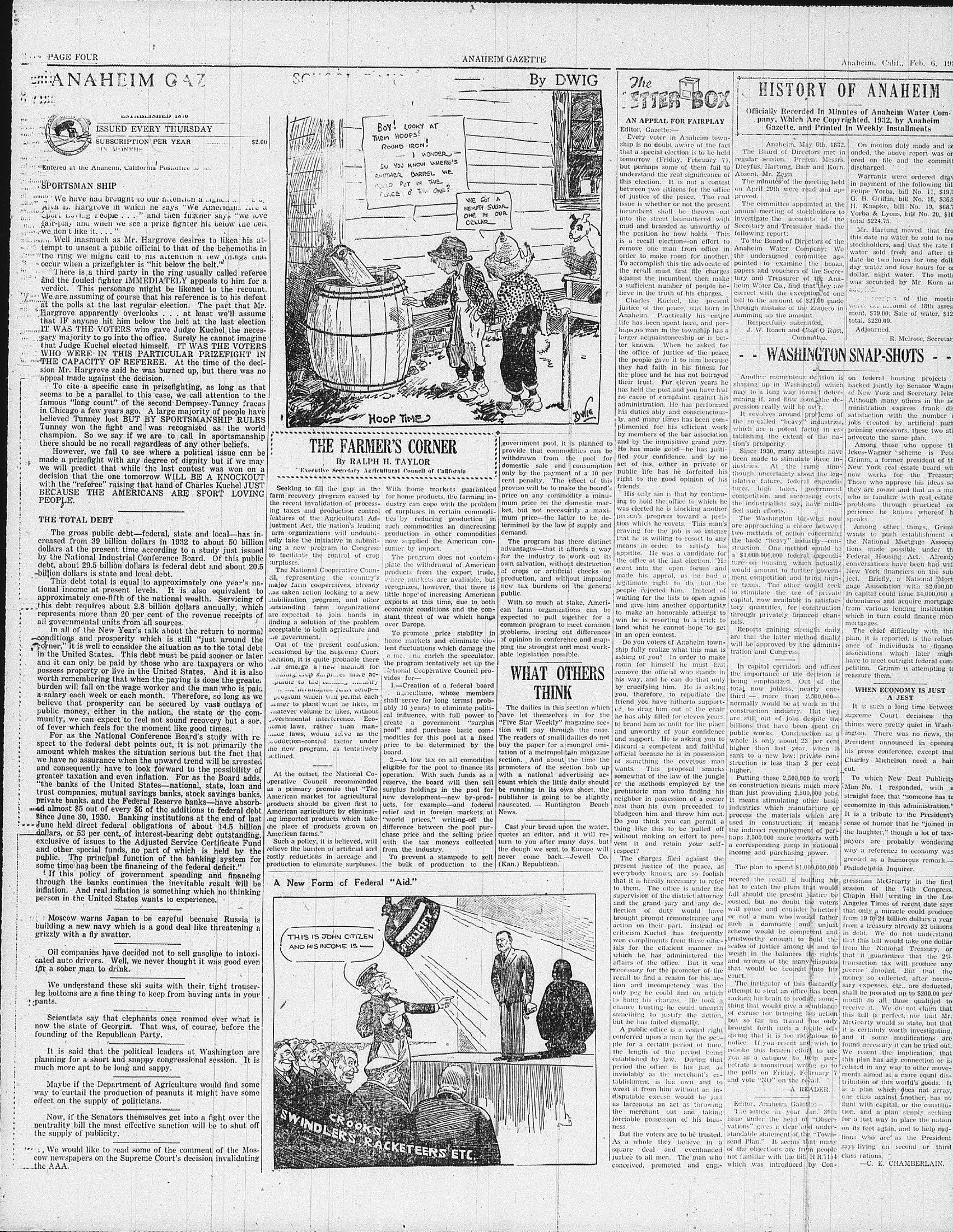
Searchable text
SPORTSMAN SHIP
We have had brought to our attention a signed notice by Alva L. Hargrove in which he says "We Americans are a Sport Living People..." and then further says "we love fair-play and when we see a prize fighter hit below the belt we don't like it."
Well inasmuch as Mr. Hargrove desires to liken his attempt to unseat a public official to that of the behemoths in the ring we might call to his attention a few things that occur when a prizefighter is "hit below the belt."
There is a third party in the ring usually called referee and the fouled fighter IMMEDIATELY appeals to him for a verdict. This personage might be likened to the recount. We are assuming of course that his reference is to his defeat at the polls at the last regular election. The part that Mr. Hargrove apparently overlooks... at least we'll assume that IF anyone hit him below the belt at the last election IT WAS THE VOTERS who gave Judge Kuchel the necessary majority to go into the office. Surely he cannot imagine that Judge Kuchel elected himself. IT WAS THE VOTERS WHO WERE IN THIS PARTICULAR PRIZEFIGHT IN THE CAPACITY OF REFEREE. At the time of the decision Mr. Hargrove said he was burned up, but there was no appeal made against the decision.
To cite a specific case in prizefighting, as long as that seems to be a parallel to this case, we call attention to the famous "long count" of the second Dempsey-Tunney fracas in Chicago a few years ago. A large majority of people have believed Tunney lost BUT BY SPORTSMANSHIP RULES Tunney won the fight and was recognized as the world champion. So we say if we are to call in sportsmanship there should be no recall regardless of any other beliefs.
However, we fail to see where a political issue can be made a prizefight with any degree of dignity.
THE TOTAL DEBT
The gross public debt—federal, state and local—has increased from 39 billion dollars in 1932 to about 50 billion dollars at the present time according to a study just issued by the National Industrial Conference Board. Of this public debt, about 29.5 billion dollars is federal debt and about 20.5 billion dollars is state and local debt.
This debt total is equal to approximately one year's national income at present levels. It is also equivalent to approximately one-fifth of the national wealth. Servicing of this debt requires about 2.8 billion dollars annually, which represents more than 20 per cent of the revenue receipts of all governmental units from all sources.
In all of the New Year's talk about the return to normal conditions and prosperity which is still "just around the corner," it is well to consider the situation as to the total debt in the United States. This debt must be paid sooner or later and it can only be paid by those who are taxpayers or who possess property or live in the United States. And it is also worth remembering that when the paying is done the greater burden will fall on the wage worker and the man who is paid a salary each week or each month. Therefore, so long as we believe that prosperity can be secured by vast outlays of public money, either in the nation, the state or the community, we can expect to feel not sound recovery but a sorrow of fever which feels for the moment like good times.
For as the National Conference Board's study with respect to the federal debt points out, it is not primarily the amount which makes the situation serious but the fact that we have no assurance when the upward trend will be arrested and consequently have to look forward to the possibility of greater taxation and even inflation. For as the Board adds, "the banks of the United States—national, state, loan and trust companies, mutual savings banks, stock savings banks, private banks, and the Federal Reserve banks—have absorbed almost $5 out of every $6 of the additions to federal debt since June 30, 1930. Banking institutions at the end of last June held direct federal obligations of about 14.5 billion dollars, or 53 per cent, of interest-bearing debt outstanding, exclusive of issues to the Adjusted Service Certificate Fund and other special funds, no part of which is held by the public. The principal function of the banking system for some time has been the financing of the federal deficit."
greater taxation and even inflation. For as the Board adds,
"the banks of the United States—national, state, loan and trust companies, mutual savings banks, stock savings banks, private banks, and the Federal Reserve banks—have absorbed almost $5 out of every $6 of the additions to federal debt Since June 30, 1930. Banking institutions at the end of last June held direct federal obligations of about 14.5 billion dollars, or 53 per cent, of interest-bearing debt outstanding, exclusive of issues to the Adjusted Service Certificate Fund and other special funds, no part of which is held by the public. The principal function of the banking system for some time has been the financing of the federal deficit."
If this policy of government spending and financing through the banks continues the inevitable result will be inflation. And real inflation is something which no thinking person in the United States wants to experience.
Moscow warns Japan to be careful because Russia is building a new navy which is a good deal like threatening a grizzly with a fly swatter.
Oil companies have decided not to sell gasoline to intoxicated auto drivers. Well, we never thought it was good even for a sober man to drink.
We understand these ski suits with their tight trouser-leg bottoms are a fine thing to keep from having ants in your pants.
Scientists say that elephants once roamed over what is now the state of Georgia. That was, of course, before the founding of the Republican Party.
It is said that the political leaders at Washington are planning for a short and snappy congressional session. It is much more apt to be long and sappy.
Maybe if the Department of Agriculture would find some way to curtail the production of peanuts it might have some effect on the supply of politicians.
Now, if the Senators themselves get into a fight over the neutrality bill the most effective sanction will be to shut off the supply of publicity.
We would like to read some of the comment of the Moscow newspapers on the Supreme Court's decision invalidating the AAA.
By DWIG
BOY! LOOKY AT THEM HOOPS!
ROUND IRON!
I WONDER—
SO YOU KNOW WHERE'S ANOTHER BARREL WE WOULD PUT IN THE PLACE OF THIS ONE?
WE GOT A NEMPTY SUGAR ONE IN OUR CELLAR
HOOP TIME
THE FARMER'S CORNER
government pool, it is planned to provide that commodities can be withdrawn from the pool for
THE FARMER'S CORNER
By RALPH H. TAYLOR
Executive Secretary Agricultural Council of California
Seeking to fill the gap in the farm recovery program caused by recent invalidation of process taxes and production control measures of the Agricultural Adjustment Act, the nation's leading organizations will undoubtedly take the initiative in submitting a new program to Congress to facilitate the control of crop surpluses.
The National Cooperative Council representing the country's major farm cooperatives, already taken action looking to a new utilization program, and other standing farm organizations expected to join hands in solving a solution of the problem applicable to both agriculture and government.
Out of the present confusion,asioned by the Supreme Court, it is quite probable there emerge a new method for using crop surplus more easily to the running industry.
The National Cooperative Council recommended a primary premise that "The American market for agricultural products should be given first to american agriculture by eliminat-imported products which take place of products grown on american farms."
Such a policy, it is believed, will leave the burden of artificial and only reductions in acreage and reduction to eliminate surpluses.
With home markets guaranteed for home products, the farming industry can cope with the problem of surpluses in certain commodities by reducing production in such commodities an increasing production in other commodities now supplied the American consumer by import.
The program does not contemplate the withdrawal of American products from the export trade, where markets are available, but recognizes, however, that there is little hope of increasing American exports at this time, due to both economic conditions and the constant threat of war which hangs over Europe.
To promote price stability in home markets and eliminate violent fluctuations which damage the mea-mer and enrich the speculator, the program tentatively set up the National Cooperative Council provides for—
1. Creation of a federal board agriculture, whose members shall serve for long terms (probably 16 years) to eliminate political influence, with full power to create a government "surplus pool" and purchase basic commodities for this pool at a fixed price to be determined by the board.
2. A low tax on all commodities eligible for the pool to finance its operation. With such funds as reserve, the board will then sell surplus holdings in the pool for new development—new by-products, for example—and federal relief and in foreign markets at "world prices," writing-off the difference between the pool purchase price and the selling price with the tax moneys collected from the industry.
To prevent a stampede to sell the bulk of production to the government pool, it is planned to provide that commodities can be withdrawn from the pool for domestic sale and consumption only by the payment of a 10 per cent penalty. The effect of this proviso will be to make the board's price on any commodity a minimum price on the domestic market, but not necessarily a maximum price—the latter to be determined by the law of supply and demand.
The program has these distinct advantages—that it affords a way for the industry to work out its own salvation, without destruction of crops or artificial checks on production, and without imposing new tax burdens on the general public.
With so much at stake, American farm organizations can be expected to pull together for a common program to meet common problems, ironing out differences of opinion in conference and mapping the strongest and most workable legislation possible.
WHAT OTHER THINK
The dailies in this section which have let themselves in for the "Five Star Weekly" magazine section will pay through the nose. The readers of small dailies do not buy the paper for a monrel imitation of a metropolitan magazine section. And about the time the promoters of the section bob up with a national advertising account which the little daily should be running in its own sheet, the publisher is going to be slightly nauseated. — Huntington Beach News.
Cast your bread upon the water; quotes an editor, and it will return to you after many days, but the dough we sent to Europe will never come back—Jewell Co. (Kan.) Republican.
His only sin is ing to hold the order was elected he is person's progression which he co-craving for the job that he is willing means in order appilitte. He was the office at the Laven into the op made his appeal legitimate right people rejected him waiting for the list and give him another to make an honor win he is resorting land what he can in an open contest.
Do you voters of ship fully realize your asking of you? In room for himself remove the official his way, and he can by crucifying him you, therefore, to friend you have hled to drag him ohe has ably filled it to brand him as usu and unworthy of it and support. He discard a competitor official because he had something they wants. This prince somewhat of the lair er the methods er prehistoric man wv neighbor in posses nest than his own bludgeon him and Do you think you thing like this too without making an vent it and retre- respect?
The charges fil present justice of
At the outset, the National Cooperative Council recommended a primary premise that "The American market for agricultural products should be given first to American agriculture by eliminat-imported products which take place of products grown on American farms."
Such a policy, it is believed, will have the burden of artificial and costly reductions in acreage and production to eliminate surpluses.
With such funds as a reserve, the board will then sell surplus holdings in the pool for new development—new by-products, for example—and federal relief and in foreign markets at "world prices," writing-off the difference between the pool purchase price and the selling price with the tax moneys collected from the industry.
To prevent a stampede to sell the bulk of production to the
Cast your bread upon the water, quotes an editor, and it will return to you after many days, but the dough we sent to Europe will never come back—Jewell Co. (Kan.) Republican.
A New Form of Federal "Aid."
THIS IS JOHN CITIZEN AND HIS INCOME IS
CROOKS SWINDLERS RACKETEERS ETC.
HISTORY OF ANAHEIM
Officially Recorded In Minutes of Anaheim Water Company, Which Are Copyrighted, 1932, by Anaheim Gazette, and Printed In Weekly Installments
Anaheim, May 6th, 1832.
The Board of Directors met in regular session. Present Messrs. Dreyfus, Hartung, Barr and Korn. Absent, Mr. Zeyn.
The minutes of the meeting held on April 29th were read and approved.
The committee appointed at the annual meeting of stockholders to investigate the accounts of the Secretary and Treasurer made the following report:
To the Board of Directors of the Anaheim Water Company: We the undersigned committee appointed to examine the books, papers and vouchers of the Secretary and Treasurer of the Anaheim Water Co., find that they are correct with the exception of one bill to the amount of $27.00 made through mistake of the Zanjero in summing up the amount.
Respectfully submitted,
J. W. Roach and Chas O Rust,
Committee.
On motion duly made and seconded, the above report was ordered on file and the committee discharged.
Warrants were ordered drawn in payment of the following bills:
Felipe Yorba, bill No. 17, $19.50;
G. B. Griffin, bill No. 18, $36.80;
H. Knapke, bill No. 19, $68.75;
Yorba & Lyons, bill No. 20, $100 total, $224.75.
Mr. Hartung moved that from this date no water be sold to non-stockholders, and that the rate for water sold from and after the date be two hours for one dollar day water and four hours for one dollar night water. The motive was seconded by Mr. Korn and accepted.
Another momentous decision is shaping up in Washington which may to a long way toward determining if, and how soon, the depression really will be over.
It revolves around problems of the so-called "heavy" industries, which are a potent factor in establishing the extent of the nation's prosperity.
Since 1930, many attempts have been made to stimulate these on federal housing projects backed jointly by Senator Wagner of New York and Secretary Ickes. Although many others in the administration express frank satisfaction with the number of jobs created by artificial pump priming endeavors, these two still advocate the same plan.
Among those who oppose the Ickes-Wagner scheme is Peter Grimm, a former president of the Anaheim Calif., Feb. 6, 1932.
the people give it to him because they had faith in his fitness for the place and he has not betrayed their trust. For eleven years he has held the post and you have had no cause of complaint against his administration. He has performed his duties ably and conscienciously, and many times has been complimented for his efficient work by members of the bar association and by the inquisitive grand jury. He has made good—he has justified your confidence, and by no act of his, either in private or public life has he forfeited his right to the good opinion of his friends.
His only sin is that by continuing to hold the office to which he was elected he is blocking another person's progress toward a position which he covets. This man's craving for the job is so intense that he is willing to resort to any means in order to satisfy his appetite. He was a candidate for the office at the last election. He went into the open forum and made his appeal, as he had a legitimate right to do, but the people rejected him. Instead of waiting for the lists to open again and give him another opportunity to make an honorable attempt to win he is resorting to a trick to land what he cannot hope to get in an open contest.
Do you voters of Anaheim township fully realize what this man is asking of you? In order to make room for himself he must first remove the official who stands in his way, and he can do that only by crucifying him. He is asking you, therefore, to repudiate the friend you have hitherto supported, to drag him out of the chair he has ably filled for eleven years, to brand him as unfit for the place and unworthy of your confidence and support. He is asking you to discard a competent and faithful official because he is in possession of something the covetous man wants. This proposal smacks somewhat of the law of the jungle or the methods employed by the prehistoric man who finding his neighbor in possession of a cozier nest than his own preceded to bludgeon him and throw him out. Do you think you can permit a thing like this to be pulled off without making an effort to prevent it and retain your self-respect?
The charges filed against the present justice of the peace, as another momentous decision is shaping up in Washington which may to a long way toward determining if, and how soon, the depression really will be over.
It revolves around problems of the so-called "heavy" industries, which are a potent factor in establishing the extent of the nation's prosperity.
Since 1930, many attempts have been made to stimulate these industries. At the same time though, uncertainty about the legislative future, federal expenditures, high taxes, government competition, and increasing costs, the industrialists say, have nullified such efforts.
The Washington big-wigs now are approaching a choice between two methods of action concerning the basic "heavy" industry—construction. One method would be a $1,000,000,000 federal expenditure on housing, which actually would amount to further government competition and bring higher taxes. The other would seek to stimulate the use of private capital, now available in satisfactory quantities, for construction through privately financed channels.
Reports gaining strength daily are that the latter method finally will be approved by the administration and Congress.
In capital corridors and offices the importance of the decision is being emphasized. Out of the total now jobless, nearly one-third — more than 2,500,000 — normally would be at work in the construction industry. But they are still out of jobs despite the billions that have been spent on public works. Construction as a whole is only about 23 per cent higher than last year, when it sank to a new low; private construction is less than 3 per cent higher.
Putting these 2,500,000 to work on construction means much more than just providing 2,500,000 jobs. It means stimulating other basic industries which manufacture or process the materials which are used in construction; it means the indirect reemployment of perhaps 2,500,000 more workers with a corresponding jump in national income and purchasing power.
The plan to spend $1,000,000,000 on federal housing projects backed jointly by Senator Wagner of New York and Secretary Ickes. Although many others in the administration express frank dissatisfaction with the number of jobs created by artificial pump priming endeavors, these two still advocate the same plan.
Among those who oppose the Ickes-Wagner scheme is Peter Grimm, a former president of the New York real estate board who now works for the Treasury. Those who approve his ideas say they are sound and that as a man who is familiar with real estate problems through practical experience he knows whereof he speaks.
Among other things, Grimm wants to push establishment of the National Mortgage Association made possible under the Federal Housing Act. Already conversations have been had with New York financiers on the subject. Briefly, a National Mortgage Association with $2,000,000 in capital could issue $4,000,000 in debentures and acquire mortgage from various lending institutions which in turn could finance more mortgages.
The chief difficulty with that plan, it is reported, is the reluctance of individuals to finance associations which later might have to meet outright federal competition. Grimm is attempting to reassure them.
WHEN ECONOMY IS JUST A JEST
It is such a long time between supreme Court decisions that things were pretty quiet in Washington. There was no news, the President announced in opening his press conference, except that Charley Michelson need a haircut.
To which New Deal Publicity Man No. 1 responded, with a straight face, that "someone has to economize in this administration." It is a tribute to the President's sense of humor that he "joined in the laughter," though a lot of tax-payers are probably wondering why a reference to economy was greeted as a humorous remark—Philadelphia Inquirer.
somewhat of the law of the jungle or the methods employed by the prehistoric man who finding his neighbor in possession of a cozier nest than his own preceded to bludgeon him and throw him out. Do you think you can permit a thing like this to be pulled off without making an effort to prevent it and retain your self-respect?
The charges filed against the present justice of the peace, as everybody knows, are so foolish that it is hardly necessary to refer to them. The office is under the supervision of the district attorney and the grand jury and any deflection of duty would have brought prompt remonstrance and action on their part, instead of criticism Kuchel has frequently won compliments from these officials for the efficient manner in which he has administered the affairs of the office. But it was necessary for the promoter of the recall to find a reason for his action and incompetence was the only peg he could find on which to hang his charges. He took a chance trusting he could unearth something to justify the action, but he has failed dismally.
A public office is a vested right conferred upon a man by the people for a certain period of time, the length of the period being established by law. During that period the office is his just as inviolably as the merchant's establishment is his own and to wrest it from him without an indisputable excuse would be just as larcenous an act as throwing the merchant out and taking forcible possession of his business.
But the voters are to be trusted. As a whole they believe in a square deal and evenhanded justice to all men. The man who conceived, promoted and engi-
Putting these 2,500,000 to work on construction means much more than just providing 2,500,000 jobs. It means stimulating other basic industries which manufacture or process the materials which are used in construction; it means the indirect reemployment of perhaps 2,500,000 more workers with a corresponding jump in national income and purchasing power.
The plan to spend $1,000,000,000
neered the recall is holding his hat to catch the plum that would fall should the present justice be ousted, but no doubt the voters will pause and consider whether or not a man who would father such a damnable and unjust scheme would be competent and trustworthy enough to hold the scales of justice among us and to weigh in the balances the rights and wrongs of the many disputes that would be brought into his court.
The instigator of this dastardly attempt to steal an office has been racking his brain to produce something that would give a semblance of excuse for bringing his action but so far his travail has only brought forth such a feeble offspring that it is too ridiculous to notice. If you resent and wish to rebute this brazen effort to use you as a catspaw to help perpetrate a monstrous wrong go to the polls on Friday, February 7 and vote "NO" on the recall.
—A READER.
Editor, Anaheim Gazette:
The article in your Jan. 30th issue under the head of "Observations" gives a clear and understandable statement of the "Townsend Plan." It seems that many of the objections are from people not familiar with the bill H.R.7154 which was introduced by Con-
To which New Deal Publicity Man No. 1 responded, with a straight face, that "someone has to economize in this administration."
It is a tribute to the President's sense of humor that he "joined in the laughter," though a lot of taxpayers are probably wondering why a reference to economy was greeted as a humorous remark.—Philadelphia Inquirer.
gressman McGroarty in the first session of the 74th Congress. Chapin Hall writing in the Los Angeles Times of recent date says that only a miracle could produce from 19 to 24 billion dollars a year from a treasury already 32 billions in debt. We do not understand that this bill would take one dollar from the National Treasury, or that it guarantees that the 2% transaction tax will produce any precise amount. But that the money so collected, after necessary expenses, etc., are deducted, shall be prorated up to $200.00 per month to all those qualified to receive it. We do not claim that this bill is perfect, nor that Mr. McGoarty would so state, but that it is certainly worth investigating, and if some modifications are found necessary it can be tried out. We resent the implication, that this plan has any connection or is related in any way to other movements aimed at a more equal distribution of this world's goods. It is a plan which does not array, one class against another, has no fight with capital, or the constitution, and a plan simply seeking for a just way to place the nation on its feet again, and to help millions who are' as the President says living on second or third class rations.
—C. E. CHAMBERLAIN.