anaheim-gazette 1935-06-27
Scanned page
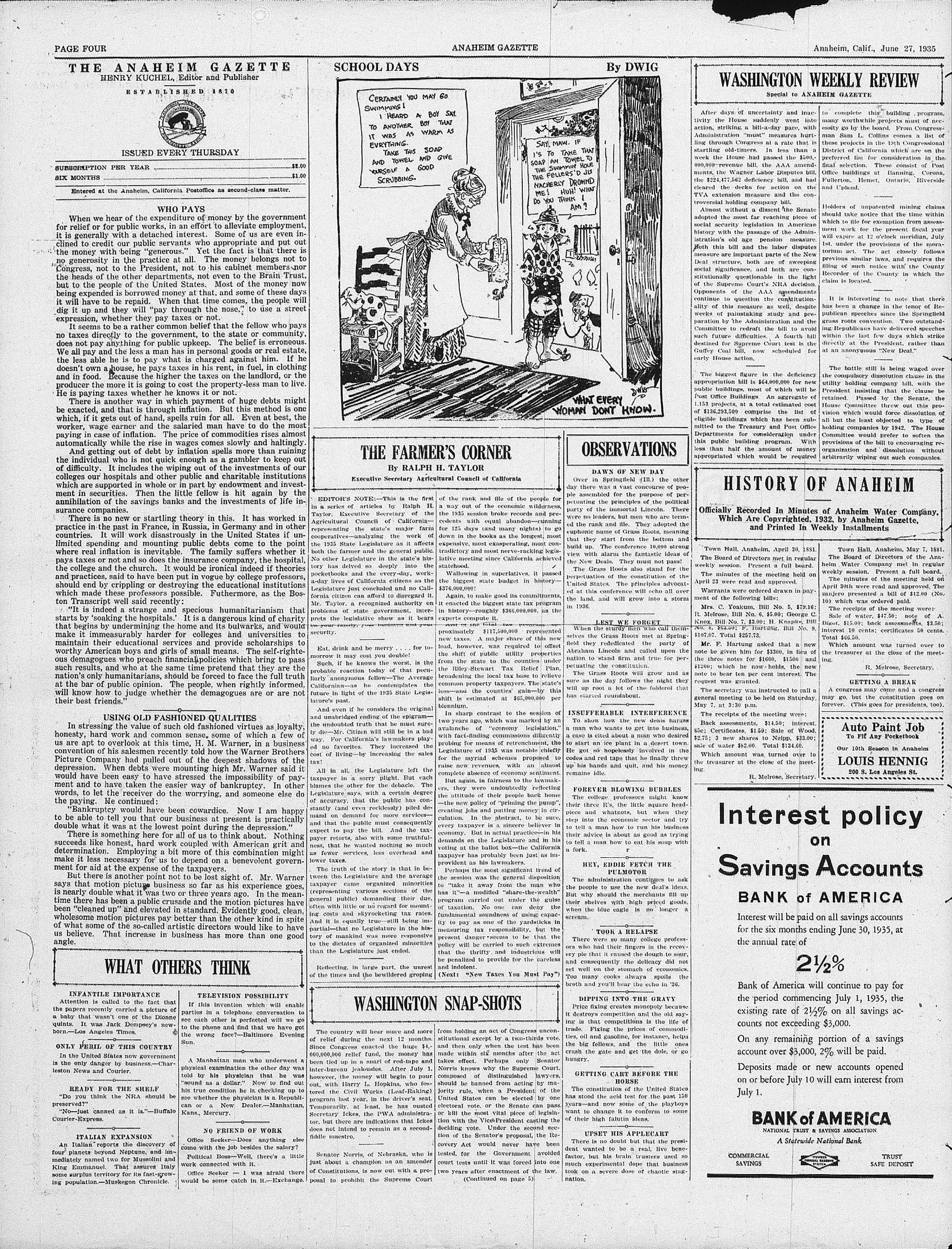
Searchable text
THE ANAHEIM GAZETTE
HENRY KUCHEL, Editor and Publisher
ESTABLISHED 1870
ISSUED EVERY THURSDAY
SUBSCRIPTION PER YEAR ... $2.00
SIX MONTHS ... $1.00
Entered at the Anaheim, California Postoffice as second-class matter.
WHO PAYS
When we hear of the expenditure of money by the government for relief or for public works, in an effort to alleviate employment, it is generally with a detached interest. Some of us are even inclined to credit our public servants who appropriate and put out the money with being "generous." Yet the fact is that there is no generosity in the practice at all. The money belongs not to Congress, not to the President, not to his cabinet members nor the heads of the other departments, not even to the Brain Trust, but to the people of the United States. Most of the money now being expended is borrowed money at that, and some of these days it will have to be repaid. When that time comes, the people will dig it up and they will "pay through the nose," to use a street expression, whether they pay taxes or not.
It seems to be a rather common belief that the fellow who pays no taxes directly to the government, to the state or community, does not pay anything for public upkeep. The belief is erroneous. We all pay and the less a man has in personal goods or real estate, the less able he is to pay what is charged against him. If he doesn't own a house, he pays taxes in his rent, in fuel, in clothing and in food. Because the higher the taxes on the landlord, or the producer the more it is going to cost the property-less man to live. He is paying taxes whether he knows it or not.
There is another way in which payment of huge debts might be exacted, and that is through inflation. But this method is one which, if it gets out of hand, spells ruin for all. Even at best, the worker, wage earner and the salaried man have to do the most paying in case of inflation. The price of commodities rises almost automatically while the rise in wages comes slowly and haltingly.
And getting out of debt by inflation spells more than ruining the individual who is not quick enough as a gambler to keep out
doesn't own a house, he pays taxes in his rent, in fuel, in clothing and in food. Because the higher the taxes on the landlord, or the producer the more it is going to cost the property-less man to live. He is paying taxes whether he knows it or not.
There is another way in which payment of huge debts might be exacted, and that is through inflation. But this method is one which, if it gets out of hand, spells ruin for all. Even at best, the worker, wage earner and the salaried man have to do the most paying in case of inflation. The price of commodities rises almost automatically while the rise in wages comes slowly and haltingly.
And getting out of debt by inflation spells more than ruining the individual who is not quick enough as a gambler to keep out of difficulty. It includes the wiping out of the investments of our colleges our hospitals and other public and charitable institutions which are supported in whole or in part by endowment and investment in securities. Then the little fellow is hit again by the annihilation of the savings banks and the investments of life insurance companies.
There is no new or startling theory in this. It has worked in practice in the past in France, in Russia, in Germany and in other countries. It will work disastrously in the United States if unlimited spending and mounting public debts come to the point where real inflation is inevitable. The family suffers whether it pays taxes or not and so does the insurance company, the hospital, the college and the church. It would be ironical indeed if theories and practices, said to have been put in vogue by college professors, should end by crippling or destroying the educational institutions which made these professors possible. Furthermore, as the Boston Transcript well said recently:
"It is indeed a strange and specious humanitarianism that starts by 'soaking the hospitals.' It is a dangerous kind of charity that begins by undermining the home and its bulwarks, and would make it immeasurably harder for colleges and universities to maintain their educational services and provide scholarships to worthy American boys and girls of small means. The self-righteous demagogues who preach financial policies which bring to pass such results, and who at the same time pretend that they are the nation's only humanitarians, should be forced to face the full truth at the bar of public opinion. The people, when rightly informed, will know how to judge whether the demagogues are or are not their best friends."
USING OLD FASHIONED QUALITIES
In stressing the value of such old fashioned virtues as loyalty, honesty, hard work and common sense, some of which a few of us are apt to overlook at this time, H. M. Warner, in a business convention of his salesmen recently told how the Warner Brothers Picture Company had pulled out of the deepest shadows of the depression. When debts were mounting high Mr. Warner said it would have been easy to have stressed the impossibility of payment and to have taken the easier way of bankruptcy. In other words, to let the receiver do the worrying, and someone else do the paying. He continued:
"Bankruptcy would have been cowardice. Now I am happy to be able to tell you that our business at present is practically double what it was at the lowest point during the depression."
There is something here for all of us to think about. Nothing succeeds like honest, hard work coupled with American grit and determination. Employing a bit more of this combination might make it less necessary for us to depend on a benevolent government for aid at the expense of the taxpayers.
But there is another point not to be lost sight of. Mr. Warner
MENT and to have taken the easier way of bankruptcy. In other words, to let the receiver do the worrying, and someone else do the paying. He continued:
"Bankruptcy would have been cowardice. Now I am happy to be able to tell you that our business at present is practically double what it was at the lowest point during the depression."
There is something here for all of us to think about. Nothing succeeds like honest, hard work coupled with American grit and determination. Employing a bit more of this combination might make it less necessary for us to depend on a benevolent government for aid at the expense of the taxpayers.
But there is another point not to be lost sight of. Mr. Warner says that motion picture business so far as his experience goes, is nearly double what it was two or three years ago. In the meantime there has been a public crusade and the motion pictures have been "cleaned up" and elevated in standard. Evidently good, clean, wholesome motion pictures pay better than the other kind in spite of what some of the so-called artistic directors would like to have us believe. That increase in business has more than one good angle.
WHAT OTHER'S THINK
INFANTILE IMPORTANCE
Attention is called to the fact that the papers recently carried a picture of a baby that wasn't one of the Dionne quints. It was Jack Dempsey's newborn.—Los Angeles Times.
ONLY PERIL OF THIS COUNTRY
In the United States now government is the only danger by business.—Charleston News and Courier.
READY FOR THE SHELF
"Do you think the NRA should be preserved?"
"No—just canned as it is."—Buffalo Courier-Express.
ITALIAN EXPANSION
An Italian reports the discovery of four planets beyond Neptune, and immediately named two for Mussolini and King Emmanuel. That assures Italy some surplus territory for its fast-growing population.—Muskegon Chronicle.
TELEVISION POSSIBILITY
If this invention which will enable parties in a telephone conversation to see each other is perfected will we go to the phone and find that we have got the wrong face?—Baltimore Evening Sun.
A Manhattan man who underwent a physical examination the other day was told by his physician that he was "sound as a dollar." Now to find out his true condition he is checking up to see whether the physician is a Republican or a New Dealer.—Manhattan, Kans., Mercury.
NO FRIEND OF WORK
Office Seeker—Does anything else come with the job besides the salary?
Political Boss—Well, there's a little work connected with it.
Office Seeker — I was afraid there would be some catch in it.—Exchange.
The country of relief during Since Congress 000,000,000 reliably been tied up in inter-bureau jobs however, the move out, with Harrison tered the Civil program last year Temporarily, a Secretary Icke tor, but there does not intend fiddle maestro.
Senator Norris just about a c of Constitution posal to proh
ANAHEIM GAZETTE
SCHOOL DAYS
By DWIG
CERTAINLY YOU MAY GO SWIMMING!
I HEARD A BOY SAY TO ANOTHER BOY THAT IT WAS AS WARM AS EVRYTHING.
TAKE THIS SOAP AND TOWEL AND GIVE YOURSELF A GOOD SCRUBBING.
SAY, MAW. IF I'S TO TAKE THAT SOAP AM TOWEL TO THE SWIMMIN HOLE THE FELLERS'D JIS NACHERLY DROHIND ME! HUH! WHAT DO YOU THINK I AM?
WHAT EVERY WOMAN DON'T KNOW.
THE FARMER'S CORNER
OBSERVATIONS
THE FARMER'S CORNER
By RALPH H. TAYLOR
Executive Secretary Agricultural Council of California
EDITOR'S NOTE:—This is the first in a series of articles by Ralph H. Taylor, Executive Secretary of the Agricultural Council of California—representing the state's major farm cooperatives—analyzing the work of the 1935 State Legislature as it affects both the farmer and the general public. No other Legislature in the state's history has delved so deeply into the pocketbooks and the everyday work—a day lives of California citizens as the Legislature just concluded and no California citizen can afford to disregard it. Mr. Taylor, a recognized authority on problems of state government, interprets the legislative show as it bears on your family, your business and your security.
Eat, drink and be merry... for tomorrow it may cost you double!
Such, if he knows the worst, is the probable reaction today of that peculiarly anonymous fellow—The Average Californian—as he contemplates the future in light of the 1935 State Legislature's past.
And even if he considers the original and unabridged ending of the epigram—the undoubted truth that he must surely die—Mr. Citizen will still be in a bad way. For California's lawmakers played no favorites. They increased the cost of living—by increasing the sales tax!
All in all, the Legislature left the taxpayer in a sorry plight. But each blames the other for the debacle. The Legislature says, with a certain degree of accuracy, that the public has constantly (and even recklessly) piled demand on demand for more services—and that the public must consequently expect to pay the bill. And the taxpayer retorts, also with some truthfulness, that he wanted nothing so much as fewer services, less overhead and lower taxes.
The truth of the story is that in between the Legislature and the average rank and file of the people for a way out of the economic wilderness, the 1935 session broke records and precedents with equal abandon—running for 125 days (and many nights) to go down in the books as the longest, most expensive, most exasperating, most contradictory and most nerve-racking legislative meeting since California achieved statehood.
Wallowing in superlatives, it passed the biggest state budget in history—$376,000,000!
Again, to make good its commitments, it enacted the biggest state tax program in history—roughly $366,000,000, as the experts compute it.
And of the total tax proxximately $117,500,000 represented new taxes. A major share of this new load, however, was required to offset the shift of public utility properties from the state to the counties under the Riley-Stewart Tax Relief Plan, broadening the local tax base to relieve common property taxpayers. The state's loss—and the counties' gain—by this shift is estimated at $65,000,000 per billionium.
In sharp contrast to the session of two years ago, which was marked by an avalanche of "economy legislation," with fact-finding commissions diligently probing for means of retrenchment, the Legislature of 1935 was notable chiefly for the myriad schemes proposed to raise new revenues, with an almost complete absence of economy sentiment.
But again, in fairness to the lawmakers, they were undoubtedly reflecting the attitude of their people back home—the new policy of "priming the pump", creating jobs and putting money in circulation. In the abstract, to be sure, every taxpayer is a sincere believer in economy. But in actual practice—in his demands on the Legislature and in his voting at the ballot box—the California taxpayer has probably been just as improvident as his lawmakers.
Perhaps the most significant trend of the session was the general disposition of the rank and file of the people for a way out of the economic wilderness, the 1935 session broke records and precedents with equal abandon—running for 125 days (and many nights) to go down in the books as the longest, most expensive, most exasperating, most contradictory and most nerve-racking legislative meeting since California achieved statehood.
Wallowing in superlatives, it passed the biggest state budget in history—$376,000,000!
Again, to make good its commitments, it enacted the biggest state tax program in history—roughly $366,000,000, as the experts compute it.
And of the total tax proxximately $117,500,000 represented new taxes. A major share of this new load, however, was required to offset the shift of public utility properties from the state to the counties under the Riley-Stewart Tax Relief Plan, broadening the local tax base to relieve common property taxpayers. The state's loss—and the counties' gain—by this shift is estimated at $65,000,000 per billionium.
In sharp contrast to the session of two years ago, which was marked by an avalanche of "economy legislation," with fact-finding commissions diligently probing for means of retrenchment, the Legislature of 1935 was notable chiefly for the myriad schemes proposed to raise new revenues, with an almost complete absence of economy sentiment.
But again, in fairness to the lawmakers, they were undoubtedly reflecting the attitude of their people back home—the new policy of "priming the pump", creating jobs and putting money in circulation. In the abstract, to be sure, every taxpayer is a sincere believer in economy. But in actual practice—in his demands on the Legislature and in his voting at the ballot box—the California taxpayer has probably been just as improvident as his lawmakers.
Perhaps the most significant trend of the session was the general disposition of the rank and file of the people for a way out of the economic wilderness, the 1935 session broke records and precedents with equal abandon—running for 125 days (and many nights) to go down in the books as the longest, most expensive, most exasperating, most contradictory and most nerve-racking legislative meeting since California achieved statehood.
Wallowing in superlatives, it passed the biggest state budget in history—$376,000,000!
Again, to make good its commitments, it enacted the biggest state tax program in history—roughly $366,000,000, as the experts compute it.
And of the total tax proxximately $117,500,000 represented new taxes. A major share of this new load, however, was required to offset the shift of public utility properties from the state to the counties under the Riley-Stewart Tax Relief Plan, broadening the local tax base to relieve common property taxpayers. The state's loss—and the counties' gain—by this shift is estimated at $65,000,000 per billionium.
In sharp contrast to the session of two years ago, which was marked by an avalanche of "economy legislation," with fact-finding commissions diligently probing for means of retrenchment, the Legislature of 1935 was notable chiefly for the myriad schemes proposed to raise new revenues, with an almost complete absence of economy sentiment.
But again, in fairness to the lawmakers, they were undoubtedly reflecting the attitude of their people back home—the new policy of "priming the pump", creating jobs and putting money in circulation. In the abstract, to be sure, every taxpayer is a sincere believer in economy. But in actual practice—in his demands on the Legislature and in his voting at the ballot box—the California taxpayer has probably been just as improvident as his lawmakers.
Perhaps the most significant trend of the session was the general disposition of the rank and file of the people for a way out of the economic wilderness, the 1935 session broke records and precedents with equal abandon—running for 125 days (and many nights) to go down in the books as the longest, most expensive, most exasperating, most contradictory and most nerve-racking legislative meeting since California achieved statehood.
Wallowing in superlatives, it passed the biggest state budget in history—$376,000,000!
Again, to make good its commitments, it enacted the biggest state tax program in history—roughly $366,000,000, as the experts compute it.
And of the total tax proxximately $117,500,000 represented new taxes. A major share of this new load, however, was required to offset the shift of public utility properties from the state to the counties under the Riley-Stewart Tax Relief Plan, broadening the local tax base to relieve common property taxpayers. The state's loss—and the counties' gain—by this shift is estimated at $65,000,000 per billionium.
In sharp contrast to the session of two years ago, which was marked by an avalanche of "economy legislation," with fact-finding commissions diligently probing for means of retrenchment, the Legislature of 1935 was notable chiefly for the myriad schemes proposed to raise new revenues, with an almost complete absence of economy sentiment.
But again, in fairness to the lawmakers, they were undoubtedly reflecting the attitude of their people back home—the new policy of "priming the pump", creating jobs and putting money in circulation. In the abstract,to be sure,every taxpayer is a sincere believer in economy. But in actual practice—in his demands onthe Legislature and in his voting atthe ballotbox—theCalifornia taxpayer has probably been just as improvident as his lawmakers.
Perhapsthemostsignificanttrendofthesessionwasthegeneraldispositionoftherankandfileofthepeopleforawayoutoftheeconomicwilderness,the1935sessionbrokerecordsandprecedentswithequalabandon--runningfor125days(andmanynights)togodowninthebooksasthelongest,mostexpensive,mostexasperating,mostcontradictoryandmostnerve-rackinglegislativemeetingsinceCaliforniaachievedstatehood.
DAWN OF NEW DAY
Over in Springfield (Ill.) there was a vast concourse ofpleaseassembledforthepurposeofpetuatingtheprinciplesofthepoorpartoftheimmortalLincoln." werenoleadersbutmenwhoareedtherankandfile.TheyledepoeticnameofGrassRootsmeetthattheystartfromthebottombuildup.Theconference10,o万sviewwithalarmthefantasticideetheNewDeals.TheymustnotpayTheGrassRootsalsostandforsoundabout.
LESTWEFORGET
WhenthesturdymenwhocallevetheGrassRootsmetatSpFieldtheyrededicatedthepartyAbrahamLincolnandcalleduponstationtostrandfirmandtrueforpetuatingthe constitution.
TheGrassRootswillgrowanensureasthedayfollowsthenightwilluproota lotofthefolderhasstartedroundabout.
INSUFFERABLEINTERFERENCE
Toshowhowthenewdealshouldmanwhowantstogetintobuscaseiscitedabouta manwhodo startaniceplantinadesertHegotsohopelessly involvedincodesandredtapethathe finallytoupsihandsandquit,andhisneemainsidle.
FOREVERBLOWINGBUBBLY
ThecollegeprofessorsmightbethreeR's,thelittle square pieceandwhatnots,butwhenstepintoetheeconomicsectorandto tellamanhowto runhissbus theiradviceisaboutasgoodastothetellamanhowtocheathis soupafork.
HEY,EDDIEFETCHTHEPULMOTOR
The administrationcontinuesto
WASHINGTON SNAP-SHOTS
The country will hear more and more of relief during the next 12 months. Since Congress enacted the huge $4,-000,000,000 relief fund, the money has been tied up in a snarl of red-tape and inter-bureau jealousies. After July 1, however, the money will begin to pour out, with Harry L. Hopkins, who fostered the Civil Works (Leaf-Raking) program last year, in the driver's seat. Temporarily, at least, he has ousted Secretary Ickes, the PWA administrator, but there are indications that Ickes does not intend to remain as a second-fiddle maestro.
Senator Norris, of Nebraska, who is just about a champion as an amender of Constitutions, is now out with a proposal to prohibit the Supreme Court from holding an act of Congress unconstitutional except by a two-thirds vote, and then only when the test has been made within six months after the act takes effect. Perhaps only Senator Norris knows why the Supreme Court composed of distinguished lawyers, should be banned from acting by majority rule, when a President of the United States can be elected by one electoral vote, or the Senate can pass or kill the most vital piece of legislation with the Vice President casting the deciding vote. Under the second section of the Senator's proposal, the Recovery Act would never have been tested, for the Government avoided court tests until it was forced into one two years after enactment of the law.
(Continued on page 5)
FOREVER BLOWING BUBBLY
The college professors might take their three R's, the little square piece and whatnots, but when they step into the economic sector and tell a man how to run his business their advice is about as good as to tell a man how to eat his soup a fork.
HEY, EDDIE FETCH THE PULMOTOR
The administration continues to help the people to use the new deal's benefits. But why should the merchants file their shelves with high priced goods when the blue eagle is no longer scream.
TOOK A RELAPSE
There were so many college professors who had their fingers in the rery pie that caused the dough to rise and consequently the delicacy did set well on the stomach of economists. Too many cooks always spoils broth and you'll hear the echo in 't.
DIPPING INTO THE GRAY
Price fixing creates monopoly because it destroys competition and the old ing is that competitions is the life trade. Fixing the prices of countries, oil and gasoline, for instance, the big fellows, and the little crush the gate and get the dole, or hungry.
GETTING CART BEFORE THE HORSE
The constitution of the United States has stood the acid test for the past years—and now some of the players want to change it to conform to one of their high falutin ideas.
UPSET HIS APPLECART
There is no doubt but that the president wanted to be a real, live factor, but his brain trusters used much experimental dope that bushed took on a severe dose of chaotic nation.
WASHINGTON WEEKLY REVIEW
Special to ANAHEIM GAZETTE
After days of uncertainty and inactivity the House suddenly went into action, striking a bill-a-day pace, with Administration "must" measures hurting through Congress at a rate that is startling old-timers. In less than a week the House had passed the $500,000,000 revenue bill, the AAA amendments, the Wagner Labor Disputes bill, the $224,477,562 deficiency bill, and had cleared the decks for action on the TVA extension measure and the controversial holding company bill.
Almost without a dissent the Senate adopted the most far reaching piece of social security legislation in American history with the passage of the Administration's old age pension measure. Both this bill and the labor disputes measure are important parts of the New Deal structure, both are of sweeping social significance, and both are constitutionally questionable in the light of the Supreme Court's NRA decision. Opponents of the AAA amendments continue to question the constitutionality of this measure as well, despite weeks of painstaking study and preparation by the Administration and the Committee to redraft the bill to avoid such future difficulties. A fourth bill destined for Supreme Court test is the Guffey Coal bill, now scheduled for early House action.
The biggest figure in the deficiency appropriation bill is $64,000,000 for new public buildings, most of which will be Post Office Buildings. An aggregate of 1,153 projects, at a total estimated cost of $136,293,500 comprise the list of eligible buildings which has been submitted to the Treasury and Post Office Departments for consideration under this public building program. With less than half the amount of money appropriated which would be required to complete this building program, many worthwhile projects must of necessity go by the board. From Congressman Sam L. Collins comes a list of those projects in the 19th Congressional District of California which are on the preferred list for consideration in the final selection. These consist of Post Office buildings at Banning, Corona, Fullerton, Hemet, Ontario, Riverside and Upland.
Holders of unpatented mining claims should take notice that the time within which to file for exemption from assessment work for the present fiscal year will expire at 12 o'clock meridian, July 1st, under the provisions of the moratorium act. The act closely follows previous similar laws, and requires the filing of such notice with the County Recorder of the County in which the claim is located.
It is interesting to note that there has been a change in the tenor of Republican speeches since the Springfield grass roots convention. Two outstanding Republicans have delivered speeches within the last few days which strike directly at the President, rather than at an anonymous "New Deal."
The battle still is being waged over the compulsory dissolution clause in the utility holding company bill, with the President insisting that the clause be retained. Passed by the Senate, the House Committee threw out this provision which would force dissolution of all but the least objected to type of holding companies by 1942. The House Committee would prefer to soften the provisions of the bill to encouraging reorganization and dissolution without arbitrarily wiping out such companies.
HISTORY OF ANAHEIM
Officially Recorded In Minutes of Anaheim Water Company,
Which Are Copyrighted, 1932, by Anaheim Gazette,
and Printed In Weekly Installments
Town Hall, Anaheim, April 30, 1881.
The Board of Directors met in regular weekly session. Present a full board.
The minutes of the meeting held on April 23 were read and approved.
Warrants were ordered drawn in payment of the following bills:
Mrs. C. Yoakum, Bill No. 5, $79.16;
R. Melrose, Bill No. 6, $5.00; George C. Knox, Bill No. 7, $3.00; H. Knapke, Bill No. 8, $63.50; F. Hartung, Bill No. 9, $107.07. Total $257.73.
Mr. F. Hartung asked that a new note be given him for $3300, in lieu of the three notes for $1600, $1500 and $1200; which he now holds, the new note to bear ten per cent interest. The request was granted.
The secretary was instructed to call a general meeting to be held on Saturday, May 7, at 3:30 p.m.
The receipts of the meeting were:
Back assessments, $14.50; interest, 85c; Certificates, $1.50; Sale of Wood, $2.75; 3 new shares to Neipp, $33.00; sale of water $82.00. Total $134.60.
Which amount was turned over to the treasurer at the close of the meeting.
R. Melrose, Secretary.
Town Hall, Anaheim, May 7, 1881.
The Board of Directors of the Anaheim Water Company met in regular weekly session. Present a full board.
The minutes of the meeting held on April 30th were read and approved. The zanjero presented a bill of $12.00 (No. 10) which was ordered paid.
The receipts of the meeting were:
Sale of water, $47.50; note of A. Digot, $15.00; back assessments, $3.50; interest 10 cents; certificates 50 cents. Total $66.50.
Which amount was turned over to the treasurer at the close of the meeting.
R. Melrose, Secretary.
GETTING A BREAK
A congress may come and a congress may go, but the constitution goes on forever. (This goes for presidents, too).
Auto Paint Job
To Flf Any Pocketbook
Our 10th Season in Anaheim
LOUIS HENNIG
200 S. Los Angeles St.
Interest policy on Savings Accounts
INTEREST POLICY
ON
SAVINGS ACCOUNTS
BANK OF AMERICA
Interest will be paid on all savings accounts for the six months ending June 30, 1935, at the annual rate of
2½%
Bank of America will continue to pay for the period commencing July 1, 1935, the existing rate of 2½% on all savings accounts not exceeding $3,000.
On any remaining portion of a savings account over $3,000, 2% will be paid.
Deposits made or new accounts opened on or before July 10 will earn interest from July 1.
BANK OF AMERICA
NATIONAL TRUST & SAVINGS ASSOCIATION
A Statewide National Bank
COMMERCIAL
SAVINGS
TRUST
SAFE DEPOSIT