anaheim-gazette 1935-06-20
Scanned page
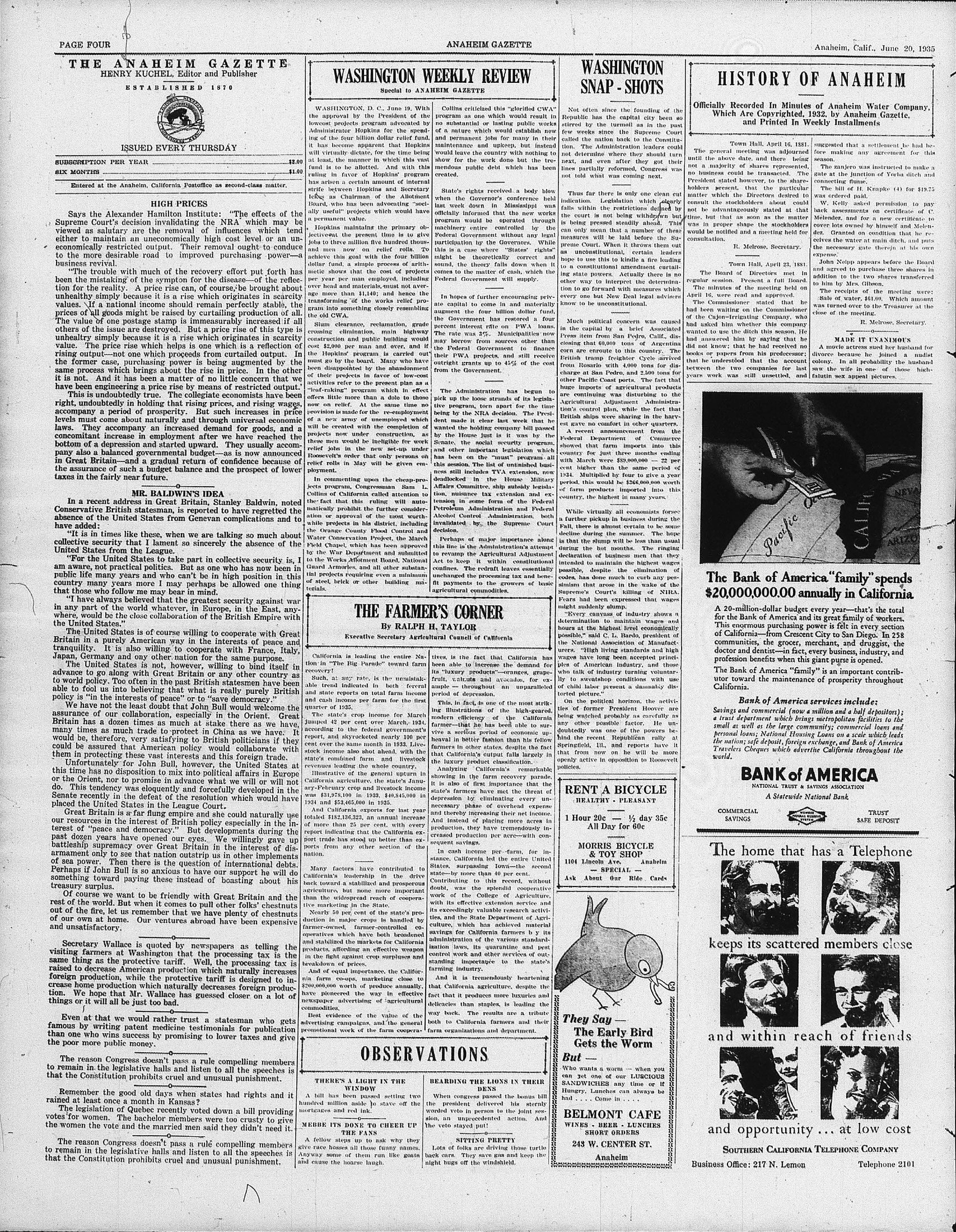
Searchable text
THE ANAHEIM GAZETTE
HENRY KUCHEL, Editor and Publisher
ESTABLISHED 1870
ISSUED EVERY THURSDAY
SUBSCRIPTION PER YEAR ... $2.00
SIX MONTHS ... $1.00
Entered at the Anaheim, California Postoffice as second-class matter.
HIGH PRICES
Says the Alexander Hamilton Institute: "The effects of the Supreme Court's decision invalidating the NRA which may be viewed as salutary are the removal of influences which tend either to maintain an uneconomically high cost level or an uneconomically restricted output. Their removal ought to conduce to the more desirable road to improved purchasing power—a business revival.
"The trouble with much of the recovery effort put forth has been the mistaking of the symptom for the disease—of the reflection for the reality. A price rise can, of course, be brought about unhealthy simply because it is a rise which originates in scarcity values. If a national income should remain perfectly stable, the prices of all goods might be raised by curtailing production of all. The value of one postage stamp is immeasurably increased if all others of the issue are destroyed. But a price rise of this type is unhealthy simply because it is a rise which originates in scarcity value. The price rise which helps is one which is a reflection of rising output—not one which proceeds from curtailed output. In the former case, purchasing power is being augmented by the same process which brings about the rise in price. In the other it is not. And it has been a matter of no little concern that we have been engineering a price rise by means of restricted output."
This is undoubtedly true. The collegiate economists have been right, undoubtedly in holding that rising prices, and rising wages, accompany a period of prosperity. But such increases in price levels must come about naturally and through universal economic laws. They accompany an increased demand for goods, and a concomitant increase in employment after we have reached the bottom of a depression and started upward. They usually accompany also a balanced governmental budget—as is now announced
MR. BALDWIN'S IDEA
In a recent address in Great Britain, Stanley Baldwin, noted Conservative British statesman, is reported to have regretted the absence of the United States from Genevan complications and to have added:
"It is in times like these, when we are talking so much about collective security that I lament so sincerely the absence of the United States from the League.
"For the United States to take part in collective security is, I am aware, not practical politics. But as one who has now been in public life many years and who can't be in high position in this country many years more I may perhaps be allowed one thing that those who follow me may bear in mind.
"I have always believed that the greatest security against war in any part of the world whatever, in Europe, in the East, anywhere, would be the close collaboration of the British Empire with the United States."
The United States is of course willing to cooperate with Great Britain in a purely American way in the interests of peace and tranquility. It is also willing to cooperate with France, Italy, Japan, Germany and any other nation for the same purpose.
The United States is not, however, willing to bind itself in advance to go along with Great Britain or any other country as to world policy. Too often in the past British statesmen have been able to fool us into believing that what is really purely British policy is "in the interests of peace" or to "save democracy."
We have not the least doubt that John Bull would welcome the assurance of our collaboration, especially in the Orient. Great Britain has a dozen times as much at stake there as we have, many times as much trade to protect in China as we have. It would be, therefore, very satisfying to British politicians if they could be assured that American policy would collaborate with them in protecting these vast interests and this foreign trade.
Unfortunately for John Bull, however, the United States at this time has no disposition to mix into political affairs in Europe or the Orient, nor to promise in advance what we will or will not do. This tendency was eloquently and forcefully developed in the Senate recently in the defeat of the resolution which would have placed the United States in the League Court.
Great Britain is a far flung empire and she could naturally use our resources in the interest of British policy especially in the interest of "peace and democracy." But developments during the past dozen years have opened our eyes. We willingly gave up battleship supremacy over Great Britain in the interest of disarmament only to see that nation outstrip us in other implements of sea power. Then there is the question of international debts.
Perhaps if John Bull is so anxious to have augmented by the same process which brings about the rise in price. In the other it is not. And it has been a matter of no little concern that we have been engineering a price rise by means of restricted output."
This is undoubtedly true. The collegiate economists have been right, undoubtedly in holding that rising prices, and rising wages, accompany a period of prosperity. But such increases in price levels must come about naturally and through universal economic laws. They accompany an increased demand for goods, and a concomitant increase in employment after we have reached the bottom of a depression and started upward. They usually accompany also a balanced governmental budget—as is now announced in Great Britain—and a gradual return of confidence because of the assurance of such a budget balance and the prospect of lower taxes in the fairly near future.
Great Britain is a far flung empire and she could naturally use our resources in the interest of British policy especially in the interest of "peace and democracy." But developments during the past dozen years have opened our eyes. We willingly gave up battleship supremacy over Great Britain in the interest of disarmament only to see that nation outstrip us in other implements of sea power. Then there is the question of international debts. Perhaps if John Bull is so anxious to have our support he will do something toward paying these instead of boasting about his treasury surplus.
Of course we want to be friendly with Great Britain and the rest of the world. But when it comes to pull other folks' chestnuts out of the fire, let us remember that we have plenty of chestnuts of our own at home. Our ventures abroad have been expensive and unsatisfactory.
Secretary Wallace is quoted by newspapers as telling the visiting farmers at Washington that the processing tax is the same thing as the protective tariff. Well, the processing tax is raised to decrease American production which naturally increases foreign production, while the protective tariff is designed to increase home production which naturally decreases foreign production. We hope that Mr. Wallace has guessed closer on a lot of things or it will all be just too bad.
Even at that we would rather trust a statesman who gets famous by writing patent medicine testimonials for publication than one who wins success by promising to lower taxes and give the poor more public money.
The reason Congress doesn't pass a rule compelling members to remain in the legislative halls and listen to all the speeches is that the Constitution prohibits cruel and unusual punishment.
Remember the good old days when states had rights and it rained at least once a month in Kansas?
The legislation of Quebec recently voted down a bill providing votes for women. The bachelor members were too crusty to give the women the vote and the married men said they didn't need it.
The reason Congress doesn't pass a rule compelling members to remain in the legislative halls and listen to all the speeches is that the Constitution prohibits cruel and unusual punishment.
WASHINGTON WEEKLY REVIEW
Special to ANAHEIM GAZETTE
WASHINGTON, D. C., June 19. With the approval by the President of the lowcost projects program advocated by Administrator Hopkins for the spending of the four billion dollar relief fund, it has become apparent that Hopkins will virtually dictate, for the time being at least, the manner in which this vast fund is to be allotted. And with this ruling in favor of Hopkins' program has arisen a certain amount of internal strife between Hopkins and Secretary Leslie as Chairman of the Allotment Board, who has been advocating "socially useful" projects which would have a permanent value.
Hopkins maintains the primary objective at the present time is to give jobs to three million five hundred thousand men now on relief rolls. To achieve this goal with the four billion dollar fund, a simple process of arithmetic shows that the cost of projects per year per man employed, including over head and materials, must not average more than $1,140; and hence the transforming of the works relief program into something closely resembling the old CWA.
Slum clearance, reclamation, grade crossing elimination, main highway construction and public building would cost $2,000 per man and over, and if the Hopkins' program is carried out must go by the board. Many who have been disappointed by the abandonment of their projects in favor of low-cost activities refer to the present plan as a "leaf-raking" program which in effect offers little more than a dole to those now on relief. At the same time no provision is made for the re-employment of a new army of unemployed which will be created with the completion of projects now under construction, as these men would be ineligible for work relief jobs in the new set-up under Roosevelt's order that only persons on Collins criticized this "glorified CWA" program as one which would result in no substantial or lasting public works of a nature which would establish new and permanent jobs for many in their maintenance and upkeep, but instead would leave the country with nothing to show for the work done but the tremendous public debt which has been created.
State's rights received a body blow when the Governor's conference held last week down in Mississippi was officially informed that the new works program would be operated through machinery entire controlled by the Federal Government without any legal participation by the Governors. While this is a case where "States' rights" might be theoretically correct and sound, the theory falls down when it comes to the matter of cash, which the Federal Government will supply.
In hopes of further encouraging private capital to come in and materially augment the four billion dollar fund, the Government has restored a four percent interest rate on PWA loans. The rate was 3%. Municipalities now may borrow from sources other than the Federal Government to finance their PWA projects, and still receive outright grants up to 45% of the cost from the Government.
The Administration has begun to pick up the loose strands of its legislative program, torn apart for the time being by the NRA decision. The President made it clear last week that he wanted the holding company bill passed by the House just is it was by the Senate, the social security program, and other important legislation which has been on the "must" program all
WASHINGTON SNAP - SHOTS
Not often since the founding of the Republic has the capital city been stirred by the turmoil as in the past few weeks since the Supreme Court called the nation back to the Constitution. The Administration leaders cannot determine where they should turn next, and even after they got the lines partially reformed, Congress will not told what was coming next.
Thus far there is only one clean indication. Legislation which clears falls within the restrictions defined by the court is not being withdrawn because it is being pressed steadily ahead. This can only mean that a number of measures will be laid before the Supreme Court. When it throws them out as unconstitutional, certain leaders hope to use this to kindle a fire leading to a constitutional amendment curring state powers. Actually there is no other way to interpret the determination to go forward with measures while every one but New Deal legal advisers know to be unconstitutional.
Much political concern was caused in the capital by a brief Associate Press item from San Pedro, Calif., disclosing that 60,000 tons of Argentina corn are enroute to this country. The British tramp freighter Cycle arrived from Rosario with 4,000 tons for discharge at San Pedro, and 2,500 tons for other Pacific Coast ports. The fact that huge imports of agricultural products are continuing was disturbing to the Agricultural Adjustment Administration's control plan, while the fact that British ships were sharing in the harvest gave no comfort in other quarters.
A recent announcement from the Federal Department of Commerce showed that farm imports into the country for just three months ending March 31.
THE FARMER'S CORNER
By RALPH H. TAYLOR
Executive Secretary Agricultural Council of California
California is leading the entire Nation in "The Big Parade" toward farm recovery!
Such, at any rate, is the unmistakable trend indicated in both federal and state reports on total farm income and cash income per farm for the first quarter of 1935.
The state's crop income for March jumped 42 per cent over March, 1934, according to the federal government's report, and skyrocketed nearly 100 per cent over the same month in 1933. Livestock income also shot ahead, with the state's combined farm and livestock revenues leading the whole country.
Illustrative of the general upturn in California agriculture, the state's January-February crop and livestock income was $31,978,100 in 1933, $40,845,000 in 1934 and $53,465,000 in 1935.
And California exports for last year totaled $182,136,323, an annual increase of more than 25 per cent, with every report indicating that the California export trade has stood up better than exports from any other section of the nation.
Many factors have contributed to this fact that California has been able to increase the demand for its "luxury products"—oranges, grapefruit, walruts and avocados, for example — throughout an unparalleled period of depression.
This, in fact, is one of the most striking illustrations of the high-geared, modern efficiency of the California farmer—that he has been able to survive a serious period of economic upheaval in better fashion than his fellow farmers in other states, despite the fact that California's output falls largely in the luxury product classification.
Analyzing California's remarkable showing in the farm recovery parade, it is also of first importance that the state's farmers have met the threat of depression by eliminating every unnecessary phase of overhead expense and thereby increasing their net income. And instead of placing more acres in production, they have tremendously increased production per acre—with consequent savings.
In cash income per farm, for instance, California led the entire United States, surpassing Iowa—the second outright grants up to 45% of the cost from the Government.
The Administration has begun to pick up the loose strands of its legislative program, torn apart for the time being by the NRA decision. The President made it clear last week that he wanted the holding company bill passed by the House just is it by the Senate, the social security program, and other important legislation which has been on the "must" program all this session. The list of unfinished business still includes TVA extension, now deadlocked in the House Military Affairs Committee, ship subsidy legislation, nuisance tax extension and extension in some form of the Federal Petroleum Administration and Federal Alcohol Control Administration, both invalidated by the Supreme Court decision.
Perhaps of major importance along this line is the Administration's attempt to revamp the Agricultural Adjustment Act to keep it within constitutional confines. The redraft leaves essentially unchanged the processing tax and benefit payments to the growers of basic agricultural commodities.
While virtually all economists force a further pickup in business during the Fall, there is almost certain to be some decline during the summer. The hope is that the slump will be less than usual during the hot months. The ringing declaration of business men that they intended to maintain the highest wage possible, despite the elimination of codes, has done much to curb any perceivedism that arose in the wake of the Supreme's Court's killing of NIRA Fears had been expressed that wage might suddenly slump.
"Every canvass of industry shows a determination to maintain wages and hours at the highest level economically possible," said C. L. Bardo, president of the National Association of Manufacturers. "High living standards and high wages have long been accepted principles of American industry, and those who talk of industry turning voluntarily to sweatshop conditions with us of child labor present a damnably distorted picture."
On the political horizon, the activities of former President Hoover are being watched probably as carefully as any other possible factor. He undoubtedly was one of the powers behind the recent Republican rally at Springfield, Ill., and reports have shown that from now on he will be more openly active in opposition to Roosevelt policies.
Illustrative of the general upturn in California agriculture, the state's January-February crop and livestock income was $31,978,100 in 1933, $40,845,000 in 1934 and $53,465,000 in 1935.
And California exports for last year totaled $182,136,323, an annual increase of more than 25 per cent, with every report indicating that the California export trade has stood up better than exports from any other section of the nation.
Many factors have contributed to California's leadership in the drive back toward a stabilized and prosperous agriculture, but none more important than the widespread reach of cooperative marketing in the State.
Nearly 50 per cent of the state's production in major crops is handled by farmer-owned, farmer-controlled cooperatives which have both broadened and stabilized the markets for California products, affording an effective weapon in the fight against crop surpluses and breakdown of prices.
And of equal importance, the California farm co-ops, marketing close to $200,000,000 worth of produce annually, have pioneered the way in effective newspaper advertising of agricultural commodities.
Best evidence of the value of the advertising campaigns, and the general promotional work of the farm coopera-
showing in the farm recovery parade, it is also of first importance that the state's farmers have met the threat of depression by eliminating every unnecessary phase of overhead expense and thereby increasing their net income. And instead of placing more acres in production, they have tremendously increased production per acre—with consequent savings.
In cash income per farm, for instance, California led the entire United States, surpassing Iowa—the second state—by more than 40 per cent.
Contributing to this record, without doubt, was the splendid cooperative work of the College of Agriculture, with its effective extension service and its exceedingly valuable research activities, and the State Department of Agriculture, which has achieved material savings for California farmers by its administration of the various standardization laws, its quarantine and pest control work and other services of outstanding importance to the state's farming industry.
And it is tremendously heartening that California agriculture, despite the fact that it produces more luxuries and delicacies than staples, is leading the way back. The results are a tribute both to California farmers and their farm organizations and department.
OBSERVATIONS
THERE'S A LIGHT IN THE WINDOW
A bill has been passed setting two hundred million aside to stave off the mortgages and red ink.
MEBBE ITS DONE TO CHEER UP THE FANS
A fellow steps up to ask why they give race hosses all those funny names. Anyway some of them run like goats and cause the hoarse laugh.
BEARDING THE LIONS IN THEIR DENS
When congress passed the bonus bill the president delivered his sternly worded veto in person to the joint session, an unprecedented action. And the veto stayed put!
SITTING PRETTY
Lots of folks are driving those turtle back cars. They save gas and keep the night bugs off the windshield.
HISTORY OF ANAHEIM
Officially Recorded In Minutes of Anaheim Water Company,
Which Are Copyrighted, 1932, by Anaheim Gazette,
and Printed In Weekly Installments
Town Hall, April 16, 1881.
The general meeting was adjourned until the above date, and there being not a majority of shares represented, no business could be transacted. The President stated however, to the shareholders present, that the particular matter which the Directors desired to consult the stockholders about could not be advantageously stated at that time, but that as soon as the matter was in proper shape the stockholders would be notified and a meeting held for consultation.
R. Melrose, Secretary.
Town Hall, April 23, 1881.
The Board of Directors met in regular session. Present a full Board. The minutes of the meeting held on April 16, were read and approved.
The Commissioner stated that he had been waiting on the Commissioner of the Cajon-Irrigating Company, who had asked him whether this company wanted to use the ditch this season. He had answered him by saying that he did not know; that he had received no books or papers from his predecessor; that he understood that the account between the two companies for last years work was still unsettled, and suggested that a settlement he had before making any agreement for this season.
The zanjero was instructed to make a gate at the junction of Yorba ditch and connecting flume.
The bill of H. Knapke (4) for $19.75 was ordered paid.
W. Kelly asked permission to pay back assessments on certificate of C. Melendez, and for a new certificate to cover lots owned by himself and Melendez. Granted on condition that he receives the water at main ditch, and puts the necessary gate therein at his own expense.
John Nelpp appears before the Board and agreed to purchase three shares in addition to the two shares transferred to him by Mrs. Gibson.
The receipts of the meeting were: Sale of water, $61.00. Which amount was turned over to the Treasurer at the close of the meeting.
R. Melrose, Secretary.
MADE IT UNANIMOUS
A movie actress sued her husband for divorce because he joined a nudist colony. In all probability the husband saw the wife in one of those high-falutin sex appeal pictures.
The Bank of America "family" spends $20,000,000 annually in California
A 20-million-dollar budget every year—that's the total for the Bank of America and its great family of workers. This enormous purchasing power is felt in every section of California—from Crescent City to San Diego. In 258 communities, the grocer, merchant, and druggist, the doctor and dentist—in fact, every business, industry, and profession benefits when this giant purse is opened.
The Bank of America "family" is an important contributor toward the maintenance of prosperity throughout California.
Bank of America services include:
Savings and commercial (now a million and a half depositors);
a trust department which brings metropolitan facilities to the small as well as the large community; commercial loans and personal loans; National Housing Loans on a scale which leads the nation; safe deposit, foreign exchange, and Bank of America Travelers Cheques which advertise California throughout the world.
BANK OF AMERICA
NATIONAL TRUST & SAVINGS ASSOCIATION
A Statewide National Bank
COMMERCIAL SAVINGS
TRUST SAFE DEPOSIT
The home that has a Telephone
BANK of AMERICA
NATIONAL TRUST & SAVINGS ASSOCIATION
A Statewide National Bank
COMMERCIAL
SAVINGS
TRUST
SAFE DEPOSIT
The home that has a Telephone
keeps its scattered members close
and within reach of friends
and opportunity ... at low cost
SOUTHERN CALIFORNIA TELEPHONE COMPANY
Business Office: 217 N. Lemon
Telephone 2101