anaheim-gazette 1935-03-21
Scanned page
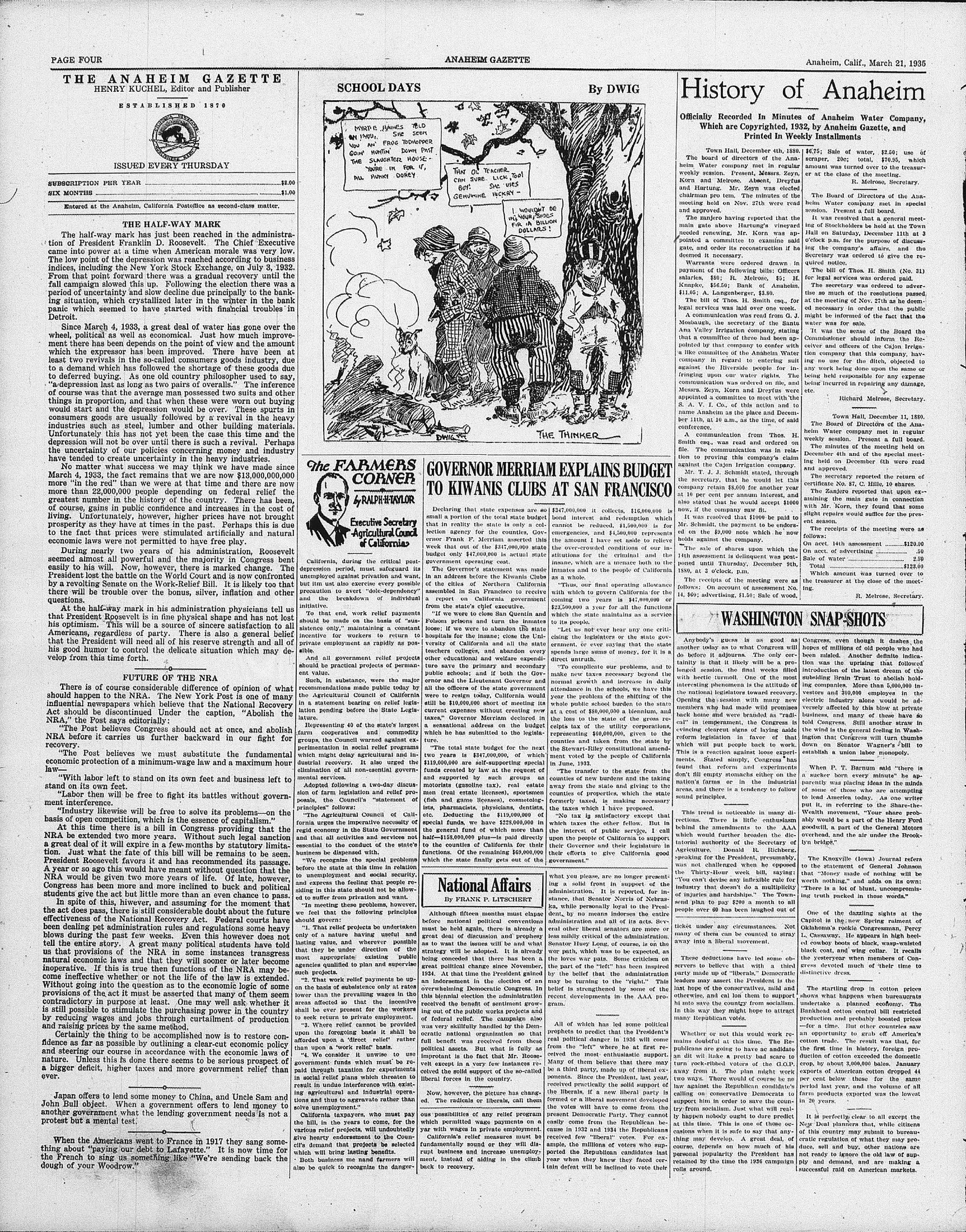
Searchable text
THE ANAHEIM GAZETTE
HENRY KUCHEL, Editor and Publisher
ESTABLISHED 1870
ISSUED EVERY THURSDAY
SUBSCRIPTION PER YEAR ... $2.00
SIX MONTHS ... $1.00
Entered at the Anaheim, California Postoffice as second-class matter.
THE HALF-WAY MARK
The half-way mark has just been reached in the administration of President Franklin D. Roosevelt. The Chief Executive came into power at a time when American morale was very low. The low point of the depression was reached according to business indices, including the New York Stock Exchange, on July 3, 1932. From that point forward there was a gradual recovery until the fall campaign slowed this up. Following the election there was a period of uncertainty and slow decline due principally to the banking situation, which crystallized later in the winter in the bank panic which seemed to have started with financial troubles in Detroit.
Since March 4, 1933, a great deal of water has gone over the wheel, political as well as economical. Just how much improvement there has been depends on the point of view and the amount which the expressor has been improved. There have been at least two revivals in the so-called consumers goods industry, due to a demand which has followed the shortage of these goods due to deferred buying. As one old country philosopher used to say, "a depression last as long as two pairs of overalls." The inference of course was that the average man possessed two suits and other things in proportion, and that when these were worn out buying would start and the depression would be over. These spurts in consumers goods are usually followed by a revival in the heavy industries such as steel, lumber and other building materials. Unfortunately this has not yet been the case this time and the depression will not be over until there is such a revival. Perhaps the uncertainty of our policies concerning money and industry have tended to create uncertainty in the heavy industries.
to a demand which has followed the shortage of these goods due to deferred buying. As one old country philosopher used to say,
"a depression last as long as two pairs of overalls." The inference of course was that the average man possessed two suits and other things in proportion, and that when these were worn out buying would start and the depression would be over. These spurts in consumers goods are usually followed by a revival in the heavy industries such as steel, lumber and other building materials. Unfortunately this has not yet been the case this time and the depression will not be over until there is such a revival. Perhaps the uncertainty of our policies concerning money and industry have tended to create uncertainty in the heavy industries.
No matter what success we may think we have made since March 4, 1933, the fact remains that we are now $13,000,000,000 more "in the red" than we were at that time and there are now more than 22,000,000 people depending on federal relief the greatest number in the history of the country. There has been, of course, gains in public confidence and increases in the cost of living. Unfortunately, however, higher prices have not brought prosperity as they have at times in the past. Perhaps this is due to the fact that prices were stimulated artificially and natural economic laws were not permitted to have free play.
During nearly two years of his administration, Roosevelt seemed almost all powerful and the majority in Congress bent easily to his will. Now, however, there is marked change. The President lost the battle on the World Court and is now confronted by a revolting Senate on the Work-Relief Bill. It is likely too that there will be trouble over the bonus, silver, inflation and other questions.
At the half-way mark in his administration physicians tell us that President Roosevelt is in fine physical shape and has not lost his optimism. This will be a source of sincere satisfaction to all Americans, regardless of party. There is also a general belief that the President will need all of his reserve strength and all of his good humor to control the delicate situation which may develop from this time forth.
FUTURE OF THE NRA
There is of course considerable difference of opinion of what should happen to the NRA. The New York Post is one of many influential newspapers which believe that the National Recovery Act should be discontinued Under the caption, "Abolish the NRA," the Post says editorially:
"The Post believes Congress should act at once, and abolish NRA before it carries us further backward in our fight for recovery.
"The Post believes we must substitute the fundamental economic protection of a minimum-wage law and a maximum hour law—
"With labor left to stand on its own feet and business left to stand on its own feet.
"Labor then will be free to fight its battles without government interference.
"Industry likewise will be free to solve its problems—on the basis of open competition, which is the essence of capitalism."
At this time there is a bill in Congress providing that the NRA be extended two more years. Without such legal sanction a great deal of it will expire in a few months by statutory limitation. Just what the fate of this bill will be remains to be seen. President Roosevelt favors it and has recommended its passage. A year or so ago this would have meant without question that the
"With labor left to stand on its own feet.
"Labor then will be free to fight its battles without government interference.
"Industry likewise will be free to solve its problems—on the basis of open competition, which is the essence of capitalism."
At this time there is a bill in Congress providing that the NRA be extended two more years. Without such legal sanction a great deal of it will expire in a few months by statutory limitation. Just what the fate of this bill will be remains to be seen. President Roosevelt favors it and has recommended its passage. A year or so ago this would have meant without question that the NRA would be given two more years of life. Of late, however, Congress has been more and more inclined to buck and political students give the act but little more than an even chance to pass.
In spite of this, he wever, and assuming for the moment that the act does pass, there is still considerable doubt about the future effectiveness of the National Recovery Act. Federal courts have been dealing pet administration rules and regulations some heavy blows during the past few weeks. Even this however does not tell the entire story. A great many political students have told us that provisions of the NRA in some instances transgress natural economic laws and that they will sooner or later become inoperative. If this is true then functions of the NRA may become ineffective whether or not the life of the law is extended. Without going into the question as to the economic logic of some provisions of the act it must be asserted that many of them seem contradictory in purpose at least. One may well ask whether it is still possible to stimulate the purchasing power in the country by reducing wages and jobs through curtailment of production and raising prices by the same method.
Certainly the thing to be accomplished now is to restore confidence as far as possible by outlining a clear-cut economic policy and steering our course in accordance with the economic laws of nature. Unless this is done there seems to be serious prospect of a bigger deficit, higher taxes and more government relief than ever.
Japan offers to lend some money to China, and Uncle Sam and John Bull object. When a government offers to lend money to another government what the lending government needs is not a protest but a mental test.
When the Americans went to France in 1917 they sang something about "paying our debt to Lafayette." It is now time for the French to sing us something like "We're sending back the dough of your Woodrow."
SCHOOL DAYS
By DWIG
MYRTLE HAINES TELD ON YOU, SHE SEEM YOU AN' FROG TODHOPPER GOIN' HUNTIN' DOWN PAST THE SLAUGHTER HOUSE - YOU'RE IN FOR IT, ALL NUNKY DOREY.
THAT OL TEACHER CAN SURE. LICK, TOO! BOY! SHE USES GENUINE HICKRY!
I WOULDN'T BE IN YOUR SHOES FOR A BILLION DOLLARS!
THE THINKER
California, during the critical post-depression period, must safeguard its unemployed against privation and want, but it must also exercise every possible precaution to avert "dole-dependency" and the breakdown of individual initiative.
To that end, work relief payments should be made on the basis of "susistence only," maintaining a constant incentive for workers to return to private employment as rapidly as possible.
And all government relief projects should be practical projects of permanent value.
Such, in substance, were the major recommendations made public today by the Agricultural Council of California in a statement bearing on relief legislation pending before the State Legislature.
Representing 40 of the state's largest farm cooperatives and commodity groups, the Council warned against experimentation in social relief programs which might delay agricultural and industrial recovery. It also urged the elimination of all non-esential governmental services.
Adopted following a two-day discussion of farm legislation and relief proposals, the Council's "statement of principles" follows:
"The Agricultural Council of California urges the imperative necessity of regid economy in the State Government and that all activities and services not essential to the conduct of the state's business be dispensed with."
"We recognize the special problems before the state at this time in relation to that end, work relief payments should be made on the basis of "susistence only," maintaining a constant incentive for workers to return to private employment as rapidly as possible."
And all government relief projects should be practical projects of permanent value.
Such, in substance, were the major recommendations made public today by the Agricultural Council of California in a statement bearing on relief legislation pending before the State Legislature.
Representing 40 of the state's largest farm cooperatives and commodity groups, the Council warned against experimentation in social relief programs which might delay agricultural and industrial recovery. It also urged the elimination of all non-esential governmental services.
Adopted following a two-day discussion of farm legislation and relief proposals, the Council's "statement of principles" follows:
"The Agricultural Council of California urges the imperative necessity of regid economy in the State Government and that all activities and services not essential to the conduct of the state's business be dispensed with."
"We recognize the special problems before the state at this time in relation to that end, work relief payments should be made on the basis of "susistence only," maintaining a constant incentive for workers to return to private employment as rapidly as possible."
And all government relief projects should be practical projects of permanent value.
Such, in substance, were the major recommendations made public today by the Agricultural Council of California in a statement bearing on relief legislation pending before the State Legislature.
Representing 40 of the state's largest farm cooperatives and commodity groups, the Council warned against experimentation in social relief programs which might delay agricultural and industrial recovery. It also urged the elimination of all non-esential governmental services.
Adopted following a two-day discussion of farm legislation and relief proposals, the Council's "statement of principles" follows:
"The Agricultural Council of California urges the imperative necessity of regid economy in the State Government and that all activities and services not essential to the conduct of the state's business be dispensed with."
"We recognize the special problems before the state at this time in relation to that end, work relief payments should be made on the basis of "susistence only," maintaining a constant incentive for workers to return to private employment as rapidly as possible."
And all government relief projects should be practical projects of permanent value.
Such, in substance, were the major recommendations made public today by the Agricultural Council of California in a statement bearing on relief legislation pending before the State Legislature.
Representing 40 of the state's largest farm cooperatives and commodity groups, the Council warned against experimentation in social relief programs which might delay agricultural and industrial recovery. It also urged the elimination of all non-esential governmental services.
Adopted following a two-day discussion of farm legislation and relief proposals, the Council's "statement of principles" follows:
"The Agricultural Council of California urges the imperative necessity of regid economy in the State Government and that all activities and services not essential to the conduct of the state's business be dispensed with."
"We recognize the special problems before the state at this time in relation to that end, work relief payments should be made on the basis of "susistence only," maintaining a constant incentive for workers to return to private employment as rapidly as possible."
And all government relief projects should be practical projects of permanent value.
Such, in substance, were the major recommendations made public today by the Agricultural Council of California in a statement bearing on relief legislation pending before the State Legislature.
Representing 40 of the state's largest farm cooperatives and commodity groups, the Council warned against experimentation in social relief programs which might delay agricultural and industrial recovery. It also urged the elimination of all non-esential governmental services.
Adopted following a two-day discussion of farm legislation and relief proposals, the Council's "statement of principles" follows:
"The Agricultural Council of California urges the imperative necessity of regid economy in the State Government and that all activities and services not essential to the conduct of the state's business be dispensed with."
"We recognize the special problems before the state at this time in relation to that end, work relief payments should be made on the basis of "susistence only," maintaining a constant incentive for workers to return to private employment as rapidly as possible."
And all government relief projects should be practical projects of permanent value.
Such, in substance, were the major recommendations made public today by the Agricultural Council of California in a statement bearing on relief legislation pending before the State Legislature.
Representing 40 of the state's largest farm cooperatives and commodity groups, the Council warned against experimentation in social relief programs which might delay agricultural and industrial recovery. It also urged the elimination of all non-esential governmental services.
Adopted following a two-day discussion of farm legislation and relief proposals, the Council's "statement of principles" follows:
"The Agricultural Council of California urges the imperative necessity of regid economy in the State Government and that all activities and services not essential to the conduct of the state's business be dispensed with."
"We recognize the special problems before the state at this time in relation to that end, work relief payments should be made on the basis of "susistence only," maintaining a constant incentive for workers to return to private employment as rapidly as possible."
Adopted following a two-day discussion of farm legislation and relief proposals, the Council's "statement of principles" follows:
"The Agricultural Council of California urges the imperative necessity of regid economy in the State Government and that all activities and services not essential to the conduct of the state's business be dispensed with.
"We recognize the special problems before the state at this time in relation to unemployment and social security, and express the feeling that people residing in this state should not be allowed to suffer from privation and want.
In meeting these problems, however, we feel that the following principles should govern:
1. That relief projects be undertaken only of a nature having useful and lasting value, and wherever possible that they be under direction of the most appropriate existing public agencies qualified to plan and supervise such projects.
2. That work relief payments be upon the basis of subsistence only at rates lower than the prevailing wages in the areas affected so that the incentive shall be ever present for the workers to seek return to private employment.
3. Where relief cannot be provided upon the foregoing basis it shall be afforded upon a 'direct relief' rather than upon a 'work relief' basis.
4. We consider it unwise to use government funds which must be repaid through taxation for experiments in social relief projects which threaten to result in undue interference with existing agricultural and industrial operations and thus to aggravate rather than solve unemployment."
California taxpayers, who must pay the bill, in the years to come, for the various relief projects, will undoubtedly give hearty endorsement to the Council's demand that projects be selected which will bring lasting benefits.
Both business me nand farmers will also be quick to recognize the danger-
and supported by such groups as motorists (gasoline tax), real estate men (real estate licenses), sportsmen (fish and game licenses), cosmetologists, pharmacists, physicians, dentists, etc. Deducting the $119,000,000 of special funds, we have $228,000,000 in the general fund of which more than half—$158,000,000 plus—is paid directly to the counties of California for their functions. Of the remaining $69,000,000 which the state finally gets out of the county of new burdens and the taking away from the state and giving to the counties of properties, which the state formerly taxed, is making necessary the taxes which I have proposed.
"No tax is satisfactory except that which taxes the other fellow. But in the interest of public service, I call upon the people of California to support their Governor and their legislature in their efforts to give California good government."
National Affairs
By FRANK P. LITSCHERT
Although fifteen months must elapse before national political conventions must be held again, there is already a great deal of discussion and prophesy as to what the issues will be and what strategy will be adopted. It is already being conceded that there has been a great political change since November, 1934. At that time the President gained an indorsement in the election of an overwhelming Democratic Congress. In this biennial election the administration received the benefit of sentiment growing out of the public works projects and of federal relief. The campaign also was very skillfully handled by the Democratic national organization so that full benefit was received from these political assets. But what is fully as improtant is the fact that Mr. Roosevelt except in a very few instances received the solid support of the so-called liberal forces in the country.
Now, however, the picture has changed. The radicals or liberals, call themous possibilities of any relief program which permitted wage payments on a year with wages in private employment.
California's relief measures must be fundamentally sound or they will disrupt business and increase unemployment, instead of aiding in the climb back to recovery.
what you please, are no longer presenting a solid front in support of the administration. It is reported, for instance, that Senator Norris of Nebraska, while personally loyal to the President, by no means indorses the entire administration and all of its acts. Several other liberal senators are more or less mildly critical of the administration. Senator Huey Long, of course, is on the wor path, which was to be expected, as the loves war pats. Some criticism on the part of the "left" has been inspired by the belief that the administration may be turning to the "right." This belief is strengthened by some of the recent developments in the AAA program.
All of which has led some political prophets to predict that the President's real political danger in 1936 will come from the "left" where he at first received the most enthusiastic support. Many of them believe that there may be a third party, made up of liberal exponents. Since the President, last year, received practically the solid support of the liberals, if a new liberal party is formed or a liberal movement developed the votes will have to come from the present Democratic Party. They cannot easily come from the Republican because in 1932 and 1934 the Republicans received few "liberal" votes. For example, the millions of voters who supported the Republican candidates last year when they knew they faced certain defeat will be inclined to vote their
History of Anaheim
Officially Recorded In Minutes of Anaheim Water Company,
Which are Copyrighted, 1932, by Anaheim Gazette, and Printed In Weekly Installments
Town Hall, December 4th, 1880.
The board of directors of the Anaheim Water company met in regular weekly session. Present, Messrs. Zeyn, Korn and Melrose. Absent, Dreyfus and Hartung. Mr. Zeyn was elected chairman pro tem. The minutes of the meeting held on Nov. 27th were read and approved.
The zanjero having reported that the main gate above Hartung's vineyard needed renewing, Mr. Korn was appointed a committee to examine said gate, and order its reconstruction if he deemed it necessary.
Warrants were ordered drawn in payment of the following bills: Officers salaries, $80; R. Melrose, $5; H. Knapke, $56.50; Bank of Anaheim, $11.05; A. Langenberger, $3.80.
The bill of Thos. H. Smith esq., for legal services was laid over one week.
A communication was read from G. J. Mosbaugh, the secretary of the Santa Ana Valley Irrigation company, stating that a committee of three had been appointed by that company to confer with a like committee of the Anaheim Water company in regard to entering suit against the Riverside people for infringing upon our water rights. The communication was ordered on file, and Messrs. Zeyn, Korn and Dreyfus were appointed a committee to meet with the S. A. V. I. Co., of this action and to name Anaheim as the place and December 11th, at 10 a.m., as the time, of said conference.
A communication from Thos. H. Smith esq., was read and ordered on file. The communication was in relation to proving this company's claim.
$6.75; Sale of water, $2.50; use of scraper, 20c; total, $70.95, which amount was turned over to the treasurer at the close of the meeting.
R. Melrose, Secretary.
The Board of Directors of the Anaheim Water company met in special session. Present a full board.
It was resolved that a general meeting of Stockholders be held at the Town Hall on Saturday, December 11th at 3 o'clock p.m. for the purpose of discussing the company's affairs, and the Secretary was ordered to give the required notice.
The bill of Thos. H. Smith (No. 31) for legal services was ordered paid.
The secretary was ordered to advertise so much of the resolutions passed at the meeting of Nov. 27th as he deemed necessary in order that the public might be informed of the fact that the water was for sale.
It was the sense of the Board the Commissioner should inform the Receiver and officers of the Cajon Irrigation company that this company, having no use for the ditch, objected to any work being done upon the same or being held responsible for any expense being incurred in repairing any damage, etc.
Richard Melrose, Secretary.
Town Hall, December 11, 1880.
The Board of Directors of the Anaheim Water company met in regular weekly session. Present a full board.
The minutes of the meeting held on December 4th and of the special meet-
WASHINGTON SNAP-SHOTS
Anybody's guess is as good as another today as to what Congress will do before it adjourns. The only certainty is that it likely will be a prolonged session, the final weeks filled with hectic turmoil. One of the most interesting phenomena is the attitude of the national legislators toward recovery. Opening the session with many new members who had made wild promises back home and were branded as "radical" in temperament, the Congress is evincing clearcut signs of laying aside reform legislation in favor of that which will put people back to work. This is a reaction against loose experiments. Stated simply, Congress has found that reform and experiments don't fill empty stomachs either on the nation's farms or in the industrial areas, and there is a tendency to follow sound principles.
This trend is noticeable in many directions. There is little enthusiasm behind the amendments to the AAA which would further broaden the dictorial authority of the Secretary of Agriculture. Donald R. Richberg, speaking for the President, presumably, was not challenged when he opposed Congress, even though it dashes the hopes of millions of old people who had been misled. Another definite indication was the uprising that followed introduction of the latest dream of the subsiding Brain Trust to abolish holding companies. More than 5,000,000 investors and 300,000 employees in the electric industry alone would be adversely affected by this blow at private business, and many of these have so told Congress. Still another straw in the wind is the general feeling in Washington that Congress will turn thumbs down on Senator Wagner's bill to establish a union labor monopoly.
When P. T. Barnum said "there is a sucker born every minute" he apparently was placing ideas in the minds of some of those who are attempting to lead America today. As one writer put it, in referring to the Share-the-Wealth movement, "Your share probably would be a part of the Henry Ford goodwill, a part of the General Motors overhead, and the air under the Brooklyn bridge."
The Knoxville (Iowa) Journal refers to the statement of General Johnson...
This trend is noticeable in many directions. There is little enthusiasm behind the amendments to the AAA which would further broaden the dictatorial authority of the Secretary of Agriculture. Donald R. Richberg, speaking for the President, presumably, was not challenged when he opposed the Thirty-Hour week bill, saying: "You can't devise any inflexible rule for industry that doesn't do a multiplicity of injuries and hardships." The Townsend plan to pay $200 a month to all people over 60 has been laughed out of ticket under any circumstances. Not many of them can be counted to stray away into a liberal movement.
These deductions have led some observers to believe that with a third party made up of "liberals," Democratic leaders may assert the President is the last hope of the conservatives, mild and otherwise, and cal lon them to support hi into save the country from socialism. In this way they might hope to attract many Republican voters.
Whether or not this would work remains doubtful at this time. The Republicans are going to have acandidate an dit wil itake a pretty bad scare to turn rock-ribbed voters of the G.O.P. away from it. The plan might work two ways. There would of course be no law against the Republican candidate's calling on conservative Democrats to support him in order to save the country from socialism. Just what will really happen nobody ought to dare predict at this time. This is one of those occasions when it is safe to say that anything may develop. A great deal, of course, depends on how much of his personal popularity the President has retained by the time the 1936 campaign rolls around.
a sucker born every minute" he apparently was placing ideas in the minds of some of those who are attempting to lead America today. As one writer put it, in referring to the Share-the-Wealth movement, "Your share probably would be a part of the Henry Ford goodwill, a part of the General Motors overhead, and the air under the Brooklyn bridge."
The Knoxville (Iowa) Journal refers to the statement of General Johnson that "Money made of nothing will be worth nothing," and adds on its own: "There is a lot of blunt, uncompromising truth packed in those words."
One of the dazzling sights at the Capitol is the new Spring raiment of Oklahoma's rookie Congressman, Percy L. Cassaway. He appears in high heels cowboy boots of black, wasp-walsted black coat, and wing collar. It recalls the yesteryear when members of Congress devoted much of their time to distinctive dress.
The startling drop in cotton prices shows what happens when bureaucrats undertake a planned economy. The Bankhead cotton control bill restricted production and probably boosted prices—for a time. But other countries saw an opportunity to grab off America's cotton trade. The result was that, for the first time in history, foreign production of cotton exceeded the domestic crop, by about 3,000,000 bales. January exports of American cotton dropped 44 per cent below those for the same period last year, and the volume of all farm products exported was the lowest in 20 years.
It is perfectly clear to all except the New Deal planners that, while citizens of this country may submit to bureaucratic regulation of what they may produce, sell and buy, other nations are not ready to ignore the old law of supply and demand, and are making a successful raid on American markets.