anaheim-gazette 1934-12-13
Scanned page
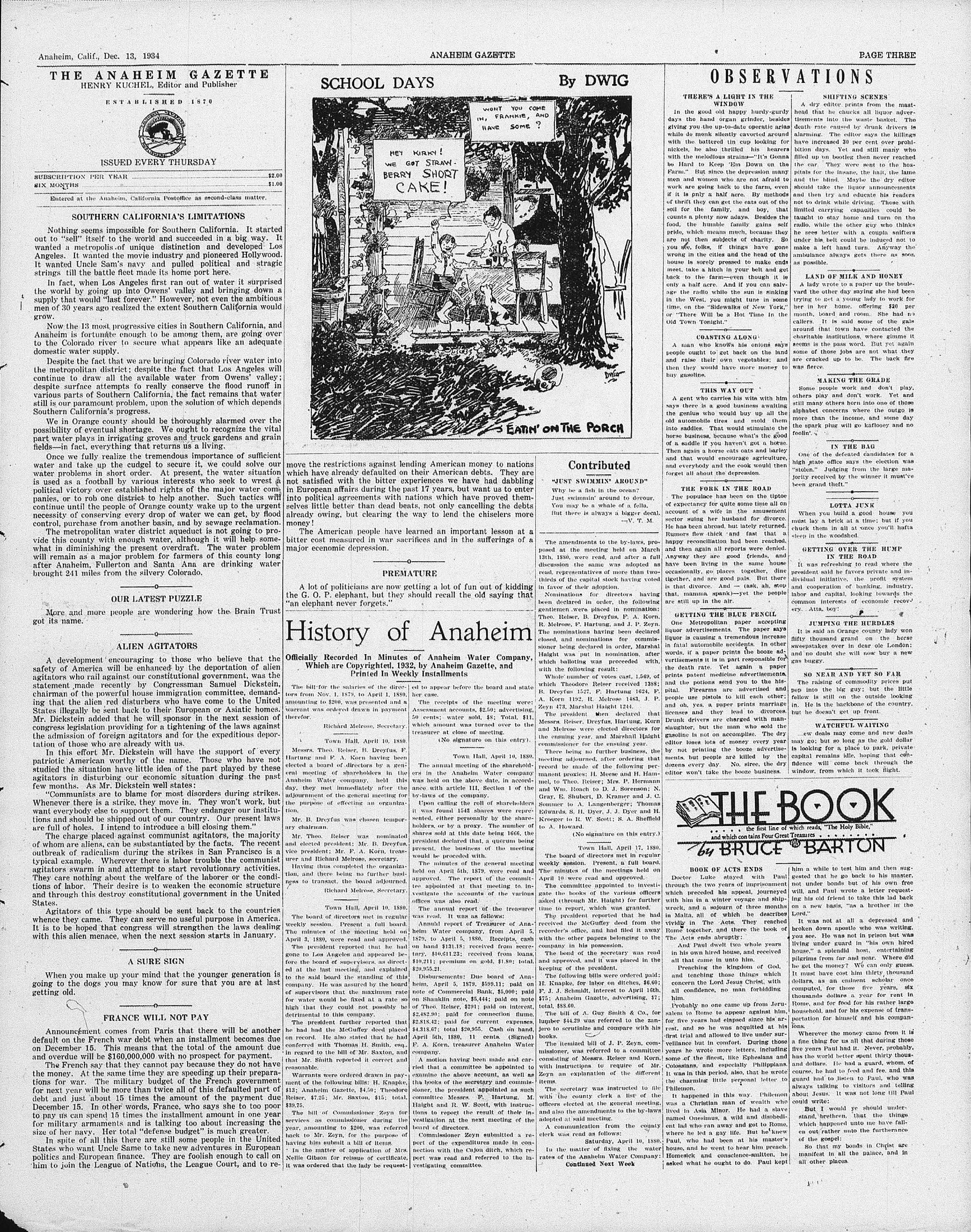
Searchable text
THE ANAHEIM GAZETTE
HENRY KUCHEL, Editor and Publisher
ESTABLISHED 1870
ISSUED EVERY THURSDAY
SUBSCRIPTION PER YEAR ... $2.00
SIX MONTHS ... $1.00
Entered at the Anaheim, California Postoffice as second-class matter.
SOUTHERN CALIFORNIA'S LIMITATIONS
Nothing seems impossible for Southern California. It started out to "sell" itself to the world and succeeded in a big way. It wanted a metropolis of unique distinction and developed Los Angeles. It wanted the movie industry and pioneered Hollywood. It wanted Uncle Sam's navy and pulled political and straggic strings till the battle fleet made its home port here.
In fact, when Los Angeles first ran out of water it surprised the world by going up into Owens' valley and bringing down a supply that would "last forever." However, not even the ambitious men of 30 years ago realized the extent Southern California would grow.
Now the 13 most progressive cities in Southern California, and Anaheim is fortunate enough to be among them, are going over to the Colorado river to secure what appears like an adequate domestic water supply.
Despite the fact that we are bringing Colorado river water into the metropolitan district; despite the fact that Los Angeles will continue to draw all the available water from Owens' valley; despite surface attempts to really conserve the flood runoff in various parts of Southern California, the fact remains that water still is our paramount problem, upon the solution of which depends Southern California's progress.
We in Orange county should be thoroughly alarmed over the possibility of eventual shortage. We ought to recognize the vital part water plays in irrigating groves and truck gardens and grain fields—in fact, everything that returns us a living.
Once we fully realize the tremendous importance of sufficient
Despite the fact that we are bringing Colorado River water into the metropolitan district; despite the fact that Los Angeles will continue to draw all the available water from Owens' valley; despite surface attempts to really conserve the flood runoff in various parts of Southern California, the fact remains that water still is our paramount problem, upon the solution of which depends Southern California's progress.
We in Orange county should be thoroughly alarmed over the possibility of eventual shortage. We ought to recognize the vital part water plays in irrigating groves and truck gardens and grain fields—in fact, everything that returns us a living.
Once we fully realize the tremendous importance of sufficient water and take up the cudgel to secure it, we could solve our water problems in short order. At present, the water situation is used as a football by various interests who seek to wrest a political victory over established rights of the major water companies, or to rob one district to help another. Such tactics will continue until the people of Orange county wake up to the urgent necessity of conserving every drop of water we can get, by flood control, purchase from another basin, and by sewage reclamation.
The metropolitan water district aqueduct is not going to provide this county with enough water, although it will help somewhat in diminishing the present overdraft. The water problem will remain as a major problem for farmers of this county long after Anaheim, Fullerton and Santa Ana are drinking water brought 241 miles from the silvery Colorado.
OUR LATEST PUZZLE
More and more people are wondering how the Brain Trust got its name.
ALIEN AGITATORS
A development encouraging to those who believe that the safety of America will be enhanced by the deportation of alien agitators who rail against our constitutional government, was the statement made recently by Congressman Samuel Dickstein, chairman of the powerful house immigration committee, demanding that the alien red disturbers who have come to the United States illegally be sent back to their European or Asiatic homes. Mr. Dickstein added that he will sponsor in the next session of congress legislation providing for a tightening of the laws against the admission of foreign agitators and for the expeditious deportation of those who are already with us.
In this effort Mr. Dickstein will have the support of every patriotic American worthy of the name. Those who have not studied the situation have little idea of the part played by these agitators in disturbing our economic situation during the past few months. As Mr. Dickstein well states:
"Communists are to blame for most disorders during strikes. Whenever there is a strike, they move in. They won't work, but want everybody else to support them. They endanger our institutions and should be shipped out of our country. Our present laws are full of holes. I intend to introduce a bill closing them."
The charge placed against communist agitators, the majority of whom are aliens, can be substantiated by the facts. The recent outbreak of radicalism during the strikes in San Francisco is a typical example. Wherever there is labor trouble the communist agitators swarm in and attempt to start revolutionary activities.
A lot of politicians—the G. O. P. elephant "an elephant never f...
agitators in disturbing our economic situation during the past few months. As Mr. Dickstein well states:
"Communists are to blame for most disorders during strikes. Whenever there is a strike, they move in. They won't work, but want everybody else to support them. They endanger our institutions and should be shipped out of our country. Our present laws are full of holes. I intend to introduce a bill closing them."
The charge placed against communist agitators, the majority of whom are aliens, can be substantiated by the facts. The recent outbreak of radicalism during the strikes in San Francisco is a typical example. Wherever there is labor trouble the communist agitators swarm in and attempt to start revolutionary activities. They care nothing about the welfare of the laborer or the conditions of labor. Their desire is to weaken the economic structure and through this destroy constitutional government in the United States.
Agitators of this type should be sent back to the countries whence they came. They can serve no useful purpose in America. It is to be hoped that congress will strengthen the laws dealing with this alien menace, when the next session starts in January.
A SURE SIGN
When you make up your mind that the younger generation is going to the dogs you may know for sure that you are at last getting old.
FRANCE WILL NOT PAY
Announcement comes from Paris that there will be another default on the French war debt when an installment becomes due on December 15. This means that the total of the amount due and overdue will be $160,000,000 with no prospect for payment.
The French say that they cannot pay because they do not have the money. At the same time they are speeding up their preparations for war. The military budget of the French government for next year will be more than twice all of this defaulted part of debt and just about 15 times the amount of the payment due December 15. In other words, France, who says she to too poor to pay us can spend 15 times the installment amount in one year for military armaments and is talking too about increasing the size of her navy. Her total "defense budget" is much greater.
In spite of all this there are still some people in the United States who want Uncle Same to take new adventures in European politics and European finance. They are foolish enough to call on him to join the League of Nations, the League Court, and to re-
ANAHEIM GAZETTE
SCHOOL DAYS By DWIG
WON'T YOU COME IN, FRANKIE, AND HAVE SOME?
HEY KIRKY!
WE GOT STRAW-BERRY SHORT CAKE!
EATIN' ON THE PORCH
move the restrictions against lending American money to nations which have already defaulted on their American debts. They are not satisfied with the bitter experiences we have had dabbling in European affairs during the past 17 years, but want us to enter into political agreements with nations which have proved themselves little better than dead beats, not only cancelling the debts already owing, but clearing the way to lend the chiselers more money!
The American people have learned an important lesson at a bitter cost measured in war sacrifices and in the sufferings of a major economic depression.
PREMATURE
A lot of politicians are now getting a lot of fun out of kidding the G. O. P. elephant, but they should recall the old saying that "an elephant never forgets."
History of Anaheim
Officially Recorded In Minutes of Anaheim Water Company, Which are Copyrighted, 1932, by Anaheim Gazette, and Printed In Weekly Installments
The bill for the salaries of the directors from Nov. 1, 1879, to April 1, 1880, amounting to $200, was presented and a warrant was ordered drawn in payment therefor.
Richard Melrose, Secretary.
Town Hall, April 10, 1880.
Messrs. Theo. Reiser, B. Dreyfus, F. Hartung and F. A. Korn having been elected a board of directors by a general meeting of shareholders in the Anaheim Water company, held this day, they met immediately after the adjournment of the general meeting for the purpose of effecting an organization.
Mr. B. Dreyfus was chosen temporary chairman.
Mr. Theo. Reiser was nominated and elected president; Mr. B. Dreyfus, vice president; Mr. F. A. Korn, treasurer and Richard Melrose, secretary.
Having thus completed the organization to appear before the board and state her case.
The receipts of the meeting were: Assessment accounts, $2.50; advertising, 50 cents; water sold, $8; Total, $11, which amount was turned over to the treasurer at close of meeting.
(No signature on this entry).
Town Hall, April 10, 1880.
The annual meeting of the shareholders in the Anaheim Water company was held on the above date, in accordance with article III, Section 1 of the by-laws of the company.
Upon calling the roll of shareholders it was found 1548 shares were represented, either personally by the shareholders, or by a proxy. The number of shares sold at this date being 1666, the president declared that, a quorum being present, the business of the meeting would be proceeded with.
The minutes of the general meeting held on April 5th, 1879 were read and contributed to the by-laws, proposed at the meeting held on March 13th, 1880, were read, and after a full discussion the same was adopted as read, representatives of more than two-thirds of the capital stock having voted in favor of their adoption.
Nominations for directors having been declared in order, the following gentlemen were placed in nomination: Theo. Reiser, B. Dreyfus, F. A. Korn, R. Melrose, F. Hartung, and J. P. Zeyn.
The nominations having been declared closed, and nominations for commissioner being declared in order, Marshal Haight was put in nomination, after which balloting was proceeded with, with the following result:
Whole number of votes cast, 1,569, of which Theodore Reiser received 1388; B. Dreyfus 1527; F. Hartung 1624; F. A. Korn 1192; R. Melrose 1483; J. P. Zeyn 473; Marshal Haight 1244.
The president then declared that Messrs. Reiser, Dreyfus, Hartung, Korn and Melrose were elected directors for the ensuing year, and Marshall Haight commissioner for the ensuing year.
There being no further business, the meeting adjourned, after ordering that record be made of the following permanent proxies: H. Meese and H. Hammel, to Theo. Reiser; Mrs. P. Hermann and Wm. Roach to D. J. Sorenson; N. Gray, E. Shubert, D. Kramer and J. C. Sommer to A. Langenberger; Thomas Edwards, S. H. Dyer, J. J. Dyer and H. Kroeger to R. W. Scott; S. A. Sheffield to A. Howard.
(No signature on this entry.)
The board of directors met in regular weekly session. Present at a full board. The minutes of the meeting held on April 3, 1880, were read and approved. The president reported that he had gone to Los Angeles and appeared before the board of supervisors, as directed at the last meeting, and explained to the said board the standing of this company. He was assured by the board of supervisors that the maximum rate for water would be fixed at a rate so high that they could not possibly be detrimental to this company.
The president further reported that he had had the McGuffey deed placed on record. He also stated that he had conferred with Thomas H. Smith, esq., in regard to the bill of Mr. Saxton, and that Mr. Smith reported it correct and reasonable.
Warrants were ordered drawn in payment of the following bills: H. Knapke, $13; Anaheim Gazette, $4.50; Theodore Reiser, $7.25; Mr. Saxton, $15; total, $39.75.
The bill of Commissioner Zeyn for services as commissioner during the year, amounting to $200, was referred back to Mr. Zeyn, for the purpose of having him submit a bill of items.
In the matter of application of Mrs. Nellie Gibson for reissue of certificate, it was ordered that the lady be request-
Town Hall, April 10, 1880.
The board of directors met in regular weekly session. Present at a full board. The minutes of the meeting held on April 3, 1880, were read and approved. The report of the committee appointed at that meeting to investigate the accounts of the various offices was also read.
The annual report of the treasurer was read. It was as follows:
Annual report of Treasurer of Anaheim Water company, from April 5, 1879, to April 5, 1880. Receipts, cash on hand $131.18; received from secretary, $10,611.23; received from loans, $10,211; premium on gold, $1.80; total, $20,955.21.
Disbursements: Due board of Anaheim, April 5, 1879, $599.11; paid on note of Commercial Bank, $5,000; paid on Shanklin note, $5,444; paid on note of Theo. Reiser, $291; paid on interest, $2,482.90; paid for connection flume, $2,818.42; paid for current expenses, $4,318.67; total $20,955. Cash on hand, April 5th, 1880, 11 cents. (Signed) F. A. Korn, treasurer Anaheim Water company.
A motion having been made and carried that a committee be appointed to examine the above account, as well as the books of the secretary and commissioner, the president appointed as such committee Messrs. F. Hartung, M. Haight and R. W. Scott, with instructions to report the result of their investigation at the next meeting of the board of directors.
Commissioner Zeyn submitted a report of the expenditures made in connection with the Cajon ditch, which report was read and referred to the investigating committee.
Town Hall, April 17, 1880.
The board of directors met in regular weekly session. Present at a full board. The minutes of the meetings held on April 10 were read and approved.
The committee appointed to investigate the books of the various officers asked (through Mr. Haight) for further time to report, which was granted.
The president reported that he had received the McGuffey deed from the recorder's office, and had filed it away with the other papers belonging to the company in his possession.
The bond of the secretary was read and approved, and it was placed in the keeping of the president.
The following bills were ordered paid: H. Knapke, for labor on ditches, $6.60; F. J. J. Schmidt, interest to April 16th, $75; Anaheim Gazette, advertising, $7; total, $88.60.
The bill of A. Guy Smith & Co., for lumber $44.29 was referred to the zanjo to scrutinize and compare with his books.
The itemized bill of J. P. Zeyn, commissioner, was referred to a committee consisting of Messrs. Reiser and Korn, with instructions to require of Mr. Zeyn an explanation of the different items.
The secretary was instructed to file with the county clerk a list of the officers elected at the general meeting, and also the amendments to the by-laws adopted at said meeting.
A communication from the county clerk was read as follows:
Saturday, April 10, 1880.
In the matter of fixing the water rates of the Anaheim Water Company:
Continued Next Week
OBSERVATIONS
THERE'S A LIGHT IN THE WINDOW
In the good old happy hurdy-gurdy days the hand organ grinder, besides giving you the up-to-date operatic arias while de monk silently cavorted around with the battered tin cup looking for nickels, he also thrilled his hearers with the melodious strains—"It's Gonna be Hard to Keep 'Em Down on the Farm." But since the depression many men and women who are not afraid to work are going back to the farm, even if it is only a half acre. By methods of thrift they can get the eats out of the soil for the family, and boy, that counts a plenty now adays. Besides the food, the humble family gains self pride, which means much, because they are not then subjects of charity. So you see, folks, if things have gone wrong in the cities and the head of the house is sorely pressed to make ends meet, take a hitch in your belt and get back to the farm—even though it is only a half acre. And if you can salvage the radio while the sun is sinking in the West, you might tune in some time, on the "Sidewalks of New York," or "There Will be a Hot Time In the Old Town Tonight."
COASTING ALONG
A man who knows his onions says people ought to get back on the land and raise their own vegetables; and then they would have more money to buy gasoline.
THIS WAY OUT
A gent who carries his wits with him says there is a good business awaiting the genius who would buy up all the old automobile tires and mold them into saddles. That would stimulate the horse business, because what's the good of a saddle if you haven't got a horse. Then again a horse eats oats and barley and that would encourage agriculture,
SHIFTING SCENES
A dry editor prints from the masthead that he chucks all liquor advertisements into the waste basket. The death rate caused by drunk drivers is alarming. The editor says the killings have increased 30 per cent over prohibition days. Yet and still many who filled up on bootleg then never reached the car. They were sent to the hospitals for the insane, the halt, the lame and the blind. Maybe the dry editor should take the liquor announcements and then try and educate his readers not to drink while driving. Those with limited carrying capacities could be taught to stay home and turn on the radio, while the other guy who thinks he sees better with a coupla sniffers under his belt could be induced not to make a left hand turn. Anyway the ambulance always gets there as soon as possible.
LAND OF MILK AND HONEY
A lady wrote to a paper up the boulevard the other day saying she had been trying to get a young lady to work for her in her home, offering $20 per month, board and room. She had no callers. It is said some of the gals around that town have contacted the charitable institutions, where gimme it seems is the pass word. But yet again some of those jobs are not what they are cracked up to be. The back fire was fierce.
MAKING THE GRADE
Some people work and don't play, others play and don't work. Yet and still many others horn into one of those alphabet concerns where the outgo is more than the income, and some day the spark plug will go kaflooey and no foolin'.
IN THE BAG
One of the defeated candidates for a
THIS WAY OUT
A gent who carries his wits with him says there is a good business awaiting the genius who would buy up all the old automobile tires and mold them into saddles. That would stimulate the horse business, because what's the good of a saddle if you haven't got a horse. Then again a horse eats oats and barley and that would encourage agriculture, and everybody and the cook would then forget all about the depression.
THE FORK IN THE ROAD
The populace has been on the tiptoe of expectancy for quite some time all on account of a wife in the amusement sector suing her husband for divorce. He has been abroad, but lately returned. Rumors flew thick and fast that a happy reconciliation had been reached, and then again all reports were denied. Anyway they are good friends, and have been living in the same house occasionally, go places together, dine tigether, and are good pals. But there is that divorce. And — (ask, ah, stop that, mamma spank)—yet the people are still up in the air.
GETTING THE BLUE PENCIL
One Metropolitan paper accepting liquor advertisements. The paper says liquor is causing a tremendous increase in fatal automobile accidents. In other words, if a paper prints the booze advertisements it is in part responsible for the death rate. Yet again a paper prints patent medicine advertisements, and the potions send you to the hospital. Firearms are advertised and people use pistols to kill each other; and oh, yes, a paper prints marriage licenses and they lead to divorces. Drunk drivers are charged with man-slaughter, but the man who sold the gasoline is not on accomplise. The dry editor loses lots of money every year by not printing the booze advertisements, but people are killed by the dozens every day. No, siree, the dry editor won't take the booze business.
MAKING THE GRADE
Some people work and don't play, others play and don't work. Yet and still many others horn into one of those alphabet concerns where the outgo is more than the income, and some day the spark plug will go kafloocy and no foolin'.
IN THE BAG
One of the defeated candidates for a high state office says the election was "stolen." Judging from the large majority received by the winner it must've been grand theft."
LOTTA JUNK
When you build a good house you must lay a brick at a time; but if you chuck them in all at once you'll hafta sleep in the woodshed.
GETTING OVER THE HUMP
It was refreshing to read where the president said he favors private and individual initiative, the profit system and cooperation of banking, industry, labor and capital, looking towards the common interests of economic recovery. Atta, boy!
JUMPING THE HURDLES
It is said an Orange county lady won fifty thousand grand on the horse sweepstakes over in dear ole London; and no doubt she will now buy a new gas buggy.
SO NEAR AND YET SO FAR
The raising of commodity prices put pep into the big guy; but the little fellow is still on the outside looking in. He is the backbone of the country, but he doesn't get up front.
WATCHFUL WAITING
ew deals may come and new deals may go; but so long as the gold dollar is looking for a place to park, private capital remains idle, hoping that confidence will come back through the window, from which it took flight.
THE BOOK
the first line of which reads, "The Holy Bible," and which contains Four Great Treasures
by BRUCE BARTON
THE BOOK
the first line of which reads, "The Holy Bible," and which contains Four Great Treasures
by BRUCE BARTON
BOOK OF ACTS ENDS
Doctor Luke stayed with Paul through the two years of imprisonment which preceded his appeal, journeyed with him in a winter voyage and shipwreck, and a sojourn of three months in Malta, all of which he describes vividly in The Acts. They reached Rome together, and there the book of The Acts ends abruptly:
And Paul dwelt two whole years in his own hired house, and received all that came in unto him.
Preaching the kingdom of God, and teaching those things which concern the Lord Jesus Christ, with all confidence, no man forbidding him.
Probably no one came up from Jerusalem to Rome to appear against him, for five years had elapsed since his arrest, and so he was acquitted at his first trial and allowed to live under surveillance but in comfort. During those years he wrote more letters, including some of the finest, like Ephesians and Colossians, and especially Philippians. It was in this period, also, that he wrote the charming little personal letter to Philemon.
It happened in this way. Philemon was a Christian man of wealth who lived in Asia Minor. He had a slave named Onesimus, a wild and disobedient lad who ran away and got to Rome, where he led a gay life. But he knew Paul, who had been at his master's house, and he went to hear him preach. Homesick and conscience-smitten, he asked what he ought to do. Paul kept him a while to test him and then suggested that he go back to his master, not under bonds but of his own free will, and Paul wrote a letter requesting his old friend to take this lad back on a new basis, "as a brother in the Lord."
It was not at all a depressed and broken down apostle who was writing, you see. He was not in prison but was living under guard in "his own hired house," a splendid host, entertaining pilgrims from far and near. Where did he get the money? We can only guess. It must have cost him thirty thousand dollars, as an eminent scholar once computed, for those five years, six thousands dollars a year for rent in Rome, and for food for his rather large household, and for his expense of transportation for himself and his companions.
Wherever the money came from it is a fine thing for us all that during those five years Paul had it. Never, probably, has the world better spent thirty thousand dollars. He had a guard, whom, of course, he had to feed and fee, and this guard had to listen to Paul, who was always talking to visitors and telling about Jesus. It was not long till Paul could write:
But I would ye should understand, brethren, that the things which happened unto me have fallen out rather unto the furtherance of the gospel:
So that my bonds in Christ are manifest in all the palace, and in all other places.