anaheim-gazette 1934-11-15
Scanned page
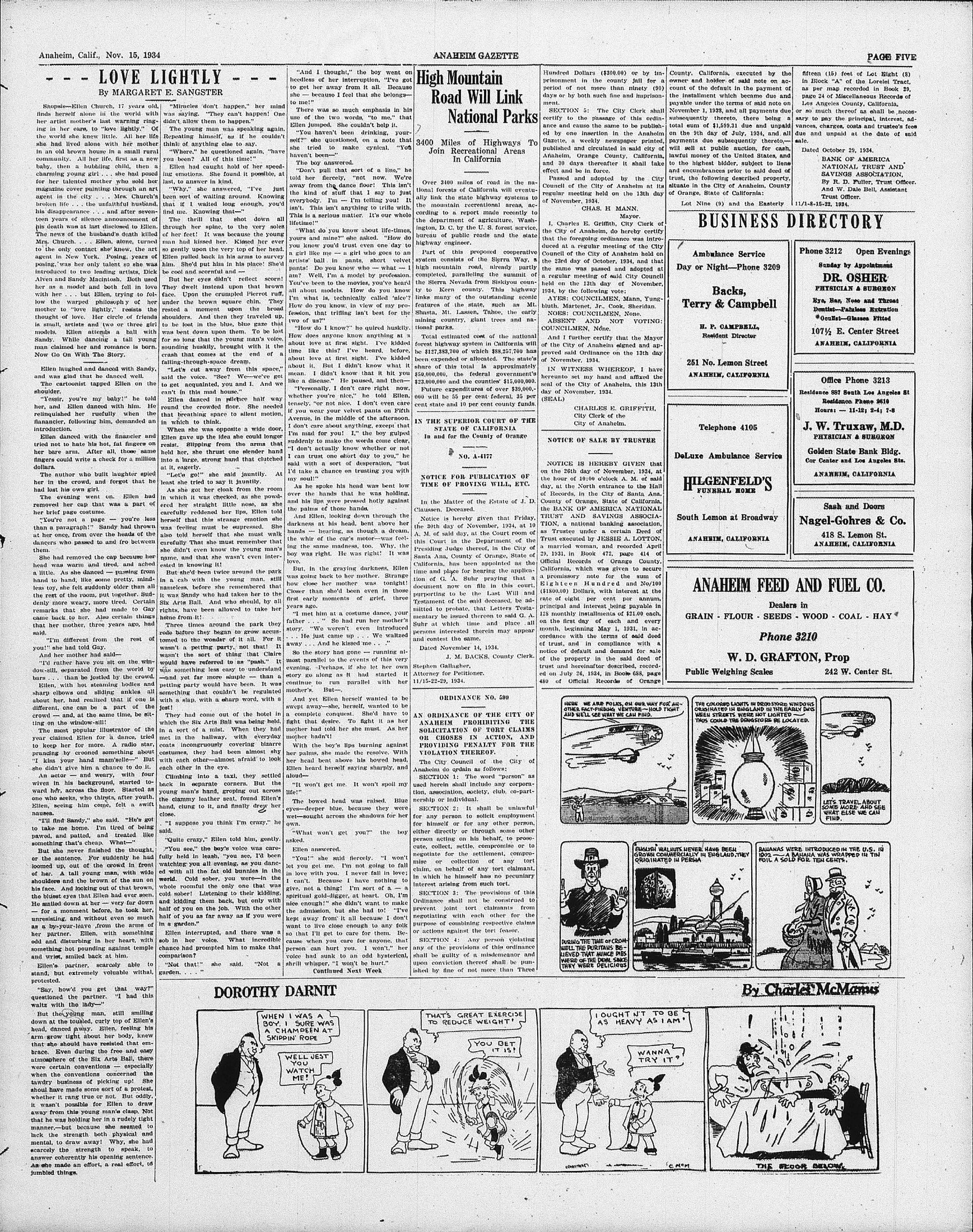
Searchable text
LOVE LIGHTLY
By MARGARET E. SANGSTER
Shops—Ellen Church, 17 years old, finds herself alone in the world with her artist mother's last warning ringing in her ears, to "love lightly." Of the world she knew little. All her life she had lived alone with her mother in an old brown house in a small rural community. All her life, first as a new baby, then a bubbling child, then a charming young girl...she had posed for her talented mother who sold her magazine cover painting through an art agent in the city...Mrs. Church's broken life...the unfaithful husband, his disappearance...and after seventeen years of silence announcement of his death was at last disclosed to Ellen. The news of the husband's death killed Mrs. Church...Ellen, alone, turned to the only contact she knew, the art agent in New York. Posing, years of posing,'was her only talent so she was introduced to two leading artists, Dick Alven and Sandy Macintosh. Both used her as a model and both fell in love with her...but Ellen, trying to follow the warped philosophy of her mother to "love lightly," resists the thought of love. Her circle of friends is small, artists and two or three girl models. Ellen attends a ball with Sandy. While dancing a tall young man claimed her and romance is born. Now Go On With The Story.
Ellen laughed and danced with Sandy, and was glad that he danced well.
The cartoonist tapped Ellen on the shoulder.
"Yessir, you're my baby!" he told her, and Ellen danced with him. He relinquished her ruefully when the flanancier, following him, demanded an introduction.
Ellen danced with the financier and tried not to hate his hot, fat fingers on her bare arm. After all, those same fingers could write a check for a million
"Miracles don't happen," her mind was saying. "They can't happen! One didn't allow them to happen."
The young man was speaking again. Repeating himself, as if he couldn't think of anything else to say.
"Where," he questioned again, "have you been? All of this time!"
Ellen had caught hold of her speeding emotions. She found it possible, at last, to answer in kind.
"Why," she answered, "I've just been sort of waiting around. Knowing that if I waited long enough, you'd find me. Knowing that—"
The thrill that shot down all through her spine, to the very soles of her feet! It was because the young man had kissed her. Kissed her ever so gently upon the very top of her head. Ellen pulled back in his arms to survey him. She'd put him in his place! She'd be cool and scornful and —
But her eyes didn't reflect scorn! They dwelt instead upon that brown face. Upon the crumpled Plierrot ruff, under the brown square chin. They rested a moment upon the broad shoulders. And then they traveled up, to be lost in the blue, blue gaze that was bent down upon them. To be lost for so long that the young man's voice, sounding huskily, brought with it the crash that comes at the end of a falling-through-space dream.
"Let's cut away from this space," said the voice. "See? We've got to get acquainted, you and I. And we can't in this mad house."
Ellen danced in silence half way round the crowded floor. She needed that breathing space to silent motion, in which to think.
When she was opposite a wide door, Ellen gave up the idea she could longer resist. Slipping from the arms that held her, she thrust one slender hand into a large strong hand that clutched "And I thought," the heedless of her interruptions to get her away from she — because I feel that to me!
There was so much use of the two words, Ellen jumped. She could "You haven't been self?" she questioned, or she tried to make it haven't been—
The boy answered.
"Don't pull that sort told her fiercely," not away from the dance flow the kind of stuff that everybody I'm — I'm isn't. This isn't anything This is a serious matter, lifetime!
"What do you know about yours and mine?" she asked you know you'd trust e a girl like me — a girl artists' ball in pants, pants! Do you know what am? Well, I'm a model You've been to the movie all about models. How I'm what is, technically How do you know, in v session, that trifling isn't two of us?
"How do I know?" he How does anyone know about love at first sight time like this? I've about love at first sight about it. But I didn't mean I didn't know to like a disease." He paused "Personally, I don't can whether you're nice," he tensely, "or not nice. If if you wear your velvet Avenue, in the middle of I don't care about anything I'm mad for you! I," he suddenly to make the word "I don't actually know you I can trust one short day..."
Ellen laughed and danced with Sandy, and was glad that he danced well.
The cartoonist tapped Ellen on the shoulder.
"Yessir, you're my baby!" he told her, and Ellen danced with him. He relinquished her ruefully when the flanancier, following him, demanded an introduction.
Ellen danced with the financier and tried not to hate his hot, fat fingers on her bare arm. After all, those same fingers could write a check for a million dollars.
The author who built laughter spied her in the crowd, and forgot that he had lost his own girl.
The evening went on. Ellen had removed her cap that was a part of her brief page costume.
"You're not a page — you're less than a paragraph!" Sandy had thrown at her once, from over the heads of the dancers who passed to and fro between them.
She had removed the cap because her head was warm and tired, and ached a little. As she danced — passing from hand to hand, like some pretty, mindless toy, she felt suddenly older than all the rest of the room, put together. Suddenly more weary, more tired. Certain remarks that she had made to Gay came back to her. Also certain things that her mother, three years ago, had said.
"I'm different from the rest of you!" she had told Gay.
And her mother had said—
"I'd rather have you sit on the window-sill, separated from the world by bars ... than be jostled by the crowd.
Ellen, with hot steaming bodies and sharp elbows and sliding ankles all about her, had realized that if one is different, one can be a part of the crowd — and, at the same time, be sitting on the window-sill!
The most popular illustrator of the year claimed Ellen for a dance, tried to keep her for more. A radio star, prancing by crooned something about "I kiss your hand mam'selle—" But she didn't give him a chance to do it.
An actor — and weary, with four wives in his background, started toward her, across the floor. Started as one who seeks, who thirsts, after youth. Ellen, seeing him come, felt a swift nausea.
"I'll find Sandy," she said. "He's got to take me home. I'm tired of being pawed, and patted, and treated like something that's cheap. What—"
But she never finished the thought, or the sentence. For suddenly he had loomed up, out of the crowd in front falling-through-space dream.
"Let's cut away from this space," said the voice. "See? We've got to get acquainted, you and I. And we can't in this mad house."
Ellen danced in silence half way round the crowded floor. She needed that breathing space to silent motion, in which to think.
When she was opposite a wide door, Ellen gave up the idea she could longer resist. Slipping from the arms that held her, she thrust one slender hand into a large, strong hand that clutched at it, eagerly.
"Let's go!" she said jauntily. At least she tried to say it jauntily.
As she got her cloak from the room in which it was checked, as she powdered her straight little nose, as she carefully reddened her lips, Ellen told herself that this strange emotion she was feeling must be suppressed. She also told herself that she must walk carefully That she must remember that she didn't even know the young man's name, and that she wasn't even interested in knowing it!
But she'd been twice around the park in a cab with the young man, still nameless, before she remembered that it was Sandy who had taken her to the Six Arts Ball. And who should, by all rights, have been allowed to take her home from it!
Three times around the park they rode before they began to grow accustomed to the wonder of it all. For it wasn't a petting party, not that! It wasn't the sort of thing that Claire would have referred to as "pash." It was something less easy to understand—and yet far more simple — than a petting party would have been. It was something that couldn't be regulated with a slap, with a sharp word, with a jest!
They had come out of the hotel in which the Six Arts Ball was being held, in a sort of a mist. When they had met in the hallway, with everyday coats incongruously covering bizarre costumes, they had been almost shy with each other—almost afraid to look each other in the eye.
Climbing into a taxi, they settled back in separate corners. But the young man's hand, groping out across the clammy leather seat, found Ellen's hand, clung to it, and finally drew her close.
"I suppose you think I'm crazy," he said.
"Quite crazy," Ellen told him, gently.
"You see," the boy's voice was carefully held in leash, "you see, I'd been watching you all evening, as you dance-with all the fetted bunnies in the falling-through-space dream."
"Let's cut away from this space," said the voice. "See? We—we've got to get acquainted, you and I. And we can't in this mad house."
Ellen danced in silence half way round the crowded floor. She needed that breathing space to silent motion, in which to think.
When she was opposite a wide door, Ellen gave up the idea she could longer resist. Slipping from the arms that held her, she thrust one slender hand into a large, strong hand that clutched at it, eagerly.
"Let's go!" she said jauntily. At least she tried to say it jauntily.
As she got her cloak from the room in which it was checked, as she powdered her straight little nose, as she carefully reddened her lips, Ellen told herself that this strange emotion she was feeling must be suppressed. She also told herself that she must walk carefully That she must remember that she didn't even know the young man's name, and that she wasn't even interested in knowing it!
But she'd been twice around the park in a cab with the young man, still nameless, before she remembered that it was Sandy who had taken her to the Six Arts Ball. And who should, by all rights, have been allowed to take her home from it!
Three times around the park they rode before they began to grow accustomed to the wonder of it all. For it wasn't a petting party, not that! It wasn't the sort of thing that Claire would have referred to as "pash." It was something less easy to understand—and yet far more simple — than a petting party would have been. It was something that couldn't be regulated with a slap, with a sharp word, with a jest!
They had come out of the hotel in which the Six Arts Ball was being held, in a sort of a mist. When they had met in the hallway, with everyday coats incongruously covering bizarre costumes, they had been almost shy with each other—almost afraid to look each other in the eye.
Climbing into a taxi, they settled back in separate corners. But the young man's hand, groping out across the clammy leather seat, found Ellen's hand, clung to it, and finally drew her close.
"I suppose you think I'm crazy," he said.
"Quite crazy," Ellen told him, gently.
"You see," the boy's voice was carefully held in leash, "you see, I'd been watching you all evening, as you dance-with all the fetted bunnies in the falling-through-space dream."
"Let's cut away from this space," said the voice. "See? We—we've got to get acquainted, you and I. And we can't in this mad house."
Ellen danced in silence half way round the crowded floor. She needed that breathing space to silent motion, in which to think.
When she was opposite a wide door, Ellen gave up the idea she could longer resist. Slipping from the arms that held her, she thrust one slender hand into a large, strong hand that clutched at it, eagerly.
"Let's go!" she said jauntily. At least she tried to say it jauntily.
As she got her cloak from the room in which it was checked, as she powdered her straight little nose, as she carefully reddened her lips, Ellen told herself that this strange emotion she was feeling must be suppressed. She also told herself that she must walk carefully That she must remember that she didn't even know the young man's name, and that she wasn't even interested in knowing it!
But she'd been twice around the park in a cab with the young man, still nameless, before she remembered that it was Sandy who had taken her to the Six Arts Ball. And who should, by all rights, have been allowed to take her home from it!
Three times around the park they rode before they began to grow accustomed to the wonder of it all. For it wasn't a petting party, not that! It wasn't the sort of thing that Claire would have referred to as "pash." It was something less easy to understand—and yet far more simple — than a petting party would have been. It was something that couldn't be regulated with a slap, with a sharp word, with a jest!
They had come out of the hotel in which the Six Arts Ball was being held, in a sort of a mist. When they had met in the hallway, with everyday coats incongruously covering bizarre costumes, they had been almost shy with each other—almost afraid to look each other in the eye.
Climbing into a taxi, they settled back in separate corners. But the young man's hand, groping out across the clammy leather seat, found Ellen's hand,clung to it,and finally drew her close.
"It won't get me. It's life!"
The bowed head was eyes—deeper blue,because wet—sought across the slowness.
What won't get you asked.
Ellen answered.
You!" she said fierce let you get me. I'm not
An actor — and weary, with four wives in his background, started toward her, across the floor. Started as one who seeks, who thirsts, after youth. Ellen, seeing him come, felt a swift nausea.
"I'll find Sandy," she said. "He's got to take me home. I'm tired of being pawed, and patted, and treated like something that's cheap. What—"
But she never finished the thought, or the sentence. For suddenly he had loomed up, out of the crowd in front of her. A tall young man, with wide shoulders and the brown of the sun on his face. And looking out of that brown, the bluest eyes that Ellen had ever seen. He smiled down at her — very far down — for a monument before, he took her, unresisting, and without even so much as a by-your-leave from the arms of her partner. Ellen, with something odd and disturbing in her heart, with something hot pounding against temple and wrist, smiled back at him.
Ellen's partner, scarcely able to stand, but extremely valuable withal, protested.
"Say, how'd you get that way?" questioned the partner. "I had this waltz with the lady—"
But the young man, still smiling down at the touled, curly top of Ellen's head, danced away. Ellen, feeling his arm grow tight about her body, knew that she should have resisted that embrace. Even during the free and easy atmosphere of the Six Arts Ball, there were certain conventions — especially when the conventions concerned the tawdry business of picking up! She shoul have made some sort of a protest, whether it rang true or not. But oddly, it wasn't possible for Ellen to draw away from this young man's clasp. Not that he was holding her in a rudely tight manner; but because she seemed to lack the strength both physical and mental, to draw away! Why, she had scarcely the strength to speak, to answer coherently his opening sentence. As she made an effort, a real effort, to jumbled things.
Climbing into a taxi, they settled back in separate corners. But the young man's hand, groping out across the clammy leather seat, found Ellen's hand, clung to it, and finally drew her close.
"I suppose you think I'm crazy," he said.
"Quite crazy," Ellen told him, gently.
"You see," the boy's voice was carefully held in leash, "you see, I'd been watching you all evening, as you danced with all the fat old bunnies in the world. Cold sober, you were—in the whole roomful the only one that was cold sober! Listening to their kidding, and kidding them back, but only with half of you on the job. With the other half of you as far away as if you were in a garden."
Ellen interrupted, and there was a sob in her voice. What incredible chance had prompted him to make that comparison?
"Not that!" she said. "Not a garden. . . ."
DOROTHY DARNIT
WHEN I WAS A BOY, I SURE WAS A CHAMPEEN AT SKIPPIN' ROPE
WELL JEST YOU WATCH ME!
"And I thought," the boy went on heedless of her interruption, "I've got to get her away from it all. Because she — because I feel that she belongs—to me!"
There was so much emphasis in his use of the two words, "to me," that Ellen jumped. She couldn't help it.
"You haven't been drinking, yourself?" she questioned, on a note that she tried to make cynical. "You haven't been—"
The boy answered.
"Don't pull that sort of a line," he told her fiercely, "not now. We're away from the dance floor! This isn't the kind of stuff that I say to just everybody. I'm — I'm telling you! It isn't. This isn't anything to trifle with. This is a serious matter. It's our whole lifetime!"
"What do you know about life-times, yours and mine?" she asked. "How do you know you'd trust even one day to a girl like me — a girl who goes to an artist's ball in pants, short velvet pants! Do you know who — what — I am? Well, I'm a model by profession. You've been to the movies, you've heard all about models. How do you know I'm what is, technically called 'nice'? How do you know, in view of my profession, that trifling isn't best for the two of us?"
"How do I know?" he quired huskily. How does anyone know anything at a about love at first sight. I've kidded time like this? I've heard, before, about love at first sight. I've kidded about it. But I didn't know what it mean. I didn't know that it hit you like a disease." He paused, and then—
"Personally, I don't care right now, whether you're nice," he told Ellen, tensely, "or not nice. I don't even care if you wear your velvet pants on Fifth Avenue, in the middle of the afternoon. I don't care about anything, except that I'm mad for you! I," the boy gulped suddenly to make the words come clear, "I don't actually know whether or not I can trust one short day to you," he
High Mountain Road Will Link National Parks
3400 Miles of Highways To Join Recreational Areas In California
Over 3400 miles of road in the national forests of California will eventually link the state highway systems to the mountain recreational areas, according to a report made recently to the department of agriculture, Washington, D.C. by the U.S. forest service, bureau of public roads and the state highway engineer.
Part of this proposed cooperative system consists of the Sierra Way, a high mountain road, already partly completed, paralleling the summit of the Sierra Nevada from Siskiyou county to Kern county. This highway links many of the outstanding scenic features of the state, such as Mt. Shasta, Mt. Lassen, Tahoe, the early mining country, giant trees and national parks.
Total estimated cost of the national forest highway system in California will be $127,383,700 of which $88,257,700 has been expended or allocated. The state's share of this total is approximately $59,000,000, the federal government's $23,000,000 and the counties' $15,000,000.
Future expenditures of over $39,000,-000 will be 55 per cent federal, 35 per cent state and 10 per cent county funds.
IN THE SUPERIOR COURT OF THE STATE OF CALIFORNIA
In and for the County of Orange
NO. A-4177
Hundred Dollars ($300.00) or by imprisonment in the county jail for a period of not more than ninety (90) days or by both such fine and imprisonment.
SECTION 5: The City Clerk shall certify to the passage of this ordinance and cause the same to be published by one insertion in the Anaheim Gazette, a weekly newspaper printed, published and circulated in said city of Anaheim, Orange County, California, and 30 days thereafter it shall take effect and be in force.
Passed and adopted by the City Council of the City of Anaheim at its regular meeting held on the 13th day of November, 1934.
CHAS. H MANN.
Mayor.
I, Charles E. Griffith, City Clerk of the City of Anaheim, do hereby certify that the foregoing ordinance was introduced at a regular meeting of the City Council of the City of Anaheim held on the 23rd day of October, 1934, and that the same was passed and adopted at a regular meeting of said City Council held on the 13th day of November, 1934, by the following vote:
AYES: COUNCILMEN, Mann, Yungbluth, Martenet, Jr., Cook, Sheridan.
NOES: COUNCILMEN, None.
ABSENT AND NOT VOTING: COUNCILMEN, None.
And I further certify that the Mayor of the City of Anaheim signed and approved said Ordinance on the 13th day of November, 1934.
IN WITNESS WHEREOF, I have hereunto set my hand and affixed the seal of the City of Anaheim, this 13th day of November, 1934.
CHARLES E. GRIFFITH,
City Clerk of the
City of Anaheim.
NOTICE OF SALE BY TRUSTEE
about it. But I didn't know what it mean. I didn't know that it hit you like a disease." He paused, and then—"Personally, I don't care right now, whether you're nice," he told Ellen, tensely, "or not nice. I don't even care if you wear your velvet pants on Fifth Avenue, in the middle of the afternoon. I don't care about anything, except that I'm mad for you! I," the boy gulped suddenly to make the words come clear, "I don't actually know whether or not I can trust one short day to you," he said with a sort of desperation, "but I'd take a chance on trusting you with my soul!"
As he spoke his head was bent low over the hands that he was holding, and his lips were pressed hotly against the palms of those hands.
And Ellen, looking down through the darkness at his head, bent above her hands — hearing, as though a dream, the whir of the car's motor—was feeling the same madness, too. Why, the boy was right. He was right! It was love.
But, in the graying darkness, Ellen was going back to her mother. Strange how close her mother was tonight! Closer than she'd been even in those first early moments of grief, three years ago.
"I met him at a costume dance, your father . . ." So had run her mother's story. "We weren't even introduced . . . He just came up . . . We waltzed away . . . And he kissed me . . ."
So the story had gone — running almost parallel to the events of this very evening. Perhaps, if she let her own story go along as it had started it continue to run parallel with her mother's. But—
And yet Ellen herself wanted to be swept away—she, herself, wanted to be a complete conquest. She'd have to fight that desire. To fight it as her mother had told her she must. As her mother hadn't!
With the boy's lips burning against her palms, she made the resolve. With her head bent above his bowed head, Ellen heard herself saying sharply, and aloud—
"It won't get me. It won't spoil my life!"
The bowed head was raised. Blue eyes—deeper blue, because they were wet—sought across the shadows for her own.
"What won't get you?" the boy asked.
Ellen answered.
"You!" she said fiercely. "I won't let you get me. I'm not going to fall share of this total is approximately $59,000,000, the federal government's $23,000,000 and the counties' $15,000,000. Future expenditures of over $39,000,-000 will be 55 per cent federal, 35 per cent state and 10 per cent county funds.
IN THE SUPERIOR COURT OF THE STATE OF CALIFORNIA
In and for the County of Orange
NO. A-4177
NOTICE FOR PUBLICATION OF TIME OF PROVING WILL, ETC.
In the Matter of the Estate of J. D. Claussen, Deceased.
Notice is hereby given that Friday, the 30th day of November, 1934, at 10 A.M. of said day, at the Court room of this Court in the Department of the Presiding Judge thereof, in the City of Santa Ana, County of Orange, State of California, has been appointed as the time and place for hearing the application of G. A. Suhr praying that a document now on file in this court, purporting to be the Last Will and Testament of the said deceased, be admitted to probate, that Letters Testamentary be issued thereon to said G. A. Suhr at which time and place all persons interested therein may appear and contest the same.
Dated November 14, 1934.
J. M. BACKS, County Clerk.
Stephen Gallagher,
Attorney for Petitioner.
11/15-22-29, 1934.
ORDINANCE NO. 590
AN ORDINANCE OF THE CITY OF ANAHEIM PROHIBITING THE SOLICITATION OF TORT CLAIMS OR CHOSES IN ACTION, AND PROVIDING PENALTY FOR THE VIOLATION THEREOF.
The City Council of the City of Anaheim do ordain as follows:
SECTION 1: The word "person" as used herein shall include any corporation, association, society, club, co-partnership or individual.
SECTION 2: It shall be unlawful for any person to solicit employment for himself or for any other person, either directly or through some other person acting on his behalf, to prosecute, collect, settle, compromise or to negotiate for the settlement, compromise or collection of any tort claim, on behalf of any tort claimant,
IN WITNESS WHEREOF, I have hereunto set my hand and affixed the seal of the City of Anaheim, this 13th day of November, 1934.
CHARLES E. GRIFFITH,
City Clerk of the
City of Anahelm.
NOTICE IS HEREBY GIVEN that on the 26th day of November, 1934, at the hour of 10:00 o'clock A.M. of said day, at the North entrance to the Hall of Records, in the City of Santa Ana, County of Orange, State of California, the BANK OF AMERICA NATIONAL TRUST AND SAVINGS ASSOCIATION, a national banking association, as Trustee under a certain Deed of Trust executed by JESSIE A. LOTTON, a married woman, and recorded April 29, 1931, in Book 472, page 414 of Official Records of Orange County, California, which was given to secure a promissory note for the sum of Eighteen Hundred and No/100 ($1800.00) Dollars, with interest at the rate of eight per cent per annum, principal and interest being payable in 128 monthly installments of $21.00 each, on the first day of each and every month, beginning May 1, 1931, in accordance with the terms of said deed of trust, and in compliance with a notice of default and demand for sale of the property in the said deed of trust and hereinafter described, recorded on July 26, 1934, in Book 688, page 480 of Official Records of Orange
"It won't get me. It won't spoil my life!"
The bowed head was raised. Blue eyes—deeper blue, because they were wet—sought across the shadows for her own.
"What won't get you?" the boy asked.
Ellen answered.
"You!" she said fiercely. "I won't let you get me. I'm not going to fall in love with you. I never fall in love; I can't. Because I have nothing to give, not a thing! I'm sort of a — a spiritual gold-digger, at heart. Oh, I'm nice enough!" she didn't want to make the admission, but she had to: "I've kept away from it all because I don't want to live close enough to any folk so that I'll get to care for them. Because when you care for anyone, that person can hurt you. I won't," her voice had sunk to an odd hysterical, shrill whisper, "I won't be hurt."
Continued Next Week
SECTION 1: The word "person" as used herein shall include any corporation, association, society, club, co-partnership or individual.
SECTION 2: It shall be unlawful for any person to solicit employment for himself or for any other person, either directly or through some other person acting on his behalf, to prosecute, collect, settle, compromise or to negotiate for the settlement, compromise or collection of any tort claim, on behalf of any tort claimant, in which he himself has no pecuniary interest arising from such tort.
SECTION 3: The provisions of this Ordinance shall not be construed to prevent joint tort claimants from negotiating with each other for the purpose of combining respective claims or actions against the tort feasor.
SECTION 4: Any person violating any of the provisions of this ordinance shall be guilty of a misdemeanor and upon conviction thereof shall be punished by fine of not more than Three.
DARNIT
City Clerk shall issue of this ordinance to be published in the Anaheim newspaper printed, dated in said city of County, California, after it shall take by the City of Anaheim at its on the 13th day.
County, California, executed by the owner and holder of said note on account of the default in the payment of the installment which became due and payable under the terms of said note on November 1, 1938, and all payments due subsequently thereto, there being a total sum of $1,599.31 due and unpaid on the 9th day of July, 1934, and all payments due subsequently thereto—will sell at public auction, for cash, lawful money of the United States, and to the highest bidder, subject to lienes and encumbrances prior to said deed of trust, the following described property, situate in the City of Anaheim, County of Orange, State of California:
Lot Nine (9) and the Easterly
fifteen (15) feet of Lot Eight (8) in Block "A" of the Lorelei Tract, as per map recorded in Book 29, page 24 of Miscellaneous Records of Los Angeles County, California, or so much thereof as shall be necessary to pay the principal, interest, advances, charges, costs and trustee's fees due and unpaid at the date of said sale.
Dated October 29, 1934.
BANK OF AMERICA
NATIONAL TRUST AND SAVINGS ASSOCIATION,
By R. D. Fuller, Trust Officer.
And W. Dale Bell, Assistant Trust Officer.
11/1-8-15-22, 1934.
BUSINESS DIRECTORY
Ambulance Service
Day or Night—Phone 3209
Backs,
Terry & Campbell
H. P. CAMPBELL,
Resident Director
251 No. Lemon Street
ANAHEIM, CALIFORNIA
Phone 3212 Open Evenings
Sunday by Appointment
DR. OSHER
PHYSICIAN & SURGEON
Eye, Bar, Nose and Throat Dentist—Painless Extration
*Oculist—Glasses Fitted
107½ E. Center Street
ANAHEIM, CALIFORNIA
Office Phone 3213
Residence 887 South Los Angeles St
Residence Phone 2610
Hours: — 11-12; 2-4; 7-8
Telephone 4105
DeLuxe Ambulance Service
J. W. Truxaw, M.D.
PHYSICIAN & SURGEON
Golden State Bank Bldg.
BY TRUSTEE
Telephone 4105
DeLuxe Ambulance Service
HILGENFELD'S
FUNERAL HOME
South Lemon at Broadway
ANAHEIM, CALIFORNIA
Office Phone 3213
Residence 887 South Los Angeles St
Residence Phone 2610
Hours: — 11-12; 2-4; 7-8
J. W. Truxaw, M.D.
PHYSICIAN & SURGEON
Golden State Bank Bldg.
Cor Center and Los Angeles Sts.
ANAHEIM, CALIFORNIA
Sash and Doors
Nagel-Gohres & Co.
418 S. Lemon St.
ANAHEIM, CALIFORNIA
ANAHEIM FEED AND FUEL CO.
Dealers in
GRAIN - FLOUR - SEEDS - WOOD - COAL - HAY
Phone 3210
W. D. GRAFTON, Prop
Public Weighing Scales 242 W. Center St.
THE COLORLED LIGHTS IN DRUGSTORE WINDOWS ORIGINATED IN ENGLAND IN THE EARLY DAYS WHEN STREETS WERE NOT LIGHTED THUS COULD THE DRUGSTORE BE LOCATED.
LET'S TRAVEL ABOUT SOME MORE AND SEE WHAT ELSE WE CAN FIND.
ENGLISH WALHUTS NEVER HAVE BEEN GROWN COMMERCIALLY IN ENGLAND, THEY ORIGINATED IN PERSIA.
BANANAS WERE INTRODUCED IN THE U.S. IN 1902 — A BANANA WAS WRAPPED IN TIN FOIL A SOLD FOR TEN CENTS.
LET'S TRAVEL ABOUT SOME MORE AND SEE WHAT ELSE WE CAN FIND.
ENGLISH WALHUTS NEVER HAVE BEEN GROWN COMMERCIALLY IN ENGLAND, THEY ORIGINATED IN PERSIA.
BAHANAS WERE INTRODUCED IN THE U.S. IN 1802 — A BAHANA WAS WRAPPED IN TIN POIL A SOLD FOR TEN CENTS.
BY CHARLES McMAMUS
RIGHT N'T TO BE HEAVY AS I AM!
WANNA TRY IT?
THE FEEDER BELOW.