anaheim-gazette 1934-11-15
Scanned page
Searchable text
THE ANAHEIM GAZETTE
HENRY KUCHEL, Editor and Publisher
ESTABLISHED 1870
ISSUED EVERY THURSDAY
SUBSCRIPTION PER YEAR ... $2.00
SIX MONTHS ... $1.00
Entered at the Anaheim, California Postoffice as second-class matter.
COMMON SENSE AND COMMON TAXES
The day is not far off when the public bill collector is going to ring your doorbell and ask you to pay up for public services rendered.
There is no use feeling squeemish about facing the bitter truth. Californians have spent way beyond their means. They bought a lot of public service—like farm advisors, university extension courses, agricultural commissioners, adult education with its classes on contract bridge and ordinary waltzes and one-steps—on time payments.
These time payments were written into the state constitution in the form of fixed charges. Consequently, they cannot be reduced without a vote of the people, and the people do not like to give up these services any more than an individual likes to see the finance company take the piano out of his household. We made small down payments and the contract calls for an ever-increasing annual allotment to maintain those services. As a matter of fact, we are pretty far in arears right now . . . something like $100 million.
Our people virtually voted for the sales tax a little more than a year ago. They thought it was going to be painless. But paying taxes, especially recognizable taxes, never ceases to produce economic rheumatism in our purse strings. And yet, to cure our condition, we must add taxes which will make rheumatic purse strings do a St. Vitus dance.
The recent gubernatorial campaign had a sobering effect upon us. There is more willingness to equalize the tax burden, and place new kinds of levies to produce needed additional revenues. Every indication points to adding an income tax. The income levy, of course, must be for revenue purposes and therefore can-
Our people virtually voted for the sales tax a little more than a year ago. They thought it was going to be painless. But paying taxes, especially recognizable taxes, never ceases to produce economic rheumatism in our purse strings. And yet, to cure our condition, we must add taxes which will make rheumatic purse strings do a St. Vitus dance.
The recent gubernatorial campaign had a sobering effect upon us. There is more willingness to equalize the tax burden, and place new kinds of levies to produce needed additional revenues. Every indication points to adding an income tax. The income levy, of course, must be for revenue purposes and therefore cannot be high enough to drive capital out of the state. But these taxes can be added to brackets low enough and continued on to the highest economic strata in a manner to make our citizens realize, first of all, that governmental functions cost money.
A nominal tax on every annual income of $500 or more would produce some much-needed revenue, would equalize the present unjust tendency of the sales tax which throws an unequal burden upon the man with small or no earnings, and would bring us face to face with the fact that we pay for what we get.
We must apply common sense to our common tax problems.
AND IT'S EASIER ON US
The fellow who refuses to take himself seriously may not be so dignified as the other fellow but he is apt to live a lot longer.
WE'LL PAY THE PIPER
Sooner or later every American worth his salt will throw Brain Trust opiates away, tear off his headache bandages, buckle up his public service belt, revert to his traditional resourcefulness, stand on his own economic feet and work like a Trojan to pull out of depression quicksands.
Talking never changed the weather and talking won't change the depression.
When the average American wakes up to the fact that this theory or that panacea or the other scheme amount to little more than vocal exercises, he will be well on the road to recognizing the fundamental fact of any civilization—the simple truth that man-made depressions, like man-made governments, are no worse and no better than the individual condons.
The longer this truth is hidden from view, the longer and harder will be our pull out of the depths of depression. The more economic palliatives we swallow the longer will be our headache. The farther afield we wander in fallacious social theories, primed with the hope of finding a short-cut to solving our economic distress instead of fired with the ideals of securing human liberty, the more dangerous becomes our problem.
It matters little what form of government we have . . . that government is no better than the people make it. . . A tyranal kingdom becomes a benevolent monarchy if the subjects so wish; a crooked Tammany yields quickly when mass thought threatens to wipe out every vistage of its graft, the life-blood of political weasels.
Public opinion, that high and mighty voice of the people, rules our destinies.
Only when it is lulled to sleep by pleasant dreams about spending ourselves back to prosperity can national, state and municipal debts climb to tragic heights; only when it demands, will the piper be paid for the long song and dance of our Brain Trusters . . . and every individual must do this paying through a long and
THIS ADVENTUROUS ERA
The other day a new kind of railroad train ran from Los Angeles to New York in 57 hours. About the same time a couple of aviators flew from England to Australia in 71 hours. A day or two before that, a young Italian flew his plane at 440 miles an hour.
Half a dozen or more persons have lately made ascensions into the stratosphere, ten miles and more above the earth's surface, where air is practically non-existent. Not long ago a naturalist was lowered half a mile into the depths of the sea and came back with the amazing accounts of the strange life of the ocean depths.
Just the other day came the report of a new, though still costly, method of extracting gold from sea water. It is only a few months since gold hunters, flying over New Guinea, discovered a race of people whose existence had been totally undreamed-of.
With so many marvels popping up in the news almost every day, it seems to us that the young people of this generation are living in the most romantic and adventurous period of all history. Somewhere there is living today a boy or a young man who will be the first to fly around the world between noon and noon. Some youth, as yet unknown to fame, will discover still undreamed-of means of adding to the world's wealth. Working in laboratories somewhere there are, beyond doubt, young experimenters who will find the means to rid mankind of the last of its pests and scourges, to add to the length of human life and the sum of human happiness.
Our earth is still very young, and our human race still younger. Greater opportunities than ever before confront the coming generations in mankind's task of conquering nature and reshaping our environment to our needs. This present is the most glorious and adventurous era since the world began.
ANAHEIM GAZETTE
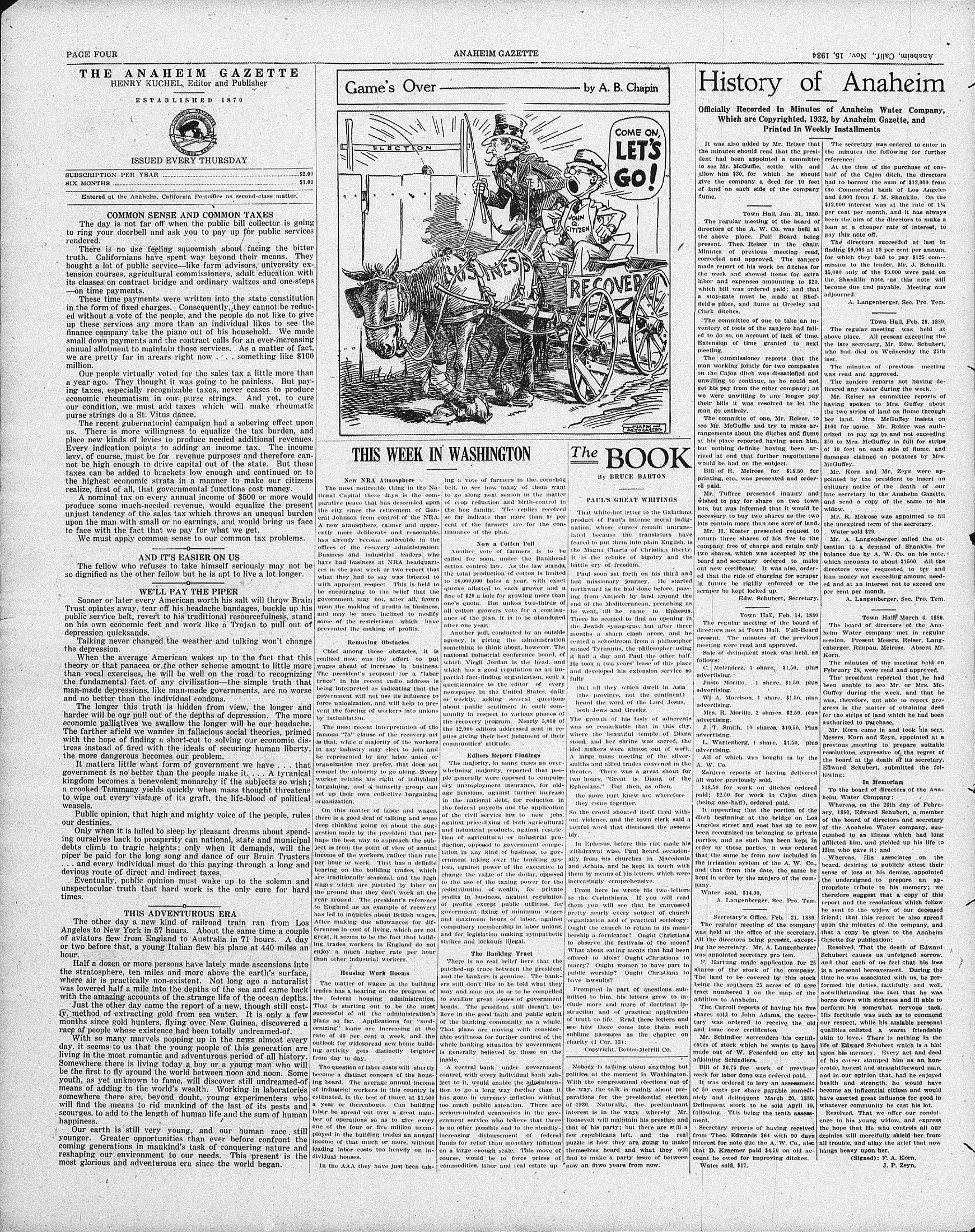
Game's Over by A. B. Chapin
COME ON,
LET'S
GO!
BUSINESS
RECOVERY
THIS WEEK IN WASHINGTON The BOOK
THIS WEEK IN WASHINGTON
New NRA Atmosphere
The most noticeable thing in the National Capital these days is the comparative peace that has descended upon the city since the retirement of General Johnson from control of the NRA. A new atmosphere, calmer and apparently more deliberate and reasonable, has already become noticeable in the offices of the recovery administration. Business and industrial leaders who have had business at NRA headquarters in the past week or two report that what they had to say was listened to with apparent respect. This is held to be encouraging to the belief that the government may not, after all, frown upon the making of profits in business, and may be more inclined to modify some of the restrictions which have prevented the making of profits.
Removing Obstacles
Chief among these obstacles, it is realized now, was the effort to put wages ahead of increase in business. The president's proposal for a "labor truce" in his recent radio address is being interpreted as indicating that the government will not use its influence to force unionization, and will help to prevent the forcing of workers into unions by intimidation.
The most recent interpretation of the famous "7a" clause of the recovery act is that, while a majority of the workers in any industry may elect to join and be represented by any labor union or organization they prefer, that does not compel the minority to go along. Every worker retains his right of individual bargaining, and a minority group can set up their own collective bargaining organization.
On this matter of labor and wages, there is a good deal of talking and some deep thinking going on about the suggestion made by the president that perhaps the best way to approach the subject is from the point of view of annual income of the workers, rather than rate per hour or week. That has a definite bearing on the building trades which bring a vote of farmers in the corn-hog belt, to see how many of them want to go along next season in the matter of crop reduction and birth-control in the hog family. The replies received so far indicate that more than 80 percent of the farmers are for the continuance of the plan.
Now a Cotton Poll
Another vote of farmers is to be called for soon, under the Bankhead cotton control law. As the law stands, the total production of cotton is limited to 10,000,000 bales a year, with exact quotas allotted to each grower and a fine of $20 a bale for growing more than one’s quota. But unless two-thirds of all cotton growers vote for a continuance of the plan, it is to be abandoned after one year.
Another poll, conducted by an outside agency, is giving the administration something to think about, however. The national industrial conference board, of which Virgil Jordan is the head, and which has a good reputation as an impartial fact-finding organization, sent a questionnaire to the editor of every newspaper in the United States, daily or weekly, asking several questions about public sentiment in each community in respect to various phases of the recovery program. Nearly 5,000 of the 12,000 editors addressed sent in replies giving their best judgment of their communities’ attitude.
Editors Report Findings
The majority, in many cases an overwhelming majority, reported that people generally were opposed to compulsory unemployment insurance, for old age pensions, against further increase in the national debt, for reduction in the federal payrolls and the application of the civil service law to new jobs, against price-fixing of both agricultural and industrial products, against restriction of agricultural or industrial production, opposed to government competition in any kind of business, to government taking over the banking system, against power of the executive to
The BOOK
By BRUCE BARTON
PAUL'S GREAT WRITINGS
That white-hot letter to the Galatians product of Paul's intense moral indignation, whose curses remain untranslated because the translators have feared to put them into plain English, in the Magna Charta of Christian liberty. It is the rebuke of bigotry and the battle cry of freedom.
Paul soon set forth on his third and last missionary journey. He started northward as he had done before, passing from Antioch by land around the end of the Mediterranean, preaching at he went, till he came to Ephesus. There he seemed to find an opening in the Jewish synagogue, but after three months a sharp clash arose, and he rented a schoolroom from a philosopher named Tyrannus, the philosopher ushnit half a day and Paul the other half. He took a two years' lease of this place and developed his extension service so fully that all they which dwelt in Asia (the province, not the continent) heard the word of the Lord Jesus, both Jews and Greeks.
The growth of his body of adherents was so remarkable that in this city where the beautiful temple of Diana stood, and her shrine was sacred, the idol makers were almost out of work. A large mass meeting of the silver-smiths and allied trades convened in the theater. There was a great shout for two hours, "Great is Diana of the Ephesians." But then, as often,
the more part knew not wherefore they come together.
So the crowd shouted itself tired without violence, and the town clerk said a tactful word that dismissed the assembly.
In Ephesus, before this riot made his withdrawal wise. Paul heard occasionally from his churches in Macedonia and Achaia, and he kept in touch with
On this matter of labor and wages, there is a good deal of talking and some deep thinking going on about the suggestion made by the president that perhaps the best way to approach the subject is from the point of view of annual income of the workers, rather than rate per hour or week. That has a definite bearing on the building trades, which are traditionally seasonal, and the high wages which are justified by labor on the ground that they don't work all the year around. The president's reference to England as an example of recovery has led to inquiries about British wages. After making due allowances for differences in cost of living, which are not great, it seems to be the fact that building trades workers in England do not enjoy a much higher rate per hour than other industrial workers.
Housing Work Booms
The matter of wages in the building trades has a bearing on the program of the federal housing administration. That is starting out to be the most successful of all the administration's plans so far. Applications for "modernizing" loans are increasing at the rate of 40 per cent a week, and the outlook for widespread new home building activity gets distinctly brighter from day to day.
The question of labor costs will shortly become a distinct concern of the housing board. The average annual income of industrial workers in this country is estimated, in the best of times, at $1,500 a year or thereabouts. Can building labor be spread out over a great number of operations so as to give every one of the four or five million unemployed in the building trades an annual income of that much or more, without loading labor costs too heavily on individual houses.
In the AAA they have just been taken generally were opposed to compulsory unemployment insurance, for old age pensions, against further increase in the national debt, for reduction in the federal payrolls and the application of the civil service law to new jobs, against price-fixing of both agricultural and industrial products, against restriction of agricultural or industrial production, opposed to government competition in any kind of business, to government taking over the banking system, against power of the executive to change the value of the dollar, opposed to the use of the taxing power for the redistribution of wealth, for private profits in business, against regulation of profits except public utilities, for government fixing of minimum wages and maximum hours of labor, against compulsory membership in labor unions, and for legislation making sympathetic strikes and lockouts illegal.
The Banking Truct
There is no real belief here that the patched-up truce between the president and the bankers is genuine. The bankers still don't like to be told what they may and may not do or to be compelled to swallow great issues of government bonds. The president still doesn't believe in the good faith and public spirit of the banking community as a whole. That plans are moving with considerable swiftness for further control of the whole banking situation by government is generally believed by those on the inside.
A central bank under government control, with every individual bank subject to it, would enable the administration to go a long way further than it has gone in currency inflation without too much public attention. There are serious-minded economists in the government service who believe that there is no other possible end to the steadily-increasing disbursement of federal funds for relief than monetary inflation on a large enough scale. This move of course, would be to force prices of commodities, labor and real estate up.
Nobody is talking about anything but politics, at the moment in Washington. With the congressional elections out of the way, the talk is mainly about preparations for the presidential election of 1936. Naturally, the predominant interest is in the ways whereby Mr. Roosevelt will maintain his prestige and that of his party; but there are still a few republicans left, and the real puzzle is how they are going to make themselves heard and what they will find to make a party issue of between now and dtw years from now.
History of Anaheim
Officially Recorded In Minutes of Anaheim Water Company,
Whieh are Copyrighted, 1932, by Anaheim Gazette, and
Printed In Weekly Installments
It was also added by Mr. Reiser that the minutes should read that the president had been appointed a committee to see Mr. McGuffle, settle with and allow him $30, for which he should give the company a deed for 10 feet of land on each side of the company flume.
Town Hall, Jan. 31, 1880.
The regular meeting of the board of directors of the A. W. Co. was held at the above place. Full Board being present. Theo. Reiser in the chair. Minutes of previous meeting read, corrected and approved. The zanjero made report of his work on ditches for the week and showed items for extra labor and expenses amounting to $20, which bill was ordered paid; and that a stop-gate must be made at Sheffield's place, and flume at Greeley and Clark ditches.
The committee of one to take an inventory of tools of the zanjero had failed to do so, on account of lack of time. Extension of time granted to next meeting.
The commissioner reports that the man working jointly for two companies on the Cajon ditch was dissatisfied and unwilling to continue, as he could not get his pay from the other company; as we were unwilling to any longer pay their bills it was resolved to let the man go entirely.
The committee of one, Mr. Reiser, to see Mr. McGuffle and try to make arrangements about the ditches and flume at his place reported having seen him, but nothing definite having been arrived at end that further negotiations
The secretary was ordered to enter in the minutes the following for further reference:
At the time of the purchase of one-half of the Cajon ditch, the directors had to borrow the sum of $12,000 from the Commercial bank of Los Angeles and 6,000 from J. M. Shanklin. On the $12,000 interest was at the rate of 1½ per cent per month, and it has always been the aim of the directors to make a loan at a cheaper rate of interest, to pay this note off.
The directors succeeded at last in finding $9,000 at 10 per cent per annum, for which they had to pay $125 commission to the lender, Mr. J. Schmidt. $5,000 only of the $9,000 were paid on the Shanklin note, as this note will become due and payable. Meeting was adjourned.
A. Langenberger, Sec. Pro. Tem.
Town Hall, Feb. 28, 1880.
The regular meeting was held at above place. All present excepting the late secretary, Mr. Edw. Schubert, who had died on Wednesday the 25th inst.
The minutes of previous meeting was read and approved.
The zanjero reports not having delivered any water during the week.
Mr. Reiser as committee reports of having spoken to Mrs. Guffey about the two strips of land on flume through her land. Mrs. McGuffey insists on $100 for same. Mr. Reiser was authorized to pay up to and not exceeding $50 to Mrs. McGuffey in full for stripe of 10 feet on each side of flume, and damages claimed on potatoes by Mrs.
GREAT WRITINGS
shot letter to the Galatians, Paul's intense moral indignation curses remain untranscribed the translators have them into plain English, is Charla of Christian liberty, bake of bigotry and the freedom.
set forth on his third and early journey. He started he had done before, passioch by land around the Mediterranean, preaching as he came to Ephesus. He met to find an opening in synagogue, but after three carp clash arose, and he fell down from a philosopher musis, the philosopher using and Paul the other half, two years' lease of this place and his extension service so they which dwelt in Asia race, not the continent) word of the Lord Jesus, and Greeks.
of his body of adherents markable that in this city, beautiful temple of Diana or shrine was sacred, the were almost out of work, is meeting of the silvered trades convened in the ere was a great shout for Great is Diana of the But then, as often, art knew not wherefore together.
shouted itself tired with and the town clerk said a that dismissed the assembling before this riot made his else. Paul heard occasion-churches in Macedonia and he kept in touch with man working jointly for two companies on the Cajon ditch was dissatisfied and unwilling to continue, as he could not get his pay from the other company; as we were unwilling to any longer pay their bills it was resolved to let the man go entirely.
The committee of one, Mr. Reiser, to see Mr. McGuffle and try to make arrangements about the ditches and flume at his place reported having seen him, but nothing definite having been arrived at end that further negotiations would be had on the subject.
Bill of R. Melrose for $18.50 for printing, etc., was presented and ordered paid.
Mr. Tuffree presented inquiry and wished to pay for share on two town lots, but was informed that it would be necessary to buy two shares as the two lots contain more than one acre of land.
Mr. H. Koster presented request to return three shares of his five to the company free of charge and retain only two shares, which was accepted by the board and secretary ordered to make out new certificate. It was also ordered that the rule of charging for scraper in future be rigidly enforced or the scraper be kept locked up.
Edw. Schubert, Secretary.
Town Hall, Feb. 14, 1880
The regular meeting of the board of directors met at Town Hall. Full-Board present. The minutes of the previous meeting were read and approved.
Sale of delinquent stock was held, as follows:
C. Melendrez, 1 share, $1.50, plus advertising.
Justo Morillo, 1 share, $1.50, plus advertising.
W. A. Morrison, 1 share, $1.50, plus advertising.
Mrs. R. Morillo, 2 shares, $2.50, plus advertising.
J. T. Smith, 10 shares, $10.50, Plus advertising.
L. Wartenberg, 1 share, $1.50, plus advertising.
All of which was bought in by the A. W. Co.
Zanjero reports of having delivered all water previously sold.
$18.50 for work on ditches ordered paid; $2.50 for work in Cajon ditch (being one-half), ordered paid.
It appearing that the portion of the ditch beginning at the bridge on Los Angeles street and east has up to now been recognized as belonging to private parties, and as such has been kept in order by those parties, it was ordered that the same be from now included in the irrigation system of the A. W. Co., and that from this date the same be
The minutes of previous meeting was read and approved.
The zanjero reports not having delivered any water during the week.
Mr. Reiser as committee reports of having spoken to Mrs. Guffey about the two strips of land on flume through her land. Mrs. McGuffey insists on $100 for same. Mr. Reiser was authorized to pay up to and not exceeding $50 to Mrs. McGuffey in full for stripe of 10 feet on each side of flume, and damages claimed on potatoes by Mrs. McGuffey.
Mr. Korn and Mr. Zeyn were appointed by the president to insert an obituary notice of the death of our late secretary in the Anaheim Gazette, and send a copy of the same to his widow.
Mr. R. Melrose was appointed to fill the unexpired term of the secretary.
Water sold $29.
Mr. A. Langenberger called the attention to a demand of Shanklin for balance due by A. W. Co. on his note, which amounts to about $1500. All the directors were requested to try and loan money not exceeding amount needed and at an interest not to exceed one per cent per month.
A. Langenberger, Sec. Pro. Tem.
Town Hall, March 6, 1880.
The board of directors of the Anaheim Water company met in regular session. Present Messrs. Reiser, Langenberger, Rimpau, Melrose. Absent Mr. Korn.
The minutes of the meeting held on February 28, were read and approved.
The president reported that he had been unable to see Mr. or Mrs. McGuffey during the week, and that he was therefore not able to report progress in the matter of obtaining deed for the strips of land which he had been authorized to purchase.
Mr. Korn came in and took his seat. Messrs. Korn and Zeyn appointed at a previous meeting to prepare suitable resolutions, expressive of the regret of the board at the death of its secretary, Edward Schubert, submitted the following:
In Memoriam
To the board of directors of the Anaheim Water Company:
Whereas, on the 26th day of February, 1880, Edward Schubert, a member of the board of directors and secretary of the Anaheim Water company, succumbed to an illness which had long afflicted him, and yielded up his life to Him who gave it; and
Whereas His associates on the board, desiring to publicly attest their
before this riot made his rise, Paul heard occasion-churches in Macedonia and he kept in touch with us of his letters, which were comprehensive.
he wrote his two-letters to theians. If you will read it, I see that he canvassed every subject of church and of practical sociology: church to retain in its mem-licator? Ought Christians the festivals of the moon? eating meats that had been adults? Ought Christians to women to have part in the city? Ought Christians to part of questions sub-jects his letters grew to include more of doctrinal issues of practical application. Read these letters and come into them such pages as the chapter on 13; t. Bobbs-Merrill Co.
liking about anything but moment in Washington. Professional elections out of talk is mainly about pre- the presidential election generally, the predominant ways whereby Mr. maintain his prestige anderty; but there are still a lot left, and the real they are going to make hard and what they will a party issue of between years from now.
It shouted itself tired with- and the town clerk said a that dismissed the assem-
It appearing that the portion of the ditch beginning at the bridge on Los Angeles street and east has up to now been recognized as belonging to private parties, and as such has been kept in order by those parties, it was ordered that the same be from now included in the irrigation system of the A. W. Co., and that from this date, the same be kept in order by the zanjero of the company.
Water sold. $14.00,
A. Langenberger. Sec. Pro. Tem.
Secretary's Office, Feb. 21, 1880.
The regular meeting of the company was held at the office of the secretary. All the directors being present, excepting the secretary. Mr. A. Langenberger was appointed secretary pro tem.
F. Hartung made application for 25 shares of the stock of the company. The land to be covered by this stock being the southern 25 acres of 40 acre tract numbered 1 on the map of the addition to Anaheim.
Tim Carroll reports of having his five shares sold to John Adams, the secretary was ordered to receive the old and issue new certificates.
Mr. Schindler surrenders his certificates of stock which he wants to have made out of W. Fesenfeld on city lot adjoining Schindlers.
Bill of $6.75 for work of previous week for labor done was ordered paid.
It was ordered to levy an assessment of 50 cents per share payable immediately and delinquent March 20, 1880. Delinquent stock to be sold April 10, following. This being the tenth assessment.
Secretary reports of having received from Theo. Edwards $64 with 90 days interest for note due the A. W. Co., also that D. Kraemer paid $4.50 on old account he owed for improving ditches.
Water sold, $17.
In Memoriam
To the board of directors of the Anaheim Water Company:
Whereas, on the 26th day of February, 1880, Edward Schubert, a member of the board of directors and secretary of the Anahelm Water company, succumbed to an illness which had long afflicted him, and yielded up his life to Him who gave it; and
Whereas, His associates on the board, desiring to publicly attest their sense of loss at his demise, appointed the undersigned to prepare an appropriate tribute to his memory; we therefore suggest that a copy of this report and the resolutions which follow be sent to the widow of our deceased friend; that this report be also spread upon the minutes of the company, and that a copy be given to the Anaheim Gazette for publication;
Resolved, That the death of Edward Schubert causes us unfleigned sorrow, and that each of us feel that his loss is a personal bereavement. During the time he was associated with us, he performed his duties faithfully and well, notwithstanding the fact that he was borne down with sickness and ill able to perform his somewhat nervous task. His fortitude was such as to commend our respect, while his amiable personal qualities enlisted a warm friendship akin to love. There is nothing in the life of Edward Schubert which is a blot upon his memory. Every act and deed of his career stamped him as an honorable, honest and straightforward man, and in our opinion that, had he enjoyed health and strength, he would have become an influential citizen and would have exerted great influence for good in whatever community he cast his lot.
Resolved. That we offer our condolence to his young widow, and express the hope that He who controls all our desinies will mercifully shield her from all trouble, and allay the grief that now hangs heavy upon her.
(Signed): F. A. Korn,
J. P. Zeyn,