anaheim-gazette 1934-10-18
Scanned page
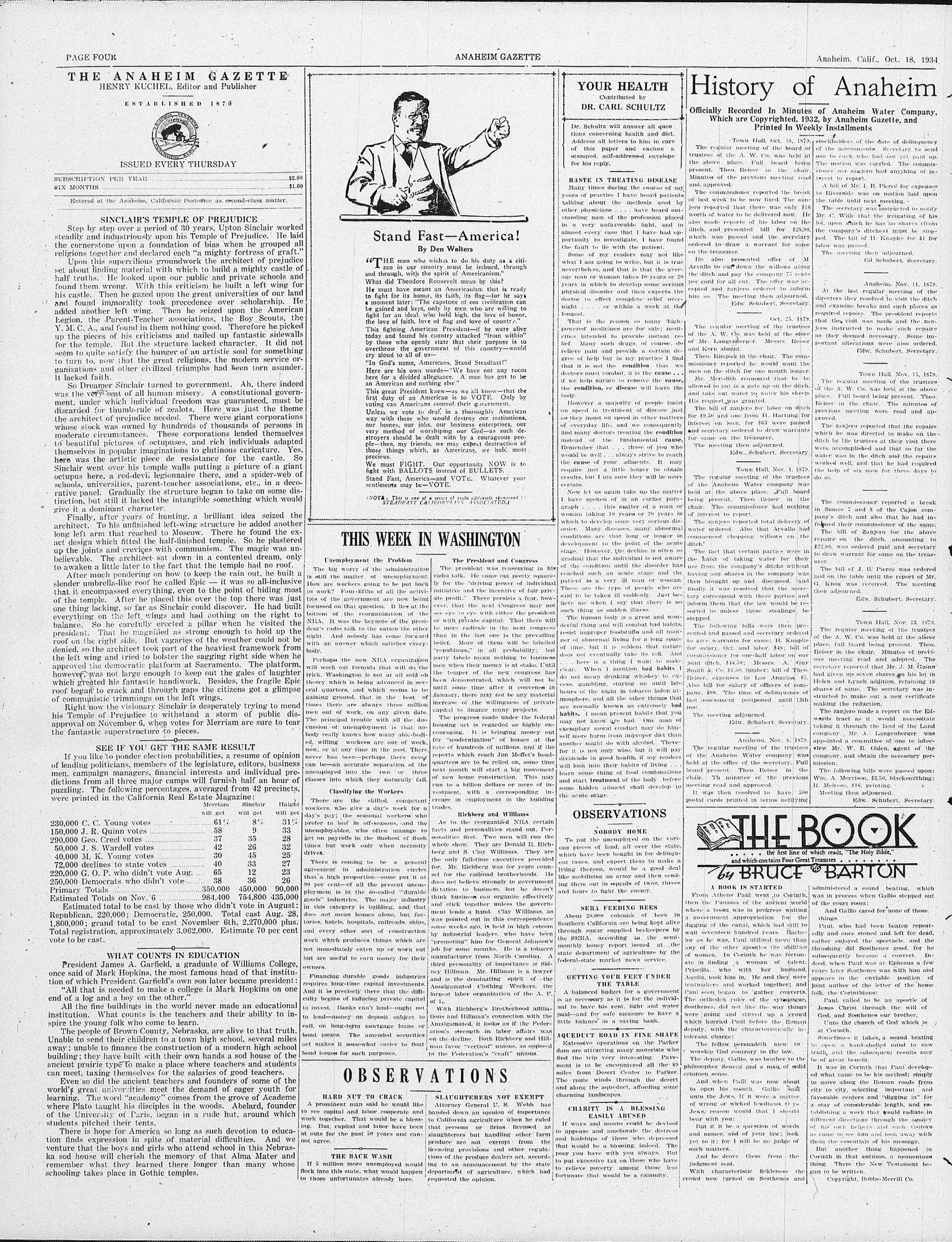
Searchable text
THE ANAHEIM GAZETTE
HENRY KUCHEL, Editor and Publisher
ESTABLISHED 1876
ISSUED EVERY THURSDAY
SUBSCRIPTION PER YEAR ... $2.00
SIX MONTHS ... $1.00
Entered at the Anaheim, California Postoffice as second-class matter.
SINCLAIR'S TEMPLE OF PREJUDICE
Step by step over a period of 30 years, Upton Sinclair worked steadily and industriously upon his Temple of Prejudice. He laid the cornerstone upon a foundation of bias when he grouped all religions together and declared each "a mighty fortress of graft."
Upon this supercilious groundwork the architect of prejudice set about linding material with which to build a mighty castle of half truths. He looked upon our public and private schools and found them wrong. With this criticism he built a left wing for his castle. Then he gazed upon the great universities of our land and found immorality took precedence over scholarship. He added another left wing. Then he seized upon the American Legion, the Parent-Teacher associations, the Boy Scouts, the Y. M. C. A., and found in them nothing good. Therefore he picked up the pieces of his criticisms and nailed up fantastic sidewalls for the temple. But the structure lacked character. It did not seem to quite satisfy the hunger of an artistic soul for something to turn to, now that the great religions, the modern service organizations and other civilized triumphs had been torn asunder. It lacked faith.
So Dreamer Sinclair turned to government. Ah, there indeed was the very seat of all human misery. A constitutional government, under which individual freedom was guaranteed, must be discarded for thumb-rule of zealots. Here was just the theme the architect of prejudice needed. There were giant corporations whose stock was owned by hundreds of thousands of persons in moderate circumstances. These corporations lended themselves to beautiful pictures of octupuses, and rich individuals adapted themselves in popular imaginations to glutinous caricature. Yes, here was the artistic piece de resistance for the castle. So
organizations and other civilized triumphs had been torn asunder.
It lacked faith.
So Dreamer Sinclair turned to government. Ah, there indeed was the very seat of all human misery. A constitutional government, under which individual freedom was guaranteed, must be discarded for thumb-rule of zealots. Here was just the theme the architect of prejudice needed. There were giant corporations whose stock was owned by hundreds of thousands of persons in moderate circumstances. These corporations lended themselves to beautiful pictures of octupuses, and rich individuals adapted themselves in popular imaginations to glutinous caricature. Yes, here was the artistic piece de resistance for the castle. So Sinclair went over his temple walls putting a picture of a giant octupus here, a red-devil legionnaire there, and a spider-web of schools, universities, parent-teacher associations, etc., in a decorative panel. Gradually the structure began to take on some distinction, but still it lacked the intangible something which would give it a dominant character.
Finally, after years of hunting, a brilliant idea seized the architect. To his unfinished left-wing structure he added another long left arm that reached to Moscow. There he found the exact design which fitted the half-finished temple. So he plastered up the joints and crevices with communism. The magic was unbelievable. The architect sat down in a contented dream, only to awaken a little later to the fact that the temple had no roof.
After much pondering on how to keep the rain out, he built a slender umbrella-like roof he called Epic — it was so all-inclusive that it encompassed everything, even to the point of hiding most of the temple. After he placed this over the top there was just one thing lacking, so far as Sinclair could discover. He had built everything on the left wings and had nothing on the right to balance. So he carefully erected a pillar when he visited the president. That he magnified as strong enough to hold up the roof on the right side. But vagaries of the weather could not be denied, so the architect took part of the heaviest framework from the left wing and tried to bolster the sagging right side when he approved the democratic platform at Sacramento. The platform, however, was not large enough to keep out the gales of laughter which greeted his fantastic handiwork. Besides, the fragile Epic roof began to crack and through gaps the citizens got a glimpse of communistic trimmings on the left wings.
Right now the visionary Sinclair is desperately trying to mend his Temple of Prejudice to withstand a storm of public disapproval on November 6, when votes for Merriam are sure to tear the fantastic superstructure to pieces.
SEE IF YOU GET THE SAME RESULT
If you like to ponder election probabilities, a resume of opinion of leading politicians, members of the legislature, editors, business men, campaign managers, financial interests and individual predictions from all three major camps will furnish half an hour of puzzling. The following percentages, averaged from 42 precincts, were printed in the California Real Estate Magazine:
| | Merriam will get | Sinclair will get | Haight will get |
| :--- | :---: | :---: | :---: |
| 230,000 C. C. Young votes | 61% | 8% | 31% |
| 150,000 J. R. Quinn votes | 58 | 9 | 33 |
| 290,000 Geo. Creel votes | 37 | 35 | 28 |
| 50,000 J. S. Wardell votes | 42 | 26 | 32 |
| 40,000 M. K. Young votes | 30 | 45 | 25 |
| 72,000 declines to state votes | 40 | 33 | 27 |
| 220,000 G. O. P. who didn't vote Aug. | 65 | 12 | 23 |
Unemployers
The big worry is still the matter How are workers to work? Fourties of the government focussed on that bottom of the NRA. It was the dent's radio talk night. And not with an answer body.
Perhaps the worker will work out trick. Washington theory which is eral quarters, a gaining ground, times there are men out of work. The principal tussion of unebody really known, willing work now, or at any never has been can—an accu unemployed into classes into white Classifyls
There are the workers, who give day's pay; they prefer to loaf in unemployables, get on payrolls times but work drives.
There is comic agreement in that a high pro
WHAT COUNTS IN EDUCATION
President James A. Garfield, a graduate of Williams College, once said of Mark Hopkins, the most famous head of that institution of which President Garfield’s own son later became president:
“All that is needed to make a college is Mark Hopkins on one end of a log and a boy on the other.”
All the fine buildings in the world never made an educational institution. What counts is the teachers and their ability to inspire the young folk who come to learn.
The people of Brown County, Nebraska, are alive to that truth. Unable to send their children to a town high school, several miles away; unable to finance the construction of a modern high school building; they have built with their own hands a sod house of the ancient prairie type to make a place where teachers and students can meet, taxing themselves for the salaries of good teachers.
Even so did the ancient teachers and founders of some of the world’s great universities meet the demand of eager youth for learning. The word “academy” comes from the grove of Academe where Plato taught his disciples in the woods. Abelard, founder of the University of Paris, began in a rude hut, around which students pitched their tents.
There is hope for America so long as such devotion to education finds expression in spite of material difficulties. And we venture that the boys and girls who attend school in this Nebraska sod house will cherish the memory of that Alma Mater and remember what they learned there longer than many whose schooling takes place in Gothic temples.
Stand Fast—America!
By Den Walters
“The man who wishes to do his duty as a citizen in our country must be imbued, through and through, with the spirit of Americanism.”
What did Theodore Roosevelt mean by this?
He must have meant an Americanism that is ready to fight for its honor, its faith, its flag—for he says a moment later: “The capstone of our civilization can be gained and kept, only by men who are willing to fight for an ideal, who hold high, the love of honor, the love of faith, love of flag and love of country.”
This fighting American President—if he were alive today and found his country attacked “from within” by those who openly state that their purpose is to overthrow the government of this country—would cry aloud to all of us—
“In God’s name, Americans, Stand Steadfast!”
Here are his own words—“We have not any room here for a divided allegiance. A man has got to be an American and nothing else.”
This great President knew—as we all know—that the first duty of an American is to VOTE. Only by voting can Americans control their government.
Unless we vote to deal, in a thoroughly American way with those who would destroy our institutions, our homes, our jobs, our business enterprises, our very method of worshiping our God—as such destroyers should be dealt with by a courageous people—then, my friends, we may expect destruction of those things which, as Americans, we hold most precious.
YOUR HEALTH
Contributed by
DR. CARL SCHULTZ
Dr. Schultz will answer all questions concerning health and diet. Address all letters to him in care of this paper and enclose a stamped, self-addressed envelope for his reply.
HASTE IN TREATING DISEASE
Many times during the course of years of practice I have heard patient talking about the methods used by other physicians . . . have heard of standing men of the profession play in a very unfavorable light, and almost every case that I have had opportunity to investigate, I have found the fault to lie with the patient.
Some of my readers may not what I am going to write, but it is nevertheless, and that is that the average man or woman takes 10 years or years in which to develop some serious physical disorder and then expects a doctor to effect complete relief overnight . . . or within a week at longest.
That is the reason so many ‘his’ powered medicines are for sale; no cines intended to provide instant relief. Many such drugs, of course, relieve pain and provide a certain gree of help but in my practice I find that it is not the condition that doctors must combat, it is the cause if we help nature to remove the cause the condition, or disease will leave body.
However a majority of people insist on speed in treatment of disease just as they insist on speed in other matters of everyday life, and we consequently find many doctors treating the condition instead of the fundamental cause. Remember that . . . those of you would be well . . always strive to re
Here are his own words—"We have not any room here for a divided allegiance. A man has got to be an American and nothing else."
This great President knew—as we all know—that the first duty of an American is to VOTE. Only by voting can Americans control their government.
Unless we vote to deal in a thoroughly American way with those who would destroy our institutions, our homes, our jobs, our business enterprises, our very method of worshiping our God—as such destroyers should be dealt with by a courageous people—they my friends, we may expect destruction of those things which, as Americans, we hold most precious.
We must FIGHT. Our opportunity NOW is to fight with BALLOTS instead of BULLETS.
Stand Fast, America—and VOTE. Whatever your sentiments may be—VOTE.
(NOTE: This is one of a series of eight editorials sponsored by STEADFAST CALIFORNIA ASSOCIATED.)
THIS WEEK IN WASHINGTON
Unemployment the Problem
The big worry of the administration is still the matter of unemployment. How are workers going to be put back to work? Four-fifths of all the activities of the government are now being focussed on that question. It lies at the bottom of the reorganization of the NRA. It was the keynote of the president's radio talk to the nation—the other night. And nobody has come forward with an answer which satisfies everybody.
Perhaps the new NRA organization will work out formula that will do the trick. Washington is not at all sold on theory which is being advanced in several quarters, and which seems to be gaining ground, that in the best of times there are always three million men out of work, on any given date.
The principal trouble with all the discussion of unemployment is that nobody really knows how many able-bodied, willing workers are out of work, now, or at any time in the past. There never has been—perhaps there never can—an accurate separation of the unemployed into the two or three classes into which naturally fall.
Classifying the Workers
There are the skilled, competent workers, who give a day's work for a day's pay; the seasonal workers who prefer to loaf in off-seasons, and the unemployables, who often manage to get on payrolls in the flushest of flush times but work only when necessity drives.
There is coming to be a general agreement in administration circles that a high proportion—some it at
The President and Congress
The president was reassuring in his radio talk. He came out pretty squarely for the "driving power of individual initiative and the incentive of fair private profit." There persists a fear, however, that the next Congress may not see eye to eye with either the president or with private capital. That there will be more radicals in the next congress than in the last one is the prevailing belief. More of them will be labelled "republican," in all probability; but party labels mean nothing to business men when their money is at stake. Until the temper of the new congress has been demonstrated, which will not be until some time after it convenes in January, there may not be any material increase of the willingness of private capital to finance many projects.
The progress made under the federal housing act is regarded as highly encouraging. It is bringing money out for "modernization" of homes at the rate of hundreds of millions, and if the reports which reach Jim Moffet's headquarters are to be relied on, some time next month will start a big movement of new home construction. This may run to a billion dollars or more of investment, with a corresponding increase in employment in the building trades.
Richberg and Williams
As to the reorganized NRA certain facts and personalities stand out. Personalities first. Two men will run the whole show. They are Donald R. Richberg and S. Clay Williams. They are the only full-time executives provided for. Mr. Richberg was for years counsel for the railroad brotherhoods. He
OBSERVATIONS
NOBODY HOME
To put the unemployed on the vantage pieces of land, all over the star which have been bought in for delineating taxes, and expect them to make living thereon, would be a good idea mobilizing an army and then serve...
Classifying the Workers
There are the skilled, competent workers, who give a day's work for a day's pay; the seasonal workers who prefer to loaf in off-seasons, and the unemployables, who often manage to get on payrolls in the flushest of flush times but work only when necessity drives.
There is coming to be a general agreement in administration circles that a high proportion—some put it at 90 per cent—of all the present unemployment is in the so-called "durable goods" industries. The major industry in this category is building, and that does not mean homes alone, but factories, hotels, hospitals, railroads, ships, and every other sort of construction work which produces things which are not immediately eaten up or worn out but are useful to earn money for their owners.
Financing durable goods industries requires long-time capital investments. And it is precisely there that the difficulty begins of inducing private capital to invest. Banks can't lend—ought not to lend—money on deposit subject to call, on long-term mortgage loans or bond issues. The amended securities act makes it somewhat easier to float bond issues for such purposes.
Richberg and Williams
As to the reorganized NRA certain facts and personalities stand out. Personalities first. Two men will run the whole show. They are Donald R. Richberg and S. Clay Williams. They are the only full-time executives provided for. Mr. Richberg was for years counsel for the railroad brotherhoods. He does not believe strongly in government dictation to business, but he doesn't think business can organize effectively and stick together unless the government lends a hand. Clay Williams, as pointed out in this correspondence some weeks ago, is held in high esteem by industrial leaders, who have been "promoting" him for General Johnson's job for some months. He is a tobacco manufacturer from North Carolina. A third personality of importance is Sidney Hillman. Mr. Hillman is a lawyer and is the dominating spirit of the Amalgamated Clothing Workers, the largest labor organization of the A.F. of L.
With Richberg's Brotherhood affiliations and Hillman's connection with the Amalgamated, it looks as if the Federation's strength in labor affairs was on the decline. Both Richberg and Hillman favor "vertical" unions, as opposed to the Federation's "craft" unions.
OBSERVATIONS
NOBODY HOME
To put the unemployed on the various pieces of land, all over the state which have been bought in for delineated taxes, and expect them to make living thereon, would be a good idea mobilizing an army and then setting them out in squads of twos, three and fours to fight the enemy.
SERA FEEDING BEES
About 20,000 colonies of bees Southern California are being kept all through sugar supplied beekeepers by the SERA, according to the senate monthly honey report issued at the state department of agriculture by the federal-state market news service.
GETTING YOUR FEET UNDER THE TABLE
A balanced budget for a government is as necessary as it is for the individual to have his rent, light and water paid—and for safe measure to have little balance in a saving bank.
AQUEDUCT ROAD IN FINE SHAPE
Extensive operations on the Park dam are attracting many motorists who find the trip very interesting. Payment is to be encountered all the miles from Desert Center to Parker. The route winds through the desert and along the aqueduct, affording some charming landscapes.
CHARITY IS A BLESSING
If ways and means could be devise to appease and ameliorate the distress and hadships of those who depress that would be a blessing, indeed. The poor you have with you always. You to put excessive tax on those who have to relieve poverty among those less fortunate that would be a calamity.
History of Anaheim
Officially Recorded In Minutes of Anaheim Water Company, Which are Copyrighted, 1932, by Anaheim Gazette, and Printed In Weekly Installments
Town Hall, Oct. 18, 1879.
The regular meeting of the board of trustees of the A. W. Co. was held at the above place. Full board being present. Theo. Reiser in the chair. Minutes of the previous meeting read and approved.
The commissioner reported the break of last week to be now fixed. The zanjero reported that there was only $16 worth of water to be delivered now. He also made reports of his labor on the ditch, and presented bill for $28.90, which was passed on the secretary ordered to draw a warrant for same on the treasurer.
He also presented offer of M. Arvallo to cut down the willows along the ditch and pay the company 75 cents per cord for all cut. The offer was accepted and zanjero ordered to inform him so. The meeting then adjourned.
Edw. Schubert, Secretary.
Anaheim, Nov. 11, 1879.
At the last regular meeting of the directors they resolved to visit the ditch and examine breaks and such places as required repairs. The president reports that the visit was made and the zanjero instructed to make such repairs as they deemed necessary. Some important alterations were also ordered.
Edw. Schubert, Secretary.
Town Hall, Nov. 15, 1879.
The regular meeting of the trustees of the A. W. Co. was held at the above place. Full board being present. Theo. Reiser in the chair. Minutes of previous meeting were read and approved.
The zanjero reported that the repairs which he was directed to make on the ditch by the trustees at their visit there were accomplished and that so far the water was in the ditch and the repairs worked well and that he had required
a majority of people insist on treatment of disease just rest on speed in other matters or life, and we consequently doctors treating the condition the fundamental cause, that... those of you who will always strive to reach your alliments. It may not a little longer to obtain I am sure they will be more again take up the matter taken of in an earlier para... this matter of a man or living 10 years or 20 years in develop some very serious diseases, many abnormal care that long or longer in it to the point of the acute fever, the decline is often so that the individual is not aware until the disorder has reached an acute stage and the very ill man or woman, the type of people who are taken ill suddenly. Just before I say that there is no sudden illness.
body is a great and won- and will combat bad habits, super foodstuffs and all man-normal living for a long space it is seldom that nature eventually take its toll. And as a thing I want to make an mention bad habits I am drinking whiskey to ex-fing, staying up until late night in tobacco laden attentions all the other things that they known as extremely bad can present habits that you know are bad. One man of moral conduct may do him harm from improper diet than do with alcohol. There- only wise, but it will pay good health, if my readers do their habits of living... thing of food combinations treatment of the body before anilment shall develop to age.
Town Hall, Nov. 1, 1879.
The regular meeting of the trustees of the Anaheim Water company was held at the above place. Full board being present. Theo. Reiser in the chair. The commissioner had nothing of interest to report.
The zanjero reported total delivery of water ordered. Also that Arvallo had commenced chopping willows on the ditch.'
The fact that certain parties were in the habit of taking water for their use from the company's ditches without having any shares in the company was then brought up and discussed, and finally it was resolved that the secretary correspond with these parties and inform them that the law would be resorted to unless these stealings be stopped.
The following bills were then presented and passed and secretary ordered to give warrants for same; H. Knipke for salary. Oct. and labor, $48; bill of commissioner for one-half labor on our joint ditch, $44.50; Messrs. A. Guy Smith & Co., $1.50; lumber; bill of Theo. Reiser, expenses to Los Angeles, $5. Also bill for salary of officers of company, $90. The time of delinquence of last assessment postponed until 13th inst.
The meeting adjourned.
Edw. Schubert, Secretary.
Anaheim, Nov. 8, 1879.
The regular meeting of the trustees of the Anaheim Water company was held at the office of the secretary. Full board present. Theo. Reiser in the chair. Th minutes of the previous meeting read and approved.
It was then resolved to have 500 postal cards printed in terms notifying men on the ditch for one month longer.
Mr. Meredith requested that he be allowed to put in a gate up on the ditch, and take out water to water his sheep. His request was granted.
The bill of zanjero for labor on ditch for $9.50 and one from H. Hartung for interest on loan, for $63 were passed and secretary ordered to draw warrants for same on the treasurer.
The meeting then adjourned.
Edw. Schubert, Secretary.
Town Hall, Nov. 15, 1879.
The regular meeting of the trustees of the A. W. Co. was held at the above place. Full board being present. Theo. Reiser in the chair. The minutes of previous meeting were read and approved.
The zanjero reported that the repairs which he was directed to make on the ditch by the trustees at their visit there were accomplished and that so far the water was in the ditch and the repairs worked well, and that he had required the help of six men for three days to do so.
The commissioner reported a break in flumes 7 and 8 of the Cajon company's ditch and also that he had informed their commissioner of the same.
The bill of Zanjero for the above repairs on the ditch, amounting to $22.90, was ordered paid and secretary to draw warrant for same on the treasurer.
The bill of J. B. Pierce was ordered laid on the table until the report of Mr. G. Knox was received. The meeting then adjourned.
Edw. Schubert, Secretary.
Town Hall, Nov. 13, 1879.
The regular meeting of the trustees of the A. W. Co. was held at the above place, full board being present. Theo. Reiser in the chair. Minutes of previous meeting read and adopted. The secretary reported that Mr. J. M. Guinn had given up seven shares on his lot in Helen and Lynch addition, retaining 16 shares of same. The secretary was instructed to make out a new certificate making the reduction.
The zanjero made a report on the Edwards tract as it would necessitate taking it through the land of the Land company. Mr. A. Langenberger was appointed a committee of one to interview Mr. W. R. Olden, agent of the company, and obtain the necessary permission.
The following bills were passed upon: Wm. A. Morrison, $3.50, blacksmithing; R. Melrose, $16, printing.
Meeting then adjourned.
Edw. Schubert, Secretary.
THE BOOK
the first line of which reads "The Holy Bible," and which contains Four Great Treasures
A BOOK IS STARTED
From Athens Paul went to Corinth,
then the Panama of the ancient world where a boom was in progress waiting a government appropriation for the digging of the canal, which had still to wait seventeen hundred years. Bachelor as he was, Paul utilized more than any of the other apostles the abilities of women. In Corinth he was fortunate in finding a woman of talent, Priscilla, who with her husband, Aquila, took him in. He and they were tentmakers and worked together; and Paul soon began to gather converts. The orthodox ruler of the symagogue, Sosthenes, did not like the way things were going and stirred up a crowd which hurried Paul before the Roman deputy, with the characteristically tolerant charge:
The fellow persuaded men to worship God contrary to the law.
The deputy, Gallio, was brother to the philosopher Seneca and a man of solid common sense.
And when Paul was now about to open his mouth, Gallio said unto the Jews, If it were a matter of wrong or wicked lewdness, O ye Jews, reason would that I should bear with you:
But if it be a question of words and names, and of your law; look yet to it; for I will be no judge of such matters.
And he drove them from the judgment seat.
With characteristic fickleness the crowd now turned on Sosthenes and administered a sound beating, which was in process when Gallio stepped out of the court room:
And Gallio cared for none of those things.
Paul, who had been beaten repeatedly and once stoned and left for dead, rather enjoyed the spectacle, and the thrashing did Sosthenes good, for he subsequently became a convert. Indeed, when Paul was at Ephesus a few years later Sosthenes was with him and appears in the enviable position of joint author of the letter of the home folk, the Corinthians:
Paul, called to be an apostle of Jesus Christ through the will of God, and Sosthenes our brother.
Unto the church of God which is at Corinth.
Sometimes it takes a sound beating to open a hard-shelled mind to new truth, and the subsequent results may be of great benefit.
It was in Corinth that Paul developed what came to be his method: simply to move along the Roman roads from city to city, selecting important and favorable centers and "digging in" for a stay of considerable length, and establishing a work that would radiate in different directions through the agency of his own helpers and such visitors as came to see him and took away with them the essentials of his message.
But another thing happened in Corinth in that autumn, a momentous thing. There the New Testament began to be written.
Copyright, Bobbs-Merrill Co.