anaheim-gazette 1934-07-19
Scanned page
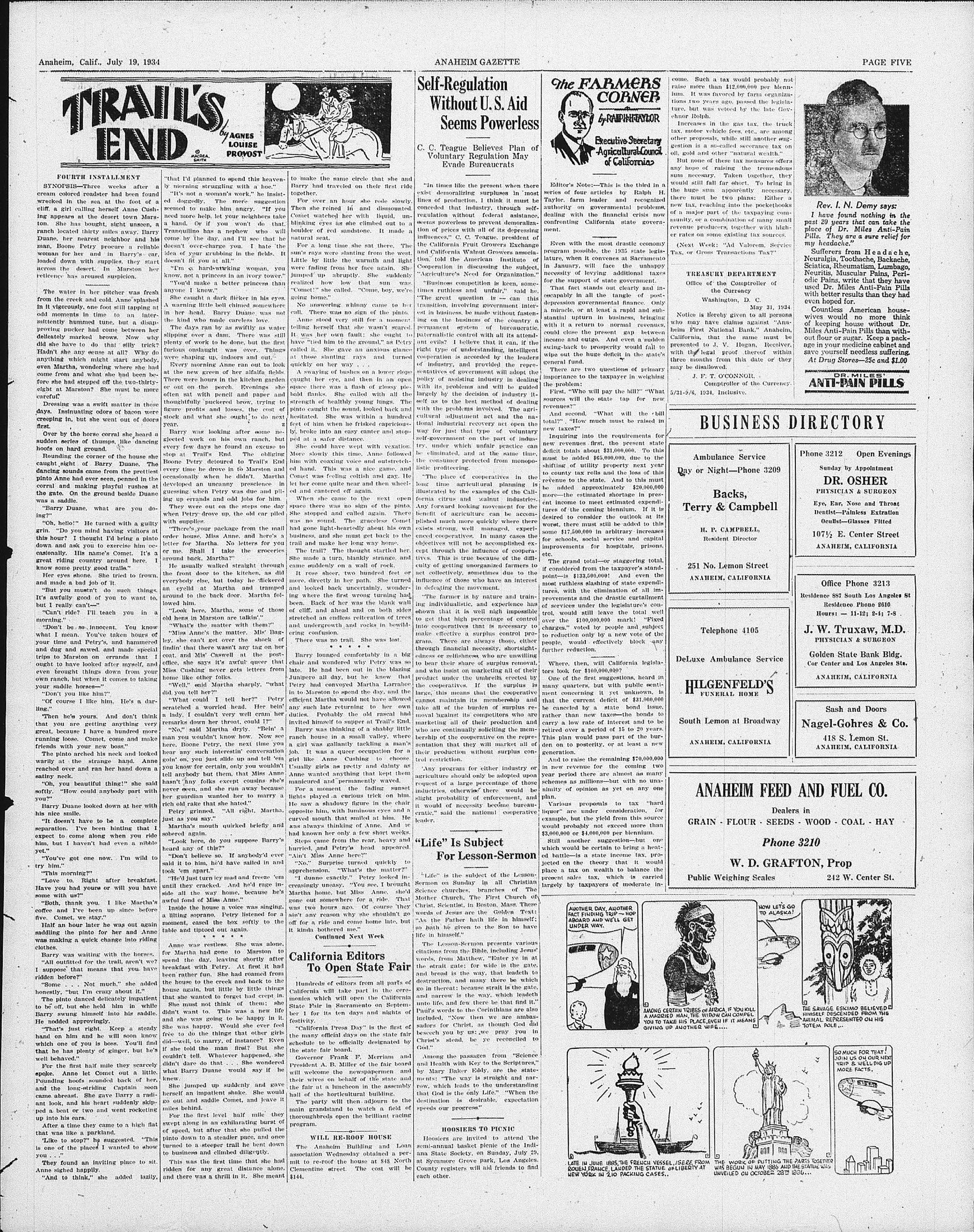
Searchable text
FOURTH INSTALLMENT
SYNOPSIS—Three weeks after a cream colored roadster had been found wrecked in the sea at the foot of a cliff, a girl calling herself Anne Cushing appears at the desert town Marson. She has bought, sight unseen, a ranch located thirty miles away. Barry Duane, her nearest neighbor and his man, Boone Petry procure a reliable woman for her and in Barry's car, loaded down with supplies, they start across the desert. In Marston her reticence has aroused suspicion.
The water in her pitcher was fresh from the creek and cold. Anne splashed in it vigorously, one foot still tapping at odd moments in time to an intermittently hummed tune, but a disapproving pucker had come between her delicately marked brows. Now why did she have to do that silly trick? Hadn't she any sense at all? Why do anything which might start anybody, even Martha, wondering where she had come from and what she had been before she had stepped off the two-thirty-eight at Marston? She must be more careful!
Dressing was a swift matter in these days. Insinuating odors of bacon were creeping in, but she went out of doors first.
Over by the horse corral she heard a sudden series of thumps, like dancing hoofs on hard ground.
Rounding the corner of the house she "that I'd planned to spend this heavenly morning struggling with a hoc."
"It's not a woman's work," he insisted doggedly. The mere suggestion seemed to make him angry. "If you need more help, let your neighbors take a hand. Or if you won't do that, Tranquillino has a nephew who will come by the day, and I'll see that he doesn't over-charge you. I hate the idea of your grubbing in the fields. It doesn't fit you at all."
"I'm a hard-wrinkling woman, you know, not a princess in an ivory tower."
"You'd make a better princess than anyone I know."
She caught a dark flicker in his eyes. A warning little bell chimed somewhere in her head. Barry Duane was not the kind who made careless love.
The days ran by as swiftly as water slipping over a dam. There was still plenty of work to be done, but the first furious onslaught was over. Things were shaping up, indoors and out.
Every morning Anne ran out to look at the new green of her alfalfa fields. There were hours in the kitchen garden or out on the porch. Evenings she often sat with pencil and paper and thoughtfully puckered brow, trying to figure profits and losses, the cost of stock and what she ought to do next year.
Barry was looking after some neglected work on his own ranch, but every few days he found an excuse to stop at Trail's End. The obliging to make the same circle Barry had traveled on together.
For over an hour she Then she reined in a Comet watched her wi blinking eyes as she c boulder of red sandstone natural seat.
For a long time she sun's rays were slanting Little by little the wa were fading from her jumped up abruptly, realized how low the Comet!' she called. "Go going home."
No answering whim call. There was no sign Anne stood very still telling herself that she It was her own fault have "died him to the g called it. She gave an at those slanting rays quickly on her way.
A swaying of bushes caught her eye, and the space there was a flash bald flanks. She calle strength of healthy you pinto caught the sound hesitated. She was wide feet of him when he frie ly broke into an easy c ped at a safer distance.
She could have wept More slowly this time.
oven Martha, wondering where she had come from and what she had been before she had stepped off the two-thirty-eight at Marston? She must be more careful.
Dressing was a swift matter in these days. Insinuating odors of bacon were creeping in, but she went out of doors first.
Over by the horse corral she heard a sudden series of thumps, like dancing hoofs on hard ground.
Rounding the corner of the house she caught sight of Barry Duane. The dancing sounds came from the prettiest plinto Anne had ever seen, penned in the corral and making playful rushes at the gate. On the ground beside Duane was a saddle.
"Barry Duane, what are you doing?"
"Oh, hello!" He turned with a guilty grin. "Do you mind having visitors at this hour? I thought I'd bring a pinto down and ask you to exercise him occasionally. His name's Comet. It's a great riding country around here. I know some pretty good trails."
Her eyes shone. She tried to frown, and made a bad job of it.
"But you mustn't do such things. It's awfully good of you to want to, but I really can't—"
"Can't ride? I'll teach you in a morning."
"Don't be so innocent. You know what I mean. You've taken hours of your time and Petry's, and hammered and dug and sawed, and made special trips to Marston on errands that I ought to have looked after myself, and even brought things down from your own ranch, but when it comes to taking your saddle horses—"
"Don't you like him?"
"Of course I like him. He's a darling."
Then he's yours. And don't think that you are getting anything very great, because I have a hundred more running loose. Comet, come and make friends with your new boss."
The plinto arched his neck and looked warily at the strange hand. Anne reached over and ran her hand down a satiny neck.
"Oh, you beautiful thing!" she said softly. "How could anybody part with you?"
Barry Duane looked down at her with his nice smile.
"It doesn't have to be a complete separation. I've been hinting that I expect to come along when you ride him, but I haven't had even a nibble yet."
"You've got one now. I'm wild to try him."
Every morning Anne ran out to look at the new green of her alfalfa fields. There were hours in the kitchen garden or out on the porch. Evenings she often sat with pencil and paper and thoughtfully puckered brow, trying to figure profits and losses, the cost of stock and what she ought to do next year.
Barry was looking after some neglected work on his own ranch, but every few days he found an excuse to stop at Trail's End. The obliging Boone Petry detoured to Trail's End every time he drove in to Marston and occasionally when he didn't. Martha developed an uncanny prescience in guessing when Petry was due and piling up errands and odd jobs for him.
They were out on the steps one day when Petry drove up, the old car piled with supplies.
"There's your package from the mail order house, Miss Anne, and here's a letter for Martha. No letters for you or me. Shall I take the groceries around back, Martha?"
He usually walked straight through the front door to the kitchen, as did everybody else, but today he flickered an eyelid at Martha and tramped around to the back door. Martha followed him.
"Look here, Martha, some of those old hens in Marston are talkin'."
"What's the matter with them?"
Miss Anne's the matter. Mis' Bagley, she can't get over the shock of findin' that there wasn't any tag on her coat, and Mis' Caswell at the postoffice, she says it's awful queer that Miss Cushing never gets letters from home like other folks.
"Well," said Martha sharply, "what did you tell her?"
What could I tell her?" Petry scratched a worried head. Her beln'a lady, I couldn't very well cram her remarks down her throat, could I?
No," said Martha dryly. "Beln'a man you wouldn't know how. Now see here. Boone Petry, the next time you hear any such interestin' conversation goin' on, you just slide up and tell 'em you know for certain, only you wouldn't tell anybody but them, that Miss Anne hasn't any folks except cousins she's never seen, and she run away because her guardian wanted her to marry a rich old rake that she hated."
Petry grinned. "All right, Martha, just as you say."
Martha's mouth quirked briefly and sobered again.
"Look here, do you suppose Barry's heard any of this?"
"Don't believe so. If anybody'd ever said it to him, he'd have sailed in and took it apart."
A swaying of bushes caught her eye, and the space there was a flash bald flanks. She called strength of healthy young pinto caught the sound, hesitated. She was wif feet of him when he frilly broke into an easy capped at a safer distance.
She could have wept More slowly this time, him with coaxing voice ed hand. This was a Comet was feeling colt let her come quite near ed and cantered off ago.
When she came to t space there was no sign She stopped and called was no sound. The g had gone light-heartedly business, and she must trail and make her long
The trail? The though She made a turn, blank came suddenly on a way It rose sheer, two hi more, directly in her pa and looked back uncer ing where the first wro been. Back of her was of cliff, ahead and stretched an endless rete and undergrowth and re ering confusion.
There was no trail.
Barry lounged comfort chair and wondered why late. He had been out Junipero all day, but he Petry had convoyed Mi in to Marston to spend t efficient Martha would not any such late returning duties. Probably the invited himself to supper Barry was thinking of ranch house in a small a girl was gallantly taj job. It was a queer oo girl like Anne Cushin Usually girls as pretty Anne wanted anything manicured and permane For a moment the lights played a curious He saw a shadowy figu opposite him, with lumin curved mouth that smile was always thinking of had known her only a fo Steps came from the m hurried, and Petry's h Ain't Miss Anne here? No." Surprise turns apprehension "What's
"Oh, you beautiful thing!" she said softly. "How could anybody part with you?"
Barry Duane looked down at her with his nice smile.
"It doesn't have to be a complete separation. I've been hinting that I expect to come along when you ride him, but I haven't had even a nibble yet."
"You've got one now. I'm wild to try him."
"This morning?"
"Love to. Right after breakfast. Have you had yours or will you have some with us?"
"Both, thank you. I like Martha's coffee and I've been up since before five. Comet, we stay."
Half an hour later he was out again saddling the plato for her and Anne was making a quick change into riding clothes.
Barry was waiting with the horses.
"All outfitted for the trail, aren't we? I suppose that means that you have ridden before?"
"Some . . . Not much," she added honestly, "but I'm crazy about it."
The pinto danced delicately impatient to be off, but she held him in while Barry swung himself into his saddle. He nodded approvingly.
"That's just right. Keep a steady hand on him and he will soon know which one of you is boss. You'll find that he has plenty of ginger, but he's well behaved."
For the first half mile they scarcely spoke. Anne let Comet out a little. Pounding hoofs sounded back of her, and the long-striding Captain soon came abreast. She gave Barry a radiant look, and his heart suddenly skipped a beat or two and went rocketing up into his ears.
After a time they came to a high flat that was like a parkland.
"Like to stop?" he suggested. "This is one of the places I wanted to show you . . ."
They found an inviting place to sit. Anne sighed happily.
"And to think," she added lazily,
tell anybody but them, that Miss Anne hasn't any folks except cousins she's never seen, and she run away because her guardian wanted her to marry a rich old rake that she hated."
Petry grinned. "All right, Martha, just as you say."
Martha's mouth quirked briefly and sobered again.
"Look here, do you suppose Barry's heard any of this?"
"Don't believe so. If anybody'd ever said it to him, he'd have salied in and took 'em apart."
He'd just turn ice mad and freeze 'em until they cracked. And he'd rage inside all the way home, because he's awful fond of Miss Anne."
Inside the house a voice was singing, a litting soprano. Petry listened for a moment, eased the box softly to the table and tiptoed out again.
Anne was restless. She was alone, for Martha had gone to Marston to spend the day, leaving shortly after breakfast with Petry. At first it had been rather fun. She had roamed from the house to the creek and back to the house again, but little by little things that she wanted to forget had crept in.
She must not think of them; she didn't want to. This was a new life and she was going to be happy in it. She was happy. Would she ever feel free to do the things that other girls did—well, to marry, of instance? Even if she told the man first? But she couldn't tell. Whatever happened, she didn't dare do that . . . She wondered what Barry Duane would say if he knew.
She jumped up suddenly and gave herself an impatient shake. She would go out and saddle Comet, and leave it miles behind.
For the first level half mile they swept along in an exhilarating burst of speed, but after that she pulled the pinto down to a steadier pace, and once turned to a steeper trail he bent down to business and climbed diligently.
This was the first time that she had ridden for any great distance alone, and there was a thrill in it. She meant
Anne wanted anything manicured and permanent.
For a moment the lights played a curious light opposite him, with luminous curved mouth that smile was always thinking of what had known her only a few steps came from the hurried, and Petry's head "Ain't Miss Anne here?"
No." Surprise turns apprehension. "What's it dunno exactly." Precisely uneasy. "You Martha home, but Miss gone out somewhere for two hours ago. Cainn't any reason why she off for a ride and come it kinda bothered me."
Continued Next
California Edit To Open S
Hundreds of editors from California will take par monies which will open State Fair in Sacramento 1 for its ten days' festivity.
"California Press Day" the many official days of schedule to be officially the state fair board.
Governor Frank F. President A. B. Miller or will welcome the news their wives on behalf of the fair at a luncheon in hall of the horticultural The party will then main grandstand to walk thoroughbreds open the program.
WILL RE-R00F
The Anaheim Build association Wednesday mit to re-roof the house Clementine street. Th $144.
to make the same circle that she and Barry had traveled on their first ride together.
For over an hour she rode slowly. Then she reined in and dismounted. Comet watched her with liquid, unblinking eyes as she climbed out to a boulder of red sandstone. It made a natural seat.
For a long time she sat there. The sun's rays were slanting from the west. Little by little the warmth and light were fading from her face again. She jumped up abruptly. She suddenly realized how low that sun was. "Comet!" she called. "Come, boy, we're going home."
No answering whinny came to her call. There was no sign of the pinto.
Anne stood very still for a moment, telling herself that she wasn't scared. It was her own fault; she ought to have "died him to the ground," as Petry called it. She gave an anxious glance at those slanting rays and turned quickly on her way.
A swaying of bushes on a lower slope caught her eye, and then in an open space there was a flash of glossy piebald flanks. She called with all the strength of healthy young lungs. The pinto caught the sound, looked back and hesitated. She was within a hundred feet of him when he frisked capriciously, broke into an easy canter and stopped at a safer distance.
She could have wept with vexation: More slowly this time. Anne followed
Self-Regulation Without U.S.Aid Seems Powerless
C. C. Teague Believes Plan of Voluntary Regulation May Evade Bureaucrats
"In times like the present when there exist demoralizing surpluses in most lines of production, I think it must be conceded that industry, through self-regulation without federal assistance, seems powerless to prevent demoralization of prices with all of its depressing influences," C. C. Teague, president of the California Fruit Growers Exchange and California Walnut Growers association, told the American Institute of Cooperation in discussing the subject, "Agriculture's Need for Organization."
"Business competition is keen, sometimes ruthless and unfair," said he.
"The great question is — can this transition, involving government interest in business, be made without fastening on the business of the country a permanent system of bureaucratic paternalistic control with all its attendant evils? I believe that it can, if the right type of understanding, intelligent cooperation is accorded by the leaders of industry, and provided the representatives of government will adopt the policy of assisting industry in dealing with its problems and will be guided largely by the decision of industry itself as to the best method of dealing with the problems involved. The agricultural adjustment act and the national industrial recovery act open the way for just that type of voluntary self-government on the part of industry, under which unfair practice can be eliminated, and at the same time, protected from harm."
Editor's Note:—This is the third in a series of four articles by Ralph H. Taylor, farm leader and recognized authority on governmental problems, dealing with the financial crisis now confronting California state government.
Even with the most drastic economy program possible, the 1935 state legislature, when it convenes at Sacramento in January, will face the unhappy necessity of levying additional taxes for the support of state government.
That fact stands out clearly and inescapably in all the tangle of post-depression governmental finance. Only a miracle, or at least a rapid and substantial upturn in business, bringing with it a return to normal revenues, could close the present gap between income and outgo. And even a sudden swing-back to prosperity would fall to wipe out the huge deficit in the state's general fund.
There are two questions of primary importance to the taxpayer in weighing the problem:
First, "Who will pay the bill?" "What sources will the state tap for new revenues?"
And second, "What will the bill total?" "How much must be raised in new taxes?"
Inquiring into the requirements for new revenues first, the present state deficit totals about $31,000,000. To this must be added $65,000,000, due to the
A swaying of bushes on a lower slope caught her eye, and then in an open space there was a flash of glossy plebald flanks. She called with all the strength of healthy young lungs. The pinto caught the sound, looked back and hesitated. She was within a hundred feet of him when he frisked capriciously, broke into an easy canter and stopped at a safer distance.
She could have wept with vexation. More slowly this time, Anne followed him with coaxing voice and outstretched hand. This was a nice game, and Comet was feeling coltish and gay. He let her come quite near and then wheeled and cantered off again.
When she came to the next open space there was no sign of the pinto. She stopped and called again. There was no sound. The graceless Comet had gone light-heartedly about his own business, and she must get back to the trail and make her long way home.
The trail? The thought startled her. She made a turn, blankly strange, and came suddenly on a wall of rock.
It rose sheer, two hundred feet or more, directly in her path. She turned and looked back uncertainly, wondering where the first wrong turning had been. Back of her was the blank wall of cliff, and ahead and on both sides stretched an endless reiteration of trees and undergrowth, and rocks in bewildering confusion.
There was no trail. She was lost.
Barry lounged comfortably in a big chair and wondered why Petry was so late. He had been out in the blazing Junipero all day, but he knew that Petry had conveyed Martha Larrabe in to Marston to spend the day, and the efficient Martha would not have allowed any such late returning to her own duties. Probably the old raseal had invited himself to supper at Trail's End.
Barry was thinking of a shabby little ranch house in a small valley, where a girl was gallantly tackling a man's job. It was a queer occupation for a girl like Anne Cushing to choose. Usually girls as pretty and dainty as Anne wanted anything that kept them manicured and permanently waved.
For a moment the fading sunset lights played a curious trick on him. He saw a shadowy figure in the chair opposite him, with luminous eyes and a curved mouth that smiled at him. He was always thinking of Anne. And it had known her only a few short weeks.
Steps came from the rear, heavy and hurried, and Petry's head appeared. "Ain't Miss Anne here?"
"No." Surprise turned quickly to apprehension. "What's the matter?"
"The place of cooperatives in the long time agricultural planning is illustrated by the examples of the California citrus and walnut industries. Any forward looking movement for the benefit of agriculture can be accomplished much more quickly where there exists strong, well managed, experienced cooperatives. In many cases the objectives will not be accomplished except through the influence of cooperatives. This is true because of the difficulty of getting unorganized farmers to act collectively, sometimes due to the influence of those who have an interest in defeating the movement.
"The farmer is by nature and training individualistic, and experience has shown that it is well nigh impossible to get that high percentage of control into cooperatives that is necessary to make effective a surplus control program. There are always those, either through financial necessity, shortsightness or selfishness, who are unwilling to bear their share of surplus removal, and who insist on marketing all of their product under the umbrella erected by the cooperatives. If the surplus is large, this means that the cooperative cannot maintain its membership and take all of the burden of surplus removal against its competitors who are marketing all of their production and who are continually soliciting the membership of the cooperative on the representation that they will market all of their production without surplus control restriction.
Any program for either industry or agriculture should only be adopted upon request of a large percentage of those industries, otherwise there would be slight probability of enforcement, and it would of necessity become bureaucratic," said the national cooperative leader.
"Life" Is Subject For Lesson-Sermon
There are two questions of primary importance to the taxpayer in weighing the problem:
First, "Who will pay the bill?" "What sources will the state tap for new revenues?"
And second, "What will the bill total?" "How much must be raised in new taxes?"
Inquiring into the requirements for new revenues first, the present state deficit totals about $31,000,000. To this must be added $65,000,000, due to the shifting of utility property next year to county tax rolls and the loss of this revenue to the state. And to this must be added approximately $20,000,000 more—the estimated shortage in present income to meet estimated expenditures of the coming biennium. If it is desired to consider the outlook at its worst, there must still be added to this some $17,500,000 in arbitrary increases for schools, social service and capital improvements for hospitals, prisons, etc.
The grand total—or staggering total, if considered from the taxpayer's standpoint—is $133,500,000! And even the most ruthless slashing of state expenditures, with the elimination of all improvements and the drastic curtailment of services under the legislature's control, would still leave the total well over the $100,000,000 mark! "Fixed charges," voted by people and subject to reduction only by a new vote of the people, would effectively block any further reduction.
Where then, will California legislators look for $100,000,000?
One of the first suggestions, heard in many quarters, but with public sentiment concerning it yet unknown, is that the current deficit of $31,000,000 be canceled by a state bond issue, rather than new taxes—the bonds to carry a low rate of interest and to be retired over a period of 15 to 20 years. This plan would pass part of the burden on to posterity, or at least a new generation.
And to raise the remaining $70,000,000 in new revenue for the coming two year period there are almost as many schemes as millions—but with no unanimity of opinion as yet on any one plan.
Various proposals to tax "hard liquor" are under consideration, for example, but the yield from this source would probably not exceed more than $3,000,000 or $4,000,000 per biennium.
Still another suggestion—but one which would be certain to bring a heated battle—is a state income tax, projected on the theory that it would place a tax on wealth to balance the
Anne wanted anything that kept them manicured and permanently waved.
For a moment the fading sunset lights played a curious trick on him. He saw a shadowy figure in the chair opposite him, with luminous eyes and a curved mouth that smiled at him. He was always thinking of Anne. And it had known her only a few short weeks.
Steps came from the rear, heavy and hurried, and Petry's head appeared. "Ain't Miss Anne here?"
"No." Surprise turned quickly to apprehension. "What's the matter?"
"I dunno exactly." Petry looked increasingly uneasy. "You see, I brought Martha home, but Miss Anne, she'd gone out somewhere for a ride. That was two hours ago. Of course they ain't any reason why she shouldn't go off for a ride and come home late, but it kinda bothered me."
Continued Next Week
California Editors To Open State Fair
Hundreds of editors from all parts of California will take part in the ceremonies which will open the California State Fair in Sacramento on September 1 for its ten days and nights of festivity.
"California Press Day" is the first of the many official days on the state fair schedule to be officially designated by the state fair board.
Governor Frank F. Merriam and President A. B. Miller of the fair board will welcome the newspapermen and their wives on behalf of the state and the fair at a luncheon in the assembly hall of the horticultural building.
The party will then adjourn to the main grandstand to watch a field of thoroughbreds open the brilliant racing program.
WILL RE-ROOF HOUSE
The Anaheim Building and Loan association Wednesday obtained a permit to re-roof the house at $48 North Clementine street. The cost will be $144.
agriculture should only be adopted upon request of a large percentage of those industries, otherwise there would be slight probability of enforcement, and it would of necessity become bureaucratic," said the national cooperative leader.
"Life" Is Subject For Lesson-Sermon
"Life" is the subject of the Lesson-Sermon on Sunday in all Christian Science churches, branches of The Mother Church, The First Church of Christ, Scientist, in Boston, Mass. These words of Jesus are the Golden Text: "As the Father hath life in himself; so hath he given to the Son to have life in himself."
The Lesson-Sermon presents various citations from the Bible, including Jesus' words, from Matthew, "Enter ye in at the strait gate; for wide is the gate, and broad is the way, that leadeth to destruction, and many there be which go in thereat; because strait is the gate, and narrow is the way, which leadeth unto life, and few there be that find it." Paul's words to the Corinthians are also included, "Now then we are ambassadors for Christ, as though God did beseech you by us: we pray you in Christ's stead, be ye reconciled to God."
Among the passages from "Science and Health with Key to the Scriptures," by Mary Baker Eddy, are the statements: "The way is straight and narrow, which leads to the understanding that God is the only Life." "When the destination is desirable, expectation speeds our progress."
HOOSIERS TO PICNIC
Hoosiers are invited to attend the semi-annual basket picnic of the Indiana State Society, on Sunday, July 29, at Sycamore Grove park, Los Angeles. County registers will aid friends to find each other.
Such a tax would probably not raise more than $12,000,000 per biennium. It was favored by farm organizations two years ago, passed the legislature, but was vetoed by the late Governor Rolph.
Increases in the gas tax, the truck tax, motor vehicle fees, etc., are among other proposals, while still another suggestion is a so-called secerance tax on oil, gold and other "natural wealth."
But none of these tax measures offers any hope of raising the tremendous sum necessary. Taken together, they would still fall far short. To bring in the huge sum apparently necessary, there must be two plans: Either a new tax, reaching into the pocketbooks of a major part of the taxpaying community, or a combination of many small revenue producers; together with higher rates on some existing tax sources.
(Next Week: "Ad Valorem Service Tax, or Gross Transactions Tax?")
TREASURY DEPARTMENT
Office of the Comptroller of the Currency
Washington, D.C.
May 31, 1934.
Notice is hereby given to all persons who may have claims against "Anaheim First National Bank," Anaheim, California, that the same must be presented to J. V. Hogan, Receiver, with the legal proof thereof within three months from this date or they may be disallowed.
J. F. T. O'CONNOR,
Comptroller of the Currency.
5/31-9/6, 1934, Inclusive.
Rev. I. N. Demy says:
I have found nothing in the past 20 years that can take the place of Dr. Miles Anti-Pain Pills. They are a sure relief for my headache."
Sufferers from Headache, Neuralgia, Toothache, Backache, Sciatica, Rheumatism, Lumbago, Neuritis, Muscular Pains, Periodic Pains, write that they have used Dr. Miles Anti-Pain Pills with better results than they had even hoped for.
Countless American housewives would no more think of keeping house without Dr. Miles Anti-Pain Pills than without flour or sugar. Keep a package in your medicine cabinet and save yourself needless suffering.
At Drug Stores—25c and $1.00
DR. MILES'
ANTI-PAIN PILLS
BUSINESS DIRECTORY
Ambulance Service
Phone 3212 Open Evenings
BUSINESS DIRECTORY
Ambulance Service
Day or Night—Phone 3209
Backs,
Terry & Campbell
H. P. CAMPBELL,
Resident Director
251 No. Lemon Street
ANAHEIM, CALIFORNIA
Phone 3212 Open Evenings
Sunday by Appointment
DR. OSHER
PHYSICIAN & SURGEON
Eye, Ear, Nose and Throat
Dentist—Painless Extration
Ocullus—Glasses Fitted
107½ E. Center Street
ANAHEIM, CALIFORNIA
Office Phone 3213
Residence 887 South Los Angeles St
Residence Phone 2610
Hours: — 11-12; 2-4; 7-8
J. W. Truxaw, M.D.
PHYSICIAN & SURGEON
Golden State Bank Bldg.
Cor Center and Los Angeles St.
ANAHEIM, CALIFORNIA
Telephone 4105
DeLuxe Ambulance Service
HILGENFELD'S
FUNERAL HOME
South Lemon at Broadway
ANAHEIM, CALIFORNIA
Sash and Doors
Nagel-Gohres & Co.
418 S. Lemon St.
ANAHEIM, CALIFORNIA
ANAHEIM FEED AND FUEL CO.
Dealers in
GRAIN - FLOUR - SEEDS - WOOD - COAL - HAY
Phone 3210
W. D. GRAFTON, Prop
ANAHEIM FEED AND FUEL CO.
Dealers in
GRAIN - FLOUR - SEEDS - WOOD - COAL - HAY
Phone 3210
W. D. GRAFTON, Prop
Public Weighing Scales 242 W. Center St.
AMONG CERTAIN TRIBES OF AFRICA, IF YOU KILL A MARRIED MAN, THE WIDOW CAN COMPEL YOU TO TAKE HIS PLACE, EVEN IF IT MEANS GIVING UP ANOTHER WIFE...
THE SAVAGE ESKIMO BELIEVED HIMSELF DESCENDED FROM THE ANIMAL REPRESENTED ON HIS TOTEM POLE...
1885, THE FRENCH VESSEL, /SEE, FROM LANDED THE STATUE OF LIBERTY AT NO PACKING CASES...
THE WORK OF PUTTING THE PARTS TOGETHER WAS BEGUN IN MAY 1886 AND THE STATUE WAS UNVEILED ON OCTOBER 28TH 1886...