anaheim-gazette 1934-07-19
Scanned page
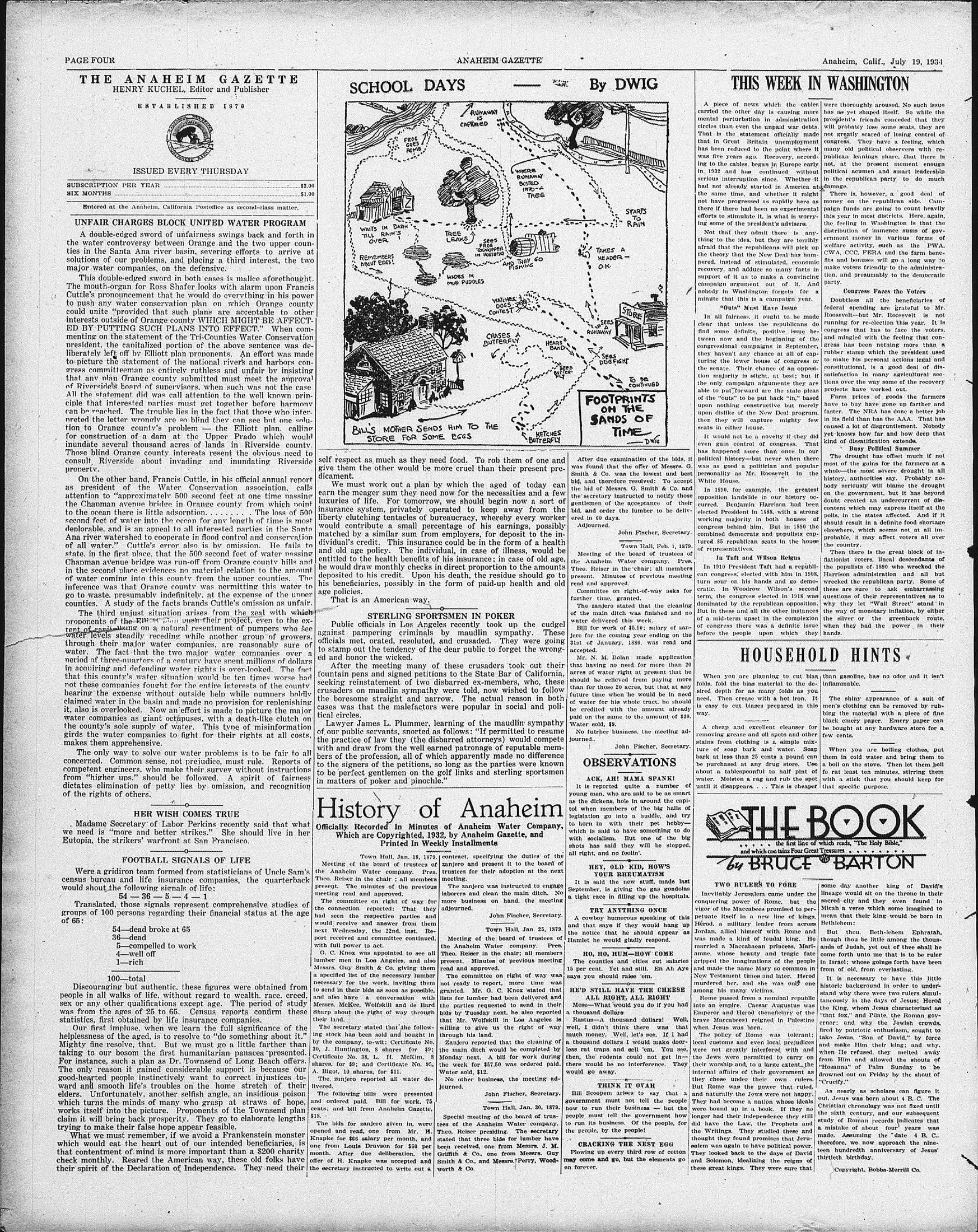
Searchable text
THE ANAHEIM GAZETTE
HENRY KUCHEL, Editor and Publisher
ESTABLISHED 1870
ISSUED EVERY THURSDAY
SUBSCRIPTION PER YEAR ... $2.00
SIX MONTHS ... $1.00
Entered at the Anaheim, California Postoffice as second-class matter.
UNFAIR CHARGES BLOCK UNITED WATER PROGRAM
A double-edged sword of unfairness swings back and forth in the water controversy between Orange and the two upper counties in the Santa Ana river basin, severing efforts to arrive at solutions of our problems, and placing a third interest, the two major water companies, on the defensive.
This double-edged sword in both cases is malice aforethought. The mouth-organ for Ross Shafer looks with alarm upon Francis Cuttle's pronouncement that he would do everything in his power to push any water conservation plan on which Orange county could unite "provided that such plans are acceptable to other interests outside of Orange county WHICH MIGHT BE AFFECTED BY PUTTING SUCH PLANS INTO EFFECT." When commenting on the statement of the Tri-Counties Water Conservation president, the capitalized portion of the above sentence was deliberately left off by Elliott plan proponents. An effort was made to picture the statement of the national rivers and harbors congress committeeman as entirely ruthless and unfair by insisting that any plan Orange county submitted must meet the approval of Riverside's board of supervisors, when such was not the case. All the statement did was call attention to the well known principle that interested parties must get together before harmonv can be reached. The trouble lies in the fact that those who interpreted the letter wrongly are so blind they can see but one solution to Orange county's problem — the Elliott plan, calling for construction of a dam at the Upper Prado which would inundate several thousand acres of lands in Riverside county. Those blind Orange county interests resent the obvious need to
to picture the statement of the national rivers and harbors congress committee as entirely ruthless and unfair by insisting that any plan Orange county submitted must meet the approval of Riverside's board of supervisors, when such was not the case. All the statement did was call attention to the well known principle that interested parties must get together before harmonv can be reached. The trouble lies in the fact that those who inter-neted the letter wrongly are so blind they can see but one solution to Orange county's problem — the Elliott plan, calling for construction of a dam at the Upper Prado which would inundate several thousand acres of lands in Riverside county. Those blind Orange county interests resent the obvious need to consult Riverside about invading and inundating Riverside property.
On the other hand, Francis Cuttle, in his official annual report as president of the Water Conservation association, calls attention to "approximately 500 second feet at one time passing the Chapman avenue bridge in Orange county from which point to the ocean there is little adsorption." The loss of 500 second feet of water into the ocean for any length of time is most deplorable, and is an appeal to all interested parties in the Santa Ana river watershed to cooperate in flood control and conservation of all water." Cuttle's error also is by omission. He fails to state, in the first place, that the 500 second feet of water passing Chapman avenue bridge was run-off from Orange county hills and in the second place evidences no material relation to the amount of water coming into this county from the upper counties. The inference was that Orange county was permitting this water to go to waste, presumably indefinitely, at the expense of the upper counties. A study of the facts brands Cuttle's omission as unfair.
The third unjust situation arises from the zeal with which proponents of the Elliott plan push their project, even to the extent of conflating on a natural resentment of pumpers who see water levels steadily receding while another group of growers through their major water companies, are reasonably sure of water. The fact that the two major water companies over a period of three-quarters of a century have spent millions of dollars in acquiring and defending water rights is over-looked. The fact that this county's water situation would be ten times worse had not these companies fought for the entire interests of the county bearing the expense without outside help while numbers boldly claimed water in the basin and made no provision for replenishing it, also is overlooked. Now an effort is made to picture the major water companies as giant octupuses, with a death-like clutch on the county's sole supply of water. This type of misinformation girds the water companies to fight for their rights at all costs, makes them apprehensive.
The only way to solve our water problems is to be fair to all concerned. Common sense, not prejudice, must rule. Reports of competent engineers, who make their survey without instructions from "higher ups," should be followed. A spirit of fairness dictates elimination of petty lies by omission, and recognition of the rights of others.
HER WISH COMES TRUE
Madame Secretary of Labor Perkins recently said that what we need is "more and better strikes." She should live in her Eutopia, the strikers' warfront at San Francisco.
FOOTBALL SIGNALS OF LIFE
HER WISH COMES TRUE
Madame Secretary of Labor Perkins recently said that what we need is "more and better strikes." She should live in her Eutopia, the strikers' warfront at San Francisco.
FOOTBALL SIGNALS OF LIFE
Were a gridiron team formed from statisticians of Uncle Sam's census bureau and life insurance companies, the quarterback would shout the following signals of life:
54 — 36 — 5 — 4 — 1
Translated, those signals represent comprehensive studies of groups of 100 persons regarding their financial status at the age of 65:
54—dead broke at 65
36—dead
5—compelled to work
4—well off
1—rich
100—total
Discouraging but authentic, these figures were obtained from people in all walks of life, without regard to wealth, race, creed, sex or any other qualifications except age. The period of study was from the ages of 25 to 65. Census reports confirm these statistics, first obtained by life insurance companies.
Our first impluse, when we learn the full significance of the helplessness of the aged, is to resolve to "do something about it." Mighty fine resolve, that. But we must go a little farther than taking to our bosom the first humanitarian panacea presented. For instance, such a plan as Dr. Townsend of Long Beach offers. The only reason it gained considerable support is because our good-hearted people instinctively want to correct injustices toward and smooth life's troubles on the home stretch of their elders. Unfortunately, another selfish angle, an insidious poison which turns the minds of many who grasp at straws of hope, works itself into the picture. Proponents of the Townsend plan claim it will bring back prosperity. They go to elaborate lengths trying to make their false hope appear feasible.
What we must remember, if we avoid a Frankenstein monster which would eat the heart out of our intended beneficiaries, is that contentment of mind is more important than a $200 charity check monthly. Reared the American way, these old folks have their spirit of the Declaration of Independence. They need their
SCHOOL DAYS By DWIG
RUNAWAY IS CAPTURED
FROG GOES HOME
WHERE RUNAWAY BUSTED IN A TREE
STARTS TO RAIN
WAITS IN BARN TILL RAIN'S OVER
TREE LEAKS
SEES FROG TOO SHOPPER IN HOGSHEAD
AND THEY GO FISHING
TAKES A HEADER - O.K.
REMEMBERS ABOUT EGGS!
WADES IN MUD PUDDLES
WATCHES DOGS CONTEST
CHASES A BUTTERFLY
HEARS BAND
SEES DOGFIGHT
TO BE CONTINUED
BILL'S MOTHER SENDS HIM TO THE STORE FOR SOME EGGS
KETCHES BUTTERFLY
FOOTPRINTS ON THE SANDS OF TIME
DWIG
self respect as much as they need food. To rob them of one and give them the other would be more cruel than their present predicament.
We must work out a plan by which the aged of today can earn the meager sum they need now for the necessities and a few luxuries of life. For tomorrow, we should begin now a sort of insurance system, privately operated to keep away from the liberty clutching tentacles of bureaucracy, whereby every worker would contribute a small percentage of his earnings, possibly matched by a similar sum from employers, for deposit to the individual's credit. This insurance could be in the form of a health and old age policy. The individual, in case of illness, would be entitled to the health benefits of his insurance; in case of old age, he would draw monthly checks in direct proportion to the amounts deposited to his credit. Upon his death, the residue should go to his beneficiaries, possibly in the form of paid-up health and old age policies.
That is an American way.
STERLING SPORTSMEN IN POKER
Public officials in Los Angeles recently took up the cudgel against pampering criminals by maudlin sympathy. These officials met, orated, resoluted, and crusaded. They were going to stamp out the tendency of the dear public to forget the wronged and honor the wicked.
After the meeting many of these crusaders took out their fountain pens and signed petitions to the State Bar of California, seeking reinstatement of two disbarred ex-members, who, these crusaders on maudlin sympathy were told, now wished to follow the boresome straight and narrow. The actual reason in both cases was that the malefactors were popular in social and political circles.
Lawyer James L. Plummer, learning of the maudlin sympathy of our public servants, snorted as follows: "If permitted to resume the practice of law they (the disbarred attorneys) would compete with and draw from the well earned patronage of reputable members of the profession, all of which apparently made no difference to the signers of the petitions, so long as the parties were known to be perfect gentlemen on the golf links and sterling sportsmen in matters of poker and pinochle."
History of Anaheim
Officially Recorded In Minutes of Anaheim Water Company, Which are Copyrighted, 1932, by Anaheim Gazette, and Printed In Weekly Installments
Town Hall, Jan. 18, 1879.
Meeting of the board of trustees of the Anaheim Water Company for their adoption at the port
After due examination of the bids, it was found that the offer of Messrs. G. Smith & Co. was the lowest and best bid, and therefore resolved: To accept the bid of Messrs. G. Smith & Co. and the secretary instructed to notify those gentlemen of the acceptance of their bid, and order the lumber to be delivered in 60 days.
Adjourned.
John Fischer, Secretary.
Town Hall, Feb. 1, 1879.
Meeting of the board of trustees of the Anaheim Water company. Press Theo. Reiser in the chair; all members present. Minutes of previous meeting read and approved.
Committee on right-of-way asks for further time, granted.
The zanjero stated that the cleaning of the main ditch was finished and no water delivered this week.
Bill for work of $5.50; salary of zanjero for the coming year ending on the 31st of January, 1880, was read and accepted.
Mr. N. M. Bolan made application that having no need for more than 20 acres of water right at present he should be relieved from paying more than for those 20 acres, but that at any future time when he would be in need of water for his whole tract, he should be credited with the amount already paid on the same to the amount of $20. Water sold, $9.
No further business, the meeting adjourned.
John Fischer, Secretary.
OBSERVATIONS
ACK, AH! MAMA SPANK!
It is reported quite a number of young men, who are said to be as smart as the dickens, hole in around the capitol when members of the big halls of legislation go into a huddle, and try to horn in with their pet hobby—which is said to have something to do with socialism. But one of the big shots has said they will be stopped, all right, and no foolin'.
HEY, OLD KID, HOW'S
History of Anaheim
Officially Recorded In Minutes of Anaheim Water Company,
Which are Copyrighted, 1932, by Anaheim Gazette, and Printed In Weekly Installments
Town Hall, Jan. 18, 1879.
Meeting of the board of trustees of the Anaheim Water company. Pres. Theo. Reiser in the chair; all members present. The minutes of the previous meeting read and approved.
The committee on right of way for the connection reported: That they had seen the respective parties and would receive and answer from them next Wednesday, the 22nd. inst. Report received and committee continued, with full power to act.
G. C. Knox was appointed to see all lumber men in Los Angeles, and also Messrs. Guy Smith & Co. giving them a specified list of the necessary lumber necessary for the work, inviting them to send in their bids as soon as possible, and also have a conversation with Messrs. McKee, Wolfskill and de Bard Sharp about the right of way through their land.
The secretary stated that the following stock has been sold and bought in by the company, to-wit: Certificate No. 30, J. Huntington, 8 shares for $9; Certificate No. 38, L. H. McKim, 8 shares, for $9; and Certificate No. 95, A. Bigot, 10 shares, for $11.
The zanjero reported all water delivered.
The following bills were presented and ordered paid. Bill for work, 75 cents; and bill from Anaheim Gazette, $18.
The bids for zanjero given in, were opened and read, one from Mr. H. Knapke for $66 salary per month, and one from Louis Dravson for $60 per month. After due deliberation, the offer of H. Knapke was accepted and the secretary instructed to write out a contract, specifying the duties of the zanjero and present it to the board of trustees for their adoption at the next meeting.
The zanjero was instructed to engage laborers and clean the main ditch. No more business on hand, the meeting adjourned.
John Fischer, Secretary.
Town Hall, Jan. 25, 1879.
Meeting of the board of trustees of the Anaheim Water company. Pres. Theo. Reiser in the chair; all members present. Minutes of previous meeting read and approved.
The committee on right of way was not ready to report, more time was granted. Mr. G. C. Knox stated that lists for lumber had been delivered and the parties requested to send in their bids by Tuesday next, he also reported that Mr. Wolfskill in Los Angeles is willing to give us the right of way through his land.
Zanjero reported that the cleaning of the main ditch would be completed by Monday next. A bill for work during the week for $57.50 was ordered paid. Water sold, $12.
No other business, the meeting adjourned.
John Fischer, Secretary.
Town Hall, Jan. 30, 1879.
Special meeting of the board of trustees of the Anaheim Water company. Theo. Reiser presiding. The secretary stated that three bids for lumber have been received, one from Messrs. J. M. Griffith & Co., one from Messrs. Guy Smith & Co., and Messrs. Perry, Woodworth & Co.
ACK, AH! MAMA SPANK!
It is reported quite a number of young men, who are said to be as smart as the dickens, hole in around the capitol when members of the big halls of legislation go into a huddle, and try to horn in with their pet hobby—which is said to have something to do with socialism. But one of the big shots has said they will be stopped, all right, and no foolin'.
HEY, OLD KID, HOW'S YOUR RHEUMATISM
It is said the new stuff, made last September, is giving the gas gondolas a tight race in filling up the hospitals.
TRY ANYTHING ONCE
A cowboy humorous speaking of this and that says if they would hang up the notice that he should appear as Hamlet he would gladly respond.
HO, HO, HUM—HOW COME
The counties and cities cut salaries 15 per cent. Yet and still. En Ah Aye says you should raise 'em.
HE'D STILL HAVE THE CHEESE
ALL RIGHT, ALL RIGHT
Mose—What would you do if you had a thousand dollars?
Rastus—a thousand dollars! Well, well, I didn't think there was that much money. Well, let's see. If I had a thousand dollars I would make doorless rat traps and sell 'em. You see, then, the rodents could not get in—there would be no interference. They would go away.
THINK IT OVAH
Bill Scoopem arises to say that a government must not tell the people how to run their business — but the people must tell the government how to run its business. Of the people, for the people, by the people!
CRACKING THE NEST EGG
Plowing up every third row of cotton may come and go, but the elements go on forever.
THIS WEEK IN WASHINGTON
A piece of news which the cables carried the other day is causing more mental perturbation in administration circles than even the unpaid war debts. That is the statement officially made that in Great Britain unemployment has been reduced to the point where it was five years ago. Recovery, according to the cables, began in Europe early in 1932 and has continued without serious interruption since. Whether it had not already started in America at the same time, and whether it might not have progressed as rapidly here as there if there had been no experimental efforts to stimulate it, is what is worrying some of the president's advisers.
Not that they admit there is anything to the idea, but they are terribly afraid that the republicans will pick up the theory that the New Deal has hampered, instead of stimulated, economic recovery, and adduce so many facts in support of it as to make a convincing campaign argument out of it. And nobody in Washington forgets for a minute that this is a campaign year.
"Outs" Must Have Issue
In all fairness, it ought to be made clear that unless the republicans do find some definite, positive issue between now and the beginning of the congressional campaigns in September, they haven't any chance at all of capturing the lower house of congress or the senate. Their chance of an opposition majority is slight, at best; but if the only campaign arguments they are able to put forward are the stale pleas of the "outs" to be put back "in," based upon nothing constructive but merely upon dislike of the New Deal program, then they will capture mighty few seats in either house.
It would not be a novelty if they did even gain control of congress. That has happened more than once in our political history—but never when there were thoroughly aroused. No such issue has yet shaped itself. So while the president's friends conceded that they will probably lose some seats, they are not greatly scared of losing control of congress. They have a feeling, which many old political observers with republican leanings share, that there is not, at the present moment enough political acumen and smart leadership in the republican party to do much damage.
There is, however, a good deal of money on the republican side. Campaign funds are going to count heavily this year in most districts. Here, again, the feeling in Washington is that the distribution of immense sums of government money in various forms of welfare activity, such as the PWA, CWA, CCC, FERA and the farm benefits and bonuses will go a long way to make voters friendly to the administration, and presumably to the democratic party.
Congress Faces the Voters
Doubtless all the beneficiaries of federal spending are grateful to Mr. Roosevelt—but Mr. Roosevelt is not running for re-election this year. It is congress that has to face the voters, and mingled with the feeling that congress has been nothing more than a rubber stamp which the president used to make his personal actions legal and constitutional, is a good deal of dissatisfaction in many agricultural sections over the way some of the recovery projects have worked out.
Farm prices of goods the farmers have to buy have gone up farther and faster. The NRA has done a better job in its field than has the AAA. That has caused a lot of disgruntlement. Nobody yet knows how far and how deep that kind of dissatisfaction extends.
Busy Political Summer
The drought has offset much if not
TO BE CONTINUED
examination of the bids, it
at the offer of Messrs. G.
was the lowest and best
before resolved: To accept
essrs. G. Smith & Co. and
instructed to notify those
the acceptance of their
or the lumber to be delivys.
John Fischer, Secretary.
Town Hall, Feb. 1, 1879.
the board of trustees of
Water company. Presin in the chair; all members
cuts of previous meeting
oved.
on right-of-way asks for
granted.
stated that the cleaning
witch was finished and no
died this week.
k of $5.50; salary of zanoming year ending on the
ary, 1880, was read and
Bolan made application
no need for more than 20
right at present that he
leaved from paying more
20 acres, but that at any
when he would be in need
his whole tract, he should
with the amount already
come to the amount of $20.
business, the meeting adservations
H! MAMA SPANK!
and quite a number of
no are said to be as smart
hole in around the capibers of the big halls of
into a huddle, and try
with their pet hobby—
to have something to do.
But one of the big
they will be stopped,
no foolin'.
THE BOOK
the first line of which reads, "The Holy Bible,"
and which contains Four Great Treasures
by BRUCE BARTON
THE BOOK
the first line of which reads, "The Holy Bible," and which contains Four Great Treasures
BY BRUCE BARTON
TWO RULERS TO FORE
Inevitably Jerusalem came under the conquering power of Rome, but the vigor of the Maccabees promised to perpetuate itself in a new line of kings. Herod, a military leader from across Jordan, allied himself with Rome and was made a kind of feudal king. He married a Maccabaean princess, Mariamne, whose beauty and tragic fate gripped the imaginations of the people and made the name Mary so common in New Testament times and later. Herod murdered her, and she was only one among his many victims.
Rome passed from a nominal republic into an empire. Caesar Augustus was Emperor and Herod (beneficiary of the brave Maccabees) reigned in Palestine when Jesus was born.
The policy of Rome was tolerant; local customs and even local prejudices were not greatly interfered with and the Jews were permitted to carry on their worship and, to a large extent, the internal affairs of their government as they chose under their own rulers. But Rome was the power that ruled, and naturally the Jews were not happy. They had become a nation whose ideals were bound up in a book. If they no longer had their independence they still did have the Law, the Prophets and the Writings. They studied these and thought they found promises that Jerusalem was again to have political power. They looked back to the days of David and Solomon, idealizing the reigns of these great kings. They were sure that some day another king of David's lineage would sit on the throne in their sacred city and they even found in Micah a verse which some imagined to mean that their king would be born in Bethlehem:
But thou, Beth-lehem Ephratah, though thou be little among the thousands of Judah, yet out of thee shall he come forth unto me that is to be ruler in Israel; whose goings forth have been from of old, from everlasting.
It is necessary to have this little historic background in order to understand why there were two rulers simultaneously in the days of Jesus; Herod the King, whom Jesus characterized as "that fox," and Pilate, the Roman governor; and why the Jewish crowds, fired by patriotic enthusiasm, sought to take Jesus, "Son of David," by force and make Him their king; and why, when He refused, they melted away from Him and allowed the shouts of "Hosanna" of Palm Sunday to be drowned out on Friday by the shout of "Crucify."
As nearly as scholars can figure it out, Jesus was born about 4 B.C. The Christian chronology was not fixed until the sixth century, and our subsequent study of Roman records indicates that a mistake of about four years was made. Assuming the date 4 B.C., therefore, we now approach the nineteen hundredth anniversary of Jesus' third birthday.
Copyright, Bobbs-Merrill Co.