anaheim-gazette 1934-04-05
Scanned page
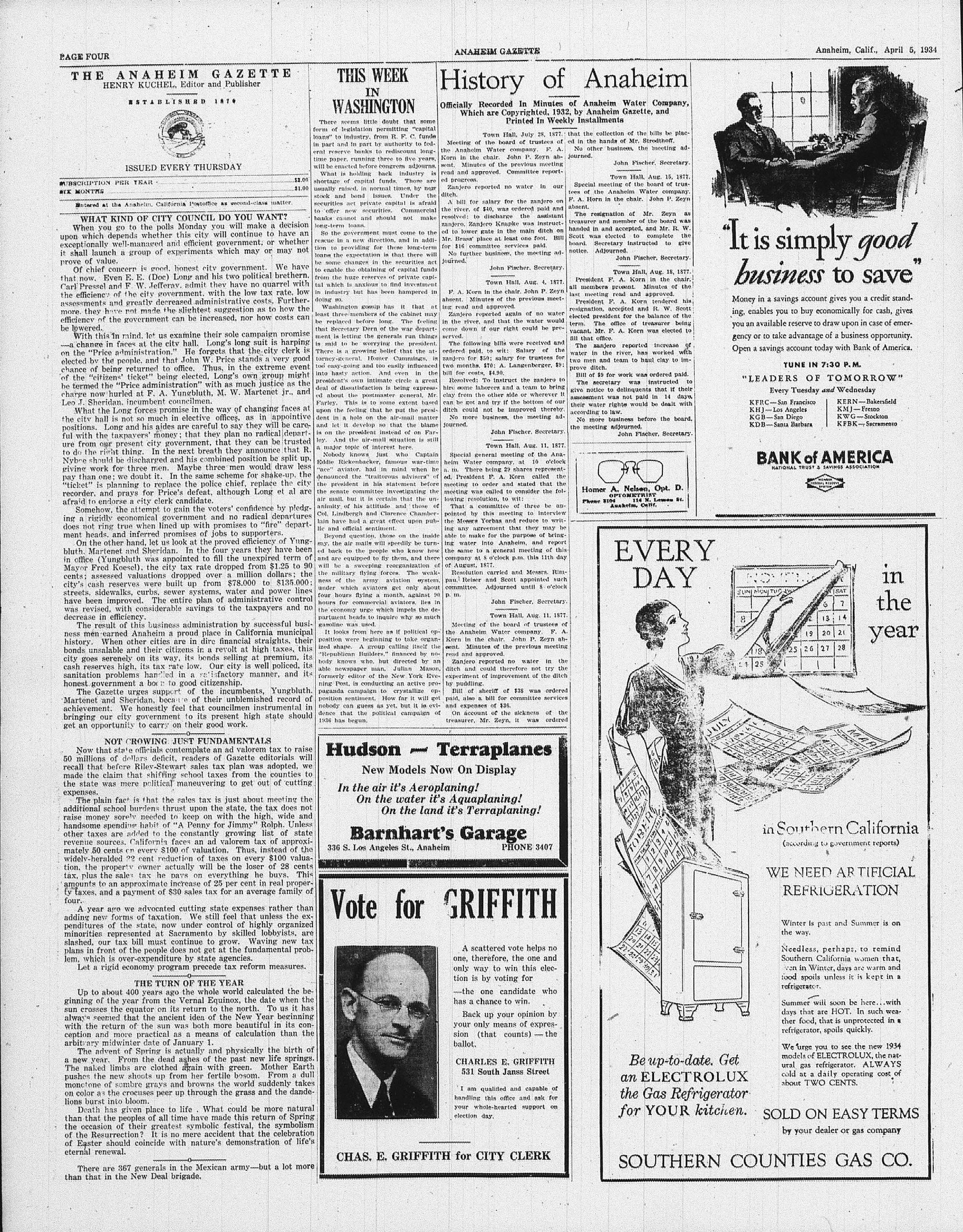
Searchable text
THE ANAHEIM GAZETTE
HENRY KUCHEL, Editor and Publisher
ESTABLISHED 1870
ISSUED EVERY THURSDAY
SUBSCRIPTION PER YEAR ... $2.00
MIX MONTHS ... $1.00
Entered at the Anaheim, California Postoffice as second-class matter.
WHAT KIND OF CITY COUNCIL DO YOU WANT?
When you go to the polls Monday you will make a decision upon which depends whether this city will continue to have an exceptionally well-managed and efficient government; or whether it shall launch a group of experiments which may or may not prove of value.
Of chief concern is good, honest city government. We have that now. Even E. E. (Doc) Long and his two political brethren, Carl Pressel and F. W. Jefferay, admit they have no quarrel with the efficiency of the city government, with the low tax rate, low assessments and greatly decreased administrative costs. Furthermore, they have not made the slightest suggestion as to how the efficiency of the government can be increased, nor how costs can be lowered.
With this in mind, let us examine their sole campaign promise—a change in faces at the city hall. Long's long suit is harping on the "Price administration." He forgets that the city clerk is elected by the people, and that John W. Price stands a very good chance of being returned to office. Thus, in the extreme event of the "citizens' ticket" being elected, Long's own group might be termed the "Price administration" with as much justice as the charge now hurled at F. A. Yungbluth, M. W. Martenet jr., and Leo J. Sheridan, incumbent councilmen.
What the Long forces promise in the way of changing faces at the city hall is not so much in elective offices, as in appointive positions. Long and his aides are careful to say they will be careful with the taxpayers' money; that they plan no radical departure from our present city government, that they can be trusted to do the right thing. In the next breath they announce that R. Nyhoe should be discharged and his combined position be split up.
What the Long forces promise in the way of changing faces at the city hall is not so much in elective offices, as in appointive positions. Long and his aides are careful to say they will be careful with the taxpayers' money; that they plan no radical departure from our present city government, that they can be trusted to do the right thing. In the next breath they announce that R. Nyboe should be discharged and his combined position be split up, giving work for three men. Maybe three men would draw less pay than one; we doubt it. In the same scheme for shake-up, the "ticket" is planning to replace the police chief, replace the city recorder, and prays for Price's defeat, although Long et al are afraid to endorse a city clerk candidate.
Somehow, the attempt to gain the voters' confidence by pledging a rigidly economical government and no radical departures does not ring true when lined up with promises to "fire" department heads, and inferred promises of jobs to supporters.
On the other hand, let us look at the proved efficiency of Yungbluth, Martenet and Sheridan. In the four years they have been in office (Yungbluth was appointed to fill the unexpired term of Mayor Fred Koesel), the city tax rate dropped from $1.25 to 90 cents; assessed valuations dropped over a million dollars; the city's cash reserves were built up from $78,000 to $135,000; streets, sidewalks, curbs, sewer systems, water and power lines have been improved. The entire plan of administrative control was revised, with considerable savings to the taxpayers and no decrease in efficiency.
The result of this business administration by successful business men earned Anaheim a proud place in California municipal history. When other cities are in dire financial straights, their bonds unsalable and their citizens in a revolt at high taxes, this city goes serenely on its way, its bonds selling at premium, its cash reserves high, its tax rate low. Our city is well policed, its sanitation problems handled in a satisfactory manner, and its honest government a boon to good citizenship.
The Gazette urges support of the incumbents, Yungbluth, Martenet and Sheridan, because of their unblemished record of achievement. We honestly feel that councilmen instrumental in bringing our city government to its present high state should get an opportunity to carry on their good work.
NOT CROWING JUST FUNDAMENTALS
Now that state officials contemplate an ad valorem tax to raise 50 millions of dollars deficit, readers of Gazette editorials will recall that before Rilev-Stewart sales tax plan was adopted, we made the claim that shifting school taxes from the counties to the state was mere political maneuvering to get out of cutting expenses.
The plain fact is that the sales tax is just about meeting the additional school burdens thrust upon the state, the tax does not raise money sorely needed to keep on with the high, wide and handsome spending habit of "A Penny for Jimmy" Rolph. Unless other taxes are added to the constantly growing list of state revenue sources, California faces an ad valorem tax of approximately 50 cents on every $100 of valuation. Thus, instead of the widely-heralded 22 cent reduction of taxes on every $100 valuation, the property owner actually will be the loser of 28 cents
made the claim that shifting school taxes from the counties to the state was mere political maneuvering to get out of cutting expenses.
The plain fact is that the sales tax is just about meeting the additional school burdens thrust upon the state, the tax does not raise money sorely needed to keep on with the high, wide and handsome spending habit of "A Penny for Jimmy" Rolph. Unless other taxes are added to the constantly growing list of state revenue sources, California faces an ad valorem tax of approximately 50 cents on every $100 of valuation. Thus, instead of the widely-heralded 22 cent reduction of taxes on every $100 valuation, the property owner actually will be the loser of 28 cents tax, plus the sales tax he pays on everything he buys. This amounts to an approximate increase of 25 per cent in real property taxes, and a payment of $30 sales tax for an average family of four.
A year ago we advocated cutting state expenses rather than adding new forms of taxation. We still feel that unless the expenditures of the state, now under control of highly organized minorities represented at Sacramento by skilled lobbyists, are slashed, our tax bill must continue to grow. Waving new tax plans in front of the people does not get at the fundamental problem, which is over-expenditure by state agencies.
Let a rigid economy program precede tax reform measures.
THE TURN OF THE YEAR
Up to about 400 years ago the whole world calculated the beginning of the year from the Vernal Equinox, the date when the sun crosses the equator on its return to the north. To us it has always seemed that the ancient idea of the New Year beginning with the return of the sun was both more beautiful in its conception and more practical as a means of calculation than the arbitrary midwinter date of January 1.
The advent of Spring is actually and physically the birth of a new year. From the dead ashes of the past new life springs. The naked limbs are clothed again with green. Mother Earth pushes the new shoots up from her fertile bosom. From a dull monctone of sombre grays and browns the world suddenly takes on color as the crocuses peer up through the grass and the dandelions burst into bloom.
Death has given place to life. What could be more natural than that the peoples of all time have made this return of Spring the occasion of their greatest symbolic festival, the symbolism of the Resurrection? It is no mere accident that the celebration of Easter should coincide with nature's demonstration of life's eternal renewal.
There are 367 generals in the Mexican army—but a lot more than that in the New Deal brigade.
THIS WEEK IN WASHINGTON
There seems little doubt that some form of legislation permitting "capital loans" to industry, from R. F. C. funds in part and in part by authority to federal reserve banks to rediscount long-time paper, running three to five years, will be enacted before congress adjourns.
What is holding back industry is shortage of capital funds. Those are usually raised, in normal times, by new stock and bond issues. Under the securities act private capital is afraid to offer new securities. Commercial banks cannot and should not make long-term loans.
So the government must come to the rescue in a new direction, and in addition to providing for these long-term loans the expectation is that there will be some changes in the securities act to enable the obtaining of capital funds from the huge reserves of private capital which is anxious to find investment in industry but has been hampered in doing so.
Washington gossip has it that at least three members of the cabinet may be replaced before long. The feeling that Secretary Dern of the war department is letting the generals run things is said to be worrying the president. There is a growing belief that the attorney-general, Homer Cummings, is too easy-going and too easily influenced into harsh action. And even in the president's own intimate circle a great deal of dissatisfaction is being expressed about the postmaster general, Mr. Farley. This is to some extent based upon the feeling that he put the president in a hole on the air-mail matter and let it develop so that the blame is on the president instead of on Farley. And the air-mail situation is still a major topic of interest here.
Nobody knows Just who Captain
History of Anaheim
Officially Recorded In Minutes of Anaheim Water Company Which are Copyrighted, 1932, by Anaheim Gazette, and Printed In Weekly Installments
Town Hall, July 28, 1877.
Meeting of the board of trustees of the Anaheim Water company, F. A. Korn in the chair. John P. Zeyn absent. Minutes of the previous meeting read and approved. Committee reported progress.
Zanjero reported no water in our ditch.
A bill for salary for the zanjero on the river, of $40, was ordered paid and resolved: to discharge the assistant zanjero. Zanjero Knapke was instructed to lower gate in the main ditch on Mr. Brass' place at least one foot. Bill for $16 committee services paid.
No further business, the meeting adjourned.
John Fischer, Secretary.
Town Hall, Aug. 4, 1877.
F. A. Korn in the chair. John P. Zeyn absent. Minutes of the previous meeting read and approved.
Zanjero reported again of no water in the river, and that the water would come down if our right could be preserved.
The following bills were received and ordered paid, to wit: Salary of the zanjero for $50; salary for trustees for two months, $70; A. Langenberger, $9; bill for costs, $4.90.
Resolved: To instruct the zanjero to hire some laborers and a team to bring clay from the other side or wherever it can be got and try if the bottom of our ditch could not be improved thereby.
No more business, the meeting adjourned.
John Fischer, Secretary.
Town Hall, Aug. 11, 1877.
Special general meeting of the Anaheim Water Company.
too easy-going and too easily influenced into hasty action. And even in the president's own intimate circle a great deal of dissatisfaction is being expressed about the postmaster general, Mr. Farley. This is to some extent based upon the feeling that he put the president in a hole on the air-mail matter and let it develop so that the blame is on the president instead of on Farley. And the air-mail situation is still a major topic of interest here.
Nobody knows Just who Captain Eddie Rickenbacker, famous war-time "ace" aviator, had in mind when he denounced the "traitorous advisers" of the president in his statement before the senate committee investigating the air mail, but it is certain that the unanimity of his attitude and those of Col. Lindbergh and Clarence Chamberlain have had a great effect upon public and official sentiment.
Beyond question, those on the inside say, the air mails will speedily be turned back to the people who know how and are equipped to fly them, and there will be a sweeping reorganization of the military flying forces. The weakness of the army aviation system, under which aviators get only about four hours flying a month, against 90 hours for commercial aviators, lies in the economy urge which impels the department heads to inquire why so much gasoline was used.
It looks from here as if political opposition were beginning to take organized shape. A group calling itself the "Republican Builders," financed by nobody knows who, but directed by an able newspaper man, Julian Mason, formerly editor of the New York Evening Post, is conducting an active propaganda campaign to crystallize opposition sentiment. How far it will get nobody can guess as yet, but it is evidence that the political campaign of 1936 has begun.
Two months, $70; A. Langenberger, $9; bill for costs, $4.90.
Resolved: To instruct the zanjero to hire some laborers and a team to bring clay from the other side or wherever it can be got and try if the bottom of our ditch could not be improved thereby.
No more business, the meeting adjourned.
John Fischer, Secretary.
Town Hall, Aug. 11, 1877.
Special general meeting of the Anaheim Water company, at 10 o'clock a.m. There being 29 shares represented, President F. A. Korn called the meeting to order and stated that the meeting was called to consider the following resolution, to wit:
That a committee of three be appointed by this meeting to interview the Messrs Yorbas and reduce to writing any agreement that they may be able to make for the purpose of bringing water into Anaheim, and report the same to a general meeting of this company at 8 o'clock p.m. this 11th day of August, 1877.
Resolution carried and Messrs. Rimpau, Reiser and Scott appointed such committee. Adjourned until 8 o'clock p.m.
John Fischer, Secretary.
Town Hall, Aug. 11, 1877.
Meeting of the board of trustees of the Anaheim Water company. F. A. Korn in the chair. John P. Zeyn absent. Minutes of the previous meeting read and approved.
Zanjero reported no water in the ditch and could therefore not try the experiment of improvement of the ditch by puddling.
Bill of sheriff of $38 was ordered paid, also a bill for committee services and expenses of $36.
On account of the sickness of the treasurer, Mr. Zeyn, it was ordered
Hudson — Terraplanes
New Models Now On Display
In the air it's Aeroplaning!
On the water it's Aquaplaning!
On the land it's Terraplaning!
Barnhart's Garage
336 S. Los Angeles St., Anaheim
PHONE 3407
In the air it's Aeroplaning!
On the water it's Aquaplaning!
On the land it's Terraplaning!
Barnhart's Garage
336 S. Los Angeles St., Anaheim PHONE 3407
Vote for GRIFFITH
A scattered vote helps no one, therefore, the one and only way to win this election is by voting for
—the one candidate who has a chance to win.
Back up your opinion by your only means of expression (that counts) — the ballot.
CHARLES E. GRIFFITH
531 South Janss Street
I am qualified and capable of handling this office and ask for your whole-hearted support on election day.
CHAS. E. GRIFFITH for CITY CLERK
"Anaheim
Anaheim Water Company,
Anaheim Gazette, and
ments
collection of the bills be placands of Mr. Strodthoff.
business, the meeting adJohn Fischer, Secretary.
Town Hall, Aug. 15, 1877.
meeting of the board of trusAnaheim Water company.
in the chair. John P. Zeyn
ignation of Mr. Zeyn as
and member of the board was
and accepted, and Mr. R. W.
elected to complete the
secretary instructed to give
journed.
John Fischer, Secretary.
Town Hall, Aug. 18, 1877.
F. A. Korn in the chair,
present. Minutes of the
ing read and approved.
F. A. Korn tendered his
accepted and R. W. Scott
president for the balance of the
office of treasurer being
F. A. Korn was elected to
ice.
Jero reported increase of
the river, has worked with
and team to haul clay to imfor work was ordered paid.
Secretary was instructed to
to delinquents that if their
was not paid in 14 days,
r rights would be dealt with
law.
business before the board,
adjourned.
John Fischer, Secretary.
"It is simply good business to save"
Money in a savings account gives you a credit standing, enables you to buy economically for cash, gives
you an available reserve to draw upon in case of emerggency or to take advantage of a business opportunity.
Open a savings account today with Bank of America.
TUNE IN 7:30 P.M.
"LEADERS OF TOMORROW"
Every Tuesday and Wednesday
KFRC—San Francisco
KHJ—Los Angeles
KGB—San Diego
KDB—Santa Barbara
KERN—Bakersfield
KMJ—Fresno
KWG—Stockton
KFBK—Sacramento
for work was ordered paid.
secretary was instructed to
to delinquents that if their
was not paid in 14 days,
right would be dealt with
law.
business before the board,
adjourned.
John Fischer, Secretary.
TUNE IN 7:30 P.M.
"LEADERS OF TOMORROW"
Every Tuesday and Wednesday
KFRC—San Francisco
KHJ—Los Angeles
KGB—San Diego
KDB—Santa Barbara
KERN—Bakersfield
KMJ—Fresno
KWG—Stockton
KFBK—Sacramento
BANK of AMERICA
NATIONAL TRUST & SAVINGS ASSOCIATION
EVERY DAY
in the year
in Southern California
(according to government reports)
in Southern California
(according to government reports)
WE NEED ARTIFICIAL REFRIGERATION
Winter is past and Summer is on the way.
Needless, perhaps, to remind Southern California women that, even in Winter, days are warm and food spoils unless it is kept in a refrigerator.
Summer will soon be here...with days that are HOT. In such weather food, that is unprotected in a refrigerator, spoils quickly.
We urge you to see the new 1934 models of ELECTROLUX, the natural gas refrigerator. ALWAYS cold at a daily operating cost of about TWO CENTS.
Be up-to-date. Get an ELECTROLUX the Gas Refrigerator for YOUR kitchen.
SOLD ON EASY TERMS
by your dealer or gas company
SOUTHERN COUNTIES GAS CO.