anaheim-gazette 1933-12-28
Scanned page
Searchable text
THE ANAHEIM GAZETTE
HENRY KUCHEL, Editor and Publisher
ESTABLISHED 1870
ISSUED EVERY THURSDAY
SUBSCRIPTION PER YEAR ... $2.00
SIX MONTHS ... $1.00
Entered at the Anaheim, California Postoffice as second-class matter.
NEW RAIL TRANSPORTATION
While we have been watching the New Deal, and speculating on its chances for success or failure, another sort of revolution has been developing in the United States, and that one is coming to the railroads themselves, and without governmental direction or control, and is one which is calculated to help the great rail systems of the nation. The change has to do with the transportation problem, and especially its passenger department.
According to an Associated Press dispatch, within a few weeks the railroads will ride into the transportation spotlight with 110-mile-an-hour streamlined trains designed to recapture some of the passenger traffic lost to bus lines, air transports and private motor cars.
Early in January, while motordom's 1934 models are being formally exhibited to the public, strange new aluminum and stainless steel versions of the "iron horse" will be streaking across the Western plains leaving the people along these transcontinental lines staring in wonder at the transformation of "old No. 6."
With two or three of the large Western systems preparing to put these highspeed trains in regular operation early in the year, some transportation observers are predicting the experiment will lead quickly to a new era in railroad equipment and service, the dispatch continues.
Early in January, while motordom's 1934 models are being formally exhibited to the public, strange new aluminum and stainless steel versions of the "iron horse" will be streaking across the Western plains leaving the people along these transcontinental lines staring in wonder at the transformation of "old No. 6."
With two or three of the large Western systems preparing to put these highspeed trains in regular operation early in the year, some transportation observers are predicting the experiment will lead quickly to a new era in railroad equipment and service, the dispatch continues.
They forecast rapid displacement of the heavy steel coach by cars of less than one-third the weight. They admit the heavy freight locomotive will continue in use, but they say passenger trains of the near future will be hauled by the new and light gas-electric gas-mechanical or oil-electric engines.
Here is a transformation that is well worth watching. A year or two ago we were informed that the railroads had lost the passenger business of the country to the bus and the private automobile. Many railroads were crying for government help and predictions were made of reorganization all the way from receiverships down to complete government operation.
Then a great many of the railroads decided to do something to help themselves, and the new model trains with their terrific speed and lower cost promise to be the result. It can be taken for granted that the majority of the people who ride the long distance busses do so because such travel is cheaper. If they can get greater speed and more comfort from the railroads at the same cost they are apt to go back to the railroads again. Of course the railroad has suffered not so much from the bus as from the privately owned automobile. But here again high speed, comfort and low cost will draw business for the railroad. For a great many men who take their families touring, with some objective point in view, would prefer to go on the train if at a reasonable cost.
Whether this revolution in passenger trains comes or not—and we think it will come—the railroads are to be commended for their efforts to try to get out of the woods. Success, by private effort when it does come is much nearer permanent, than that which comes through government aid.
PRICE FIXING
It is rapidly becoming evident that the chief defect of the NRA program is that part of it which has to do with price fixing. Price fixing always leads to suspicion, and is never popular. Either the consumer gets the idea that the established price is too high, or the producer becomes convinced that it is too low. And in addition, all efforts to get around the laws of supply and demand usually come to grief sooner or later.
A case in point is the criticism growing out of the price provisions of the cleaners and dyers' code. The new scale of prices seems to be popular neither with the public nor some of the cleaners and dyers themselves. The public is responding to the higher prices b ywearing its clothing longer between pressings and cleanings. This has caused many of the shops who do the work to suffer, with the result that there have been committees of complaint at Washington. Of course, all the cleaners do not want the price reduced but there are numbers of them who say they can make a fair profit with lower prices and that the higher motor cars.
On De
United St
time ago,
notified th
was done,
the debt,
can find o
Since other
ment has
due the U
try into w
soldiers fo
intend to o
the debt i
It is m
This is b
Eighteenth
been grea
for neigh
wine as s
So we
bassador r
for conces
States. O
the French
to do is t
money wi
stead of p
profit on t
It is s
was inform
wine quot
cultural p
direction,
Why n
which ow
any wines
the cost o
about tha
private bu
government
activities,
A case in point is the criticism growing out of the price provisions of the cleaners and dyers' code. The new scale of prices seems to be popular neither with the public nor some of the cleaners and dyers themselves. The public is responding to the higher prices by wearing its clothing longer between pressings and cleanings. This has caused many of the shops who do the work to suffer, with the result that there have been committees of complaint at Washington. Of course, all the cleaners do not want the price reduced but there are numbers of them who say they can make a fair profit with lower prices and that the higher prices will drive them out of business. Charges and counter charges of profiteering and chiseling were hurled back and forth in the meeting at Washington.
The adoption of the code for cleaners and dyers was authorized on the assumption that it would do away with sweatshop labor, racketeering and many other evils. Few people favor sweating labor; or racketeering in this or any other industry. But incident to the many complaints that go with price fixing a great many folks are wondering whether it would not have been simpler and more effective to have provided for a minimum wage and minimum week for the cleaning and dyeing industry and then to have let nature take her course.
1934, THE HOPEFUL YEAR
Habits of a lifetime are accentuated this year. People right and left, former rich and newly-poor, look forward to 1934 as a year full of hope, promise, expectations.
Mellowed by the knowledge that money is not even a major objective in a life of service, the people of Orange county and the nation are turning their attention to an expanded social order to bring the necessities and some of the luxuries of life to a greater portion of the inhabitants of this old world. The New Deal holds promise along this line.
Perhaps the most hopeful sign yet evident is that the people are studying politics, economics and social measures more candidly than ever before. They are looking into the old machinery to see what made it tick, to discover what made it go wrong, and to find out if it can be patched together for greater service, or has to be replaced altogether with long-time reform engines.
Anyhow, the mass of people are thinking. When concerted thought of our nation is turned upon the problems confronting it, we will get somewhere. The goal of banishing poverty from America may not be achieved, but definite strides forward are being made.
The greatest danger, as we see it, is not that our present problems will overwhelm us, but that our people, their stomachs filled for six months during an economic upturn, will forget to "follow through" in their political and economic thinking and turn their attention to jazz-like absurdities which fogged rational action during the credit-inflated twenties.
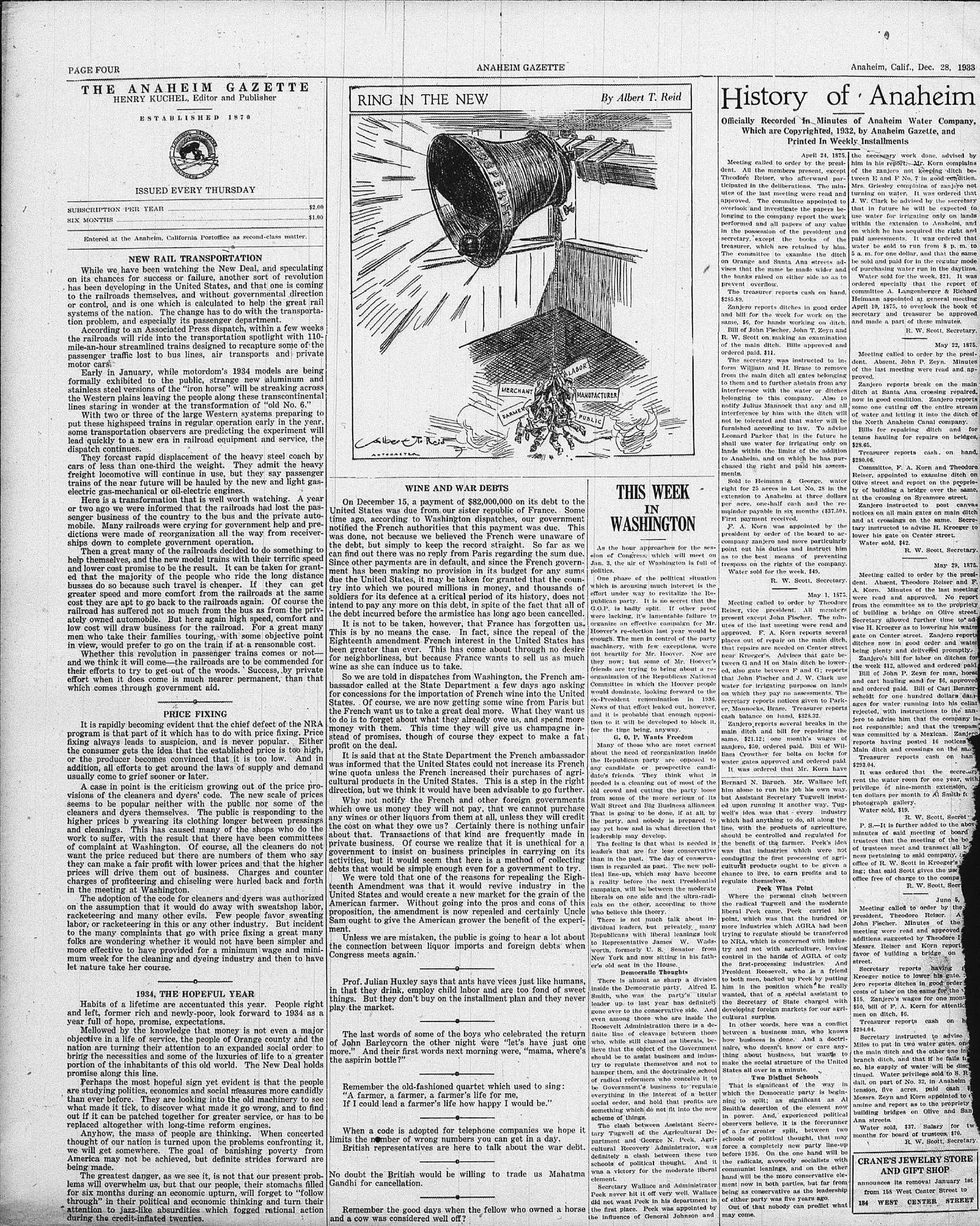
RING IN THE NEW
By Albert T. Reid
WINE AND WAR DEBTS
On December 15, a payment of $82,000,000 on its debt to the United States was due from our sister republic of France. Some time ago, according to Washington dispatches, our government notified the French authorities that this payment was due. This was done, not because we believed the French were unaware of the debt, but simply to keep the record straight. So far as we can find out there was no reply from Paris regarding the sum due. Since other payments are in default, and since the French government has been making no provision in its budget for any sums due the United States, it may be taken for granted that the country into which we poured millions in money, and thousands of soldiers for its defence at a critical period of its history, does not intend to pay any more on this debt, in spite of the fact that all of the debt incurred before the armistice has long ago been cancelled.
It is not to be taken, however, that France has forgotten us. This is by no means the case. In fact, since the repeal of the Eighteenth amendment French interest in the United States has been greater than ever. This has come about through no desire for neighborliness, but because France wants to sell us as much wine as she can induce us to take.
So we are told in dispatches from Washington, the French ambassador called at the State Department a few days ago asking for concessions for the importation of French wine into the United States. Of course, we are now getting some wine from Paris but the French want us to take a great deal more. What they want us to do is to forget about what they already owe us, and spend more money with them. This time they will give us champagne instead of promises, though of course they expect to make a fat profit on the deal.
It is said that at the State Department the French ambassador was informed that the United States could not increase its French wine quota unless the French increased their purchases of agricultural products in the United States. This is a step in the right direction, but we think it would have been advisable to go further.
Why not notify the French and other foreign governments which owe us money they will not pay, that we cannot purchase any wines or other liquors from them at all, unless they will credit the cost on what they owe us? Certainly there is nothing unfair about that. Transactions of that kind are frequently made in private business. Of course we realize that it is unethical for a government to insist on business principles in carrying on its activities, but it would seem that here is a method of collecting
THIS WEEK IN WASHINGTON
As the hour approaches for the election of Congress, which will run Jan. 3, the air of Washington is politicized.
One phase of the political process is arousing much interest; effort under way to revitalize the publican party. It is no secret that G.O.P. is badly split. If others were lacking, it's lamentable fact: organize an effective campaign in Hoover's re-election last year with enough. The men in control of the machinery, with few exceptions, not heartily for Mr. Hoover. They now; but some of Mr. Hoover friends are trying to bring about organization of the Republican New Committee in which the Hoover would dominate, looking forward ex-President renomination in News of that effort leaked out, he and it is probable that enough information to it will be developed to tell for the time being, anyway.
G. O. P. Wants Freedom
Many of those who are most about the need of reorganization in the Republican party are oppose any candidate or prospective date's friends. They think we needed is a cleaning out of most old crowd and cutting the part from some of the more serious Wall Street and Big Business all That is going to be done, if at all the party, and nobody is prepared say yet how and in what directive leadership may develop.
The feeling is that what is no leader's that are far less conscientious in the past. The day of coalition is regarded as past. The new
wine quota unless the French increased their purchases of agricultural products in the United States. This is a step in the right direction, but we think it would have been advisable to go further.
Why not notify the French and other foreign governments which owe us money they will not pay, that we cannot purchase any wines or other liquors from them at all, unless they will credit the cost on what they owe us? Certainly there is nothing unfair about that. Transactions of that kind are frequently made in private business. Of course we realize that it is unethical for a government to insist on business principles in carrying on its activities, but it would seem that here is a method of collecting debts that would be simple enough even for a government to try.
We were told that one of the reasons for repealing the Eighteenth Amendment was that it would revive industry in the United States and would create a new market for the grain of the American farmer. Without going into the pros and cons of this proposition, the amendment is now repealed and certainly Uncle Sam ought to give the American grower the benefit of the experiment.
Unless we are mistaken, the public is going to hear a lot about the connection between liquor imports and foreign debts when Congress meets again.
Prof. Julian Huxley says that ants have vices just like humans, in that they drink, employ child labor and are too fond of sweet things. But they don't buy on the installment plan and they never play the market.
The last words of some of the boys who celebrated the return of John Barleycorn the other night were "let's have just one more." And their first words next morning were, "mama, where's the aspirin bottle?"
Remember the old-fashioned quartet which used to sing:
"A farmer, a farmer, a farmer's life for me,
If I could lead a farmer's life how happy I would be."
When a code is adopted for telephone companies we hope it limits the number of wrong numbers you can get in a day.
British representatives are here to talk about the war debt.
No doubt the British would be willing to trade us Mahatma Gandhi for cancellation.
Remember the good days when the fellow who owned a horse and a cow was considered well off?
The feeling is that what is no leaders that are far less conscientious than in the past. The day of coition is regarded as past. The new tical line-up, which may have a reality before the next Pres campaign, will be between the most liberals on one side and the ultra-cals on the other, according to who believe this theory.
There is not much talk about individual leaders, but privately, Republicans with liberal leaning to Representative James W. worth, formerly U. S. Senator New York and now sitting in her's old seat in the House.
Democratic Thoughts
There is almost as sharp a inside the Democratic party. A Smith, who was the party's leader up to last year has done over to the conservative side even among those who are in Roosevelt Administration there a finite line of cleavage between who, while still classed as liberal lieve that the object of the Gov't should be to assist business and try to regulate themselves and hamper them, and the doctrinaire of radical reformers who conceal be Government's business to everything in the interest of a social order, and hold that pro-something which do not fit into scheme of things.
The clash between Assistant Tugwell of the Agricultural department and George N. Peek cultural Recovery Administrate definitely a clash between the schools of political thought. was a victory for the moderate element.
Secretary Wallace and Admin Peek never hit it off very well. did not want Peek in his departure the first place. Peek was appoilthe influence of General Johnse
History of Anaheim
Officially Recorded In Minutes of Anaheim Water Company,
Which are Copyrighted, 1932, by Anaheim Gazette, and
Printed In Weekly Installments
April 24, 1875
Meeting called to order by the president. All the members present, except
Theodore Reiser, who afterward paricipated in the deliberations. The minutes of the last meeting were read and
approved. The committee appointed to
overlook and investigate the papers belonging to the company report the work
performed and all papers of any value
in the possession of the president and
secretary, except the books of the
treasurer, which are retained by him.
The committee to examine the ditch on Orange and Santa Ana streets advises that the same be made wider and
the banks raised on either side so as to prevent overflow.
The treasurer reports cash on hand.
$285.89.
Zanjero reports ditches in good order
and bill for the week for work on the
same, $6, for hands working on ditch.
Bill of John Fischer, John T. Zeyn and
R. W. Scott on making an examination
of the main ditch. Bills approved and
ordered paid, $11.
The secretary was instructed to inform William and H. Brase to remove from the main ditch all gates belonging to them and to further abstain from any interference with the water or ditches belonging to this company. Also to notify Julius Mannock that any and all interference by him with the ditch will not be tolerated and that water will be furnished according to law. To advise Leonard Parker that in the future he shall use water for irrigating only on lands within the limits of the addition to the necessary work done, advised by him in his report. Mr. Korn complains of the zanjero not keeping ditch between E and F No. 7 in good condition. Mrs. Griesley complains of zanjero not turning on water. It was ordered that J. W. Clark be advised by the secretary that in future he will be expected to use water for irrigating only on lands within the extension to Anaheim, and on which he has acquired the right and paid assessments. It was ordered that water be sold to run from 8 p.m. to 5 a.m. for one dollar, and that the same be sold and paid for in the regular mode of purchasing water run in the daytime.
Water sold for the week, $21. It was ordered specially that the report of committee A. Langenberger & Richard Helmann appointed at general meeting April 10, 1875, to overlook the book of secretary and treasurer be approved and made a part of these minutes.
R. W. Scott, Secretary.
May 22, 1875
Meeting called to order by the president. Absent, John P. Zeyn. Minutes of the last meeting were read and approved.
Zanjero reports break on the main ditch at Santa Ana crossing repaired, now in good condition. Zanjero reports some one cutting off the entire stream of water and letting it into the ditch of the North Anaheim Canal company.
Bills for repairing ditch and for teams hauling for repairs on bridges, $28.65.
Treasurer reports cash, on hand,
THIS WEEK IN WASHINGTON
The hour approaches for the session Congress, which will meet on the air of Washington is full of phase of the political situation is arousing much interest is the under way to revitalize the Re-n party. It is no secret that the is badly split. If other proofocking, it's lamentable failure to be an effective campaign for Mr. is re-election last year would be The men in control of the party party, with few exceptions, were tardy for Mr. Hoover. Nor are now; but some of Mr. Hoover's are trying to bring about a relation of the Republican National tree in which the Hoover people dominate, looking forward to the ident renomination in 1936. If that effort leaked out, however, it is probable that enough opposition will be developed to block it, time being, anyway.
G. O. P. Wants Freedom
Of those who are most earnest the need of reorganization inside publican party are opposed to candidate or prospective candidates. They think what is is a cleaning out of most of the ward and cutting the party loose one of the more serious of its street and Big Business alliances. Going to be done, if at all, by duty, and nobody is prepared to show and in what direction that help may develop.
Ceiling is that what is needed is that are far less conservative the past. The day of conservatism as past. The new poll
The secretary was instructed to inform William and H. Brase to remove from the main ditch all gates belonging to them and to further abstain from any interference with the water or ditches belonging to this company. Also to notify Julius Mannock that any and all interference by him with the ditch will not be tolerated and that water will be furnished according to law. To advise Leonard Parker that in the future he shall use water for irrigating only on lands within the limits of the addition to Anaheim, and on which he has purchased the right and paid his assessments.
Sold to Helmann & George, water right for 25 acres in Lot No. 28 in the extension to Anahelm at three dollars per acre, one-half cash and the remainder payable in six months ($37.50). First payment received.
F. A. Korn was appointed by the president by order of the board to accompany zanjero and more particularly point out his duties and instruct him as to the best means of preventing trespass on the rights of the company. Water sold for the week, $49.
R. W. Scott, Secretary.
May 1, 1875.
Meeting called to order by Theodore Reiser, vice president. All members present except John Fischer. The minutes of the last meeting were read and approved. F. A. Korn reports several places out of repair on the main ditch, that repairs are needed on Center street near Kroeger's. Advises that gate between G and H on Main ditch be lowered, also gate between F and G; reports that John Fischer and J. W. Clark use water for irrigating purposes on lands on which they pay no assessments. The secretary reports notices given to Parker, Mannocks, Brase. Treasurer reports cash balance on hand, $328.32.
Zanjero reports several breaks in the main ditch and bill for repairing the same, $21.12; one month's wages of zanjero, $50, ordered paid. Bill of William Crowther for bolts on locks for water gates approved and ordered paid.
It was ordered that Mr. Korn have Bernard N. Baruch. Mr. Wallace left him alone to run his job his own way, but Assistant Secretary Tugwell insisted upon running it another way. Tugwell's idea was that every industry which had anything to do, all along the line, with the products of agriculture, should be controlled and regulated for the benefit of the farmer. Peek's idea was that industries which were not conducting the first processing of agricultural products ought to be given a dent. Absent, John P. Zeyn. Minutes of the last meeting were read and approved.
Zanjero reports break on the main ditch at Santa Ana crossing repaired, now in good condition. Zanjero reports some one cutting off the entire stream of water and letting it into the ditch of the North Anaheim Canal company.
Bills for repairing ditch and for teams hauling for repairs on bridges, $28.65.
Treasurer reports cash, on hand, $280.06.
Committee, F. A. Korn and Theodore Reiser, appointed to examine ditch on Olive street and report on the propriety of building a bridge over the same, at the crossing on Sycamore street.
Zanjero instructed to post canvas notices on all main gates on main ditch and at crossings on the same. Secretary instructed to advise H. Kroeger to lower his gate on Center street.
Water sold, $42.
R. W. Scott, Secretary.
May 29, 1875.
Meeting called to order by the president. Absent, Theodore Reiser and F. A. Korn. Minutes of the last meeting were read and approved. No report from the committee as to the propriety of building a bridge on Olive street. Secretary allowed further time to advise H. Kroeger as to lowering his water gate on Center street. Zanjero reports ditches now in good order and water being plenty and delivered promptly.
Zanjero's bill for labor on ditches for the week $12, allowed and ordered paid.
Bill of John P. Zeyn for man, horse and cart hauling sand for $6, approved and ordered paid. Bill of Carl Benner-scheldt for one hundred dollars damages for water running into his cellar rejected, with instructions to the zanjero to advise him that the company is not responsible; and that the trespass was committed by a Mexican. Zanjero reports having posted 16 notices Main ditch and crossings on the same.
Treasurer reports cash on han $293.04.
It was ordered that the secretary rent the water room for one year, with privilege of nine-month extension, ten dollars per month to Al Smith f photograph gallery.
Water sold, $19.
R. W. Scott, Secret
P. S.-It is further added to the above minutes of said meeting of board trustees that the meeting of the board of trustees meet and transact all business pertaining to said company, office of R. W. Scott in Kroeger's
Bernard N. Baruch, Mr. Wallace left him alone to run his job his own way, but Assistant Secretary Tugwell insisted upon running it another way. Tugwell's idea was that every industry which had anything to do, all along the line, with the products of agriculture, should be controlled and regulated for the benefit of the farmer. Peek's idea was that industries which were not conducting the first processing of agricultural products ought to be given a chance to live, to earn profits and to regulate themselves.
Peek Wins Point
Where the personal clash between the radical Tugwell and the moderate liberal Peek came, Peek carried his point, which was that the hundred or more industries which AGRA had been trying to regulate should be transferred to NRA, which is concerned with industry and not with agriculture, leaving control in the hands of AGRA of only the first-processing industries. And President Roosevelt, who is a friend to both men, backed up Peek by putting him in the position which he really wanted, that of a special assistant to the Secretary of State charged with developing foreign markets for our agricultural surplus.
In other words, here was a conflict between a business man, who knows how business is done. And a doctrinaire, who doesn't know or care anything about business, but wants to make the social structure of the United States all over in a minute.
Two Distinct Schools
That is significant of the way in which the Democratic party is beginning to split; as significant as Al Smith's desertion of the element now in power. And, experienced political observers believe, it is the forerunner of a far greater split, between two schools of political thought, that may force a completely new party line-up before 1936. On the one hand will be the radicals, avowedly socialists with communist leanings, and on the other hand will be the more conservative element now in both parties, but far from being as conservative as the leadership of either party was five years ago.
Out of that nobody can predict what may come.
It was ordered that the secretary rent the water room for one year, with privilege of nine-month extension, ten dollars per month to Al Smith for photograph gallery.
Water sold, $19.
R. W. Scott, Secretary
P. S.—It is further added to the above minutes of said meeting of board trustees that the meeting of the board of trustees meet and transact all business pertaining to said company, office of R. W. Scott in Kroeger's acting; that said Scott gives the use office free of charge to the company.
R. W. Scott, Secretr
June 5,
Meeting called to order by the president, Theodore Reisler. A John Fischer. Minutes of the meeting were read and approved additions suggested by Theodore I. Messrs. Reisler and Korn report favor of building a bridge on street.
Secretary reports having P. Kroeger notice to lower his gate. Jero reports ditches in good order costs of labor on the same for the wi$15. Zanjero's wages for one month $50, bill of F. A. Korn for attentive men on ditch, $6.
Treasurer reports cash on h$294.04.
Secretary instructed to advise Miles to put in two water gates, on the main ditch and the other one in branch ditch, and that if he falls so, his supply of water will be discontinued. Water privilege sold to S. R. dall, on part of No. 32, in Anaheim tension, five acres, paid cash $Messrs. Zeyn and Korn appointed to amine and report as to the propriety building bridges on Olive and San Ana streets.
Water sold, $37. Salary for two months for board of trustees, $70.
R. W. Scott, Secretary