anaheim-gazette 1933-12-14
Scanned page
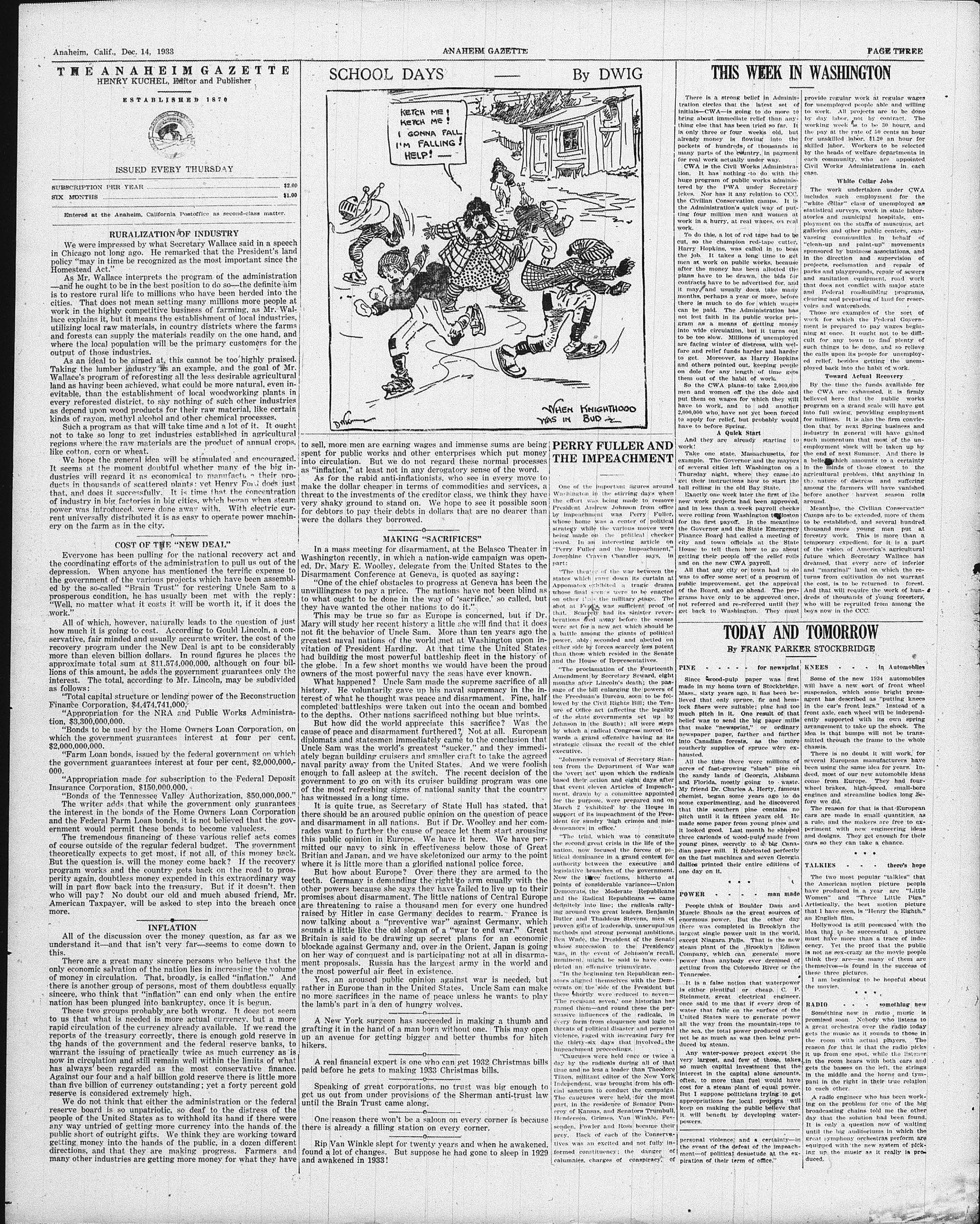
Searchable text
THE ANAHEIM GAZETTE
HENRY KUCHEL, Editor and Publisher
ESTABLISHED 1870
ISSUED EVERY THURSDAY
SUBSCRIPT PER YEAR $2.00
SIX MONTHS $1.00
Entered at the Anaheim, California Postoffice as second-class matter.
RURALIZATION OF INDUSTRY
We were impressed by what Secretary Wallace said in a speech in Chicago not long ago. He remarked that the President's land policy "may in time be recognized as the most important since the Homestead Act."
As Mr. Wallace interprets the program of the administration—and he ought to be in the best position to do so—the definite aim is to restore rural life to millions who have been herded into the cities. That does not mean setting many millions more people at work in the highly competitive business of farming, as Mr. Wallace explains it, but it means the establishment of local industries, utilizing local raw materials, in country districts where the farms and forests can supply the materials readily on the one hand, and where the local population will be the primary customers for the output of those industries.
As an ideal to be aimed at, this cannot be too highly praised. Taking the lumber industry as an example, and the goal of Mr. Wallace's program of reforesting all the less desirable agricultural land as having been achieved, what could be more natural, even inevitable, than the establishment of local woodworking plants in every reforested district, to say nothing of such other industries as depend upon wood products for their raw material, like certain kinds of rayon, methyl alcohol and other chemical processes.
Such a program as that will take time and a lot of it. It ought not to take so long to get industries established in agricultural regions where the raw materials are the product of annual crops, like cotton, corn or wheat.
As an ideal to be aimed at, this cannot be too highly praised. Taking the lumber industry as an example, and the goal of Mr. Wallace's program of reforesting all the less desirable agricultural land as having been achieved, what could be more natural, even inevitable, than the establishment of local woodworking plants in every reforested district, to say nothing of such other industries as depend upon wood products for their raw material, like certain kinds of rayon, methyl alcohol and other chemical processes.
Such a program as that will take time and a lot of it. It ought not to take so long to get industries established in agricultural regions where the raw materials are the product of annual crops, like cotton, corn or wheat.
We hope the general idea will be stimulated and encouraged. It seems at the moment doubtful whether many of the big industries will regard it as economical to manufacture their products in thousands of scattered plants: vet Henry Ford does just that, and does it successfully. It is time that the concentration of industry in big factories in big cities, which began when steam power was introduced, were done away with. With electric current universally distributed it is as easy to operate power machinery on the farm as in the city.
COST OF THE "NEW DEAL"
Everyone has been pulling for the national recovery act and the coordinating efforts of the administration to pull us out of the depression. When anyone has mentioned the terrific expense to the government of the various projects which have been assembled by the so-called "Brain Trust" for restoring Uncle Sam to a prosperous condition, he has usually been met with the reply: "Well, no matter what it costs it will be worth it, if it does the work."
All of which, however, naturally leads to the question of just how much it is going to cost. According to Gould Lincoln, a conservative, fair minded and usually accurate writer, the cost of the recovery program under the New Deal is apt to be considerably more than eleven billion dollars. In round figures he places the approximate total sum at $11,574,000,000, although on four billions of this amount, he adds the government guarantees only the interest. The total, according to Mr. Lincoln, may be subdivided as follows:
"Total capital structure or lending power of the Reconstruction Finance Corporation, $4,474,741,000."
"Appropriation for the NRA and Public Works Administration, $3,300,000,000."
"Bonds to be used by the Home Owners Loan Corporation, on which the government guarantees interest at four per cent, $2,000,000,000."
"Farm Loan bonds, issued by the federal government on which the government guarantees interest at four per cent, $2,000,000,-000."
"Appropriation made for subscription to the Federal Deposit Insurance Corporation, $150,000,000."
"Bonds of the Tennessee Valley Authorization, $50,000,000."
The writer adds that while the government only guarantees the interest in the bonds of the Home Owners Loan Corporation and the Federal Farm Loan bonds, it is not believed that the government would permit these bonds to become valueless.
The tremendous financing of these various relief acts comes of course outside of the regular federal budget. The government theoretically expects to get most, if not all, of this money back. But the question is, will the money come back? If the recovery
In a mass meeting Washington received Dr. Mary E. V. Disarmament Corp.
"One of the chief unwillingness to pay to what ought to pay for debtors to pay were the dollars to sell, more men spent for public into circulation."
This may be Mary will study how not fit the behavior greatest naval naval variation of President had building the globe. In a few owners of the moor.
What happened history. He volunteered of what he completed battles to the depths. O
But how did cause of peace and diplomats and star Uncle Sam was tately began building naval parity away enough to fall as government to go of the most refreshed has witnessed in a
It is quite true there should be an and disarmament rades want to fund this public opinion mitted our navy Britian and Japan where it is little r
"Appropriation made for subscription to the Federal Deposit Insurance Corporation, $150,000,000."
"Bonds of the Tennessee Valley Authorization, $50,000,000."
The writer adds that while the government only guarantees the interest in the bonds of the Home Owners Loan Corporation and the Federal Farm Loan bonds, it is not believed that the government would permit these bonds to become valueless.
The tremendous financing of these various relief acts comes of course outside of the regular federal budget. The government theoretically expects to get most, if not all, of this money back. But the question is, will the money come back? If the recovery program works and the country gets back on the road to prosperity again, doubtless money expended in this extraordinary way will in part flow back into the treasury. But if it doesn't, then who will pay? No doubt our old and much abused friend, Mr. American Taxpayer, will be asked to step into the breach once more.
INFLATION
All of the discussion over the money question, as far as we understand it—and that isn't very far—seems to come down to this.
There are a great many sincere persons who believe that the only economic salvation of the nation lies in increasing the volume of money in circulation. That, broadly, is called "inflation." And there is another group of persons, most of them doubtless equally sincere, who think that "inflation" can end only when the entire nation has been plunged into bankruptcy, once it is begun.
These two groups probably are both wrong. It does not seem to us that what is needed is more actual currency, but a more rapid circulation of the currency already available. If we read the reports of the treasury correctly, there is enough gold reserve in the hands of the government and the federal reserve banks, to warrant the issuing of practically twice as much currency as is now in circulation and still remain well within the limits of what has always been regarded as the most conservative finance. Against our four and a half billion gold reserve there is little more than five billion of currency outstanding; yet a forty percent gold reserve is considered extremely high.
We do not think that either the administration or the federal reserve board is so unpatriotic, so deaf to the distress of the people of the United States as to withhold its hand if there were any way untried of getting more currency into the hands of the public short of outright gifts. We think they are working toward getting money into the hands of the public, in a dozen different directions, and that they are making progress. Farmers and many other industries are getting more money for what they have enough to fall asleep on government to go on with their witness in an important public opinion mitted our navy Britian and Japan where it is little more.
But how about teeth. Germany now talking about sounds a little like Britain is said to blockade against her way of comment proposals, the most powerful Yes, an arouse rather in Europe no more sacrifice the lamb's part in A New York grafting it in the up an avenue for hikers. A real financial paid before he Speaking of get us out from until the Brain T One reason there is already Rip Van Winkle found a lot of char and awakened in
SCHOOL DAYS — By DWIG
KETCH ME!
KETCH ME!
I GONNA FALL
I'M FALLING!
HELP!
WHEN KNIGHTHOOD
WAS IN BUD
PERRY FULLER AND
THE IMPEACHMENT
to sell, more men are earning wages and immense sums are being spent for public works and other enterprises which put money into circulation. But we do not regard these normal processes as "inflation," at least not in any derogatory sense of the word.
As for the rabid anti-inflationists, who see in every move to make the dollar cheaper in terms of commodities and services, a threat to the investments of the creditor class, we think they have very shaky ground to stand on. We hope to see it possible soon for debtors to pay their debts in dollars that are no dearer than were the dollars they borrowed.
MAKING "SACRIFICES"
In a mass meeting for disarmament, at the Belasco Theater in Washington recently, in which a nation-wide campaign was opened, Dr. Mary E. Woolley, delegate from the United States to the Disarmament Conference at Geneva, is quoted as saying:
"One of the chief obstacles to progress at Geneva has been the unwillingness to pay a price. The nations have not been blind as to what ought to be done in the way of 'sacrifice,' so called, but they have wanted the other nations to do it."
This may be true so far as Europe is concerned, but if Dr. Mary will study her recent history a little she will find that it does not fit the behavior of Uncle Sam. More than ten years ago the greatest naval nations of the world met at Washington upon invitation of President Harding. At that time the United States had building the most powerful battleship fleet in the history of the globe. In a few short months we would have been the proud owners of the most powerful navy the seas have ever known.
What happened? Uncle Sam made the supreme sacrifice of all history. He voluntarily gave up his naval supremacy in the interest of what he thought was peace and disarmament. Fine, half completed battleships were taken out into the ocean and bombed to the depths. Other nations sacrificed nothing but blueprints.
But how did the world appreciate this sacrifice? Was the cause of peace and disarmament furthered? Not at all. European diplomats and statesmen immediately came to the conclusion that Uncle Sam was the world's greatest "sucker," and they immediately began building cruisers and smaller craft to take the agreed naval parity away from the United States. And we were foolish enough to fall asleep at the switch. The recent decision of the government to go on with its cruiser building program was one of the most refreshing signs of national sanity that the country has witnessed in a long time.
It is quite true, as Secretary of State Hull has stated, that there should be an aroused public opinion on the question of peace and disarmament in all nations. But if Dr. Woolley and her comrades want to further the cause of peace let them start arousing this public opinion in Europe. We have it here. We have permitted our navy to sink in effectiveness below those of Great Britian and Japan, and we have skeletonized our army to the point where it is little more than a glorified national police force.
PERRY FULLER AND THE IMPEACHMENT
One of the important figures around Washington in the stirring days when the effort was being made to remove President Andrew Johnson from office by impeachment was Perry Fuller, whose home was a center of political strategy while the various moves were being made on the political checker board. In an interesting article on "Perry Fuller and the Impeachment," Josephine Craven Chandler says, in part:
"The theater of the war between the states which rang down its curtain at Appomattox exhibited a tragic drama whose final scenes were to be enacted on other than the military stage. The shot at Fort Sill was sufficient proof of that. Scarcely had its sinister reverberations fled away before the scenes were set for a new act which should be a battle among the giants of political power, ably seconded and abetted on either side by forces scarcely less potent than those which resided in the Senate and the House of Representatives.
"The proclamation of the Fourteenth Amendment by Secretary Seward, eight months after Lincoln's death; the passage of the bill enlarging the powers of the Freedman's Bureau, soon to be followed by the Civil Rights Bill; the Tenure of Office act (affecting the legality of the state governments set up by Johnson in the South); all were steps by which a radical Congress moved towards a grand offensive having as its strategic climax the recall of the chief executive.
"Johnson's removal of Secretary Stanton from the Department of War was the 'overt act' upon which the radicals based their action and eight days after that event eleven Articles of Impeachment, drawn by a committee appointed for the purpose, were prepared and on March 2 'exhibited' by the House in support of its impeachment of the President for sundry high crimes and misdemeanors in office."
The trial, which was to constitute the second great crisis in life of the nation, now focused the forces of political dominance in a grand contest for authority between the executive and
enough to fall asleep at the switch. The recent decision of the government to go on with its cruiser building program was one of the most refreshing signs of national sanity that the country has witnessed in a long time.
It is quite true, as Secretary of State Hull has stated, that there should be an aroused public opinion on the question of peace and disarmament in all nations. But if Dr. Woolley and her comrades want to further the cause of peace let them start arousing this public opinion in Europe. We have it here. We have permitted our navy to sink in effectiveness below those of Great Britian and Japan, and we have skeletonized our army to the point where it is little more than a glorified national police force.
But how about Europe? Over there they are armed to the teeth. Germany is demanding the right to arm equally with the other powers because she says they have failed to live up to their promises about disarmament. The little nations of Central Europe are threatening to raise a thousand men for every one hundred raised by Hitler in case Germany decides to rearm. France is now talking about a "preventive war" against Germany, which sounds a little like the old slogan of a "war to end war." Great Britain is said to be drawing up secret plans for an economic blockade against Germany and, over in the Orient, Japan is going on her way of conquest and is participating not at all in disarmament proposals. Russia has the largest army in the world and the most powerful air fleet in existence.
Yes, an aroused public opinion against war is needed; but rather in Europe than in the United States. Uncle Sam can make no more sacrifices in the name of peace unless he wants to play the lamb's part in a den of hungry wolves.
A New York surgeon has succeeded in making a thumb and grafting it in the hand of a man born without one. This may open up an avenue for getting bigger and better thumbs for hitch hikers.
A real financial expert is one who can get 1932 Christmas bills paid before he gets to making 1933 Christmas bills.
Speaking of great corporations, no trust was big enough to get us out from under provisions of the Sherman anti-trust law until the Brain Trust came along.
One reason there won't be a saloon on every corner is because there is already a filling station on every corner.
Rip Van Winkle slept for twenty years and when he awakened, found a lot of changes. But suppose he had gone to sleep in 1929 and awakened in 1933!
THIS WEEK IN WASHINGTON
There is a strong belief in Administration circles that the latest set of initials—CWA—is going to do more to bring about immediate relief than anything else that has been tried so far. It is only three or four weeks old, but already money is flowing into the pockets of hundreds of thousands in many parts of the country, in payment for real work actually under way.
CWA is the Civil Works Administration. It has nothing to do with the huge program of public works administered by the PWA under Secretary Ickes. Nor has it any relation to CCC, the Civilian Conservation camps. It is the Administration's quick way of putting four million men and women at work in a hurry, at real wages, on real work.
To do this, a lot of red tape had to be cut, so the champion red-tape cutter, Harry Hopkins, was called in to boss the job. It takes a long time to get men at work on public works, because after the money has been allotted the plans have to be drawn, the bids for contracts have to be advertised for, and it may and usually does, take many months, perhaps a year or more, before there is much to do for which wages can be paid. The Administration has not lost faith in its public works program as a means of getting money into wide circulation, but it turns out to be too slow. Millions of unemployed are facing winter of distress, with welfare and relief funds harder and harder to get. Moreover, as Harry Hopkins and others pointed out, keeping people on dole for any length of time gets them out of the habit of work.
So the CWA plans to take 2,000,000 men and women off the dole and put them on wages for which they will have to work, and to add another 2,000,000 who, have not yet been forced to apply for relief, but probably would have to before Spring.
A Qulek Start
And they are already starting to work!
Take one state, Massachusetts, for provide regular work at regular wages for unemployed people able and willing to work. All projects are to be done by day labor, not by contract. The working week is to be 30 hours, and the pay at the rate of 50 cents an hour for unskilled labor, $1.20 an hour for skilled labor. Workers to be selected by the heads of welfare departments in each community, who are appointed Civil Works Administrations in each case.
White Collar Jobs
The work undertaken under CWA includes such employment for the "white collar" class of unemployed as statistical surveys, work in state laboratories and municipal hospitals, employment on the staffs of museums, art galleries and other public centers, canvassing communities in behalf of "clean-up and paint-up" movements sponsored by business associations, and in the direction and supervision of projects, reclamation and repair of parks and playgrounds, repair of sewers and sanitation equipment, road work that does not conflict with major state and Federal roadbuilding programs, clearing and preparing of land for reservoirs and watersheds.
Those are examples of the sort of work for which the Federal Government is prepared to pay wages beginning at once. It ought not to be difficult for any town to find plenty of such things to be done, and so relieve the calls upon its people for unemployed relief, besides getting the unemployed back into the habit of work.
Toward Actual Recovery
By the time the funds available for the CWA are exhausted, it is firmly believed here that the public works program on a grand scale will have got into full swing, providing employment for millions. It is also the firm conviction that by next Spring business and industry in general will have gained such momentum that most of the unemployment slack will be taken up by the end of next Summer. And there is
TODAY AND TOMORROW
By FRANK PARKER STOCKBRIDGE
PINE for newsprint
Since wood-pulp paper was first made in my home town of Stockbridge, Mass., sixty years ago, it has been believed that only spruce, fir and hemlock fibers were suitable; pine had too much pitch in it. One result of that belief was to send the big paper mills that make "newsprint," or ordinary newspaper paper, farther and farther into Canadian forests, as the more southerly supplies of spruce were exhausted.
All the time there were millions of acres of fast-growing "slash" pine on the sandy lands of Georgia, Alabama and Florida, mostly going to waste. My friend Dr. Charles A. Herty, famous chemist, began some years ago to do some experimenting, and he discovered that this southern pine contains no pitch until it is fifteen years old. He made some paper from young pines and it looked good. Last month he shipped three carloads of wood-pulp made from young pines, secretly to a big Canadian paper mill. It fabricated perfectly on the fast machines and seven Georgia dailies printed their entire editions of relief, besides getting the unemployed back into the habit of work.
Toward Actual Recovery
By the time the funds available for the CWA are exhausted, it is firmly believed here that the public works program on a grand scale will have got into full swing, providing employment for millions. It is also the firm conviction that by next Spring business and industry in general will have gained such momentum that most of the unemployment slack will be taken up by the end of next Summer. And there is a belief which amounts to a certainty in the minds of those closest to the agricultural problem, that anything in the nature of distress and suffering among the farmers will have vanished before another harvest season rolls around.
Meantime, the Civilian Conservation Camps are to be extended, more of them to be established, and several hundred thousand more young men put at forestry work. This is more than a temporary expedient; for it is part of the vision of America's agricultural future which Secretary Wallace has dreamed, that every acre of inferior and "marginal" land on which the returns from cultivation do not warrant the cost, is to be returned to forest. And that will require the work of hundreds of thousands of young foresters, who will be recruited from among the boys now in the CCC.
which the radicals and eight days after articles of Impach committee appointed were prepared and on by the House in enactment of the Pres-egh crimes and mis-
was to constitute basis in the life of the and the forces of po-a grand contest for the executive and of the government. tions, hitherto at whole variance—Union moderate Republicans republicans — came into the radicals rally-t leaders, Benjamin Stevens, men of pers-ship, unsercupulous personal ambitions. president of the Senate to the Presidency of Johnson's recall, said to have contrimvirate.
ten Republican sen-selves with the Dem- of the President but pre-reduced to seven—one historian has found these the per- of the radicals, in sequence and logic to disaster and personal increasing fury for that involved the readings.
field once or twice is during all of that reader than Theodore or of the New York bought from his offi-duct the campaign held, for the most price of Senator Pom-Senators Trumbull, Van Winkle, Fess-Ross became their of the Conserva- and not fully in-; the danger of conspiracy, of
personal violence; and a certainty—in the event of the defeat of the impeachment—of political desuetude at the expiration of their term of office."
TALKIES ... there's hope
The two most popular "talkies" that the American motion picture people have produced in a year are "Little Women" and "Three Little Pigs." Artistically, the best motion picture that I have seen, is "Henry the Eighth," an English film.
Hollywood is still possessed with the idea that to be successful a picture must have more than a trace of inde-cency. Yet the proof that the public is not as sex-crazy as the movie people think they are—as many of them are themselves—is found in the success of these three pictures.
I am beginning to be hopeful about the movies.
RADIO ... something new
Something new in radio music is promised soon. Nobody who listens to a great orchestra over the radio today gets the music as it sounds to those in the room with actual players. The reason for that is that the radio picks it up from one spot, while the listener in the room hears with both ears and gets the basses on the left, the strings in the middle and the horns and tym-pan in the right in their true relation to each other.
A radio engineer who has been working on the problem for one of the big broadcasting chains told me the other day that the solution had been found. It is only a question now of waiting until the big auditoriums in which the great symphony orchestras perform are equipped with the new system of picking up the music as it really is produc-