anaheim-gazette 1933-12-07
Scanned page
Searchable text
THE ANAHEIM GAZETTE
HENRY KUCHEL, Editor and Publisher
ESTABLISHED 1870
ISSUED EVERY THURSDAY
SUBSCRIPTION PER YEAR $2.00
SIX MONTHS $1.00
Entered at the Anaheim, California Postoffice as second-class matter.
SOME GOOD ADVICE
There was a great deal of hard, common sense, in a lecture delivered before the University Club at Washington, D.C., recently by Lothroy Stoddard, noted author and lecturer, who advised, among other things, that America isolate herself from Europe politically if we want to avoid the next war which, Mr. Stoddard believes, will break out within the next five years. The League of Nations and Versailles treaty have failed, Mr. Stoddard declared, and he added: "Never has the world been so blatantly nationalistic as since Versailles. So let us keep out of this mess brewing in Europe."
The author said that if we advance goods to Soviet Russia on long time credit we will never get paid for them and he characterized the oriental policy promulgated under Secretary Stimson as "extraordinarily indefensible" and one calculated to draw us into war. Mr. Stoddard stated that in his opinion what America needs most in her international policy is to see things as they actually are, without distorting the view through international idealism. Such idealism, he added, is blind, and fails to take into consideration such actualities as the fact that "International law does not exist."
Mr. Stoddard's observations will certainly bear repeating. The trouble with most of our internationalists, especially those who do not have a predatory motive for their internationalism, is that they permit their idealism to blind them to the real political facts. They assume that nearly everyone, the world over, thinks and believes as they do, and all that is necessary for international
into war. Mr. Stoddard stated that in his opinion what America needs most in her international policy is to see things as they actually are, without distorting the view through international idealism. Such idealism, he added, is blind, and fails to take into consideration such actualities as the fact that "International law does not exist."
Mr. Stoddard's observations will certainly bear repeating. The trouble with most of our internationalists, especially those who do not have a predatory motive for their internationalism, is that they permit their idealism to blind them to the real political facts. They assume that nearly everyone, the world over, thinks and believes as they do, and all that is necessary for international amity is to "pass a law outlawing war." But as Mr. Stoddard states, there is no international law comparable to the law of a nation. And if there were, it could not be enforced without bringing about the very state of war which it sought to avoid. In the enforcement of a national law, there is generally a fairly unanimous sentiment behind the law. But in international complications there is no universal sentiment. Nations think and act in accordance with what they believe to be their best national interests. Only the international professors think internationally. It is too bad it isn't otherwise, but it cannot be otherwise. Merely putting our own heads in the clouds will not lift the rest of humanity to the same exalted position. We must face facts as they are not as we would like them to be.
OUR GROWING FEDERAL DEBT
Further proof of the old saying that it is much easier to get into debt than to get out of it, can be gathered from the experience of our national government. According to a recent report of the National Industrial Conference Board the gross public debt of the United States government has increased $6,300,000,000 during the past three fiscal years; to a total of $22,500,000,000 more than cancelling the reduction of the indebtedness made during the preceding six years.
From the period 1923 to 1930, the report goes on to say, the government debt was decreased in the sum of $6,100,000,000 dropping from $22,300,000,000 to $16,200,000,000. In this period of prosperity, through increased government receipts the Treasury department was able to take care of the ordinary expenses of government, including the statutory requirements of the sinking fund, and to apply a considerable surplus to debt reduction. But in 1930 the picture was changed. Mounting expenses due to the depression and the falling off in revenue resulted in a small deficit for that year.
While outstanding bonds increased only slightly after 1930 other forms of debt increased in the sum of $4,421,000,000 according to the report, with a resultant increase in the amount of short term Treasury obligations.
The picture presented by this imposing array of figures is not particularly an encouraging one. While it may be true that the ordinary budget for the conduct of the government will be nearly, if not quite, balanced during this fiscal year, there is an extraordinary budget of expenditures in the relief program which will result in additional billions in the way of debt, so that it is more than possible that, before government expenditures are cut to income, the national debt will have reached the staggering totals of the years immediately following the World War.
It would seem that when it comes to economic laws, governments are no more exempt than individuals. It is easy to buy an automobile or a grand piano if one's credit is good, but the pay-
The picture presented by this imposing array of figures is not particularly an encouraging one. While it may be true that the ordinary budget for the conduct of the government will be nearly, if not quite, balanced during this fiscal year, there is an extraordinary budget of expenditures in the relief program which will result in additional billions in the way of debt, so that it is more than possible that, before government expenditures are cut to income, the national debt will have reached the staggering totals of the years immediately following the World War.
It would seem that when it comes to economic laws, governments are no more exempt than individuals. It is easy to buy an automobile or a grand piano if one's credit is good, but the payment is slower and not so easy or pleasant. The same seems to apply to governments.
AMERICA'S FINEST FARM PRODUCT
Once more the season rolls around when the finest products of the American farm are assembled for inspection and awards of merit at Chicago. We refer to the International Live Stock Exhibition, but we are thinking not so much of the prize cattle, sheep and hogs which will be shown there, when we speak of the finest products of the American farm, as we are of the boys and girls of the 4-H Clubs.
Here the healthiest, the most skillful, the most promising of the young folk from every part of the country are brought together once a year, and anyone who has the real interest of America's future at heart must feel that they are by far the most important of all our American products.
We hear a great deal about the pitiful condition of the farmer. But we do not hear enough about the farms and their people who produce these boys and girls, who, through their 4-H clubs, are preparing to be the master farmers of the next generation. Farming does not seem like a hopeless endeavor to them. On the contrary, it seems to them the best way of living, the most independent and satisfying occupation there is.
So it is, for the great majority of farmers and farm families. There are good farmers and bad farmers, good farms and poor farms. It is unfortunate that a great many good farmers have found themselves saddled with bad farms, and that so many bad farmers find themselves unable to get ahead on good farms. We are in sympathy with the movement to eliminate the bad farms and turn them back into forest or grass; but even that will not guarantee the remaining farmers a living unless they are good farmers.
That is what these 4-H Club boys and girls are growing up to be: good farmers and good farmers' wives. Give them a chance on good farms and it will not be long as another generation before we shall be hearing little about the "farmer's troubles."
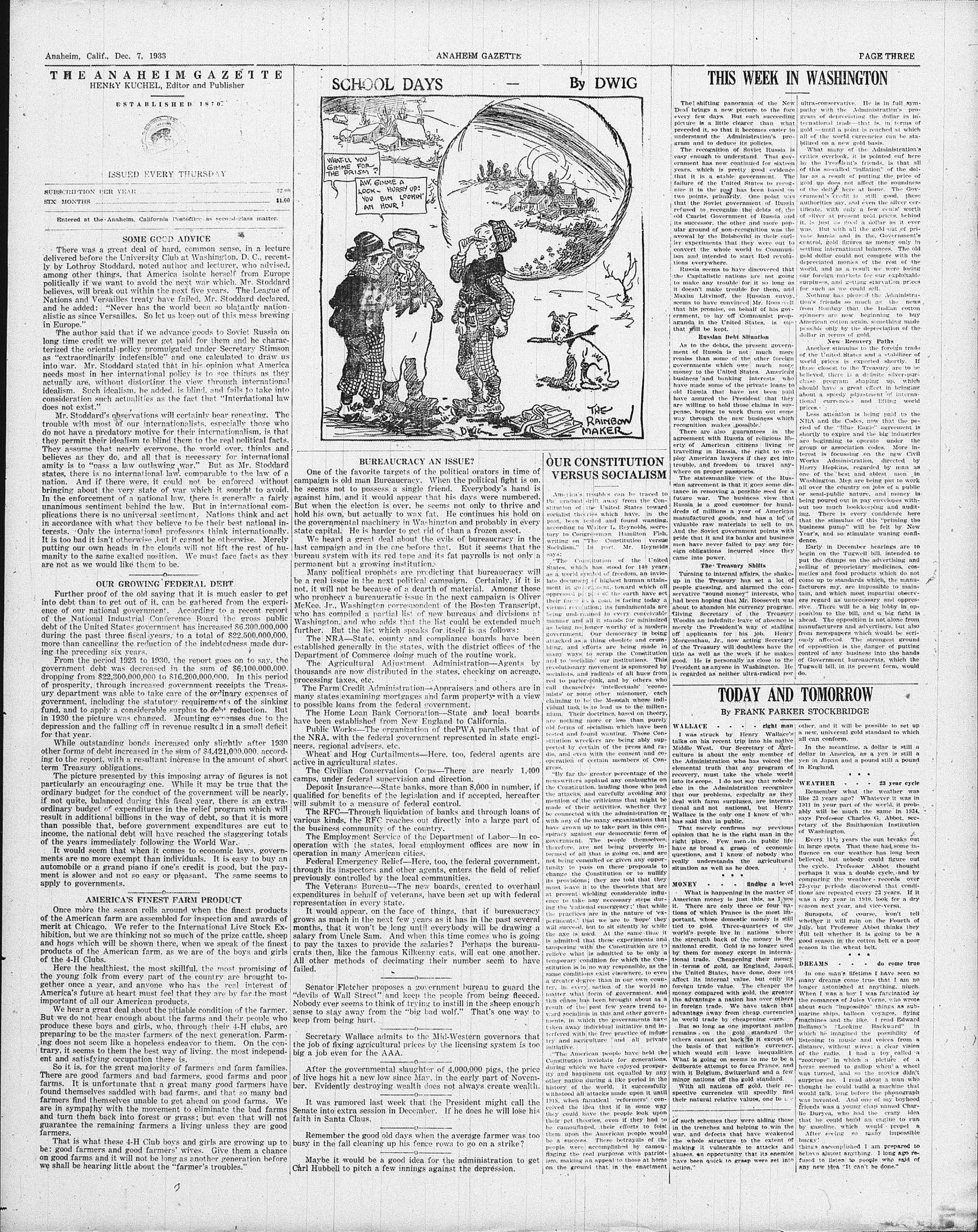
SCHOOL DAYS — By DWIG
WHAT'LL YOU GIMME FOR THE PRISM?
AW, GIMME A LOOK - HURRY UP!
YOU BIM LOOKIN' AM HOUR!
THE RAINBOW MAKER
BUREAUCRACY AN ISSUE?
One of the favorite targets of the political orators in time of campaign is old man Bureaucracy. When the political fight is on, he seems not to possess a single friend. Everybody's hand is against him, and it would appear that his days were numbered. But when the election is over, he seems not only to thrive and hold his own, but actually to wax fat. He continues his hold on the governmental machinery in Washington and probably in every state capital. He is harder to get rid of than a frozen asset.
We heard a great deal about the evils of bureaucracy in the last campaign and in the one before that. But it seems that the bureau system with its red tape and its fat payrolls is not only a permanent but a growing institution.
Many political prophets are predicting that bureaucracy will be a real issue in the next political campaign. Certainly, if it is not, it will not be because of a dearth of material. Among those who prophecy a bureaucratic issue in the next campaign is Oliver McKee, Jr., Washington correspondent of the Boston Transcript, who has compiled a partial list of new bureaus and divisions at Washington, and who adds that the list could be extended much further. But the list which speaks for itself is as follows:
The NRA—State, county and compliance boards have been established generally in the states, with the district offices of the Department of Commerce doing much of the routine work.
The Agricultural Adjustment Administration—Agents by thousands are now distributed in the states, checking on acreage, processing taxes, etc.
The Farm Credit Administration—Appraisers and others are in many states examining mortgages and farm property with a view to possible loans from the federal government.
The Home Loan Bank Corporation—State and local boards have been established from New England to California.
Public Works—The organization of the PWA parallels that of the NRA, with the federal government represented in state engineers, regional advisers, etc.
Wheat and Hog Curtailments—Here, too, federal agents are active in agricultural states.
The Civilian Conservation Corps—There are nearly 1,400 camps, under federal supervision and direction.
Deposit Insurance—State banks, more than 8,000 in number, if qualified for benefits of the legislation and if accepted, hereafter will submit to a measure of federal control.
The RFC—Through liquidation of banks and through loans of various kinds, the RFC reaches out directly into a large part of the business community of the country.
The Employment Service of the Department of Labor—In cooperation with the states, local employment offices are now in operation in many American cities.
Federal Emergency Relief—Here, too, the federal government, through its inspectors and other agents enters the field of relief
OUR CONSTITUTION VERSUS SOCIALISM
America's troubles can be traced to the grudual drift away from the Constitution of the United States toward socialist theories which have, in the past, been tested and found wanting. according to Walter L. Reynolds, secretary to Congressman Hamilton Fish, writing on "The Constitution versus Socialism." In part, Mr. Reynolds says:
"The Constitution of the United States, which has stood for 140 years as a world symbol of freedom, an inviolate document of highest human attainment in government, toward which all oppressed peoples of the earth have set their face as a goat, is facing today a virtual revolution; its fundamentals are being undrained in every conceivable manner and all it stands for minimized as being no longer worthy of a modern government. Our democracy is being attacked as a thing obsolete and crumbling, and efforts are being made in many ways to scrap the Constitution and to 'socialize' our institutions. This revolutionary movement is sponsored by socialists, and radicals of all hues from red to parlor-pink, and by others who call themselves 'intellectuals' 'economists' or some other misnomer, each claiming to be the Messiah whose individual task is to lead us to the millennium. Their doctrines, based on theory, are nothing more or less than purely old forms of socialism which have been tested and found wanting. These Constitution wreckers are being ably supported by certain of the press and radio, and even with the consent and cooperation of certain members of Congress.
"By far the greater percentage of the newswriters applaud any onslaughts on the Constitution, lauding those who lead the attacks, and carefully avoiding any mention of the criticisms that might be made of their activities, whether they be connected with the administration or with any of the many organizations that have grown up to take part in this conspiracy against our democratic form of government. The people themselves, therefore, are not being properly informed of all that is going on, and are not being consulted or given any opportunity to pass on these proposals to
Deposit Insurance—State banks, more than 8,000 in number, if qualified for benefits of the legislation and if accepted, hereafter will submit to a measure of federal control.
The RFC—Through liquidation of banks and through loans of various kinds, the RFC reaches out directly into a large part of the business community of the country.
The Employment Service of the Department of Labor—In cooperation with the states, local employment offices are now in operation in many American cities.
Federal Emergency Relief—Here, too, the federal government, through its inspectors and other agents, enters the field of relief previously controlled by the local communities.
The Veterans Bureau—The new boards, created to overhaul expenditures in behalf of veterans, have been set up with federal representation in every state.
It would appear, on the face of things, that if bureaucracy grows as much in the next few years as it has in the past several months, that it won't be long until everybody will be drawing a salary from Uncle Sam. And when this time comes who is going to pay the taxes to provide the salaries? Perhaps the bureaucrats then, like the famous Kilkenny cats, will eat one another. All other methods of decimating their number seem to have failed.
Senator Fletcher proposes a government bureau to guard the "devils of Wall Street" and keep the people from being fleeced. Nobody ever seems to think of trying to instill in the sheep enough sense to stay away from the "big bad wolf." That's one way to keep from being hurt.
Secretary Wallace admits to the Mid-Western governors that the job of fixing agricultural prices by the licensing system is too big a job even for the AAA.
After the governmental slaughter of 4,000,000 pigs, the price of live hogs hit a new low since May, in the early part of November. Evidently destroying wealth does not always create wealth.
It was rumored last week that the President might call the Senate into extra session in December. If he does he will lose his faith in Santa Claus.
Remember the good old days when the average farmer was too busy in the fall cleaning up his fence rows to go on a strike?
Maybe it would be a good idea for the administration to get Carl Hubbell to pitch a few innings against the depression.
THIS WEEK IN WASHINGTON
The shifting panorama of the New Deal brings a new picture to the fore every few days. But each succeeding picture is a little clearer than what preceded it, so that it becomes easier to understand the Administration's program and to deduce its policies.
The recognition of Soviet Russia is easy enough to understand. That government has now continued for sixteen years, which is pretty good evidence that it is a stable government. The failure of the United States to recognize it in the past has been based on two points, primarily. One point was that the Soviet government of Russia refused to recognize the debts of the old Czarist Government of Russia and its successor, the other and more popular ground of non-recognition was the avowal by the Bolsheviks in their earlier experiments that they were out to convert the whole world to Communism and intended to start Red revolutions everywhere.
Russia seems to have discovered that the Capitalistic nations are not going to make any trouble for it so long as it doesn't make trouble for them, and Maxim Litvinoff, the Russian envoy, seems to have convinced Mr. Roosevelt that his promise, on behalf of his government, to lay off Communist propaganda in the United States, is one that will be kept.
Russian Debt Situation
As to the debts, the present government of Russia is not much more remiss than some of the other foreign governments which owe much more money to the United States. American business and banking interests who have made some of the private loans to old Russia that have not been paid have assured the President that they are willing to hold those claims in suspense, hoping to work them out some way through the new business which recognition makes possible.
There are also guarantees in the agreement with Russia of religious liberty of American citizens living or travelling in Russia, the right to employ American lawyers if they get into ultra-conservative. He is in full sympathy with the Administration's program of depreciating the dollar in international trade—that is, in terms of gold—until a point is reached at which all of the world currencies can be stabilized on a new gold basis.
What many of the Administration's critics overlook, it is pointed out here by the President's friends, is that all of this so-called "inflation" of the dollar as a result of putting the price of gold up does not affect the soundness of the dollar here at home. The Government's credit is still good, these authorities say, and even the silver certificate, with only a few cents' worth of silver at present gold prices, behind it, is just as good a dollar as it ever was. But with all the gold out of private hands and in the. Government's control, gold figures as money only in settling international balances. The old gold dollar could not compete with the depreciated monies of the rest of the world, and as a result we were losing our foreign markets for our exploitable surpluses, and getting starvation prices for such as we could sell.
Nothing has pleased the Administration's friends so much as the news from Bombay that the Indian cotton spinners are now beginning to buy American cotton again, something made possible only by the depreciation of the dollar in terms of gold.
New Recovery Paths
Another stimulus to the foreign trade of the United States and a stabilizer of world prices is expected shortly. If these closest to the Treasury are to be believed, there is a definite silver-purchase program shaping up, which should have a great effect in bringing about a speedy adjustment of international currencies and lifting world prices.
Less attention is being paid to the NRA and the Codes, now that the period of the "Blue Eagle" agreement is shortly to expire and the big industries are beginning to operate under the group or association codes. More interest is focussing on the new Civil War Administration.
TODAY AND TOMORROW
By FRANK PARKER STOCKBRIDGE
WALLACE . . . right man
I was struck by Henry Wallace's talks on his recent trip into his native Middle West. Our Secretary of Agriculture is about the only member of the Administration who has voiced the elemental truth that any program of recovery, must take the whole world into its scope. I do not say that nobody else in the Administration recognizes that our problems, especially as they deal with farm surpluses, are international and not national, but Henry Wallace is the only one I know of who has said that in public.
That merely confirms my previous opinion that he is the right man in the right place. Few men in public life have as broad a grasp of economic questions, and I know of nobody who really understands the agricultural situation as well as he does.
other, and it will be possible to set up a new, universal gold standard to which all can conform.
In the meantime, a dollar is still a dollar in America, as a yen is still a yen in Japan and a pound still a pound in England.
WEATHER . . . 23 year cycle
Remember what the weather was like 23 years ago? Whatever it was in 1911 in your part of the world, it probably will be much the same in 1934, says Professor Charles G. Abbot, secretary of the Smithsonian Institution of Washington.
Every 11½ years the sun breaks out in large spots. That these had some influence on our weather has long been believed, but nobody could figure out the cycle. Professor Abbot thought
the percentage of the many onslaughts on being those who lead fully avoiding any terms that might be used, whether they administration or organizations that part in this democratic form of people themselves, being properly ingoing on, and are given any oppor- tese proposals to action or to nullify are told that they theorists that are considerable influ- nessary steps dur- gency; that while the nature of ex- ture to 'hope' they are silently by while at the same time it experiments and constitution are to be only a for which the Con- responsible, as the elsewhere, to even in our own coun- government, and brought about as a new years trend to and other govern- governments have initiative and in- practice of indus- and all private people have held the for generations, we enjoyed prosper- et equalled by any like period in the It successfully made upon it until 'reformers', con- if in some way people look upon if they had to efforts to foist can people would betrayals of the finished by camou-oses with patriot- led to those at home in the enactment recovery, must take the whole world into its scope. I do not say that nobody else in the Administration recognizes that our problems, especially as they deal with farm surpluses, are international and not national, but Henry Wallace is the only one I know of who has said that in public.
That merely confirms my previous opinion that he is the right man in the right place. Few men in public life have as broad a grasp of economic questions, and I know of nobody who really understands the agricultural situation as well as he does.
MONEY finding a level
What is happening in the matter of American money is just this, as I see it. There are only three or four nations of which France is the most important, whose domestic money is still tied to gold. Three-quarters of the world's people live in nations where the strength back of the money is the national credit. Gold is no longer used by them for money except in international trade. Cheapening their money in terms of gold, as England, Japan, the United States, have done, does not affect its internal value, but only its foreign trade value. The cheaper the money compared with gold, the greater the advantage a nation has over others in foreign trade. We have taken that advantage away from cheap currencies in world trade by cheapening ours.
But so long as one important nation remains on the gold standard the others cannot get back to it except on the basis of that nation's currency, which would still leave inequalities. What is going on seems to me to be a deliberate attempt to force France, and with it Belgium, Switzerland and a few minor nations off the gold standard.
With all nations off gold, their respective currencies will speedily find their natural relative values, one to one.
of such schemes they were aiding those in the trenches and helping to win the war, and defects that have weakened the whole structure to the extent of making it vulnerable to attacks and abuses, an opportunity that its enemies have been quick to grasp were set into action."
WEATHER 23 year cycle
Remember what the weather was like 23 years ago? Whatever it was in 1911 in your part of the world, it probably will be much the same in 1934, says Professor Charles G. Abbot, secretary of the Smithsonian Institution of Washington.
Every 11½ years the sun breaks out in large spots. That these have some influence on our weather has long been believed, but nobody could figure out the cycle. Professor Abbot thought perhaps it was a double cycle, and by comparing the weather records over 23-year periods discovered that conditions are repeated every 23 years. If it was a dry year in 1910, look for a dry season next year, and vice versa.
Sunspots, of course, won't tell whether it will rain on the Fourth of July, but Professor Abbot thinks they will tell whether it is going to be a good season in the cotton belt or a poor season in the wheat belt.
DREAMS do come true
In one man's lifetime I have seen so many dreams come true that I am no longer astonished at anything, much. When I was a boy I was fascinated by the romances of Jules Verne, who wrote about such "impossible" things as submarine ships, balloon voyages, flying machines and the like. I read Edward Bellamy's "Looking Backward" in which he imagined the possibility of listening to music and voices from a distance, without wires; a clear vision of the radio. I had a toy called a "zootrope" in which a picture of a horse seemed to gallop when a wheel was turned, and so the movies didn't surprise me. I read about a man who thought he could build a machine that would talk, long before the phonograph was invented. And one of my boyhood friends was a young chap named Charlie Duryea, who had the crazy idea that he could build an engine to run by gasoline, which would propel a After seeing so many impossible buggy! things accomplished I am prepared to believe almost anything. I long ago refused to listen to people who said of any new idea "It can't be done."