anaheim-gazette 1933-11-30
Scanned page
Searchable text
THE ANAHEIM GAZETTE
HENRY KUCHEL, Editor and Publisher
ESTABLISHED 1870
ISSUED EVERY THURSDAY
SUBSCRIPTION PER YEAR $2.00
SIX MONTHS $1.00
Entered at the Anaheim, California Postoffice as second-class matter.
THE PRICE OF LEGAL SPARRING
Kidnapers and slayers of Brooke Hart paid with their lives for their crime against society in the most feared and dramatic methods of punishment — lynching.
Two factors entered into the situation. An outraged public responded to its primal instinct for self preservation. The threat of kidnapping, worst of crimes, struck at the heart of every home in California. The cruel and merciless slaying of the San Jose youth, combined with attempts to trick relatives into paying ransom for a loved one already dead, provided the spark which led otherwise peaceful and law-abiding citizens to take the law into their own hands.
Back of the lynching, however, was a long period in which these citizens learned the short-comings of our legal system. They saw laws originally passed as our Anglo-Saxon ancestors emerged from feudalism, for the purpose of protecting the peasant from an over-bearing landlord, twisted by clever lawyers to protect criminals from society. Of course, most legal advice on how to evade consequences of the law is obtained by criminals from lawyers who circumvent the purposes of the bar associations. The fact remains, however, that civil and criminal trials are delayed time and again, that juries have a way of not finding wealthy persons guilty, even to the point of acquitting Doheny of bribing Albert Fall but of convicting Fall of accepting a bribe from Doheny.
Citizens gradually are showing increased resentment at legal sparring, delays and other tricks to evade justice. When persons preparing to defend the kidnapers announced the latter would
from an over-bearing landlord, twisted by clever lawyers to protect criminals from society. Of course, most legal advice on how to evade consequences of the law is obtained by criminals from lawyers who circumvent the purposes of the bar associations. The fact remains, however, that civil and criminal trials are delayed time and awain. That juries have a way of not finding wealthy persons guilty, even to the point of acquitting Doheny of bribing Albert Fall but of convicting Fall of accepting a bribe from Doheny.
Citizens gradually are showing increased resentment at legal sparring, delays and other tricks to evade justice. When persons preparing to defend the kidnapers announced the latter would plead not guilty by reason of insanity, the public may not have lost confidence in ultimate justice, but it did lose patience when the crime demanded swift and sure justice.
Much as we disapprove extra-legal methods of punishment, we must admire the staunch courage of San Jose's vigilantes. More than half a century ago California was infested with bad men whose methods finally exasperated a law-abiding citizenship. Vigilantes then put a swift end to atrocious crimes in and around San Francisco. History may be repeating itself. Kidnapers have received fair warning not to ply their trade in this state.
Ultimately, we look to see the same attitude developed toward gangsters. Gunmen from Chicago and other Eastern cities are becoming increasingly unpopular. At present they are protected by the shrewdest legal talent money can buy. Unless the bar associations succeed in preventing lawyers from giving advice on how to evade the law, unless justice becomes swifter and surer, look for an uprising against all forms of violent crime.
From a legal point of view, one cannot justify lynchings. But from society's point of view — and that is the important one, after all — any measure, even lynching with its great danger of injustice to an individual — is justified as a means of self protection.
TAMMANY IS OVERTHROWN
Tammany Hall, the most corrupt, brutal and heartless political organization in America, has been ousted from control of the nation's greatest city. For the first time in 16 years the grip of the Tiger upon the people of New York has been broken.
Tammany is a peculiar institution. It professes to represent the democratic party, but democrats and republicans alike allied themselves behind the fusion ticket, headed by Major Fiorello La Guardia, to overthrow the beast.
Tammany Hall has never represented anything but its own pocket. Pretending to the democratic, it worked for years in corrupt alliance with a corrupt republican party machine in New York.
Originally a social organization, founded in the very early days when the words "republican" and "democrat" meant the same thing, the official name of Tammany Hall is "The Young Men's Republican-Democratic Society of St. Tammany." A hundred years ago it stood for all that was best in the social and political life of the city. "The Hall" was a meeting place for the artistic, literary and intellectual life of the city. But control of Tammany fell into corrupt hands, and it gradually became a mere instrument of graft and thievery.
It takes a good deal to stir up the people of New York City. Seven million persons, of diverse interests and many racial strains, have little in common. That made it easy for Tammany to carry at Washington, clerk.
"We are in Gothenburg there is a possible negotiation we will however, interest pean aspect, of the no way politically of purpose as has matters."
It is undoubted in Europe's politics on every opportunity fear of getting caught about the League of Nations.
The government limitation of arms in the way we have to set an example other naval powers forces without wiping military force gladly hail any so do not want to be any program which in Europe from day that the best thing and mind his own.
If Europe is not might come back to out some of our looms.
THIS
So much has been many politicians hitherto gloomy colors, that that all the farmers forclosure proceeded.
Nothing could do our readers. A study of the who twentieth century amounts to only a city property.
Fully 60 percent this survey reported 60 percent are river and east of the debtors are danger of losing thievery.
when the words "republican" and "democrat" meant the same thing, the official name of Tammany Hall is "The Young Men's Republican-Democratic Society of St. Tammany." A hundred years ago it stood for all that was best in the social and political life of the city. "The Hall" was a meeting place for the artistic, literary and intellectual life of the city. But control of Tammany fell into corrupt hands, and it gradually became a mere instrument of graft and thievery.
It takes a good deal to stir up the people of New York City. Seven million persons, of diverse interests and many racial strains, have little in common. That made it easy for Tammany to carry on its campaign of public plunder. But even New Yorkers get tired, after a while, of being robbed.
COME HOME, UNCLE SAM
Now that Germany has left the League of Nations and the Arms Conference has been adjourned temporarily at least, a great many Americans are asking themselves the question whether it wouldn't be a good time just now for Uncle Sam to come home, or at least to suggest to Mr. Norman H. Davis, our representative to Geneva, that he now make use of his return ticket to the United States.
For many months those who make a study of European affairs, from Frank Simonds on down, have been convinced that the disarmament conference would come to naught. Germany is determined to re-arm, unless the allied nations cut down their armament, in fact may have already started to do so, and France and her allies have determined not to reduce their armament. There seems to be no way to solve the problem.
There is no disposition here to criticise the motives of our own government in the matter. No doubt the administration has been inspired by a real desire to help iron out world difficulties. But it has now come to the point where further effort on our part is apt to harm the United States a great deal more than it aids Europe. It is difficult to see what interest, more than an academic one, Uncle Sam has in the matter of land disarmament. Our own army has been scaled down to the point where it is little more than a glorified police force. Compared to the armies, even of second class European powers, it looks small. There is nothing, therefore, that we can offer in the way of military sacrifice. The question is purely one for Europe to decide and it is so bound up in European politics that we are apt to get ourselves unpleasantly involved if we go much deeper into the mess.
A few days ago the internationalist press was rather gleefully announcing that the United States was once more "lined up" with its old allies and that we were in Europe once more. The statement issued by Mr. Davis at Geneva, which was doubtless inspired
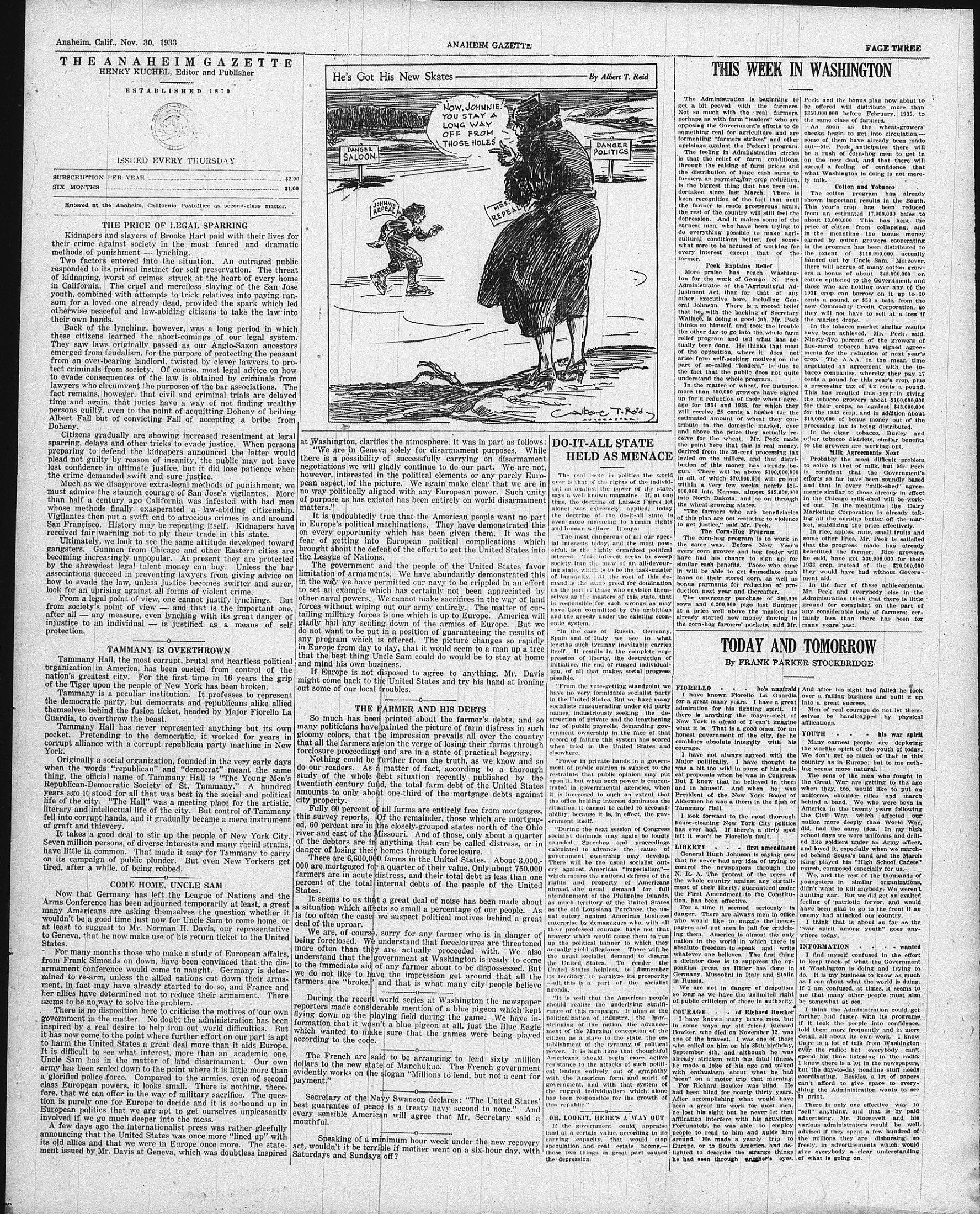
He's Got His New Skates — By Albert T. Reid
NOW, JOHNNIE.
YOU STAY A LONG WAY OFF FROM THOSE HOLES
DANGER SALOON
DANGER POLITICS
JOHNNIE REPEAL
MRS. REPEAL
Albert T. Reid
at Washington, clarifies the atmosphere. It was in part as follows:
"We are in Geneva solely for disarmament purposes. While there is a possibility of successfully carrying on disarmament negotiations we will gladly continue to do our part. We are not, however, interested in the political elements or any purely European aspect, of the picture. We again make clear that we are in no way politically aligned with any European power. Such unity of purpose as has existed has been entirely on world disarmament matters."
It is undoubtedly true that the American people want no part in Europe's political machinations. They have demonstrated this on every opportunity which has been given them. It was the fear of getting into European political complications which brought about the defeat of the effort to get the United States into the League of Nations.
The government and the people of the United States favor limitation of armaments. We have abundantly demonstrated this in the way we have permitted our navy to be crippled in an effort to set an example which has certainly not been appreciated by other naval powers. We cannot make sacrifices in the way of land forces without wiping out our army entirely. The matter of curtailing military forces is one which is up to Europe. America will gladly hail any scaling down of the armies of Europe. But we do not want to be put in a position of guaranteeing the results of any program which is offered. The picture changes so rapidly in Europe from day to day, that it would seem to a man up a tree that the best thing Uncle Sam could do would be to stay at home and mind his own business.
If Europe is not disposed to agree to anything, Mr. Davis might come back to the United States and try his hand at ironing out some of our local troubles.
THE FARMER AND HIS DEBTS
So much has been printed about the farmer's debts, and so many politicians have painted the picture of farm distress in such gloomy colors, that the impression prevails all over the country that all the farmers are on the verge of losing their farms through forclosure proceedings and are in a state of practical beggary.
Nothing could be further from the truth, as we know and so do our readers. As a matter of fact, according to a thorough study of the whole debt situation recently published by the twentieth century fund, the total farm debt of the United States amounts to only about one-third of the mortgage debts against city property.
Fully 60 percent of all farms are entirely free from mortgages, this survey reports. Of the remainder, those which are mortgaged, 60 percent are in the closely-grouped states north of the Ohio river and east of the Missouri. And of those, only about a quarter of the debtors are in anything that can be called distress, or in danger of losing their homes through foreclosure.
DO-IT-ALL STATE HELD AS MENACE
The real issue in politics the world over is that of the rights of the individual as against the power of the state, says a well known magazine. If, at one time, the doctrine of Laissez Faire (let alone) was extremely applied, today the doctrine of the do-it-all state is even more menacing to human rights and human welfare. It says:
"The most dangerous of all our special interests today, and the most powerful, is the highly organized political interest. This interest seeks to sweep society into the maw of an all-devouring state, which is to be the task-master of humanity. At the root of this demand is the same greed for domination on the part of those who envision themselves as the masters of this state, that is responsible for such wrongs as may have been committed by the ambitious and the greedy under the existing economic system.
"In the case of Russia, Germany, Spain and of Italy we see to what lengths such tyranny inevitably carries itself. It results in the complete suppression of liberty, the destruction of initiative, the end of rugged individualism, of all that makes social progress possible.
"From the vote-getting standpoint we have no very formidable socialist party in the United States. But we have many socialists masquerading under old party names, industriously seeking the destruction of private and the lengthening of public payrolls, demanding government ownership in the face of that record of failure this system has scored when tried in the United States and elsewhere.
"Power in private hands in a government of public opinion is subject to the restraints that public opinion may put upon it, but when such power is concentrated in governmental agencies, when it is increased to such an extent that the office holding interest dominates the situation, it cannot be called to accountability, because it is, in effect, the government itself.
"During the next session of Congress socialist demands may again be loudly sounded. Speeches and proceedings calculated to advance the cause of government ownership may develop."
Fully 60 percent of all farms are entirely free from mortgages, this survey reports. Of the remainder, those which are mortgaged, 60 percent are in the closely-grouped states north of the Ohio river and east of the Missouri. And of those, only about a quarter of the debtors are in anything that can be called distress, or in danger of losing their homes through foreclosure.
There are 6,600,000 farms in the United States. About 3,000,-000 are mortgaged for a quarter of their value. Only about 750,000 farmers are in acute distress, and their total debt is less than one percent of the total internal debts of the people of the United States.
It seems to us that a great deal of noise has been made about a situation which affects so small a percentage of our people. As is too often the case we suspect political motives behind a great deal of the uproar.
We are, of course, sorry for any farmer who is in danger of being foreclosed. We understand that foreclosures are threatened more often than they are actually proceeded with. We also understand that the government at Washington is ready to come to the immediate aid of any farmer about to be dispossessed. But we do not like to have the impression get around that all the farmers are "broke," and that is what many city people believe
During the recent world series at Washington the newspaper reporters made considerable mention of a blue pigeon which kept flying down on the playing field during the game. We have information that it wasn't a blue pigeon at all, just the Blue Eagle which wanted to make sure that the games were being played according to the code.
The French are said to be arranging to lend sixty million dollars to the new state of Manchukuo. The French government evidently works on the slogan "Millions to lend, but not a cent for payment."
Secretary of the Navy Swanson declares: "The United States' best guarantee of peace is a treaty navy second to none." And every sensible American will agree that Mr. Secretary said a mouthful.
Speaking of a minimum hour week under the new recovery act, wouldn't it be terrible if mother went on a six-hour day, with Saturdays and Sundays off?
"During the next session of Congress socialist demands may again be loudly sounded. Speeches and proceedings calculated to advance the cause of government ownership may develop. There will be the usual socialist outcry against American "imperialism"—which means the national defense of the rights and property of Americans abroad, the usual demand for full abandonment of the Philippine Islands, as much territory of the United States as the old Louisiana Purchase, the usual outcry against American business enterprise by demagogues who, with all their professed courage, have not that bravery which would cause them to run up the political banner to which they actually yield allegiance. There will be the usual socialist demand to disarm the United States. To render the United States helpless, to dismember its territory, to paralyze its prosperity—all this is a part of the socialist agenda.
"It is well that the American people should realize the underlying significance of this campaign. It aims at the politicalization of industry, the hamstringing of the nation, the advancement of the Marxian conception of the citizen as a slave to the state, the establishment of the tyranny of political power. It is high time that thoughtful Americans should begin more active resistance to the attacks of such political leaders entirely out of sympathy with the American form and spirit of government, and with that system of the rugged individualism which alone has been responsible for the growth of this republic."
OH, LOOKIT, HERE'S A WAY OUT
If the government could appraise land at a certain value, according to its earning capacity, that would stop speculation and real estate booms—those two things in great part caused the depression.
THIS WEEK IN WASHINGTON
The Administration is beginning to get a bit peeved with the farmers. Not so much with the real farmers, perhaps as with farm "leaders" who are opposing the Government's efforts to do something real for agriculture and are formenting "farmers strikes" and other uprisings against the Federal program.
The feeling in Administration circles is that the relief of farm conditions, through the raising of farm prices and the distribution of huge cash sums to farmers as payments for crop reduction, is the biggest thing that has been undertaken since last March. There is keen recognition of the fact that until the farmer is made prosperous again, the rest of the country will still feel the depression. And it makes some of the earnest men, who have been trying to do everything possible to make agricultural conditions better, feel somewhat sore to be accused of working for every interest except that of the farmer.
Peek Explains Relief
More praise has reach Washington for the work of George N. Peek Administrator of the Agricultural Adjustment Act, than for that of any other executive here, including General Johnson. There is a rooted belief that he with the backing of Secretary Wallace, is doing a good job. Mr. Peek thinks so himself, and took the trouble the other day to go into the whole farm relief program and tell what has actually been done. He thinks that most of the opposition, where it does not arise from self-seeking motives on the part of so-called "leaders," is due to the fact that the public does not quite understand the whole program.
In the matter of wheat, for instance, more than 550,000 growers have signed up for a reduction of their wheat acreage for 1934 and 1935, for which they will receive 28 cents a bushel for the estimated amount of wheat they contribute to the domestic market, over and above the price they actually receive for the wheat. Mr. Peek made the point here that this is real money, derived from the 30-cent processing tax.
Peek, and the bonus plan now about to be offered will distribute more than $350,000,000 before February, 1935, to the same class of farmers.
As soon as the wheat-growers' checks begin to get into circulation—some of them have already been made out—Mr. Peek anticipates there will be a rush of corn-hog men to get in on the new deal, and that there will spread a feeling of confidence that what Washington is doing is not merely talk.
Cotton and Tobacco
The cotton program has already shown important results in the South. This year's crop has been reduced from an estimated 17,000,000 bales to about 13,000,000. This has kept the price of cotton from collapsing, and in the meantime the bonus money earned by cotton growers cooperating in the program has been distributed to the extent of $110,000,000 actually handed out by Uncle Sam. Moreover, there will accrue of many cotton growers a bonus of about $48,000,000 on cotton optioned to the Government, and those who are holding over any of the 1938 crop can borrow on it up to 10 cents a pound, or $50 a bale, from the New Commodity Credit Corporation, so they will not have to sell at a loss if the market drops.
In the tobacco market similar results have been achieved, Mr. Peek said. Ninety-five percent of the growers of flue-cured tobacco have signed agreements for the reduction of next year's crop. The A.A.A. in the mean time negotiated an agreement with the tobacco companies, whereby they pay 17 cents a pound for this year's crop, plus a processing tax of 4.2 cents a pound. This resulted this year in giving the tobacco growers about $100,000,000 for their crops, as against $43,000,000 for the 1932 crop, and in addition about $10,000,000 of bonus money out of the processing tax being distributed.
In the cigar tobacco, Burley and other tobacco districts, similar benefits to the growers are working out.
TODAY AND TOMORROW
By FRANK PARKER STOCKBRIDGE
FIORELLO . . . he's unafraid
I have known Florello La Guardia for a great many years. I have a great admiration for his fighting spirit. If there is anything the mayor-elect of New York is afraid of I can't imagine what it is. That is a good omen for an honest government of the city, for he combines absolute integrity with his courage.
I have not always agreed with the Major politically. I have thought he was a bit too wild in some of his radical proposals when he was in Congress. But I know that he believed in them and himself. And when he was President of the New York Board of Aldermen he was a thorn in the flesh of Tammany Hall.
I look forward to the most thorough house-cleaning New York City politics has ever had. If there's a dirty spot left it won't be Florello's fault.
LIBERTY . . . first amendment
General Hugh Johnson is saying now
And after his sight had failed he took over a failing business and built it up into a great success.
Men of real courage do not let themselves be handicapped by physical afflictions.
YOUTH . . . his war spirit
Many earnest people are deploring the warlike spirit of the youth of today. We don't get so much of that in this country as in Europe; but to me nothing seems more natural.
The sons of the men who fought in the Great War are getting to the age when they, too, would like to put on uniforms, shoulder rifles and march behind a band. We who were boys in America in the twenty years following the Civil War, which affected our nation more deeply than World War, did, had the same idea. In my high school days we wore uniforms, and drilled like soldiers under an Army officer, and loved it, especially when we marched behind Sousa's band and the March
session of Congress may again be loudly and proceedings be the cause of ship may develop unusual socialist outnism "imperialism"—normal defense of the city of Americans demand for full Philippine Islands, the United States Purchase, the us-american business argues who, with all age, have not that because them to run over to which they face. There will be demand to disarm To render the s., to dismember byze its prosperity of the socialist American people underlying signifi- itm. It aims at the industry, the ham-oon, the advance-conception of the state, the es-serranny of political life that thoughtful begin more activeasks of such politi- out of sympathy form and spirit of that system ofism which alone for the growth of
COURAGE of Richard Bowker I have known many brave men, but in some ways my old friend Richard Bowker, who died on November 12, was one of the bravest. I was one of those who called on him on his 85th birthday, September 4th, and although he was already stricken with his fatal illness, he made a joke of his age and talked with enthusiasm about what he had "seen" on a motor trip that morning.
For Richard Bowker was blind. He had been blind for nearly thirty years. After accomplishing what would have been a great life work for most men, he lost his sight but he never let that affiliation interfere with his activities. Fortunately, he was able to employ people to read to him and guide him around. He made a yearly trip to Europe, or to South America, and delighted to describe the strange things he had seen through another's eyes.
There is only one effective way to "sell" anything, and that is by paid advertising. Mr. Roosevelt and his various administrators would be well advised if they were a few hundred of the millions they are disbursing so freely, in advertisements which would give everybody a clear understanding of what is going on.