anaheim-gazette 1933-11-23
Scanned page
Searchable text
THE ANAHEIM GAZETTE
HENRY KUCHEL, Editor and Publisher
ESTABLISHED 1870
ISSUED EVERY THURSDAY
SUBSCRIPTION PER YEAR $2.00
SIX MONTHS $1.00
Entered at the Anaheim, California Postoffice as second-class matter.
TRIAL AND ERROR, THE BETTER WAY
“If it doesn’t work, we’ll try something else.”
This is the most encouraging statement President Franklin Roosevelt has made during his term of office. It indicates an open mind, a determination to get to the bottom of our present difficulties — and implies selection of the best of three common means of learning, viz: trial and error, punishment, and imitation.
We’ve imitated worn-out economic theories to the point of punishing ourselves. Vainly and blindly trying to patch up the old system, reinforcing credit here and adding a daub of relief there, only seems to get us deeper into the financial mire. When we look over the industrial and financial chart, we see that our credit system has failed. Everything done to date only seems to tighten up credit instead of loosen it. The government issues bonds to unleash four kinds of federal credit to farmers; private capital as quickly withdraws from the field of private loans and hastens to buy government bonds. The more government credit, the less private credit. Money released by federal loans goes to buy more government bonds.
The chain is endless, with the shift accelerating during the past year.
Something must be done to encourage or force private capital back into private channels. This the president is attempting to do by an elaborate and complicated internal program of regulation and external policy of buying gold on the world markets. He figures that if he can force internal and world commodity prices
bonds to unleash four kinds of federal credit to farmers; private capital as quickly withdraws from the field of private loans and hastens to buy government bonds. The more government credit, the less private credit. Money released by federal loans goes to buy more government bonds.
The chain is endless, with the shift accelerating during the past year.
Something must be done to encourage or force private capital back into private channels. This the president is attempting to do by an elaborate and complicated internal program of regulation and external policy of buying gold on the world markets. He figures that if he can force internal and world commodity prices to rise, the trick will have been done. He may be right. If so, he will not have to junk his program.
But, if the program lags or fails, he has the clear duty of trying something else. Perhaps he then will focus his attention on the spectacle of billions of dollars finding earning capacity and refuge from uncertainties of private business by the simple process of buying government bonds and letting Uncle Sam take the risk. The more money the government borrows, the more money is removed from tax rolls, the less money becomes available for business enterprises.
This, we believe, is one of the keys to our financial plight.
By the process of trial and error, one of the experiments may yet be directed at this base of the knotty problem. In the meantime the important thing is an intelligent attempt to do something for the masses.
THANKSGIVING DAY
We think it appropriate at this time to print the first account of the origin of Thanksgiving Day, as it was set down in 1623 by William Bradford, governor of Plymouth Plantation. The spelling and punctuation are just as Governor Bradford wrote it in his Journal.
"Nothwithstanding all their great paines & industrie, and ye great hops of large crops, the Lord seemed to blast, & take away the same, and to threaten further & more sore famine unto them by a great drought which continued for ye 3, weeke in May, till about ye midle of July, without any raine, and with great heat (for ye most parte), insomuch as ye corne begane to wither away, though it was set with fishe, the moysture whereof helped it much. Yet at length it begane to languish sore, and some of ye drier grounds are partched like withered hay, part whereof was never recovered. Upon which they set a parte a solemne day of humiliation, to seek ye Lord by humble & fervente prayer, in this great distrese. And he was pleased to give them a gracious & speedy answer, both to their owne & the Indeans admiration, that lived amongst them. For all ye morning, and greatest part of the day, it was clear weather & very hotte, and not a cloud or any signe of raine to be seen, yet toward evening it began to overcast, and shortly after to raine, with shuch sweete and gentle showers, as gave them cause of rejoyceing, & blessing God. It came, without either wind or thunder, or any violence, and by degrees in ye abundance, as that ye earth was thorowly wete and soked there-with. Which did so apparently revive & quicken ye decayed corne & other fruits, as was wonderfull to see, and make ye Indeans astonished to behold; and afterwards the Lord sent them such seasonable showers, with enterchange of faire warme weather, as though his blessing, caused a fruitfall & liberall harvest to their small comfort and raioweing. For which mercie benefits to the farmer government hoped to making the consumer enough Uncle Sam ww.
The Agricultural branches of the governors or not, its sole aim is argued that in spite yet been made prosperous us are enjoying that the record of the past assertion that the fact Everybody sympa everyone hopes he w because it is known t of its population in t task of bringing pro be accomplished in i It is faintly possible. at Washington before returned to their hom farmer might not ha No matter how u is not a forgotten m professional agitators w wto, which we do not. Just at present i opinion, it is the po America.
OP
Evidence continue tration are not entire ness. In commenting dustry itself to take General Johnson, wh made clear what he vision, stating "Abs are permitted without Only, a few hour council for the Depa "The members o improvement in ind employment through re to be surmounted." in assisting the adr still ahead, to the en duction in unemploym be sooner achieved.
"The continuance
it was clear weather & very hotte, and not a cloud or any signe of raine to be seen, yet toward evening it began to overcast, and shortly after to raine, with shuch sweete and gentle showers, as gave them cause of rejoyceing, & blessing God. It came, without either wind or thunder, or any violence, and by degreee in ye abundance, as that ye earth was thorowly wete and soked therewith. Which did so apparently revive & quicken ye decayed corne & other fruits, as was wonderfull to see, and make ye Indeans astonished to behold; and afterwards the Lord sent them such seasonable showers, with enterchange of faire warme weather, as though his blessing, caused a fruitfall & liberall harvest, to their no small comfort and rejoicing. For which mercie (in time conveniente) they also sett aparte a day of thanksgiving."
We have kept the form of Thanksgiving Day, but ought we not also to keep it in the spirit of those Pilgrim Fathers?
THE "FORGOTTEN MAN"
In commenting on the failure of the visit of the Western governors to the White House in putting over their program and in expressing his disappointment as to the result of his conferences with President Roosevelt and Secretary Wallace, Governor Langer is quoted as saying:
"It is a 100 per cent failure. I am very disappointed and disgusted. The farmer is the forgotten man. Everybody else has been here before him, the banker, the insurance man, the railroad man, and got all the money. There is nothing left for the farmer."
Without going into detail as to the soundness of the policies of this and the preceding administration in the matter of "rescuing the farmer" it might be well to reflect for a moment on the justness of the good Governor's statement quoted above. Is the farmer indeed the forgotten man?
In a recent issue, the New York Times, a newspaper noted for the accuracy of its reporting, called attention to the fact that an official survey of what the government in recent years had done for the farmer indicated that since July, 1929, more than two billion dollars has been advanced to the farmers by the various government agencies who have been seeking to help him to become prosperous. And this staggering sum, it is also pointed out, does not include the $360,000,000 expended by the Farm Board in its efforts to peg the price of wheat and cotton so that the farmer might get a higher price for his produce.
But this total, nearly two and a half billions, is not the end. Another quarter of a billion has been made available for a loan of ten cents a pound on cotton in an effort to peg the price of this product, and the extension of loans on other farm commodities are to follow so that during the next year it is believed that another billion will be loaned for this purpose. In the program for production control, the government is now extending further
Only, a few hours council for the Depar
"The members of improvement in indemnity through reto be surmounted." in assisting the adn still ahead, to the enduction in unemployment be sooner achieved.
"The continuance of living is of necessity To maintain this state of governmental intre to continue to exercise have characterized it Evidently there as to what course s business, or perhaps control. Undoubted the old Ship of State
There isn't so many stars than among the principal difference in page with their dom An Iowa boy who eat candy or pop coke health, is now learning doing something whi neighborhood.
It is said that a hogs will raise the time it will be the c One thing which administration is a looking at everybody According to them in photographing a thing to do any time One of our inquiry the next European v as soon as Uncle Sam
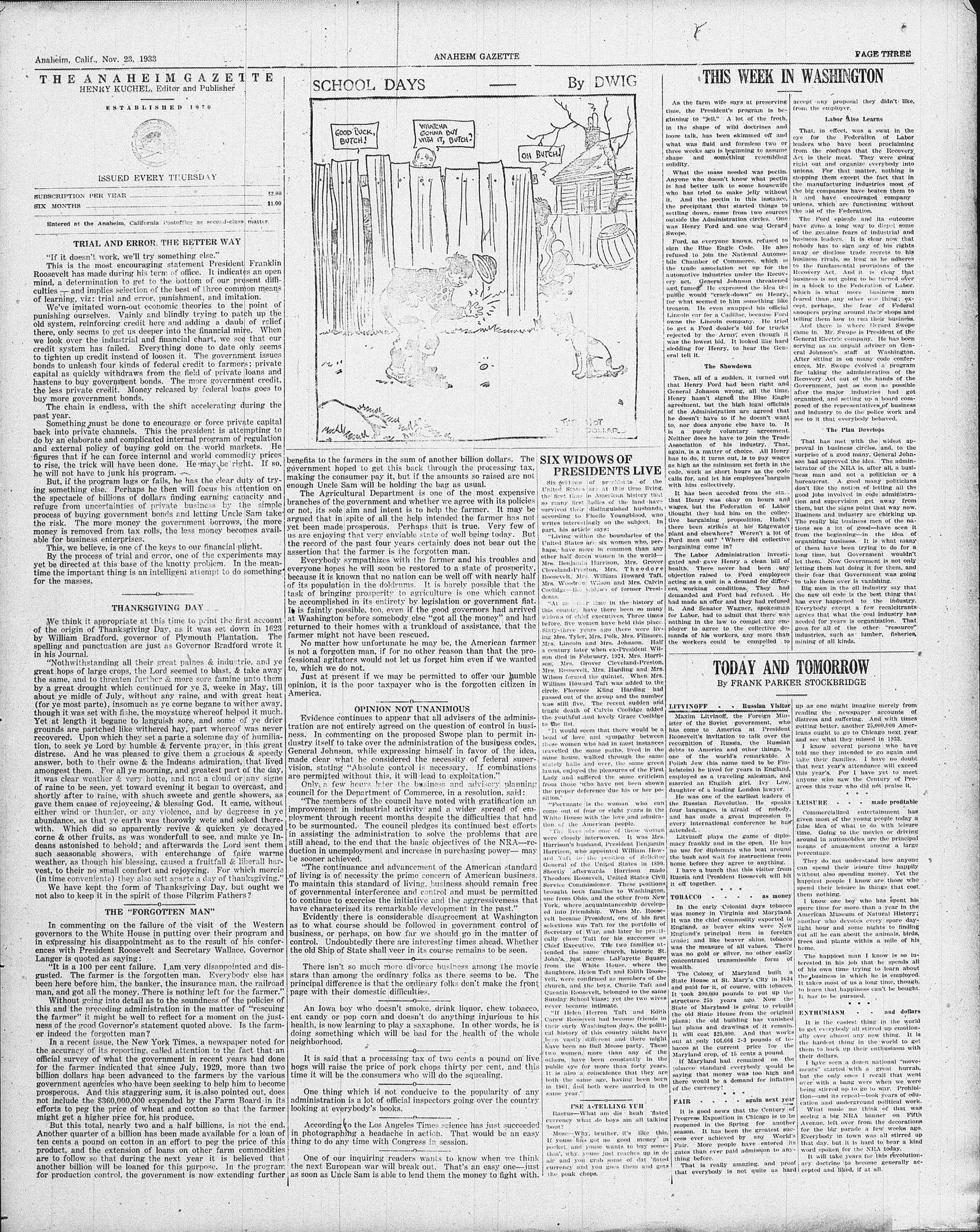
SCHOOL DAYS — By DWIG
GOOD LUCK,
BUTCH!
WHATCHA GONNA BUY
WITH IT, BUTCH?
OH BUTCH!
benefits to the farmers in the sum of another billion dollars. The government hoped to get this back through the processing tax, making the consumer pay it, but if the amounts so raised are not enough Uncle Sam will be holding the bag as usual.
The Agricultural Department is one of the most expensive branches of the government and whether we agree with its policies or not, its sole aim and intent is to help the farmer. It may be argued that in spite of all the help intended the farmer has not yet been made prosperous. Perhaps that is true. Very few of us are enjoying that very enviable state of well being today. But the record of the past four years certainly does not bear out the assertion that the farmer is the forgotten man.
Everybody sympathizes with the farmer and his troubles and everyone hopes he will soon be restored to a state of prosperity, because it is known that no nation can be well off with nearly half of its population in the doldrums. It is barely possible that the task of bringing prosperity to agriculture is one which cannot be accomplished in its entirety by legislation or government fiat. It is faintly possible, too, even if the good governors had arrived at Washington before somebody else "got all the money" and had returned to their homes with a trunkload of assistance, that the farmer might not have been rescued.
No matter how unfortunate he may be, the American farmer is not a forgotten man, if for no other reason than that the professional agitators would not let us forget him even if we wanted to, which we do not.
Just at present if we may be permitted to offer our humble opinion, it is the poor taxpayer who is the forgotten citizen in America.
OPINION NOT UNANIMOUS
Evidence continues to appear that all advisers of the administration are not entirely agreed on the question of control in business. In commenting on the proposed Swope plan to permit industry itself to take over the administration of the business codes, General Johnson, while expressing himself in favor of the idea, made clear what he considered the necessity of federal supervision, stating "Absolute control is necessary. If combinations are permitted without this, it will lead to exploitation."
Only a few hours later the business and advisory planning council for the Department of Commerce, in a resolution, said:
"The members of the council have noted with gratification an improvement in industrial activity and a wider spread of employment through recent months despite the difficulties that had to be surmounted. The council pledges its continued best efforts in assisting the administration to solve the problems that are still ahead, to the end that the basic objectives of the NRA—reduction in unemployment and increase in purchasing power—may be sooner achieved."
"The continuance and advancement of the American standard benefits to the farmers in the sum of another billion dollars. The government hoped to get this back through the processing tax, making the consumer pay it, but if the amounts so raised are not enough Uncle Sam will be holding the bag as usual.
The Agricultural Department is one of the most expensive branches of the government and whether we agree with its policies or not, its sole aim and intent is to help the farmer. It may be argued that in spite of all the help intended the farmer has not yet been made prosperous. Perhaps that is true. Very few of us are enjoying that very enviable state of well being today. But the record of the past four years certainly does not bear out the assertion that the farmer is the forgotten man.
Everybody sympathizes with the farmer and his troubles and everyone hopes he will soon be restored to a state of prosperity, because it is known that no nation can be well off with nearly half of its population in the doldrums. It is barely possible that the task of bringing prosperity to agriculture is one which cannot be accomplished in its entirety by legislation or government flat. It is faintly possible, too, even if the good governors had arrived at Washington before somebody else "got all the money" and had returned to their homes with a trunkload of assistance, that the farmer might not have been rescued.
No matter how unfortunate he may be, the American farmer is not a forgotten man, if for no other reason than that the professional agitators would not let us forget him even if we wanted to, which we do not.
Just at present if we may be permitted to offer our humble opinion, it is the poor taxpayer who is the forgotten citizen in America."
are permitted without this, it will lead to exploitation."
Only, a few hours later the business and advisory planning council for the Department of Commerce, in a resolution, said:
"The members of the council have noted with gratification an improvement in industrial activity and a wider spread of employment through recent months despite the difficulties that had to be surmounted. The council pledges its continued best efforts in assisting the administration to solve the problems that are still ahead, to the end that the basic objectives of the NRA—reduction in unemployment and increase in purchasing power—may be sooner achieved.
"The continuance and advancement of the American standard of living is of necessity the prime concern of American business. To maintain this standard of living, business should remain free of governmental interference and control and must be permitted to continue to exercise the initiative and the aggressiveness that have characterized its remarkable development in the past."
Evidently there is considerable disagreement at Washington as to what course should be followed in government control of business, or perhaps, on how far we should go in the matter of control. Undoubtedly there are interesting times ahead. Whether the old Ship of State shall veer in its course remains to be seen.
There isn't so much more divorce business among the movie stars than among the ordinary folks as there seems to be. The principal difference is that the ordinary folks don't make the front page with their domestic difficulties.
An Iowa boy who doesn't smoke, drink liquor, chew tobacco, eat candy or pop corn and doesn't do anything injurious to his health, is now learning to play a saxophone. In other words, he is doing something which will be bad for the health of the whole neighborhood.
It is said that a processing tax of two cents a pound on live hogs will raise the price of pork chops thirty per cent, and this time it will be the consumers who will do the squealing.
One thing which is not conducive to the popularity of any administration is a lot of official inspectors going over the country looking at everybody's books.
According to the Los Angeles Times science has just succeeded in photographing a headache in action. That would be an easy thing to do any time with Congress in session.
One of our inquiring readers wants to know when we think the next European war will break out. That's an easy one—just as soon as Uncle Sam is able to lend them the money to fight with.
Lady and suffered the same criticism from those 'who have not been shown the proper deference due his or her position.'
"Fortunate is the woman who can come out of four or eight years in the White House with the love and admiration of the American people.
"The lives of one of these women were closely interwoven. It was Mrs. Harrison's husband, President Benjamin Harrison, who appointed William Howard Taft to the position of Solicitor General of the United States in 1890. Shortly afterwards Harrison made Theodore Roosevelt, United States Civil Service Commissioner. These positions brought both families to Washington, one from Ohio, and the other from New York, where acquaintanceship developed into friendship. When Mr. Roosevelt became President, one of his first selections was Taft for the portfolio of Secretary of War, and later he practically chose Taft for his successor as Chief Executive. The two families attended the same church, historic St. John's, just across LaFayette Square from the White House, where the daughters, Helen Taft and Edith Roosevelt, were confirmed as members of the church, and the boys, Charlie Taft and Quentin Roosevelt, belonged to the same Sunday School class; yet the two wives never became intimate.
"If Helen Herron Taft and Edith Carew Roosevelt had become friends in their early Washington days, the political history of this country might have been vastly different and there might have been no Bull Moose party. These two women, more than any of the others, have been constantly in the public eye for more than forty years. It is also a coincidence that they are both the same age, having been born in 1861, and both were married in the same year."
THIS WEEK IN WASHINGTON
As the farm wife says at preserving time, the President's program is beginning to "jell." A lot of the froth, in the shape of wild doctrines and loose talk, has been skimmed off and what was fluid and formless two or three weeks ago is beginning to assume shape and something resembling solidity.
What the mass needed was pectin. Anyone who doesn't know what pectin is had better talk to some housewife who has tried to make jelly without it. And the pectin in this instance, the precipitant that started things to settling down, came from two sources outside the Administration circles. One was Henry Ford and one was Gerard Swope.
Ford, as everyone knows, refused to sign the Blue Eagle Code. He also refused to join the National Automobile Chamber of Commerce, which is the trade association set up for the automotive industries under the Recovery Act. General Johnson threatened and fumed. He expressed the idea the public would "crack-down" on Henry, for what seemed to him something like treason. He even swapped his official Lincoln car for a Cadillac, because Ford owns the Lincoln company. He tried to get a Ford dealer's bid for trucks rejected by the Army, even though it was the lowest bid. It looked like hard sledding for Henry, to hear the General tell it.
The Showdown
Then, all of a sudden, it turned out that Henry Ford had been right and General Johnson wrong, all the time. Henry hasn't signed the Blue Eagle agreement, but the high legal officials of the Administration are agreed that he doesn't have to if he doesn't want to, nor does anyone else have to. It is a purely voluntary agreement. Neither does he have to join the Trade Association of his industry. That, again, is a matter of choice. All Henry has to do, it turns out, is to pay wages accept any proposal they didn't like, from the employer.
Labor Also Learns
That, in effect, was a swat in the eye for the Federation of Labor leaders who have been proclaiming from the rooftops that the Recovery Act is their meat. They were going right out and organize everybody into unions. For that matter, nothing is stopping them except the fact that in the manufacturing industries most of the big companies have beaten them to it and have encouraged company unions, which are functioning without the aid of the Federation.
The Ford episode and its outcome have gone a long way to dispel some of the genuine fears of industrial and business leaders. It is clear now that nobody has to sign any of his rights away or disclose trade secrets to his business rivals, so long as he adheres to the fundamental provisions of the Recovery Act. And it is clear that business is not going to be turned over in a block to the Federation of Labor, which is what more business men feared than any other thing; except perhaps, the fear of Federal snopers prying around their shops and telling them how to run their business.
And there is where Gerard Swope came in. Mr. Swope is President of the General Electric company. He has been serving as an unpaid adviser on General Johnson's staff at Washington. After sitting in on many code conferences, Mr. Swope evolved a program for taking the administration of the Recovery Act out of the hands of the Government, just as soon as possible after the major industries had got organized, and setting up a board composed of the representatives of business and industry to do the police work and see to it that everybody behaved.
The Plan Develops
That has met with the widest approval in business circles, and, to the surprise of a good many, General John-
THE SHOWDOWN
Then, all of a sudden, it turned out that Henry Ford had been right and General Johnson wrong, all the time. Henry hasn't signed the Blue Eagle agreement, but the high legal officials of the Administration are agreed that he doesn't have to if he doesn't want to, nor does anyone else have to. It is a purely voluntary agreement. Neither does he have to join the Trade Association of his industry. That, again, is a matter of choice. All Henry has to do, it turns out, is to pay wages as high as the minimum set forth in the code, work as short hours as the code calls for, and let his employees bargain with him collectively.
It has been acceded from the state that Henry was okay on hours and wages, but the Federation of Labor thought they had him on the collective bargaining proposition. Hadn't there been strikes at his Edgewater plant and elsewhere? Werent a lot of Ford men out? Where did collective bargaining come in?
The Labor Administration investigated and gave Henry a clean bill of health. There never had been any objection raised to Ford employees acting as a unit in a demand for different working conditions. They had demanded and Ford had refused. He had made an offer and they had refused it. And Senator Wagner, spokesman for Labor, had to admit that there was nothing in the law to compel any employer to agree to the collective demands of his workers, any more than the workers could be compelled to
TODAY AND TOMORROW
By FRANK PARKER STOCKBRIDGE
LITVINOFF - Russian Visitor
Maxim Litvinoff, the Foreign Minister of the Soviet government, who has come to America at President Roosevelt's invitation to talk over the recognition of Russia, the Russian debts to America and other things, is one of the world's remarkable. A Polish Jew (his name used to be Finkelstein) he lived for years in England, employed as a traveling salesman, and married an English girl, Ivy Low, daughter of a leading London lawyer.
He was one of the earliest leaders of the Russian Revolution. He speaks four languages, is afraid of nobody, and has made a great impression in every international conference he has attended.
Litvinoff plays the game of diplomacy frankly and in the open. He has no use for diplomats who beat around the bush and wait for instructions from home before they agree to anything.
I have a hunch that this visitor fromences Mr. Swope evolved a program for taking the administration of the Recovery Act out of the hands of the Government, just as soon as possible after the major industries had got organized, and setting up a board composed of the representatives of business and industry to do the police work and see to it that everybody behaved.
The Plan Develops
That has met with the widest approval in business circles, and, to the surprise of a good many, General Johnson had approved the idea. The administrator of the NRA is, after all, a business man and not a politician or a bureaucrat. A good many politicians don't like the notion of letting all the good jobs involved in code administration and supervision get away from them, but the signs point that way now. Business and industry are chirking up. The really big business men of the nations see a lot of good—have seen it from the beginning—in the idea of organizing business. It is what many of them have been trying to do for a long time, but Government wouldn't let them. Now Government is not only letting them but doing it for them, and their fear that Government was going to take them over is vanishing.
Big men in the oil industry say that the new oil code is the best thing that has ever happened to the industry. Everybody except a few recalcitrants agrees that what the coal industry has needed for years is organization. That goes for all of the other "resource" industries, such as lumber, fisheries, mining of all kinds.
LEISURE - made profitable
Commercialized entertainment has given most of the young people today a false idea of what to do with leisure time. Going to the movies or driving around in automobiles are the principal means of amusement among a large percentage.
They do not understand how anyone can spend their leisure time happily
same criticism
not been shown
he his or her powoman who can
night years in the
love and admirapeople.
of these women
in. It was Mrs.
president Benjamin
and William Howtion of Solicitor
States in 1890.
Harrison made
United States Civil
These positions
to Washington.
other from New
enceship developWhen Mr. Rooseone of his first
the portfolio of
later he practihis successor as
two families attarch, historic St.
Fayette Square
house, where the
and Edith Roosemembers of the
Charlie Taft and
onged to the same
get the two wives.
Taft and Edith
become friends in
days, the politinity might have
and there might
rose party. These
man any of the
constantly in the
than forty years,
pace that they are
having been born
are married in the
TOBACCO . . . as money
In the early Colonial days tobacco was money in Virginia and Maryland. It was the chief commodity exported to England, as beaver skins were New England's principal item in foreign trade; and like beaver skins, tobacco was the measure of all values. There was no gold or silver, no other easily concentrated transmissible form of wealth.
The Colony of Maryland built a State House at St. Mary's City in 1634 and paid for it, of course, with tobacco. It took 300,000 pounds to put up the structure 259 years ago. Now the State of Maryland is going to rebuild the old State House from the original plans; the old building has vanished but plans and drawings of it remain. It will cost $25,000. And that works out at only 166,666 2-3 pounds of tobacco at the current price for the Maryland crop, of 15 cents a pound.
If Maryland had remained on the tobacco standard everybody would be saying that money was too high and there would be a demand for inflation of the currency!
FAIR . . . again next year
It is good news that the Century of Progress Exposition in Chicago is to be reopened in the Spring for another season. It has been the greatest success ever achieved by any World's Fair. More people have entered its gates than ever paid admission to anything before.
That is really amazing, and proof that everybody is not quite as hard employed as a traveling salesman, and married an English girl, Ivy Low, daughter of a leading London lawyer.
He was one of the earliest leaders of the Russian Revolution. He speaks four languages, is afraid of nobody, and has made a great impression in every international conference he has attended.
Litvinoff plays the game of diplomacy frankly and in the open. He has no use for diplomats who beat around the bush and wait for instructions from home before they agree to anything.
I have a hunch that this visitor from Russia and President Roosevelt will hit it off together.
LEISURE . . . made profitable
Commercialized entertainment has given most of the young people today a false idea of what to do with leisure time. Going to the movies or driving around in automobiles are the principal means of amusement among a large percentage.
They do not understand how anyone can spend their leisure time happily without also spending money. Yet the happiest people I know are those who spend their leisure in things that cost them nothing.
I know one boy who has spent his spare time for more than a year in the American Museum of Natural History; another who devotes every spare daylight hour and some nights to finding out all he can about the animals, birds, trees and plants within a mile of his home.
The happiest man I know is so interested in his job that he spends all of his own time trying to learn about the business in which he is employed. It takes most of us a long time, though, to learn that happiness can't be bought. It has to be pursued.
ENTHUSIASM . . . and dollars
It is the easiest thing in the world to get everybody all stirred up emotionally over almost any new thing. It is the hardest thing in the world to get them to back up their enthusiasm with their dollars.
I have seen a dozen national "movements" started with a great hurrah, but the only ones I recall that went over with a bang were when we were being stirred up to go to war. Prohibition—and its repeal—took years of education and underground political work.
What made me think of that was seeing a big NRA banner on Fifth Avenue, left over from the decorations for the big parade a few weeks ago. Everybody in town was all stirred up that day, but it is hard to hear a kind word spoken for the NRA today.
It will take years for this revolutionary doctrine to become generally accepted and liked, if at all.