anaheim-gazette 1933-11-09
Scanned page
Searchable text
THE ANAHEIM GAZETTE
HENRY KUCHEL, Editor and Publisher
ESTABLISHED 1870
ISSUED EVERY THURSDAY
SUBSCRIPTION PER YEAR $2.00
SIX MONTHS $1.00
Entered at the Anaheim, California Postoffice as second-class matter.
ROLPHITIS AND RED INK
From the moment Governor James Rolph began giving in to his incurably soft heart by approving expenditures from state funds, there has been no reasonable doubt but what California's ledger would show "red" before 1934.
The inevitable has happened. California debts are being paid by warrants, which in themselves draw five per cent interest, thus increasing the total indebtedness. Only a few self-sustaining departments have any cash. Governor Rolph has drawn heavily upon those departments for loans to the general fund, or the state would have been "in the red" long ago.
Every voter should know the true condition of California's finances. When Rolph took office, he inherited a 31½ million dollar surplus from the out-going C. C. Young administration. That surplus had been accumulated in a four-year period, despite increasing state expenditures for all kinds of doodads demanded by the public. Midway through Rolph's term, the surplus disappeared. Yet spending increased, instead of decreasing. Now the general fund has little if any money to operate upon. In spite of the 2½-cent sales tax, which is expected to yield 100 millions in the course of the present biennium, 1935 will see the state with a deficit approximating 48 million dollars. From 31½ million in the treasury when Rolph took office we will be 48 million in the "red" by 1935 — or, the state is spending 79 million more than it is taking in.
dollar surplus from the out-going C. C. Young administration.
That surplus had been accumulated in a four-year period, despite increasing state expenditures for all kinds of doodads demanded by the public. Midway through Rolph's term, the surplus disappeared. Yet spending increased, instead of decreasing. Now the general fund has little if any money to operate upon. In spite of the 2½-cent sales tax, which is expected to yield 100 millions in the course of the present biennium, 1935 will see the state with a deficit approximating 48 million dollars. From 31½ million in the treasury when Rolph took office we will be 48 million in the "red" by 1935 — or, the state is spending 79 million more than it is taking in.
Rolph, of course, cannot be blamed for this entire difference. The depression materially decreased the amount of money received from utilities of California, which paid taxes on an income basis. Then, too, the people of the state have been demanding more and more governmental services. Certain factions have clambored long and loudly for tremendous expenditures which benefit a minority. The legislature also has shown an inclination to refuse to cut appropriations, preferring to add expenditures and then juggle taxes in hope of diverting an over-taxed and angry public. The public, parts of it at a time led to believe it will profit from the state's treasury, has insisted upon certain extravagant functions.
The result: Rolph symbolizes the most expensive administration in California. This odious reference is not made thoughtlessly. The governor, by extravagant example and favoring such pork barrel measures as the 170 million dollar central valley project, has made Rolphitis and red ink synonymous.
BELATED ASSURANCE
Despite General Johnson's belated assurance that the NRA code shall note interfer with freedom of the press, American newspapers insist that the clause be written into the code. The important thing to bear in mind is that General Johnson himself proposed licensing newspapers, thus providing an implement through which the press of America could be throttled. Now he terms the reaction to his dictatorial suggestion "the biggest imitation dead cat" thrown by objectors.
The NRA administrator has refused to approve the newspaper code during the four months it has lain on his desk. The big issue has been the clause guaranteeing freedom of the press, which newspapers unanimously supported. A minor issue was hours of labor. The question of compensation did not enter because newspapers throughout the country pay well.
General Johnson grudgingly gives in to the main demands of newspapers in the following sneer; delivered at Chicago Monday: "I do not believe in any restrictions whatever on the press today. I am now going to take an official step which I think will level this silly bugaboo forever. In my official opinion, there is no authority in the national industrial recovery act to license a newspaper. I think that the licensing sections of the statute must be read with the free-press clauses of the constitution. I think that, together, they clearly preclude the idea of any intent of congress to create any right in the NIRA to license the press."
The issue still remains. General Johnson will approve a code guaranteeing freedom of the press or there will be no code.
Even if we are off the gold standard, the Golden Rule has not been repealed, although a lot of folks seem to think it has.
NO IN
In announcing to the government of Russia that nation, President indorse or advocate recognizes the fact developing a new fire survived and is appalled that it is the Russian government tasked with it.
It seems to us to recognize the right as it is to regard absolute monarch, of them has our foot to impose our ideas.
Recognition of laws are now impeded, as all the nations. To settled. Will the Soviets old Russian government American property needs answerable.
Man may be there we don't know yet with us, and they are of things themselves.
For instance, we have again become settlers imported after they became a seri government had to pay them remained to
Even more surprising land of a great miracle into the adjoining
this silly bugaboo forever. In my official opinion, there is no authority in the national industrial recovery act to license a newspaper. I think that the licensing sections of the statute must be read with the free-press clauses of the constitution. I think that, together, they clearly preclude the idea of any intent of congress to create any right in the NIRA to license the press."
The issue still remains. General Johnson will approve a code guaranteeing freedom of the press or there will be no code.
Even if we are off the gold standard, the Golden Rule has not been repealed, although a lot of folks seem to think it has.
WE ARE SORRY
Somebody pulled a boner. The citizens of Orange county last week were led to believe that Uncle Sam would foot the bill for an 8 million dollar flood control measure. Of course, there were a few hedgers who could not see the Golden Goose laying a Golden Egg of that proportion. On the whole, however, the over-optimistic attitude toward the project encouraged local citizenry to believe they were going to get something for nothing.
The facts of the case are quite different from the original announcement. Even were it true that the federal government had changed its policy and would donate the entire amount for flood control dams, the expenditures of federal funds are restricted to actual paying of labor and buying of supplies. Where there is the slightest indication of controversy Uncle Sam can not afford to enter the picture. He will not give funds with which to buy sites. Purchase of dam site and property necessary for the project at Prado, according to Engineer Elliott's estimates, would involve more than 2 million dollars. Purchase of water rights would involve considerable more money. Moving the state secondary highway and changing the route of the Santa Fe railroad to provide room for the dam would necessitate another large expenditure. In all, about two-thirds of Elliott's 8 millions would be spent before a shovel of dirt could be turned on the dam. Uncle Sam, even if he agreed to finance the dam 100 per cent, would put up only 3 million dollars or less—and that after the county had voted about 6 million dollars in bonds to prepare for the project.
We are sorry the water situation has become more confusing. If persons seeking the gift from Uncle Sam had sought a few more facts before announcing a hopeful dream as a financial discovery scheme would not have fallen like the dud it is. And local citizens would be more willing to vote future bonds to meet the county's share of the expenses, if and when the undertaking is decided upon.
As it is, a 6 million dollar bond issue must be approved by the people before Uncle Sam will donate any money, let alone all of the approximate 3 millions required for the dam and similar construction work.
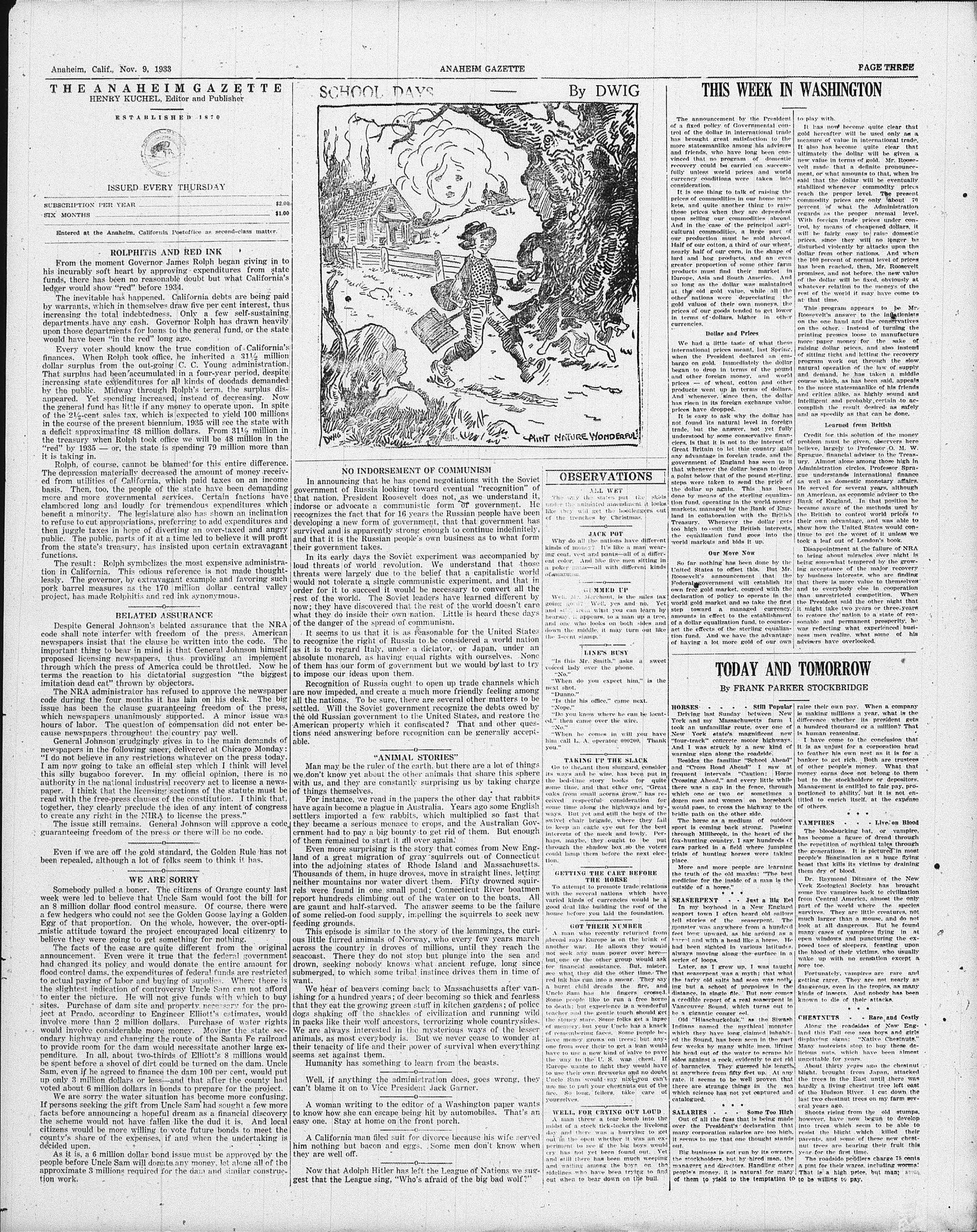
SCHOOL DAYS — By DWIG
AINT NATURE WONDERFUL
NO INDORSEMENT OF COMMUNISM
In announcing that he has open negotiations with the Soviet government of Russia looking toward eventual “recognition” of that nation, President Roosevelt does not, as we understand it, indorse or advocate a communistic form of government. He recognizes the fact that for 16 years the Russian people have been developing a new form of government, that that government has survived and is apparently strong enough to continue indefinitely, and that it is the Russian people’s own business as to what form their government takes.
In its early days the Soviet experiment was accompanied by loud threats of world revolution. We understand that those threats were largely due to the belief that a capitalistic world would not tolerate a single communist experiment, and that in order for it to succeed it would be necessary to convert all the rest of the world. The Soviet leaders have learned different by now; they have discovered that the rest of the world doesn’t care what they do inside their own nation. Little is heard these days of the danger of the spread of communism.
It seems to us that it is as reasonable for the United States to recognize the right of Russia to be considered a world nation as it is to regard Italy, under a dictator, or Japan, under an absolute monarch, as having equal rights with ourselves. None of them has our form of government but we would last to try to impose our ideas upon them.
Recognition of Russia ought to open up trade channels which are now impeded, and create a much more friendly feeling among all the nations. To be sure, there are several other matters to be settled. Will the Soviet government recognize the debts owed by the old Russian government to the United States, and restore the American property which it confiscated? That and other questions need answering before recognition can be generally acceptable.
“ANIMAL STORIES”
Man may be the ruler of the earth, but there are a lot of things we don’t know yet about the other animals that share this sphere with us, and they are constantly surprising us by taking charge of things themselves.
For instance, we read in the papers the other day that rabbits have again become a plague in Australia. Years ago some English settlers imported a few rabbits, which multiplied so fast that they became a serious menace to crops, and the Australian Government had to pay a big bounty to get rid of them. But enough of them remained to start it all over again.
Even more surprising is the story that comes from New England of a great migration of gray squirrels out of Connecticut into the adjoining states of Rhode Island and Massachusetts.
we don't know yet about the other animals that share this sphere with us, and they are constantly surprising us by taking charge of things themselves.
For instance, we read in the papers the other day that rabbits have again become a plague in Australia. Years ago some English settlers imported a few rabbits, which multiplied so fast that they became a serious menace to crops, and the Australian Government had to pay a big bounty to get rid of them. But enough of them remained to start it all over again.
Even more surprising is the story that comes from New England of a great migration of gray squirrels out of Connecticut into the adjoining states of Rhode Island and Massachusetts. Thousands of them, in huge droves, move in straight lines, letting neither mountains nor water divert them. Fifty drowned squirrels were found in one small pond; Connecticut River boatmen report hundreds climbing out of the water on to the boats. All are gaunt and half-starved. The answer seems to be the failure of some relied-on food supply, impelling the squirrels to seek new feeding grounds.
This episode is similar to the story of the lemmings, the curious little furred animals of Norway, who every few years march across the country in droves of millions, until they reach the seacoast. There they do not stop but plunge into the sea and drown, seeking nobody knows what ancient refuge, long since submerged, to which some tribal instinct drives them in time of want.
We hear of beavers coming back to Massachusetts after vanishing for a hundred years; of deer becoming so thick and fearless that they eat the growing green stuff in kitchen gardens; of police dogs shaking off the shackles of civilization and running wild in packs like their wolf ancestors, terrorizing whole countrysides. We are always interested in the mysterious ways of the lesser animals, as most everybody is. But we never cease to wonder at their tenacity of life and their power of survival when everything seems set against them.
Humanity has something to learn from the beasts.
Well, if anything the administration does, goes wrong, they can't blame it on to Vice President Jack Garner.
A woman writing to the editor of a Washington paper wants to know how she can escape being hit by automobiles. That's an easy one. Stay at home on the front porch.
A California man filed suit for divorce because his wife served him nothing but bacon and eggs. Some men don't know when they are well off.
Now that Adolph Hitler has left the League of Nations we suggest that the League sing, "Who's afraid of the big bad wolf?"
THIS WEEK IN WASHINGTON
The announcement by the President of a fixed policy of Governmental control of the dollar in international trade has brought great satisfaction to the more statesmanlike among his advisers and friends, who have long been convinced that no program of domestic recovery could be carried on successfully unless world prices and world currency conditions were taken into consideration.
It is one thing to talk of raising the prices of commodities in our home markets, and quite another thing to raise those prices when they are dependent upon selling our commodities abroad. And in the case of the principal agricultural commodities, a large part of our production must be sold abroad. Half of our cotton, a third of our wheat, nearly half of our corn, in the shape of lard and hog products, and an even greater proportion of some other farm products must find their market in Europe, Asia and South America. And so long as the dollar was maintained at the old gold value, while all the other nations were depreciating the gold values of their own moneys, the prices of our goods tended to get lower in terms of dollars, higher in other currencies.
Dollar and Prices
We had a little taste of what these international prices meant, last Spring, when the President declared an embargo on gold. Immediately the dollar began to drop in terms of the pound and other foreign money, and world prices — of wheat, cotton and other products went up in terms of dollars. And whenever, since then, the dollar has risen in its foreign exchange value, prices have dropped.
It is easy to ask why the dollar has not found its natural level in foreign trade, but the answer, not yet fully understood by some conservative financiers, is that it is not to the interest of Great Britain to let this country gain any advantage in foreign trade, and the to play with.
It has now become quite clear that gold hereafter will be used only as a measure of value in international trade. It also has become quite clear that ultimately the dollar will be given a new value in terms of gold. Mr. Roosevelt made that a definite pronouncement, or what amounts to that, when he said that the dollar will be eventually stabilized whenever commodity prices reach the proper level. The present commodity prices are only about 70 percent of what the Administration regards as the proper normal level. With foreign trade prices under control, by means of cheapened dollars, it will be fairly easy to raise domestic prices, since they will no longer be disturbed violently by attacks upon the dollar from other nations. And when the 100 percent of normal level of prices has been reached, then, Mr. Roosevelt promises, and not before, the new value of the dollar will be fixed, obviously at whatever relation to the moneys of the rest of the world it may have come to at that time.
This program appears to be Mr. Roosevelt's answer to the inflationists on the one hand and the conservatives on the other. Instead of turning the printing presses loose to manufacture more paper money for the sake of raising dollar prices, and also instead of sitting tight and letting the recovery program work out through the slow natural operation of the law of supply and demand, he has taken a middle course which, as has been said, appeals to the more statesmanlike of his friends and critics alike, as highly sound and intelligent and probably certain to accomplish the result desired as safely and as speedily as that can be done.
Learned from British
Credit for this solution of the money problem must be given, observers here believe, largely to Professor O. M. W. Sprague, financial adviser to the Treas-
TODAY AND TOMORROW
By FRANK PARKER STOCKBRIDGE
HORSES... Still Popular
Driving last Sunday between New York and my Massachusetts farm I took an unfamiliar route, over one of New York state's magnificent new "four-track" concrete motor highways. And I was struck by a new kind of warning sign along the roadside.
Besides the familiar "School Ahead" and "Cross Road Ahead" I saw at frequent intervals "Caution: Horse Crossing Ahead," and every little while there was a gap in the fence, through which one or two or sometimes a dozen men and women on horseback would pass, to cross the highway to the bridle path on the other side.
The horse as a medium of outdoor sport is coming back strong. Passing through Millbrook, in the heart of the fox-hunting country, I saw hundreds of cars parked in a field where jumping trials of hunting horses were taking place.
More and more people are learning barge on gold. Immediately the dollar began to drop in terms of the pound and other foreign money, and world prices — of wheat, cotton and other products went up in terms of dollars. And whenever, since then, the dollar has risen in its foreign exchange value, prices have dropped.
It is easy to ask why the dollar has not found its natural level in foreign trade, but the answer, not yet fully understood by some conservative financiers, is that it is not to the interest of Great Britain to let this country gain any advantage in foreign trade, and the government of England has seen to it that whenever the dollar began to drop a point below that of the pound sterling, steps were taken to send the price of the dollar up again. This has been done by means of the sterling equalization fund, operating in the world money markets, managed by the Bank of England in collaboration with the British Treasury. Whenever the dollar gets too high to suit the British interests, the equalization fund goes into the world markets and bids it up.
Our Move Now
So far nothing has been done by the United States to offset this. But Mr. Roosevelt's announcement that the Federal government will establish its own free gold market, coupled with the declaration of policy to operate in the world gold market and so take the first step toward a managed currency, amounts in effect to the establishment of a dollar equalization fund, to counteract the effects of the sterling equalization fund. And we have the advantage of having a lot more gold of our own raise their own pay. When a company is making millions a year, what is the difference whether its president gets a hundred thousand or a million? That is human reasoning.
I have come to the conclusion that it is as unjust for a corporation head to feather his own nest as it is for a banker to get rich. Both are trustees of other people's money. What that money earns does not belong to them but to the stockholders or depositors. Management is entitled to fair pay, proportioned to ability, but it is not entitled to enrich itself, at the expense of others.
VAMPIRES... Live on Blood
The bloodsucking bat, or vampire, has become a figure of dread through the repetition of mythical tales through the generations. It is pictured in most people's imagination as a huge flying beast that kills its victims by draining them dry of blood.
HART BEFORE HORSE
Note trade relations
tons which have
enclaves would be a
ing the roof of the
the foundation.
NUMBER
only returned from
on the brink of
follows they would
power over here—
group would ask
face. But, mister,
one other time. The
smear. They say
the fire, and
fingers crossed.
run a free horse
race is a wonderful
touch should get
the folks get a lapee
Uncle has a knack
Some people ben trees; but anyget a loan would
and of salve to pave
was chest. If
they would have
works and no doubt
you can't nest nuts out of the
take care of
NG OUT LOUD
ear bomb into the
stocks the livelong
a hurrying to get
her it was an exare big boys would
found out. Yet
seen much weeping
the boys on the
seen trying to find
own on the bull.
START BEFORE HORSE
Note trade relations
tons which have
enclaves would be a
ing the roof of the
the foundation.
NUMBER
only returned from
on the brink of
follows they would
power over here—
group would ask
face. But, mister,
one other time. The
smear. They say
the fire, and
fingers crossed.
run a free horse
race is a wonderful
touch should get
the folks get a lapee
Uncle has a knack
Some people ben trees; but anyget a loan would
and of salve to pave
was chest. If
they would have
works and no doubt
you can't nest nuts out of the
take care of
NG OUT LOUD
ear bomb into the
stocks the livelong
a hurrying to get
her it was an exare big boys would
found out. Yet
seen much weeping
the boys on the
seen trying to find
own on the bull.
SEASERPENT
In my boyhood in a New England seaport town I often heard old sailors tell stories of the seaserpent. The monster was anywhere from a hundred feet long upward, as big around as a barrel and with a head like a horse. He had been sighted in various latitudes, always moving along the surface in a series of loops.
Later, as I grew up, I was taught that seaserpent was a myth; that what the tarry old salts had seen was notting but a school of porpoises in the distance, in single file. But now comes a credible report of a real seaserpent in Vancouver Sound, which turns out to be a gigantic conger eel.
Old "Hlaschuckoluk." as the Siwash Indians named the mythical monster which they have long claimed inhabited the Sound, has been seen in the past few weeks by many white men, lifting his head out of the water to scrape his sides against a rock, evidently to get rid of barnacles. They guessed his length at anywhere from fifty feet up. At any rate, it seems to be well proven that there are strange things in the sea which science has not yet captured and catalogued.
SALARIES
Out of all the fuss that is being made over the President's declaration that many corporation salaries are too high, it seems to me that one thought stands out.
Big business is not run by its owners, the stockholders, but by hired men, the managers and directors. Handling other people's money, it is natural for many of them to yield to the temptation to money earns does not belong to them but to the stockholders or depositors. Management is entitled to fair pay, proportioned to ability, but it is not entitled to enrich itself, at the expense of others.
VAMPIRES
Live on Blood
The bloodsucking bat, or vampire, has become a figure of dread through the repetition of mythical tales through the generations. It is pictured in most people's imagination as a huge flying beast that kills its victims by draining them dry of blood.
Dr. Raymond Ditmars of the New York Zoological Society has brought some live vampires back to civilization from Central America, almost the only part of the world where the species survives. They are little creatures, not much larger than a mouse, and do not look at all dangerous. But he found many cases of vampires flying in at open windows and puncturing the exposed toes of sleepers, feasting upon the blood of their victims, who usually wake up with no sensation except a sore toe.
Fortunately, vampires are rare and getting rarer. They are not nearly as dangerous, even in the tropics, as many kinds of insects. And nobody has been known to die of their attacks.
CHESTNUTS
Rare and Costly
Along the roadsides of New England this Fall one sees boys and girls displaying signs: "Native Chestnuts." Many motorists stop to buy these delicious nuts, which have been almost ungettable for years.
About thirty years ago the chestnut blight, brought from Japan, attacked the trees in the East until there was hardly a living chestnut tree left east of the Hudson River. I cut down the last two chestnut trees on my farm several years ago.
Shoots rising from the old stumps, however, have now begun to develop into trees which seem to be able to resist the blight which killed their parents, and some of these new chestnut trees are bearing their fruit this year for the first time.
The roadside peddlers charge 75 cents a pint for their wares, including worms! That is a high price, but man; to be willing to pay.