anaheim-gazette 1933-10-26
Scanned page
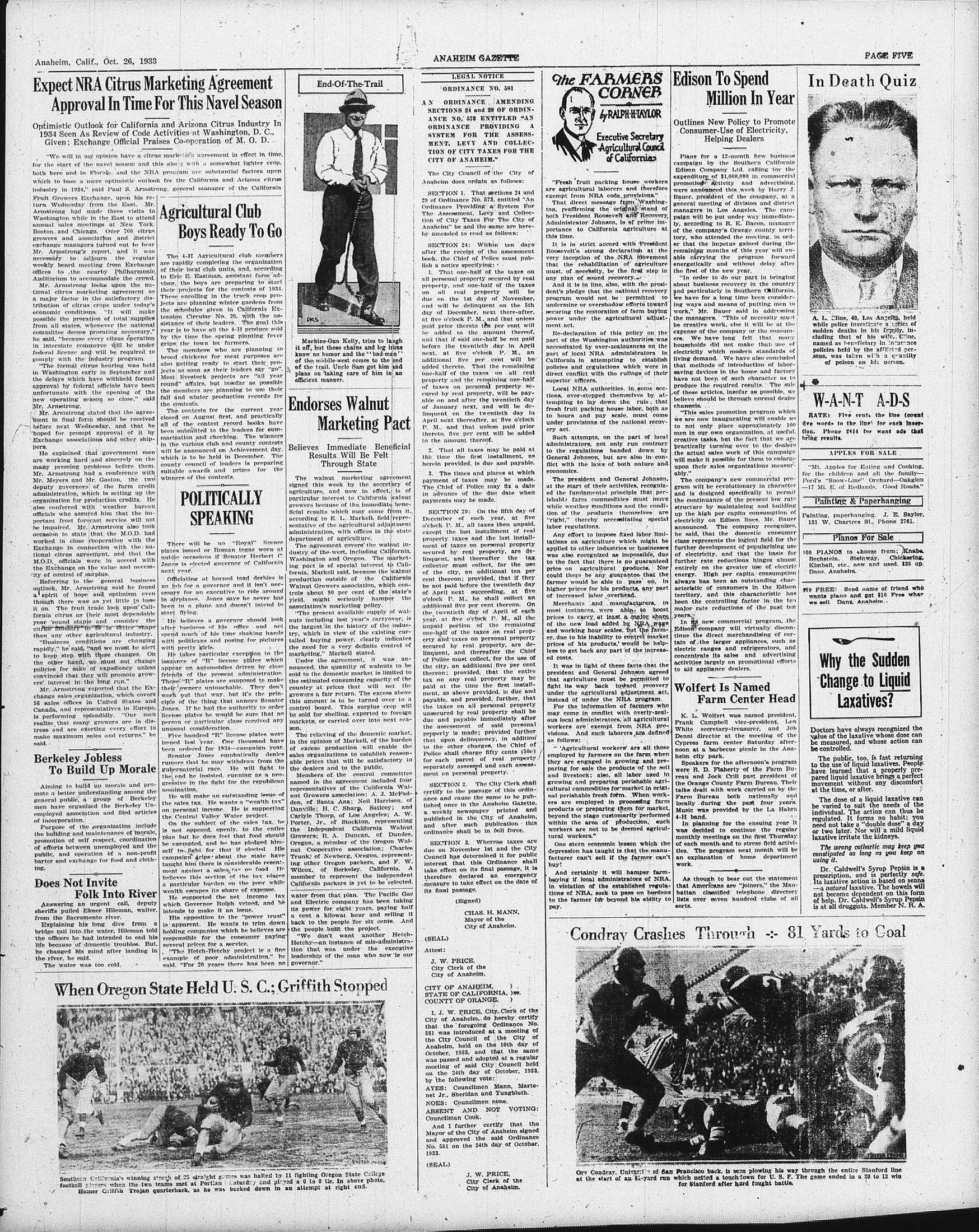
Searchable text
Expect NRA Citrus Marketing Agreement Approval In Time For This Navel Season
Optimistic Outlook for California and Arizona Citrus Industry In 1934 Seen As Review of Code Activities at Washington, D.C., Given; Exchange Official Praises Co-operation of M.O.D.
"We will in my opinion have a citrus marketing agreement in effect in time, for the start of the navel season and this along with a somewhat lighter crop, both here and in Florida, and the NRA program are substantial factors upon which to base a more optimistic outlook for the California and Arizona citrus industry in 1934," said Paul S. Armstrong, general manager of the California Fruit Growers Exchange, upon his return Wednesday from the East. Mr. Armstrong had made three visits to Washington while in the East to attend annual sales meetings at New York, Boston and Chicago. Over 700 citrus growers and association and district exchange managers turned out to hear Mr. Armstrong's report, and it was necessary to adjourn the regular weekly board meeting from Exchange offices to the nearby Philharmonic Auditorium to accommodate the crowd.
Mr. Armstrong looks upon the national citrus marketing agreement as a major factor in the satisfactory distribution of citrus crops under today's economic conditions. "It will make possible the proration of total supplies from all states, whenever the national committee deems proring necessary," he said, "because every citrus operation in interstate commerce will be under federal license and will be required to comply with the industry program.
"The formal citrus hearing was held in Washington early in September and the delays which have withheld formal approval by federal officials have been unfortunate with the opening of the new operating season so close," said Mr. Armstrong.
Mr. Armstrong stated that the agreement in final form should be received before next Wednesday, and that he hoped for prompt approval of it by Exchange associations and other shipers.
He explained that government men are working hard and sincerely on the
"The formal citrus hearing was held in Washington early in September and the delays which have withheld formal approval by federal officials have been unfortunate with the opening of the new operating season so close," said Mr. Armstrong.
Mr. Armstrong stated that the agreement in final form should be received before next Wednesday, and that he hoped for prompt approval of it by Exchange associations and other shipers.
He explained that government men are working hard and sincerely on the many pressing problems before them. Mr. Armstrong had a conference with Mr. Meyers and Mr. Gaston, the two deputy governors of the farm credit administration, which is setting up the organization for production credits. He also conferred with weather bureau officials who assured him that the important frost forecast service will not be impaired. Mr. Armstrong also took occasion to state that the M.O.D. had worked in close cooperation with the Exchange in connection with the national citrus agreement, and that the M.O.D. officials were in accord with the Exchange on the value and necessity of control of surplus.
Referring to the general business outlook, Mr. Armstrong said he found a spirit of hope and optimism even though there was as yet little to base it on. The fruit trade look upon California citrus as their most dependable year 'round staple and consider the citrus industry to be in better shape than any other agricultural industry.
"Business conditions are changing rapidly," he said, "and we must be alert to keep step with these changes. On the other hand, we must not change policies for sake of expediency unless convinced that they will promote growers' interest in the long run."
Mr. Armstrong reported that the Exchange sales organization, which covers 56 sales offices in United States and Canada, and representatives in Europe, is performing splendidly. "Our men realize that many growers are in distress and are exerting every effort to make maximum sales and returns," he said.
Berkeley Jobless To Build Up Morale
Aiming to build up morale and promote a better understanding among the general public, a group of Berkeley men have organized the Berkeley Unemployed association and filed articles of incorporation.
Purpose of the organization include the building and maintenance of morale, promotion of self respect, coordination of efforts between unemployed and the public, and operation of a non-profit barter and exchange for food and clothing.
There will be no "Royal" license plates issued or Roman togas worn at public occasions if Senator Herbert C. Jones is elected governor of California next year.
Officiating at horned toad derbies is no job for a governor and it isn't necessary for an executive to ride around in airplanes. Jones says he never has been in a plane and doesn't intend to start flying.
He believes a governor should look after business of his office and not spend much of his time shaking hands with politicians and posing for pictures with pretty girls.
He takes particular exception to the issuance of "R" license plates which appear on automobiles driven by close friends of the present administration. Those "R" plates are supposed to make their owners untouchable. They don't work out that way, but it's the principle of the thing that annoys Senator Jones. If he had the authority to order license plates he would be sure that no person or particular class received any unusual consideration.
Five hundred "R" license plates were issued last year. One thousand have been ordered for 1934—campaign year.
Senator Jones emphatically denies rumors that he may withdraw from the gubernatorial race. He will fight to the end he insisted running as a progressive in the fight for the republican nomination.
He will make an outstanding issue of the sales tax. He wants a "wealth tax" on personal income. He is supporting the Central Valley Water project.
On the subject of the sales tax, he is not opposed, openly, to the entire plan but he does feel that food should be exempted, and he has pledged himself to fight for that if elected. His campaign trips about the state have taught him there is considerable resentment against a sales tax on food. He also getting ready to start their projects as soon as their leaders say "go." Most livestock projects are "all year round" affairs, but insofar as possible the members are planning to use their fall and winter production records for the contests.
The contests for the current year closed on August first, and practically all of the contest record books have been submitted to the leaders for summarization and checking. The winners in the various club and county contests will be announced on Achievement day, which is to be held in December. The county council of leaders is preparing suitable awards and prizes for the winners of the contests.
POLITICALLY SPEAKING
There will be no "Royal" license plates issued or Roman togas worn at public occasions if Senator Herbert C. Jones is elected governor of California next year.
Officiating at horned toad derbies is no job for a governor and it isn't necessary for an executive to ride around in airplanes. Jones says he never has been in a plane and doesn't intend to start flying.
He believes a governor should look after business of his office and not spend much of his time shaking hands with politicians and posing for pictures with pretty girls.
He takes particular exception to the issuance of "R" license plates which appear on automobiles driven by close friends of the present administration. Those "R" plates are supposed to make their owners untouchable. They don't work out that way, but it's the principle of the thing that annoys Senator Jones. If he had the authority to order license plates he would be sure that no person or particular class received any unusual consideration.
Five hundred "R" license plates were issued last year. One thousand have been ordered for 1934—campaign year.
Senator Jones emphatically denies rumors that he may withdraw from the gubernatorial race. He will fight to the end he insisted running as a progressive in the fight for the republican nomination.
He will make an outstanding issue of the sales tax. He wants a "wealth tax" on personal income. He is supporting the Central Valley Water project.
On the subject of the sales tax, he is not opposed, openly, to the entire plan but he does feel that food should be exempted, and he has pledged himself to fight for that if elected. His campaign trips about the state have taught him there is considerable resentment against a sales tax on food. He also getting ready to start their projects as soon as their leaders say "go." Most livestock projects are "all year round" affairs, but insofar as possible the members are planning to use their fall and winter production records for the contests.
The walnut market signed this week by the agriculture, and now in particular interest to Californians because of the industrial results which may according to E. L. Marks sentative of the agricultural administration, with office department of agriculture.
The agreement covers 'dustry of the west,' including Washington and Oregon, ing pact is of special importance in formia, Markell said, because production outside of Walnut Growers associates controls about 90 per cent yield, might seriously associate's marketing pact.
"The present available nuts including last year's largest in the history try, which in view of this tailored buying power, could need for a very definite marketing," Markell said.
Under the agreement, nounced, the quantity of sold to the domestic market estimated consuming country at prices that growers a fair return. This amount is to be taken control board. This sure be sold for shelling, export markets, or carried over son.
The relieving of the doe in the opinion of Markell of excess production would sales organizations to establish prices that will be dealt with by dealers and to the members of the contract named in the agreement representatives of the Oak nut Growers association, den of Santa Ana; New Danville; H. C. Sharp; Carlyle Thorp; of Los Angeles Porter, Jr., of Stockton; the Independent Californians; R. A. Duncan; Oregon, a member of the nut Cooperative association Trunk; of Newberg, Oregon; ing other Oregon packer Wilcox of Berkeley.
Aiming to build up morale and promote a better understanding among the general public, a group of Berkeley men have organized the Berkeley Unemployed Association and filed articles of incorporation.
Purpose of the organization include the building and maintenance of morale, promotion of self respect, coordination of efforts between unemployed and the public, and operation of a non-profit barter and exchange for food and clothing.
Does Not Invite Folk Into River
Answering an urgent call, deputy sheriffs pulled Elmer Hileman, walter, from the Sacramento river.
Explaining his long dive from a bridge call into the water, Hileman told the officers he had intended to end his life because of domestic troubles. But, he changed his mind after landing in the river, he said.
The water was too cold.
He will make an outstanding issue of the sales tax. He wants a "wealth tax" on personal income. He is supporting the Central Valley Water project.
On the subject of the sales tax, he is not opposed, openly, to the entire plan but he does feel that food should be exempted, and he has pledged himself to fight for that if elected. His campaign trips about the state have taught him there is considerable resentment against a sales tax on food. He believes this section of the tax places a particular burden on the poor while wealth escapes its share of expense.
He supported the net income tax which Governor Rolph vetoed, and he intends to make it an issue.
His opposition to the "power trust" is apparent. He wants to trim down holding companies which he believes are responsible for the consumer paying several prices for a service.
"The Hetch-Hetchy project is a fine example of poor administration," he said. "For 20 years there has been no
When Oregon State Held U. S. C.; Griffith Stop
Southern California's winning streak of 25 straight games was halted by 11 fighting Oregon State football players when the two teams met at Portland Saturday and played a 0 to 0 tie. In above Homer Griffith Trojan quarterback, as he was bucked down in an attempt at right end
LEGAL NOTICE
ORDINANCE NO. 581
AN ORDINANCE AMENDING SECTIONS 24 and 29 OF ORDINANCE NO. 578 ENTITLED "AN ORDINANCE PROVIDING A SYSTEM FOR THE ASSESSMENT, LEVY AND COLLECTION OF CITY TAXES FOR THE CITY OF ANAHEIM."
The City Council of the City of Anaheim does ordain as follows:
SECTION 1. That sections 24 and 29 of Ordinance No. 573, entitled "An Ordinance Providing a System For The Assessment, Levy and Collection of City Taxes For The City of Anaheim" be and the same are hereby amended to read as follows:
SECTION 24: Within ten days after the receipt of the assessment book, the Chief of Police must publish a notice specifying:
1. That one-half of the taxes on all personal property secured by real property, and one-half of the taxes on all real property will be due on the 1st day of November, and will be delinquent on the 5th day of December, next thereafter, at five o'clock P.M., and that unless paid prior thereto ten per cent will be added to the amount thereof, and that if said one-half be not paid before the twentieth day in April next, at five o'clock P.M., an additional five per cent will be added thereto. That the remaining one-half of the taxes on all real property and the remaining one-half of taxes on personal property secured by real property, will be payable on and after the twentieth day of January next, and will be delinquent on the twentieth day in April next thereafter, at five o'clock P.M., and that unless paid prior thereto, five per cent will be added to the amount thereof.
2. That all taxes may be paid at the time the first installment, as
"The fresh fruit packing house workers are agricultural laborers and therefore exempt from NRA code provisions."
That direct message from Washington, reaffirming the original stand of both President Roosevelt and Recovery Administrator Johnson, is of prime importance to California agriculture at this time.
It is in strict accord with President Roosevelt's strong declaration at the very inception of the NRA movement that the rehabilitation of agriculture must, of necessity, be the first step in any plan of sound recovery.
And it is in line, also, with the president's pledge that the national recovery program would not be permitted to undermine or overshadow efforts toward securing the restoration of farm buying power under the agricultural adjustment act.
Re-declaration of this policy on the part of the Washington authorities was necessitated by over-zealousness on the part of local NRA administrators in California in attempting to establish policies and regulations which were in direct conflict with the rulings of their superior officers.
Local NRA authorities, in some sections, over-stepped themselves by attempting to lay down the rule; that fresh fruit packing house labor, both as to hours and pay scale, must come under provisions of the national recovery act.
Such attempts, on the part of local administrators, not only run contrary to the regulations handed down by General Johnson, but are also in con-
Endorses Walnut Marketing Pact
Believes Immediate Beneficial Results Will Be Felt Through State
The walnut marketing agreement signed this week by the secretary of agriculture, and now in effect, is of particular interest to California walnut growers because of the immediate beneficial results which may come from it, according to E. L. Markell, field representative of the agricultural adjustment administration, with offices in the state department of agriculture.
The agreement covers the walnut industry of the west, including California, Washington and Oregon. The marketing pact is of special interest to California, Markell said, because the walnut production outside of the California Walnut Growers association, which controls about 90 per cent of the state's yield, might seriously hamper the association's marketing policy.
"The present available supply of walnuts including last year's carryover, is the largest in the history of the industry, which in view of the existing curtailed buying power, clearly indicates the need for a very definite control of marketing," Markell stated.
Under the agreement, it was announced, the quantity of walnuts to be sold to the domestic market is limited to the estimated consuming capacity of the country at prices that will not net the growers a fair return. The excess above this amount is to be turned over to a control board. This surplus crop will be sold for shelling, exported to foreign markets, or carried over into next season.
The relieving of the domestic market, in the opinion of Markell, of the burden of excess production will enable the sales organizations to establish reasonable prices that will be satisfactory to the dealers and to the public.
Members of the control committee named in the agreement included four representatives of the California Walnut Growers association: A. J. McFadden, of Santa Ana; Nell Harrison, of Danville; H. C. Sharp, Saticoy; and Carlyle Thorp, of Los Angeles; A. W. Porter, Jr., of Stockton, representing the Independent California Walnut Growers; R. A. Duncan, of Dundee, Oregon, a member of the Oregon Walnut Cooperative association; Charles Trunk, of Newberg, Oregon, representing other Oregon packers, and F. W. Wilcox of Berkeley, California.
Add thereto. That the remaining one-half of the taxes on all real property and the remaining one-half of taxes on personal property secured by real property, will be payable on and after the twentieth day of January next, and will be delinquent on the twentieth day in April next thereafter, at five o'clock P.M., and that unless paid prior thereto, five per cent will be added to the amount thereof.
2. That all taxes may be paid at the time the first installment, as herein provided, is due and payable.
3. The times and places at which payment of taxes may be made. The Chief of Police may fix a date in advance of the due date when payments may be made.
SECTION 29: On the fifth day of December of each year, at five o'clock P.M., all taxes then unpaid, except the last installment of real property taxes and the last installment of taxes on personal property secured by real property, are delinquent, and thereafter the tax collector must collect, for the use of the city, an additional ten per cent thereon; provided, that if they be not paid before the twentieth day of April next succeeding, at five o'clock P.M., he shall collect an additional five per cent thereon. On the twentieth day of April of each year, at five o'clock P.M., all the unpaid portion of the remaining one-half of the taxes on real property and taxes on personal property secured by real property, are delinquent, and thereafter the Chief of Police must collect, for the use of the city, an additional five per cent thereon; provided, that the entire tax on any real property may be paid at the time the first installation, as above provided, is due and payable, and provided further, that the taxes on all personal property unsecured by real property shall be due and payable immediately after the assessment of said personal property is made; provided further that upon delinquency, in addition to the other charges, the Chief of Police shall charge fifty cents (50c) for each parcel of real property separately assessed and each assessment on personal property.
SECTION 2. The City Clerk shall certify to the passage of this ordinance and cause the same to be published once in the Anaheim Gazette, a weekly newspaper printed and published in the City of Anaheim, and after such publication this ordinance shall be in full force.
SECTION 3. Whereas taxes are due on November 1st and the City Council has determined it for public interest that this Ordinance shall take effect on its final passage, it is
Local NRA authorities, in some sections, over-stepped themselves by attempting to lay down the rule that fresh fruit packing house labor both as to hours and pay scale must come under provisions of the national recovery act.
Such attempts, on the part of local administrators, not only run contrary to the regulations handed down by General Johnson, but are also in conflict with the laws of both nature and economics.
The president and General Johnson, at the start of their activities, recognized the fundamental principle that perishable farm commodities must move while weather conditions and the condition of the products themselves are "right," thereby necessitating special labor regulations.
Any effort to impose fixed labor limitations on agriculture which might be applied to other industries or businesses was also recognized as impossible due to the fact that there is no guaranteed price on agricultural products. Nor could there be any guarantee that the farmer would be able to pass on, in higher prices for his products, any part increased labor overhead.
Merchants and manufacturers, in most instances, were able to boost prices to carry at least a major share of the new load added by NRA wage and working hour scales, but the farmer, due to his inability to control market prices of his products, would be helpless to get back any part of the increased costs.
It was in light of these facts that the president and General Johnson agreed that agriculture must be permitted to fight its way back toward recovery under the agricultural adjustment act, instead of under the NRA program.
For the information of farmers who may come in conflict with overly zealous local administrators, all agricultural workers are exempt from NRA provisions. And such laborers are defined as follows:
"'Agricultural workers' are all those employed by farmers on the farm when they are engaged in growing and preparing for sale the products of the soil and livestock; also, all labor used in growing and preparing perishable agricultural commodities for market in original perishable fresh form. When workers are employed in processing farm products or preparing them for market beyond the stage customarily performed within the area of production, such workers are not to be deemed agricultural workers."
One stern economic lesson which the depression has taught is that the manufacturer can't sell if the farmer can't buy!
Members of the control committee named in the agreement included four representatives of the California Walnut Growers association: A. J. McFadden, of Santa Ana; Nell Harrison, of Danville; H. C. Sharp, Saticoy; and Carlyle Thorp, of Los Angeles; A. W. Porter, Jr., of Stockton, representing the Independent California Walnut Growers; R. A. Duncan, of Dundee, Oregon, a member of the Oregon Walnut Cooperative association; Charles Trunk; of Newberg, Oregon, representing other Oregon packers, and F. W. Wilcox, of Berkeley, California. A member to represent the independent California packers is yet to be selected.
water from that plan. The Pacific Gas and Electric company has been taking its power for eight years, paying half a cent a kilowat hour and selling it back to the people for six cents. And the people built the project.
"We don't want another Hetch-Hetchy—an instance of mis-administration that was under the executive leadership of the man who now is our governor."
SECTION 2. The City Clerk shall certify to the passage of this ordinance and cause the same to be published once in the Anaheim Gazette, a weekly newspaper printed and published in the City of Anaheim, and after such publication this ordinance shall be in full force.
SECTION 3. Whereas taxes are due on November 1st and the City Council has determined it for public interest that this Ordinance shall take effect on its final passage, it is therefore declared an emergency measure to take effect on the date of its final passage.
(Signed)
CHAS. H. MANN,
Mayor of the
City of Anaheim.
(SEAL)
Attest:
J. W. PRICE,
City Clerk of the
City of Anaheim.
CITY OF ANAHEIM,
STATE OF CALIFORNIA,
COUNTY OF ORANGE.
I. J. W. PRICE, City Clerk of the City of Anaheim, do hereby certify that the foregoing Ordinance No. 581 was introduced at a meeting of the City Council of the City of Anaheim, held on the 10th day of October, 1933, and that the same was passed and adopted at a regular meeting of said City Council held on the 24th day of October, 1933, by the following vote:
AYES: Councilmen Mann, Martenet Jr., Sheridan and Yungbluth.
NOES: Councilmen none.
ABSENT AND NOT VOTING: Councilman Cook.
And I further certify that the Mayor of the City of Anaheim signed and approved the said Ordinance No. 581 on the 24th day of October, 1933.
(SEAL)
J. W. PRICE,
City Clerk of the
City of Anaheim,
One stern economic lesson which the depression has taught is that the manufacturer can't sell if the farmer can't buy!
And certainly it will hamper farm-buying if local administrators of NRA, in violation of the established regulations of NRA, seek to pass on burdens to the farmer far beyond his ability to pay.
Condray Crashes
Ory Condray, University of San Francisco at the start of an 81-yard run which for $
Edison To Spend Million In Year
Outlines New Policy to Promote Consumer-Use of Electricity, Helping Dealers
Plans for a 12-month new business campaign by the Southern California Edison Company Ltd. calling for the expenditure of $1,000,000 in commercial promotion activity and advertising, were announced this week by Harry J. Bauer, president of the company, at a general meeting of division and district managers in Los Angeles. The campaign will be put under way immediately, according to R. E. Bacon, manager of the company's Orange county territory, who attended the meeting, in order that the impetus gained during the remaining months of this year will enable carrying the program forward energetically and without delay after the first of the new year.
"In order to do our part in bringing about business recovery in the country and particularly in Southern California, we have for a long time been considering ways and means of putting men to work," Mr. Bauer said in addressing the managers. "This of necessity must be creative work, else it will be at the expense of the company or the consumers. We have long felt that many households did not make that use of electricity which modern standards of living demand. We have also concluded that methods of introduction of labor-saving devices in the home and factory have not been of such character as to produce the required results. The sale of these articles, insofar as possible, we believe should be through normal dealer channels."
This sales promotion program which we are now inaugurating will enable us to not only place approximately 100 men in our own organization, at useful, creative tasks, but the fact that we are practically turning over to the dealers the actual sales work of this campaign will make it possible for them to enlarge
In Death Quiz
A. L. Cline, 40, Los Angeles, held while police investigate a series of sudden deaths in his family, including that of his wife, Cline, named as beneficiary in insurance policies held by the afflicted persons, was taken with a quantity of poison on his person.
W-A-N-T A-D-S
RATE: Five cents; the line (count five words to the line) for each insertion. Phone 2414 for want ads that bring results.
APPLES FOR SALE
WOLFERT IS NAMED FARM CENTER HEAD
K. L. Wolfert was named president, Frank Campbell vice-president, Len White secretary-treasurer, and Job Denni director at the meeting of the Cypress farm center Saturday afternoon at a barbecue picnic in the Anaheim city park.
Speakers for the afternoon's program were R. D. Flaherty of the Farm Bureau and Jock Crill past president of the Orange County Farm Bureau. Their talks dealt with work carried on by the Farm Bureau both nationally and locally during the past four years. Music was provided by the La Habra 4-H band.
In planning for the ensuing year it was decided to continue the regular monthly meetings on the first Thursday of each month and to stress field activities. The program next month will be an explanation of home department work.
DOCTORS HAVE ALWAYS RECOGNIZED THE VALUE OF THE LAXATIVE WHOSE DOSE CAN BE MEASURED, AND WHOS ACTION CAN BE CONTROLLED.
The public, too, is fast returning to the use of liquid laxatives. People have learned that a properly prepared liquid laxative brings a perfect movement without any discomfort at the time, or after.
The dose of a liquid laxative can be varied to suit the needs of the individual. The action can thus be regulated. It forms no habit; you need not take a "double dose" a day or two later. Nor will a mild liquid laxative irritate the kidneys.
The wrong cathartic may keep you constipated as long as you keep on using it.
Dr. Caldwell's Syrup Pepsin is a
Day Crashes Through 81 Yards to Coal
University of San Francisco back, is seen plowing his way through the entire Stanford line of an 81-yard run which netted a touchdown for U. S. F. The game ended in a 20 to 13 win for Stanford after hard fought battle.