anaheim-gazette 1933-10-26
Scanned page
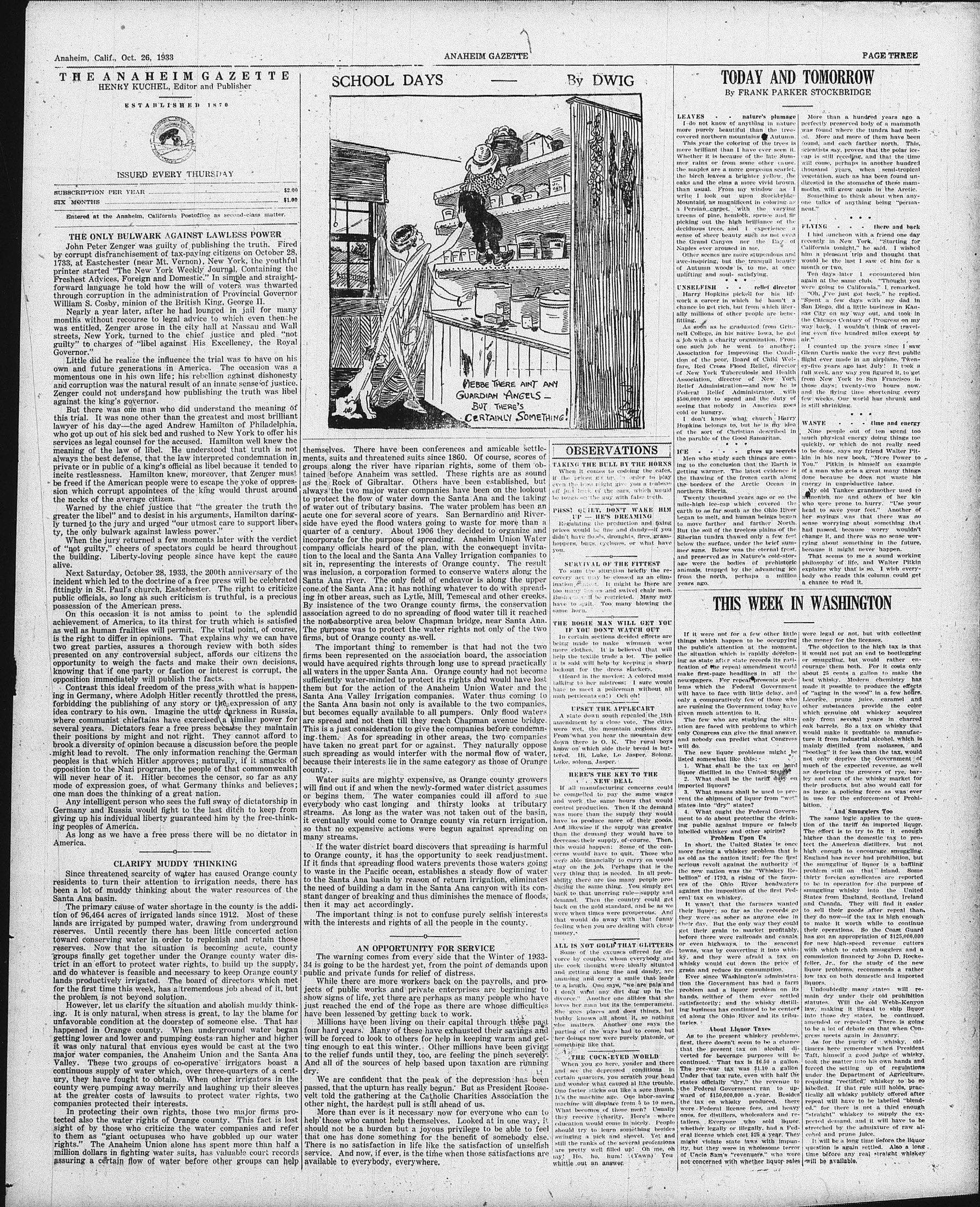
Searchable text
THE ANAHEIM GAZETTE
HENRY KUCHEL, Editor and Publisher
ESTABLISHED 1870
ISSUED EVERY THURSDAY
SUBSCRIPTION PER YEAR ... $2.00
SIX MONTHS ... $1.00
Entered at the Anaheim, California Poetoffice as second-class matter.
THE ONLY BULWARK AGAINST LAWLESS POWER
John Peter Zenger was guilty of publishing the truth. Fired by corrupt disfranchisement of tax-paying citizens on October 28, 1733, at Eastchester (near Mt. Vernon), New York, the youthful printer started "The New York Weekly Journal, Containing the Freshest Advices, Foreign and Domestic." In simple and straightforward language he told how the will of voters was thwarted through corruption in the administration of Provincial Governor William S. Cosby, minion of the British King, George II.
Nearly a year later, after he had lounged in jail for many months without recourse to legal advice to which even then he was entitled, Zenger arose in the city hall at Nassau and Wall streets, New York, turned to the chief justice and pled "not guilty" to charges of "libel against His Excellency, the Royal Governor."
Little did he realize the influence the trial was to have on his own and future generations in America. The occasion was a momentous one in his own life; his rebellion against dishonesty and corruption was the natural result of an innate sense of justice. Zenger could not understand how publishing the truth was libel against the king's governor.
But there was one man who did understand the meaning of this trial. It was none other than the greatest and most brilliant lawyer of his day—the aged Andrew Hamilton of Philadelphia, who got up out of his sick bed and rushed to New York to offer his services as legal counsel for the accused. Hamilton well knew the meaning of the law of libel. He understood that truth is not
Little did he realize the influence the trial was to have on his own and future generations in America. The occasion was a momentous one in his own life; his rebellion against dishonesty and corruption was the natural result of an innate sense of justice. Zenger could not understand how publishing the truth was libel against the king's governor.
But there was one man who did understand the meaning of this trial. It was none other than the greatest and most brilliant lawyer of his day—the aged Andrew Hamilton of Philadelphia, who got up out of his sick bed and rushed to New York to offer his services as legal counsel for the accused. Hamilton well knew the meaning of the law of libel. He understood that truth is not always the best defense, that the law interpreted condemnation in private or in public of a king's official as libel because it tended to incite restlessness. Hamilton knew, moreover, that Zenger must be freed if the American people were to escape the yoke of oppression which corrupt appointees of the king would thrust around the necks of the average citizen.
Warned by the chief justice that "the greater the truth the greater the libel" and to desist in his arguments, Hamilton daringly turned to the jury and urged "our utmost care to support liberty, the only bulwark against lawless power."
When the jury returned a few moments later with the verdict of "not guilty," cheers of spectators could be heard throughout the building. Liberty-loving people since have kept the cause alive.
Next Saturday, October 28, 1933, the 200th anniversary of the incident which led to the doctrine of a free press will be celebrated fittingly in St. Paul's church, Eastchester. The right to criticize public officials, so long as such criticism is truthful, is a precious possession of the American press.
On this occasion it is not amiss to point to the splendid achievement of America, to its thirst for truth which is satisfied as well as human frailties will permit. The vital point, of course, is the right to differ in opinions. That explains why we can have two great parties, assures a thorough review with both sides presented on any controversial subject, affords our citizens the opportunity to weigh the facts and make their own decisions, knowing that if one party or faction or interest is corrupt, the opposition immediately will publish the facts.
Contrast this ideal freedom of the press with what is happening in Germany, where Adolph Hitler recently throttled the press, forbidding the publishing of any story or the expression of any idea contrary to his own. Imagine the utter darkness in Russia, where communist chieftains have exercised a similar power for several years. Dictators fear a free press because they maintain their positions by might and not right. They cannot afford to brook a diversity of opinion because a discussion before the people might lead to revolt. The only information reaching the German peoples is that which Hitler approves; naturally, if it smacks of opposition to the Nazi program, the people of that commonwealth will never hear of it. Hitler becomes the censor, so far as any mode of expression goes, of what Germany thinks and believes; one man does the thinking of a great nation.
Any intelligent person who sees the full sway of dictatorship in Germany and Russia would fight to the last ditch to keep from giving up his individual liberty guaranteed him by the free-thinking peoples of America.
As long as we have a free press there will be no dictator in America.
peoples is that which Hitler approves; naturally, if it smacks of opposition to the Nazi program, the people of that commonwealth will never hear of it. Hitler becomes the censor, so far as any mode of expression goes, of what Germany thinks and believes; one man does the thinking of a great nation.
Any intelligent person who sees the full sway of dictatorship in Germany and Russia would fight to the last ditch to keep from giving up his individual liberty guaranteed him by the free-thinking peoples of America.
As long as we have a free press there will be no dictator in America.
CLARIFY MUDDY THINKING
Since threatened scarcity of water has caused Orange county residents to turn their attention to irrigation needs, there has been a lot of muddy thinking about the water resources of the Santa Ana basin.
The primary cause of water shortage in the county is the addition of 96,464 acres of irrigated lands since 1912. Most of these lands are irrigated by pumped water, drawing from underground reserves. Until recently there has been little concerted action toward conserving water in order to replenish and retain those reserves. Now that the situation is becoming acute, county groups finally get together under the Orange county water district in an effort to protect water rights, to build up the supply, and do whatever is feasible and necessary to keep Orange county lands productively irrigated. The board of directors which met for the first time this week, has a tremendous job ahead of it, but the problem is not beyond solution.
However, let us clarify the situation and abolish muddy thinking. It is only natural, when stress is great, to lay the blame for unfavorable condition at the doorstep of someone else. That has happened in Orange county. When underground water began getting lower and lower and pumping costs ran higher and higher it was only natural that envious eyes would be cast at the two major water companies, the Anaheim Union and the Santa Ana Valley. These two groups of co-operative irrigators boast a continuous supply of water which, over three-quarters of a century, they have fought to obtain. When other irrigators in the county were pumping away merrily and laughing up their sleeves at the greater costs of lawsuits to protect water rights, two companies protected their interests.
In protecting their own rights, those two major firms protected also the water rights of Orange county. This fact is lost sight of by those who criticize the water companies and refer to them as "giant octupuses who have gobbled up our water rights." The Anaheim Union alone has spent more than half a million dollars in fighting water suits, has valuable court records assuring a certain flow of water before other groups can help because their interest...
SCHOOL DAYS — By DWIG
WEBBE THERE AINT ANY
GUARDIAN ANGELS —
BUT THERE'S
CERTAINLY SOMETHING!
themselves. There have been conferences and amicable settlements, suits and threatened suits since 1860. Of course, scores of groups along the river have riparian rights, some of them obtained before Anaheim was settled. These rights are as sound as the Rock of Gibraltar. Others have been established, but always the two major water companies have been on the lookout to protect the flow of water down the Santa Ana and the taking of water out of tributary basins. The water problem has been an acute one for several score of years. San Bernardino and River-side have eyed the flood waters going to waste for more than a quarter of a century. About 1906 they decided to organize and incorporate for the purpose of spreading. Anaheim Union Water company officials heard of the plan, with the consequent invitation to the local and the Santa Ana Valley Irrigation companies to sit in, representing the interests of Orange county. The result was inclusion, a corporation formed to conserve waters along the Santa Ana river. The only field of endeavor is along the upper cone of the Santa Ana; it has nothing whatever to do with spreading in other areas, such as Lytle, Mill, Temescal and other creeks. By insistence of the two Orange county firms, the conservation association agreed to do no spreading of flood water till it reached the non-absorptive area below Chapman bridge, near Santa Ana. The purpose was to protect the water rights not only of the two firms, but of Orange county as well.
The important thing to remember is that had not the two firms been represented on the association board, the association would have acquired rights through long use to spread practically all waters in the upper Santa Ana. Orange county had not become sufficiently water-minded to protect its rights and would have lost them but for the action of the Anaheim Union Water and the Santa Ana Valley Irrigation companies. Water thus coming to the Santa Ana basin not only is available to the two companies, but becomes equally available to all pumpers. Only flood waters are spread and not then till they reach Chapman avenue bridge. This is a just consideration to give the companies before condemning them. As for spreading in other areas, the two companies have taken no great part for or against. They naturally oppose such spreading as would interfere with the normal flow of water, because their interests lie in the same category as those of Orange county...
Water suits are mighty expensive, as Orange county growers will find out if and when the newly-formed water district assumes or begins them. The water companies could ill afford to sue everybody who cast longing and thirsty looks at tributary streams. As long as the water was not taken out of the basin, it eventually would come to Orange county via return irrigation, so that no expensive actions were begun against spreading on many streams.
If the water district board discovers that spreading is harmful
OBSERVATIONS
TAKING THE BULL BY THE HORNS
When it comes to codeing the cafes, if the prices get up, order to play even the lowest might give you a teabone off just back of the ours, which would be tough on the guy with false teeth.
PHSS! QUIET, DON'T WAKE HIM UP — HE'S DREAMING
Regulating the production and fixing prices would be fine and dandy—if you didn't have floods, droughts, fires, grass-hoppers, bugs, cyclones, or what have you.
SURVIVAL OF THE FITTEST
To sum the situation briefly the recovery act may be closed as an elimination attempt. It might be there are too many losses and swivel chair men. Business will be restricted. Many may have to quit. Too many blowing the same horn.
THE HOOGIE MAN WILL GET YOU IF YOU DONT WATCH OUT
In certain sections decided efforts are being made to make wimmen wear more clothes. It is believed that will help the textile trade a lot. The police it is said will help by keeping a sharp lookout for the dress slackers.
(Heard in the movies: A colored maid talking to her mistress; I sure would hate to meet a policeman without all mah petticoats on!) Och oh!
UPSET THE APPLECART
A state down south repealed the 18th amendment by a close vote. The cities were wet, the mountain regions dry. From what you hear the mountain dew down there is O. K. The rural boys know on which side their bread is buttered. Hi, Luke, Lo Jasper, Solong, Luke, solong, Jasper.
HERE'S THE KEY TO THE NEW DEAL
If all manufacturing concerns could be compelled to pay the same wages and work the same hours that would control production. Then if the demand was more than the supply they would have to produce more of their goods. And likewise if the supply was greater than the demand they would have to decrease their supply, of course. Then this would happen: Some of the consumers would have to quit. Those who
because their interests lie in the same category as those of Orange county.
Water suits are mighty expensive, as Orange county growers will find out if and when the newly-formed water district assumes or begins them. The water companies could ill afford to sue everybody who cast longing and thirsty looks at tributary streams. As long as the water was not taken out of the basin, it eventually would come to Orange county via return irrigation, so that no expensive actions were begun against spreading on many streams.
If the water district board discovers that spreading is harmful to Orange county, it has the opportunity to seek readjustment. If it finds that spreading flood waters prevents those waters going to waste in the Pacific ocean, establishes a steady flow of water to the Santa Ana basin by reason of return irrigation, eliminates the need of building a dam in the Santa Ana canyon with its constant danger of breaking and thus diminishes the menace of floods, then it may act accordingly.
The important thing is not to confuse purely selfish interests with the interests and rights of all the people in the county.
AN OPPORTUNITY FOR SERVICE
The warning comes from every side that the Winter of 1933-34 is going to be the hardest yet, from the point of demands upon public and private funds for relief of distress.
While there are more workers back on the payrolls, and projects of public works and private enterprises are beginning to show signs of life, yet there are perhaps as many people who have just reached the end of the rope as there are whose difficulties have been lessened by getting back to work.
Millions have been living on their capital through these past four hard years. Many of these have exhausted their savings and will be forced to look to others for help in keeping warm and getting enough to eat this winter. Other millions have been giving to the relief funds until they, too, are feeling the pinch severely. And all of the sources of help based upon taxation are running dry.
We are confident that the peak of the depression has been passed, that the upturn has really begun.' But as President Roosevelt told the gathering at the Catholic Charities Association the other night, the hardest pull is still ahead of us.
More than ever is it necessary now for everyone who can to help those who cannot help themselves. Looked at in one way, it should not be a burden but a joyous privilege to be able to feel that one has done something for the benefit of somebody else. There is no satisfaction in life like the satisfaction of unselfish service. And now, if ever, is the time when those satisfactions are available to everybody, everywhere.
HERES THE KEY TO THE NEW DEAL
If all manufacturing concerns could be compelled to pay the same wages and work the same hours that would control production. Then if the demand was more than the supply they would have to produce more of their goods. And likewise if the supply was greater than the demand they would have to decrease their supply, of course. Then, this would happen: Some of the concerns would have to quit. Those who were able financially to carry on would stay on the job. Perhaps that is the very thing that is needed. In all probability there are too many people producing the same thing. You simply get back to that unerring rule—supply and demand. Then the country could get back on the gold standard, and be as we were when times were prosperous. And that would do away with that funny feeling when you are dealing with cheap money.*
ALL IS NOT GOLD THAT GLITTERS
Some of the excuses offered for divorce by couples, whom everybody and the cook thought were ideally situated and getting along fine and dandy, are amusing and carry a smile that leads to a laugh. One says, "we are pals and I don't want any dirt dug up in the divorce." Another one alibies that she loves her man but its the temperament. She goes places and does things, but hubby knows all about it, so nothing else matters. Another one says the parting of the ways had to come, but her doings now were purely platonic, or something like that.
THE COCK-EYED WORLD
When you go here, yonder and there and see the depressed conditions in certain quarters, you scratch your head and wonder what caused at the trouble. One factor sticks out like a sore thumb. It's the machine age. One labor-saving machine will displace from 5 to 10 men. What becomes of those men? Usually they receive charity. Here's where education would come in nicely. People should try to learn something besides swinging a pick and shovel. Yet and still the ranks of the several professions are pretty well filled up! Oh me, oh ray! Ho, ho, hum! (Yawn) You whittle out an answer.
TODAY AND TOMORROW
By FRANK PARKER STOCKBRIDGE
LEAVES nature's plumage
I do not know of anything in nature more purely beautiful than the treecovered northern mountains Autumn.
This year the coloring of the trees is more brilliant than I have ever seen it. Whether it is because of the late Summer rains or from some other cause, the maples are a more gorgeous scarlet, the birch leaves a brighter yellow, the oaks and the elms a more vivid brown than usual. From my window as I write I look out upon Stockbridge Mountain, as magnificent in coloring as a Persian carpet, with the varying greens of pine, hemlock, spruce and fir picking out the high brilliance of the deciduous trees, and I experience a sense of sheer beauty such as not even the Grand Canyon nor the Day of Naples ever aroused in me.
Other scenes are more stupendous and awe-inspiring, but the tranquil beauty of Autumn woods is, to me, at once uplifting and soul-satisfying.
UNSELFISH relief director
Harry Hopkins picked for his life work a career in which he hasn't a chance to get rich, but from which literally millions of other people are benefitting.
As soon as he graduated from Grinnell College, in his native Iowa, he got a job with a charity organization. From one such job he went to another; Association for Improving the Condition of the poor, Board of Child Welfare, Red Cross Flood Relief, director of New York Tuberculosis and Health Association, director of New York Relief Administration—and now he is Federal Relief Administrator, with $500,000,000 to spend and the duty of seeing that nobody in America goes cold or hungry.
I don't know what church Harry Hopkins belongs to, but he is my idea of the sort of Christian described in the parable of the Good Samaritan.
More than a hundred years ago a perfectly preserved body of a mammoth was found where the tundra had melted. More and more of them have been found, and each farther north. This, scientists say, proves that the polar icecap is still receding, and that the time will come, perhaps in another hundred thousand years, when semi-tropical vegetation, such as has been found undirected in the stomachs of these mammoths, will grow again in the Arctic.
Something to think about when anyone talks of anything being "permanent."
FLYING there and back
I had uncheek with a friend one day recently in New York, "Starting for California tonight," he said. I wished him a pleasant trip and thought that would be the last I saw of him for a month or two.
Ten days later I encountered him again at the same club. "Thought you were going to California," I remarked. "Oh, I've just got back," he replied. "Spent a few days with my dad in San Diego, did a little business in Kansas City on my way out, and took in the Chicago Century of Progress on my way back. I wouldn't think of traveling even five hundred miles except by air."
I counted up the years since I saw Glenn Curtis make the very first public flight ever made in an airplane. Twenty-five years ago last July! It took a full week, any way you figured it, to get from New York to San Francisco in those days; twenty-two hours now-and the flying time shortening every few weeks. Our world has shrunk and is still shrinking.
WASTE time and energy
Nine people out of ten spend too much physical energy doing things too quickly, or which do not really need
ACTIONS
DON'T WAKE HIM DREAMING and dandy—if you boughts fires, grasses, or what have THE FITTEST notion briefly the re-closed as an elim might be there are swivel chair men. Distracted. Many may many blowing the WILL GET YOU WATCH OUT decided efforts are wise winnmen wear believed that will be a lot. The police try keeping a sharp mess slackers; A colored maid press: I sure would policeman without all Och oh!
APPLECART th repealed the 18th case vote. The cities contain regions dry, for the mountain dew K. The rural boys their bread is but Lo Jasper, Solong.
KEY TO THE DEAL being concerns could why the same wages hours that would Then if the demand supply they would more of their goods, supply was greater they would have to rely, of course. Then, Some of the con-
tion of the poor, Board of Child Welfare, Red Cross Flood Relief, director of New York Tuberculosis and Health Association, director of New York Relief Administration—and now he is Federal Relief Administrator, with $500,000,000 to spend and the duty of seeing that nobody in America goes cold or hungry.
I don't know what church Harry Hopkins belongs to, but he is my idea of the sort of Christian described in the parable of the Good Samaritan.
ICE gives up secrets Men who study such things are coming to the conclusion that the Earth is getting warmer. The latest evidence is the thawing of the frozen earth along the borders of the Arctic Ocean in northern Siberia.
Twenty thousand years ago or so the mile-high ice-cap which covered the earth to as far south as the Ohio River began to melt, and human beings began to move farther and farther North. But the soil of the treeless plains of the Siberian tundra thawed only a few feet below the surface, under the brief summer suns. Below was the eternal frost, and preserved as in Nature's cold-storage were the bodies of prehistoric animals, trapped by the advancing ice from the north, perhaps a million years ago.
THIS WEEK IN WASHINGTON
If it were not for a few other little things which happen to be occupying the public's attention at the moment, the situation which is rapidly developing as state after state records its ratification of the repeal amendment would make first-page headlines in all the newspapers. For repeat presents problems which the Federal Government will have to face with little delay, and only a comparatively few of those who are running the Government today have given much attention to it.
The few who are studying the situation are faced with problems to which only Congress can give the final answer, and nobody can predict what Congress will do.
The new liquor problems might be listed somewhat like this:
1. What shall be the tax on hard liquor distilled in the United States?
2. What shall be the tariff duty on imported liquors?
3. What means shall be used to prevent the shipment of liquor from "wet" states into "dry" states?
4. What ought the Federal Government to do about protecting the drinking public against impure or falsely labelled whiskey and other spirits?
Problem Upon Us In short, the United States is once more facing a whiskey problem that is flight ever made in an airplane. Twenty-five years ago last July! It took a full week, any way you figured it, to get from New York to San Francisco in those days; twenty-two hours now and the flying time shortening every few weeks. Our world has shrunk and is still shrinking.
WASTE time and energy Nine people out of ten spend too much physical energy doing things too quickly, or which do not really need to be done, says my friend Walter Pitkin in his new book, "More Power to You." Pitkin is himself an example of a man who gets a great many things done because he does not waste his energy in unproductive labor.
My old Yankee grandmother used to ammonite me and others of her kin who were prone to hurry. "Use your head to save your feet." Another of her sayings was that there was no sense worrying about something that had passed, because worry wouldn't change it, and there was no sense worrying about something in the future, because it might never happen.
That seems to me a sound working philosophy of life, and Walter Pitkin explains why that is so. I wish everybody who reads this column could get a chance to read it.
The objection to the high tax is that it would not put an end to bootlegging or smuggling, but would rather encourage them both. For it costs only about 25 cents a gallon to make the best whisky. Modern chemistry has made it possible to produce the effects of "aging in the wood" in a few hours. Licorice, prune juice, caramel and other substances provide the color which genuine old whiskey acquires only from several years in charred oak barrels. So a tax on whisky that would make it profitable to manufacture it from industrial alcohol, which is mainly distilled from molasses, and "bootleg" it for less than the tax, would not only deprive the Government of much of the expected revenue, as well as depriving the growers of rye, barley and corn of the whisky market for their products, but also would call for as large a policing force as was ever in use for the enforcement of Prohibition.
And Smugglers Too The same logic applies to the question of the tariff on imported liquor. The effort is to try to fix it enough higher than the domestic tax to protect the American distillers, but not high enough to encourage smuggling.
KEY TO THE DEAL
mining concerns could pay the same wages for hours that would
Then if the demand for supply they would more of their goods.
Supply was greater they would have to pay, of course. Then,
Some of the conquit. Those who try to carry on would everhaps that is the needed. In all problems many people proling. You simply get using rule—supply and the country could get standard, and be as we are prosperous. And with that funny dealing with cheap
THAT GLITTERS
uses offered for dihom everybody and were ideally situated fine and dandy, are a smile that leads eyes, "we are pals and dirt dug up in the one alibes that she stets the temperament, and does things, but about it, so nothing either one says the has had to come, but the purely platonic, or
YEED WORLD
e, yonder and there passed conditions in you scratch your head caused al the trouble, but like a sore thumb.
One labor-saving force from 5 to 10 men, those men? Usually city. Here's where some in nicely. People in something besides good shovel. Yet and several professions used up! Oh me, oh him! (Yawn) You never.
ABOUT LIQUOR TAXES
As to the present whiskey problems, first, there doesn't seem to be a chance that the present tax on alcohol diverted for beverage purposes will be continued. That tax is $6.50 a gallon. The pre-war tax was $1.10 a gallon Under that tax rate, even with half the states officially "dry," the revenue to the Federal Government ran to upward of $150,000,000 a year. Besides the tax on whisky produced, there were Federal license fees, and heavy ones, for distillers, wholesalers and retailers. Everyone who sold liquor, whether legally or illegally, had a Federal license which cost $25 a year. They might violate state laws with impunity, but they were in wholesome terror of Uncle Sam's "revenuers," who were not concerned with whether liquor sales not only deprive the Government of much of the expected revenue, as well as depriving the growers of rye, barley and corn of the whisky market for their products, but also would call for as large a policing force as was ever in use for the enforcement of Prohibition.
And Smugglers Too
The same logic applies to the question of the tariff on imported liquor. The effort is to try to fix it enough higher than the domestic tax to protect the American distillers, but not high enough to encourage smuggling. England has never had prohibition, but the smuggling of liquor is a baffling problem still on that island. Some thirty foreign syndicates are reported to be in operation for the purpose of smuggling whisky into the United States from England, Scotland, Ireland and Canada. They will find it easier to sell their goods after repeal than, they do now—if the tax is high enough to make it worth while to continue their operations. So the Coast Guard has got an appropriation of $125,000,000 for new high-speed revenue cutters with which to catch smugglers and a commission financed by John D. Rockefeller, Jr., for the study of the new liquor problems, recommends a rather low tax on both domestic and imported liquors.
Undoubtedly many states will remain dry under their old prohibition statutes. Will the old Webb-Kenyon law, making it illegal to ship liquor into those dry states, be continued, amended or repealed? There is going to be a lot of debate on that when Congress meets again in January.
As for the purity of whisky, old-timers here remember when President Taft, himself a good judge of whisky, took the matter into his own hands and forced the setting up of regulations under the Department of Agriculture, requiring "rectified" whisky to be so labelled. If that rule still holds, practically all whisky publicly offered after repeal will have to be labelled "blended," for there is not a third enough "straight" whisky to supply the expected demand, and it will have to be stretched by the admixture of raw alcohol and prune juice.
It will be a long time before the liquor question is again settled. Also a long time before any real straight whisky will be available.