anaheim-gazette 1933-10-19
Scanned page
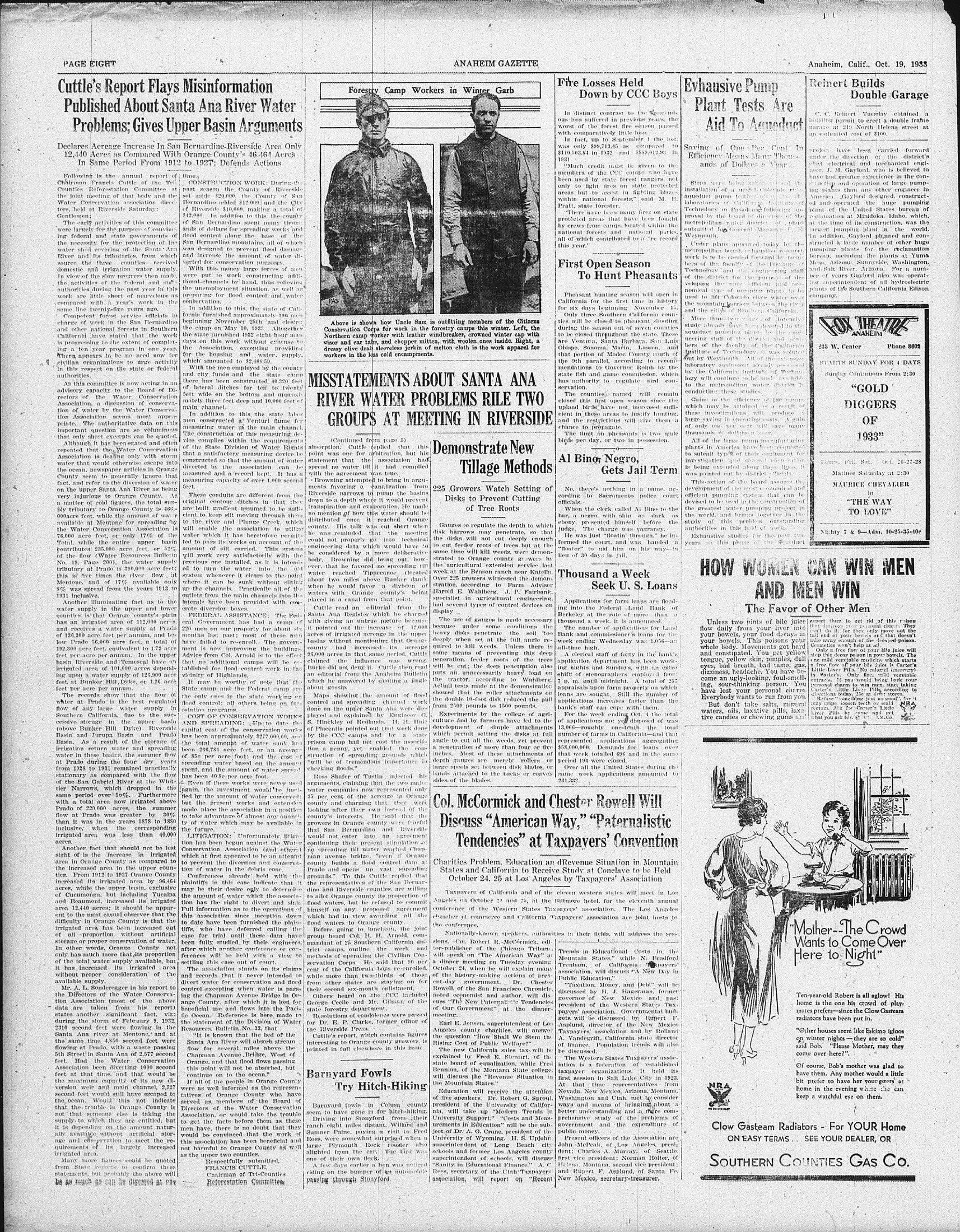
Searchable text
Cuttle’s Report Flays Misinformation Published About Santa Ana River Water Problems; Gives Upper Basin Arguments
Declares Acreage Increase In San Bernardine-Riverside Area Only 12,440 Acres as Compared With Orange County’s 46,464 Acres In Same Period From 1912 to 1927; Defends Actions
Following is the annual report of Chairman Francis Cuttle of the Tri-Counties Reforestation Committee at the joint meeting of that body and the Water Conservation association directors, held at Riverside Saturday: Gentlemen:
The early activities of this committee were largely for the purpose of conserving federal and state governments of the necessity for the protection of the water shed covering of the Santa Ana River and its tributaries, from which source the three counties received domestic and irrigation water supply. In view of the slow progress then made, the activities of the federal and state authorities during the past year in this work are little short of marvelous as compared with a year's work in the same line twenty-five years ago.
Competent forest service officials in charge of work in the San Bernardino and other national forests in Southern California have stated that the work is progressing to the extent of completing a ten year program in one year. There appears to be no need now for civilian organizations to urge activity in this respect on the state or federal authorities.
As this committee is now acting in an advisory capacity to the Board of Directors of the Water Conservation Association, a discussion of conservation of water by the Water Conservation Association seems most appropriate. The authoritative data on this important question are so voluminous that only short excerpts can be quoted.
Although it has been stated and often repeated that the Water Conservation Association is dealing only with storm time.
CONSTRUCTION WORK: During the past season the County of Riverside set aside $20,000, the County of San Bernardino added $12,000 and the City of Riverside $10,000, making a total of $42,000. In addition to this, the county of San Bernardino spent many thousands of dollars for spreading works and flood control along the base of the San Bernardino mountains, all of which was designed to prevent flood damage and increase the amount of water diverted for conservation purposes.
With this money large forces of men were put to work constructing additional channels by hand, thus relieving the unemployment situation, as well as preparing for flood control and water conservation.
In addition to this, the state of California furnished approximately 100 men beginning November 28th, and closing the camp on May 10, 1933. Altogether the state furnished 4932 eight hour man days on this work without expense to the Association, excepting providing for the housing and water supply, which amounted to $2,468.59.
With the men employed by the county and city funds and the state camp there has been constructed 40,320 feet of lateral ditches for ten to twenty feet wide on the bottom and approximately three feet deep and 10,000 feet of main channel.
In addition to this the state labor men constructed a Venturi flume for measuring water in the main channel. The construction of this measuring device complies within the requirements of the State Division of Water Rights that a satisfactory measuring device be constructed so that
As this committee is now acting in an advisory capacity to the Board of Directors of the Water Conservation Association, a discussion of conservation of water by the Water Conservation Association seems most appropriate. The authoritative data on this important question are so voluminous that only short excerpts can be quoted.
Although it has been stated and often repeated that the Water Conservation Association is dealing only with storm water that would otherwise escape into the ocean, newspaper articles in Orange County seem to generally ignore that fact, and refer to the diversion of water on the upper Santa Ana River as being very injurious to Orange County. As a matter of cold figures, the total supply tributary to Orange County is 466,000 acre feet, while the amount of water available at Mentone for spreading by the Water Conversation Association is 76,000 acre feet, or only 17% of the Total, while the entire upper basin contributes 235,000 acre feet, or 52% of the flow (Water Resources Bulletin No. 19, Page 200), the water supply tributary at Prado is 390,000 acre feet; this is five times the river flow at Mentone, and of 17% available only 8% was spread from the years 1913 to 1931 inclusive.
Another illuminating fact as to the water supply in the upper and lower counties is that Orange county's plain has an irrigated area of 112,000 acres, and receives a water supply at Prado of 136,300 acre feet per annum, and below Prado 56,000 acre feet, a total of 192,300 acre feet equivalent to 1.72 acre feet per acre per annum. In the upper basin Riverside and Temescal have an irrigated area of 101,000 acres depending upon a water supply of 126,900 acre feet at Bunker Hill, Dyke, or 1.26 acre feet per acre per annum.
The records show that the flow of water at Prado is the best regulated flow of any large water supply in Southern California, due to the successive storage in the upper basin (above Bunker Hill Dyke) Riverside Basin and Jurupa Basin and Prado Basin. As a result of the storage of irrigation return water and spreading water in these basins, the summer flow at Prado during the four dry years from 1928 to 1931 remained practically stationary as compared with the flow of the San Gabriel River at the Whitier Narrows, which dropped in the same period over 50%. Furthermore with a total area now irrigated above Prado of 220,000 acres, the summer flow at Prado was greater by 30% than it was in the years 1878 to 1880 inclusive, when the corresponding irrigated area was less than 40,000 acres.
Another fact that should not be lost sight of is the increase in irrigated area in Orange County as compared to the increased area in the upper countryside.
With the men employed by the county and city funds and the state camp there has been constructed 40,320 feet of lateral ditches for ten to twenty feet wide on the bottom and approximately three feet deep and 10,000 feet of main channel.
In addition to this the state labor men constructed a Venturi flume for measuring water in the main channel. The construction of this measuring device complies within the requirements of the State Division of Water Rights that a satisfactory measuring device be constructed so that the amount of water diverted by the association can be measured and a record kept. It has a measuring capacity of over 1,000 second feet.
These conduits are different from the original contour ditches in that they are built gradient assumed to be sufficient to keep slit moving through them to the river and Plunge Creek, which will enable the association to utilize water which it has heretofore permitted to pass its works on account of the amount of slit carried. This system will work very satisfactorily with the previous one installed, as it is intended to turn the water into the old system whenever it clears to the point where it can be sunk without slitting up the channels. Practically all of the outlets from the main channels into the laterals have been provided with concrete diversion boxes.
FEDERAL ASSISTANCE: The Federal Government has had a camp of 220 men on our property for about six months last past; most of these men have failed to re-enroll. The government is now improving the buildings. Advice from Col. Arnold is to the effect that no additional camps will be established for flood control work in the vicinity of Highlands.
It may be worthy of note that the State camp and the Federal camp are the only ones in the state working on flood control; all others being on foundation programs.
COST OF CONSERVATION WORKS AND SPREADING: Up to date the capital cost of the conservation works has been approximately $277,000.00, and the total amount of water sunk has been 266,784 acre feet, or an average of 85 per acre foot; and the cost of spreading water based on the amount spent, and the amount of water spread has been 40.88 per acre foot.
Even if these works were never used again, the investment would be justified by the amount of water conserved; but the present works and extension made place the association in a position to take advantage of almost any quantity of water which may be available in the future.
LITIGATION: Unfortunately litigation has been begun against the Water Conservation Association (and others) which at first appeared to be an attempt to prevent the diversion and conservation of water in the debris cone.
(Continue absorption. Cut point was one statement that spread no water with the agreement. Browning attentions favoring Riverside narrow down to a depth transpiration and no mention of how distributed once county. His talk he was reminded could not properly engineering data be considered by body. Browning ever, that he faced water reached about two miles when he would waters with Or placed in a canal.
Cuttle read and Santa Ana Register with giving an it pointed out that acres of irrigated basins without more county had in 96,000 acres in this claimed in Burke did not deny an editorial from which he answer about gossip.
Maps showing control and spread done on the uplift played and explained S. Hinkley of B Plaencia polity by the CCC camp prison camp hadition a penny, yet structure of sprung "will be of trembling floods."
Ross Shafer of arguments claim water companies 35 per cent of county and chart looking after the county's interest growers in Orange that San Bernardo would not enter continuing their no spreading till man avenue bristle county builds a Prado and opens
stationary as compared with the flow of the San Gabriel River at the Whitier Narrows, which dropped in the same period over 50%. Furthermore with a total area now irrigated above Prado of 220,000 acres, the summer flow at Prado was greater by 30% than it was in the years 1878 to 1880 inclusive; when the corresponding irrigated area was less than 40,000 acres.
Another fact that should not be lost sight of is the increase in irrigated area in Orange County as compared to the increased area in the upper counties. From 1912 to 1927 Orange County increased its irrigated area by 96,464 acres, while the upper basin, exclusive of Cucumonge, but including Yucalpa and Beaumont, increased its irrigated area 12,440 acres; it should be apparent to the most casual observer that the difficulty in Orange County is that the irrigated area has been increased out of all proportion without artificial storage or proper conservation of water. In other words, Orange County not only has much more that its proportion of the total water supply available, but it has increased its irrigated area without proper consideration of the available supply.
Mr. A. L. Sonderegger in his report to the Directors of the Water Conservation Association (most of the above data are taken from his report) states another significant fact: viz: during the storm of February 9, 1932, 2310 second feet were flowing in the Santa Ana river at Mentone, and at the same time 4,850 second feet were flowing at Prado, with a waste passing 5th Street in Santa Ana of 2,577 second feet. Had the Water Conservation Association been diverting 1000 second feet at that time, and that would be the maximum capacity of its new diversion weir and main channel, 2,327 second feet would still have escaped to the ocean. Would this not indicate that the trouble in Orange County is not that someone else is taking the supply to which they are entitled, but it is depending on the amount naturally available without artificial storage and conservation to meet the requirements of its largely increased irrigated area.
Many more figures could be quoted from State reports to confirm these statements, but probably the above will have so much as can be digested at one place.
Even if these works were never used again, the investment would be justified by the amount of water conserved; but the present works and extension made, place the association in a position to take advantage of almost any quantity of water which may be available in the future.
LITIGATION: Unfortunately, litigation has been begun against the Water Conservation Association (and others) which at first appeared to be an attempt to prevent the diversion and conservation of water in the debris cone.
Conferences already held with the plaintiffs in this case indicate that it may be their desire oglly to determine the amount of water which the association has right to divert and sink. Full information as to the operations of this association since inception down to date have been furnished the plaintiffs, who have deferred calling the case for trial until these data have been fully studied by their engineers; after which another conference or conferences will be held with a view to settling this case out of court.
The association stands on its claims and records that it never intended to divert water for conservation and flood control excepting when water is passing the Chapman Avenue Bridge in Orange County, after which it is lost for beneficial use and flows into the Pacific Ocean. Reference is here made to the statement of the Division of Water Resources, Bulletin No. 33, that
"It is known that the bed of the Santa Ana River will absorb stream flow for several miles above the Chapman Avenue Bridge, West of Orange, and that flood flows passing this point will not be absorbed, but continue on to the ocean."
If all of the people in Orange County were as well informed as the representatives of Orange County who served as members of the Board of Directors of the Water Conservation Association, or would take the trouble to get the facts before them as these men have, there is no doubt that they would be convinced that the work of this association has been beneficial and not harmful to Orange County as well as the upper two counties.
Respectfully submitted,
FRANCIS CUTTLE,
Chairman of Tri-Counties
Reforestation Committee,
Ross Shafer of arguments, claims water companies 35 per cent of the county and charge looking after the county's interest growers in Oranje that San Bernardo would not enter continuing their no spreading till man avenue bridge county builds an Prado and opens grounds." To this the representative dino and Riverside to allot Orange city flood waters, but himself on any which had in view flood waters to a Before going group heard Colmandant of 25 Scriet camps, our methods of operative servation Corps. cent of the Californians while more than from other state their second six Others heard George Cecile and state forestry deserves Resolutions of Dr. E. P. Claythe Riverside Pri Cuttle's report interesting to Oranje printed in full clu
Barnyard Try
Barnyard fowl seem to have gone Driving into Srranch eight miles Sumner Paine, p Ross, were some large Plymouth alighted from one of their own
A few days earl riding on the bus passing through
Forestry Camp Workers in Winter Garb
Above is shown how Uncle Sam is outfitting members of the Citizens Conservation Corps for work in the forestry camps this winter. Left, the Northern camp worker with leather windbreaker, crowned winter cap with visor and ear tabs, and chopper mitten, with woolen ones inside. Right, a dressy olive drab sleeveless jerkin of melton cloth is the work apparel for workers in the less cold encampments.
MISSTATEMENTS ABOUT SANTA ANA RIVER WATER PROBLEMS RILE TWO GROUPS AT MEETING IN RIVERSIDE
(Continued from page 1)
absorption. Cuttle replied that this point was one for arbitration, but his statement that the limit on pheasants is two male birds per day, or two in possession.
Fire Losses Held Down by CCC Boys
In distinct contrast to the tremendous loss suffered in previous years, the worst of the forest fire season passed with comparatively little loss.
In fact, up to September 1 the loss was only $99,713.45 as compared to $110,503.84 in 1932 and $889,012.93 in 1931.
"Much credit must be given to the members of the CCC camps who have been used by state forest rangers, not only to fight fires on state protected areas but to assist in fighting blazes within national forests," said M. E. Pratt, state forester.
There have been many fires on state protected areas that have been fought by crews from camps located within the national forests and national parks, all of which contributed to a fire record this year."
First Open Season To Hunt Pheasants
Pheasant hunting season will open in California for the first time in history for six days beginning November 15.
Only three Southern California counties will be closed to pheasant shooting during the season out of seven counties to be closed throughout the state. These are Ventura, Santa Barbara, San Luis Obispo, Sonoma, Marin, Lassen, and that portion of Modoc County south of the 9th parallel, according to recommendations to Governor Rolph by the state fish and game commission, when has authority to regulate bird conservation.
The counties named will remain closed this first open season since the upland birds have not increased sufficient in these areas to justify hunting, and the restrictions will give them a chance to propagate.
The limit on pheasants is two male birds per day, or two in possession.
MISSTATEMENTS ABOUT SANTA ANA RIVER WATER PROBLEMS RILE TWO GROUPS AT MEETING IN RIVERSIDE
(Continued from page 1)
absorption. Cuttle replied that this point was one for arbitration, but his statement that the association had spread no water till it had compiled with the agreement was true.
Browning attempted to bring in arguments favoring a canalization from Riverside narrows to pump the basins down to a depth where it would prevent transpiration and evaporation. He made no mention of how this water should be distributed once it reached Orange county. His talk was cut short when he was reminded that the meeting could not properly go into technical engineering data which would have to be considered by a more deliberative body. Browning did bring out, however, that he favored no spreading till water reached Tippecanoe (located about two miles above Bunker dam). When he would favor a division of waters with Orange county's being placed in a canal from that point.
Cuttle read an editorial from the Santa Ana Register which he charged with giving an untrue picture because it pointed out the increase of 12,000 acres of irrigated acreage in the upper basins without mentioning that Orange county had increased its acreage 96,000 acres in that same period. Cuttle claimed the influence was wrong. Burke did not deny it. Cuttle then read an editorial from the Anaheim Bulletin which he answered by quoting a jingle about gossip.
Maps showing the amount of flood control and spreading channel work done on the upper Santa Ana were displayed and explained by Engineer G. S. Hinkle of Redlands. H. H. Hale of Placentia pointed out that work done by the CCC camps and by a state prison camp had not cost the association a penny, yet enabled the construction of spreading grounds which "will be of tremendous importance to checking floods."
Ross Shafer of Tustin injected his arguments, claiming that the two major water companies now represented only 35 per cent of the acreage in Orange county and charging that they were looking after their own instead of the county's interests. He said that the growers in Orange county were fearful that San Bernardino and Riverside would not enter into an agreement continuing their present stimulation of no spreading till water reached Chapman avenue bridge, even if Orange county builds a flood control dam at Prado and opens up vast spreading
Demonstrate New Tillage Methods
225 Growers Watch Setting of Disks to Prevent Cutting of Tree Roots
Gauges to regulate the depth to which disk harrows may penetrate, so that the disks will not cut deeply enough to cut feeder roots of trees but at the same time will kill weeds, were demonstrated to Orange county growers by the agricultural extension service last week at the Benson ranch near Katella. Over 225 growers witnessed the demonstration, according to Farm Advisor Harold E. Wahlberg. J. P. Fairbank-specialist in agricultural engineering, had several types of control devices on display.
The use of gauges is made necessary because under some conditions the heavy disks penetrate the soil too deeply when set at the full angle required to kill weeds. Unless there is some means of preventing this deep penetration, feeder roots of the trees will be cut; the deep penetration also puts an unnecessarily heavy load on the tractor, according to Wahlberg. Actual tests made at the demonstration showed that the roller attachments on the double 10-foot disk reduced the pull from 2500 pounds to 1500 pounds.
Experiments by the college of agriculture and by farmers have led to the development of simple attachments which permit setting the disks at full angle to cut all the weeds, yet prevent a penetration of more than four or five inches. Most of these attachments of depth gauges are merely rollers or large spools set between disk blades, or bands attached to the backs or convex sides of the blades.
Col. McCormick and Chester Rowell Will Discuss “American Way,” “Paternalistic Tendencies” at Taxpayers' Convention
Charities Problem. Education and dRevenue Situation in Mountain States and California to Receive Study at Conclave to be Hold
Ross Shafer of Tustin infected his arguments, claiming that the two major water companies now represented only 35 per cent of the average in Orange county and charging that they were looking after their own instead of the county's interests. He said that the growers in Orange county were fearful that San Bernardino and Riverside would not enter into an agreement continuing their present stipulation of no spreading till water reached Chapman avenue bridge. "Even if Orange county builds a flood control dam at Prado and opens up vast spreading grounds." To this Cuttle replied that the representatives of the San Bernardino and Riverside counties are willing to allot Orange county its proportion of flood waters, but he refused to commit himself on any proposed agreement which had in view awarding all the flood waters to Orange county.
Before going to lunchon, the joint group heard Col. H. H. Arnold, commandant of 25 Southern California district camps, outline the work and methods of operating the Civilian Conservation Corps. He said that 90 per cent of the California boys re-enrolled, while more than two-thirds of those from other states are staying on for their second six-month enlistment.
Others heard on the CCC included George Ceile and Mr. Gilman of the state forestry department.
Resolutions of condolence were passed for Dr. E. P. Clarke, former editor of the Riverside Press.
Cuttle's report, which contains figures interesting to Orange county growers, is printed in full elsewhere in this issue.
Barnyard Fowls Try Hitch-Hiking
Barnyard fowls in Colusa county seem to have gone in for hitch-hiking.
Driving into Stonyford from their ranch eight miles distant, Willard and Sumner Palne, paying a visit to Fred Ross, were somewhat surprised when a large Plymouth Rock rooster also alighted from the car. The bird was one of their own flock.
A few days earlier a hen was noticed eliding on the bumper of an automobile passing through Stonyford.
Col. McCormick and Chester Rowell Will Discuss “American Way,” “Paternalistic Tendencies” at Taxpayers' Convention
Charities Problem. Education an dRevenue Situation in Mountain States and Californja to Receive Study at Conclave to be Held October 24. 25 at Los Angeles by Taxpayers' Association
Taxpayer of California and of the eleven western states will meet in Los Angeles on October 24 and 25, at the Biltmore hotel, for the eleventh annual conference of the Western States Taxpayers' association. The Los Angeles chapter of commerce and California Taxpayers' association are joint hosts to the conference.
Nationally-known speakers, authorities in their fields, will address the sessions. Col. Robert R. McCormick, editor-publisher of the Chicago Tribune, will speak on "The American Way" at a dinner meeting on Tuesday evening. October 24, when he will explain many of the history-making actions of present-day government. Dr. Chester Rowell, of the San Francisco Chronicle, noted economist and author, will discuss "The New Paternalistic Tendencies of Our Government" at the dinner-meeting.
Earl E. Jensen, superintendent of Los Angeles county charities, will answer the question "How shall We Steam the Rising Cost of Public Welfare?"
The new California sales tax-will be explained by Fred E. Stewart, of the state board of equalization, while Fred Bennion, of the Montana State college, will discuss the "Revenue Situation in the Mountain States."
Education will receive the attention of five speakers. Dr. Robert G. Sproul, president of the University of California, will take up "Modern Trends in University Support." "Costs and Measurements in Education" will be the subject of Dr. A. G. Crane, president of the University of Wyoming. H. S. Upjohn, superintendent of Long Beach city schools and former Los Angeles county superintendent of schools, will discuss "Sanity in Educational Finance." A. C. Rees, secretary of the Utah Taxpayers' association, will report on "Recent Trends in Educational Costs in the Mountain States," while N. Bradford Trenham, of California Taxpayers' association, will discuss "A New Day in Public Education."
"Taxation, Money, and Debt" will be discussed by H. J. Hagerman, former governor of New Mexico and past president of the Western States Taxpayers' association. Governmental budgets will be discussed by Rupert F. Asplund, director of the New Mexico Taxpayers' association and by Rolland A. Vandegrift, California state director of finance. Population trends will also be discussed.
The Western States Taxpayers' association is a federation of established taxpayer organizations. It held its first session in Salt Lake City in 1923. At that time representatives from Nevada, New Mexico, Arizona, Montana, Washington and Utah, met to consider ways and means of bringing about a better understanding and a more comprehensive study of the problems of government and the expenditure of public money.
Present officers of the Association are John McPeak, of Los Angeles, president; Charles A. Murray, of Seattle; first vice president; Norman Holter, of Helena, Montana; second vice president; and Rupert F. Asplund, of Santa Fe, New Mexico, secretary-treasurer.
Evhausive Pump Plant Tests Are Aid To Aqueduct
Saving of One Per Cent In Efficiency Means Many Thousands of Dollars a Year
Steps were being taken toward the installation of a model Colorado river aqueduct pump testing plant in the laboratories of California Institute of Technology in Pasadena following approval by the board of directors of the metropolitan water district of plans submitted by General Manager F. J. Weymouth.
Under plans approved today by the metropolitan board, exhaustive research work is to be carried forward by members of the faculty of the Institute of Technology and the engineering staff of the district for the purposes of developing the most efficient and economical type of pumping plants to be used to lift Colorado river water over the mountain barriers between the river and the city of Southern California.
More than two years of intensive study already have been devoted to the aqueduct pumping plants by the engineering staff of the district and members of the faculty of the California Institute of Technology. It was polished out by Weymouth. All of the extensive laboratory equipment already possessed by the California Institute of Technology will continue to be made available to the metropolitan water district to conducting these studies.
Gains in the efficiency of the pumps which may be attained as a result of these investigations will produce a large saving in operating costs. A gain of only one per cent will save many thousands of dollars a year.
All of the large pump manufacturing plants in America have been requested to submit types of their equipment for inspection and testing.
Reinert Builds Double Garage
C. C. Reinert Tuesday obtained a building permit to erect a double frahie garage at 219 North Helena street at an estimated cost of $100.
project have been carried forward under the direction of the district's chief electrical and mechanical engineer, J. M. Gaylord, who is believed to have had greater experience in the construction and operation of large pumping plants than any other engineer in America. Gaylord designed, constructed and operated the huge pumping plant of the United States bureau of reclamation at Minidoka, Idaho, which, at the time of its construction, was the largest pumping plant in the world. In addition, Gaylord planned and constructed a large number of other huge pumping plants for the reclamation bureau, including the plants at Yuma Mesa, Arizona, Sunnyside, Washington, and Salt River, Arizona. For a number of years Gaylord also was operating superintendent of all hydroelectric plants of the Southern California Edison company.
HOW WOMEN CAN WIN MEN AND MEN WIN
The Favor of Other Men
Unless two pints of bile juice flow daily from your liver into your bowels, your food decays in your bowels. This poisons your whole body. Movements get hard and constipated. You get yellow tongue, yellow skin, pimples, dull eyes, bad breath, bad taste, gas, dizziness, headache. You have become an ugly-looking, foul-smelling, sour-thinking person. You have lost your personal charm. Everybody wants to run from you.
But don't take salts, mineral waters, oils, laxative pills, laxative candies or chewing gums and expect them to get rid of this poison that destroys your personal charm. They can't do it; for they only move out the tail end of your bowels and that doesn't make away enough of the deceived poison. Cosmetics won't help at all.
Only a free flow of your bile juice will stop this decay poison in your bowels. The one mild vegetable medicine which starts a free flow of your bile juice is Carter's Little Liver Pills. No calorie (nerve) in Carter's. Only fats, mild vegetable extracts. If you would be back your personal charm to win men, start taking Carter's Little Liver Pills according to directions today. 21st at different stores.
Refuse "something just as good," for it may grip roosen teeth or scalp rectum. Ask for Carter's Little Liver Pills by phone and get what you ask for. © J.M.Co.
"Mother--The Crowd Wants to Come Over Here to Night"
Ten-year-old Robert is all aglow! His home is the one his crowd of playmates prefers—since the Clow Gasteam radiators have been put in.
"Other houses seem like Eskimo igloos on winter nights—they are so cold" said Bob. "Please Mother, may they come over here?"
Of course, Bob's mother was glad to have them. Any mother would a little bit prefer to have her youngsters at home in the evening where she can keep a watchful eye on them.
Clow Gasteam Radiators - For YOUR Home ON EASY TERMS... SEE YOUR DEALER, OR
SOUTHERN COUNTIES GAS CO.