anaheim-gazette 1933-10-19
Scanned page
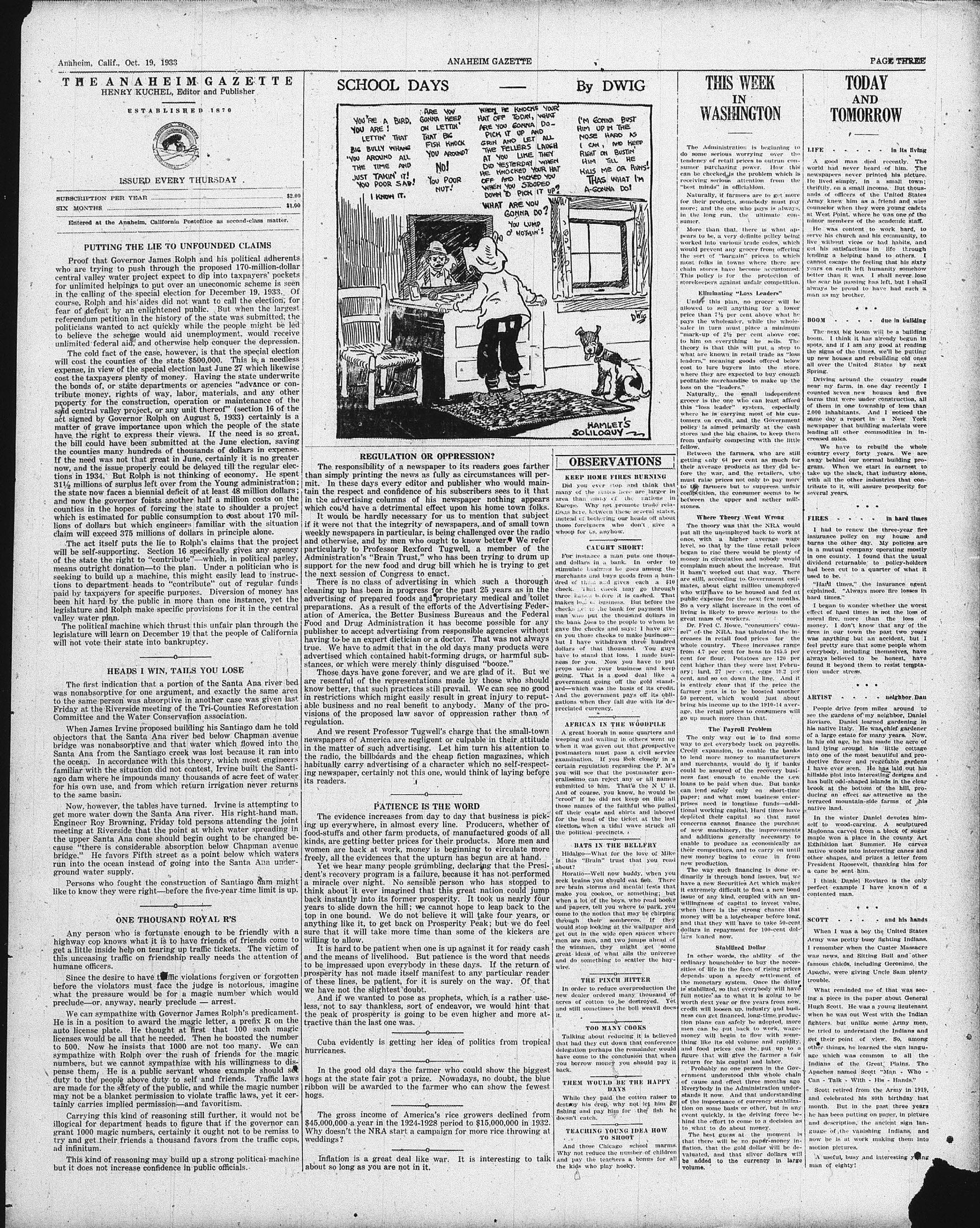
Searchable text
THE ANAHEIM GAZETTE
HENRY KUCHEL, Editor and Publisher
ESTABLISHED 1870
ISSUED EVERY THURSDAY
SUBSCRIPTION PER YEAR $2.00
SIX MONTHS $1.00
Entered at the Anaheim, California Postoffice as second-class matter.
PUTTING THE LIE TO UNFOUNDED CLAIMS
Proof that Governor James Rolph and his political adherents who are trying to push through the proposed 170-million-dollar central valley water project expect to dip into taxpayers' pockets for unlimited helpings to put over an uneconomic scheme is seen in the calling of the special election for December 19, 1933. Of course, Rolph and his aides did not want to call the election; for fear of defeat by an enlightened public. But when the largest referendum petition in the history of the state was submitted; the politicians wanted to act quickly while the people might be led to believe the scheme would aid unemployment, would receive unlimited federal aid, and otherwise help conquer the depression.
The cold fact of the case, however, is that the special election will cost the counties of the state $500,000. This is a needless expense, in view of the special election last June 27 which likewise cost the taxpayers plenty of money. Having the state underwrite the bonds of, or state departments or agencies "advance or contribute money, rights of way, labor, materials, and any other property for the construction, operation or maintenance of the said central valley project, or any unit thereof" (section 16 of the act signed by Governor Rolph on August 5, 1933) certainly is a matter of grave importance upon which the people of the state have the right to express their views. If the need is so great, the bill could have been submitted at the June election, saving the counties many hundreds of thousands of dollars in expense.
will cost the counties of the state $500,000. This is a needless expense, in view of the special election last June 27 which likewise cost the taxpayers plenty of money. Having the state underwrite the bonds of, or state departments or agencies "advance or contribute money, rights of way, labor, materials, and any other property for the construction, operation or maintenance of the said central valley project, or any unit thereof" (section 16 of the act signed by Governor Rolph on August 5, 1933) certainly is a matter of grave importance upon which the people of the state have the right to express their views. If the need is so great, the bill could have been submitted at the June election, saving the counties many hundreds of thousands of dollars in expense. If the need was not that great in June, certainly it is no greater now, and the issue properly could be delayed till the regular elections in 1934. But Rolph is not thinking of economy. He spent 31½ millions of surplus left over from the Young administration; the state now faces a biennial deficit of at least 48 million dollars; and now the governor foists another half a million costs on the counties in the hopes of forcing the state to shoulder a project which is estimated for public consumption to cost about 170 millions of dollars but which engineers familiar with the situation claim will exceed 375 millions of dollars in principle alone.
The act itself puts the lie to Rolph's claims that the project will be self-supporting. Section 16 specifically gives any agency of the state the right to "contribute"—which, in political parley, means outright donation—to the plan. Under a politician who is seeking to build up a machine, this might easily lead to instructions to department heads to "contribute" out of regular funds paid by taxpayers for specific purposes. Diversion of money has been hit hard by the public in more than one instance, yet the legislature and Rolph make specific provisions for it in the central valley water plan.
The political machine which thrust this unfair plan through the legislature will learn on December 19 that the people of California will not vote their state into bankruptcy.
HEADS I WIN, TAILS YOU LOSE
The first indication that a portion of the Santa Ana river bed was nonabsorptive for one argument, and exactly the same area to the same person was absorptive in another case was given last Friday at the Riverside meeting of the Tri-Counties Reforestation Committee and the Water Conservation association.
When James Irvine proposed building his Santiago dam he told objectors that the Santa Ana river bed below Chapman avenue bridge was nonabsorptive and that water which flowed into the Santa Ana from the Santiago creek was lost because it ran into the ocean. In accordance with this theory, which most engineers familiar with the situation did not contest, Irvine built the Santiago dam where he impounds many thousands of acre feet of water for his own use, and from which return irrigation never returns to the same basin.
Now, however, the tables have turned. Irvine is attempting to get more water down the Santa Ana river. His right-hand man, Engineer Roy Browning, Friday told persons attending the joint meeting at Riverside that the point at which water spreading in the upper Santa Ana cone should begin ought to be changed because "there is considerable absorption below Chapman avenue bridge." He favors Fifth street as a point below which waters run into the ocean instead of going into the Santa Ana under-
Now, however, the tables have turned. Irvine is attempting to get more water down the Santa Ana river. His right-hand man, Engineer Roy Browning, Friday told persons attending the joint meeting at Riverside that the point at which water spreading in the upper Santa Ana cone should begin ought to be changed because "there is considerable absorption below Chapman avenue bridge." He favors Fifth street as a point below which waters run into the ocean instead of going into the Santa Ana underground water supply.
Persons who fought the construction of Santiago dam might like to know they were right—before the five-year time limit is up.
ONE THOUSAND ROYAL R'S
Any person who is fortunate enough to be friendly with a highway cop knows what it is to have friends of friends come to get a little inside help on tearing up traffic tickets. The victim of this unceasing traffic on friendship really needs the attention of humane officers.
Since the desire to have traffic violations forgiven or forgotten before the violators must face the judge is notorious, imagine what the pressure would be for a magic number which would preclude—or, anyway, nearly preclude — arrest.
We can sympathize with Governor James Rolph's predicament. He is in a position to award the magic letter, a prefix R on the auto license plate. He thought at first that 100 such magic licenses would be all that he needed. Then he boosted the number to 500. Now he insists that 1000 are not too many. We can sympathize with Rolph over the rush of friends for the magic numbers, but we cannot sympathize with his willingness to dispense them. He is a public servant whose example should set duty to the people above duty to self and friends. Traffic laws are made for the safety of the public, and while the magic number may not be a blanket permission to violate traffic laws, yet it certainly carries implied permission—and favoritism.
Carrying this kind of reasoning still further, it would not be illogical for department heads to figure that if the governor can grant 1000 magic numbers, certainly it ought not to be remiss to try and get their friends a thousand favors from the traffic cops, ad infinitum.
This kind of reasoning may build up a strong political machine but it does not increase confidence in public officials.
SCHOOL DAYS — By DWIG
YOU'RE A BIRD,
YOU ARE!
LETTIN' THAT
BIG BULLY WHANG
'YOU AROUND ALL
THE TIME AND
JUST TAKIN' IT!
YOU POOR SAD!
I KNOW IT.
ARE YOU GONNA HEEP ON LETTIN'
THAT BIG FISH KNOCK YOU AROUND?
NO!
YOU POOR NUT!
WHEN HE KNOCKS YOUR HAT OFF TODAY, WHAT ARE YOU GONNA DO—PICK IT UP AND GRAN AND LET ALL THE FELLERS LAUGH AT YOU LIKE THEY DID YESTERDAY WHEN HE KNOCKED YOUR HAT OFF AND MICKED YOU WHEN YOU STOOPED DOWN 'D PICK IT UP?
I'M GONNA BUST HIM UP IN THE NOSE HARD AS I CAN, AND HEEP RIGHT ON BUSTIN'HIM TILL HE HILLS ME OR RUNS! THAS WHAT I'M A-GONNA DO!
WHAT ARE YOU GONNA DO?
YOU LUMP O' NOTHING!
HAMLET'S SOLILOQUY
REGULATION OR OPPRESSION?
The responsibility of a newspaper to its readers goes farther than simply printing the news as fully as circumstances will permit. In these days every editor and publisher who would maintain the respect and confidence of his subscribers sees to it that in the advertising columns of his newspaper nothing appears which could have a detrimental effect upon his home town folks.
It would be hardly necessary for us to mention that subject if it were not that the integrity of newspapers, and of small town weekly newspapers in particular, is being challenged over the radio and otherwise, and by men who ought to know better. We refer particularly to Professor Rexford Tugwell, a member of the Administration's "Brain Trust," who has been trying to drum up support for the new food and drug bill which he is trying to get the next session of Congress to enact.
There is no class of advertising in which such a thorough cleaning up has been in progress for the past 25 years as in the advertising of prepared foods and proprietary medical and toilet preparations. As a result of the efforts of the Advertising Federation of America, the Better Business Bureaus and the Federal Food and Drug Administration it has become possible for any publisher to accept advertising from responsible agencies without having to be an expert dietician or a doctor. That was not always true. We have to admit that in the old days many products were advertised which contained habit-forming drugs, or harmful substances, or which were merely thinly disguised "booze."
Those days have gone forever, and we are glad of it. But we are resentful of the representations made by those who should know better, that such practices still prevail. We can see no good restrictions which might easily result in great injury to reputable business and no real benefit to anybody. Many of the provisions of the proposed law savor of oppression rather than of regulation.
And we resent Professor Tugwell's charge that the small-town newspapers of America are negligent or culpable in their attitude in the matter of such advertising. Let him turn his attention to the radio, the billboards and the cheap fiction magazines, which habitually carry advertising of a character which no self-respecting newspaper, certainly not this one, would think of laying before its readers.
PATIENCE IS THE WORD
The evidence increases from day to day that business is picking up everywhere, in almost every line. Producers, whether of food-stuffs and other farm products, of manufactured goods of all kinds, are getting better prices for their products. More men and women are back at work, money is beginning to circulate more freely, all the evidences that the upturn has begun are at hand.
Yet we hear many people grumbling, declaring that the Presi-
OBSERVATIONS
KEEP HOME FIRES BURNING
Did you ever stop and think that many of the states here are larger in area than many of the nations in Europe. Why not promote trade relations here between these several states, instead of bothering our heads off about those foreigners who don't give a whoop for us, anyhow.
CAUGHT SHORT!
For instance a man puts one thousand dollars in a bank. In order to stimulate business he goes among the merchants and buys goods from a hundred of them and gives each a $10 check. That check may go through three hands before it is cashed. That makes loss on business. But before the checks go to the bank for payment the man who put the thousand dollars in the bank goes to the people to whom he gave the checks and says: I have given you those checks to make business—but I have withdrawn three hundred dollars of that thousand. You guys have to stand that loss. I made business for you. Now you have to put props under your business and keep going. That is a good deal like a government going off the gold standard—which was the basis of its credit. And the government pays off its obligations when they fall due with its depreciated currency.
AFRICAN IN THE WOODPILE
A great hoorah in some quarters and weeping and wailing in others went up when it was given out that prospective postmasters must pass a civil service examination. If you look closely in a certain regulation regarding the P.M.'s you will see that the postmaster generalissimo can reject any or all names submitted to him. That's the N U B. And of course, you know, he would be "crool" if he did not keep on file all those names of the faithful who pulled off their coats and shirts and labored for the head of the ticket at the last election when a tidal wave struck all the political precincts.
BATS IN THE BELLFRY
Hidalgo—What for the love of Mike is this "Brain" trust that you read about?
PATIENCE IS THE WORD
The evidence increases from day to day that business is picking up everywhere, in almost every line. Producers, whether of food-stuffs and other farm products, of manufactured goods of all kinds, are getting better prices for their products. More men and women are back at work, money is beginning to circulate more freely, all the evidences that the upturn has begun are at hand.
Yet we hear many people grumbling, declaring that the President's recovery program is a failure, because it has not performed a miracle over night. No sensible person who has stopped to think about it ever imagined that this great nation could jump back instantly into its former prosperity. It took us nearly four years to slide down the hill; we cannot hope to leap back to the top in one bound. We do not believe it will take four years, or anything like it, to get back on Prosperity Peak; but we do feel sure that it will take more time than some of the kickers are willing to allow.
It is hard to be patient when one is up against it for ready cash and the means of livelihood. But patience is the word that needs to be impressed upon everybody in these days. If the return of prosperity has not made itself manifest to any particular reader of these lines, be patient, for it is surely on the way. Of that we have not the slightest doubt.
And if we wanted to pose as prophets, which is a rather useless, not to say thankless, sort of endeavor, we would hint that the peak of prosperity is going to be even higher and more attractive than the last one was.
Cuba evidently is getting her idea of politics from tropical hurricanes.
In the good old days the farmer who could show the biggest hogs at the state fair got a prize. Nowadays, no doubt, the blue ribbon will be awarded to the farmer who can show the fewest hogs.
The gross income of America's rice growers declined from $45,000,000 a year in the 1924-1928 period to $15,000,000 in 1932. Why doesn't the NRA start a campaign for more rice throwing at weddings?
Inflation is a great deal like war. It is interesting to talk about so long as you are not in it.
THIS WEEK IN WASHINGTON
The Administration is beginning to do some serious worrying over the tendency of retail prices to outrun consumer purchasing power. How this can be checked is the problem which is receiving serious attention from the "best minds" in officialdom.
Naturally, if farmers are to get more for their products, somebody must pay more; and the one who pays is always, in the long run, the ultimate consumer.
More than that, there is what appears to be, a very definite policy being worked into various trade codes, which would prevent any grocer from offering the sort of "bargain" prices to which most folks in towns where there are chain stores have become accustomed. This policy is for the protection of storekeepers against unfair competition.
Eliminating "Loss Leaders"
Under this plan, no grocer will be allowed to sell anything for a lower price than 7½ per cent above what he pays the wholesaler, while the wholesaler in turn must place a minimum "mark-up of 2½ per cent above cost to him on everything he sells. The theory is that this will put a stop to what are known in retail trade as "loss leaders," meaning goods offered below cost to lure buyers into the store, where they are expected to buy enough profitable merchandise to make up the loss on the "leaders."
Naturally, the small independent grocer is the one who can least afford this "loss leader" system, especially where he is carrying most of his customers on credit, and the Government policy is aimed primarily at the cash stores and the big chains, to keep them from unfairly competing with the little fellow.
Between the farmers, who are still
TODAY AND TOMORROW
LIFE ... In its living
A good man died recently. The world had never heard of him. The newspapers never printed his picture. He lived simply, in a small town; thriftily, on a small income. But thousands of officers of the United States Army knew him as a friend and wise counselor when they were young cadets at West Point, where he was one of the minor members of the academic staff.
He was content to work hard, to serve his church and his community, to live without vices or bad habits, and get his satisfaction in life through lending a helping hand to others. I cannot escape the feeling that his sixty years on earth left humanity somehow better than it was. I shall never lose the scar his passing has left, but I shall always be proud to have had such a man as my brother.
BOOM ... due in building
The next big boom will be a building boom. I think it has already begun in spots, and if I am any good at reading the signs of the times, we'll be putting up new houses and rebuilding old ones all over the United States by next Spring.
Driving around the country roads near my farm, in one day recently I counted seven new houses and five barns that were under construction, all of them in one township of less than 2,000 inhabitants. And I noticed the same day a report in a New York newspaper that building materials were leading all other commodities in increased sales.
We have to rebuild the whole country every forty years. We are
NATIONS
FIRES BURNING
op and think that there are larger in the nations in promote trade relations these several states, our heads off about who don't give a bow.
SHORT!
man puts one thousand bank. In order to go among the goods from a humgives each a $10 may go through it is cashed. That less. But before the bank for payment the thousand dollars in people to whom he says: I have gives to make business—dawn three hundred thousand. You guys loss. I made busiow you have to put business and keep good deal like a off the gold stande basis of its credit, but pays off its oblifall due with its de
THE WOODPILE
in some quarters and ing in others went up out that prospective pass a civil service you look closely in a regarding the P. M's the postmaster genet any or all names That's the N U B. know, he would be not keep on file all faithful who pulled shirts and labored the ticket at the last ideal wave struck all acts.
THE BELLFRY
for the love of Mike must that you read leaders, meaning goods offered below cost to lure buyers into the store, where they are expected to buy enough profitable merchandise to make up the loss on the "leaders."
Naturally, the small independent grocer is the one who can least afford this "loss leader" system, especially where he is carrying most of his customers on credit, and the Government policy is aimed primarily at the cash stores and the big chains, to keep them from unfairly competing with the little fellow.
Between the farmers, who are still getting only 64 per cent as much for their average products as they did before the war, and the retailers, who must raise prices not only to pay more to the farmers but to suppress unfair competition, the consumer seems to be between the upper and nether millstones.
Where Theory Went Wrong
The theory was that the NRA would put all the unemployed back to work at once, with a higher average wage level, so that by the time retail prices began to rise there would be plenty of money in circulation and nobody would complain much about the increase. But it hasn't worked out that way. There are still, according to Government estimates, about eight million unemployed who will have to be housed and fed at public expense for the next few months. So a very slight increase in the cost of living is likely to prove serious to the great mass of workers.
Dr. Fred C. Howe, "consumers' counsel" of the NRA, has tabulated the increases in retail food prices for the whole country. These increases range from 4.7 per cent for hens to 165.5 per cent for flour. Potatoes are 120 per cent higher than they were last February; lard, 27 per cent, eggs 19.2 per cent, and so on down the line. And it is entirely clear that if the price the farmer gets is to be boosted another 50 percent, which would just about bring his income up to the 1910-14 average, the retail prices to consumers will go up much more than that.
The Payroll Problem
The only way out is to find some way to get everybody back on payrolls. Credit expansion, to enable the banks to lend more money to manufacturers and merchants, would do it if banks could be assured of the recovery business fast enough to enable the new loans to be paid when due. But banks can lend safely only on short-time paper; and what most business enterprises need is longtime funds—additional working capital. Hard times have depleted their capital so that most concerns cannot finance the purchase of new machinery, the improvements and additions generally necessary to enable to produce as economically as their competitors, and to carry on until new money begins to come in from new production.
FIRES . . . in hard times
I had to renew the three-year fire insurance policy on my house and barns the other day. My policies are in a mutual company operating mostly in one county. I found that the usual dividend returnable to policy-holders had been cut to a quarter of what it used to be.
"Hard times," the insurance agent explained. "Always more fire losses in hard times."
I began to wonder whether the worst effect of hard times is not the loss of moral fire, more than the loss of money. I don't know that any of the fires in our town past two years was anything but an accident, but I feel pretty sure that some people whom everybody, including themselves, have always believed to be honest, have found it beyond them to resist temptation under stress.
ARTIST . . . neighbor Dan
People drive from miles around to see the gardens of my neighbor, Daniel Roviaro. Daniel learned gardening in his native Italy. He was chief gardener of a large estate for many years. Now, in his old age, he has made the acre of land lying around his little cottage into one of the most beautiful and productive flower and vegetable gardens I have ever seen. He has laid out his hillside plot into interesting designs and has built odd-shaped islands in the clear brook at the bottom of the hill, producing an effect as attractive as the terraced mountain-side farms of his native land.
In the winter Daniel devotes himself to wood-carving. A sculptured Madonna carved from a block of sugar maple won a place in the county Art Exhibition last Summer. He carves native woods into interesting canes and other shapes, and prizes a letter from President Roosevelt, thanking him for
the postmaster genect any or all names
That's the N U B.
know, he would be
not keep on file all
faithful who pulled
shirts and labored
the ticket at the last
del wave struck all
acts.
THE BELLFRY
for the love of Mike
must that you read
new buddy, when you
would eat fish. There
and mental tests that
or something; but
boys, who read books
where to park, you
that may be chirping
mombreros. If they
at the wallpaper and
are open spaces where
two jumps ahead of
might get some
at alls the universe
to scatter the hay
TH HITTER
overproduction the
many thousand of
be destroyed. Yet
the boll weavil does
NY COOKS
educing it is believed
down that conference
the remainder would
conclusion that when
you should pay it
BE THE HAPPY
DAYS
the cotton raiser to
why not let him go
for the fish he
UNG IDEA HOW
SHOOT
ago school marms.
the number of children
a bonus for all
hooky.
STABILIZED DOLlar
In other words, the ability of the ordinary householder to buy the necessities of life in the face of rising prices depends upon a speedy settlement of the monetary system. Once the dollar is stabilized, so that everybody will have full notice as to what it is going to be worth next year or five years from now, credit will loosen up, industry and business can get financed, long-time production plans can safely be adopted, more men can be put back to work, wage-money will begin to flow with something like its old volume and rapidity, and food prices can be put up to a figure that will give the farmer a fair return for his capital and labor.
Probably no one person in the Government understood this whole chain of cause and effect three months ago. Everybody in the Administration understands it now. And that understanding of the importance of currency stabilization on some basis or other, but in any event quickly, is the driving force behind the effort to come to a decision as to what to do about money.
The best guess at the moment is that there will be no paper-money inflation, that the gold dollar will be devaluated, and that silver dollars will be added to the currency in large volume.
SCOTT and his hands
When I was a boy the United States Army was pretty busy fighting Indians. I remember when the Custer Massacre was news, and Sitting Bull and other famous chiefs, including Geronimo, the Apache, were giving Uncle Sam plenty trouble.
What reminded me of that was seeing a piece in the paper about General Hugh Scott. He was a young lieutenant when he was out West with the Indian fighters, but unlike some Army men, he tried to understand the Indians and get their point of view. So, among other things, he learned the sign language which was common to all the Indians of the Great Plains. The Apaches named Scott "Man - Who - Can - Talk - With - His - Hands."
Scott retired from the Army in 1919, and celebrated his 80th birthday last month. But in the past three years he has been putting on paper, in picture and description, the ancient sign language of the vanishing Indians, and now he is at work making them into motion pictures.
A useful, busy and interesting young man of eighty!