anaheim-gazette 1933-10-12
Scanned page
Searchable text
THE ANAHEIM GAZETTE
HENRY KUCHEL, Editor and Publisher
ESTABLISHED 1870
ISSUED EVERY THURSDAY
SUBSCRIPTION PER YEAR $2.00
SIX MONTHS $1.00
Entered at the Anaheim, California Poetoffice as second-class matter.
PULLING IRVINE'S CHESTNUTS OUT OF THE FIRE
For several weeks two daily newspapers of Orange county have shown a strange unanimity in their portrayal of water conditions along the Santa Ana river. They point with horrified exclamations to spreading on Lytle creek, and work themselves into such a frenzy of fear that we pondered many an editorial and studied many news stories in an honest effort to arrive at what would prove the center of the sudden verbal storm.
We have come to this conclusion: Both newspapers, at least one of them unwittingly, are engaged in a subtle campaign to pull James Irvine's chestnuts out of the fire.
The water situation, unfortunately, lends itself to political hokum. To be perfectly fair in the matter, there are instances where Orange county's water rights must be preserved, if necessary by lawsuits. This phase, however, is susceptible to a lot of manufactured hysteria, especially when a good politician sets his mind upon saving himself a good-sized fortune. Irvine two years ago took it upon himself to sue nearly everybody along the Santa Ana river. Since most users of water have riparian rights which suits till doomsday would not alter, the wealthy rancher finds his foot in legal mire which might easily cost him one hundred thousand dollars or more, with not much chance of getting enough additional water sent down the river to justify even a small part of that expenditure.
What would be nicer, from Irvine's point of view, than to have the Orange county water district assume this legal burden?
Hence, the smoke. All of a sudden a terrific amount of under-
manufactured hysteria, especially when a good politician sets his mind upon saving himself a good-sized fortune. Irvine two years ago took it upon himself to sue nearly everybody along the Santa Ana river. Since most users of water have riparian rights which suits till doomsday would not alter, the wealthy rancher finds his foot in legal mire which might easily cost him one hundred thousand dollars or more, with not much chance of getting enough additional water sent down the river to justify even a small part of that expenditure.
What would be nicer, from Irvine's point of view, than to have the Orange county water district assume this legal burden?
Hence, the smoke. All of a sudden a terrific amount of underhand pressure is exerted to do something about protecting Orange county's water rights—the very objective of the newly-formed Orange county water district for which a board of directors will be elected October 18. But Irvine cannot trust the prospective board to use its own best judgment, because men of vision and the courage to battle popular clamor realize that spreading within certain well-defined limits actually benefits this county by regulating the flow of underground water and tending to prevent damage in times of flood.
Since a non-political board cannot be trusted by the large landowner with a political question, the proper persons are getting free rides to the Upper Santa Ana and shown dry places in the river. As a matter of fact, most of those places have been dry—excepting in times of flood—for more than a quarter of a century, and, if all the waters in the Upper Santa Ana, Mills and Lytle creeks and a score of other streams were turned loose, the river would remain dry. One must go deeper into the subject than a few dry places to get a start at understanding the problems confronted. Engineers' figures seem to have a tendency to prove the political theories of persons footing the pay check. There is reason to believe that many of the figures presented recently have been arrived at on some such basis.
The average layman, without considerable expense and several months of individual effort, could not obtain authentic data upon which to base his decision. To try to make such a decision without first getting authentic data would be playing right into the hands of persons who stand to profit most.
The sensible thing for property owners to do is to elect capable, trustworthy directors to the Orange county water district, and let them ponder the situation. They will have the incentive to arrive at honest decisions, the means through which to obtain correct data, and the machinery for making it effective. That is the purpose of the water district. To arouse political bugaboo dictating certain policies before the water board is elected is poor judgment and possibly against the best interests of the county.
Elect water board members on their merits, and then let them decide the technical questions involved, free of tampering by a misinformed public.
ROLPH BOARDS THE BOND WAGON
The only question about Governor James Rolph's candidacy for re-election, since his taking office three years ago, was the method which he would choose to enter the 1934 political arena.
For three years he has pulled on his high boots and doffed his hat from a fancy-stepping horse heading parades from Tomato Springs to Squash Center. He studiously pondered methods of being late at all scheduled public appearances, entering in a dramatic manner and purposely singling out some ragged urchin selling newspapers to chat with him before addressing the "dear
We are getting radio, and reading tions, in which they
That sort of talk so far as we have We agree that a great many are b expense. How many some outside aid suspect that a gre somehow if there
But the fact is merely because we flection upon the o of the people of th millions in the mid radio put it th
The plain fact sency on the part people who take al Then there is always too happy to find s has broken down Some of that talk i word for the scher incompetent. Some emotions of the sin
Whatever its o times, the United in the world, and starve if we find o
A famous group effects of radium all matter is the p rays given off und elemental substance
This sounds, at certain schools of It certainly throws came into being, t discover how the p
We cannot help always had about in scientific terms.
ROLPH BOARDS THE BOND WAGON
The only question about Governor James Rolph's candidacy for re-election, since his taking office three years ago, was the method which he would choose to enter the 1934 political arena.
For three years he has pulled on his high boots and doffed his hat from a fancy-stepping horse heading parades from Tomato Springs to Squash Center. He studiously pondered methods of being late at all scheduled public appearances, entering in a dramatic manner and purposely singling out some ragged urchin selling newspapers to chat with him before addressing the "dear people." The governor's maudlin sympathy for men and women "gone wrong" rivals Ma Ferguson's.
Now he enters the 1934 campaign, riding on the $170,000,000 bond wagon for the central counties. This is the juiciest plumb in the offing, and he intends to capitalize upon it.
The bond project is none other than the old salinity proposal fostered by San Francisco politicians, who see a great need for more than a hundred million dollars to be spent along the lower Sacramento. Of course, this idea of building San Francisco prosperity upon California funds is soft-pedalled. The talking points are: Water conservation on a state-wide scale, preventing San Joaquin farms from going back to desert. Most of the arguments in favor of the project are pure tommyrot, in view of the actual plans which call for nine out of every ten dollars to be spent in the vicinity of San Francisco. Of course, the $170,000,000 bond issue is supposed to be self-supporting. So were the Imperial and numerous other irrigation bond issues floated on a private market.
They had a much better chance of success than the present plan, which would bring more lands under cultivation and hence increase demoralization of agriculture. Putting the water on the lands, moreover, would be so expensive that the farms cannot pay. Engineers admit this feature. Therefore, the state, which is asked to underwrite the bonds, would be forced to dig down into the taxpayers' pockets and haul out principle and interest.
Do not let a lot of fine theorizing fool you. Rolph will stress state-wide water conservation plans in his campaign, but will fail to point out its localized nature.
The proposition on the bond issue simmers down to this: Southern California, through its metropolitan water district, is bonding itself to build the Colorado river aqueduct, which will cost three times more than the proposed $170,000,000 project. Southern California will pay its own bills, without asking San Francisco and her northern allies to share in the expense.
Let those favoring the $170,000,000 bond issue pay their own bills, without the threat of drawing upon Southern Californians to shoulder more than half the cost.
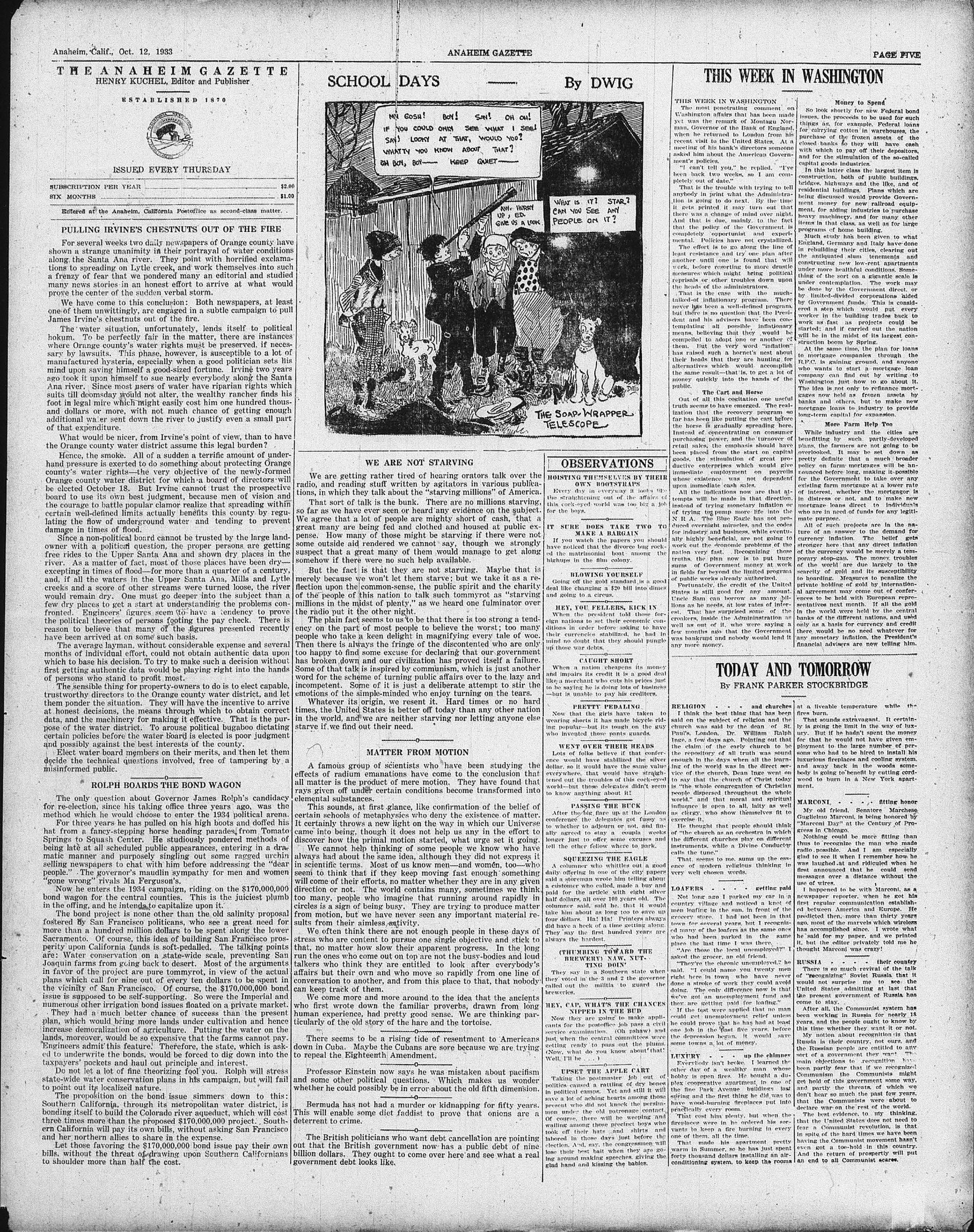
SCHOOL DAYS By DWIG
MY GOSH! BOY! SAI! OH OH!
IF YOU COULD ONLY SEE WHAT I SEE!
SAY! LOOKY AT THAT, WOULD YOU?
WHATTY YOU KNOW ABOUT THAT?
OH BOY, BOY—KEEP QUIET—
AH-HURRY UP, ED.
GIVE US A LOOK.
WHAT IS IT? STAR?
CAN YOU SEE ANY PEOPLE ON IT?
THE SOAP-WRAPPER TELESCOPE
WE ARE NOT STARVING
We are getting rather tired of hearing orators talk over the radio, and reading stuff written by agitators in various publications, in which they talk about the "starving millions" of America.
That sort of talk is the bunk. There are no millions starving, so far as we have ever seen or heard any evidence on the subject. We agree that a lot of people are mighty short of cash, that a great many are being fed and clothed at public expense. How many of those might be starving if there were not some outside aid rendered we cannot say, though we strongly suspect that a great many of them would manage to get along somehow if there were no such help available.
But the fact is that they are not starving. Maybe that is merely because we won't let them starve; but we take it as a reflection upon the common-sense, the public spirit and the charity of the people of this nation to talk such tommyrot as "starving millions in the midst of plenty," as we heard one fulminator over the radio put it the other night.
The plain fact seems to us to be that there is too strong a tendency on the part of most people to believe the worst; too many people who take a keen delight in magnifying every tale of woe. Then there is always the fringe of the discontented who are only too happy to find some excuse for declaring that our government has broken down and our civilization has proved itself a failure. Some of that talk is inspired by communism, which is just another word for the scheme of turning public affairs over to the lazy and incompetent. Some of it is just a deliberate attempt to stir the emotions of the simple-minded who enjoy turning on the tears.
Whatever its origin, we resent it. Hard times or no hard times, the United States is better off today than any other nation in the world, and we are neither starving nor letting anyone else starve if we find out their need.
MATTER FROM MOTION
A famous group of scientists who have been studying the effects of radium emanations have come to the conclusion that all matter is the product of mere motion. They have found that rays given off under certain conditions become transformed into elemental substances.
This sounds, at first glance, like confirmation of the belief of certain schools of metaphysics who deny the existence of matter. It certainly throws a new light on the way in which our Universe came into being, though it does not help us any in the effort to discover how the primal motion started, what urge set it going.
We cannot help thinking of some people we know who have always had about the same idea, although they did not express it in scientific terms. Most of us know men—and women, too—who
OBSERVATIONS
HOISTING THEMSELVES BY THEIR OWN BOOTSTRAPS
Every day in everyday it looks like the straightening out of the affairs of this cock-eyed world was too big a job for the boys.
IT SURE DOES TAKE TWO TO MAKE A BARGAIN
If you watch the papers you should have noticed that the divorce bug rocked the matrimonial boat among the highups in the film colony.
BLOWING YOURSELF
Going off the gold standard is a good deal like changing a $20 bill into dimes and going to a circus.
HEY, YOU FELLERS, KICK IN
When the president told those foreign nations to set their economic conditions in order before asking to have their currencies stabilized, he had in mind no doubt that they should pungle up those war debts.
CAUGHT SHORT
When a nation cheapens its money and impairs its credit it is a good deal like a merchant who cuts his prices just to be saying he is doing lots of business—but is unable to pay his creditors.
PRETTY PEDALING
Now that the girls have taken to wearing shorts it has made bicycle riding popular—but its tough on the guy who invented those pants guards.
WENT OVER THEIR HEADS
Lots of folks believe if that conference would have stabilized the silver dollar, so it would have the same value everywhere, that would have straightened out the troubles of this cock-eyed world—but those delegates didn't seem to know anything about it!
PASSING THE BUCK
After the big flare up at the London conference the delegates got fussy as to whether to adjourn or not, and finally agreed to stay a couple weeks longer just to offer some excuses and tell the other fellow where to park.
SQUEEZING THE EAGLE
A columner who whittles out a good
effects of radium emanations have come to the conclusion that all matter is the product of mere motion. They have found that rays given off under certain conditions become transformed into elemental substances.
This sounds, at first glance, like confirmation of the belief of certain schools of metaphysics who deny the existence of matter. It certainly throws a new light on the way in which our Universe came into being, though it does not help us any in the effort to discover how the primal motion started, what urge set it going.
We cannot help thinking of some people we know who have always had about the same idea, although they did not express it in scientific terms. Most of us know men—and women, too—who seem to think that if they keep moving fast enough something will come of their efforts, no matter whether they are in any given direction or not. The world contains many, sometimes we think too many, people who imagine that running around rapidly in circles is a sign of being busy. They are trying to produce matter from motion, but we have never seen any important material results from their aimless activity.
We often think there are not enough people in these days of stress who are content to pursue one single objective and stick to that, no matter how slow their apparent progress. In the long run the ones who come out on top are not the busy-bodies and loud talkers who think they are entitled to look after everybody's affairs but their own and who move so rapidly from one line of conversation to another, and from this place to that, that nobody can keep track of them.
We come more and more around to the idea that the ancients who first wrote down the familiar proverbs, drawn from long human experience, had pretty good sense. We are thinking particularly of the old story of the hare and the tortoise.
There seems to be a rising tide of resentment to Americans down in Cuba. Maybe the Cubans are sore because we are trying to repeal the Eighteenth Amendment.
Professor Einstein now says he was mistaken about pacifism and some other political questions. Which makes us wonder whether he could possibly be in error about the old fifth dimension.
Bermuda has not had a murder or kidnapping for fifty years. This will enable some diet faddist to prove that onions are a deterrent to crime.
The British politicians who want debt cancellation are pointing out that the British government now has a public debt of nine billion dollars. They ought to come over here and see what a real government debt looks like.
PASSING THE BUCK
After the big flare up at the London conference the delegates got fussy as to whether to adjourn or not, and finally agreed to stay a couple weeks longer just to offer some excuses and tell the other fellow where to park.
SQUEEZING THE EAGLE
A columner who whittles out a good daily offering in one of the city papers said a storeman wrote him telling about a customer who called, made a buy and paid for the article with eight silver half dollars, all over 100 years old. The columner said, said he, that it would take him about as long too to save up four dollars. Ha! Ha! Printers always did have a heck of a time getting along. They say the first hundred years are always the hardest.
(THUMBING TOWARD THE BREWERY) NAW, NUTTING DOIN'
They say in a Southern state when they voted in the 3 and 2 the governor called out the militia to guard the breweries.
HEY, CAP, WHAT'S THE CHANCES NIPPED IN THE BUD
Now they are going to make applicants for the postoffice job pass a civil service examination. (Oh pshaw) and just when the central committees were getting ready to pass out the plums. (Now, what do you know about' that! Well, I'll be . . .)
UPSET THE APPLE CART
Taking the postmaster job out of politics caused a rattling of dry bones in political camps. Yet and still it will save a lot of aching hearts among those present who did not knock the persimmon under the old patronage contact. Of course, there will be weeping and wailing among those precinct boys who took off their hats and shirts and labored in those days just before the election. And, say, the congressmen will lose their best bait when they are going around making speeches, giving the glad hand and kissing the babies.
THIS WEEK IN WASHINGTON
The most penetrating comment on Washington affairs that has been made yet was the remark of Montagu Norman, Governor of the Bank of England, when he returned to London from his recent visit to the United States. At a meeting of his bank's directors someone asked him about the American Government's policies.
"I can't tell you," he replied. "I've been back two weeks, so I am completely out of date."
That is the trouble with trying to tell anybody in print what the Administration is going to do next. By the time it gets printed it may turn out that there was a change of mind over night. And that is due, mainly, to the fact that the policy of the Government is completely opportunist and experimental. Policies have not crystallized.
The effort is to go along the line of least resistance and try one plan after another until one is found that will work, before resorting to more drastic measures which might bring political reprisals or other troubles down upon the heads of the administrators.
That is the case with the much-talked-of inflationary program. There never has been a well-defined program, but there is no question that the President and his advisers have been contemplating all possible inflationary means, believing that they would be compelled to adopt one or another of them. But the very word "inflation" has raised such a hornet's nest about their heads that they are hunting for alternatives which would accomplish the same result—that is, to get a lot of money quickly into the hands of the public.
The Cart and Horse
Out of all this cogitation one useful truth seems to have emerged. The realization that the recovery program so far has been like putting the cart before the horse is gradually spreading here. Instead of concentrating on consumer purchasing power, and the turnover of retail sales, the emphasis should have been placed from the start on capital goods, the stimulation of great pro
Money to Spend
So look shortly for new Federal bond issues, the proceeds to be used for such things as, for example, Federal loans for carrying cotton in warehouses, the purchase of the frozen assets of the closed banks so they will have cash with which to pay off their depositors, and for the stimulation of the so-called capital goods industries.
In this latter class the largest item is construction, both of public buildings, bridges, highways and the like, and of residential buildings. Plans which are being discussed would provide Government money for new railroad equipment, for aiding industries to purchase heavy machinery, and for many other items in that class, as well as for large programs of home building.
Much study has been given to what England, Germany and Italy have done in rebuilding their cities, clearing out the antiquated slum tenements and constructing new low-rent apartments under more healthful conditions. Something of the sort on a gigantic scale is under contemplation. The work may be done by the Government direct, or by limited-divided corporations aided by Government funds. This is considered a step which would put every worker in the building trades back to work as fast as projects could be started; and if carried out the nation will be in the midst of its largest construction boom by Spring.
At the same time, the plan for loans to mortgage companies through the R.F.C. is gaining ground, and anyone who wants to start a mortgage loan company can find out by writing to Washington just how to go about it. The idea is not only to refinance mortgages now held as frozen assets by banks and others, but to make new mortgage loans to industry to provide long-term capital for expansion.
More Farm Help Too
While industry and the cities are benefitting by such partly-developed plans, the farmers are not going to be overlooked. It may be set down as pretty definite that a much broader
TODAY AND TOMORROW
By FRANK PARKER STOCKBRIDGE
RELIGION and churches
I think the best thing that has been said on the subject of religion and the church was said by the dean of St. Paul's, London, Dr. William Ralph Inge, a few days ago. Pointing out that the claim of the early church to be the repository of all truth was sound enough in the days when all the learning of the world was in the direct service of the church, Dean Inge went on to say that the church of Christ today is "the whole congregation of Christian people dispersed throughout the whole world," and that moral and spiritual influence is open to all, laity as well as clergy, who show themselves fit to exercise it.
He thought that people should think of "the church as an orchestra in which the different churches play on different instruments, while a Divine Conductor calls the tune."
That seems to me, sums up the essence of modern religious thinking in at a liveable temperature while the fires burn.
That sounds extravagant. It certainly is going limit in the way of luxury. But if he hadn't spent the money for that he would not have given employment to the large number of persons who had to be hired to install his luxurious fireplaces and cooling system, and away back in the woods somebody is going to benefit by cutting cordwood to burn in a New York apartment.
MARCONI fitting honor
My old friend, Senatore Marchese Guglielmo Marconi, is being honored by "Marconi Day" at the Century of Progress in Chicago.
Nothing could be more fitting than thus to recognize the man who made radio possible. And I am especially glad to see it when I remember how he was laughed at and ridiculed when he first announced that he could send
have straight lines of this cock-eyed megates didn't seem about it!
up at the London states got fussy as on or not, and fina couple weeks some excuses and where to park.
hittles out a good of the city papers he him telling about made a buy and with eight silver 100 years old. The he, that it would long too to save up! Printers always time getting along hundred years are
OWARD THE LAW, NUTBOIN'
sthern state when and 2 the governor a to guard the
THE CHANCES
THE BUD
to make appliance job pass a civil (Oh pshaw) and committees were done out the plums. know about' that!
PUPPLE CART
master job out of drilling of dry bones yet and still it will hearts among those knock the persimmonation contact, be weeping and precinct boys who and shirts and just before the congressmen will when they are gooseeches, giving the babies.
LOAFERS . . . getting paid
Not long ago I parked my car in a country village and noticed a knot of men loafing in the sun, in front of the grocery store. I had not been in that town for several years, but I recognized many of the loafers as the same ones who had been parked in the same place the last time I was there.
"Are these the local unemployed?" I asked the grocer, an old friend.
"They're the chronic unemployed," he said. "I could name you twenty men right here in town who have never done a stroke of work they could avoid doing. The only difference now is that we've got an unemployment fund and they are getting paid for loafing."
If the test were applied that no man could get unemployment relief unless he could prove that he has had at least one job in the last five years, before the depression began, it would save some towns a lot of money.
LUXURY . . . up the chimney
Everybody isn't broke. I learned the other day of a wealthy man whose hobby is open fires. He bought a duplex cooperative apartment in one of the fine Park Avenue buildings last spring and the first thing he did was to have wood-burning fireplaces put into practically every room.
That cost him plenty, but when the fireplaces were in he ordered his servants to keep a fire burning in every one of them, all the time.
That made his apartment pretty warm in Summer, so he has just spent forty thousand dollars installing an air-conditioning system, to keep the rooms
of the church, Dean Ringe went on to say that the church of Christ today is "the whole congregation of Christian people dispersed throughout the whole world," and that moral and spiritual influence is open to all, laity as well as clergy, who show themselves fit to exercise it.
He thought that people should think of "the church as an orchestra in which different churches play on different instruments, while a Divine Conductor calls the tune."
That seems to me, sums up the essence of modern religious thinking in very well chosen words.
MARCONI . . . fitting honor
My old friend, Senatore Marchese Guglielmo Marconi, is being honored by "Marconi Day" at the Century of Progress in Chicago.
Nothing could be more fitting than thus to recognize the man who made radio possible. And I am especially glad to see it when I remember how he was laughed.at and ridiculed when he first announced that he could send messages over a distance without the use of wires.
I happened to be with Marconi, as a newspaper reporter, when he got his first regular communication established between America and Europe. He predicted then, more than thirty years ago, most of the marvels which wireless has accomplished since. I wrote what he said for my paper, and we printed it, but the editor privately told me he thought Marconi was crazy!
RUSSIA . . . their country
There is so much revival of the talk of "recognizing" Soviet Russia that it would not surprise me to see the United States admitting at last that the present government of Russia has come to stay.
After all, the Communist system has been working in Russia for nearly 18 years, and the people ought to know by this time whether they want it or not.
My notion about recognition is that Russia is their country, not ours, and the Russian people are entitled to any sort of a government they want. The main objections to recognition have been partly fear that if we recognized Communism the Communists might get hold of this government some way, and partly the threats, of which we don't hear so much the past few years, that the Communists were about to declare war on the rest of the world.
The best evidence, to my thinking, that the United States does not need to fear a Communist revolution, is that in spite of the hard times we have been having the Communist movement hasn't even got a toe-hold in this country. And the return of prosperity will put an end to all Communist scares.