anaheim-gazette 1933-10-05
Scanned page
Searchable text
THE ANAHEIM GAZETTE
HENRY KUCHEL, Editor and Publisher
ESTABLISHED 1870
ISSUED EVERY THURSDAY
SUBSCRIPT PER YEAR ... $2.00
SIX MONTHS ... $1.00
Entered at the Anaheim, California Postoffice as second-class matter.
MEN STILL COUNT
The way a good many people are talking about the so-called recovery program, one would think they expected some sort of a system which would relieve everybody of responsibility and which would run all business without regard to intelligence, initiative or industry.
That is nonsense, of course; nevertheless, there are a lot of people who still do not realize that any system, like any machine, has to have men to operate it.
The success of the administration's program will depend entirely upon the quality of the men who head up the business enterprises of the United States. In other words, there isn't going to be any change from the ancient truth that every institution, whether it is a rat-trap factory or a railroad system, is the lengthened shadow of a man.
Owen D. Young, who uses his brains to about as good advantage as any man we know of, pointed out that what broke down and caused all our economic woes, was not human beings but the system under which business and public affairs were administrated. What is being done now is to try to change — and improve — the system, but it will still take men to run it.
We have an idea that young men growing up in the world of business and affairs from now on will find just as great opportunities for self-expression as anyone had under the old system; but as things point now, they will operate the system very much more for the benefit of everybody and very much less for the benefit of a few individuals.
We find that many men who were thought to be entirely selfish
as any man we know of, pointed out that what broke down and caused all our economic woes, was not human beings but the system under which business and public affairs were administrated. What is being done now is to try to change — and improve — the system, but it will still take men to run it.
We have an idea that young men growing up in the world of business and affairs from now on will find just as great opportunities for self-expression as anyone had under the old system; but as things point now, they will operate the system very much more for the benefit of everybody and very much less for the benefit of a few individuals.
We find that many men who were thought to be entirely selfish in their point of view are accepting the idea that any scheme which works for the benefit of the entire social group is far better than one which benefits some but not all. Under the old system it was inevitable that there should be inequalities and injustices. We do not anticipate that any plan of human devising will ever be entirely free from them, but with the right men of the right spirit at the helm of things, there is hope.
EUROPE AND LATIN-AMERICA
There is said to be considerable opinion in Washington to the effect that the present trouble in Cuba may have been at least in part inspired by European interests who are always desirous of promoting discord between the United States and the countries of Latin-America for trade reasons. This theory is not as far fetched as it seems. For years it has been the policy of the great exporting nations of Europe to create as much friction as possible between the United States and Latin-America. The reason is obvious. The Europeans have always feared that Uncle Sam might change his old methods for acquiring foreign trade and center his efforts in South and Central America. Every Pan-American conference, every effort to promote more friendly relations between the United States and Latin-American nations is viewed with suspicion and resentment in Europe. Europeans have generally held the bulk of the Latin-American trade and they intend to hang on to it if possible.
In their efforts to hang on to it they have used every method possible to poison the minds of Latin-Americans against the United States. Every time the United States has been compelled to intervene in countries like Nicaragua and Haiti to protect the lives and the property of Europeans as well as Americans, the European press has hailed it as another evidence of "Yankee imperialism." That Uncle Sam always withdraws without taking over any land or property, as an imperialist nation would do, is never mentioned by them.
In addition, the principal sources of world news going into Latin-America are controlled by Europe. As a result most of the news about the United States, before it is sent into Latin-American nations, is colored to suit the purposes of the European nations and their exporters. This is not an exaggeration. Any shrewd American traveler who has spent a month of two in Latin-America runs across this phase of underhanded European policy. But it is not only the European news dispatches to Latin-America which lie about the United States, European trade representatives do it too.
In an interesting newspaper article discussing this phase of world politics and world trade, Charles P. Stewart, well known newspaper correspondent, recently said:
"Just after the World War, Yankee exporters actually did gain pupils as could be money which they Incidentally, siderably more tion.
What we have might give a better chance to teach trades o that there are ceen on which more o get learned you gets through high and honor are o got off to a poor And we are go into the world e takes it for grant A really sour nature and huma
news about the United States, before it is sent into Latin-American nations, is colored to suit the purposes of the European nations and their exporters. This is not an exaggeration. Any shrewd American traveler who has spent a month of two in Latin-America runs across this phase of underhanded European policy. But it is not only the European news dispatches to Latin-America which lie about the United States, European trade representatives do it too.
In an interesting newspaper article discussing this phase of world politics and world trade, Charles P. Stewart, well known newspaper correspondent, recently said:
"Just after the World War, Yankee exporters actually did gain a considerable foothold in Latin-American markets, but were practically driven out by the successful slanders of the allied powers' more experienced trade representatives.
"As a resident in the River Platte region at the time, I was thoroughly acquainted with the campaign."
Here is something for Americans to think about. Let us quit wool gathering over prospects of increasing our European trade. Let us rather cultivate closer relations with Latin-America. One of the first things to do is to give the Latin-American people some authentic information about the United States and the friendly disposition of our people toward Latin-Americans. We have suffered enough both at home and in South America from lying European propaganda, aided and abetted by some of our own internationlists. Isn't it about time to start a little propaganda of our own? All we have to do is to give them the truth. Misrepresentation of our motives will not be necessary.
EDUCATION
The school season is in full swing again all over the United States. More boys and girls are getting an education at public expense in this country than there are in all the rest of the world, so far as we know anything about it. There is nothing to compare anywhere with the public school system of America, both in the number of young people that it serves and in the general excellence of the instruction given.
We sometimes wonder whether our school systems might not be better adapted than they are to the needs of the youth of America. It occurs to us at times that a good many of the subjects to which considerable attention is given might be left out or modified in favor of other things which would be of more practical help when these children have left school and have their way in the world to make. But there has been a great deal of progress in exactly that direction in the past few years, and we imagine that, on the whole, the schools are doing as well by their
ANAHEIM GAZETTE
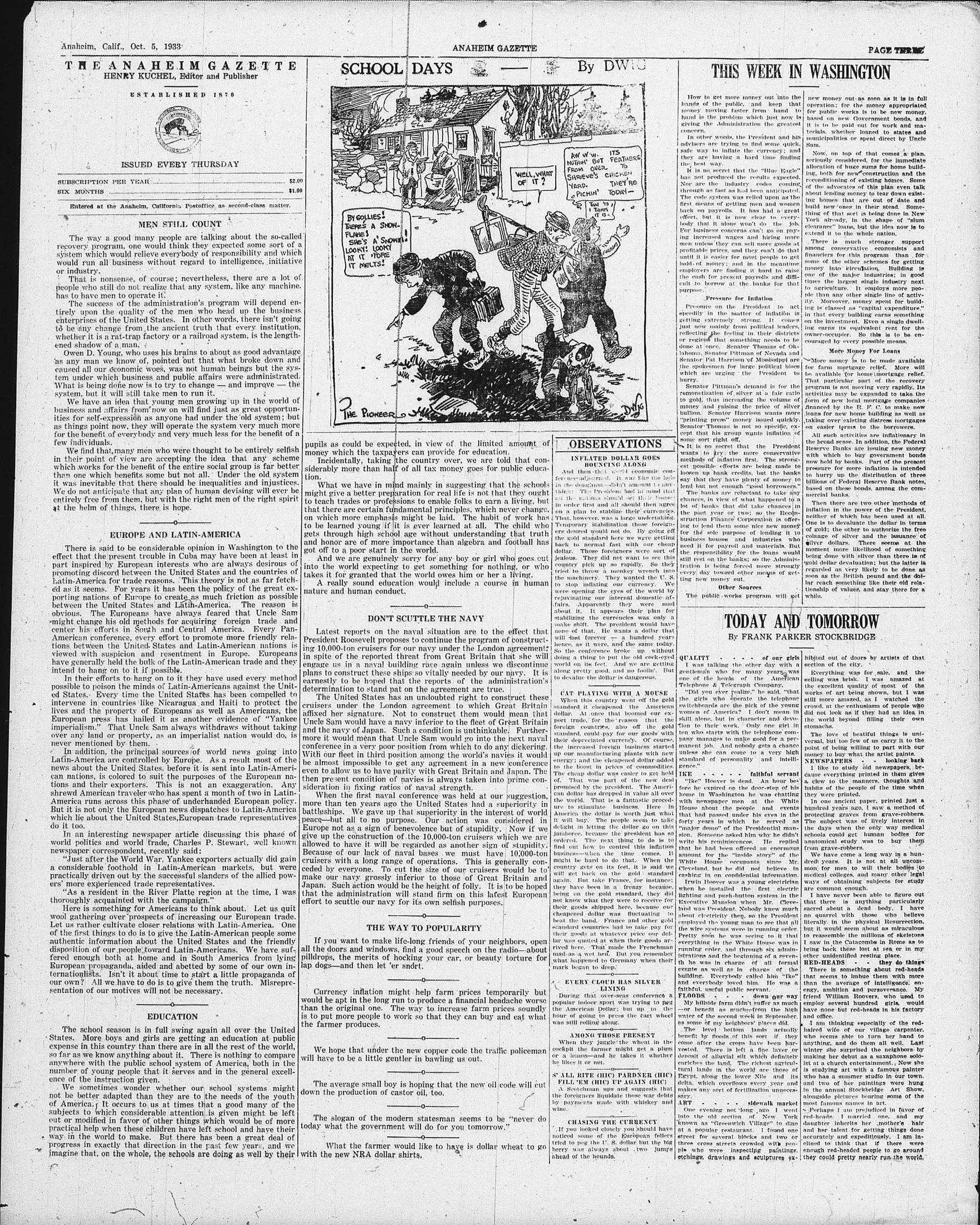
SCHOOL DAYS — By DWIG
WELL, WHAT OF IT?
AW WWW. ITS MUTHIN' BUT FEATHERS FROM OVER TO SHRIEVE'S CHICKEN YARD. THEY'RE PICHIN' TODAY—
BY GOLLIES!
THERE'S A SNOW-FLAKE!
SHE'S A'SNOWIN'
LOOKY! LOOKY AT IT 'FORE IT MELTS!
THE PIONEER
OBSERVATIONS
pupils as could be expected, in view of the limited amount of money which the taxpayers can provide for education.
pupils as could be expected, in view of the limited amount of money which the taxpayers can provide for education.
Incidentally, taking the country over, we are told that considerably more than half of all tax money goes for public education.
What we have in mind mainly in suggesting that the schools might give a better preparation for real life is not that they ought to teach trades or professions to enable folks to earn a living, but that there are certain fundamental principles, which never change, on which more emphasis might be laid. The habit of work has to be learned young if it is ever learned at all. The child who gets through high school age without understanding that truth and honor are of more importance than algebra and football has got off to a poor start in the world.
And we are genuinely sorry for any boy or girl who goes out into the world expecting to get something for nothing, or who takes it for granted that the world owes him or her a living.
A really sound education would include a course in human nature and human conduct.
DON'T SCUTTLE THE NAVY
Latest reports on the naval situation are to the effect that President Roosevelt proposes to continue the program of constructing 10,000-ton cruisers for our navy under the London agreement; in spite of the reported threat from Great Britain that she will engage us in a naval building race again unless we discontinue plans to construct these ships so vitally needed by our navy. It is earnestly to be hoped that the reports of the administration's determination to stand pat on the agreement are true.
The United States has an undoubted right to construct these cruisers under the London agreement to which Great Britain affixed her signature. Not to construct them would mean that Uncle Sam would have a navy inferior to the fleet of Great Britain and the navy of Japan. Such a condition is unthinkable. Furthermore it would mean that Uncle Sam would go into the next naval conference in a very poor position from which to do any dickering. With our fleet in third position among the world's navies it would be almost impossible to get any agreement in a new conference even to allow us to have parity with Great Britain and Japan. The then present condition of navies is always taken into prime consideration in fixing ratios of naval strength.
When the first naval conference was held at our suggestion, more than ten years ago the United States had a superiority in battleships. We gave up that superiority in the interest of world peace—but all to no purpose. Our action was considered in Europe not as a sign of benevolence but of stupidity. Now if we give up the construction of the 10,000-ton cruisers which we are allowed to have it will be regarded as another sign of stupidity. Because of our lack of naval bases we must have 10,000-ton cruisers with a long range of operations. This is generally con-
OBSERVATIONS
INFLATED DOLLAR GOES BOUNCING ALONG
And then that world economic conference adjourned. It was like the hole in the doughnut—didn't amount to anything: The President had in mind that all the nations should set their houses in order first and all should then agree on a plan to stabilize their currencies. That, however, was a large undertaking. Temporary stabilization those foreigners desired would not do. By going off the gold standard here we were getting back to normal fast with our cheap dollar. Those foreigners were sort of jealous. They did not want to see this country pick up so rapidly. So they tried to throw a monkey wrench into the machinery. They wanted the U.S. to stop inflating our currency. We were opening the eyes of the world by rejuvenating our internal domestic affairs. Apparently they were mad about it. It appears their plan for stabilizing the currencies was only a make shift. The president would have none of that. He wants a dollar that will last forever — a hundred years hence, as it were, and the same today. So the conference broke up without doing a thing to put the old cock-eyed world on its feet. And we are getting along pretty good, and no foolin'. But to devalue the dollar is dangerous.
CAT PLAYING WITH A MOUSE
When this country went off the gold standard it cheapened the American dollar. At once that boomed our export trade, for the reason that the foreign countries, also off the gold standard, could pay for our goods with their depreciated currency. Of course, the increased foreign business started up our manufacturing plants with new energy; and the cheapened dollar added to the boost in prices of commodities. The cheap dollar was easier to get hold of. That was part of the new deal promised by the president. The American dollar has dropped in value all over the world. That is a fantastic procedure to stimulate business. Here in America the dollar is worth just what it will buy. The people seem to take delight in letting the dollar go on this jamboree, because the president has so ordered. The next thing to do is to find out how to control this inflation business—when the time comes. It might be hard to do that. When the
even to allow us to have parity with Great Britain and Japan. The then present condition of navies is always taken into prime consideration in fixing ratios of naval strength.
When the first naval conference was held at our suggestion, more than ten years ago the United States had a superiority in battleships. We gave up that superiority in the interest of world peace—but all to no purpose. Our action was considered in Europe not as a sign of benevolence but of stupidity. Now if we give up the construction of the 10,000-ton cruisers which we are allowed to have it will be regarded as another sign of stupidity. Because of our lack of naval bases we must have 10,000-ton cruisers with a long range of operations. This is generally conceded by everyone. To cut the size of our cruisers would be to make our navy grossly inferior to those of Great Britain and Japan. Such action would be the height of folly. It is to be hoped that the administration will stand firm on this latest European effort to scuttle our navy for its own selfish purposes.
THE WAY TO POPULARITY
If you want to make life-long friends of your neighbors, open all the doors and windows, find a good speech on the radio—about pilldrops, the merits of hocking your car, or beauty torture for lap dogs—and then let 'er snort.
Currency inflation might help farm prices temporarily but would be apt in the long run to produce a financial headache worse than the original one. The way to increase farm prices soundly is to put more people to work so that they can buy and eat what the farmer produces.
We hope that under the new copper code the traffic policeman will have to be a little gentler in bawling us out.
The average small boy is hoping that the new oil code will cut down the production of castor oil, too.
The slogan of the modern statesman seems to be "never do today what the government will do for you tomorrow."
What the farmer would like to have is dollar wheat to go with the new NRA dollar shirts.
THIS WEEK IN WASHINGTON
How to get more money out into the hands of the public, and keep that money moving faster from hand to hand is the problem which just now is giving the Administration the greatest concern.
In other words, the President and his advisers are trying to find some quick, safe way to inflate the currency; and they are having a hard time finding the best way.
It is no secret that the "Blue Eagle" has not produced the results expected. Nor are the industry codes coming through as fast as had been anticipated. The code system was relied upon as the first means of getting men and women back on payrolls. It has had a great effect, but it is now clear to everybody that it alone won't do the job. For business concerns can't go on paying increased wages and hiring more men unless they can sell more goods at profitable prices, and they can't do that until it is easier for most people to get hold of money; and in the meantime employers are finding it hard to raise the cash for present payrolls and difficult to borrow at the banks for that purpose.
Pressure for Inflation
Pressure on the President to act speedily in the matter of inflation is getting extremely strong. It comes just now mainly from political leaders, reflecting the feeling in their districts or regions that something needs to be done at once. Senator Thomas of Oklahoma, Senator Pittman of Nevada and Senator Pat Harrison of Mississippi are the spokesmen for large political blocs which are urging the President to hurry.
Senator Pittman's demand is for the remonetization of silver at a fair ratio to gold, thus increasing the volume of money and raising the price of silver bullion. Senator Harrison wants more "printing press" money issued quickly. Senator Thomas is not so specific, except that his group wants inflation of some sort right off.
It is no secret that the President wants to try the more conservative new money out as soon as it is in full operation; for the money appropriated for public works is to be new money, based on new Government bonds, and it is to be paid out for work and materials, whether loaned to states and municipalities or spent direct by Uncle Sam.
Now, on top of that comes a plan, seriously considered, for the immediate allocation of huge sums for home building, both for new construction and the reconditioning of existing homes. Some of the advocates of this plan even talk about lending money to tear down existing homes that are out of date and build new ones in their stead. Something of that sort is being done in New York already, in the shape of "slum clearance" loans, but the idea now is to extend it to the whole nation.
There is much stronger support among conservative economists and financiers for this program than for some of the other schemes for getting money into circulation. Building is one of the major industries; in good times the largest single industry next to agriculture. It employs more people than any other single line of activity. Moreover, money spent for building is classed as "capital expenditure," in that every building earns something on the investment. Even a single dwelling earns its equivalent rent for the owner-occupier. So this is to be encouraged by every possible means.
More Money For Loans
More money is to be made available for farm mortgage relief. More will be available for home mortgage relief. That particular part of the recovery program is not moving very rapidly. Its activities may be expanded to take the form of new local mortgage companies financed by the R. F. C. to make new loans for new home building as well as taking over existing distress mortgages on easier terms to the borrowers.
All such activities are inflationary in the broad sense. In addition, the Federal Reserve Banks are issuing new money with which to buy government bonds
TODAY AND TOMORROW
By FRANK PARKER STOCKBRIDGE
QUALITY of our girls
I was talking the other day with a gentleman who for many years was one of the heads of the American Telephone & Telegraph Company.
"Did you ever realize," he said, "that the girls who operate the telephone switchboards are the pick of the young women of America? I don't mean in skill alone, but in character and devotion to their work. Only one girl in ten who starts with the telephone company manages to make good for a permanent job. And nobody gets a chance unless she can come to a very high standard of personality and intelligence."
IKE faithful servant
"Ike" Hoover is dead. An hour before he expired on the door-step of his home in Washington he was chatting with newspaper men at the White House about the people and events that had passed under his eyes in the forty years in which he served as "major domo" of the Presidential mansion. Someone asked him why he didn't write his reminiscences. He replied that he had been offered an enormous amount for the "inside story" of the White House occupants since Mr.
hibited out of doors by artists of that section of the city.
Everything was for sale, and the selling was brisk. I was amazed at the excellent quality of most of the works of art being shown, but I was still more amazed, as I watched the crowd, at the enthusiasm of people who did not look as if they had an idea in the world beyond filling their own stomachs.
The love of beatiful things is universal, but too few of us carry it to the point of being willing to part with our money to buy what the artist paints.
NEWSPAPERS looking back
I like to study old newspapers, because everything printed in them gives a clew to the manners, thoughts and habits of the people of the time when they were printed.
In one ancient paper, printed just a hundred years ago, I saw a method of protecting graves from grave-robbers. The subject was of lively interest in the days when the only way medical schools could get human bodies for anatomical study was to buy them from grave-robbers.
We have come a long way in a hundred years. It is not at all uncom-
IKE . . . . . . faithful servant
"Ike" Hoover is dead. An hour before he expired on the door-step of his home in Washington he was chatting with newspaper men at the White House about the people and events that had passed under his eyes in the forty years in which he served as "major domo" of the Presidential mansion. Someone asked him why he didn't write his reminiscences. He replied that he had been offered an enormous amount for the "inside story" of the White House occupants since Mr. Cleveland, but he did not believe in cashing in on confidential information.
Irwin Hoover was a young electrician when he installed the first electric lighting and push-button system in the Executive Mansion when Mr. Cleveland was President. Nobody knew much about electricity then, so the President employed the young man to see that all the wire systems were in running order. Pretty soon he was seeing to it that everything in the White House was in running order, and through six administrations and the beginning of a seventh he was in charge of all formal events as well as in charge of the building. Everybody called him "Ike" and everybody loved him. He was a faithful, useful public servant.
FLOODS . . . down our way
My hillside farm didn't suffer as much—or benefit as much—from the high water of the second week in September, as some of my neighbors' places did.
The level bottom lands actually benefit by floods of this sort if they come after the crops have been harvested. There is left a fine layer or denosit of alluvial silt which definitely enriches the land. The richest agricultural lands in the world are those of Egypt, along the lower Nile and its delta, which overflows every year and makes any sort of fertilization unnecessary.
ART . . . sidewalk market
One evening not long ago I went into the old section of New York known as "Greenwich Village" to dine at a popular restaurant. I found one street for several blocks and two or three cross streets crowded with people who were inspecting paintings, drawings and sculptures ex-
because everything printed in them gives a clew to the manners, thoughts and habits of the people of the time when they were printed.
In one ancient paper, printed just a hundred years ago, I saw a method of protecting graves from grave-robbers. The subject was of lively interest in the days when the only way medical schools could get human bodies for anatomical study was to buy them from grave-robbers.
We have come a long way in a hundred years. It is not at all uncommon for men to will their bodies to medical colleges, and many other legal ways of obtaining subjects for study are common enough.
I have never been able to figure out that there is anything particularly sacred about a dead body. I have no quarrel with those who believe literally in the physical Resurrection, but it would seem about as miraculous to reassemble the millions of skeletons I saw in the Catacombs in Rome as to bring back those lost at sea or in my other unidentified resting place.
RED-HEADS . . . they do things
There is something about red-heads that seems to imbue them with more than the average of intelligence, energy, ambition and perseverance. My friend William Roovers, who used to employ several hundred girls, would have none but red-heads in his factory and office.
I am thinking especially of the red-haired wife of our village carpenter, who seems able to turn her hand to anything, and do them all well. Last winter she surprised the neighbors by making her debut as a saxaphone soloist at a church entertainment. Now she is studying art with a famous painter who has a summer studio in our town, and two of her paintings were hung in the annual Stockbridge Art Show, alongside pictures bearing some of the most famous names in art.
Perhaps I am prejudiced in favor of red-heads. I married one, and my daughter inherits her mother's hair and her talent for getting things done accurately and expeditiously. I am inclined to think that if there were enough red-headed people to go around they could pretty nearly run the world.