anaheim-gazette 1933-09-28
Scanned page
Searchable text
THE ANAHEIM GAZETTE
HENRY KUCHEL, Editor and Publisher
ESTABLISHED 1870
ISSUED EVERY THURSDAY
SUBSCRIPTION PER YEAR ... $2.00
SIX MONTHS ... $1.00
Entered at the Anaheim, California Postoffice as second-class matter.
SOME THINGS TO REMEMBER
In these days of national efforts to put over the recovery program as outlined by the administration, with the assertion frequently made by some of the over-enthusiastic proponents that unless the program succeeds fully there will be chaos, a great deal of doubt and confusion seems to occupy the public mind.
Any temporary recession of business, any report in a decline in car loadings, or electric power production, is apt to cause cold shivers to run down the spines of those who take these graveyard stories too seriously.
Everybody hopes that the national recovery program will succeed in speeding us on our way out of the depression. But the fact is that things had begun to get better anyhow, as the improvement in European nations evidences. This is not taken to mean that we should relax our efforts, but that we ought not become panicky when improvement does not come along as rapidly as we might wish. We have been in depressions before and have pulled out of them, just as we give evidences that we are going to pull out now. Other nations have been in depressions and have to pull out now. Other nations have been in depressions and have nation, when there were not enough brains to organize a trust.
In this respect, what the Baltimore Sun said recently is well worth reading. It runs as follows:
"Amid all the hullabaloo about codes, blue eagles and processing taxes, we are in danger of forgetting that business is actually improving, that the improvement began before the hullabaloo set
to mean that we should relax our efforts, but that we ought to become panicky when improvement does not come along as rapidly as we might wish. We have been in depressions before and have pulled out of them, just as we give evidences that we are going to pull out now. Other nations have been in depressions and have to pull out now. Other nations have been in depressions and have nation, when there were not enough brains to organize a trust.
In this respect, what the Baltimore Sun said recently is well worth reading. It runs as follows:
"Amid all the hullabaloo about codes, blue eagles and processing taxes, we are in danger of forgetting that business is actually improving, that the improvement began before the hullabaloo set in, that it is in progress not only in this country but in Europe, and that it is running more or less true to the form of recovery set after each of the other major depressions since the Civil war.
"To recall the fact of normal basic gains is not, of course, to say that the present position is free from danger. There is always serious danger that by undertaking artificially to expedite recovery in one direction we may disturb the relationship between costs and prices, between supply and demand, in such a way as to retard rather than hasten our arrival at the goal. But the fact that we have begun to move along the lines by which we have escaped from previous depressions is the main and the truly encouraging thing. It is just as important to remember this fundamental factor as it is to hang on the latest ruling from the NRA."
Here is some pretty good food for thought. By all means let us "hope and pray for the NRA," (no poesy intended), but let us at the same time remember that natural factors are working for recovery, too, and that it may not mean anarchy or chaos if any phase of the recovery program doesn’t happen to work out. What we need just now is less doubt and less shuddering and more confidence in the future of America. It may be, as some of the professorial members of the brain trust would have us believe, that we are now in a new era, and that the old days of individualism are gone forever and nothing but new ideas will work. But let's just wait and see. Individuals are still pretty important even if it does take a lot of them to make a big nation. Some of the old principles do seem to have a grain of truth in them, and it is barely possible that we may have to rely on them some of these days. They have never led us to anarchy and chaos before and maybe they won’t this time.
At any rate, Mother Nature has always been a great doctor, and she doesn’t even possess a college degree.
Professor Einstein, the ardent pacifist, is now advising France and Belgium to arm against Germany. With pacifism as with other things it sometimes depends on whose toes are stepped on.
NEW “DEBT DRIVE” COMING
Of late there have been rumors to the effect that the American government is preparing to agree to a slash in the European debt which would amount almost to cancellation. These reports have originated in European diplomatic circles and some of them hinted that Norman H. Davis, credited with favoring the reduction of the debts, had made such a promise to foreign diplomats with the knowledge of the national administration.
There is nothing yet, so far as the public knows, to indicate that there is any truth in these reports. The probability is that they foreshadow a revival on the part of European nations of an
NEW "DEBT DRIVE" COMING
Of late there have been rumors to the effect that the American government is preparing to agree to a slash in the European debt which would amount almost to cancellation. These reports have originated in European diplomatic circles and some of them hinted that Norman H. Davis, credited with favoring the reduction of the debts, had made such a promise to foreign diplomats with the knowledge of the national administration.
There is nothing yet, so far as the public knows, to indicate that there is any truth in these reports. The probability is that they foreshadow a revival on the part of European nations of an intensive effort to secure debt cancellation from the United States. It is an old trick of European diplomacy, when it is getting ready to try to put something over on Uncle Sam, to send out stories to the effect that the American government "favors" the thing which the European diplomats are getting ready to put over. That is a good deal like sending out a smoke screen at the beginning of an attack.
The national administration is on record as opposed to debt cancellation. There is no reason yet to believe that there has been any change in policy. The only thing hinting of such a change has been the rumors emanating from European political circles.
Certainly the American people have not changed their minds on the subject of debt cancellation. They realize that for every dollar the European statesmen succeed in chiselling from the amount which Europe owes us, another dollar must be raised by the American taxpayers, to help liquidate the war which was waged "to save the world for democracy' but which succeeded only in raising dictatorships over a great section of the world's population.
Just now the American people have about all they can do to raise money to carry on the American government and to pay for the administration's recovery program. They do not feel that they are at this time able to pay the rest of the world's bill for waging the great war. Nor do they think they are justly called on to do this.
European observers are just now rather proudly stating that many of the nations of Europe are now further on the road to recovery from the depression than we are in spite of our NRA. They seem to think that this shows the superiority of their own economic ideas. If it is true that they are now better off economically than we are and have proportionately less employment, then they ought to be able to pay something on the debt which they owe us.
But it is a good bet that when the time comes for debt negotiation they will suddenly become poor again, and will want Uncle Sam to resume the entire burden of liquidating the expenses of the World War. European diplomats are built that way. They will settle if they have to, but will find it a lot more fun to force Uncle Sam to pay for something which they started.
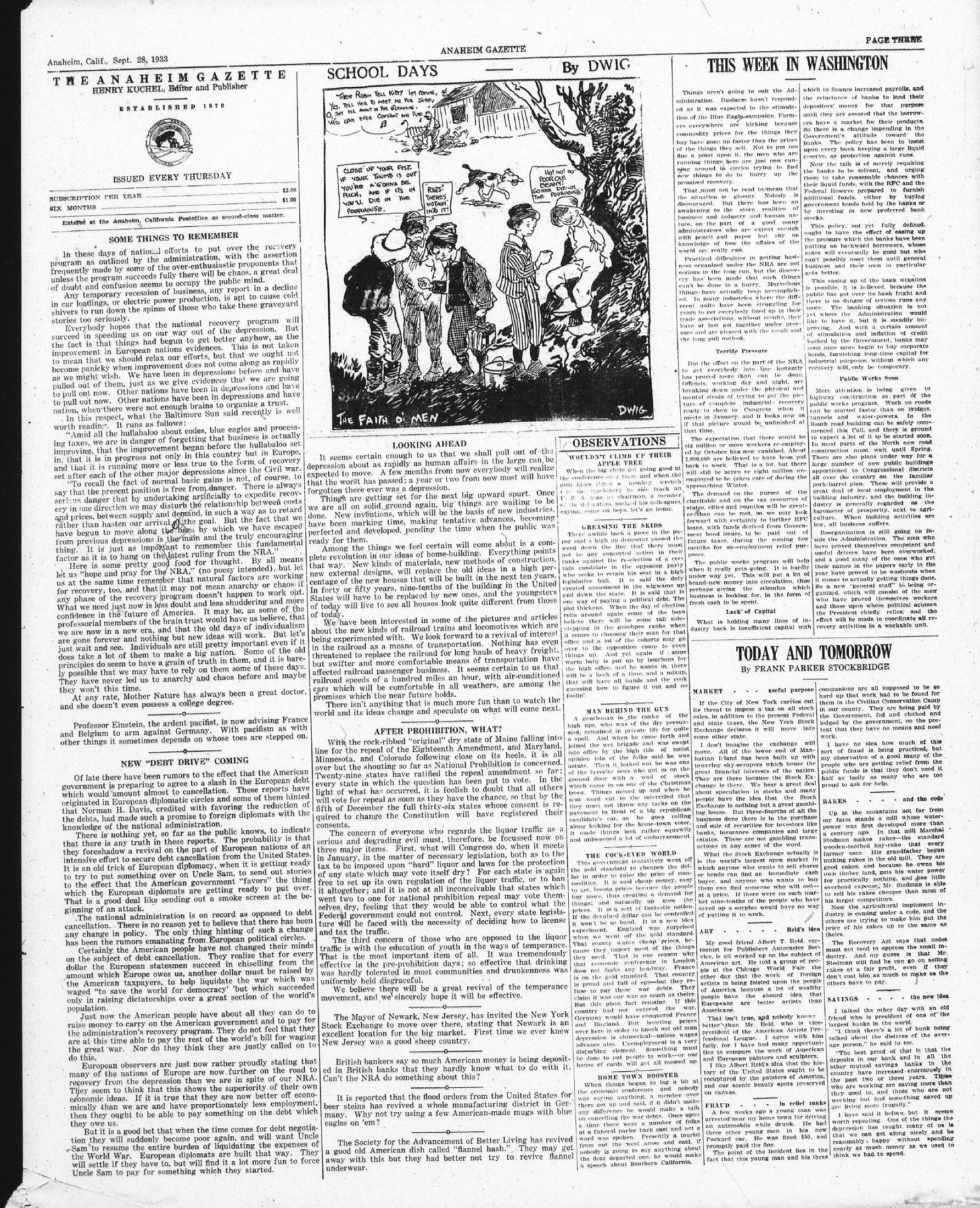
SCHOOL DAYS — By DWIG
THEM ROBIN TELL KITTY I'M COMING,
YES, TELL HER TO MEET ME FOR SURE,
O, SAY MLL AWAIT IN THE GLOAMING,
WITH LOVE EVER CONSTANT AND PURE
CLOSE UP YOUR FIST.
IF YOUR THUMB IS OUT
YOU'RE A 'GONNA DE
RICH', AND IF IT'S IN
YOU'LL DIE IN THE
POORHOUSE.
RATS!
THERE'S NOTHING
INTO IT!
HO! HO! HO!
POOR OLE
BEANY!
GO NINA DIE IN
THE POORHOUSE!
THE FAITH D'MEN
DWIG
LOOKING AHEAD
OBSERVATIONS
LOOKING AHEAD
It seems certain enough to us that we shall pull out of the depression about as rapidly as human affairs in the large can be expected to move. A few months from now everybody will realize that the worst has passed; a year or two from now most will have forgotten there ever was a depression.
Things are getting set for the next big upward spurt. Once we are all on solid ground again, big things are waiting to be done. New inventions, which will be the basis of new industries, have been marking time, making tentative advances, becoming perfected and developed, pending the time when the public was ready for them.
Among the things we feel certain will come about is a complete revolution in our ideas of home-building. Everything points that way. New kinds of materials, new methods of construction, new external designs, will replace the old ideas in a high percentage of the new houses that will be built in the next ten years. In forty or fifty years, nine-tenths of the building in the United States will have to be replaced by new ones, and the youngsters of today will live to see all houses look quite different from those of today.
We have been interested in some of the pictures and articles about the new kinds of railroad trains and locomotives which are being experimented with. We look forward to a revival of interest in the railroad as a means of transportation. Nothing has even threatened to replace the railroad for long hauls of heavy freight, but swifter and more comfortable means of transportation have affected railroad passenger business. It seems certain to us that railroad speeds of a hundred miles an hour, with air-conditioned cars which will be comfortable in all weathers, are among the promises which the near future holds.
There isn’t anything that is much more fun than to watch the world and its ideas change and speculate on what will come next.
AFTER PROHIBITION, WHAT?
With the rock-ribbed “original” dry state of Maine falling into line for the repeal of the Eighteenth Amendment, and Maryland, Minnesota, and Colorado following close on its heels, it is all over but the shouting so far as National Prohibition is concerned. Twenty-nine states have ratified the repeal amendment so far; every state in which the question has been put to vote. In the light of what has occurred, it is foolish to doubt that all others will vote for repeal as soon as they have the chance, so that by the fifth of December the full thirty-six states whose consent is required to change the Constitution will have registered their consents.
The concern of everyone who regards the liquor traffic as a serious and degrading evil must, therefore, be focussed now on three major items. First, what will Congress do, when it meets
OBSERVATIONS
WOULDNT CLIMB UP THEIR APPLE TREE
When the big shots got going good at the conference over there and when the gold blocs threw a monkey wrench into the machinery to side track an U.S.A man as chairman, a member of the delegation, nudged his colleagues, saying, come on boys, let’s go home.
GREASING THE SKIDS
There awhile back a piece in the paper said a high up democrat passed the word down the line that there must not be any concerted action in their ranks against the re-election of a certain candidate in the opposing party who seeks to retain his seat in a high legislative hall. It is said the defy created uneasiness in the wigwams up and down the state. It is said that is one way of paying a political debt. The plot thickens. When the day of election rolls around again some of the boys believe there will be some tall side-stepping in the geeohpee ranks when it comes to choosing their man for that office and a lot of the cohorts may go over to the opposition camp to even things up. And yet again if some warm baby is put up by bourbons for the high office, and he wants in, there will be a heck of a time, and a mixup, that will have all hands and the cook guessing how to figure it out and no foolin’.
MAN BEHIND THE GUN
A gentleman in the ranks of the high ups, who was of the dry persuasion, remained in private life for quite a spell. And when he came forth and joined the wet brigade and was swept into office by the high tide of moist opinion lots of the folks said he was astute. Then it leaked out he was one of the favorite sons who got in on the ground floor with a wad of stock which came in on one of the Christmas trees. Things moved up and when he sent word out to the interrified that they must not throw any tacks on the pavement in front of a big republican candidate’s car, as he goes rolling along looking for the home-town voter, it made things look rather squawly and unloosened a lot of embarrassment.
Minnesota, and Colorado following close on over but the shouting so far as National Prohibition is concerned. Twenty-nine states have ratified the repeal amendment so far; every state in which the question has been put to vote. In the light of what has occurred, it is foolish to doubt that all others will vote for repeal as soon as they have the chance, so that by the fifth of December the full thirty-six states whose consent is required to change the Constitution will have registered their consents.
The concern of everyone who regards the liquor traffic as a serious and degrading evil must, therefore, be focussed now on three major items. First, what will Congress do, when it meets in January, in the matter of necessary legislation, both as to the tax to be imposed upon "hard" liquor and laws for the protection of any state which may vote itself dry? For each state is again free to set up its own regulation of the liquor traffic, or to ban it altogether; and it is not at all inconceivable that states which went two to one for national prohibition repeal may vote themselves dry, feeling that they would be able to control what the Federal government could not control. Next, every state legislature will be faced with the necessity of deciding how to license and tax the traffic.
The third concern of those who are opposed to the liquor traffic is with the education of youth in the ways of temperance. That is the most important item of all. It was tremendously effective in the pre-prohibition days; so effective that drinking was hardly tolerated in most communities and drunkenness was uniformly held disgraceful.
We believe there will be a great revival of the temperance movement, and we sincerely hope it will be effective.
The Mayor of Newark, New Jersey, has invited the New York Stock Exchange to move over there, stating that Newark is an excellent location for the big market. First time we ever knew New Jersey was a good sheep country.
British bankers say so much American money is being deposited in British banks that they hardly know what to do with it. Can't the NRA do something about this?
It is reported that the flood orders from the United States for beer steins has revived a whole manufacturing district in Germany. Why not try using a few American-made mugs with blue eagles on 'em?
The Society for the Advancement of Better Living has revived a good old American dish called "flannel hash." They may get away with this but they had better not try to revive flannel underwear.
THE COCK-EYED WORLD
This government tentatively went off the gold standard to cheapen the dollar in order to raise the price of commodities. It is said cheap money, easy to get, boosts prices because the people buy more, thus creating a demand for things; and naturally up goes the prices. It is a sort of fantastic notion if the devalued dollar can be controlled it won't be so band. It is a new idea experiment. England was surprised when we went off the gold standard. That county wants cheap prices, because they import most of the things they need. That is one reason why that economic conference in London does not make any headway. France is on the gold standard. That country is proud and full of ego—but they refuse to pay those war debts. They claim it was our war as much as theirs. But this plain fact remains. If this country had not entered the war Germany would have conquered France and England. But boosting price over here in order to knock out old man depression is chimerical—unless wage advance also. Unemployment is a very disturbing element. Something must be done to put people to work—or on house of cards will get all messed up.
HOME TOWN BOOSTER
When things began to lag a bit in the economic conference and nobody was saying anything, a member owed there got up and said, if it didn't make any difference he would make a tax on cancelling the war debts. Once up a time there were a number of folks at a funeral parlor back east and not word was spoken. Presently a tour from out the west arose and said, nobody is going to say anything about the dear departed one, he would make a speech about Southern California.
THIS WEEK IN WASHINGTON
Things aren't going to suit the Administration. Business hasn't responded as it was expected to the stimulation of the Blue Eagle campaign. Farmers everywhere are kicking because commodity prices for the things they buy have gone up faster than the prices of the things they sell. Not to put too fine a point upon it, the men who are running things here are just now running around in circles trying to find new things to do to hurry up the promised recovery.
That must not be read to mean that the situation is gloomy. Nobody is discouraged. But there has been an awakening to the stern realities of business and industry and human nature, on the part of a good many administrators who are expert enough with pencil and paper but shy on knowledge of how the affairs of the world are really run.
Practical difficulties in getting business organized under the NRA are not serious in the long run, but the discovery has been made that such things can't be done in a hurry. Marvellous things have actually been accomplished. In many industries where the different units have been struggling for years to get everybody lined up in their trade associations, without results, they have at last got together under pressure and are pleased with the result and the long-pull outlook.
Terrific Pressure
But the effort on the part of the NRA to get everybody into line instantly has proved more than can be done. Officials, working day and night, are breaking down under the physical and mental strain of trying to get the picture of complete industrial recovery ready to show to Congress when it meets in January, and it looks now as if that picture would be unfinished at that time.
The expectation that there would be six million or more workers re-employable October has now vanished About which to finance increased payrolls, and the reluctance of banks to lend their depositors' money for that purpose until they are assured that the borrowers have a market for their products. So there is a change impending in the Government's attitude toward the banks. The policy has been to insist upon every bank keeping a large liquid reserve, as protection against runs.
Now the talk is of merely requiring the banks to be solvent, and urging them to take reasonable chances with their liquid funds, with the RFC and the Federal Reserve prepared to furnish additional funds, either by buying government bonds held by the banks or by investing in new preferred bank stocks.
This policy, not yet fully defined, ought to have the effect of easing up the pressure which the banks have been putting on backward borrowers, whose notes will eventually be good but who can't possibly meet them until general business and their own in particular gets better.
This easing up of the bank situation is possible, it is believed, because the public has got over its bank fright and there is no danger of serious runs any more. The banking situation is not yet where the Administration would like to have it, but it is steadily improving. And with a certain amount of stimulation and inflation of credit backed by the Government, banks may soon once more begin to buy corporate bonds, furnishing long-time capital for industrial purposes, without which any recovery will only be temporary.
Public Works Soon
More attention is being given to highway construction as part of the public works program. Work on roads can be started faster than on bridges, tunnels and water-powers. In the South road building can be safely commenced this Fall, and there is ground to expect a lot of it to be started soon. In most parts of the North new road construction must wait until Spring.
But the effort on the part of the NRA to get everybody into line instantly has proved more than can be done. Officials, working day and night, are breaking down under the physical and mental strain of trying to get the picture of complete industrial recovery ready to show to Congress when it meets in January, and it looks now as if that picture would be unfinished at that time.
The expectation that there would be six million or more workers re-employed by October has now vanished. About 2,000,000 are believed to have been put back to work. That is a lot, but there will still be seven or eight million unemployed to be taken care of during the approaching Winter.
The demand on the purses of the charitable and on the tax resources of states, cities and counties will be greater than can be met, so we may look forward with certainty to further RFC loans, with funds derived from Government bond issues, to be paid out of future taxes, during the coming few months for un-employment relief purposes.
The public works program will help when it really gets going. It is hardly under way yet. This will put a lot of brand-new money into circulation, thus perhaps giving the stimulus which business is looking for, in the form of fresh cash to be spent.
Lack of Capital
What is holding many lines of industry back is insufficient capital with companions are all supposed to be so hard up that work had to be found for them in the Civilian Conservation Camp in our county. They are being paid by the Government, fed and clothed and lodged by the government, on the pretext that they have no means and need work.
I have no idea how much of this sort of fraud is being practiced, but my observation of a good many of the people who are getting relief from the public funds is that they don't need it half as badly as many who are too proud to ask for help.
RAKES ... and the code
Up in the mountains not far from my farm stands a mill whose water-power was first developed more than a century ago. In that mill Marshal Stedman makes rakes—the standard wooden-toothed hay-rake that every farmer uses. His grandfather began...
STOCK-EYED WORLD
A moment tentatively went off in England to cheapen the dollar so raise the price of commodities said cheap money, easy prices because the people thus creating a demand for naturally up goes the sort of fantastic notion and dollar can be controlled on band. It is a new idea in England was surprised not off the gold standard. We want cheap prices, but import most of the things that is one reason why this conference in London make any headway. France had standard. That country has full of ego—but they re- those war debts. They our war as much as theirs. In fact remains. If this war not entered the war, would have conquered France and. But boosting prices order to knock out old man his chimerical—unless wages. Unemployment is a very element. Something must people to work—or our words will get all messed up.
THE TOWN BOOSTER
Wings began to lag a bit at the conference and nobody anything, a member over and said, if it didn't make once he would make a talk the war debts. Once upon there were a number of folks parlor back east and not a spokesperson. Presently a tourist the west arise and said, if going to say anything about departed one, he would make about Southern California.
ART ····· Reld's idea
My good friend Albert T. Reid, cartoonist for Publishers Autocaster Service, is all worked up on the subject of American art. He told a group of people at the Chicago World Fair the other day that the work of foreign artists is being foisted upon the people of America because a lot of wealthy people have the absurd idea that Europeans are better artists than Americans.
That isn't true, and nobody knows better than Mr. Reid, who is vice-president of the American Artists Professional League. I agree with him fully, for I have had many opportunities to compare the work of American and European painters and sculptors.
I like Albert Reid's idea that the history of the United States ought to be recaptured by the painters of America, and our scenic beauty spots preserved on canvas.
FRAUD ····· In relief ranks
A few weeks ago a young man was arrested near my home town for driving an automobile while drunk. He had three other young men in his new Packard car. He was fined $50, and promptly paid the fine.
The point of the incident lies in the fact that this young man and his three towering sky-scrapers which house the great financial interests of the nation. They are there because the Stock Exchange is there. We hear a great deal about speculation in stocks and many people have the idea that the Stock Exchange is nothing but a great gambling house. But three-fourths of all the business done there is in the purchase and sale of securities for investors like banks, insurance companies and large estates. These are not gambling transactions in any sense of the word.
What the Stock Exchange actually is is the world's largest open market in which anyone who wants to sell shares or bonds can find an immediate cash buyer, and anyone who wants to buy them can find someone who will sell-at a price. If there were no such market nine-tenths of the people who have saved up a surplus would have no way of putting it to work.
RAKES ····· and the code
Up in the mountains not far from my farm stands a mill whose water-power was first developed more than a century ago. In that mill Marshal Stedman makes rakes—the standard wooden-toothed hay-rake that every farmer uses. His grandfather began making rakes in the old mill. They are good rakes, and because he owns his own timber land, gets his water power for practically nothing, and has little overhead expense. Mr. Stedman is able to sell his rakes cheaper than most of his larger competitors.
Now the agricultural implement industry is coming under a code, and the others are trying to make him put the price of his rakes up to the same as theirs.
The Recovery Act says that codes must not tend to oppress the small industry. And my guess is that Mr. Stedman will find he can go on selling rakes at a fair profit, even if they don't cost him as much to make as the others have to pay.
SAVINGS ····· the new idea
I talked the other day with an old friend who is president of one of the largest banks in the world.
"I think there's a lot of bunk being talked about the distress of the average person." he said to me.
"The best proof of that is that the deposits in our bank and in all tho other mutual savings banks in the country have increased enormously in the past two or three years. Those who are working are saving more than they used to, and those who are not working but had something saved up are living more frugally."
I have said it before, but it seems worth repeating. One of the things the depression has taught many of us is that we can get along nicely and be reasonably happy without spending nearly as much money as we used to think we had to spend.