anaheim-gazette 1933-09-21
Scanned page
Searchable text
THE ANAHEIM GAZETTE
HENRY KUCHEL, Editor and Publisher
ESTABLISHED 1870
ISSUED EVERY THURSDAY
SUBSCRIPTION PER YEAR ... $2.00
SIX MONTHS ... $1.00
Entered at the Anaheim, California Postoffice as second-class matter.
ENCOURAGING SIGNS
Those who believe that we have passed the bottom of the valley of depression and are now on the way up again draw a great deal of consolation from the fact that the apparent recovery from depression is world wide, and is not therefore confined to our own country. While the stock market has gone up faster in the United States than in England and France due in part to the fact that it went down farther in the beginning, employment and building construction have improved more substantially in Great Britain than in the United States. France, of course, was never so hard hit by the depression as we were.
In view of these comparisons it is interesting to note, too, what is going on in Italy, where the improvement is quite pronounced. The Italians are facing the coming winter with much more confidence than they faced the last one a year ago. Unemployment has been decreased by eleven and a half per cent during the year, up to August 1, which is surely an encouraging performance. Public construction is being pushed and Mussolini's wheat program is meeting with success. In this respect it may be noted that the wheat problem in Italy is entirely different from that of the United States. While we are seeking to decrease our surplus by cutting down production, Italy has been trying to stimulate production to the point where she will not have to import any wheat at all. And the campaign is about 100 per cent successful, and the country almost self sustaining, so far as wheat is concerned. This has increased employment and is a good thing for Italy but not so good for the wheat exporting countries like our own, who are losing a valuable customer.
Railroad travel has increased a great deal during the year in
Public construction is meeting with success. In this respect it may be noted that the wheat problem in Italy is entirely different from that of the United States. While we are seeking to decrease our surplus by cutting down production, Italy has been trying to stimulate production to the point where she will not have to import any wheat at all. And the campaign is about 100 per cent successful, and the country almost self-sustaining, so far as wheat is concerned. This has increased employment and is a good thing for Italy but not so good for the wheat exporting countries like our own, who are losing a valuable customer.
Railroad travel has increased a great deal during the year in Italy and the number of tourists entering the country has gained 55 per cent. Industrial activity has increased in the basic trades and the Associated Press, in a dispatch from Rome, concludes:
"Hardship was undoubtedly experienced last winter, and hardship will be again experienced this winter, but Italians in general believe the crisis is past and that Mussolini has won his battle against the specter of idleness."
All of which is encouraging news not only to Italians but to the people of other lands. For coupled with the reports we get from other countries it seems to indicate that the depression is on the wane.
SAVING IS ESSENTIAL
People who write about economics divide all the things which people spend money for into two classes: "consumer goods" and "capital goods." Consumer goods, as we understand it, include everything that people use up and have to replace in a shorter or longer time, such as stockings, automobiles, radio sets, and food. Capital goods are things bought for the purpose of making them earn something for the buyer. In this class would come workmen's tools, factories and machinery, buildings of all kinds, toll bridges, power plants, business trucks and anything else that will earn or save money for the owner.
Most of the talk in connection with the NRA and the "buy now" appeal seems to be about consumer goods. Of course, there must be trade in consumer goods, but it is our notion that real prosperity has always been based upon large investments in capital goods. Railroad locomotives and cars are capital goods; they earn money. Perhaps the railroads can't buy any more rolling stock until the traffic in consumer goods is enough to keep their present equipment busy; but we mention that to indicate that the real return of prosperity will begin when we hear of new factories, new houses, new ships and other sorts of capital goods being produced in large volume everywhere.
Capital, for the larger part, consists of the accumulated surplus of great numbers of people, deposited in banks or invested in shares of corporations, where it can be handled in large volume, to finance the purchase of capital goods. That sort of capital is still accumulating. Savings bank deposits, for example, have increased greatly in the past year. So have investments in the shares of the sound industrial corporations; which provide the only way in which the average man can participate in the growth and development of the nation's business and industry.
The new laws regulating banks and the sale of securities should make it safer than ever for the "little fellow" to put part of his surplus into them. We should like to hear Washington failure of the League again eloquently den international affairs.
Now France, which strongest political force it is acting alone and to rumors in various to keep the Austrian cision because it is destroy the organization.
The League has said it has failed to act in it is practically useless in Europe. Even so the use of the League ing statistics.
Certainly subseq dom of the course ratify the League of President Wilson.
The federal govern the price of poultry.
We have a notice complicated job that tobacco. But we aim to her appropriate.
It will be a hard distributed. It does of farmers don't bo department statist hens kept on 5,400 more than 5,000,000 while only 22,000 t.
But besides these hens, who aren't co eggs and poultry last time they were covered some twent hens. It would be million hens that run or two.
We are for giving poultry business know of no line with the notion that has done. It is one to get out of the possible profile
plus of great numbers of people, deposited in banks or invested in shares of corporations, where it can be handled in large volume, to finance the purchase of capital goods. That sort of capital is still accumulating. Savings bank deposits, for example, have increased greatly in the past year. So have investments in the shares of the sound industrial corporations; which provide the only way in which the average man can participate in the growth and development of the nation's business and industry.
The new laws regulating banks and the sale of securities should make it safer than ever for the "little fellow" to put part of his surplus into them. We should like to hear Washington while it is talking about spending, do some serious talking about saving and investing. We do not believe genuine, sound prosperity will be with us until there is a surplus above living expenses flowing from the income of every worker into these pools of capital, and the huge annual investment in capital goods, which prevailed before the depression, is resumed.
AUSTRIA AND THE LEAGUE
One of the storm centers of Europe during the past few months has been little Austria, which has been threatened by a Fascist revolution similar to the one which occurred in Germany. Only the firm hand of Chancellor Dolfuss who, it is suspected, has had aid from France and Italy, has kept the Hitlerites out of power in Austria.
Indeed Great Britain recently joined France in representation to Germany over the alleged Fascist activities in Austria. And now Premier Daladier of France has come forward with a statement that France will guard the political and economic independence of Austria. This is taken to mean that France will back up Premier Dolfuss in putting down any Fascist revolt which, it is believed, would be tantamount to putting Austria under the control of Hitler. It is known also that Mussolini would take action in such event, as he does not want Austria to become a part of Germany.
The significant fact is, however, that it has been an individual European government which has intervened in favor of the present Austrian government. Which might well lead one to ask what has become of the League of Nations in this latest European crisis. Austria is a member of the League, so is France and so is Germany. If Germany is guilty of some breach of international etiquette, one might well ask why the League doesn't "call her on the carpet?" The answer is of course that the League "went fishing" again as it usually does in an important crisis in European affairs.
This intervention of France in the affairs of Austria and the
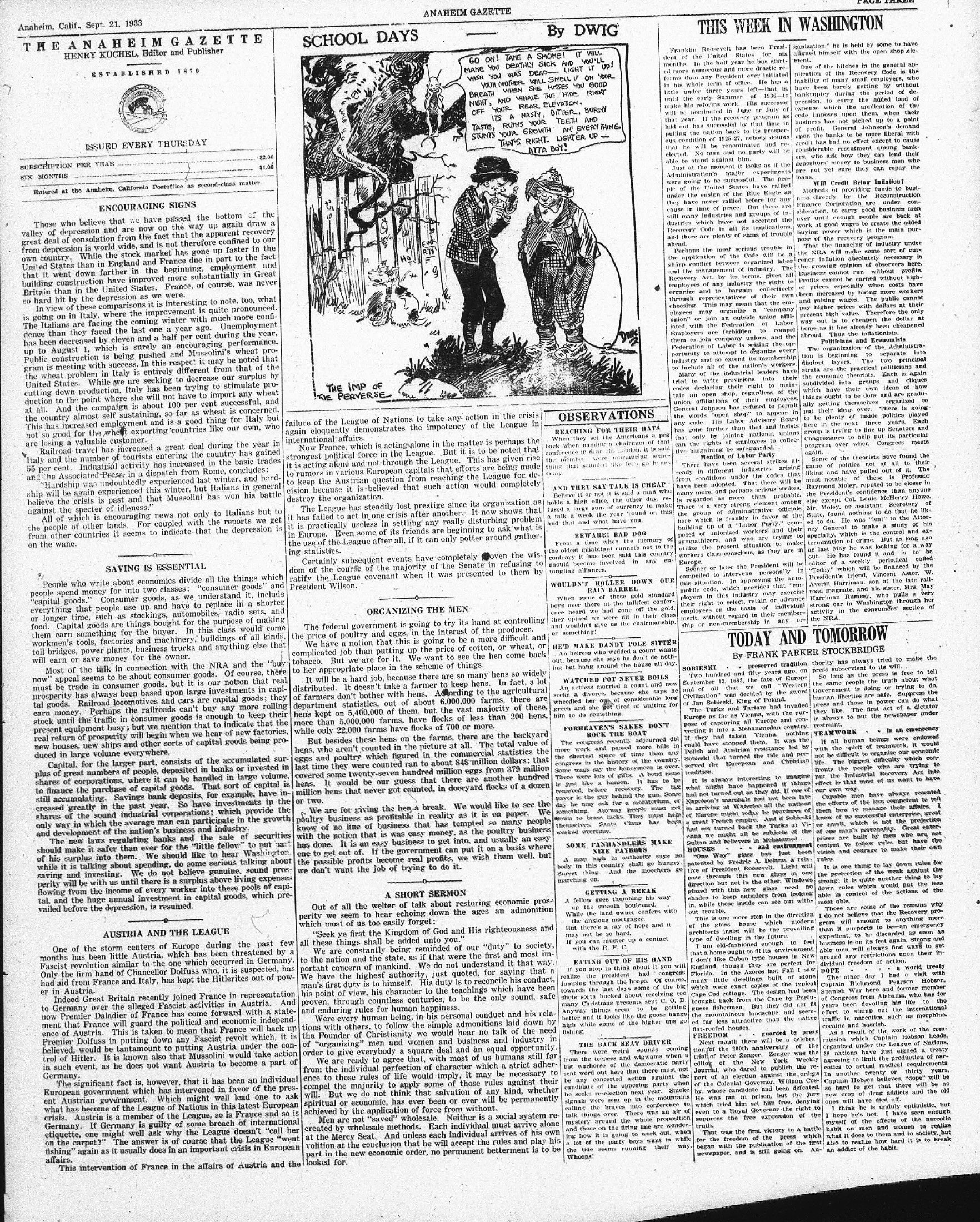
SCHOOL DAYS — By DWIG
GO ON! TAKE A SMOKE! IT WILL MAKE YOU DEATHLY SICK AND YOU'LL WISH YOU WAS DEAD—LIGHT IT UP!
YOUR MOTHER WILL SMELL IT ON YOUR BREATH WHEN SHE KISSES YOU GOOD NIGHT, AND WALE THE HIDE RIGHT OFF YOUR REAR ELEVATION.
ITS A NASTY, BITTER, BURNY TASTE, RUINS YOUR TEETH AND STUNTS YOUR GROWTH AN' EVERYTHING.
THAT'S RIGHT- LIGHTER UP — ATTA BOY!
THE IMP OF THE PERVERSE
Failure of the League of Nations to take any action in the crisis again eloquently demonstrates the impotency of the League in international affairs.
Now France, which is acting alone in the matter is perhaps the strongest political force in the League. But it is to be noted that
Failure of the League of Nations to take any action in the crisis again eloquently demonstrates the impotency of the League in international affairs.
Now France, which is acting alone in the matter is perhaps the strongest political force in the League. But it is to be noted that it is acting alone and not through the League. This has given rise to rumors in various European capitals that efforts are being made to keep the Austrian question from reaching the League for decision because it is believed that such action would completely destroy the organization.
The League has steadily lost prestige since its organization as it has failed to act in one crisis after another. It now shows that it is practically useless in settling any really disturbing problem in Europe. Even some of its friends are beginning to ask what is the use of the League after all, if it can only potter around gathering statistics.
Certainly subsequent events have completely oven the wisdom of the course of the majority of the Senate in refusing to ratify the League covenant when it was presented to them by President Wilson.
ORGANIZING THE MEN
The federal government is going to try its hand at controlling the price of poultry and eggs, in the interest of the producer.
We have a notion that this is going to be a more difficult and complicated job than putting up the price of cotton, or wheat, or tobacco. But we are for it. We want to see the hen come back to her appropriate place in the scheme of things.
It will be a hard job, because there are so many hens so widely distributed. It doesn’t take a farmer to keep hens. In fact, a lot of farmers don’t bother with hens. According to the agricultural department statistics, out of about 6,000,000 farms, there are hens kept on 5,400,000 of them, but the vast majority of these, more than 5,000,000 farms, have flocks of less than 200 hens, while only 22,000 farms have flocks of 700 or more.
But besides these hens on the farms, there are the backyard hens, who aren’t counted in the picture at all. The total value of eggs and poultry which figured in the commercial statistics the last time they were counted ran to about 848 million dollars; that covered some twenty-seven hundred million eggs from 379 million hens. It would be our guess that there are another hundred million hens that never got counted, in dooryard flocks of a dozen or two.
We are for giving the hen a break. We would like to see the poultry business as profitable in reality as it is on paper. We know of no line of business that has tempted so many people with the notion that is was easy money, as the poultry business has done. It is an easy business to get into, and usually an easy one to get out of. If the government can put it on a basis where the possible profits become real profits, we wish them well, but...
A SHORT SERMON
Out of all the welter of talk about restoring economic prosperity we seem to hear echoing down the ages an admonition which most of us too easily forget:
“Seek ye first the Kingdom of God and His righteousness and all these things shall be added unto you.”
We are constantly being reminded of our “duty” to society, to the nation and the state, as if that were the first and most important concern of mankind. We do not understand it that way. We have the highest authority, just quoted, for saying that a man’s first duty is to himself. His duty is to reconcile his conduct, his point of view, his character to the teachings which have been proven, through countless centuries, to be the only sound, safe and enduring rules for human happiness.
Were every human being, in his personal conduct and his relations with others, to follow the simple admonitions laid down by the Founder of Christianity we would hear no talk of the need of “organizing” men and women and business and industry in order to give everybody a square deal and an equal opportunity.
We are ready to agree that, with most of us humans still far from the individual perfection of character which a strict adherence to those rules of life would imply, it may be necessary to compel the majority to apply some of those rules against their will. But we do not think that salvation of any kind, whether spiritual or economic, has ever been or ever will be permanently achieved by the application of force from without.
Men are not “saved” wholesale. Neither is a social system recreated by wholesale methods. Each individual must arrive alone at the Mercy Seat. And unless each individual arrives of his own volition at the conclusion that he will accept the rules and play his part in the new economic order, no permanent betterment is to be looked for.
THIS WEEK IN WASHINGTON
Franklin Roosevelt has been President of the United States for six months. In the half year he has started more numerous and more drastic reforms than any President ever initiated in his whole term of office. He has a little under three years left—that is, until the early Summer of 1936—to make his reforms work. His successor will be nominated in June or July of that year. If the recovery program as laid out has succeeded by that time in pulling the nation back to its prosperous condition of 1925-27, nobody doubts that he will be renominated and re-elected. No man and no party will be able to stand against him.
Just at the moment it looks as if the Administration's major experiments were going to be successful. The people of the United States have rallied under the ensign of the Blue Eagle as they have never rallied before for any cause in time of peace. But there are still many industries and groups of industries which have not accepted the Recovery Code in all its implications, and there are plenty of signs of trouble ahead.
Perhaps the most serious trouble in the application of the Code will be a sharp conflict between organized labor and the management of industry. The Recovery Act, by its terms, gives all employees of any industry the right to organize and to bargain collectively through representatives of their own choosing. This may mean that the employees may organize a "company union" or join an outside union affiliated with the Federation of Labor. Employers are forbidden to compel them to join company unions, and the Federation of Labor is seizing the opportunity to attempt to organize every industry and so extend its membership to include all of the nation's workers.
Many of the industrial leaders have tried to write provisions into their codes declaring their right to maintain an open shop, regardless of the union affiliations of their employees. General Johnson has refused to permit the words "open shop" to appear in any code. His Labor Advisory Board has gone farther than that and insists that only by joining national unions can the rights of employees to collective bargaining be safeguarded.
organization," he is held by some to have aligned himself with the open shop element.
One of the hitches in the general application of the Recovery Code is the inability of many small employers, who have been barely getting by without bankruptcy during the period of depression, to carry the added load of expense which the application of the code imposes upon them, when their business has not picked up to a point of profit. General Johnson's demand upon the banks to be more liberal with credit has had no effect except to cause considerable resentment among bankers, who ask how they can lend their depositors' money to business men who are not yet sure they can repay the loans.
Will Credit Bring Inflation?
Methods of providing funds to business directly by the Reconstruction Finance Corporation are under consideration, to carry good business men over until enough people are back at work at good wages to create the added buying power which is the main purpose of the recovery program.
That the financing of industry under the NRA will make some sort of currency inflation absolutely necessary is the growing opinion of observers here. Business cannot run without profits. Profits cannot be earned without higher prices, especially when costs have been increased by hiring more workers and raising wages. The public cannot pay higher prices with dollars at their present high value. Therefore the only way out is to cheapen the dollar at home as it has already been cheapened abroad. Thus the inflationists.
Politicians and Economists
The organization of the Administration is beginning to separate into distinct layers. The two principal strata are the practical politicians and the economic theorists. Each is again subdivided into groups and cliques which have their own ideas of how things ought to be done and are gradually getting themselves organized to put their ideas over. There is going to be plenty of inside politics played here in the next three years. Each group is trying to line up Senators and Congressmen to help put its particular program over when Congress meets again.
TODAY AND TOMORROW
By FRANK PARKER STOCKBRIDGE
SOBIESKI - preserved tradition
Two hundred and fifty years ago, on September 12, 1683, the fate of Europe and of all that we call "Western Civilization" was decided by the sword of Jan Sobieski, King of Poland.
The Turks and Tartars had invaded Europe as far as Vienna, with the purpose of capturing all Europe and converting it into a Mohammedan country. If they had taken Vienna, nothing could have stopped them. It was the Polish and Austrian resistance led by Sobieski that turned the tide and preserved the European and Christian tradition.
It is always interesting to imagine what might have happened if things had not turned out as they did. If one of Napoleon's marshals had not been late in arriving at Waterloo all the nations of Europe might today be provinces of a great French empire. And if Sobieski had not turned back the Turks at Vienna we might all be subjects of the Sultan and believers in Mohammed.
"One Way" glass has just been patented by Fredric A. Delano, a distinct layers. The two principal strata are the practical politicians and the economic theorists. Each is again subdivided into groups and cliques which have their own ideas of how things ought to be done and are gradually getting themselves organized to put their ideas over. There is going to be plenty of inside politics played here in the next three years. Each group is trying to line up Senators and Congressmen to help put its particular program over when Congress meets again.
Some of the theorists have found the game of politics not at all to their liking and have pulled out of it. The most notable of these is Professor Raymond Moley, reputed to be closer in the President's confidence than anyone else except Col. Louis McHenry Howe. Mr. Moley, as assistant Secretary of State, found nothing to do that he liked to do. He was "lent" to the Attorney General to make a study of his specialty, which is the control and extermination of crime. But as long ago as last May he was looking for a way out. He has found it and is to be editor of a weekly periodical called "Today" which will be financed by the President's friend, Vincent Astor, W. Averill Harriman, son of the late railroad magnate, and his sister, Mrs. May Harriman Rumsey, who pulls a very strong oar in Washington through her activity in the consumers' section of the NRA.
TEAMWORK - In an emergency
If all human beings were endowed with the spirit of teamwork, it would not be difficult to organize our economic life. The biggest difficulty which confronts the people who are trying to put the Industrial Recovery Act into effect is that most of us want to have our own way.
Capable men have always resented the efforts of the less competent to tell them how to manage their affairs. I know of no successful enterprise, great or small, which is not the projection of one man's personality. Great enterprises are built by men who are not content to follow rules but have the vision and courage to make their own rules.
HANDLERS MAKE PAYBOWS
An authority says no entry shall go hungry and the moochers go
G A BREAK
In humbling his way with boulevard,
he owner confers with mortgagee.
Day of hope and it hard,
master up a contact F. C.
OUT OF HIS HAND
I think about it you will incident had congress in the hoops. Of course, days some of the big news about receiving too presents sent C. O. D. seem to be getting back like the goose hangs off of the higher ups go
K SEAT DRIVER
Weird sounds coming from and wigwams when a of the democratic party there that there must not used action against the opposing party when election next year. Smoke went up in the mountains leaves into conference to war. There was an air of fear the whole proposition the firing line are wonder-going to work out, whenarty boys want in while is running their way.
It is always interesting to imagine what might have happened if things had not turned out as they did. If one of Napoleon's marshals had not been late in arriving at Waterloo all the nations of Europe might today be provinces of a great French empire. And if Sobleski had not turned back the Turks at Vienna we might all be subjects of the Sultan and believers in Mohammed.
HOUSES - and environment
"One Way" glass has just been patented by Fredric A. Delano, a relative of President Roosevelt. Light will pass through this new glass in one direction but not in the other. Windows glazed with this new glass need no shades to keep outsiders from looking in, while those inside can see out without trouble.
This is one more step in the direction of the glass house which modern architects insist will be the prevailing type of dwelling in the future.
I am old-fashioned enough to feel that a home ought to fit its environment. I don't like Cuban type houses in New England, though they are perfect for Florida. In the Azores last Fall I saw many little dwellings built of stone which were exact copies of the typical Cape Cod cottage. The design had been brought back from the Cape by Portuguese fishermen. But they did not fit the mountainous landscape, and seemed far less attractive than the native flat-roofed houses.
FREEDOM - guarded by press
Next month there will be a celebration of the 200th anniversary of the trial of Peter Zenger. Zenger was the editor of the New York Weekly Journal, who dared to publish the report of an election against the orders of the Colonial Governor, William Cosby, whose candidate had been defeated. He was put in prison, but the jury which tried him set him free, denying even to a Royal Governor the right to suppress the free expression of the truth.
That was the first victory in a battle for the freedom of the press which began with the publication of the first newspaper, and is still going on. Au-
fronts the people who are dying put the Industrial Recovery Act into effect is that most of us want to have our own way.
Capable men have always resented the efforts of the less competent to tell them how to manage their affairs. I know of no successful enterprise, great or small, which is not the projection of one man's personality. Great enterprises are built by men who are not content to follow rules but have the vision and courage to make their own rules.
It is one thing to lay down rules for the protection of the weak against the strong; it is quite another thing to lay down rules which would put the less able in control of the actions of the most able.
Those are some of the reasons why I do not believe that the Recovery program will amount to anything more than it purports to be—an emergency expedient, to be discarded as soon as business is on its feet again. Strong and able men will always find ways to get around any restrictions upon their individual freedom of action.
DOPE - a world treaty
The other day I had a visit with Captain Richmond Pearson Hobson, Spanish War hero and former member of Congress from Alabama, who has for years been devoting his life to tho effort to stamp out the international traffic in narcotics, such as morphine, cocaine and hasrish.
As a result of the work of the commission which Captain Hobson heads, organized under the League of Nations, 39 nations have just signed a treaty agreeing to limit the production of narcotics to actual medical requirements. In another twenty or thirty years, Captain Hobson believes, "dope" will be so hard to get that there will be no new crop of drug addicts and the old ones will have died off.
I think he is unduly optimistic, but I hope he's not. I have seen enough myself of the effects of the narcotic habit on men and women to realize what it does to them and to society, but also to realize how hard it is to break an addict of the habit.