anaheim-gazette 1933-09-14
Scanned page
Searchable text
THE ANAHEIM GAZETTE
HENRY KUCHEL, Editor and Publisher
ESTABLISHED 1870
ISSUED EVERY THURSDAY
SUBSCRIPTION PER YEAR ... $2.00
SIX MONTHS ... $1.00
Entered at the Anaheim, California Postoffice as second-class matter.
PROSPERITY COMES FROM THE SOIL
It may turn out that the most important thing that has happened in the world in the past three years is the international wheat agreement which has been signed by the representatives of 21 nations. We believe that Frederick E. Murphy, the head of the American delegation to the wheat conference, is right when he says that the records for a thousand years past show clearly that wheat has always been the index to the price of other commodities.
In other words, as Mr. Murphy puts it, "prosperity comes from the soil."
Under the terms of the London agreement, the great wheat-growing nations are to reduce their acreage of wheat by about 15 percent, the wheat importing nations are to keep their own acreage down to or below present levels and use every possible measure to increase the consumption of wheat, and they agree to pay a price of not less than 55 cents, gold, rising to 63.02 cents. At the present value of the dollar in foreign exchange that would give an equivalent of about 92 cents for American wheat. And since the trend of the dollar is downward, it seems, as Mr. Murphy points out, that we can look for "dollar wheat" as the minimum for years to come. For whenever the price has been maintained at the 63.02 cents minimum for four months, the importing nations agree to reduce their tariffs to further stimulate the importation of wheat.
The importance of this to every man, woman and child in
age down to or below present levels and use every possible measure to increase the consumption of wheat, and they agree to pay a price of not less than 55 cents, gold, rising to 63.02 cents. At the present value of the dollar in foreign exchange that would give an equivalent of about 92 cents for American wheat. And since the trend of the dollar is downward, it seems, as Mr. Murphy points out, that we can look for "dollar wheat" as the minimum for years to come. For whenever the price has been maintained at the 63.02 cents minimum for four months, the importing nations agree to reduce their tariffs to further stimulate the importation of wheat.
The importance of this to every man, woman and child in America may not be apparent on the surface. But it touches the pocket-books of all of us. It will cut down the surplus of wheat above the present world demand in two ways, first by regulating production, second by increasing consumption. It should not take long to absorb the present world surplus of something like half a billion bushels. Even before that is absorbed, however, money at a rate that is profitable to the wheat grower will begin to flow into the farmers' pockets; and that should be the break in the vicious circle of economic depression that is needed to start the world back to prosperity.
RECKONS NOT THE PUBLIC
Before the monthly session of the San Diego County League of Municipalities in Escondido Friday evening, a most interesting address was given by Louis H. Burk, city attorney of Montebello and legal counsel of the State League of Municipalities. He set forth to explain many new laws and some old ones relative to city government, and made a very fine talk. But we hope that his remarks were better advised and on a better foundation as to other subjects than was his comment on the matter of legal publication of governmental acts.
In substance the very pleasing speaker said that legal publication is useless and should be eliminated except for the fact that newspapers do a great amount of good for cities and should be given something (the publications) in recompense. That statement, while made in a spirit of generosity, is, when analyzed and extended to its full meaning, practically an insult to the newspaper profession or business, although evidently not so intended. In other words, Mr. Burk evidently thinks that newspapers should be given legal publications as pay for other unnamed services which cannot be legally paid for.
But what is more important is, that Mr. Burk reckons not the public. The importance of legal publication has been recognized in all times, since the days of the town crier. The people DO want to know. They want the real facts and not the "reported" facts as distorted by some newspaper or by "word of mouth." Of course everybody does not read the legal notices. Everybody does not read the sports page, the society page, or any particular part of the newspaper. But the people who are interested in government—and they are certainly an important section of the public—do read the legals. And that is the recognized worth of this honorable custom.—Escondido Times-Advocate.
BETTER SIGNS ABROAD
One of the most encouraging signs on the world horizon at this time is furnished by the fact that Uncle Sam is not the only nation which is recovering. Conditions are getting better in the leading raising, without resisting fool-hardy."
Of course Uncle Sam European criticism need to worry over in general Any crane naturally based on view Europe. The American observers to pay debt cancellation.
At the same time getting better in E improving naturally different reconstruction.
As usual, report This is due, of course government which which it does not world.
For this reason stories that the Rural hand and there from the Archbishop in Southern Russia that 2,000,000 people lack of nourishment appeal to all church mittees to go to Russia.
Of course it is of Russia and family highways it is difficult country to the other to go very slow abo misrepresents condition.
"The world has opinion that the dictators indicate country in the industry worker the envy of been extended to anized that the inducing agricultural psovietism.
"Russian wheat
BETTER SIGNS ABROAD
One of the most encouraging signs on the world horizon at this time is furnished by the fact that Uncle Sam is not the only nation which is recovering. Conditions are getting better in the leading nations of Europe. According to dispatches from across the Atlantic, economic conditions are decidedly better in Great Britain, France and Italy, as well as in some of the smaller nations dotting the old continent. This indicates for one thing that the failure of the London Economic Conference did not mean slow death and despair to Europe, as a great many internationalists tried to make us believe. It indicates also that the real turn in the world-wide depression has come and that things will get better through force of nature, if they are not halted in their improvement by man-made mistakes. Since the world went down together in economic collapse it is pretty evident that the improvement will have to be general to be lasting and that it cannot be due in its entirety to any set program anywhere, but rather to natural forces acting through economic law.
In fact there are a great many observers who now believe that Europe is further on the road to recovery than the United States. They base their belief on an analysis of conditions in Great Britain and France, where unemployment is said to be decreasing more rapidly than here. To quote from William H. Hessler, cable editor of his weekly "Trend of Week in Foreign Affairs":
"It seems almost hopeless to try to combat the idea that America is leading the world to recovery. But the facts are so strong to prove the contrary that some mention of them should be made. Europe was recovering from depression before Roosevelt was inaugurated, and had never sunk so deep into depression as America. The result is that we are trailing the rest of the world, not leading. British and French leaders are frank in their criticism of the American recovery program, asserting it involves a measure of speculation which endangers the real recovery in process abroad."
"Unemployed in most of Europe never anything like as great as in America, is decreasing steadily. Prices, while they have not enjoyed the sudden boom that they have had in America, due to the depreciation of the dollar, are firm and are considered satisfactory."
"The British have re-established a private capital market, and building construction is attaining substantial dimensions. In the United States, London business leaders point out, there has been some stock market activity, but virtually no new security issues. To attempt a recovery by government public works and wage-
ANAHEIM GAZETTE
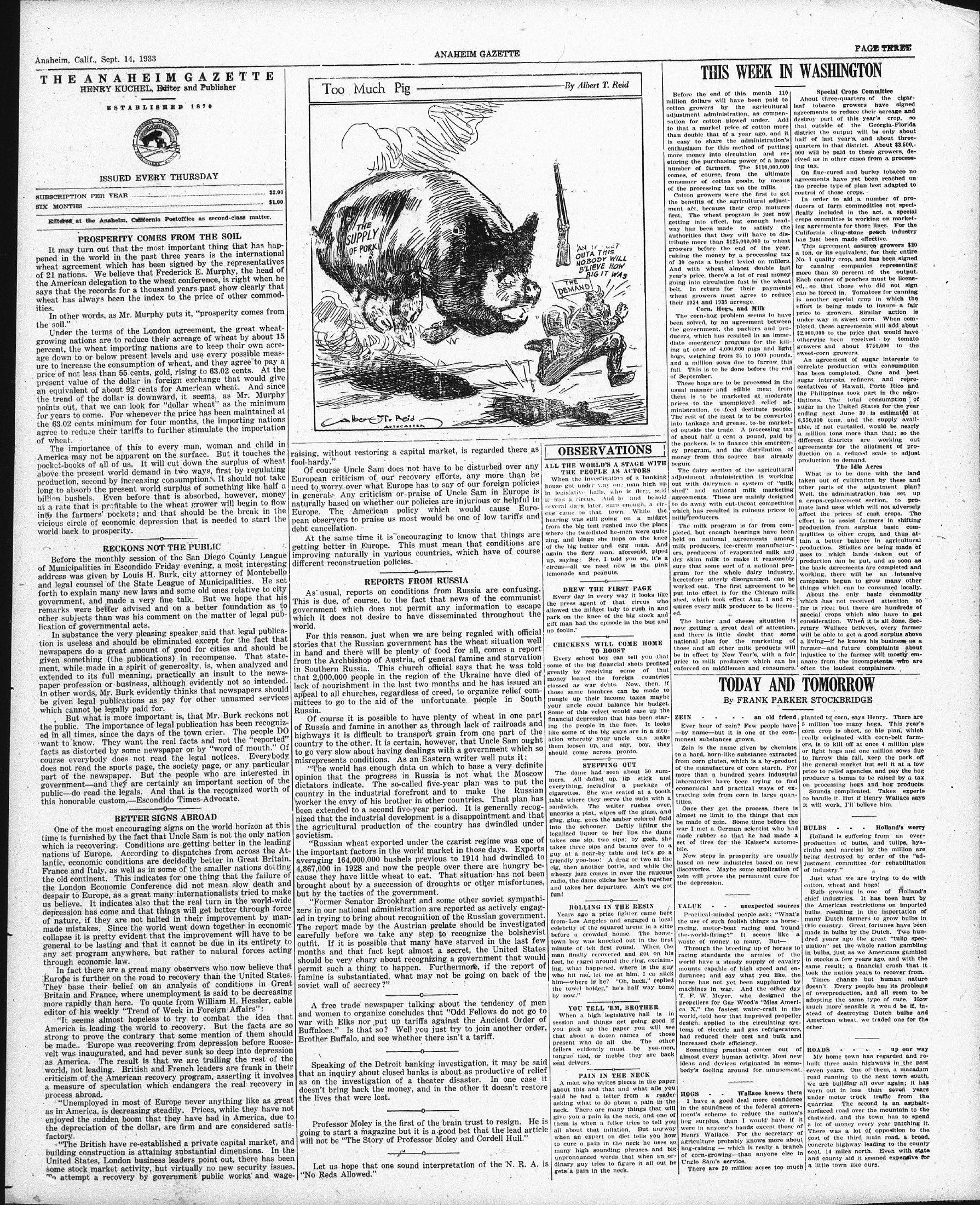
Too Much Pig — By Albert T. Reid
THE SUPPLY OF PORK
AN IT WOULD OUTA THIS NOBODY WILL B'LIEVE HOW BIG IT WAS
THE DEMAND
Albert T. Reid
AUTOCASTER
raising, without restoring a capital market, is regarded there as fool-hardy."
Of course Uncle Sam does not have to be disturbed over any European criticism of our recovery efforts, any more than he need to worry over what Europe has to say of our foreign policies in general. Any criticism or praise of Uncle Sam in Europe is naturally based on whether our policies are injurious or helpful to Europe. The American policy which would cause European observers to praise us most would be one of low tariffs and debt cancellation.
At the same time it is encouraging to know that things are getting better in Europe. This must mean that conditions are improving naturally in various countries, which have of course different reconstruction policies.
REPORTS FROM RUSSIA
As usual, reports on conditions from Russia are confusing. This is due, of course, to the fact that news of the communist government which does not permit any information to escape which it does not desire to have disseminated throughout the world.
For this reason, just when we are being regaled with official stories that the Russian government has the wheat situation well in hand and there will be plenty of food for all, comes a report from the Archbishop of Austria, of general famine and starvation in Southern Russia. This church official says that he was told that 2,000,000 people in the region of the Ukraine have died of lack of nourishment in the last two months and he has issued an appeal to all churches, regardless of creed, to organize relief committees to go to the aid of the unfortunate people in South Russia.
Of course it is possible to have plenty of wheat in one part of Russia and famine in another as through lack of railroads and highways it is difficult to transport grain from one part of the country to the other. It is certain, however, that Uncle Sam ought to go very slow about having dealings with a government which so misrepresents conditions. As an Eastern writer well puts it:
"The world has enough data on which to base a very definite opinion that the progress in Russia is not what the Moscow dictators indicate. The so-called five-year plan was to put the country in the industrial forefront and to make the Russian worker the envy of his brother in other countries. That plan has been extended to a second five-year period. It is generally recognized that the industrial development is a disappointment and that the agricultural production of the country has dwindled under sovietism.
"Russian wheat exported under the czarist regime was one of the important factors in the world market in those days. Exports
OBSERVATIONS
ALL THE WORLD'S A STAGE WITH THE PEOPLE AS ACTORS
When the investigation of a banking house got under way one man high up in legislative halls, who is fiery, said it was a circus. And lo and behold several days later, sure enough, a circus came to that town. While the hearing was still going on a midget from the big tent rushed into the place where the two-fisted he-men were quizzing, and bingo she flops on the knee of the big butter and egg man. And again the fiery man, aforesaid, piped up, saying: See, I told you so, it's a circus—all we need now is the pink lemonade and peanuts.
DREW THE FIRST PAGE
Every day in every way it looks like the press agent of that circus who allowed the midget lady to rush in and park on the knee of the big stock and gift man had the episode in the bag and no foolin.'
CHICKENS WILL COME HOME TO ROOST
Every school boy can tell you that some of the big financial shots profited greatly by receiving some of that money loaned the foreign countries classed as war debts. Now, then, if those same hombres can be made to pungle up their income taxes maybe your uncle could balance his budget. Some of this velvet would ease up the financial depression that has been staring the people in the face. It looks like some of the big guys are in a situation whereby your uncle can make them loosen up, and say, boy, they should come across pronto.
STEPPING OUT
The dame had seen about 50 summers. All dolled up, lip stick and everything, including a package of cigarettes. She was seated at a booth table where they serve the suds with a sandwich. The waiter rushes over, uncorks a pint, wipes off the glass, and glug, glug, goes the amber colored fluid into the schooner. Deftly lifting the legalized liquor to her lips the dame takes one sip, two sips; by gosh, she takes three sips and beams over to a
"The world has enough data on which to base a very definite opinion that the progress in Russia is not what the Moscow dictators indicate. The so-called five-year plan was to put the country in the industrial forefront and to make the Russian worker the envy of his brother in other countries. That plan has been extended to a second five-year period. It is generally recognized that the industrial development is a disappointment and that the agricultural production of the country has dwindled under sovietism.
"Russian wheat exported under the czarist regime was one of the important factors in the world market in those days. Exports averaging 164,000,000 bushels previous to 1914 had dwindled to 4,867,000 in 1928 and now the people over there are hungry because they have little wheat to eat. That situation has not been brought about by a succession of droughts or other misfortunes, but by the tactics of the government.
"Former Senator Brookhart and some other Soviet sympathizers in our national administration are reported as actively engaged in trying to bring about recognition of the Russian government. The report made by the Austrian prelate should be investigated carefully before we take any step to recognize the bolshevist outfit. If it is possible that many have starved in the last few months and that fact kept almost a secret, the United States should be very chary about recognizing a government that would permit such a thing to happen. Furthermore, if the report of famine is substantiated, what may not be going on back of the soviet wall of secrecy?"
A free trade newspaper talking about the tendency of men and women to organize concludes that "Odd Fellows do not go to war with Elks nor put up tariffs against the Ancient Order of Buffaloes." Is that so? Well you just try to join another order, Brother Buffalo, and see whether there isn't a tariff.
Speaking of the Detroit banking investigation, it may be said that an inquiry about closed banks is about as productive of relief as on the investigation of a theater disaster. In one case it doesn't bring back the money, and in the other it doesn't restore the lives that were lost.
Professor Moley is the first of the brain trust to resign. He is going to start a magazine but it is a good bet that the lead article will not be "The Story of Professor Moley and Cordell Hull."
Let us hope that one sound interpretation of the N. R. A. is "No Reds Allowed."
THIS WEEK IN WASHINGTON
Before the end of this month 110 million dollars will have been paid to cotton growers by the agricultural adjustment administration, as compensation for cotton plowed under. Add to that a market price of cotton more than double that of a year ago, and it is easy to share the administration's enthusiasm for this method of putting more money into circulation and restoring the purchasing power of a large number of farmers. The $110,000,000 comes, of course, from the ultimate consumer of cotton goods, by means of the processing tax on the mills.
Cotton growers were the first to get the benefits of the agricultural adjustment act, because their crop matures first. The wheat program is just now getting into effect, but enough headway has been made to satisfy the authorities that they will have to distribute more than $125,000,000 to wheat growers before the end of the year, raising the money by a processing tax of 30 cents a bushel levied on millers. And with wheat almost double last year's price, there's a lot of real money going into circulation fast in the wheat belt. In return for their payments wheat growers must agree to reduce their 1934 and 1935 acreage.
Corn, Hogs, and Milk
The corn-hog problem seems to have been solved, by an agreement between the government, the packers and producers, which has resulted in an immediate emergency program for the killing at once of 4,000,000 pigs and light hogs, weighing from 25 to 1000 pounds, and a million sows due to farrow this fall. This is to be done before the end of September.
These hogs are to be processed in the usual manner and edible meat from them is to be marketed at moderate prices to the unemployed relief administration, to feed destitute people. The rest of the meat is to be converted into tankage and grease, to be marketed outside the trade. A processing tax of about half a cent a pound, paid by the packers, is to finance this emergency program and the distribution of Special Crops Committee.
About three-quarters of the cigar-leaf tobacco growers have signed agreements to reduce their acreage and destroy part of this year's crop, so that outside of the Georgia-Florida district the output will be only about half of last year's, and about three-quarters in that district. About $3,500,-000 will be paid to these growers, derived as in other cases from a processing tax.
On flue-cured and burley tobacco no agreements have yet been reached on the precise type of plan best adapted to control of those crops.
In order to aid a number of producers of farm commodities not specifically included in the act, a special crops committee is working on marketing agreements for those lines. For the California cling-stone peach industry has just been made effective.
This agreement assures growers $20 a ton, or its equivalent, for their entire No. 1 quality crop, and has been signed by canning companies representing more than 80 percent of the output. Each canner of peaches must be licensed, so that those who did not sign can be forced in. Tomatoes for canning is another special crop in which the effort is being made to insure a fair price to growers. Similar action is under way in sweet corn. When completed, these agreements will add about $2,000,000 to the price that would have otherwise been received by tomato growers and about $750,000 to the sweet-corn growers.
An agreement of sugar interests to correlate production with consumption has been completed. Cane and beet sugar interests, refiners, and representatives of Hawaii, Porto Rico and the Philippines took part in the negotiations. The total consumption of sugar in the United States for the year ending next June 30 is estimated at 6,550,000 tons, and the supply available, if not curtailed, would be nearly a million tons more than that; so the different districts are working out agreements for the allotment of pro-
TODAY AND TOMORROW
By FRANK PARKER STOCKBRIDGE
ZEIN ... an old friend
Ever hear of zein? Few people have—by name—but it is one of the commonest substances grown.
Zein is the name given by chemists to a hard, horn-like substance extracted from corn gluten, which is a by-product of the manufacture of corn starch. For more than a hundred years industrial laboratories have been trying to find economical and practical ways of extracting zein from corn in large quantities.
Once they get the process, there is almost no limit to the things that can be made of zein. Some time before the war I met a German scientist who had made rubber so that he had made a set of tires for the Kaiser’s automobile.
planted to corn, says Henry. There are 5 million too many hogs. This year’s corn crop is short, so his plan, which really originated with corn-belt farmers, is to kill off at once 4 million pigs or light hogs and one million sows due to farrow this fall, keep the pork off the general market but sell it at a low price to relief agencies, and pay the hog producer a bonus to be raised by a tax on processing hogs and hog products.
Sounds complicated. Takes experts to handle it. But if Henry Wallace says it will work, I’ll believe him.
BULBS ... Holland’s worry
Holland is suffering from an over-production of bulbs, and tulips, hyacinths and narcissi by the million are
HING OUT
Men about 50 summons, lip stick and
a package of
seated at a booth
have the suds with a
winter rushes over,
off the glass, and
amber colored fluid
Deftly lifting the
inner lips the dame
sips; by gosh, she
beams over to a
table and let's go a
drag or two at the
tattle, and while the
man over the raucous
her heels together
future. Ain't we got
THE RESIN
The fighter came here
and engaged a local
raced arena in a sitto
house. The homekicked out in the first
round. When the
need and got on his
hand the ring, exclaiming where is the guy
at him, I ca nlick
"Oh, heck," replied
one's half way home
M, BROTHER
This legislative hall is in
get going good if
paper you will see
names of those
the. The other
must be yes-men,
above they are back
THE NECK
Is pieces in the paper
and what ails you
refer from a reader
about a pain in the
many things that will
the neck, and one of
older tries to tell you
information. But anyway
is diet tells you how
the neck he uses soolong phrases and bigisms that when an orfigure it all out he
neck.
VALUE - unexpected sources
Practical-minded people ask: "What's the use of such foolish things as horseracing, motor-boat racing and 'round the-world-flying?" It seems like a waste of money to many, But—
Through the breeding up of horses to racing standards the armies of the world have a steady supply of cavalry mounts capable of high speed and endurance; and say what you like, the horse has not yet been supplanted by machines in war. And the other day T. F. W. Meyer, who designed the propellers for Gar Wood's "Miss America X." the fastest water-craft in the world, told how that improved propeller design, applied to the circulating systems of electric and gas refrigerators, had reduced their cost and bulk and increased their efficiency.
Something practical comes out of almost every human activity. Most new ideas and devices originated in somebody's fooling around for amusement.
HOGS - Wallace knows them
I have a good deal more confidence in the soundness of the federal government's scheme to reduce the nation's hog surplus, than I would have if it were in anyone's hands except those of Henry Wallace. For the secretary of agriculture probably knows more about hog-raising — which is really a branch of corn-growing—than anyone else in Uncle Sam's service.
There are 20 million acres too much from corn gluten, which is a by-product of the manufacture of corn starch. For more than a hundred years industrial laboratories have been trying to find economical and practical ways of extracting zein from corn in large quantities.
Once they get the process, there is almost no limit to the things that can be made of zein. Some time before the war I met a German scientist who had made rubber so that he had made a set of tires for the Kaiser's automobile.
New steps in prosperity are usually based on new industries based on new discoveries. Maybe some application of zein will prove the permanent cure for the depression.
BULBS - Holland's worry
Holland is suffering from an over-production of bulbs, and tullips, hyacinths and narcissii by the million are being destroyed by order of the "adjustment committee for rehabilitation of industry."
Just what we are trying to do with cotton, wheat and hogs!
Bulb growing is one of Holland's chief industries. It has been hurt by the American restrictions on imported bulbs, resulting in the importation of many Dutch farmers to grow bulbs in this country. Great fortunes have been made in bulbs by the Dutch. Two hundred years ago the great "tulip speculation" set the whole nation gambling in bulbs, just as we Americans gambled in stocks a few years ago, and with the same result; a financial crash that it took the nation years to recover from.
Times change but human nature doesn't. Every people has its problems of overproduction, and all seem to be adopting the same type of cure. How much more sensible it would be if, instead of destroying Dutch bulbs and American wheat, we traded one for the other.
ROADS - up our way
My home town has regarded and rebuilt three main highways in the past seven years. One of them, a macadam road running to the next town south, we are building all over again; it has worn out in less than seven years under motor truck traffic from the quarries. The second is an asphalt-surfaced road over the mountain to the eastward, and the town has to spend a lot of money every year patching it. There was a lot of opposition to the cost of the third main road, a broad, concrete highway leading to the county seat, 14 miles north. Even with state and county aid it seemed expensive for a little town like ours.