anaheim-gazette 1933-09-07
Scanned page
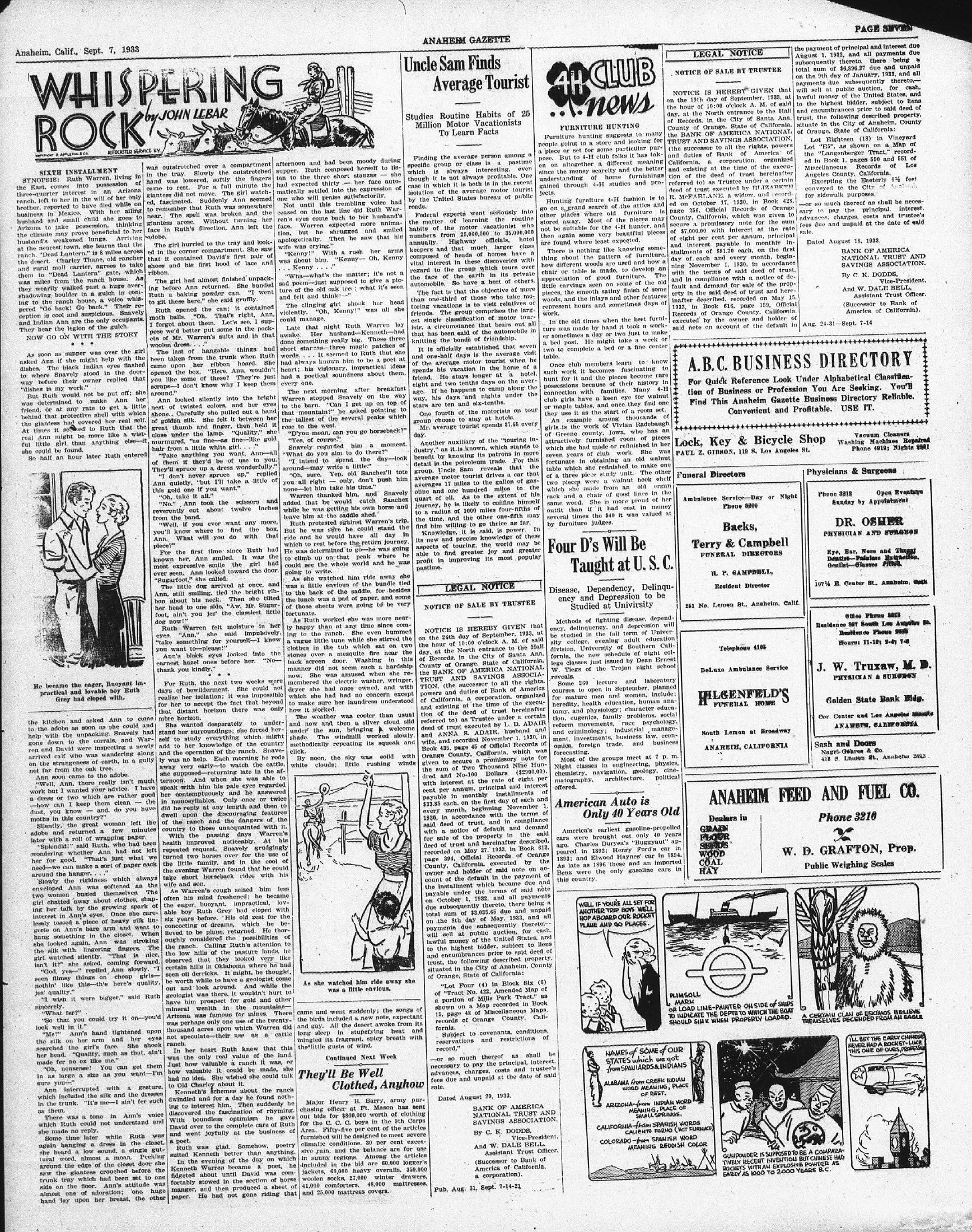
Searchable text
WHISPERING ROCK by JOHN LEBAR
SIXTH INSTALLMENT
SYNOPSIS: Ruth Warren, living in the East, comes into possession of three-quarter interest in an Arizona ranch, left to her in the will of her only brother, reported to have died while on business in Mexico. With her alling husband and small child she goes to Arizona to take possession, thinking the climate may prove beneficial to her husband's weakened lungs. Arriving at the nearest town, she learns that the ranch. "Dead Lantern," is 8 miles across the desert. Charley Thane, old rancher and rural mail carrier, agrees to take them to "Dead Lantern" gate, which was miles from the ranch house. As they wearily walked past a huge overshadowing boulder in a gulch in coming to the ranch house, a voice whispered "Go back! Go back." Their reception is cool and suspicious. Snavely and Indian Ann are the only occupants. They hear the legion of the gulch.
NOW GO ON WITH THE STORY
As soon as supper was over the girl asked Ann if she might help with the dishes. The black Indian eyes flashed to where Snavely stood in the doorway before their owner replied that "dishes is my work."
But Ruth would not be put off; she was determined to make Ann her friend, or at any rate to get a little behind that protective shell with which the giantess had covered her real self. At times it seemed to Ruth that the real Ann might be more like a wistful little girl than anything else—if she could be found.
So half an hour later Ruth entered was outstretched over a compartment in the tray. Slowly the outstretched hand was lowered, softly the fingers came to rest. For a full minute the giantess did not move. The girl watched, fascinated. Suddenly Ann seemed to remember that Ruth was somewhere near. The spell was broken and the giantess arose. Without turning her face in Ruth's direction, Ann left the adobe.
The girl hurried to the tray and looked in the corner compartment. She saw that it contained David's first pair of shoes and his first hood of lace and ribbon.
The girl had almost finished unpacking before Ann returned. She handed Ruth a baking powder can. "I went to git these here," she said gruffly.
Ruth opened the can; it contained moth balls. "Oh. That's right, Ann, I forgot about them. Let's see, I suppose we'd better put some in the pockets of Mr. Warren's suits and in that woolen dress..."
The last of hangable things had been taken from the trunk when Ruth came upon her ribbon hoard. She opened the box. "Here, Ann, wouldn't you like some of these? They're just scraps—I don't know why I keep them around."
Ann looked silently into the bright nest of twisted colors, and her eyes shone. Carefully she pulled out a band of golden silk. She felt it between her great thumb and finger, then held it close under the lamp. "Quality," she murmured, "as fine—as fine—like gold hair from a little white girl...".
Take anything you want, Ann—all afternoon and had been made supper. Ruth composed herself to the three short stairs had expected thirty — her matically settled into the e one who will praise satisfaction, but he shrugged apologetically. Then he s wife was crying.
"Kenny!" With a rush was about him. "Kenny—... Kenny ..."
"Wha—what's the matter sad poem—just supposed to ture of the old oak tree; w and felt and think—"
The clinging girl shook violently. "Oh, Kenny!" could manage.
Late that night Ruth awake. Her husband—I done something really big, short starzas—three mag words. It seemed to I had always known him to heart; his visionary, imp had a poetical soundness every one.
The next morning after Warren stopped Snavely to the barn. "Can I get that mountain?" he asked the tallest of the several rose to the west.
D'you mean, can you go Yes, of course."
Snavely regarded him What do you aim to do?
He became the eager, Buoyant impractical and lovable boy Ruth Grey had eloped with.
the kitchen and asked Ann to come to the adobe as soon as she could and help with the unpacking. Snavely had gone down to the corrals, and Warren and David were inspecting a newly arrived calf who was wandering along on the strangeness of earth, in a gully not far from the oak tree.
Ann soon came to the adobe.
"Well, Ann, there really isn't much work but I wanted your advice. I have a dress or two which are rather good—how can I keep them clean—the dust, you know—and, do you have moths in this country?"
Silently, the great woman left the adobe and returned a few minutes later with a roll of wrapping paper.
"Splendid!" said Ruth, who had been wondering whether Ann had not left her for good. "That's just what we need—we can make a sort of paper sack came upon her ribbon hoard. She opened the box. "Here, Ann, wouldn't you like some of these? They're just scraps—I don't know why I keep them around."
Ann looked silently into the bright nest of twisted colors, and her eyes shone. Carefully she pulled out a band of golden silk. She felt it between her great thumb and finger, then held it close under the lamp. "Quality," she murmured, "as fine—as fine—like gold hair from a little white girl..."
"Take anything you want, Ann—all of them if they'd be of use to you. They'll spruce up a dress wonderfully."
"I don't never spruce up," replied Ann quietly, "but I'll take a little of this gold one if you want."
"Oh, take it all."
"No." Ann took the scissors and reverently cut about twelve inches from the band.
"Well, if you ever want any more, you'll know where to find the box, Ann. What will you do with that piece?"
For the first time since Ruth had known her, Ann smiled. It was the most expressive smile the girl had ever seen. Ann looked toward the door. "Sugarfoot," she called.
The little dog arrived at once, and Ann, still smiling, tied the bright ribbon about his neck. Then she tilted her head to one side, "Aw, Mr. Sugarfoot, aln't youjes' the classiest little dog now!"
Ruth Warren felt moisture in her eyes. "Ann," she said impulseively, "take something for yourself—I know you want to—please!"
Ann's black eyes looked into the earnest hazel ones before her. "No—thank you kindly."
For Ruth, the next two weeks were days of bewilderment. She could not realize her isolation; it was impossible for her to accept the fact that beyond that distant horizon there was only more horizon.
She wanted desperately to understand her surroundings; she forced herself to study everything which might add to her knowledge of the country and the operation of the ranch. Snavely was no help. Each morning he rode away very early—to watch the cattle, she supposed—returning late in the afternoon. And when she was able to speak with him his pale eyes regarded her contemptuously and he answered in monosyllables. Only once or twice did he reply at any length and then to dwell upon the discouraging features of the ranch and the dangers of the country to those unacquainted with it.
With the passing days Warren's health improved noticeably. At his repeated request, Snavely grudgingly turned two horses over for the use of the little family, and in the cool of the evening Warren found that he could
he always known him to heart; his visionary, Impala had a poetical soundness every one.
The next morning after Warren stopped Snavely to the barn. "Can I get that mountain?" he asked the tallest of the several rose to the west.
"D'you mean, can you go? Yes, of course."
Snavely regarded him. "What do you aim to do? I intend to spend time around—may write a little." "Oh, sure. Yep, old boy all right — only, done—let him take his tipper." Warren thanked him, added that he would continue while he was getting his leave him at the saddle saddle.
Ruth protested against it. But he was sure he could ride and he would have which to rest before he He was determined to go to climb up on that peel could see the whole world going to write.
As she watched him was a little envious of to the back of the saddle the lunch was a pad of those sheets were good fortunate.
As Ruth worked she very happy than at any time to the ranch. She a vague little tune while clothes in the tub whit stones over a mesquite back screen door. Woman manner did not seem now. She was amused membered the electric dryer she had once owed which she had had no way to make sure her launch how it worked.
The weather was cool and now and then a shade under the sun, bringing shade. The windmill methodically repeating click.
By noon, the sky was white clouds; little
Ann soon came to the adobe.
"Well, Ann, there really isn't much work but I wanted your advice. I have a dress or two which are rather good—how can I keep them clean—the dust, you know—and, do you have moths in this country?"
Silently, the great woman left the adobe and returned a few minutes later with a roll of wrapping paper.
"Splendid!" said Ruth, who had been wondering whether Ann had not left her for good. "That's just what we need—we can make a sort of paper sack around the hanger..."
Slowly the rigidness which always enveloped Ann was softened as the two women busied themselves. The girl chatted away about clothes, shaping her talk by the growing spark of interest in Ann's eyes. Once she carelessly tossed a piece of heavy silk lingerie on Ann's bare arm and went to hang something in the closet. When she looked again, Ann was stroking the silk with lingering fingers. The girl watched silently. "That is nice, isn't it?" she asked, coming forward.
"God, yes—" replied Ann slowly. "I seen flimsy things on cheap girls—nothin' like this—th's here's quality, jes' quality."
"I wish it were bigger," said Ruth sincerely.
"What fer?"
"So that you could try it on—you'd look well in it."
"Me?" Ann's hand tightened upon the silk on her arm and her eyes searched the girl's face. She shook her head. "Quality, such as that, ain't made fer no ox like me."
"Oh, nonsense! You can get them in as large a size as you want—I'm sure you—"
Ann interrupted with a gesture, which included the silk and the dresses in the trunk. "It's me—I ain't fer such as them.
There was a tone in Ann's voice which Ruth could not understand and she made no reply.
Some time later while Ruth was again hanging a dress in the closet, she heard a low sound, a single guttural word, almost a moan. Peeking around the edge of the closet door she saw the giantess crouched before the trunk tray which had been set to one side on the floor. Ann's attitude was almost one of adoration; one huge hand lay upon her breast, the other she supposed—returning late in the afternoon. And when she was able to speak with him his pale eyes regarded her contemptuously and he answered in monosyllables. Only once or twice did he reply at any length and then to dwell upon the discouraging features of the ranch and the dangers of the country to those unacquainted with it.
With the passing days Warren's health improved noticeably. At his repeated request, Snavely grudgingly turned two horses over for the use of the little family, and in the cool of the evening Warren found that he could take short horseback rides with his wife and son.
As Warren's cough seized him less often his mind freshened; he became the eager, buoyant, impractical, lovable boy Ruth Grey had eloped with six years before. His old zest for the concocting of dreams, which he believed to be plans, returned. He thoroughly considered the possibilities of the ranch. Calling Ruth's attention to the low hills of the pasture lands, he observed that they looked very like certain hills in Oklahoma where he had seen oil derricks. It might, he thought, be worth while to have a geologist come out and look around. And while the geologist was there, it wouldn't hurt to have him prospect for gold and other mineral wealth in the mountains—Arizona was famous for mines. There was perhaps only one use of the twenty-thousand acres upon which Warren did not speculate—their use as a cattle ranch.
In her heart Ruth knew that this was the only real value of the land. Just how valuable a ranch it was, or how valuable it could be made, she had no idea. She wished she could talk to Old Charley about it.
Kenneth's schemes about the ranch dwindled and for a day he found nothing to interest him. Then suddenly he discovered the fascination of rhyming. With boundless optimism he gave David over to the complete care of Ruth and went joyfully at the business of a poet.
Ruth was glad. Somehow, poetry suited Kenneth better than anything.
In the evening of the day on which Kenneth Warren became a poet, he fidgeted about until David was comfortably stowed in the section of horse manger, and then produced a sheet of paper. He had not gone riding that
Early noon and had been moody during sleep. Ruth composed herself to listen to the three short stanzas — she had expected thirty — her face automatically settled into the expression of who will praise satisfactorily.
Not until this trembling voice had based on the last line did Ruth Warren's eyes come back to her husband's face. Warren expected more animation, but he shrugged and smiled logistically. Then he saw that his life was crying."
"Kenny!" With a rush her arms was about him. "Kenny—Oh, Kenny... Kenny...""
"Wha—what's the matter; it's not a poem—just supposed to give a picture of the old oak tree; what it's seen and felt and thinks—"
The clinging girl shook her head violently. "Oh, Kenny!" was all she could manage.
Late that night Ruth Warren lay awake. Her husband—Kenneth—had one something really big. Those three short starzas—three magic patches of words. It seemed to Ruth that she had always known him to be a poet at heart; his visionary, impractical ideas and a poetical soundness about them, every one.
The next morning after breakfast Warren stopped Snavely on the way to the barn. "Can I get up on top of that mountain?" he asked pointing to the tallest of the several peaks which rose to the west.
"D'you mean, can you go horseback?"
"Yes, of course."
Snavely regarded him a moment. What do you aim to do there?
Uncle Sam Finds Average Tourist
Studies Routine Habits of 25 Million Motor Vacationists To Learn Facts
Finding the average person among a specific group or class is a pastime which is always interesting, even though it is not always profitable. One case in which it is both is in the recent isolation of the average motor tourist by the United States bureau of public roads.
Federal experts went seriously into the matter of learning the routine habits of the motor vacationist who numbers from 25,000,000 to 35,000,000 annually. Highway officials, hotel keepers and that much larger class composed of heads of homes have a vital interest in these discoveries with regard to the group which tours over the face of the earth in its private automobile. So have a host of others.
The fact is that the objective of more than one-third of those who take motor vacations is to visit relatives or friends. The group comprises the largest single classification of motor tourists, a circumstance that bears out all that has been said of the automobile in knitting the bonds of friendship.
It is officially established that seven and one-half days is the average visit of the average motor tourist when he spends his vacation in the home of a friend. He stays longer at a hotel, eight and two tenths days on the average. If he happens to camp along the way, his days and nights under the stars are ten and six-tenths.
One fourth of the motorists on tour group choose to stay at hotels.
Mr. average tourist spends $7.65 every day.
Another auxiliary of the "touring industry," as it is known, which stands to benefit by knowing its patrons in more people going to a store and looking for a piece or set for some particular purpose. But to 4-H club folks it has taken on altogether a different meaning since the money scarcity and the better understanding of home furnishings gained through 4-H studies and projects.
Hunting furniture 4-H fashion is to go on a grand search of the attics and other places where old furniture is stored away. Most of the pieces may not be suitable for the 4-H hunter, and then again some very beautiful pieces are found where least expected.
There is nothing like knowing something about the pattern of furniture, how different woods are used and how a chair or table is made, to develop an appreciation of good furniture. The little carvings seen on some of the old pieces, the smooth satiny finish of some woods, and the inlays and other features represent hours and sometimes days of work.
In the old times when the best furniture was made by hand it took a worker sometimes a day or two just to make a bed post. He might take a week or two to complete a bed or a fine center table.
Once club members learn to know such work it becomes fascinating to hunt for it and the pieces become rare possessions because of their history in connection with families. Many 4-H club girls have a keen eye for walnut or maple tables, and once they find one they use it as the start of a room set.
An example among thousands of girls is the work of Vivian Radebaugh of Greene county, Iowa, who has an attractively furnished room of pieces which she had made or refinished in her seven years of club work. She was
The next morning after breakfast Warren stopped Snavely on the way to the barn. "Can I get up on top of that mountain?" he asked pointing to the tallest of the several peaks which rose to the west.
"D'you mean, can you go horseback?"
"Yes, of course."
Snavely regarded him a moment. What do you aim to do there?
"I intend to spend the day—look around—may write a little."
"Oh, sure. Yep, old Sanchez'll tote you all right — only, don't push him none—let him take his time."
Warren thanked him, and Snavely added that he would catch Sanchez while he was getting his own horse and leave him at the saddle shed.
Ruth protested against Warren's trip. But he was sure he could stand the ride and he would have all day in which to rest before the return journey. He was determined to go—he was going to climb up on that peak where he could see the whole world and he was going to write.
As she watched him ride away she was a little envious of the bundle tied to the back of the saddle, for besides the lunch was a pad of paper, and some of those sheets were going to be very fortunate.
As Ruth worked she was more nearly happy than at any time since coming to the ranch. She even hummed a vague little tune while she stirred the clothes in the tub which sat on two stones over a mesquite fire near the back screen door. Washing in this manner did not seem such a hardship now. She was amused when she remembered the electric washer, wringer, dryer she had once owned, and with which she had had no concern except to make sure her laundress understood how it worked.
The weather was cooler than usual and now and then a silver cloud slid under the sun, bringing welcome shade. The windmill worked slowly, methodically repeating its squeak and click.
By noon, the sky was solid with white clouds; little rushing winds
LEGAL NOTICE
NOTICE OF SALE BY TRUSTEE
NOTICE IS HEREBY GIVEN that on the 26th day of September, 1933, at the hour of 10:00 o'clock A.M. of said day, at the North entrance to the Hall of Records, in the City of Santa Ana, County of Orange, State of California, the BANK OF AMERICA NATIONAL TRUST AND SAVINGS ASSOCIATION, (the successor to all the rights, powers and duties of Bank of America of California, a corporation, organized and existing at the time of the execution of the deed of trust hereinafter referred to) as Trustee under a certain deed of trust executed by L. D. ADAIR and ANNA S. ADAIR, husband and wife, and recorded November 1, 1930, in Book 435, page 45 of Official Records of Orange County, California, which was given to secure a promissory note for the sum of Two Thousand Nine Hundred and No-100 Dollars ($2900.00), with interest at the rate of eight per cent per annum, principal and interest payable in monthly installments of $33.85 each, on the first day of each and every month, beginning November 1, 1930, in accordance with the terms of said deed of trust, and in compliance with a notice of default and demand for sale of the property in the said deed of trust and hereinafter described, recorded on May 27, 1933, in Book 612, page 394, Official Records of Orange County, California, executed by the holder of said note on ac-
Once club members learn to know such work it becomes fascinating to hunt for it and the pieces become rare possessions because of their history in connection with families. Many 4-H club girls have a keen eye for walnut or maple tables, and once they find one they use it as the start of a room set.
An example among thousands of girls is the work of Vivian Radebaugh of Greene county, Iowa, who has an attractively furnished room of pieces which she had made or refinished in her seven years of club work. She was fortunate in obtaining an old walnut table which she refinished to make one of a three piece study unit. The other two pieces were a walnut book shelf which she made from an old organ rack and a chair of good lines in the same wood. She is more proud of her outfit than if it had cost in money several times the $40 it was valued at by furniture judges.
Four D's Will Be Taught at U.S.C.
Disease, Dependency, Delinquency and Depression to be Studied at Univirsity
Methods of fighting disease, dependency, delinquency, and depression will be studied in the fall term of University college, evening adult education division, University of Southern California, the new schedule of night college classes just issued by Dean Ernest W. Tiegs of the Trojan night school reveals.
Some 260 lecture and laboratory courses to open in September, planned for mature men and women, include: heredity, health education, human anatomy, and physiology; character education, eugenics, family problems, social reform movements, race psychology, and criminology; industrial management, investments, business law, economics, foreign trade, and business forecasting.
Most of the groups meet at 7 p.m. Night classes in engineering, physics, chemistry, navigation, geology, cinematography, architecture, political offered.
American Auto is Only 40 Years Old
America's earliest gasoline-propelled cars were brought out only 40 years ago. Charles Duryea's "Buggyaut" appeared in 1892; Henry Ford's car in 1893; and Elwood Haynes' car in 1894. As late as 1896 these and an imported only gasoline-car in
As she watched him ride away she was a little envious.
came and went suddenly; the songs of the birds included a new note, expectant and gay. All the desert awoke from its long sleep in stupefying heat and mingled its fragrant, spicy breath with the little gusts of wind.
Continued Next Week
They'll Be Well Clothed, Anyhow
Major Henry B. Barry, army purchasing officer at Ft. Mason has sent out bids for $800,000 worth of clothing for the C. C. C. boys in the 9th Corps Area. Fifty-five per cent of the articles furnished will be designed to meet severe climatic conditions. 30 per cent excessive rain, and the balance are for use in sunny regions. Among the articles included in the bid are 60,000 logger's jackets, 60,000 heavy overalls, 359,000 woolen socks, 27,000 winter drawers, 41,000 comforters, 48,000 mattresses, and 25,000 mattress covers.
with interest at the rate of eight per cent per annum, principal and interest payable in monthly installments of $33.85 each, on the first day of each and every month, beginning November 1, 1930, in accordance with the terms of said deed of trust, and in compliance with a notice of default and demand for sale of the property in the said deed of trust and hereinafter described, recorded on May 27, 1933, in Book 612, page 394, Official Records of Orange County, California, executed by the owner and holder of said note on account of the default in the payment of the installment which became due and payable under the terms of said note on October 1, 1932, and all payments due subsequently thereto, there being a total sum of $3,035.65 due and unpaid on the 8th day of May, 1933, and all payments due subsequently thereto.—will sell at public auction, for cash, lawful money of the United States, and to the highest bidder, subject to liens and encumbrances prior to said deed of trust, the following described property situated in the City of Anaheim, County of Orange, State of California:
"Lot Four (4) in Block Six (6) of "Tract No. 422, Amended Map of a portion of Mills Park Tract," as shown on a Map recorded in Book 15, page 48 of Miscellaneous Maps, records of Orange County, California.
Subject to covenants, conditions, reservations and restrictions of record."
—or so much thereof as shall be necessary to pay the principal, interest, advances, charges, costs and trustee's fees due and unpaid at the date of said sale.
Dated August 29, 1933.
BANK OF AMERICA
NATIONAL TRUST AND SAVINGS ASSOCIATION.
By C. K. DODDS,
Vice-President,
And W. DALE BELL,
Assistant Trust Officer,
(Successor to Bank of America of California, a corporation).
Pub. Aug. 31, Sept. 7-14-21
LEGAL NOTICE
NOTICE OF SALE BY TRUSTEE
NOTICE IS HEREBY GIVEN that on the 19th day of September, 1933, at the hour of 10:00 o'clock A.M. of said day, at the North entrance to the Hall of Records, in the City of Santa Ana, County of Orange, State of California, the BANK OF AMERICA NATIONAL TRUST AND SAVINGS ASSOCIATION, (the successor to all the rights, powers and duties of Bank of America of California, a corporation, organized and existing at the time of the execution of the deed of trust hereinafter referred to) as Trustee under a certain deed of trust executed by ELIZABETH R. McFARLANE, a widow, and recorded on October 17, 1930, in Book 428, page 256, Official Records of Orange County, California, which was given to secure a promissory note for the sum of $7,000.00 with interest at the rate of eight per cent annum, principal and interest payable in monthly installments of $81.70 each, on the first day of each and every month, beginning November 1, 1930, in accordance with the terms of said deed of trust, and in compliance with a notice of default and demand for sale of the property in the said deed of trust and hereinafter described, recorded on May 15, 1933, in Book 616, page 159, Official Records of Orange County, California, executed by the owner and holder of said note on account of the default in payment of principal and interest due August 1, 1932, and all payments due subsequently thereto, there being a total sum of $6,896.27 due and unpaid on the 9th day of January, 1933, and all payments due subsequently thereto—will sell at public auction, for cash, lawful money of the United States, and to the highest bidder, subject to liens and encumbrances prior to said deed of trust, the following described property, situate in the City of Anaheim, County of Orange, State of California:
Lot Eighteen (18) in Vineyard Lot "E5", as shown on a Map of the "Langenberger Tract," recorded in Book 1, pages 550 and 551 of Miscellaneous Records of Los Angeles County, California.
Excepting the Easterly 6½ feet conveyed to the City of Anaheim for sidewalk purposes.
Or so much thereof as shall be necessary to pay the principal, interest advances, charges, costs and trustee's fees due and unpaid at the date of sale.
Dated August 18, 1933.
BANK OF AMERICA NATIONAL TRUST AND SAVINGS ASSOCIATION.
By C. K. DODDS,
Vice-President,
And W. DALE BELL,
Assistant Trust Officer.
(Successor to Bank of America of California).
Aug. 24-31—Sept. 7-14
A.B.C. BUSINESS DIRECTORY
For Quick Reference Look Under Alphabetical Classification of Business or Profession You Are Seeking. You'll Find This Anaheim Gazette Business Directory Relinable, Convenient and Profitable. USE IT.
Lock, Key & Bicycle Shop
PAUL Z. GIBSON, 119 S. Los Angeles St.
Vacuum Cleaners
Washing Machines Repaired
Phone 4919; Nights 28:11
A.B.C. BUSINESS DIRECTORY
For Quick Reference Look Under Alphabetical Classification of Business or Profession You Are Seeking. You'll Find This Anaheim Gazette Business Directory Relinable, Convenient and Profitable. USE IT.
Lock, Key & Bicycle Shop
PAUL Z. GIBSON, 119 S. Los Angeles St.
Vacuum Cleaners
Washing Machines Repaired
Phone 4919; Nights 22:31
Funeral Directors
Ambulance Service—Day or Night
Phone 8209
Backs,
Terry & Campbell
FUNERAL DIRECTORS
H. P. CAMPBELL,
Resident Director
251 No. Lemon St., Anaheim, Calif.
Physicians & Surgeons
Phone 3212 Open Evening
Sunday by Appointment
DR. OSHER
PHYSICIAN AND SURGEON
Eye, Bar, Nose and Throat
Dentist—Painless Extraction.
Oculist—Glasses Fitted.
107½ E. Center St., Anaheim, Calif.
Telephone 4105
DeLuxe Ambulance Service
HLGENFELD'S
FUNERAL HOME
South Lemon at Broadway
ANAHEIM, CALIFORNIA
Office Phone 3218
Residence 867 South Los Angeles St.
Residence Phone 3218
Hours: 11-18; 2-4; 7-8
J. W. Truxaw, M.D.
PHYSICIAN & SURGEON
Golden State Bank Bridge.
Cor. Center and Los Angeles District
ANAHEIM, CALIFORNIA
Sash and Doors
Nagel-Gehres & Co.
418 S. Laman St., Anaheim 2493
ANAHEIM FEED AND FUEL CO.
Dealers in
GRAIN
FLOOR
SEEDS
WOOD
COAL
Hay
Phone 3210
W. D. GRAFTON, Prop.
Public Weighing Scales
ANAHEIM FEED AND FUEL CO.
Dealers in
GRAIN
FLOOR
SEEDS
WOOD
COAL
HAY
Phone 3210
W. D. GRAFTON, Prop.
Public Weighing Scales
PLIMSOLL MARK
OR LOAD LINE-PAINTED ON SIDE OF SHIPS
TO INDICATE THE DEPTH TO WHICH THE BOAT
SHOULD SINK WHEN PROPERLY LOADED.
A CERTAIN CLAN OF ESKIMOS BELIEVE
THEMSELVES DECENDED FROM AN EAGLE
NAMES OF SOME OF OUR
STATES which we got
from SPANIARDS & INDIANS
ALBAMA from CREEK INDIAN
WORD MEANING, PLACE
OF REST.
ARIZONA-from INDIAN WORD
MEANING, PLACE OF
SMALL SPRINGS.
CALIFORNIA-from SPANISH WORDS
CALIENTO PORNO (NOT FURNACE)
COLORADO-from SPANISH WORD
MEANING REDDISH COLOR
GUNPOWDER IS SUPPOSED TO BE A COMPARATIVE RECENT INVENTION BUT CHINESE HAD ROCKETS WITH AN EXPLOSIVE POWDER AS EARLY AS 1000 TO 2000 YEARS B.C.